Anti-Aging · Reference
NAD+ vs FOXO4-DRI: Mechanism, Evidence, FDA Status, Dosing and Cost
This page explains each on its own terms, puts them side by side, covers what the research does and does not show, where each stands with the FDA, how each is dosed, what each costs at Pepti, and who tends to suit which.
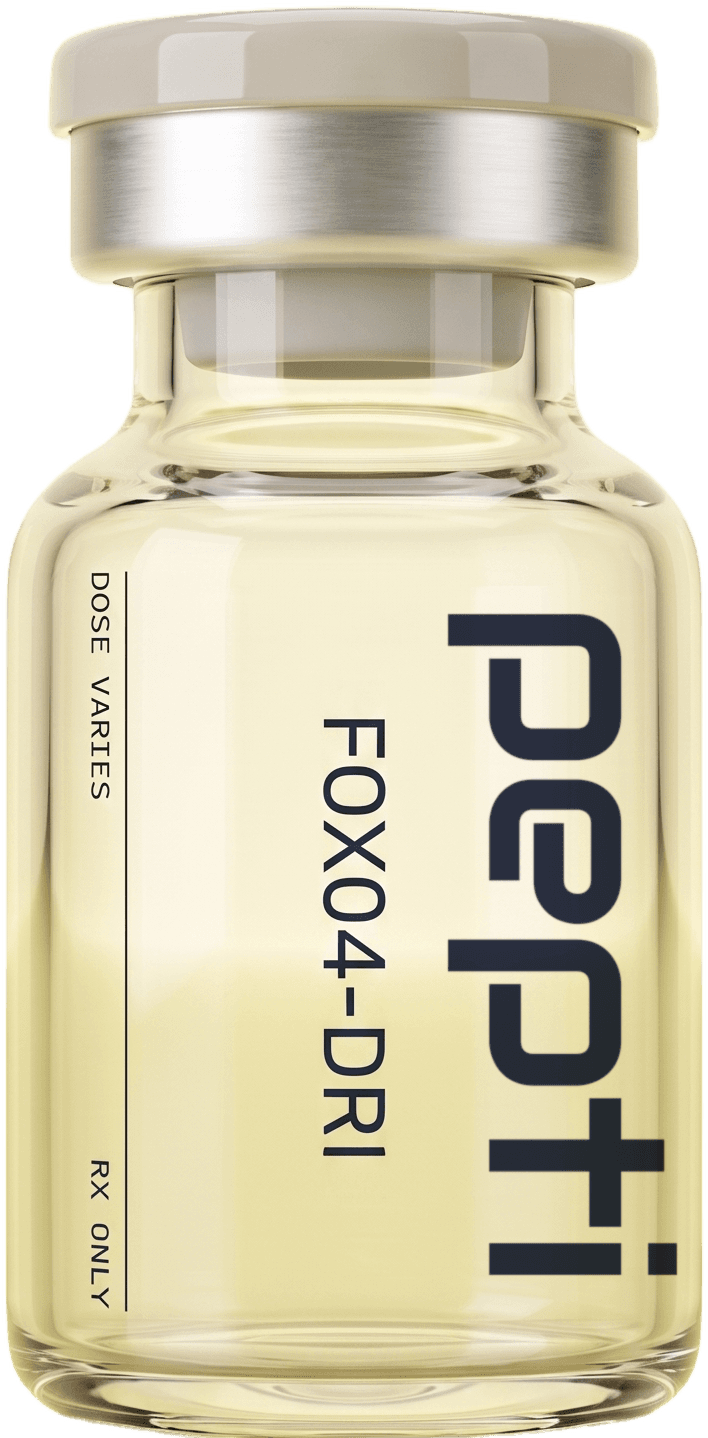
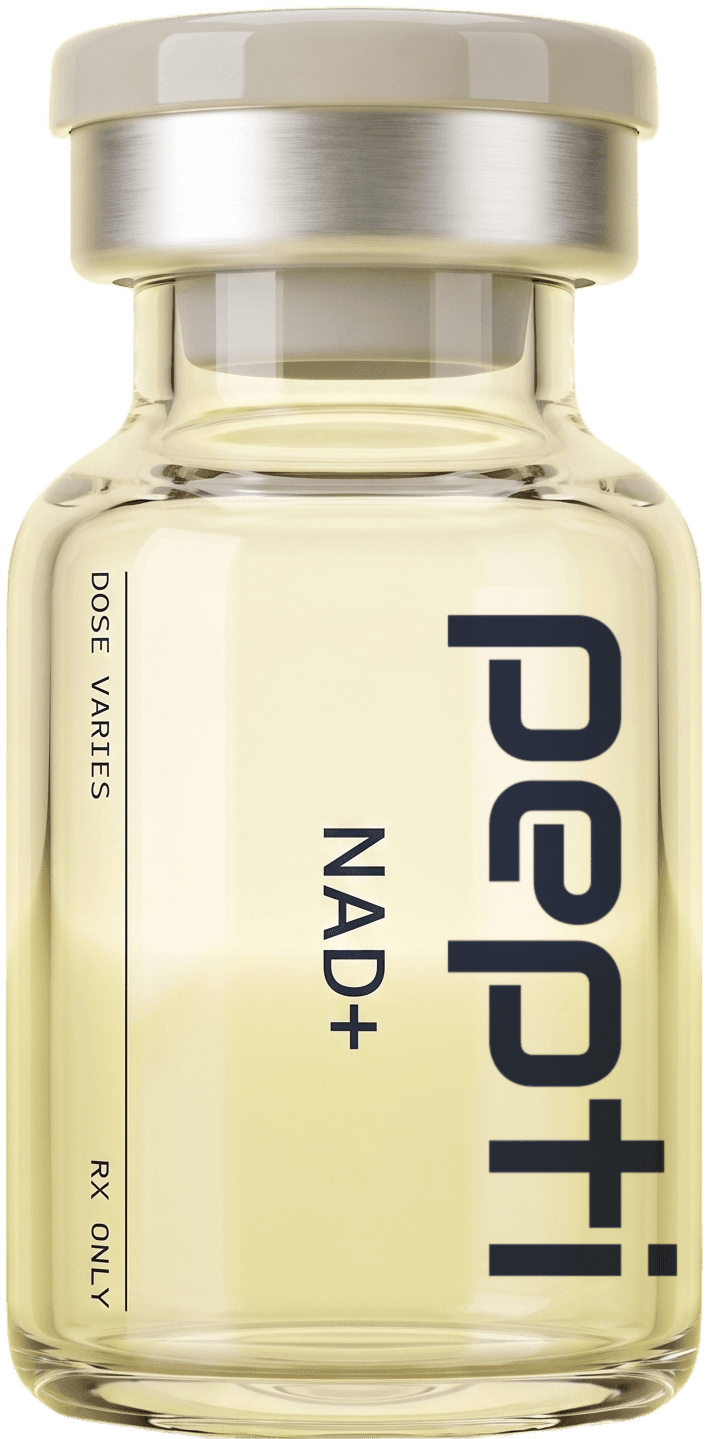
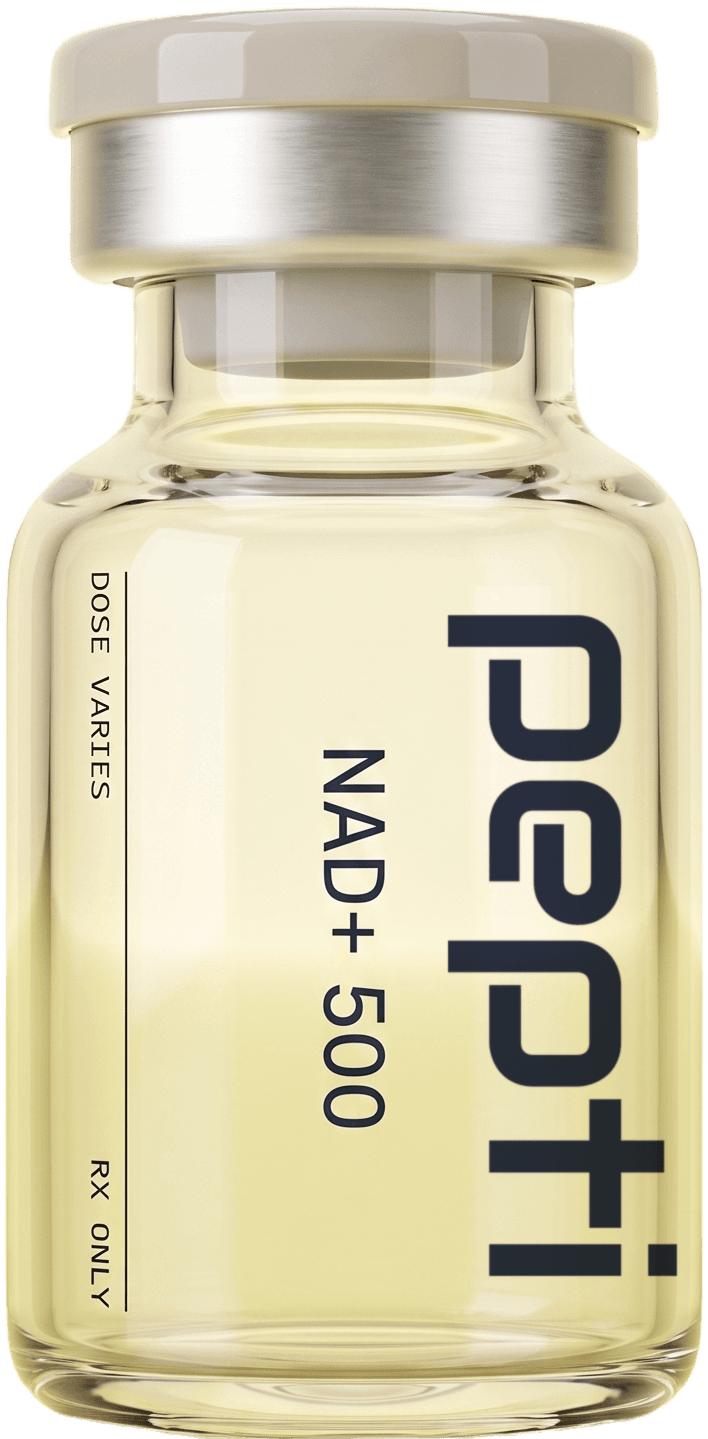
NAD+ and FOXO4-DRI are both prescribed under the anti-aging label, but they work in opposite directions: NAD+ is a coenzyme meant to top up something every cell already uses, while FOXO4-DRI is a designed peptide meant to remove senescent cells altogether. NAD+ has human research behind it, mostly trials of oral precursors plus one small intravenous study, and sits in Category 1 of the FDA's compounding list. FOXO4-DRI has a well-defined mechanism, a handful of mouse and cell studies, no human data at all, and has never been evaluated by the FDA. Both are prescription-only compounded medications, and neither is FDA approved.
This page explains each on its own terms, puts them side by side, covers what the research does and does not show, where each stands with the FDA, how each is dosed, what each costs at Pepti, and who tends to suit which.
NAD+ vs FOXO4-DRI
The short answer
| If your main goal is | The usual prescription | What is in it | Price |
|---|---|---|---|
| Supporting cellular energy metabolism | NAD+ Injection | 1,000 mg NAD+ in a 10 mL vial | $249/mo |
| The same, at a lower dose per injection | NAD+ Injection (500 mg) | 500 mg NAD+ in a 10 mL vial | $229/mo |
| A course of an experimental senolytic | FOXO4-DRI | 10 mg FOXO4-DRI in a 5 mL vial | $229/mo |
| Mitochondrial signalling rather than a substrate | MOTS-c | 10 mg MOTS-c in a 5 mL vial | $259/mo |
| The mitochondrial membrane specifically | SS-31 | 10 mg SS-31 in a 5 mL vial | $249/mo |
Every figure is an all-in monthly price covering the medication, physician review, refill management and shipping. There is no separate membership fee, and Pepti is cash-pay and does not bill insurance. Current pricing always lives on each product page.
NAD+ vs FOXO4-DRI
NAD+ on its own terms
What it is
NAD+ is nicotinamide adenine dinucleotide. It is not a peptide. It is a coenzyme, two nucleotides joined together, one carrying nicotinamide (a form of vitamin B3) and the other adenine, and every living cell makes it and uses it continuously. The body builds most of it by recycling nicotinamide through nicotinamide mononucleotide (NMN); nicotinamide riboside (NR) is another way into that pathway. NMN and NR are the "precursors" sold as supplements, and most of the human trial literature is about them rather than NAD+ itself. The full reference is at what is NAD+ injection.
How NAD+ is described to work
- Carrying electrons. NAD+ picks up electrons from broken-down glucose and fat, becomes NADH, and hands them to the mitochondria to make ATP. This is textbook biochemistry.
- Fuel for sirtuins. Sirtuins (SIRT1 to SIRT7) consume NAD+ each time they act. A 2015 review in Science by Verdin set out the case, from cell and animal work, that declining NAD+ limits sirtuin activity with age.
- Fuel for PARP enzymes and DNA repair. PARP enzymes respond to DNA damage and spend NAD+ in the process. A 2014 review in Cell Cycle by Fang and Bohr described how PARPs and sirtuins draw on the same limited pool.
- Levels fall with age. A 2012 study in PLOS ONE measured NAD+ in human skin across age groups and reported lower levels in older tissue. That is human data, and it is observational: it shows the decline, not that reversing it changes anything.
What human data exists for NAD+
Oral precursors reliably raise blood NAD+ in randomized trials, with small and inconsistent effects on things like insulin sensitivity and walking distance. The only published study of NAD+ given directly to people, a 2019 pilot in Frontiers in Aging Neuroscience, infused it intravenously over six hours and found plasma NAD+ did not rise at all for the first two hours; the molecule was cleared as fast as it arrived. There are no randomized controlled trials of subcutaneous NAD+ injection in humans. More is in NAD+ benefits.
NAD+ vs FOXO4-DRI
FOXO4-DRI on its own terms
What it is
FOXO4-DRI is not a fragment of anything the body makes. It was designed in the laboratory of Peter de Keizer at Erasmus University Medical Center in Rotterdam and described in a 2017 paper in Cell. The starting point was FOXO4, a transcription factor that senescent cells use to stay alive: it holds onto p53, the protein that normally decides whether a damaged cell dies. The peptide copies a stretch of FOXO4 and acts as a decoy.
A senescent cell is one that has stopped dividing permanently but has not died. It sits in tissue and secretes inflammatory signals, a pattern called the senescence-associated secretory phenotype. The senolytic hypothesis is that removing these cells improves the tissue around them. "DRI" stands for D-retro-inverso: the sequence is built backwards from mirror-image D-amino acids so enzymes do not break it down, with a cell-penetrating tail attached. The full reference is at what is FOXO4-DRI.
How FOXO4-DRI is described to work
- Blocking the FOXO4 and p53 interaction. The 2017 Cell paper reports that FOXO4-DRI competes with FOXO4 for p53 in senescent cells. A 2025 structural paper in Nature Communications reported that it binds the same region of p53 that natural FOXO4 uses.
- Letting the cell's own death programme run. Once freed, p53 is described leaving the nucleus and triggering apoptosis. Cell work in 2025 and 2026 filled in the downstream steps.
- Selectivity. The Cell paper reports apoptosis in senescent cells but not in dividing cells in culture. A 2021 study on human cartilage cells grown in a dish reported the same selective removal.
All of the mechanism work is in mice and in cells.
What human data exists for FOXO4-DRI
None. There are no randomized human trials of FOXO4-DRI, no non-randomized trials, no dose-finding study and no human safety or pharmacokinetic study. The headline findings, restored fitness, fur density and kidney function in aged and fast-aging mice, came from a short course of injections into the abdominal cavity, not weeks of subcutaneous dosing. Later studies in mice and in human cells in a dish looked at testis cells, lung fibrosis, keloid scar tissue and blood vessels.
NAD+ vs FOXO4-DRI
Head to head
| NAD+ | FOXO4-DRI | |
|---|---|---|
| What it is | A coenzyme every cell makes | A designed D-amino-acid peptide |
| What it is meant to do | Supply a substrate cells consume | Remove senescent cells |
| Main described mechanism | Electron carrier; fuel for sirtuins and PARP enzymes | Disrupts the FOXO4 and p53 complex, allowing apoptosis |
| Acts on healthy cells? | Yes, every cell uses it | Not described; the action is on senescent cells |
| Human trials | Oral precursor trials; one 2019 intravenous pilot; none of subcutaneous NAD+ | None |
| Strongest evidence | Precursor trials raising blood NAD+ | The 2017 Cell mouse study |
| FDA position | Category 1, under evaluation | Not nominated, not evaluated |
| Key safety question | Cancer history (NAD+ recycling and senescent-cell secretions in mice) | Cancer history (acts on p53); lung disease (a mouse senolytic finding) |
| Vial at Pepti | 10 mL, 100 mg/mL (1,000 mg) | 5 mL, 2 mg/mL (10 mg) |
| Typical directions | 0.83 mL (83 units) three times per week | 0.25 mL (25 units) once daily, Monday to Friday |
| Per dose | 83 mg | 0.5 mg |
| Doses per vial | 12, about 4 weeks | 20, about 4 weeks |
| Formats | Vial or pre-filled pepti Pen | Vial only |
| Price at Pepti | $249 a month | $229 a month |
The real difference is replenish versus remove
People ask which is "better for aging," but these are answers to different questions. NAD+ is about how well existing cells run: it is a supply the machinery uses up. FOXO4-DRI is about clearing out cells that have stopped working and will not die on their own. It does not do anything for energy metabolism directly, and NAD+ does not kill any cells. No study has compared them, and no study has measured either against an aging outcome in people.
An interesting overlap
The two meet at the senescent cell. A 2019 mouse study in Nature Cell Biology reported that NAMPT, the rate-limiting enzyme in the NAD+ recycling pathway, governs the inflammatory secretions of senescent cells, and that those secretions had tumor-promoting effects; the authors concluded NAD+ augmentation "should be administered with precision." FOXO4-DRI is designed to remove the very cells producing those secretions. That is a mouse finding and says nothing about people, but it is why a cancer history matters for both, for different reasons.
NAD+ vs FOXO4-DRI
Who suits which
NAD+ first
NAD+ is the more conventional starting point when the interest is cellular energy, fatigue that has been worked up, or a general longevity conversation with some human research behind it. It is a molecule the body already makes, it has a human tolerability record from the precursor trials, and the FOXO4-DRI page itself notes that NAD+ is the more defensible choice for someone who wants one anti-aging intervention with human data. The 500 mg vial gives a lower dose per injection with the same draw.
FOXO4-DRI
FOXO4-DRI suits a narrower group: people who understand they are choosing an experimental compound with no human data, specifically to try the senolytic hypothesis. It is the only senolytic in Pepti's catalogue. Senescent cell clearance, if it happens, is not something a person would feel, so most people notice nothing during a course, and there is no marker a patient can watch.
Can you take NAD+ and FOXO4-DRI together?
They act on different systems and nothing in the literature describes an interaction, but no study has tested the combination, so it means two sets of unknowns at once. Most people start with one. If both are being considered, tell your physician on the intake, and your directions for each will be printed on its vial.
NAD+ vs FOXO4-DRI
When neither is the right first step
| Situation | What makes more sense |
|---|---|
| Fatigue you have not had checked | Low B12, thyroid, iron, sleep apnea and depression all cause it; methylcobalamin if B12 is the finding |
| The goal is mitochondrial signalling | MOTS-c, described around AMPK and fuel handling in muscle |
| The goal is the mitochondrial membrane | SS-31, which has randomized human trials in mitochondrial disease |
| A different aging hypothesis | Epithalon, described around the pineal gland and telomerase |
| Weight or blood sugar is the real goal | Semaglutide or tirzepatide, which have large randomized trials for that purpose |
NAD+ vs FOXO4-DRI
Where each stands with the FDA
The two are in very different regulatory positions, as of the FDA documents checked in September 2026:
| NAD+ | FOXO4-DRI | |
|---|---|---|
| 503A nominated-substances list (14 May 2026) | Category 1, "Bulk Drug Substances Under Evaluation" | Not in Category 1, 2 or 3 |
| Category 2 history | Never in Category 2 | Never in Category 2 |
| Advisory committee | 2017 vote against listing a 5 mg oral capsule for fatigue in multiple sclerosis; a 2019 proposed rule carrying that forward has not been finalized | Never reviewed; not on the July 2026 agenda or the meeting announced for early 2027 |
| Other FDA action | October 2024 reminder that food-grade NAD+ powder is not suitable for sterile injections, after endotoxin reactions | None |
| How it is compounded today | Under the FDA's interim policy for Category 1 substances | Prescribed and compounded by licensed pharmacies; the FDA has expressed no view |
Neither is banned, and neither is an FDA-approved drug. Compounded medications are not FDA approved. Are peptides FDA approved explains the difference between not approved and not legal.
NAD+ vs FOXO4-DRI
Dosing, side by side
Both are injected under the skin (subcutaneously) into the abdomen or thigh, rotating sites, from a multi-dose vial that ships ready to use with sterile syringes and alcohol prep pads. Nothing is mixed at home. The schedules differ:
| NAD+ Injection | FOXO4-DRI | |
|---|---|---|
| Typical printed directions | Inject 0.83 mL (83 units) subcutaneously three times per week | Inject 0.25 mL (25 units) subcutaneously once daily Monday through Friday |
| Concentration | 100 mg/mL | 2 mg/mL |
| Per dose (math only) | 0.83 mL x 100 mg/mL = 83 mg | 0.25 mL x 2 mg/mL = 0.5 mg |
| Doses per vial | 12 (10 mL divided by 0.83 mL) | 20 (5 mL divided by 0.25 mL) |
| How long a vial lasts | 12 doses at three a week, about 4 weeks | 20 doses at five a week, about 4 weeks |
| Practical note | Inject slowly; the flushing reaction tracks with injection speed | Weekend off is part of the schedule |
On a U-100 insulin syringe, 1 unit is 0.01 mL, so the units are a volume mark, not a strength. The milligram figures are arithmetic for reading a label, not a way to set a dose. Your physician sets your directions after reviewing your intake, and your directions are printed on the vial. The FOXO4-DRI schedule is a clinical convention rather than something established by research, since the mouse work used a different route entirely. Both ship refrigerated with ice packs, and refills run every 28 days, one vial per fill. NAD+ is fussier in storage than most, because it degrades with heat and light. More on doses is in NAD+ injection dosage.
NAD+ vs FOXO4-DRI
Side effects
NAD+. The characteristic reaction happens during the injection: flushing, warmth, tightness in the chest or abdomen, or nausea, fading within minutes and tied to how fast it goes in. Stinging at the site is common. Chills, shaking or vomiting after a dose are not an expected reaction and should be reported the same day. The full picture is in is NAD+ safe.
FOXO4-DRI. There is no human safety data of any kind. The mouse studies report it was well tolerated at the doses used. What gets reported clinically is mostly injection-site redness, mild soreness and occasional bruising. Because it acts on p53, the central tumor-suppressor protein, a personal or family history of cancer needs a careful conversation first. A 2023 mouse study in Circulation reported that removing senescent cells from the lung vessels of mice with senolytic interventions worsened pulmonary hypertension, which is why lung disease belongs on the intake.
For both, message your care team about anything unexpected. Facial or throat swelling, a widespread rash or difficulty breathing is an emergency: call 911 first, then tell your physician.
NAD+ vs FOXO4-DRI
Who should not take either, or should discuss it first
| Situation | Why |
|---|---|
| Pregnancy or breastfeeding | Not used for either; safety data is absent |
| Active or recent cancer | NAD+ metabolism intersects with cell growth pathways; FOXO4-DRI acts on p53 |
| Pulmonary hypertension or significant lung disease | Especially for FOXO4-DRI, because of the mouse senolytic finding |
| Significant kidney or liver disease | Especially for NAD+, because those organs clear and process it |
| Tested athletes | NAD+ is not named on the 2026 WADA Prohibited List; check your sport's current list before starting either |
NAD+ vs FOXO4-DRI
What the evidence shows, honestly
Neither has been tested against any aging outcome in people. NAD+ has settled biochemistry, a documented decline with age in human tissue, and randomized trials of oral precursors with small, mixed effects, but nothing on subcutaneous injection. FOXO4-DRI has an unusually precise mechanism, consistent mouse and cell studies, and no human data. Any provider describing either as reversing aging is describing something that has not been studied. What would change the picture is a controlled human trial of either by the route it is prescribed; none has been published.
NAD+ vs FOXO4-DRI
Where to get NAD+ or FOXO4-DRI prescribed
Neither can be bought legitimately without a prescription. Sites selling them "for research use only" are not accountable for what is in the vial: identity, purity, sterility and concentration are untested, and with NAD+ the FDA has specifically warned about contaminated ingredients. The prescription route:
- Complete a free online intake covering your history, medications and what you want help with.
- A physician licensed in your state reviews it, usually within 24 hours.
- If it is appropriate, a PCAB-accredited, FDA-registered US 503A compounding pharmacy prepares it to that prescription. Lot test results are published at /quality/lab-results.
- It ships refrigerated with ice packs and your directions printed on the vial.
- Your physician stays reachable for questions and dose changes.
Pepti prescribes both in every state except Oklahoma, plus DC Step by step: how to get NAD+ prescribed online. Related reading: NAD+ vs MOTS-c, NAD+ vs SS-31 and peptides for longevity and anti-aging.
References
What this is based on.
References
- Baar MP, Brandt RMC, Putavet DA et al.. Targeted Apoptosis of Senescent Cells Restores Tissue Homeostasis in Response to Chemotoxicity and Aging · Cell (2017) · PMID 28340339
- Bourgeois B, Spreitzer E, Platero-Rochart D et al.. The disordered p53 transactivation domain is the target of FOXO4 and the senolytic compound FOXO4-DRI · Nature Communications (2025) · PMID 40593617
- Zhang C, Xie Y, Chen H et al.. FOXO4-DRI alleviates age-related testosterone secretion insufficiency by targeting senescent Leydig cells in aged mice · Aging (Albany NY) (2020) · PMID 31959736
- Huang Y, He Y, Makarcyzk MJ et al.. Senolytic Peptide FOXO4-DRI Selectively Removes Senescent Cells From in vitro Expanded Human Chondrocytes · Frontiers in Bioengineering and Biotechnology (2021) · PMID 33996787
- Liu Y, Hou Q, Wang R et al.. FOXO4-D-Retro-Inverso targets extracellular matrix production in fibroblasts and ameliorates bleomycin-induced pulmonary fibrosis in mice · Naunyn-Schmiedeberg's Archives of Pharmacology (2023) · PMID 37074394
- Li Y, Zhang C, Cheng H et al.. FOXO4-DRI improves spermatogenesis in aged mice through reducing senescence-associated secretory phenotype secretion from Leydig cells · Experimental Gerontology (2024) · PMID 39025385
- Hu Z, Li F, Hu C et al.. FOXO4-DRI regulates endothelial cell senescence via the P53 signaling pathway · Frontiers in Bioengineering and Biotechnology (2026) · PMID 41625068
- Kong YX, Li ZS, Liu YB et al.. FOXO4-DRI induces keloid senescent fibroblast apoptosis by promoting nuclear exclusion of upregulated p53-serine 15 phosphorylation · Communications Biology (2025) · PMID 39994346
- Born E, Lipskaia L, Breau M et al.. Eliminating Senescent Cells Can Promote Pulmonary Hypertension Development and Progression · Circulation (2023) · PMID 36515093
Citations are provided for educational purposes. They do not constitute medical advice. Always discuss any peptide protocol with your prescribing physician.
Common questions
NAD+ vs FOXO4-DRI, answered.
Neither has been tested against an aging outcome in people. NAD+ has human research, mostly with oral precursors, and is the more conventional starting point. FOXO4-DRI is an experimental senolytic with mouse data only. They work in opposite directions, so "better" depends on which hypothesis you and your physician want to try.
NAD+ is a coenzyme every cell uses for energy metabolism and as fuel for repair enzymes. FOXO4-DRI is a laboratory-designed peptide that is described as removing senescent cells by freeing p53 to trigger their self-destruction. One supplies something; the other removes something.
Yes. FOXO4-DRI is a peptide built from D-amino acids. NAD+ is not a peptide; it is a coenzyme made from a form of vitamin B3, prescribed and compounded the same way peptides are. More is in is NAD+ a peptide.
Nothing in the literature describes an interaction, and they act on different systems, but no study has tested the combination. Tell your physician about both on the intake. Each would come with its own directions printed on its vial.
No. There are no published human trials of any kind. The evidence is the 2017 Cell mouse study, a 2025 structural study, and a handful of mouse and human-cell studies since.
One 2019 intravenous pilot tracked what happens to NAD+ in the blood and tested no clinical outcome. There are no randomized trials of subcutaneous NAD+. The randomized human trials in this field are of oral NMN and NR.
NAD+ has the better-described profile: flushing, chest or abdominal tightness and nausea during the injection, fading within minutes, plus site stinging. FOXO4-DRI has no human safety data; clinically, injection-site reactions are what get reported. Its open questions are about p53 and long-term effects, which nobody has studied in people.
No trial gives a timeline for either by injection. The oral precursor trials ran from six weeks to six months and measured blood NAD+ and function. The FOXO4-DRI mouse studies measured effects over days to weeks after a short course, with no established way to translate that to people.
At Pepti, NAD+ Injection is $249 a month, NAD+ Injection (500 mg) is $229 a month, and FOXO4-DRI is $229 a month, all-in, including the medication, physician review, refill management and shipping.
Yes, with a valid prescription, as compounded medications from a licensed US pharmacy. NAD+ is in Category 1 of the FDA's nominated-substances list. FOXO4-DRI has never been nominated or evaluated. Neither is FDA approved, and neither is banned.
Not in any human study, because there are none. A 2020 mouse study in Aging reported that clearing senescent testis cells with FOXO4-DRI was associated with improved testosterone secretion in aged mice. NAD+ is not described as acting on testosterone either.
Bloodwork is not required for any Pepti treatment. If your physician wants labs for your care, they'll ask through your account. The free assessment goes to a physician licensed in your state. A consultation does not guarantee a prescription.
Next step
See what a physician recommends for you.
A licensed physician in your state reviews your intake and decides what is appropriate. A consultation does not guarantee a prescription.