Anti-Aging · Reference
FOXO4-DRI: What It Is, Where to Get It Prescribed, and What It Costs
This page covers what FOXO4-DRI is, the senolytic mechanism the research describes, what the published work does and does not establish, where it currently stands with the FDA, how it is dosed, and how to get it prescribed.

Reviewed by Dr. Gene, MD · Board-certified Family Medicine
Every Pepti prescription is reviewed by a licensed U.S. physician before it's dispensed — and only provided if clinically appropriate.
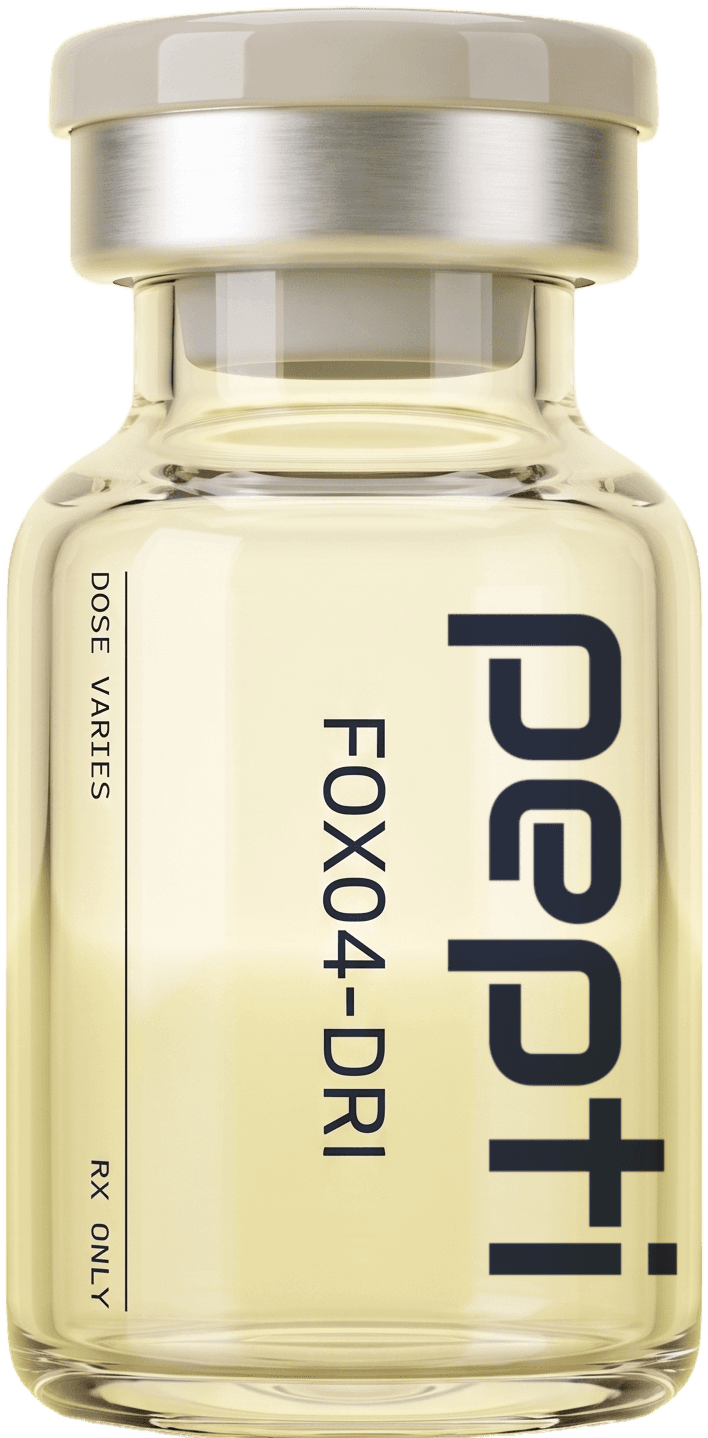
Treatments mentioned
FOXO4-DRI is a prescription injection supplied as vial — FOXO4-DRI 10mg/5mL 2mg/mL (5mL). The reviewed directions are: Inject 0.25 mL (25 units) subcutaneously once daily Monday through Friday. That is 20 doses per vial, about 4 weeks at Monday through Friday. It requires a prescription from a physician licensed in your state, is compounded by a state-licensed US pharmacy, and is not FDA approved.
This page covers what FOXO4-DRI is, the senolytic mechanism the research describes, what the published work does and does not establish, where it currently stands with the FDA, how it is dosed, and how to get it prescribed.
FOXO4-DRI
What FOXO4-DRI actually is
A designed peptide, not a natural one
FOXO4-DRI is not a fragment of something the body makes. It was designed in the laboratory of Peter de Keizer at Erasmus University Medical Center in Rotterdam and described in a 2017 paper in Cell (Baar and colleagues). The starting point was FOXO4, a transcription factor that senescent cells use to stay alive: in those cells FOXO4 holds onto p53 in the nucleus and keeps it from triggering the cell's own death programme. The peptide copies a stretch of FOXO4 and acts as a decoy, occupying p53 so the real FOXO4 cannot.
"Senescent" needs a definition, because everything on this page depends on it. A senescent cell is one that has stopped dividing permanently, usually after damage or too many divisions, but has not died. It sits in tissue and secretes inflammatory signals, a pattern called the senescence-associated secretory phenotype. The senolytic hypothesis is that removing these cells improves the tissue around them. FOXO4-DRI is one of the compounds designed to test that hypothesis.
What "DRI" means
DRI stands for D-retro-inverso. Ordinary peptides are built from L-amino acids and are chewed up by proteases within minutes. A retro-inverso peptide is built from the mirror-image D-amino acids, assembled in reverse order, so the side chains end up in roughly the same spatial arrangement as the original sequence while the backbone is one that proteases do not recognise. The practical result is a peptide that survives far longer in the body than the natural sequence would. FOXO4-DRI also carries a short cell-penetrating tail borrowed from the HIV TAT protein, which is what lets it cross the cell membrane and reach p53 in the nucleus.
So the name is a description of the chemistry: the FOXO4 sequence, made backwards out of D-amino acids, with a delivery tag attached.
What it is not
It is not a hormone and it does not act on a hormone receptor. It is not a growth hormone secretagogue like ipamorelin or sermorelin, and it does not change IGF-1. It is not an antioxidant, it is not a mitochondrial peptide like MOTS-c or SS-31, and it is not a recovery peptide like BPC-157. It does not repair cells. Its entire described action is to remove a particular category of cell, and it has no described action on healthy dividing cells at all.
It is also not a proven anti-aging treatment. It is an experimental senolytic with a small body of animal and cell research behind it, described in more detail below.
FOXO4-DRI
How FOXO4-DRI is described to work
The mechanism is unusually well defined for a compounded peptide, because it was engineered around a specific molecular interaction rather than discovered by screening. All of the detail below comes from mouse and cell studies. None of it has been demonstrated in a human being.
Blocking the FOXO4–p53 interaction
In the 2017 Cell paper, the de Keizer group reports that FOXO4 is expressed at high levels in senescent cells and that it binds p53 there. p53 is the protein that normally decides whether a damaged cell dies; a senescent cell has damage but does not die, and the paper identifies the FOXO4–p53 complex as one reason why. FOXO4-DRI is described as competing for that interaction. When it binds p53, FOXO4 cannot, and the arrangement that was keeping the cell alive is disrupted.
A 2025 paper in Nature Communications from the same collaborators (Bourgeois and colleagues) solved NMR structural models of the interaction and reports that FOXO4-DRI binds the disordered transactivation domain of p53, the same region the natural FOXO4 forkhead domain uses. That is structural confirmation of the target the original paper proposed.
p53 nuclear exclusion and cell-intrinsic apoptosis
Once the complex is disrupted, the Cell paper describes p53 leaving the nucleus of the senescent cell and moving to the cytoplasm, where it triggers the cell's own apoptosis programme. Later cell work has filled in the downstream steps: a 2026 paper in Frontiers in Bioengineering and Biotechnology on senescent endothelial cells describes phosphorylated p53 being exported from the nucleus, followed by BAX and cleaved caspase-3, the standard machinery of programmed cell death. A 2025 paper in Communications Biology on keloid fibroblasts describes the same nuclear exclusion of p53 phosphorylated at serine 15.
The phrase "cell-intrinsic" matters. The cell is described as killing itself through its own normal pathway, rather than being destroyed from outside. That is why the proposed action is selective: a cell that is not senescent has no FOXO4–p53 complex to disrupt.
Selectivity for senescent over healthy cells
The central claim of the senolytic field is that a compound kills senescent cells and leaves healthy ones alone. For FOXO4-DRI, the 2017 Cell paper reports that the peptide induced apoptosis in senescent cells but not in proliferating cells in culture, and that it was tolerated in mice at the doses used. A 2021 study in Frontiers in Bioengineering and Biotechnology on human chondrocytes expanded in a dish reports that the peptide selectively removed the senescent fraction while sparing the rest. That is the basis for describing it as selective, and it is a cell-culture and mouse observation, not a human one.
Reducing the inflammatory secretions of senescent cells
Senescent cells are not a problem only because they take up space. The secretory phenotype, a mix of cytokines, proteases and growth factors, is what the field considers most damaging to surrounding tissue. Mouse work on aged Leydig cells (Experimental Gerontology, 2024) describes FOXO4-DRI reducing the secretion of these factors after senescent cells were cleared, with a knock-on effect on neighbouring cells in co-culture. The logic is that removing the source removes the signal. Again, this is a description from animal and cell models.
FOXO4-DRI
What the research actually shows
The published body of work is small. There is one foundational paper, a structural follow-up, and a handful of independent mouse and cell studies in specific tissues. That is honestly the whole picture.
Chemotherapy toxicity in mice
The first thing the 2017 Cell paper tested was doxorubicin, a chemotherapy drug that induces senescence and causes side effects partly through it. The paper reports that FOXO4-DRI neutralised doxorubicin-induced chemotoxicity in mice, measured by liver toxicity markers and physical wellbeing, under conditions where the peptide itself was well tolerated. This is the cleanest experiment in the literature because senescence was induced deliberately and the comparison is direct.
Fast-aging and naturally aged mice
The same paper then treated two kinds of aged mice: a progeroid strain that ages rapidly because of a DNA repair defect, and ordinary mice that were simply old. In both, the authors report restored fitness (running-wheel activity), fur density, and renal function, the last measured as a reduction in urinary albumin. Treatment was a short course of intermittent intraperitoneal injection, not daily subcutaneous dosing, which is worth keeping in mind when reading the directions on this page. These are the findings that made the compound famous, and they are mouse findings.
Testis and Leydig cells in aged mice
A group in China has published two studies on the aging male reproductive system. The first, in Aging in 2020, reports that FOXO4 is expressed in human Leydig cells, that its nuclear localisation in elderly men correlated with lower testosterone synthesis, and that in aged mice FOXO4-DRI cleared senescent Leydig cells and was associated with improved testosterone secretion. The second, in Experimental Gerontology in 2024, reports improved sperm quality and spermatogenesis in naturally aged mice after treatment, with reduced secretory-phenotype output from Leydig cells. The human component of the first study was observational tissue analysis, not treatment of people.
Fibrosis and scar tissue
A 2023 paper in Naunyn-Schmiedeberg's Archives of Pharmacology reports that in a bleomycin-induced pulmonary fibrosis model in mice, FOXO4-DRI was associated with milder pathological change and less collagen deposition, and describes the peptide reducing extracellular matrix production in activated fibroblasts. The 2025 Communications Biology keloid paper describes senescent fibroblasts in human keloid tissue and reports that FOXO4-DRI induced their apoptosis in keloid organ cultures and cell models. The keloid tissue was human, but it was studied in a dish after removal, which is a different thing from treating a person.
Blood vessels in aged mice
The 2026 Frontiers in Bioengineering and Biotechnology paper reports that injection of FOXO4-DRI in both naturally aged and induced-aging mice was associated with reduced aortic aging markers and improved aortic function, and describes the p53 pathway mechanism in oxygen-glucose-deprived endothelial cells. This is the most recent addition to the animal literature.
Human cells in a dish
Two studies have used human cells directly: the 2021 chondrocyte paper (cells expanded for autologous cartilage implantation, where senescence accumulates during expansion) and the 2025 keloid paper. Both report selective removal of senescent cells in culture. Cell-culture work on human cells is a step above mouse work in relevance, but it is not evidence of what happens when the peptide is injected into a person.
What human data exists
There are no randomised human trials of FOXO4-DRI. There are no published non-randomised human trials either. No dose-finding study, no pharmacokinetic study, no safety study in people has been published. The compound was first described in 2017, and as of September 2026 the human evidence base consists of observational tissue analysis (the Leydig cell study looked at FOXO4 localisation in tissue from elderly men) and human cells studied outside the body.
This makes FOXO4-DRI different from most of the peptides on this site. BPC-157 has decades of animal work plus early-phase human studies for gut indications; semaglutide has large trials. FOXO4-DRI has neither. The honest framing is: a well-defined mechanism, a small number of mouse and cell studies that are consistent with each other, and no human data. Anyone describing it as proven, or citing human results, is describing something that does not exist.
What the evidence does not establish
- It does not establish that FOXO4-DRI clears senescent cells in humans. Every senolytic observation is from mice or cultured cells.
- It does not establish any effect on human aging, lifespan, healthspan, appearance, energy, or any other outcome a person might hope for.
- It does not establish a dose, a schedule, or a route for humans. The mouse work used intermittent intraperitoneal injection over days, not weeks of subcutaneous dosing.
- It does not establish safety in humans, short-term or long-term. The mouse studies report the peptide was tolerated; that is the extent of it.
- It does not establish what happens with repeated courses. Whether senescent cells re-accumulate, and on what timeline, has not been studied in people.
- It does not establish anything about the compounded product specifically. The published work used research-grade peptide in a laboratory setting.
FOXO4-DRI
Where FOXO4-DRI stands with the FDA right now
As of September 2026 the FDA has not evaluated FOXO4-DRI at all. That is a different position from BPC-157, which has been through the advisory committee, and worth being precise about.
Under section 503A, a compounding pharmacy may use a bulk substance only if it has a USP or NF monograph, is a component of an FDA-approved drug, or appears on the 503A bulks list. Separately, the FDA sorts nominated substances into three interim categories while it evaluates them. FOXO4-DRI does not appear in Category 1, Category 2 or Category 3 of the FDA's 503A nominated-substances document, most recently updated 14 May 2026. It is also absent from the FDA's page of bulk substances that may present significant safety risks, current as of 22 April 2026, both from the Category 2 table and from the list of substances withdrawn from it. It is not on the positive 503A bulks list at 21 CFR 216.23, which as of the 22 September 2026 eCFR issue still holds the six substances placed there in 2019.
The Pharmacy Compounding Advisory Committee's 23–24 July 2026 meeting reviewed BPC-157, KPV, TB-500 and MOTS-c on the first day and DSIP, Semax and Epitalon on the second. FOXO4-DRI was not on the agenda. The FDA has also announced a further committee meeting before the end of February 2027 to consider cathelicidin (LL-37), GHK-Cu, dihexa acetate, Melanotan II and PEG-MGF. FOXO4-DRI is not among those either.
So: no safety notice, no Category 2 listing, no advisory-committee vote, no position on the bulks list. It has simply not been through the process. The FDA's 503A page notes that substances nominated on or after 7 January 2025 are no longer placed into the interim categories at all, so a future nomination would not necessarily change that picture. It is not an FDA-approved drug product, and compounded medications never are.
FOXO4-DRI
Realistic expectations
This section is shorter than on other pages because there is less to say honestly. There are no human trial endpoints, and there is far less prescriber experience than with established peptides. What follows is the reasoning a physician would apply, not a timeline anyone can promise.
The first four weeks
Senescent cell clearance, if it happens, is not something you would feel. There is no described acute effect; the peptide is not a stimulant, not a sedative, not an anti-inflammatory in the direct sense. Most people should expect to notice nothing during a first vial, and that is consistent with the mechanism rather than a sign of failure. What is more likely to be noticeable early is the injection site.
Why the mouse timelines do not translate
In the 2017 Cell paper, effects in aged mice were measured over days to a few weeks after a short course. A mouse ages in two years and its tissues turn over quickly. There is no established conversion to human timescales, and prescribers who use FOXO4-DRI generally treat it as an intermittent course rather than a continuous daily medication, which is why the directions are five days a week and a vial is sized at about four weeks.
What "working" would even mean
For a recovery peptide, a sore tendon feeling better is a reasonable marker. For a senolytic there is no comparable signal a patient can observe. Some prescribers look at inflammatory markers on bloodwork before and after; whether that is meaningful for this compound has not been studied. Set expectations around the honest position: this is an experimental compound with a defined mechanism, not a treatment with an expected result.
After the course
There is no withdrawal and no rebound described in the animal work. Whether any senescent cells removed would re-accumulate, and how fast, is unknown in humans. Whether a repeat course is appropriate is a physician's decision, and the answer may reasonably be no.
FOXO4-DRI
When something else makes more sense
A reference that only ever recommends its own product is not much of a reference. Given how thin the human evidence is, there are a number of situations where FOXO4-DRI is not the right first conversation:
- You want something with human data behind it. NAD+ has been studied in people; so have tesamorelin and sermorelin. FOXO4-DRI has not. If your priority is an intervention with a human evidence base, start there.
- Your goal is energy, metabolism or body composition. MOTS-c and SS-31 are aimed at mitochondrial function and have their own research bases. A senolytic does not address these directly.
- You are after a broad anti-aging stack rather than a single mechanism. The ETERNAL blend combines GHK-Cu, BPC-157, TB-500 and Epithalon, and Epithalon on its own works through a different hypothesis (telomere and pineal biology). Neither is a senolytic, and a physician may prefer one of them as a starting point.
- Skin, hair and connective tissue are the priority. GHK-Cu and the RADIANCE blend are aimed at that more directly.
- You have a history of cancer, lung disease or a serious chronic illness. The p53 pathway and senescence biology both intersect with cancer, and a mouse study has raised a question about senolytics and pulmonary vessels (see Safety). This is a conversation to have before anything is prescribed.
Your physician will tell you if FOXO4-DRI is not the right tool for what you have described. A consultation does not guarantee a prescription, and being declined is refunded.
FOXO4-DRI
Strengths available
| Strength | Directions |
|---|---|
| FOXO4-DRI 10mg/5mL | Inject 0.25 mL (25 units) subcutaneously once daily Monday through Friday. |
One strength is supplied. Whether it is prescribed at all, and on what schedule, is your physician's decision.
FOXO4-DRI
Dosing, and how a vial is actually used
Why the dose is measured in units
The directions are written in millilitres and in insulin-syringe units because that is what you can actually read off the barrel. 0.25 mL is 25 units on a U-100 syringe. At 2 mg/mL, that volume contains 0.5 mg of FOXO4-DRI. You are not calculating anything; the number is printed on your medication.
Subcutaneous, five days a week
Subcutaneous means into the fat layer, not the muscle. Abdomen and thigh are the usual sites, rotated so the same spot is not used repeatedly. The directions are Monday through Friday with the weekend off, which reflects how prescribers have chosen to structure an intermittent course rather than anything established by research. The published mouse work used intraperitoneal injection, which is not a route used in people for this purpose; the subcutaneous route is a clinical decision, not a translated one.
Why a vial covers about four weeks
20 doses at five per week is four weeks, which is why refills run on a 28-day cycle. One vial per fill, always. Whether a second vial is prescribed at all is a separate physician decision each time, and with an experimental compound it is reasonable for that answer to change.
Storage
Refrigerated, and it ships that way in insulated packaging with ice packs. The D-amino acid chemistry makes the peptide more stable than a natural sequence, but the compounded solution is still handled as a refrigerated multi-dose vial. Beyond-use dating runs from first puncture and is on the label.
FOXO4-DRI
Safety and side effects
The safety record is a mouse record. The 2017 Cell paper reports that FOXO4-DRI was well tolerated in mice at the doses used and did not cause the toxicity seen with the chemotherapy it was tested against. Subsequent mouse studies report similar tolerability. There is no published human safety data of any kind: no adverse-event series, no pharmacokinetics, no long-term follow-up.
What gets reported clinically is mostly injection-site: redness, mild soreness, occasional bruising. Because the peptide carries a cell-penetrating sequence and is built from D-amino acids, its behaviour in the body is less predictable from first principles than a natural peptide's, and immune reactions to unusual peptide chemistry are a theoretical concern that has not been studied in people.
The senescence–cancer relationship
Senescence is one of the body's defences against cancer: a cell with dangerous damage is parked rather than allowed to divide. A senolytic removes parked cells, which in principle is the safer outcome, but the compound acts on p53, the central tumour-suppressor protein, and nobody has studied what that means over time in humans. A personal or family history of cancer is a reason to discuss this carefully with your physician before starting, even though it does not appear in the exclusion table below.
One mouse finding worth knowing about
A 2023 study in Circulation reported that eliminating senescent cells in the pulmonary vessels of mice, using senolytic interventions, worsened pulmonary hypertension rather than improving it. That is a finding about senolytics as a class in a specific tissue, in mice, and it has not been shown in people. It is included here because it is the clearest published example of a senolytic doing something unexpected, and because anyone with pulmonary hypertension or significant lung disease should raise it with their physician.
There is no established interaction list, because the trials that would produce one have not been run. That is precisely why the intake asks for every medication you take and why a physician reviews it rather than a form.
Stop and contact your physician for any reaction that is severe, spreading, or involves difficulty breathing.
FOXO4-DRI
How FOXO4-DRI compares
FOXO4-DRI vs Epithalon
Both are filed under anti-aging and the similarity ends there. Epithalon is a four-amino-acid peptide derived from pineal gland extracts, and its research is largely older Russian work on telomerase and pineal function. FOXO4-DRI is a designed D-peptide with a single defined molecular target. Epithalon was reviewed by the FDA's advisory committee in July 2026; FOXO4-DRI has not been nominated. A physician choosing between them is choosing between two different hypotheses about aging, neither of which has randomised human trial support.
FOXO4-DRI vs NAD+
NAD+ is a coenzyme the body makes, involved in cellular energy metabolism and DNA repair, and it has been given to humans in clinical studies. It does not kill any cells. FOXO4-DRI does nothing for energy metabolism directly and has no human studies. If a person wants one anti-aging intervention with human data, NAD+ is the more defensible choice; if a physician specifically wants to trial a senolytic, FOXO4-DRI is the only one in this catalogue.
FOXO4-DRI vs MOTS-c and SS-31
MOTS-c and SS-31 act on mitochondria: MOTS-c is a mitochondrial-derived peptide described around metabolic signalling, and SS-31 (elamipretide) binds cardiolipin in the inner mitochondrial membrane. Both aim to improve how existing cells function. FOXO4-DRI aims to remove cells that no longer function. They are not alternatives so much as answers to different questions, and a physician may consider them in different people for different reasons.
FOXO4-DRI
Availability and formats
| Question | Answer |
|---|---|
| Can I get it by telehealth? | Yes, where a physician licensed in your state prescribes it |
| Which states? | All 50 states and DC |
| Does it come as a pen? | No, this one is a vial and syringe only |
| Does it come as a capsule? | No |
| Does it come as a nasal spray? | No |
| Is bloodwork required first? | Not routinely; your physician decides |
FOXO4-DRI
Where to get FOXO4-DRI prescribed
FOXO4-DRI cannot be bought legitimately without a prescription. Sites shipping it with no prescription are selling a research-use-only product, where no pharmacy is accountable for identity, purity, sterility or concentration.
The prescription route works like this:
- Complete a medical intake covering your history, medications, allergies and what you are treating.
- A physician licensed in your state reviews it.
- If appropriate, a state-licensed, FDA-registered pharmacy compounds it to that prescription.
- It ships refrigerated with your directions printed on the vial.
- Your physician stays reachable afterwards for dose questions and side effects.
Current all-in pricing for FOXO4-DRI is published: medication, physician review, refill management and shipping in one figure, with no separate membership fee. What to check on any provider is in how to tell if a peptide seller is legitimate.
FOXO4-DRI
Who should not take it, or should discuss it first
| Situation | Why |
|---|---|
| Pregnancy or breastfeeding | Not used; safety data is absent |
| Tested athletes | Many peptides are prohibited in competition; check the current list |
Full specification
Everything on the label.
Product
FOXO4-DRI (Injectable)
How supplied
vial — FOXO4-DRI 10mg/5mL 2mg/mL (5mL)
Typical directions
Inject 0.25 mL (25 units) subcutaneously once daily Monday through Friday.
Dose volume
0.25 mL (25 units on a U-100 insulin syringe)
Doses per vial
20
Coverage per vial
about 4 weeks at Monday through Friday
Formats
Vial and syringe
Available in
All 50 states and DC
Bloodwork
Not routinely required; your physician decides
Legal status
Prescription-only, compounded, not FDA approved
Category
Anti-Aging
References
What this is based on.
References
- Baar MP, Brandt RMC, Putavet DA et al.. Targeted Apoptosis of Senescent Cells Restores Tissue Homeostasis in Response to Chemotoxicity and Aging · Cell (2017) · PMID 28340339
- Bourgeois B, Spreitzer E, Platero-Rochart D et al.. The disordered p53 transactivation domain is the target of FOXO4 and the senolytic compound FOXO4-DRI · Nature Communications (2025) · PMID 40593617
- Zhang C, Xie Y, Chen H et al.. FOXO4-DRI alleviates age-related testosterone secretion insufficiency by targeting senescent Leydig cells in aged mice · Aging (Albany NY) (2020) · PMID 31959736
- Huang Y, He Y, Makarcyzk MJ et al.. Senolytic Peptide FOXO4-DRI Selectively Removes Senescent Cells From in vitro Expanded Human Chondrocytes · Frontiers in Bioengineering and Biotechnology (2021) · PMID 33996787
- Liu Y, Hou Q, Wang R et al.. FOXO4-D-Retro-Inverso targets extracellular matrix production in fibroblasts and ameliorates bleomycin-induced pulmonary fibrosis in mice · Naunyn-Schmiedeberg's Archives of Pharmacology (2023) · PMID 37074394
- Li Y, Zhang C, Cheng H et al.. FOXO4-DRI improves spermatogenesis in aged mice through reducing senescence-associated secretory phenotype secretion from Leydig cells · Experimental Gerontology (2024) · PMID 39025385
- Hu Z, Li F, Hu C et al.. FOXO4-DRI regulates endothelial cell senescence via the P53 signaling pathway · Frontiers in Bioengineering and Biotechnology (2026) · PMID 41625068
- Kong YX, Li ZS, Liu YB et al.. FOXO4-DRI induces keloid senescent fibroblast apoptosis by promoting nuclear exclusion of upregulated p53-serine 15 phosphorylation · Communications Biology (2025) · PMID 39994346
- Born E, Lipskaia L, Breau M et al.. Eliminating Senescent Cells Can Promote Pulmonary Hypertension Development and Progression · Circulation (2023) · PMID 36515093
Citations are provided for educational purposes. They do not constitute medical advice. Always discuss any peptide protocol with your prescribing physician.
Common questions
FOXO4-DRI, answered.
Through a telehealth provider where a physician licensed in your state reviews a medical intake and a licensed US pharmacy compounds the prescription. Pepti prescribes FOXO4-DRI in all 50 states and DC; start with the free assessment.
vial — FOXO4-DRI 10mg/5mL 2mg/mL (5mL)
Inject 0.25 mL (25 units) subcutaneously once daily Monday through Friday. Your physician sets your own dose and it is printed on your medication.
20 at the standard volume, about 4 weeks at Monday through Friday.
FOXO4-DRI is supplied as a vial, drawn with an insulin syringe. It is not available as a pen or capsule.
Not routinely, though your physician may want labs depending on your history. at-home blood testing covers hormone, metabolic and thyroid markers without a lab visit.
It is legal to prescribe and dispense in the United States with a valid prescription. It is not FDA approved: compounded medications are prepared by licensed pharmacies pursuant to a prescription rather than approved as manufactured products. See are peptides FDA approved.
Pricing is published on the FOXO4-DRI page as one all-in figure covering medication, physician review, refill management and shipping. What drives peptide pricing generally is in how much do peptides cost.
A compound designed to remove senescent cells: cells that have permanently stopped dividing but have not died, and that secrete inflammatory signals into the tissue around them. The senolytic hypothesis is that clearing these cells improves tissue function. FOXO4-DRI is one of several senolytic candidates studied in animals; none is an approved drug.
No. There are no randomised human trials of FOXO4-DRI, and no published non-randomised human trials either. The evidence is a 2017 mouse study in Cell from the de Keizer laboratory, a 2025 structural study in Nature Communications, and a handful of independent mouse and cell studies since. Human cells have been studied in a dish; no person has been treated in a published study.
No published evidence supports that in humans. The 2017 Cell paper reports restored fitness, fur density and kidney function in aged and fast-aging mice after a short course. Those are mouse outcomes, and there is no established way to translate them to people. Anyone describing FOXO4-DRI as reversing human aging is describing something that has not been studied.
No. As of September 2026 FOXO4-DRI does not appear in Category 1, 2 or 3 of the FDA's 503A nominated-substances document, is not on the FDA's significant-safety-risk page, and was not on the agenda of the Pharmacy Compounding Advisory Committee's July 2026 meeting or the meeting announced for early 2027. It has not been evaluated by the FDA either way. It is not FDA approved, and no compounded medication is.
Not in any human study, because there are none. A 2020 mouse study in Aging reported that clearing senescent Leydig cells with FOXO4-DRI was associated with improved testosterone secretion in aged mice. That is a mouse finding in a specific cell type, not a human result, and FOXO4-DRI is not a hormone or a hormone-releasing peptide. If testosterone is the concern, that is a bloodwork and physician conversation, not a reason to start a senolytic.
Because prescribers treat it as an intermittent course rather than a continuous daily medication, which loosely mirrors the short, intermittent dosing in the mouse work. The Monday-through-Friday schedule is a clinical convention, not a trial-established regimen. Your physician sets your schedule and it is printed on your vial.
In mice, the published work reports the peptide was well tolerated at the doses tested. In people, there is no published safety data at all. What gets reported clinically is mostly injection-site reactions. Because it acts on the p53 pathway, a history of cancer is a reason to discuss it carefully first, and a 2023 mouse study in Circulation raised a question about senolytics and pulmonary hypertension that anyone with lung disease should mention to their physician.
It is the only compound in this catalogue designed to remove cells rather than to change how cells behave. Epithalon works on a telomere and pineal hypothesis, NAD+ on cellular energy metabolism, MOTS-c and SS-31 on mitochondria. Those have either human data or a longer research history; FOXO4-DRI has a more precisely defined mechanism and less evidence. Which, if any, is appropriate is a physician's decision.
Next step
See what a physician recommends for you.
A licensed physician in your state reviews your intake and decides what is appropriate. A consultation does not guarantee a prescription.