Anti-Aging · Reference
NAD+ Injection Dosage: How Pepti Prescribes It, in Units, mL and mg
This page explains the NAD+ dosage Pepti prescribes, what the units on the syringe mean, a dosage chart for both vials, how often and how it is injected, what can change your directions, and the side effects to know about. It covers how Pepti prescribes NAD+, not online protocols. Nothing here is a reason to change your own dose.
Medically reviewed by Dr. Gene, MD · November 4, 2026
Treatments mentioned
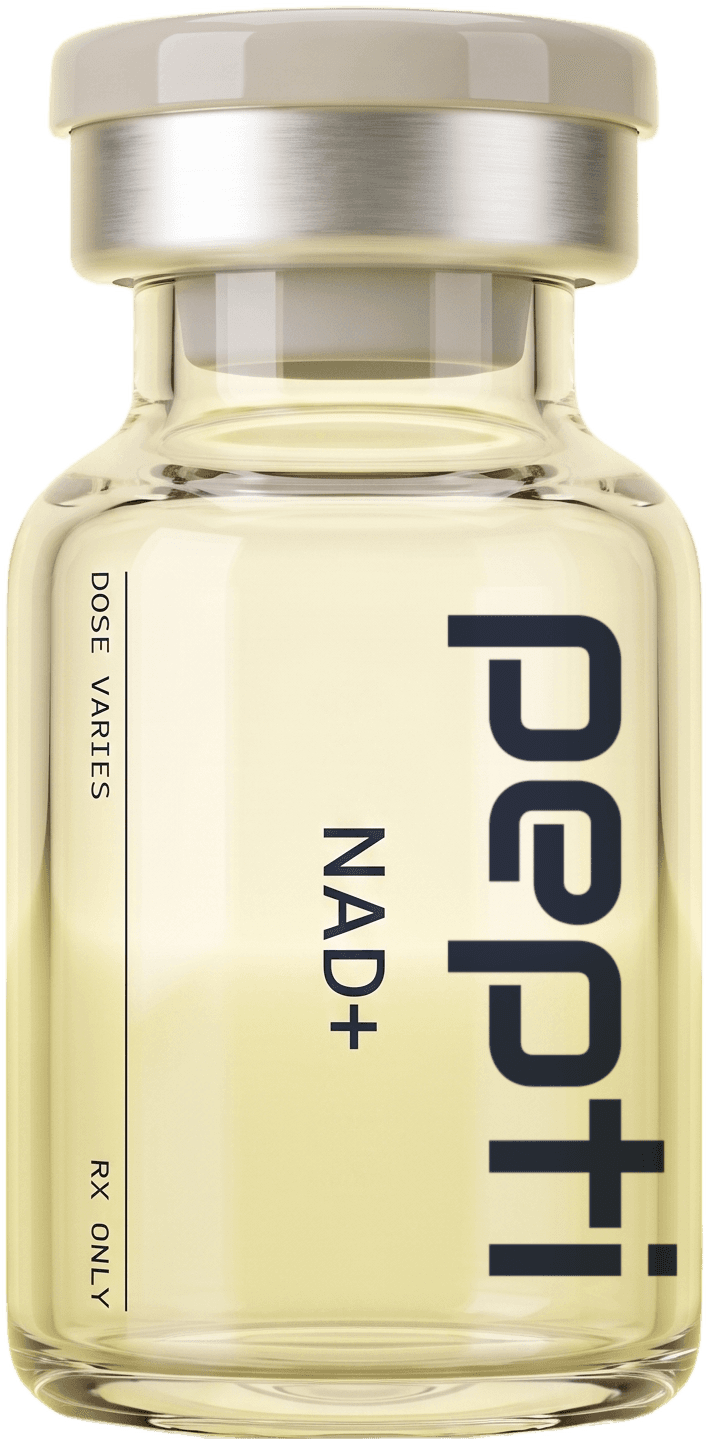
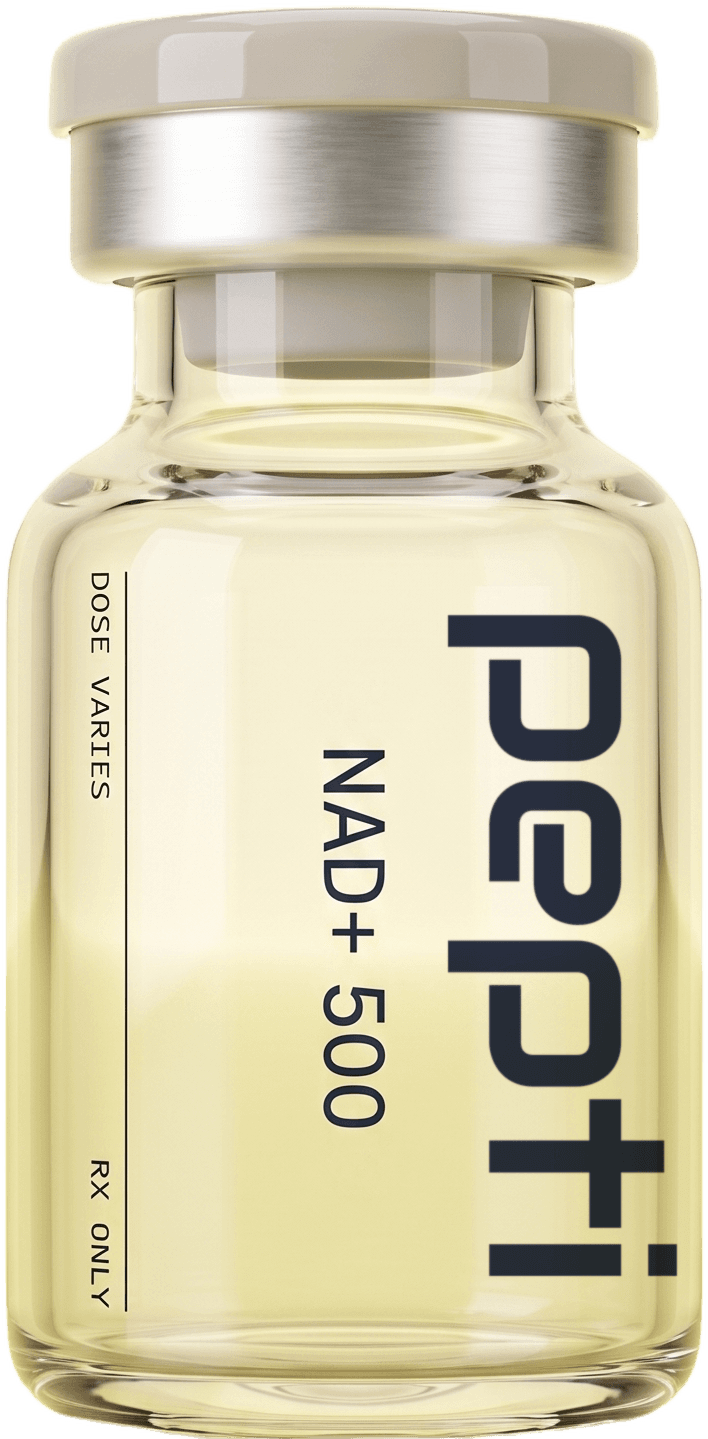
At Pepti, NAD+ injection is prescribed as 0.83 mL, which is 83 units on a U-100 insulin syringe, injected under the skin three times per week. The standard vial is 10 mL at 100 mg/mL (1,000 mg per vial), so each dose carries 83 mg of NAD+; the lower-strength NAD+ Injection (500 mg) is 10 mL at 50 mg/mL, so the same 83 units carries 41.5 mg. Both vials hold 12 doses, about four weeks. Your physician sets your directions after reviewing your intake, and your exact dose and units are printed on the vial.
This page explains the NAD+ dosage Pepti prescribes, what the units on the syringe mean, a dosage chart for both vials, how often and how it is injected, what can change your directions, and the side effects to know about. It covers how Pepti prescribes NAD+, not online protocols. Nothing here is a reason to change your own dose.
NAD+ Injection Dosage
The short answer
| Product | Vial | Directions | Doses per vial | Price |
|---|---|---|---|---|
| NAD+ Injection | 10 mL, 100 mg/mL (1,000 mg per vial) | Inject 0.83 mL (83 units) subcutaneously three times per week | 12 | $249/mo |
| NAD+ Injection (500 mg) | 10 mL, 50 mg/mL (500 mg per vial) | Inject 0.83 mL (83 units) subcutaneously three times per week | 12 | $229/mo |
Every price is all-in, covering medication, physician review, refill management and shipping, with no separate membership fee. Pepti is cash-pay and does not bill insurance. Your own directions are the ones printed on your vial.
NAD+ is not a peptide. It is a coenzyme, nicotinamide adenine dinucleotide, which every cell makes and uses. People search for "NAD peptide dosage" because it is compounded and prescribed the same way peptides are.
NAD+ Injection Dosage
NAD+ dosage in units, mL and mg
Pepti's directions are written in millilitres and units, because prescriptions are written in millilitres and insulin syringes are marked in units. On a U-100 insulin syringe, 1 unit is 0.01 mL, so 100 units is 1 mL and 83 units is 0.83 mL. A unit is a volume mark on the barrel, not a measure of how strong the medication is.
The milligram figure comes from the concentration on the label:
| What you read | NAD+ Injection | NAD+ Injection (500 mg) |
|---|---|---|
| Dose volume | 0.83 mL | 0.83 mL |
| On a U-100 insulin syringe | 83 units | 83 units |
| Concentration | 100 mg/mL | 50 mg/mL |
| NAD+ per dose | 83 mg | 41.5 mg |
| Total in the vial | 1,000 mg in 10 mL | 500 mg in 10 mL |
| Doses per vial | 12 | 12 |
The per-dose figure is the concentration multiplied by 0.83 mL. That arithmetic is a way to read a label, not a way to set a dose. A vial labelled 1,000 mg is not a 1,000 mg dose: at Pepti's directions it is twelve 83 mg doses. If your label and your syringe seem to disagree, do not dose; message your care team. How long does a peptide vial last explains every number on a vial label.
Why 12 doses and not 12.05
A 10 mL vial divided by 0.83 mL is just over 12, and the vial is counted as 12 doses. Draw what your label says each time; the small remainder is not a thirteenth dose.
NAD+ Injection Dosage
NAD+ injection dosage chart
| NAD+ Injection | NAD+ Injection (500 mg) | |
|---|---|---|
| Draw | 83 units (0.83 mL) | 83 units (0.83 mL) |
| How often | Three times per week | Three times per week |
| Route | Subcutaneous | Subcutaneous |
| Per dose | 83 mg | 41.5 mg |
| Doses per vial | 12 | 12 |
| How long a vial lasts | About 4 weeks | About 4 weeks |
| Formats | Vial, or a pre-filled pepti Pen cartridge | Vial only |
| Price | $249/mo | $229/mo |
The two vials are the same molecule, the same 10 mL volume, the same 0.83 mL draw and the same schedule. The only difference is concentration. The 500 mg vial exists so a physician has a lower per-dose amount to prescribe without changing how the medication is drawn or given; it does not last longer. More is in what is NAD+ 500 and what is NAD+ injection.
The Pen
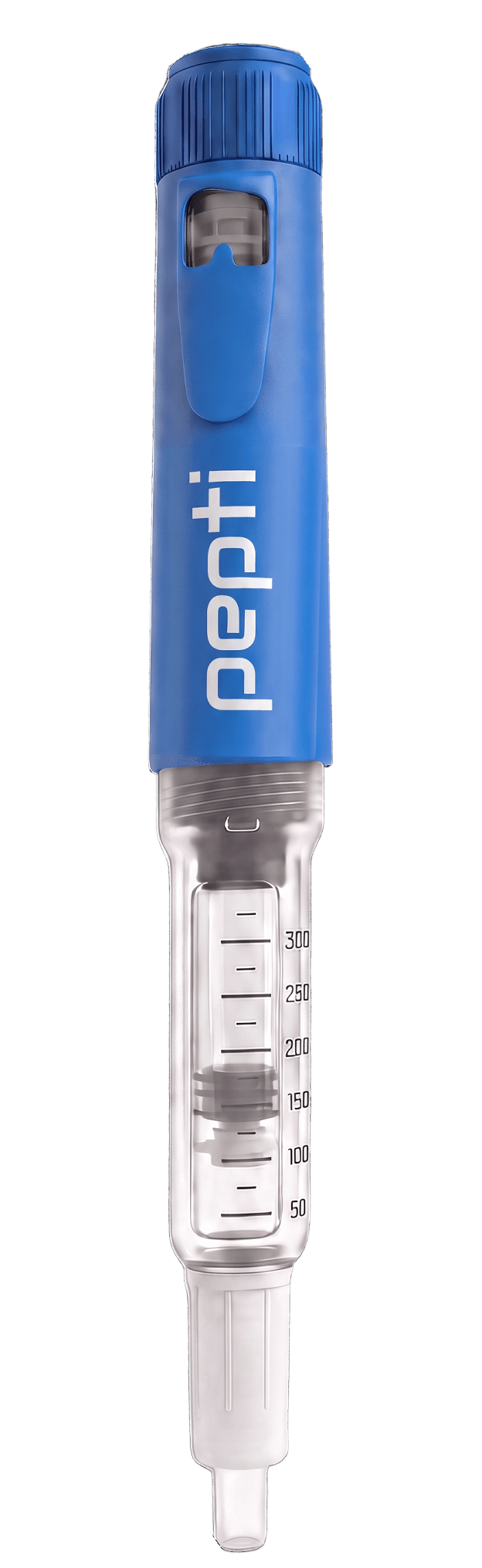
NAD+ Injection also comes as a 3 mL pre-filled pepti Pen cartridge containing 600 mg NAD+, in a reusable click-dial injector. It is dosed by dial rather than drawn with a syringe, as printed with your prescription, so there is no unit conversion. A cartridge typically covers four to five weeks at the prescribed dose. It is the same medication; the comparison is in vial vs pen.
NAD+ Injection Dosage
How NAD+ is injected
Three times per week
NAD+ is a larger-volume injection given three times a week rather than daily. The spacing is in your directions. Twelve doses at three a week is four weeks, which is why refills run every 28 days.
Slowly
With NAD+ specifically, prescribers consistently advise injecting slowly. The flushing, chest or abdominal tightness and nausea some people feel during the injection track with how fast NAD+ enters the circulation, and a slow injection is the simplest way to blunt it. Your directions will say.
Under the skin
Subcutaneous means into the fat layer, not the muscle. Abdomen and thigh are the usual sites, rotated. Technique is covered in how to inject peptides safely.
Directions say What it means in practice 0.83 mL (83 units) Draw to the 83 mark on a U-100 insulin syringe Subcutaneously Into the fat layer, abdomen or thigh, rotating sites Three times per week On the days your directions give 12 doses per vial About four weeks, then the next refill
NAD+ Injection Dosage
Storage, and why NAD+ is fussier than most
Vials are multi-dose solutions shipped ready to use, refrigerated with ice packs, with sterile syringes and alcohol prep pads. Nothing is mixed at home. Storage matters more than usual here: the FDA's own 2017 review describes the molecule as reactive, degrading with heat, alkaline pH and light. Keep it in the fridge, out of light, and follow the beyond-use date on the label, which runs from first puncture. One vial per fill, every 28 days. How to store peptides covers storage.
If a vial runs short before the refill, message your care team rather than adjusting anything yourself. If you miss a dose, follow your directions and do not take two doses to make up for one.
NAD+ Injection Dosage
What changes the directions
Your physician sets your directions after reviewing your intake. Things that can lead to different directions, or a different product, include:
| What can change | How it shows up |
|---|---|
| Which strength is prescribed | The 500 mg or 1,000 mg vial; same draw, different mg per dose |
| Vial or Pen | The Pen is dosed by dial instead of units |
| Your medical history | A cancer history, significant kidney or liver disease, or pregnancy change the conversation |
| Your other medications | The intake asks for everything you take; there is no established interaction list |
| How you respond | Reactions you report go to your physician, who may revise your directions or timing |
When directions change, the new numbers are printed on the new label. Never carry a number over from a previous fill. Bloodwork is not required for any Pepti treatment. If your physician wants labs for your care, they'll ask through your account.
NAD+ Injection Dosage
Side effects, in summary
The fuller picture is in NAD+ benefits and is NAD+ safe.
| What is reported | When | What to do |
|---|---|---|
| Flushing, warmth, chest or abdominal tightness, nausea | During the injection, fading within minutes | Inject slowly; report it |
| Stinging, redness, a small lump at the site | Around the injection | Rotate sites |
| Headache or light-headedness | Uncommon | Report it |
| Chills, shaking or vomiting after a dose | Not an expected reaction | Contact your physician the same day |
| Facial or throat swelling, widespread rash, difficulty breathing | Rare | Emergency care first, then tell your physician |
Prescribers describe the in-injection reaction as milder at the 50 mg/mL concentration, and they advise injecting slowly with either vial. There is no controlled safety dataset for subcutaneous NAD+ and no long-term data by any route. NAD+ is not used in pregnancy or breastfeeding.
Compounded medications are not FDA approved. NAD+ sits in Category 1 of the FDA's list of substances nominated for the 503A bulks list, under evaluation, and is compoundable under the FDA's interim policy.
NAD+ Injection Dosage
Where to get NAD+ prescribed
NAD+ Injection cannot be bought legitimately without a prescription. Sites selling it "for research use only" are not accountable for what is in the vial: identity, purity, sterility and concentration are untested. The prescription route:
- Complete a free online intake covering your history, medications and what you want help with.
- A physician licensed in your state reviews it, usually within 24 hours.
- If it is appropriate, a PCAB-accredited, FDA-registered US 503A compounding pharmacy prepares it to that prescription. Lot test results are published at /quality/lab-results.
- It ships refrigerated with your directions printed on the vial.
- Your physician stays reachable for questions and dose changes.
Pepti prescribes NAD+ Injection in all 50 states and DC. Step by step: how to get NAD+ prescribed online. What to check on any seller is in where to buy NAD online.
References
What this is based on.
References
- Massudi H, Grant R, Braidy N, et al.. Age-associated changes in oxidative stress and NAD+ metabolism in human tissue · PLOS ONE (2012) · PMID 22848760
- Yoshino J, Baur JA, Imai SI. NAD+ Intermediates: The Biology and Therapeutic Potential of NMN and NR · Cell Metabolism (2018) · PMID 29249689
- Verdin E. NAD⁺ in aging, metabolism, and neurodegeneration · Science (2015) · PMID 26785480
- Martens CR, Denman BA, Mazzo MR, et al.. Chronic nicotinamide riboside supplementation is well-tolerated and elevates NAD+ in healthy middle-aged and older adults · Nature Communications (2018) · PMID 29599478
- Dollerup OL, Christensen B, Svart M, et al.. A randomized placebo-controlled clinical trial of nicotinamide riboside in obese men: safety, insulin-sensitivity, and lipid-mobilizing effects · American Journal of Clinical Nutrition (2018) · PMID 29992272
- Yoshino M, Yoshino J, Kayser BD, et al.. Nicotinamide mononucleotide increases muscle insulin sensitivity in prediabetic women · Science (2021) · PMID 33888596
- Yi L, Maier AB, Tao R, et al.. The efficacy and safety of β-nicotinamide mononucleotide (NMN) supplementation in healthy middle-aged adults: a randomized, multicenter, double-blind, placebo-controlled, parallel-group, dose-dependent clinical trial · GeroScience (2023) · PMID 36482258
- Brakedal B, Dölle C, Riemer F, et al.. The NADPARK study: A randomized phase I trial of nicotinamide riboside supplementation in Parkinson's disease · Cell Metabolism (2022) · PMID 35235774
- McDermott MM, Martens CR, Domanchuk KJ, et al.. Nicotinamide riboside for peripheral artery disease: the NICE randomized clinical trial · Nature Communications (2024) · PMID 38871717
- Shiffman S, Stone AA, Hufford MR. Ecological momentary assessment · Annu Rev Clin Psychol (2008) · PMID 18509902
- Conze D, Brenner C, Kruger CL. Safety and Metabolism of Long-term Administration of NIAGEN (Nicotinamide Riboside Chloride) in a Randomized, Double-Blind, Placebo-controlled Clinical Trial of Healthy Overweight Adults · Scientific Reports (2019) · PMID 31278280
- Nacarelli T, Lau L, Fukumoto T, et al.. NAD+ metabolism governs the proinflammatory senescence-associated secretome · Nature Cell Biology (2019) · PMID 30778219
Citations are provided for educational purposes. They do not constitute medical advice. Always discuss any peptide protocol with your prescribing physician.
Common questions
NAD+ Injection Dosage, answered.
At Pepti, 0.83 mL, which is 83 units on a U-100 insulin syringe, injected subcutaneously three times per week. Your physician sets your directions after reviewing your intake, and your exact dose is printed on the vial.
83 mg from the 1,000 mg vial (100 mg/mL) and 41.5 mg from the 500 mg vial (50 mg/mL). The draw is the same 0.83 mL either way.
The number printed on your vial. Pepti's standard directions are 83 units, which is 0.83 mL on a U-100 insulin syringe, where 1 unit is 0.01 mL.
Three times per week under Pepti's directions, with the spacing given in your directions.
Twelve, at 0.83 mL each, which covers about four weeks at three times per week. That is true of both the 1,000 mg and 500 mg vials.
The chart above compares both Pepti vials: the same 83 units three times a week, 83 mg or 41.5 mg per dose, 12 doses per vial. Your own label is the one that applies.
Only the amount of NAD+ in each dose. Both are 10 mL vials drawn at 0.83 mL three times a week; the 500 mg vial delivers 41.5 mg per dose and the 1,000 mg vial 83 mg. Neither lasts longer.
NAD+ is a coenzyme rather than a peptide, but it is prescribed the same way. The dosage is the same as above: 0.83 mL (83 units) subcutaneously three times per week.
It is the characteristic reaction to NAD+ entering the circulation quickly, and it passes within minutes. That is why prescribers advise injecting slowly. Chills, rigors or vomiting are not part of that reaction and should be reported to your physician.
No. Take the dose printed on your vial, on the schedule printed on your vial. If you have questions about your dose, message your care team.
No. Pepti vials are multi-dose solutions shipped ready to use, with sterile syringes and alcohol prep pads.
Bloodwork is not required for any Pepti treatment. If your physician wants labs for your care, they'll ask through your account. The free assessment goes to a physician licensed in your state. A consultation does not guarantee a prescription.
Next step
See what a physician recommends for you.
A licensed physician in your state reviews your intake and decides what is appropriate. A consultation does not guarantee a prescription.