Weight Loss · Reference
Where to Buy Tirzepatide Online: What to Verify Before You Pay
This page covers what tirzepatide is, the three different things sold under that name online, how the prescription route works from intake to refill, what a legitimate provider should be able to show you before you pay, the red flags that identify a research-chemical seller, how pricing works, where the molecule stands with the FDA as of September 2026, and what the human trials do and do not establish.

Reviewed by Dr. Gene, MD · Board-certified Family Medicine
Every Pepti prescription is reviewed by a licensed U.S. physician before it's dispensed — and only provided if clinically appropriate.
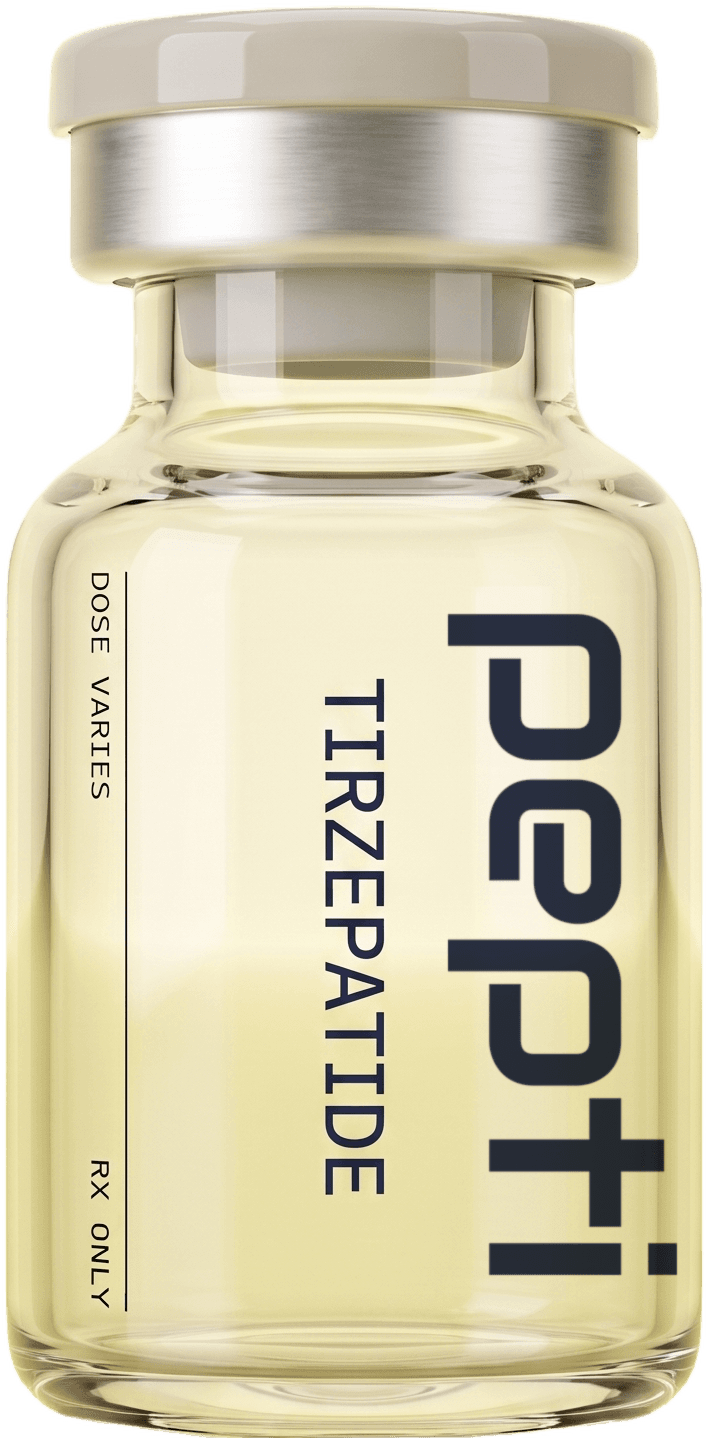
Treatments mentioned
Tirzepatide requires a prescription in every form, so buying it online legitimately means either a branded product through a pharmacy or a compounded preparation prescribed by a physician licensed in your state and made by a licensed US compounding pharmacy. Sites shipping it without a prescription are research-chemical sellers, and what arrives is frequently a salt form rather than the active ingredient in the medication. Compounded tirzepatide is not FDA approved; the branded products are. Beyond that, the question most buyers never ask is what else is in the vial, because compounded tirzepatide preparations often include additional ingredients.
This page covers what tirzepatide is, the three different things sold under that name online, how the prescription route works from intake to refill, what a legitimate provider should be able to show you before you pay, the red flags that identify a research-chemical seller, how pricing works, where the molecule stands with the FDA as of September 2026, and what the human trials do and do not establish.
Where to Buy Tirzepatide Online
The short answer
| If your situation is | The route | What is in it | Price |
|---|---|---|---|
| Starting compounded treatment | Tirzepatide at the first rung | 10 mg tirzepatide per 2 mL (5 mg/mL) with cyanocobalamin | From $159 |
| Continuing an existing dose | Tirzepatide at your current rung | Dose-specific vials up to 60 mg per 2 mL (30 mg/mL) with cyanocobalamin | Published per rung |
| Considering the single-receptor option | Semaglutide | Dose-specific vials from 1 mg per 1 mL | From $99 |
| Insurance may cover an approved product | Branded tirzepatide through your plan | The approved product | Varies by plan |
| GLP-1 is not appropriate for you | Other metabolic options such as SHRED | 10 mg AOD-9604, 6 mg CJC-1295, 10 mg Ipamorelin, 10 mg MOTS-c | $279 |
Compounded pricing is per dose rung, because strength drives compounding cost. Each figure is all-in: medication, physician review, refill management and shipping, on a subscription you cancel in your account.
What "legitimately" means in one sentence
A physician licensed in your state decides whether tirzepatide is appropriate for you and writes the prescription, and a state-licensed pharmacy prepares it to that prescription and ships it to you. If either part is missing, what you are buying is not a medication, whatever the label says. The single most useful question to ask any seller is which pharmacy will compound it: a legitimate provider names it, and its license is a public record with its state board.
Where to Buy Tirzepatide Online
What tirzepatide actually is
A dual agonist, not a stronger semaglutide
Tirzepatide is a single synthetic peptide that activates two receptors: the glucose-dependent insulinotropic polypeptide (GIP) receptor and the glucagon-like peptide-1 (GLP-1) receptor. Semaglutide activates only the GLP-1 receptor. That is the whole structural difference, and it is why tirzepatide is discussed as a different drug rather than a higher-strength version of the same one.
The GLP-1 arm does what GLP-1 receptor agonists do: glucose-dependent insulin release, glucagon suppression, slower gastric emptying, and action on appetite centers in the brain. The GIP arm adds separate signalling on insulin secretion and on adipose tissue. A phase 1 study in The Lancet Diabetes & Endocrinology in 2022 compared tirzepatide with placebo and with semaglutide in adults with type 2 diabetes and reported effects on islet function and insulin sensitivity the authors attributed to the dual mechanism. The fuller explanation is in what tirzepatide is, and the side-by-side is in semaglutide vs tirzepatide.
How the approved product is dosed
The approved tirzepatide labeling starts at the lowest weekly dose for four weeks and moves up in fixed steps, each held for at least four weeks before the next, to a maintenance dose the prescriber chooses. That rhythm — once weekly, subcutaneous, titrated upward rather than started at a working dose — is the reason compounded tirzepatide is sold in dose rungs and the reason a legitimate provider will not start a new patient high.
Where to Buy Tirzepatide Online
Ask what is in the vial
Compounded tirzepatide is frequently prepared with cyanocobalamin, a form of vitamin B12, included in the same vial. That is a normal compounding practice and it is disclosed on the label, but it is worth knowing rather than discovering later, particularly if you already supplement B12 or if a clinician is tracking your levels.
| Question to ask any provider | What a straight answer sounds like |
|---|---|
| What is in the vial besides tirzepatide | A named ingredient and a concentration |
| What concentration is my rung | A figure in mg per mL, which changes as the rung goes up |
| What volume do I draw | A number on the label, written for the vial you were sent |
| Which pharmacy compounded it | A named, state-licensed, FDA-registered pharmacy |
| What happens if the shipment arrives warm | A replacement process, not a shrug |
One practical safety point follows from the second row. The concentration changes between rungs, so the marks on an insulin syringe do not carry over from your last vial. Read the directions printed on the new vial each time a rung changes, and ask if anything reads differently from what you expect.
Why the concentration matters more here than for most peptides
The FDA's page on unapproved GLP-1 drugs says it has received adverse event reports that may be related to dosing errors with compounded injectable products, including patients drawing the wrong volume and patients receiving doses above what the approved labeling describes. The mechanism of those errors is the one in the table: a multi-dose vial, a syringe marked in units, and a concentration that changed since the last vial. A legitimate provider prints the draw volume for the specific vial you were sent, so the arithmetic is never your job.
Why B12 is in there at all
Pharmacies add cyanocobalamin to compounded GLP-1 preparations for their own formulation reasons, and its presence is one of the things that makes the preparation differ from the approved product. It is on the label. If you already take B12, or a clinician tracks your level, tell the physician at intake. If a seller cannot tell you whether B12 or anything else is in the vial, you do not know the contents of what you would be injecting.
Where to Buy Tirzepatide Online
Compounded versus branded versus research chemical
| Branded tirzepatide | Compounded tirzepatide | "Research use only" vial | |
|---|---|---|---|
| FDA approved | Yes | No | No |
| Prescription required | Yes | Yes | No |
| Prepared by | The manufacturer | A state-licensed, FDA-registered compounding pharmacy | A chemical supplier |
| Active ingredient | Tirzepatide | Tirzepatide, often with cyanocobalamin | Frequently a salt form, which is not the same active ingredient |
| Insurance | Sometimes covered, subject to criteria | Generally not covered | No |
| Who answers for sterility | Manufacturer | Pharmacy, to its state board | Nobody |
| Dose guidance | Approved labelling | Your prescriber's directions | None |
Check your plan before paying cash for anything. Coverage criteria for approved products are strict but not impossible, and the cash price of a compounded preparation only looks cheap next to an uncovered branded one. See does insurance cover peptide therapy.
The approved products
Tirzepatide was approved for chronic weight management on 8 November 2023, for adults with obesity or with overweight plus at least one weight-related condition, alongside a reduced-calorie diet and increased physical activity. On 20 December 2024 the same product was approved for moderate to severe obstructive sleep apnea in adults with obesity. A separate tirzepatide product carries the type 2 diabetes indication. These are the products whose labeling carries the trial data, the boxed warning and the titration schedule described on this page.
The compounded preparation
Compounded tirzepatide is prepared by a pharmacy under section 503A or 503B of the Federal Food, Drug, and Cosmetic Act. The FDA is explicit that "compounded drugs are not FDA-approved," meaning the agency does not verify their safety, effectiveness or quality before they are marketed; 503A pharmacies answer to their state board of pharmacy, while 503B outsourcing facilities are held to current good manufacturing practice and inspected by the FDA on a risk-based schedule. The active ingredient is tirzepatide; the trials were not run on the compounded preparation; accountability for sterility and concentration sits with the pharmacy and its license.
The research-use-only vial
A vial sold "for research" is sold under the fiction that it will not be injected into a person. No pharmacy or physician is involved and no one is accountable for identity, purity, sterility or concentration. The FDA has said that some products sold as semaglutide may in fact be salt forms — semaglutide sodium, semaglutide acetate — and that it has no information on whether those salts share the chemical and pharmacologic properties of the active ingredient in the approved drug; the same logic applies to "tirzepatide acetate" on a research vial. The FDA has also received reports of counterfeit products carrying false label information, including pharmacy names that do not exist. Pepti sells nothing as research use only.
Where to Buy Tirzepatide Online
The process, step by step
- Complete a medical intake: weight history, medical history, medications, personal or family history of medullary thyroid carcinoma or MEN 2, pancreatitis, gallbladder disease, pregnancy status, and any history of disordered eating.
- A physician licensed in your state reviews it, may order labs, and may decline. Tell them your current dose if you are already on one, including how long you have been at it, because that decides whether you continue or restart.
- A prescription is written with a starting rung and a titration plan tied to tolerance.
- A licensed compounding pharmacy prepares your dose-specific vial and ships it refrigerated with directions printed for that vial.
- You titrate with the prescriber reachable, which is the part that matters when nausea arrives. Practical management is in GLP-1 nausea, how to manage it.
What the intake is actually screening for
The intake questions map to warnings on the approved tirzepatide labeling: the boxed warning on thyroid C-cell tumors, contraindication for a personal or family history of medullary thyroid carcinoma or Multiple Endocrine Neoplasia syndrome type 2, and precautions covering acute pancreatitis, acute gallbladder disease, severe gastrointestinal reactions, acute kidney injury from volume depletion, hypoglycemia, diabetic retinopathy complications, hypersensitivity, and pulmonary aspiration during general anesthesia. A provider whose intake never asks about thyroid cancer, pancreatitis or an upcoming surgery has skipped the screening specific to this class, and that is something you can check before paying.
The physician review, and what "may decline" means
The review is by a physician licensed in your state, not a form, and declining is a real outcome: a contraindication from the list above, a BMI that does not meet the criteria the physician applies, pregnancy or planned pregnancy, insulin use that needs coordinating with another prescriber, or a history that points elsewhere. A consultation does not guarantee a prescription, and being declined is refunded. If tirzepatide is not the right tool, the physician may raise semaglutide or a non-incretin option such as SHRED; that is their decision, not a menu.
The starting rung, and continuing from elsewhere
A new patient starts at the first rung and titrates in steps as tolerance allows, mirroring the approved labeling's rhythm of holding each dose for at least four weeks. If you are already on tirzepatide from another prescriber, say so, with the dose and how long you have been at it. A physician can continue an established dose or restart lower; a gap of more than a few weeks usually means restarting, because tolerance to the gastrointestinal effects is built step by step and lost during a gap. Missed-dose detail is in what if I miss a dose of tirzepatide.
The pharmacy, the cold chain, and 28-day refills
The pharmacy compounds a vial at the concentration matching your rung, prints the draw volume for that vial, and ships it refrigerated with ice packs. The FDA has received complaints about compounded GLP-1 products arriving warm or with inadequate ice packs, which can affect quality, so know the provider's replacement process before the first box arrives; storage is in how to store peptides. Treatment is long-term and refills run every 28 days, one vial per fill. A rung change happens at a refill with a new label and draw volume; stockpiling vials at a concentration you have moved past is how the syringe-mark error above happens. Nausea, constipation and reflux are the expected early experience and are dose-related, which is why the prescriber staying reachable during titration is where the decision to hold, move up or come down gets made.
Where to Buy Tirzepatide Online
What a legitimate provider shows you
The FDA's BeSafeRx guidance describes a safe online pharmacy as one that always requires a prescription, is licensed with a state board of pharmacy, provides a US physical address and telephone number, and has a licensed pharmacist on staff to answer questions. A telehealth provider sits in front of that pharmacy, so there are two sets of things to check.
The physician's license, and a prescription with no workaround
The prescriber must be licensed in the state you are in when the prescription is written, and you can verify that through your state medical board's public lookup; a legitimate provider gives you the physician's name so you can. It will not sell tirzepatide without that review, to a person the physician has declined, or into a state where the physician is not licensed. "No consultation needed," "instant approval" and "no questions asked" each describe the same missing step. More in how to tell if a peptide seller is legitimate.
The pharmacy's identity and license
The pharmacy is named, its license is verifiable with its state board of pharmacy, and if it ships into your state it holds a non-resident license there too. "FDA-registered" describes a pharmacy that has registered with the agency, which 503B outsourcing facilities must do; it does not mean the product is FDA approved, and no legitimate provider says it does. Pepti names the pharmacies that fill its prescriptions, and the product page states availability for your state.
Batch testing you can read
Every batch is tested independently before the pharmacy releases it, and the laboratory reports are published at /quality/lab-results. A certificate of analysis for a sterile injectable states identity, potency against the labeled concentration, sterility and endotoxin results, and the name of the laboratory that ran them; a certificate with no laboratory on it is a document, not a test. How the reports are produced is on the quality page.
The full ingredient list, and the terms you will live with
You should know every ingredient in the vial before you pay: the active ingredient, its concentration in mg per mL, any added ingredient such as cyanocobalamin, and the draw volume for your rung. The product page carries the exact formulation and the label repeats it. Read, before the first charge, how a subscription is paused or cancelled (on Pepti, in your account, not by phone), what happens if a shipment arrives warm, and what the physician's reachability is between refills.
Where to Buy Tirzepatide Online
Red flags when buying tirzepatide
| What you see | What it tells you |
|---|---|
| "No prescription" or "no consultation needed" | Research-chemical seller |
| "Tirzepatide acetate" or powder plus bacteriostatic water to mix yourself | Laboratory supply, and home compounding of a sterile injectable |
| A brand name used to describe a compounded preparation | Compounded tirzepatide is not the branded product and must not be sold as it |
| "FDA approved" on a compounded preparation | Untrue, and a serious tell |
| Weight-loss figures or timelines promised | No legitimate provider promises an outcome |
| A jump straight to a high rung | Titration exists because side effects are dose-related |
| The vial contents are vague or unlisted | You should know every ingredient you are injecting |
| No screening question about thyroid cancer or pancreatitis | The specific screening for this class was skipped |
| Cancellation by phone only, or a refill you cannot pause | Look at that before you start, not after |
More checks, and how to verify a prescriber's licence yourself, are in how to tell if a peptide seller is legitimate.
Salt forms and mix-it-yourself powders
The active ingredient in the approved tirzepatide products is the tirzepatide base. "Tirzepatide acetate" or "tirzepatide sodium" names a salt, which is what a chemical supplier ships as a powder, and the FDA has stated for the equivalent semaglutide salts that it lacks information on whether they share the properties of the approved active ingredient. Reconstituting such a powder with bacteriostatic water at home is sterile compounding by an untrained person in a non-sterile environment: every safeguard a licensed pharmacy's clean room, testing and labeling provide is absent, and the person calculating the concentration is you.
Brand names and prices that seem too good to be true
A compounded preparation may not be sold as, or described as, the branded product; a seller using a brand name for a compounded vial has either misunderstood the rule or is counting on you not knowing it. Pepti's product is tirzepatide, described as compounded tirzepatide, with the formulation on the page. Separately, the BeSafeRx guidance lists deep discounts and prices that seem too good to be true among the warning signs of an unsafe online pharmacy. The active ingredient, sterile preparation, testing and cold-chain shipping each cost money; a price far below the market for a rung is more often a research vial with a medical-sounding label than a bargain.
Where to Buy Tirzepatide Online
What it costs
Compounded tirzepatide on Pepti is priced per dose rung, because a higher rung needs more active ingredient per vial. Each rung's price is a single all-in figure covering the medication, the physician's review, refill management and shipping, with no separate membership or consultation fee. The current figures are on the tirzepatide cost page and the product page; they are not repeated here because they change. Three things move the price between providers: the rung, what is bundled versus billed separately, and whether a prepay or membership is required, so a headline that excludes the physician or requires a multi-month prepay is not comparable with one that includes them. The general mechanics are in how much do peptides cost. If your plan covers an approved tirzepatide product for your indication, that route may cost less than any compounded preparation.
Where to Buy Tirzepatide Online
Where tirzepatide stands with the FDA right now
This section was verified live in September 2026. Much of what is published online about compounded tirzepatide dates from the shortage period and is now wrong. The branded tirzepatide products are FDA-approved drugs; compounded tirzepatide is not, and no compounded medication is, because the FDA does not verify the safety, effectiveness or quality of compounded drugs before they are marketed. The general question is in are peptides FDA approved.
The shortage is over, and has been since December 2024
During the national shortage of the approved products, compounders could prepare tirzepatide under the shortage provisions of federal law. The FDA determined that the tirzepatide injection shortage was resolved on 19 December 2024, and its enforcement discretion for compounders then ended on 18 February 2025 for 503A pharmacies and 19 March 2025 for 503B outsourcing facilities. Semaglutide followed: its shortage was declared resolved on 21 February 2025, with enforcement discretion ending 22 April 2025 for 503A pharmacies and 22 May 2025 for 503B facilities. A seller still describing compounded tirzepatide as "available because of the shortage" is describing a situation that ended more than a year and a half ago.
What "essentially a copy" means for a compounded vial
With the shortage resolved, the general rule applies: a pharmacy may not compound a drug that is essentially a copy of a commercially available approved product unless the prescriber determines that a change produces a significant difference for that patient and documents it. The FDA has said it may consider a compounded product that combines the active ingredient with another ingredient to be essentially a copy, absent that documented determination. In practice, the physician's decision that a compounded preparation is appropriate for you is a clinical judgement made per patient and recorded, not a checkbox, which is one reason a real physician review sits at the front of the process rather than an "instant approval."
The 30 April 2026 proposal on the 503B bulks list
On 30 April 2026 the FDA announced a proposal to exclude semaglutide, tirzepatide and liraglutide from the 503B bulks list, on the basis that there is no clinical need for outsourcing facilities to compound them from bulk drug substances. Outsourcing facilities may compound from a bulk substance only if it appears on that list or the compounded drug is on the drug shortage list at the time; public comment ran through 29 June 2026 and a final determination follows. The announcement addresses 503B outsourcing facilities and does not address 503A pharmacies. As of this page's verification date it had not been finalized. For a buyer that means compounded tirzepatide remains legal to prescribe and dispense under 503A where a physician has made and documented the patient-specific determination; that the regulatory ground has shifted twice in eighteen months and may again, so a provider that explains its current legal basis is worth more than one that says nothing; and that none of it changes the position of a research vial, which was never legal to sell for human use.
The FDA's stated concerns about unapproved GLP-1 products
The FDA's page on unapproved GLP-1 drugs, updated 1 September 2026, lists its concerns: no FDA review for safety, effectiveness and quality; adverse event reports that may relate to dosing errors with compounded injectables; doses above the approved labeling, including larger single doses, more frequent dosing and faster titration; salt forms; products arriving warm; and counterfeit labeling. Read as a checklist, every item is something a legitimate provider addresses before you pay: a named pharmacy, a labeled concentration, a printed draw volume, a titration schedule the physician controls, cold-chain shipping with a replacement process, and batch testing you can read.
Where to Buy Tirzepatide Online
What the evidence shows, honestly
Tirzepatide is supported by large randomised trials for weight management and type 2 diabetes, for the branded products. That is a strong evidence base by any standard and far stronger than most of this catalogue.
SURMOUNT-1 and SURMOUNT-2: with and without diabetes
The New England Journal of Medicine in 2022 published SURMOUNT-1, a 72-week randomised, placebo-controlled trial of once-weekly tirzepatide in adults with obesity or overweight and at least one weight-related condition, without diabetes; The Lancet in 2023 published SURMOUNT-2, the same design in adults with type 2 diabetes. The FDA's approval summary, drawing on both, reports that adults without diabetes on the highest weekly dose lost on average 18% of body weight relative to placebo at 72 weeks, adults with type 2 diabetes 12%, and that a greater proportion of treated participants reached at least 5% weight reduction than on placebo. The smaller effect in people with diabetes is consistent across the incretin class and is one reason a physician wants your diabetes status before choosing a rung and setting expectations.
SURMOUNT-3 and SURMOUNT-4: after lifestyle change, and after stopping
Nature Medicine in 2023 published SURMOUNT-3, in which adults who had first completed a 12-week intensive lifestyle program were randomised to tirzepatide or placebo for a further 72 weeks; treated participants continued losing weight where the placebo group did not. JAMA in 2024 published SURMOUNT-4, in which adults who had taken tirzepatide for 36 weeks were randomised to continue or switch to placebo for another 52 weeks; those switched to placebo regained a substantial share of what they had lost, while those who continued did not. That second result is the trial-level basis for why treatment is framed as long-term.
SURPASS-2 and SURMOUNT-5: against semaglutide
The New England Journal of Medicine in 2021 published SURPASS-2, a 40-week trial in adults with type 2 diabetes comparing three tirzepatide doses with semaglutide at its diabetes dose, with glycated hemoglobin as the primary endpoint; tirzepatide was reported non-inferior and superior on that endpoint at all three doses, with greater weight reduction. Because it used a diabetes dose of semaglutide, it did not settle the weight-management comparison; the same journal in 2025 published SURMOUNT-5, which compared the two at their maximum tolerated weight-management doses over 72 weeks in adults with obesity without diabetes and reported greater mean weight reduction with tirzepatide. That is the trial behind semaglutide vs tirzepatide; it does not make tirzepatide right for every patient, and semaglutide remains the physician's choice for some.
SURMOUNT-OSA and SURPASS-CVOT: sleep apnea and cardiovascular outcomes
The New England Journal of Medicine in 2024 published SURMOUNT-OSA, two 52-week placebo-controlled trials in adults with obesity and moderate to severe obstructive sleep apnea, reporting a statistically significant reduction in the apnea-hypopnea index and a greater proportion of participants reaching remission or mild disease with symptom resolution; those trials are the basis of the December 2024 approval. The same journal in 2025 published SURPASS-CVOT, a cardiovascular outcomes trial in adults with type 2 diabetes comparing tirzepatide with dulaglutide, an approved GLP-1 receptor agonist, rather than with placebo.
What the trials do not establish for a compounded vial
The caveats concern the compounded version, not the molecule. Compounded preparations share the active ingredient but not the approval, and were not themselves the subject of those trials. Gastrointestinal effects including nausea, constipation and reflux are common. Lean-mass loss accompanies weight loss unless protein intake and resistance training are addressed deliberately. Response varies, and stopping returns appetite signalling toward baseline, which is why the plan for stopping belongs in the first conversation. Tolerability detail is in is tirzepatide safe.
Where to Buy Tirzepatide Online
Who should not buy it without that conversation first
| Situation | Why |
|---|---|
| Personal or family history of medullary thyroid carcinoma, or MEN 2 | Contraindicated on the approved labeling; boxed warning on thyroid C-cell tumors |
| History of pancreatitis | Acute pancreatitis is a labeled precaution |
| Gallbladder disease | Acute gallbladder disease is a labeled precaution |
| Pregnancy, planning pregnancy, or breastfeeding | Not used; weight loss is not appropriate in pregnancy and safety data are absent |
| Insulin or a sulfonylurea | Hypoglycemia risk rises when combined; needs coordination |
| Diabetic retinopathy | Rapid glucose change is associated with retinopathy complications on the labeling |
| Planned surgery under general anesthesia | Slowed gastric emptying and aspiration risk; tell the anesthesia team |
| History of disordered eating | Appetite suppression can worsen it; a physician decides |
The items in this table are drawn from the approved tirzepatide labeling's contraindications and warnings. None is automatically disqualifying except the first; each is a conversation the intake is designed to start.
Where to Buy Tirzepatide Online
Monitoring and bloodwork
Bloodwork is not always required before compounded tirzepatide, but a physician may want metabolic markers — glucose, HbA1c, lipids, kidney and liver function — depending on your history, and may recheck them after a few months on treatment. At-home blood testing covers those markers without a lab visit; whether it is needed for you is the physician's decision, and the general logic is in do you need bloodwork before peptides. On your own, track weight weekly, protein intake, resistance training, fluids in the first weeks at each rung, and the pattern of nausea relative to injection day: those are what the physician asks about at a rung change.
References
What this is based on.
References
- Jastreboff AM, Aronne LJ, Ahmad NN, et al.. Tirzepatide Once Weekly for the Treatment of Obesity (SURMOUNT-1) · New England Journal of Medicine (2022) · PMID 35658024
- Garvey WT, Frias JP, Jastreboff AM, et al.. Tirzepatide once weekly for the treatment of obesity in people with type 2 diabetes (SURMOUNT-2) · Lancet (2023) · PMID 37385275
- Frías JP, Davies MJ, Rosenstock J, et al.. Tirzepatide versus Semaglutide Once Weekly in Patients with Type 2 Diabetes (SURPASS-2) · New England Journal of Medicine (2021) · PMID 34170647
- Inagaki N, Takeuchi M, Oura T, et al.. Effects of subcutaneous tirzepatide versus placebo or semaglutide on pancreatic islet function and insulin sensitivity in adults with type 2 diabetes: a multicentre, randomised, double-blind, parallel-arm, phase 1 clinical trial · The Lancet Diabetes & Endocrinology (2022) · PMID 35468322
- Malhotra A, Grunstein RR, Fietze I, et al.. Tirzepatide for the Treatment of Obstructive Sleep Apnea and Obesity (SURMOUNT-OSA) · New England Journal of Medicine (2024) · PMID 38912654
- Nicholls SJ, Pavo I, Bhatt DL, et al.. Cardiovascular Outcomes with Tirzepatide versus Dulaglutide in Type 2 Diabetes (SURPASS-CVOT) · New England Journal of Medicine (2025) · PMID 41406444
- Aronne LJ, Sattar N, Horn DB, et al.. Continued Treatment With Tirzepatide for Maintenance of Weight Reduction in Adults With Obesity: The SURMOUNT-4 Randomized Clinical Trial · JAMA (2024) · PMID 38078870
- Pasternak B, Wintzell V, Hviid A et al.. Glucagon-like peptide 1 receptor agonist use and risk of thyroid cancer: Scandinavian cohort study · BMJ (2024) · PMID 38683947
- Quddos F, Hubshman Z, Tegge A, et al.. Semaglutide and Tirzepatide reduce alcohol consumption in individuals with obesity · Scientific Reports (2023) · PMID 38017205
- Drummond RF, Seif KE, Reece EA. Glucagon-like peptide-1 receptor agonist use in pregnancy: a review · Am J Obstet Gynecol (2025) · PMID 39181497
- Wang S, Sun J, Wang J, et al.. Does obesity based on body mass index affect semen quality? A meta-analysis and systematic review from the general population rather than the infertile population · Andrologia (2021) · PMID 34028074
- Urva S, Coskun T, Loghin C, et al.. The novel dual glucose-dependent insulinotropic polypeptide and glucagon-like peptide-1 (GLP-1) receptor agonist tirzepatide transiently delays gastric emptying similarly to selective long-acting GLP-1 receptor agonists · Diabetes, Obesity and Metabolism (2020) · PMID 32519795
Citations are provided for educational purposes. They do not constitute medical advice. Always discuss any peptide protocol with your prescribing physician.
Common questions
Where to Buy Tirzepatide Online, answered.
No. Any site shipping it without one is selling a research chemical, often a salt form that is not the same active ingredient, labelled as not for human use. The FDA's guidance on safe online pharmacies makes always requiring a prescription the first sign of a legitimate one, and not requiring one the first warning sign.
From $159 a month, priced per dose rung because higher strengths cost more to compound. That price includes medication, physician review, refill management and shipping. Current per-rung figures are on the tirzepatide cost page.
Compounded tirzepatide is commonly prepared with cyanocobalamin included. It should be on the label and disclosed before you buy. If it is not disclosed anywhere, that is a reason to ask before ordering. Tell your physician at intake if you already take B12 or a clinician is tracking your level.
That is a prescriber's decision and depends on your current dose, how you tolerated it and why you want to change. Bring the specifics rather than the request, and expect the starting rung to be chosen conservatively. The head-to-head trials are described above and in semaglutide vs tirzepatide.
There is standard guidance for this and it depends on how late you are. The approved labeling says to take a missed dose as soon as possible within four days, and otherwise skip it and resume on the usual day. See what if I miss a dose of tirzepatide.
Compounded preparations from licensed US pharmacies are made to sterile-compounding standards under state board oversight, but they are not FDA approved and the trials were not run on them. The same verification questions apply as for compounded semaglutide. The FDA's stated concerns about compounded GLP-1 products — dosing errors, doses above the labeling, salt forms, warm shipments and counterfeit labels — are each addressed by the checks on this page.
Not always, though a physician may want metabolic markers depending on your history and may recheck them later. See do you need bloodwork before peptides.
Yes, under the general compounding rules rather than the shortage provisions. The FDA declared the tirzepatide shortage resolved on 19 December 2024 and its enforcement discretion for compounders ended in early 2025. A 503A pharmacy may still compound tirzepatide for a specific patient where the prescriber determines and documents that the compounded preparation differs from the approved product in a way that matters for that patient. On 30 April 2026 the FDA proposed excluding tirzepatide from the 503B bulks list, which concerns outsourcing facilities and was not final at the time of writing.
No. The branded tirzepatide products are FDA approved. Compounded tirzepatide is prepared by a licensed pharmacy to a physician's prescription and is not reviewed or approved by the FDA as a finished product. Any seller putting "FDA approved" on a compounded preparation is wrong, and it is one of the clearest red flags on this page.
The active ingredient in the approved products is tirzepatide. "Tirzepatide acetate" or "tirzepatide sodium" names a salt form, which is what a chemical supplier ships. The FDA has said it lacks information on whether such salts share the properties of the approved active ingredient. A vial labeled with a salt name, or a powder you are told to mix yourself, is a research chemical, not a prescription medication.
Ask the provider for the pharmacy's name and the state it is licensed in, then look it up on that state's board of pharmacy license search. A pharmacy shipping into your state also needs a non-resident license there. Pepti names its pharmacies, and batch test reports from independent laboratories are published at /quality/lab-results.
Because gastrointestinal side effects are dose-related and tolerance to them is built step by step. The approved labeling starts at the lowest weekly dose for four weeks and holds each subsequent step for at least four weeks before the next. A provider that starts a new patient on a high rung is skipping the part of the process that makes the treatment tolerable.
Appetite signalling returns toward baseline, and in SURMOUNT-4 participants switched from tirzepatide to placebo after 36 weeks regained a substantial share of the weight they had lost over the following year, while those who continued did not. That is why treatment is framed as long-term with 28-day refills, and why the plan for eventually stopping belongs in the first conversation with your physician rather than the last. The free assessment goes to a physician licensed in your state. A consultation does not guarantee a prescription.
Next step
See what a physician recommends for you.
A licensed physician in your state reviews your intake and decides what is appropriate. A consultation does not guarantee a prescription.