Weight Loss · Reference
SLU-PP-332 Dosage: How Pepti Prescribes It, in Units, mL and mg
This page explains the SLU-PP-332 dosage Pepti prescribes, what the units on the syringe mean, a dosage chart that converts units to millilitres and milligrams, how long a vial lasts, why it is injected rather than taken by mouth, why the mouse studies cannot give you a dose, and the side effects to know about. It covers how Pepti's SLU-PP-332 is typically prescribed, not dosing protocols from the internet. Nothing here is a reason to change your own dose.
Treatments mentioned
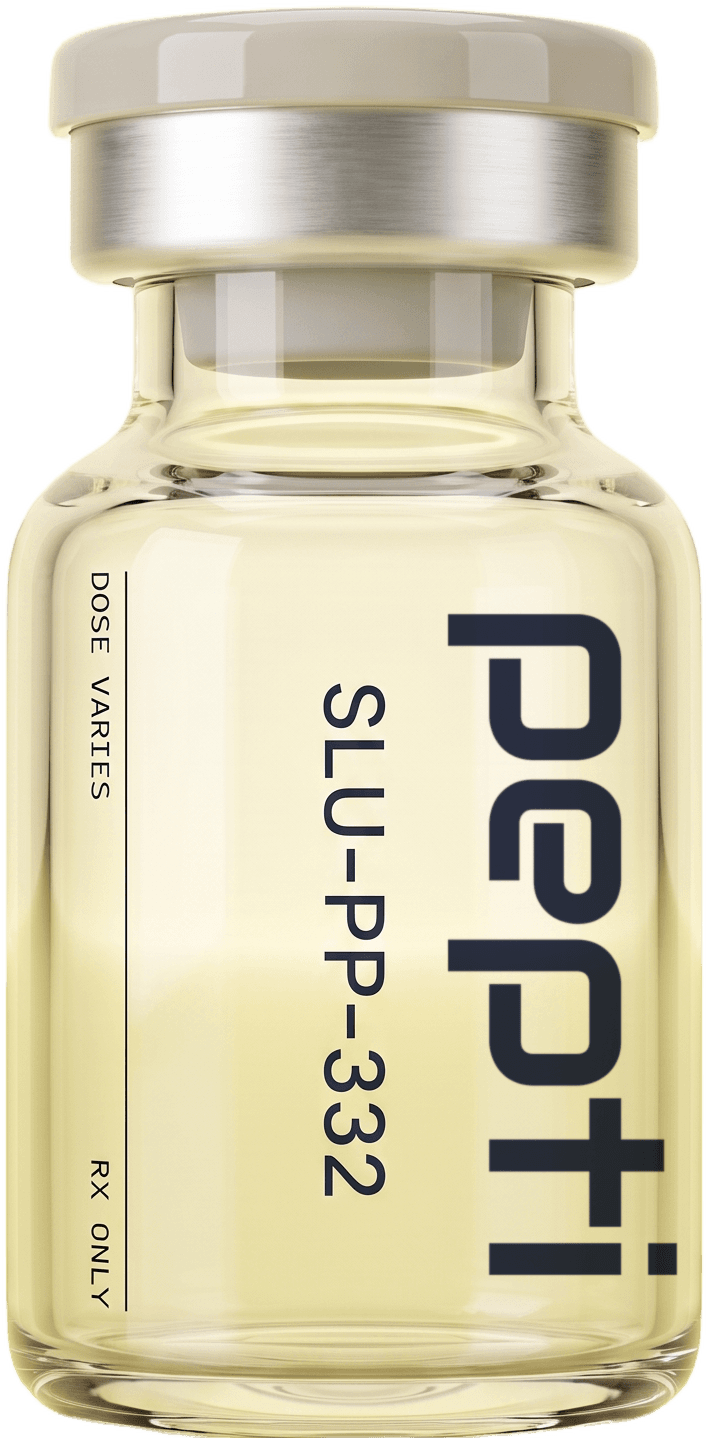
At Pepti, SLU-PP-332 is prescribed as 0.25 mL, which is 25 units on a U-100 insulin syringe, injected under the skin once daily Monday through Friday. The vial is 5 mL at 2 mg/mL, so each dose carries 0.5 mg of SLU-PP-332 and the vial holds 20 doses, about four weeks. Your physician sets your directions after reviewing your intake, and your exact dose and units are printed on the vial. SLU-PP-332 has never been given to people in a published trial, so no human dose has been established by research.
This page explains the SLU-PP-332 dosage Pepti prescribes, what the units on the syringe mean, a dosage chart that converts units to millilitres and milligrams, how long a vial lasts, why it is injected rather than taken by mouth, why the mouse studies cannot give you a dose, and the side effects to know about. It covers how Pepti's SLU-PP-332 is typically prescribed, not dosing protocols from the internet. Nothing here is a reason to change your own dose.
SLU-PP-332 Dosage
The short answer
| Product | Vial | Typical directions | SLU-PP-332 per dose | Doses per vial | Price |
|---|---|---|---|---|---|
| SLU-PP-332 | 5 mL, 2 mg/mL (10 mg per vial) | Inject 0.25 mL (25 units) subcutaneously once daily Monday through Friday | 0.5 mg | 20 | $229/mo |
Every price is all-in, covering medication, physician review, refill management and shipping, with no separate membership fee. Pepti is cash-pay and does not bill insurance. These are the typical printed directions; your own directions are the ones on your vial. SLU-PP-332 is supplied as a single vial only: it is not in a Pepti blend, and it does not come as a pen or a capsule.
SLU-PP-332 Dosage
SLU-PP-332 dosage in units, mL and mg
Pepti's directions are written in two forms, millilitres and units, because prescriptions are written in millilitres and insulin syringes are marked in units. On a U-100 insulin syringe, 1 unit is 0.01 mL, so 100 units is 1 mL and 25 units is 0.25 mL. A unit is a volume mark on the barrel, not a measure of how strong the medication is. Units only mean something alongside the concentration printed on the label.
The milligram figure comes from that concentration. Pepti's SLU-PP-332 is supplied at 2 mg/mL, so:
| What you read | Value | Where it comes from |
|---|---|---|
| Dose volume | 0.25 mL | Printed on the vial |
| On a U-100 insulin syringe | 25 units | 0.25 mL x 100 units per mL |
| Concentration | 2 mg/mL | Printed on the vial |
| SLU-PP-332 per dose | 0.5 mg (500 mcg) | 2 mg/mL x 0.25 mL |
| Total in the vial | 10 mg in 5 mL | Printed on the vial |
| Doses per vial | 20 | 5 mL divided by 0.25 mL |
That arithmetic is a way to read a label, not a way to set a dose. A vial labelled 10 mg is not a 10 mg dose: it is twenty 0.5 mg doses. If your label and your syringe seem to disagree, do not dose; message your care team. How long does a peptide vial last explains every number on a vial label in more detail.
SLU-PP-332 Dosage
SLU-PP-332 dosage chart: units to mL to mg
People search for an "SLU-PP-332 dosage chart" because doses online are quoted in milligrams, micrograms and units interchangeably, and the numbers only line up if you know the concentration. The chart below is the conversion for a 2 mg/mL vial, drawn with a U-100 insulin syringe. It is math only. It is not a menu of doses, and the only line that applies to you is the one that matches the number printed on your vial.
| Syringe mark (U-100) | Volume | SLU-PP-332 from a 2 mg/mL vial |
|---|---|---|
| 5 units | 0.05 mL | 0.1 mg (100 mcg) |
| 10 units | 0.1 mL | 0.2 mg (200 mcg) |
| 15 units | 0.15 mL | 0.3 mg (300 mcg) |
| 20 units | 0.2 mL | 0.4 mg (400 mcg) |
| 25 units (Pepti's typical directions) | 0.25 mL | 0.5 mg (500 mcg) |
| 30 units | 0.3 mL | 0.6 mg (600 mcg) |
| 40 units | 0.4 mL | 0.8 mg (800 mcg) |
| 50 units | 0.5 mL | 1 mg |
| 100 units | 1 mL | 2 mg |
The rule behind every row: units divided by 100 gives millilitres, and millilitres multiplied by 2 gives milligrams. That only holds at 2 mg/mL. A chart from another source, written for a different concentration or a capsule product, gives different figures for the same units, which is the main reason not to dose from a chart, including this one.
SLU-PP-332 Dosage
How long an SLU-PP-332 vial lasts
At Pepti's typical directions, one 10 mg vial lasts four weeks:
| Step | Value |
|---|---|
| Dose | 25 units, 0.25 mL, 0.5 mg |
| Doses per week | 5 (once daily, Monday through Friday) |
| Doses per vial | 20 (5 mL divided by 0.25 mL) |
| SLU-PP-332 used | 20 x 0.5 mg = 10 mg, the whole vial |
| Time per vial | 20 doses divided by 5 per week = 4 weeks |
Four weeks is why refills run every 28 days, one vial per fill. Vials are multi-dose solutions shipped ready to use, refrigerated with ice packs, with sterile syringes and alcohol prep pads. Nothing is mixed at home. Keep the vial in the fridge between doses, do not freeze it, and follow the beyond-use date printed on the label, which runs from first puncture. How to store peptides covers storage, and which peptides need refrigeration lists SLU-PP-332 among the refrigerated products.
If a vial runs short before the refill, message your care team rather than adjusting anything yourself. If you miss a dose, follow your directions and do not take two doses to make up for one.
SLU-PP-332 Dosage
When and how SLU-PP-332 is taken
Once daily, Monday through Friday
Pepti's SLU-PP-332 directions say once daily, Monday through Friday, with weekends off. The weekend gap is part of the directions, not an omission or a missed dose. It also makes the vial arithmetic clean: 20 doses at five a week is exactly four weeks. The printed directions do not name a time of day; if your physician wants a particular time, your label will say.
Under the skin
Subcutaneous means into the fat layer, not the muscle. Abdomen and thigh are the usual sites, rotated so the same spot is not used repeatedly. Technique is covered in how to inject peptides safely.
Directions say What it means in practice 0.25 mL (25 units) Draw to the 25 mark on a U-100 insulin syringe Subcutaneously Into the fat layer, abdomen or thigh, rotating sites Once daily, Monday through Friday Five doses a week, weekends off 20 doses per vial About four weeks, then the next refill Why it is injected, not swallowed
SLU-PP-332 is not a peptide. It is a small synthetic molecule that binds the estrogen-related receptors ERRα, ERRβ and ERRγ. The published pharmacology reports that it lacks oral bioavailability, which is why the research group that made it developed a separate, orally active compound, SLU-PP-915. The mouse studies gave it by intraperitoneal injection, which has no equivalent in routine care, so subcutaneous injection is the practical route. A capsule sold as SLU-PP-332 is not the same thing as the compounded injection, and any dose figure attached to it does not translate. Is 5-Amino-1MQ a peptide explains why small molecules like these sit in a peptide catalog.
SLU-PP-332 Dosage
Why the research cannot give you a dose
Most questions about SLU-PP-332 dosing assume someone has tested a human dose. Nobody has.
| What exists | What it tells you about dosing |
|---|---|
| Human trials | None of any phase. No human pharmacokinetic data |
| Human tissue | A 2025 pilot in Frontiers in Physiology treated muscle cells from inactive women in a dish. Cells, not a person, and not a dose |
| Mouse studies | The 2023 ACS Chemical Biology paper, the 2024 Journal of Pharmacology and Experimental Therapeutics paper, a 2024 heart-failure study in Circulation and an eight-week kidney study in old mice (American Journal of Pathology, 2023). Doses were set by body weight and given intraperitoneally |
| Anti-doping science | Two 2026 papers mapped how human liver enzymes break it down, so labs can detect it. Not a dosing study |
The mouse doses do not map directly onto a compounded vial, and the compounded directions are a physician's judgement, not a trial-derived figure. Exercise mimetics have a history of working in rodents and failing to translate, and whether that happens here is an open question. That is why your directions come from a physician who has reviewed your intake, not from a study table. The full evidence picture is in what is SLU-PP-332.
SLU-PP-332 Dosage
What changes the directions
Your physician sets your directions after reviewing your intake. Things that can lead to different directions, or a different product, include:
| What can change | How it shows up |
|---|---|
| Whether SLU-PP-332 is the right tool | If weight loss is the main goal, semaglutide or tirzepatide have large human trials; MOTS-c is the peptide option for related pathways |
| Your medical history | A cancer history or a heart condition changes the conversation, because the receptors involved are active in both |
| Your other medications | There is no established interaction list, so the intake asks for everything you take |
| Whether you are a tested athlete | SLU-PP-332 falls in a class WADA prohibits, and detection methods are published |
| How you respond | Reactions you report go to your physician, who may revise your directions |
When directions change, the new numbers are printed on the new label. Never carry a number over from a previous fill. Bloodwork is not required for any Pepti treatment. If your physician wants labs for your care, they'll ask through your account.
SLU-PP-332 Dosage
Side effects, in summary
There is no human safety data for SLU-PP-332. The mouse studies, including eight weeks of treatment in old animals, did not describe overt toxicity at the doses used.
| What is reported | How often | What to do |
|---|---|---|
| Injection-site redness, mild soreness, occasional bruising | Most common | Rotate sites |
| Early nausea or light-headedness | Occasional | Tell your physician if it persists. Do not change the dose yourself |
| A reaction that is severe, spreading, or involves difficulty breathing | Rare | Stop and contact your physician; call 911 for breathing difficulty or throat swelling |
Who should not take SLU-PP-332, or should discuss it first: anyone pregnant or breastfeeding, where it is not used; anyone with a personal history of cancer, because ERRα is a well-studied regulator of metabolism inside cancer cells; anyone with a cardiac history, because the compound acts on the heart's fuel metabolism and its effect in a healthy human heart has not been measured; and tested athletes. WADA prohibits exercise mimetics and metabolic modulators as a class, and the 2027 Prohibited List names SLU-PP-332 under S4.4.
As of September 2026, SLU-PP-332 does not appear in any category of the FDA's 503A bulk drug substances list and has not been considered by the Pharmacy Compounding Advisory Committee. The FDA has not evaluated it in either direction. Compounded medications are not FDA approved, and SLU-PP-332 is not an approved drug.
SLU-PP-332 Dosage
Where to get SLU-PP-332 prescribed
SLU-PP-332 cannot be bought legitimately without a prescription. Sites selling it "for research use only" are not accountable for what is in the vial: identity, purity, sterility and concentration are untested, so even the concentration your units chart depends on is unknown. The prescription route:
- Complete a free online intake covering your history, medications and what you want help with.
- A physician licensed in your state reviews it, usually within 24 hours.
- If it is appropriate, a PCAB-accredited, FDA-registered US 503A compounding pharmacy prepares it to that prescription. Lot test results are published at /quality/lab-results.
- It ships refrigerated with your directions printed on the vial.
- Your physician stays reachable for questions and dose changes.
Pepti prescribes SLU-PP-332 in every state except Oklahoma, plus DC Step by step: how to get SLU-PP-332 prescribed online. How it compares with the other metabolic options: MOTS-c vs SLU-PP-332 vs 5-Amino-1MQ, and the wider picture is in the best peptides for weight loss.
References
What this is based on.
References
- Billon C, Sitaula S, Banerjee S et al.. Synthetic ERRα/β/γ Agonist Induces an ERRα-Dependent Acute Aerobic Exercise Response and Enhances Exercise Capacity · ACS Chem Biol (2023) · PMID 36988910
- Billon C, Schoepke E, Avdagic A et al.. A Synthetic ERR Agonist Alleviates Metabolic Syndrome · J Pharmacol Exp Ther (2024) · PMID 37739806
- Xu W, Billon C, Li H et al.. Novel Pan-ERR Agonists Ameliorate Heart Failure Through Enhancing Cardiac Fatty Acid Metabolism and Mitochondrial Function · Circulation (2024) · PMID 37961903
- Wang XX, Myakala K, Libby AE et al.. Estrogen-Related Receptor Agonism Reverses Mitochondrial Dysfunction and Inflammation in the Aging Kidney · Am J Pathol (2023) · PMID 37717940
- Billon C, Appourchaux K, Côté I, Burris TP. An orally active estrogen receptor-related receptor agonist, SLU-PP-915, enhances aerobic exercise capacity · J Pharmacol Exp Ther (2026) · PMID 41421047
- Bonanni R, Falvino A, Matticari A et al.. Targeting ERRs to counteract age-related muscle atrophy associated with physical inactivity: a pilot study · Front Physiol (2025) · PMID 40692696
- Avliyakulov NK, Sobolevsky T, Ahrens E. Analysis and Identification of In Vitro Metabolites of Exercise Mimetic SLU-PP-332 ERRα/β/γ Agonist for Doping-Control Purposes · Drug Test Anal (2026) · PMID 41688415
- Okda HE, Zhao P, Hayes M et al.. Chemical optimization of the exercise mimetic SLU-PP-332 enables insight into estrogen-related receptor signaling · Int J Biol Macromol (2026) · PMID 41850449
- Möller T, Krug O, Thevis M. In Vitro Metabolism and Analytical Characterization of SLU-PP-332 and SLU-PP-915: Novel Pan-ERR Agonists With Doping Potential · Rapid Commun Mass Spectrom (2026) · PMID 41588687
Citations are provided for educational purposes. They do not constitute medical advice. Always discuss any peptide protocol with your prescribing physician.
Common questions
SLU-PP-332 Dosage, answered.
At Pepti, SLU-PP-332 is typically prescribed as 0.25 mL, which is 25 units on a U-100 insulin syringe, injected subcutaneously once daily Monday through Friday. From the 2 mg/mL vial that is 0.5 mg per dose. Your physician sets your directions after reviewing your intake, and your exact dose is printed on the vial.
The amount printed on your vial, on the schedule printed on your vial. Pepti's typical directions are 25 units once a day on weekdays, but your own directions are set by your physician after reviewing your intake. If you have questions about your dose, message your care team.
The number printed on your vial. Pepti's typical directions are 25 units, which is 0.25 mL on a U-100 insulin syringe, where 1 unit is 0.01 mL.
From a 2 mg/mL vial, 0.5 mg, or 500 mcg. 10 units is 0.2 mg and 50 units is 1 mg. Those figures only hold at 2 mg/mL.
The chart above converts units to millilitres to milligrams for a 2 mg/mL vial, the concentration Pepti supplies. It is a conversion, not a list of doses to choose from. Your own label is the one that applies.
Not from research. There are no published human trials of any phase and no human pharmacokinetic data. The mouse studies dosed by body weight and by intraperitoneal injection, which does not convert into a human figure.
Pepti's printed directions say once daily, Monday through Friday, without naming a time. If your physician wants a particular time, it will be on your label.
About four weeks. A 10 mg vial at 25 units (0.5 mg) once a day on weekdays is 20 injections, which uses the whole vial in four weeks, matching the 28-day refill.
At Pepti it is a subcutaneous injection. The published pharmacology reports that it lacks oral bioavailability, which is why the same research group developed a separate oral compound, SLU-PP-915.
No. Take the dose printed on your vial, on the schedule printed on your vial. No study has tested any dose in people, so there is no evidence that more does more. If you have questions about your dose, message your care team.
They act through entirely different mechanisms, and there is no published data, in animals or humans, on using them together. Your physician sets your directions after reviewing your full medication list.
No. Pepti vials are multi-dose solutions shipped ready to use, with sterile syringes and alcohol prep pads. Nothing is reconstituted at home.
Bloodwork is not required for any Pepti treatment. If your physician wants labs for your care, they'll ask through your account. The free assessment goes to a physician licensed in your state. A consultation does not guarantee a prescription.
Next step
See what a physician recommends for you.
A licensed physician in your state reviews your intake and decides what is appropriate. A consultation does not guarantee a prescription.