Weight Loss · Reference
SLU-PP-332: What It Is, Where to Get It Prescribed, and What It Costs
This page covers what SLU-PP-332 is, the receptor it acts on and the pathways researchers have described, what the published mouse work does and does not establish, where it currently stands with the FDA, how it is dosed, and how to get it prescribed.

Reviewed by Dr. Gene, MD · Board-certified Family Medicine
Every Pepti prescription is reviewed by a licensed U.S. physician before it's dispensed — and only provided if clinically appropriate.
Treatments mentioned
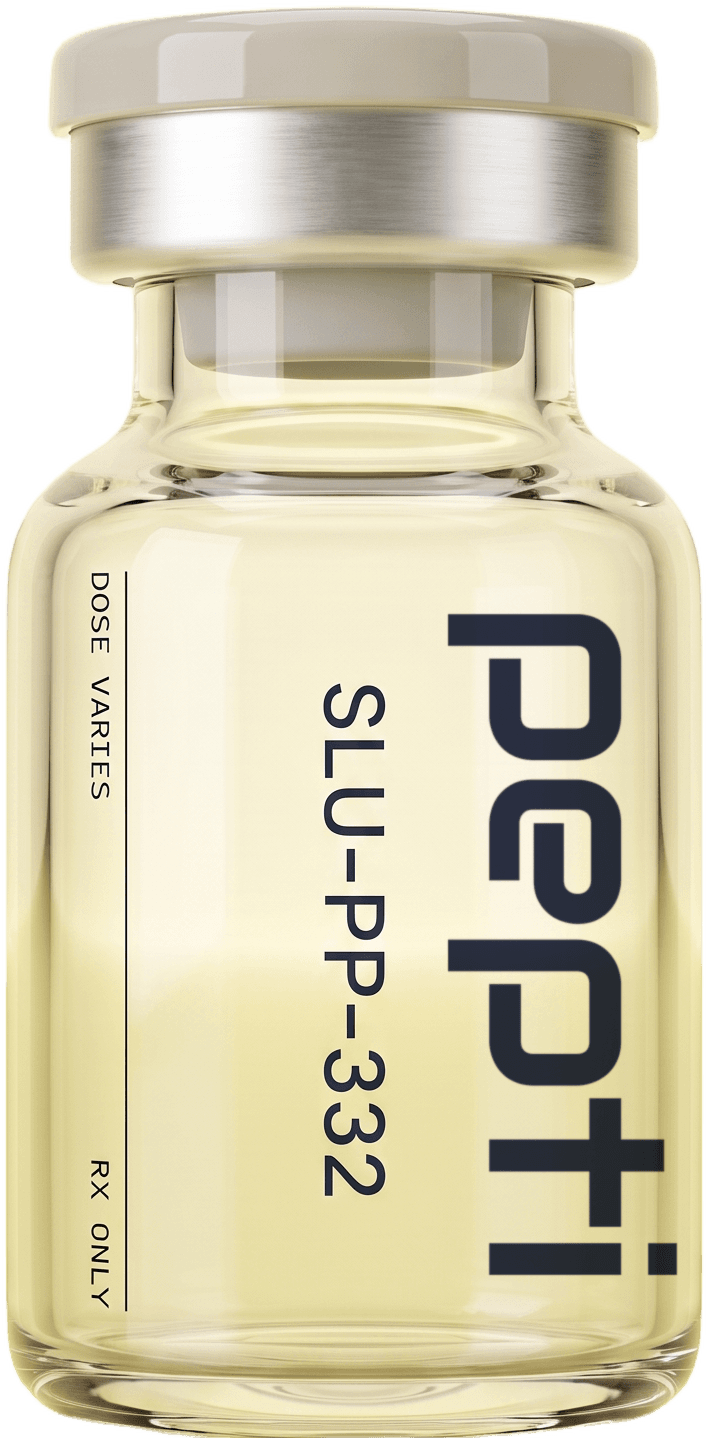
SLU-PP-332 is a prescription injection supplied as 5 mL multi-dose vial, SLU-PP-332 2 mg/mL (10 mg SLU-PP-332 per vial). The reviewed directions are: Inject 0.25 mL (25 units) subcutaneously once daily Monday through Friday. That is 20 doses per vial, about 4 weeks at Monday through Friday. It requires a prescription from a physician licensed in your state, is compounded by a state-licensed US pharmacy, and is not FDA approved.
This page covers what SLU-PP-332 is, the receptor it acts on and the pathways researchers have described, what the published mouse work does and does not establish, where it currently stands with the FDA, how it is dosed, and how to get it prescribed.
SLU-PP-332
What SLU-PP-332 actually is
A small synthetic molecule, not a peptide
SLU-PP-332 is not a peptide. It is a small synthetic organic molecule, built around a naphthalene ring and a phenol, designed to bind a family of receptors called the estrogen-related receptors, or ERRs. It is listed alongside peptides because it is prescribed, compounded and injected through the same channels, but chemically it has more in common with a conventional drug than with BPC-157 or semaglutide: it is metabolised in the liver the way small-molecule drugs are, and the published work on it comes from pharmacology and medicinal chemistry rather than peptide biology.
The receptors it targets, ERRα, ERRβ and ERRγ, are "orphan" nuclear receptors. Despite the name they do not bind estrogen and have no known natural hormone that switches them on. They sit on DNA and control the genes that build mitochondria, run oxidative phosphorylation and oxidise fatty acids. In muscle, heart and kidney they are among the main switches the body uses to adapt to aerobic exercise.
Where the name comes from
SLU stands for Saint Louis University. The compound came out of a collaboration between medicinal chemists there and the pharmacology group of Thomas Burris, published in ACS Chemical Biology in 2023. That paper reported the first synthetic agonist with meaningful activity at ERRα, which had been considered hard to drug, alongside activity at ERRβ and ERRγ. The authors called it an "exercise mimetic" because, in mice, it switched on the same gene program that a bout of endurance exercise does. The number is its place in the lab's compound series; a later, orally active sibling is SLU-PP-915. A 2026 paper in the International Journal of Biological Macromolecules mapped how each part of the structure contributes to potency and selectivity, and describes SLU-PP-332 as the reference compound other ERR agonists are now measured against.
What it is not
It is not a stimulant, a thyroid hormone or a thermogenic. It does not act on the brain to suppress appetite and it is not a GLP-1 medication. It is not a hormone, it does not bind an androgen or estrogen receptor, and it is not a substitute for exercise: the researchers who made it describe it as a candidate for people who cannot exercise adequately, not as a replacement for training in people who can.
It is also not a human-tested medication. Every efficacy finding on this page comes from mice or from cells in a dish.
SLU-PP-332
How SLU-PP-332 is described to work
Five linked mechanisms come up repeatedly in the published work. All of the detail below is from mouse and cell studies.
Turning on the ERR receptors that drive mitochondrial genes
ERRα and ERRγ, working with a coactivator protein called PGC-1α, control a large block of genes involved in mitochondrial biogenesis, the electron transport chain, the Krebs cycle and fatty acid oxidation. SLU-PP-332 binds all three ERR subtypes, with the highest potency at ERRα, and increases their transcriptional activity. In a mouse skeletal-muscle cell line, the 2023 ACS Chemical Biology paper reported increased mitochondrial function and cellular respiration after treatment: more mitochondrial machinery, more capacity to make energy aerobically.
The acute aerobic-exercise gene program
A single session of endurance exercise changes which genes muscle expresses in the hours afterwards. The 2023 paper reported that a dose of SLU-PP-332 in mice induced a strikingly similar set of genes, and that the response depended on ERRα: mice engineered to lack it did not show the gene program and did not gain the endurance benefit. A 2026 paper in the Journal of Pharmacology and Experimental Therapeutics reported that one marker of that program, a gene called Ddit4, rose to levels matching or exceeding a treadmill run, depending on the muscle sampled.
More oxidative muscle fibres
Muscle fibres come in fast, glycolytic types that fatigue quickly and slower, oxidative types that keep going; endurance training shifts the balance toward the oxidative end. The 2023 work reported that treated mice had a higher proportion of type IIa oxidative fibres, the structural change the group proposed as the basis for the longer running times.
Whole-body energy expenditure and fatty acid oxidation
The 2024 paper in the Journal of Pharmacology and Experimental Therapeutics moved from muscle to whole-body metabolism. In diet-induced obese mice and in ob/ob mice, treatment was reported to raise energy expenditure and fatty acid oxidation, with less fat mass accumulated over the study. The authors' framing is that the compound shifts fuel preference toward fat, in the same direction regular aerobic exercise does.
Heart and kidney: ERRγ-dependent protection in disease models
Two groups outside the original lab have used SLU-PP-332 to ask what ERR activation does in other organs. A 2024 paper in Circulation reported that in a mouse model of pressure-overload heart failure, ERR agonists improved ejection fraction, reduced fibrosis and improved survival, with the effect tracing mainly to ERRγ in heart muscle cells. A 2023 paper in the American Journal of Pathology reported that eight weeks of treatment in 21-month-old mice moved several age-related kidney measures, including albuminuria and inflammatory signalling, back toward those of younger animals. Both are mechanism studies in animals; neither has been taken into people.
SLU-PP-332
What the research actually shows
Exercise capacity and endurance
This is the founding result. Mice given SLU-PP-332 ran further and for longer on a treadmill than untreated mice, reported in the 2023 ACS Chemical Biology paper and reproduced in the 2026 JPET paper on its oral successor. The mechanism was tested with knockout animals, a higher standard than most compounds in this category meet. It remains a mouse result.
Obesity and metabolic syndrome
The 2024 JPET paper reported that in two mouse models of obesity, treatment increased energy expenditure and fatty acid oxidation and reduced fat mass gain, and that insulin sensitivity improved in the metabolic-syndrome model. These are the results behind the compound's "weight loss" categorisation. They were measured in animals with controlled diets, at doses that do not map directly onto a compounded vial.
Heart failure
The Circulation paper is the most rigorous single study of the compound: a pressure-overload model with functional, genetic and multi-omics readouts. It says nothing about the heart of a healthy person taking the compound for a metabolic reason, which has not been studied.
The aging kidney
The American Journal of Pathology paper is one of the few long-duration treatment studies, eight weeks in old animals, and reported no obvious harm alongside the kidney findings. It is a study of ERRs as a caloric-restriction mimetic, not of SLU-PP-332 as a product.
What human data exists
This is the honest part, and it is shorter than it is for most peptides on this site. There are no randomised controlled trials of SLU-PP-332 in humans. There are no published human trials of any kind, at any phase, and no human pharmacokinetic data. The nearest thing is a 2025 pilot study in Frontiers in Physiology, in which muscle cells taken from inactive women during hip surgery were treated with SLU-PP-332 in culture and showed changes in mitochondrial and stress-response proteins. That is human tissue in a dish, and the authors call for further work before drawing conclusions.
The other human-relevant literature is anti-doping science. Two 2026 papers, in Drug Testing and Analysis and Rapid Communications in Mass Spectrometry, mapped how human liver enzymes metabolise it so that testing labs can detect it. Those exist because the World Anti-Doping Agency prohibits exercise mimetics and metabolic modulators as a class, not because anyone has measured what the compound does in a person.
So the accurate framing is: a well-characterised mouse pharmacology tool, with no human evidence in either direction. Any source describing it as proven in people is describing something that has not been published.
What the evidence does not establish
- It does not establish that any effect seen in mice occurs in humans. Exercise mimetics have a history of working in rodents and failing to translate; that question is open here.
- It does not establish a human dose. The mouse doses were set by body weight and given intraperitoneally; the compounded directions are a physician's judgement, not a trial-derived figure.
- It does not establish a timeline. There are no human endpoints to anchor one.
- It does not establish safety in humans over any duration.
- It does not establish efficacy for any condition as an approved treatment. It is not approved for anything.
SLU-PP-332
Where SLU-PP-332 stands with the FDA right now
Most of what is written online about peptide regulation does not apply to this compound, because it has never been through the process the peptides went through.
As of September 2026, SLU-PP-332 does not appear in any category of the FDA's list of bulk drug substances nominated for compounding under section 503A. The current version of that list, updated 14 May 2026, has no entry for it in Category 1 (under evaluation), Category 2 (significant safety risks) or Category 3 (nominated without adequate support). It is likewise absent from the FDA's page of substances flagged for significant safety risks, where BPC-157, ipamorelin and others were listed in 2023.
It was not on the agenda when the Pharmacy Compounding Advisory Committee met on 23 and 24 July 2026 to consider BPC-157, KPV, TB-500, MOTS-c, DSIP, Semax and Epitalon, and it is not among the substances announced for the committee's next meeting (LL-37, GHK-Cu, Dihexa, Melanotan II and PEG-MGF). It is not on the 503B nominations list either.
In plain terms: the FDA has not evaluated SLU-PP-332 at all. It has not been flagged as a safety concern, and it has not been reviewed for any positive list. That is a different situation from BPC-157, which was flagged, then un-flagged, then voted on; this is closer to a blank page. It is not an FDA-approved drug product, and compounded medications never are; it is prepared by a state-licensed pharmacy for an individual prescription. If the FDA acts on it in either direction, this page will change.
SLU-PP-332
Realistic expectations
There is less to go on here than for most compounds on this site, because no human endpoints exist. These are patterns described by prescribers, not trial endpoints, and a physician decides whether treatment is appropriate at all.
The first one to two weeks
The mouse gene-expression changes are rapid, within hours of a dose, but that says nothing about what a person notices. Prescribers most often describe steadier energy through the day as the earliest report, if anything is reported at all. Injection-site redness in this window is normal. Noticing nothing is also normal.
Weeks three to eight
This is the window prescribers point to for any change in stamina or body composition, on the reasoning that the animal fibre-type and fat-mass changes took weeks rather than days. Whether those changes occur in humans at the compounded dose is exactly the thing nobody has measured. Anyone who tells you what to expect by week six is guessing.
It does not replace training
The compound was designed around the exercise response. The 2026 JPET paper reported that its oral successor's effect on mitochondrial gene expression was larger combined with exercise training than with either alone. Whatever it does, the honest expectation is that it does more in someone who is also training.
Ongoing use
Refills run on a 28-day cycle and a physician reviews each one. There is no described withdrawal, because nothing about stopping it has been studied in people. The longest animal treatment on file is eight weeks. Whether continuous use over months is appropriate is your physician's judgement, and one the research cannot make for them.
SLU-PP-332
When something else makes more sense
Some honest cases where SLU-PP-332 is not the first thing to reach for:
- Weight loss is the main goal. Semaglutide and tirzepatide have large randomised human trials, published weight-loss figures and known safety profiles. SLU-PP-332 has none of those. For most people whose primary aim is losing weight, a GLP-1 medication is the evidence-based conversation to have first.
- You want a peptide rather than a synthetic small molecule. MOTS-c is a mitochondrial-derived peptide studied for related pathways, and 5-Amino-1MQ works on a different fat-cell enzyme; both are also animal-evidence products.
- Endurance is the goal and you are already training hard. A physician may reasonably say that progressive aerobic training, with decades of human evidence, is the intervention with the best return.
- A broader body-composition protocol fits better. The SHRED blend and the PHYSIQ blend combine several agents aimed at fat and growth-hormone pathways, and L-carnitine, which does have human data, is the conventional choice for fatty-acid transport.
- You are a tested athlete. SLU-PP-332 sits squarely in the class WADA prohibits, and detection methods have been published.
Your physician will tell you if SLU-PP-332 is not the right tool for what you have described. A consultation does not guarantee a prescription, and being declined is refunded.
SLU-PP-332
Dosing, and how a vial is actually used
Why the dose is measured in units
The directions are written in millilitres and insulin-syringe units because that is what you can read off the barrel. 0.25 mL is 25 units on a U-100 syringe. You are not calculating anything; the number is printed on your medication.
Subcutaneous, and why it is injected at all
Subcutaneous means into the fat layer, not the muscle. Abdomen and thigh are the usual sites, rotated so the same spot is not used repeatedly. It is injected rather than swallowed because the published pharmacology reports that SLU-PP-332 lacks oral bioavailability; the Burris group's 2026 paper describes developing SLU-PP-915 for exactly that reason. The mouse studies gave it by intraperitoneal injection, which has no equivalent in routine care, so subcutaneous is the practical route.
Why a vial covers about four weeks
20 doses at once daily Monday through Friday is four weeks, which is why refills run on a 28-day cycle. The weekend gap is part of the directions, not an omission. One vial per fill, always; not a stockpile.
Storage
Refrigerated, and it ships that way in insulated packaging with ice packs. Beyond-use dating runs from first puncture and is on the label. Do not freeze it.
SLU-PP-332
Safety and side effects
There is no human safety data for SLU-PP-332. That sentence is the whole of the formal safety picture, and it is worth reading twice before starting.
What the animal work reports is reassuring as far as it goes: the mouse studies, including eight weeks of treatment in old animals, did not describe overt toxicity at the doses used. Prescribers report mostly injection-site effects, redness, mild soreness, occasional bruising, and occasionally early nausea or light-headedness, the same pattern as any subcutaneous injection.
Two points are specific to this compound. First, ERRα is also a well-studied regulator of metabolism inside cancer cells, and the effect of activating it in someone with an existing tumour has not been examined; a personal history of cancer belongs on the intake. Second, the compound acts on the heart's fuel metabolism; anyone with a cardiac history should say so, because the effect in a healthy human heart has not been measured.
There is no established interaction list, because the trials that would produce one have not been run. That is precisely why the intake asks for every medication you take and why a physician reviews it rather than a form.
Stop and contact your physician for any reaction that is severe, spreading, or involves difficulty breathing.
SLU-PP-332
How SLU-PP-332 compares
SLU-PP-332 vs semaglutide and tirzepatide
Different mechanisms and, more importantly, different evidence. Semaglutide and tirzepatide act on gut-hormone receptors to reduce appetite and are approved drugs in their branded forms, with large human trials. SLU-PP-332 acts inside muscle and other cells on how fuel is used, has no appetite mechanism, and has no human trials. They are not interchangeable.
SLU-PP-332 vs MOTS-c
Both are described around mitochondrial metabolism and both are animal-evidence products. MOTS-c is a peptide encoded in mitochondrial DNA, described as acting through AMPK signalling; SLU-PP-332 is a synthetic molecule acting through the ERR nuclear receptors upstream of mitochondrial gene expression. The MOTS-c literature is older and broader; the SLU-PP-332 literature is newer and more mechanistically precise. Neither has human trial data.
SLU-PP-332 vs 5-Amino-1MQ
5-Amino-1MQ inhibits an enzyme called NNMT in fat cells and is described around cellular NAD+ and fat-cell metabolism. SLU-PP-332 is aimed at muscle first and fat second. Both rest on mouse work.
SLU-PP-332
Availability and formats
| Question | Answer |
|---|---|
| Can I get it by telehealth? | Yes, where a physician licensed in your state prescribes it |
| Which states? | All 50 states and DC |
| Does it come as a pen? | No, this one is a vial and syringe only |
| Does it come as a capsule? | No |
| Does it come as a nasal spray? | No |
| Is bloodwork required first? | Not routinely; your physician decides |
SLU-PP-332
Where to get SLU-PP-332 prescribed
SLU-PP-332 cannot be bought legitimately without a prescription. Sites shipping it with no prescription are selling a research-use-only product, where no pharmacy is accountable for identity, purity, sterility or concentration.
The prescription route works like this:
- Complete a medical intake covering your history, medications, allergies and what you are treating.
- A physician licensed in your state reviews it.
- If appropriate, a state-licensed, FDA-registered pharmacy compounds it to that prescription.
- It ships refrigerated with your directions printed on the vial.
- Your physician stays reachable afterwards for dose questions and side effects.
Current all-in pricing for SLU-PP-332 is published: medication, physician review, refill management and shipping in one figure, with no separate membership fee. What to check on any provider is in how to tell if a peptide seller is legitimate.
SLU-PP-332
Who should not take it, or should discuss it first
| Situation | Why |
|---|---|
| Pregnancy or breastfeeding | Not used; safety data is absent |
| Tested athletes | Many peptides are prohibited in competition; check the current list |
Full specification
Everything on the label.
Product
SLU-PP-332 (Injectable)
How supplied
5 mL multi-dose vial, SLU-PP-332 2 mg/mL (10 mg SLU-PP-332 per vial)
Typical directions
Inject 0.25 mL (25 units) subcutaneously once daily Monday through Friday.
Dose volume
0.25 mL (25 units on a U-100 insulin syringe)
Doses per vial
20
Coverage per vial
about 4 weeks at Monday through Friday
Formats
Vial and syringe
Available in
All 50 states and DC
Bloodwork
Not routinely required; your physician decides
Legal status
Prescription-only, compounded, not FDA approved
Category
Weight Loss
References
What this is based on.
References
- Billon C, Sitaula S, Banerjee S et al.. Synthetic ERRα/β/γ Agonist Induces an ERRα-Dependent Acute Aerobic Exercise Response and Enhances Exercise Capacity · ACS Chem Biol (2023) · PMID 36988910
- Billon C, Schoepke E, Avdagic A et al.. A Synthetic ERR Agonist Alleviates Metabolic Syndrome · J Pharmacol Exp Ther (2024) · PMID 37739806
- Xu W, Billon C, Li H et al.. Novel Pan-ERR Agonists Ameliorate Heart Failure Through Enhancing Cardiac Fatty Acid Metabolism and Mitochondrial Function · Circulation (2024) · PMID 37961903
- Wang XX, Myakala K, Libby AE et al.. Estrogen-Related Receptor Agonism Reverses Mitochondrial Dysfunction and Inflammation in the Aging Kidney · Am J Pathol (2023) · PMID 37717940
- Billon C, Appourchaux K, Côté I, Burris TP. An orally active estrogen receptor-related receptor agonist, SLU-PP-915, enhances aerobic exercise capacity · J Pharmacol Exp Ther (2026) · PMID 41421047
- Bonanni R, Falvino A, Matticari A et al.. Targeting ERRs to counteract age-related muscle atrophy associated with physical inactivity: a pilot study · Front Physiol (2025) · PMID 40692696
- Avliyakulov NK, Sobolevsky T, Ahrens E. Analysis and Identification of In Vitro Metabolites of Exercise Mimetic SLU-PP-332 ERRα/β/γ Agonist for Doping-Control Purposes · Drug Test Anal (2026) · PMID 41688415
- Okda HE, Zhao P, Hayes M et al.. Chemical optimization of the exercise mimetic SLU-PP-332 enables insight into estrogen-related receptor signaling · Int J Biol Macromol (2026) · PMID 41850449
- Möller T, Krug O, Thevis M. In Vitro Metabolism and Analytical Characterization of SLU-PP-332 and SLU-PP-915: Novel Pan-ERR Agonists With Doping Potential · Rapid Commun Mass Spectrom (2026) · PMID 41588687
Citations are provided for educational purposes. They do not constitute medical advice. Always discuss any peptide protocol with your prescribing physician.
Common questions
SLU-PP-332, answered.
Through a telehealth provider where a physician licensed in your state reviews a medical intake and a licensed US pharmacy compounds the prescription. Pepti prescribes SLU-PP-332 in all 50 states and DC; start with the free assessment.
5 mL multi-dose vial, SLU-PP-332 2 mg/mL (10 mg SLU-PP-332 per vial)
Inject 0.25 mL (25 units) subcutaneously once daily Monday through Friday. Your physician sets your own dose and it is printed on your medication.
20 at the standard volume, about 4 weeks at Monday through Friday.
SLU-PP-332 is supplied as a vial, drawn with an insulin syringe. It is not available as a pen or capsule.
Not routinely, though your physician may want labs depending on your history. at-home blood testing covers hormone, metabolic and thyroid markers without a lab visit.
It is legal to prescribe and dispense in the United States with a valid prescription. It is not FDA approved: compounded medications are prepared by licensed pharmacies pursuant to a prescription rather than approved as manufactured products. See are peptides FDA approved.
Pricing is published on the SLU-PP-332 page as one all-in figure covering medication, physician review, refill management and shipping. What drives peptide pricing generally is in how much do peptides cost.
No. It is a small synthetic molecule that binds the estrogen-related receptors ERRα, ERRβ and ERRγ. It is grouped with peptides because it is prescribed, compounded and injected through the same channels, but chemically it is a conventional drug-like compound, not a chain of amino acids.
No. There are no randomised controlled trials in humans and no published human trials of any phase. The efficacy findings are from mice and from cells, including one 2025 pilot study on human muscle cells in culture.
It means the compound switches on, in muscle, the gene program that a session of endurance exercise switches on. In mice that was reported to include more oxidative muscle fibres, more mitochondrial activity and longer treadmill running. It does not mean the compound produces the full benefits of exercise.
No. As of September 2026 it does not appear in any category of the FDA's 503A nominated-substances list, has never been flagged on the FDA's significant-safety-risks page, and has not been considered by the Pharmacy Compounding Advisory Committee. The FDA has not evaluated it in either direction. It remains a compounded, prescription-only medication that is not FDA approved.
On an anti-doping panel, it can. WADA prohibits exercise mimetics and metabolic modulators as a class, and laboratories published detection methods for SLU-PP-332 and its metabolites in 2026. A standard workplace drug screen does not look for it. Tested athletes should not use it.
The published pharmacology reports that it lacks oral bioavailability, which is why the same research group developed a separate, orally active compound, SLU-PP-915. Pepti supplies it as a subcutaneous injection because that is the route the prescribing and the pharmacy's preparation are built around.
They act through entirely different mechanisms and there is no published data, in animals or humans, on using them together. Whether any combination is appropriate for you is your physician's decision.
In humans, unknown, because it has not been studied in people. The animal work did not describe overt toxicity at the doses used. Prescribers report mostly injection-site reactions, redness, mild soreness, occasional bruising, and sometimes early nausea or light-headedness. Anyone with a history of cancer or heart disease should raise it on the intake, because the receptors involved are active in both.
Next step
See what a physician recommends for you.
A licensed physician in your state reviews your intake and decides what is appropriate. A consultation does not guarantee a prescription.