Weight Loss · Reference
Is 5-Amino-1MQ a Peptide? What It Actually Is, What It Targets, and How It Is Supplied
This page explains what makes something a peptide and why 5-Amino-1MQ is not one, what it is described to do, how it compares with MOTS-c and SLU-PP-332, how Pepti supplies it, what the evidence honestly shows, and how it fits alongside tirzepatide.
Medically reviewed by Dr. Gene, MD · November 4, 2026
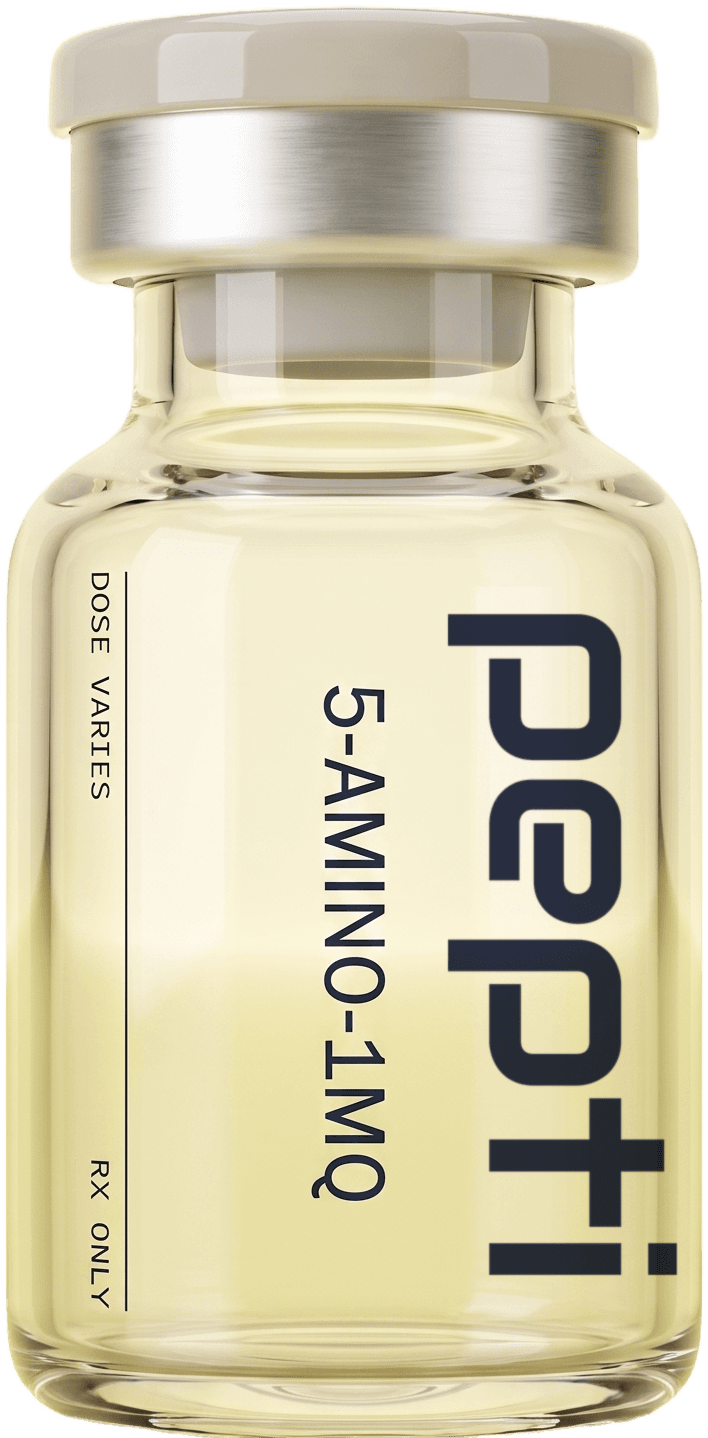
Treatments mentioned
No. 5-Amino-1MQ is not a peptide. It is a small synthetic molecule, 5-amino-1-methylquinolinium, built on a quinolinium ring with no chain of amino acids in it. In laboratory work it blocks one enzyme, nicotinamide N-methyltransferase (NNMT), which is active in fat tissue. It sits alongside peptides in a catalog because it is prescribed, compounded and injected through the same channels, not because of its chemistry, and it has no human trials.
This page explains what makes something a peptide and why 5-Amino-1MQ is not one, what it is described to do, how it compares with MOTS-c and SLU-PP-332, how Pepti supplies it, what the evidence honestly shows, and how it fits alongside tirzepatide.
Is 5-Amino-1MQ a Peptide? What It Actually Is, What It Targets, and How It Is Supplied
The short answer
| Question | Answer |
|---|---|
| Is 5-Amino-1MQ a peptide? | No. A small synthetic molecule with no amino acids |
| Full name | 5-amino-1-methylquinolinium |
| What it targets | The enzyme NNMT, in laboratory work |
| Where it came from | A medicinal chemistry program at the University of Texas Medical Branch in Galveston |
| Human trials | None of any design |
| Appetite effect | None described; mouse food intake was unchanged |
| How Pepti supplies it | 5-Amino-1MQ, 5 mg in a 5 mL vial (1 mg/mL), $219/mo |
| Also found in | The FUSION Blend, $279/mo |
| FDA status | Not FDA approved; never evaluated by the FDA for compounding |
Every price is all-in, covering medication, physician review, refill management and shipping, with no separate membership fee.
Is 5-Amino-1MQ a Peptide? What It Actually Is, What It Targets, and How It Is Supplied
What makes something a peptide
A peptide is a short chain of amino acids joined end to end. GHK-Cu is three amino acids with a copper ion attached. MOTS-c is sixteen. Semaglutide and tirzepatide are longer peptide chains. What they have in common is the backbone: amino acids linked by peptide bonds.
5-Amino-1MQ has no such backbone. Its core is a quinolinium ring, a two-ring aromatic structure with a positively charged nitrogen, carrying a methyl group on that nitrogen and an amino group at the fifth position. That is where the name comes from: 5-amino, 1-methyl, quinolinium. It is a fraction of the size of the peptides it is listed beside.
| A peptide, such as MOTS-c | 5-Amino-1MQ | |
|---|---|---|
| Built from | A chain of amino acids | A quinolinium ring |
| Size | 16 amino acids for MOTS-c | A small molecule, a fraction of the size |
| Origin | MOTS-c is encoded in the body's own mitochondrial DNA | Designed in a medicinal chemistry program |
| How it acts | Signalling, described around AMPK | Blocks one enzyme, NNMT |
Why it sits in a peptide catalog
Because of how it is used, not what it is. 5-Amino-1MQ is prescribed for the same kinds of goals as the metabolic peptides, compounded by the same licensed pharmacies, supplied the same way as a multi-dose vial, and injected under the skin with an insulin syringe. From a patient's side, starting it looks exactly like starting a peptide. SLU-PP-332 is in the same position: a small molecule that lives in a peptide catalog for the same reasons.
The distinction is still worth knowing. "Peptide" is often used loosely to mean anything in this category, and a source that calls 5-Amino-1MQ a peptide is a source that has not looked closely at it.
What it is not
It is not a hormone, does not act on a hormone receptor, and is not a growth hormone secretagogue. It is not a GLP-1 medication and does not act on the appetite and incretin pathways that semaglutide and tirzepatide act on. It is not a stimulant or a thermogenic. And it is not NAD+ and does not contain NAD+; the cell work describes it changing how cells handle a precursor of NAD+, which is a different thing.
Is 5-Amino-1MQ a Peptide? What It Actually Is, What It Targets, and How It Is Supplied
What 5-Amino-1MQ is described to do
All of the mechanistic detail below comes from cell culture and mouse studies. None of it has been demonstrated in a person.
The enzyme it blocks
NNMT takes nicotinamide, the form of vitamin B3 that cells recycle into NAD+, and attaches a methyl group to it using S-adenosylmethionine (SAM), the cell's main methyl donor. The product, 1-methylnicotinamide, is not used to make NAD+; it is excreted. So each time the enzyme runs it uses up one NAD+ precursor and one molecule of SAM. Blocking it is proposed to keep both in the cell.
Why anyone went looking
A 2014 paper in Nature from Barbara Kahn's laboratory reported NNMT expression rising in the white fat and liver of obese and diabetic mice, and reported that knocking the enzyme down protected mice against diet-induced obesity. The Galveston group, led by Stanley Watowich, set out to do pharmacologically what that study did genetically. A 2017 Journal of Medicinal Chemistry paper identified quinoliniums as the promising series, and a 2018 Biochemical Pharmacology paper reported that methylquinoliniums carrying a primary amine crossed cell membranes well and were selective for NNMT.
What the cell and mouse work reported
Study What it reported Model Biochemical Pharmacology, 2018 Higher intracellular NAD+ and SAM, less fat-building inside cultured fat cells Cultured adipocytes Biochemical Pharmacology, 2018 Lower body weight and white fat mass, food intake unchanged Diet-induced obese mice Diabetes, Obesity and Metabolism, 2024 Once daily for 28 days: limited fat gain, improved glucose tolerance and insulin sensitivity, less fatty liver Diet-induced obese mice Scientific Reports, 2022 Combined with a diet change, adiposity normalised faster than with the diet change alone Diet-induced obese mice Scientific Reports, 2024 Greater grip strength in aged mice, additive with exercise Mice aged 22 to 24 months The 2018 cell result is the origin of the "raises NAD+" description attached to 5-Amino-1MQ. It is a cell-culture measurement, and it has not been reproduced in human tissue.
Is 5-Amino-1MQ a Peptide? What It Actually Is, What It Targets, and How It Is Supplied
How it compares with MOTS-c and SLU-PP-332
These are the three metabolic options people most often compare, and only one of them is a peptide. MOTS-c is a 16-amino-acid peptide described as activating AMPK in muscle. SLU-PP-332 is a small synthetic molecule that switches on the estrogen-related receptors behind the exercise gene program. 5-Amino-1MQ is a small molecule aimed at fat cells through NNMT.
| MOTS-c | SLU-PP-332 | 5-Amino-1MQ | |
|---|---|---|---|
| A peptide? | Yes | No | No |
| Target | AMPK, via the folate cycle | ERRα, ERRβ, ERRγ | The enzyme NNMT |
| Main tissue in the research | Skeletal muscle | Skeletal muscle first | Fat tissue, also liver and aged muscle |
| Human data | Observational only | None | None; target enzyme measured in human fat |
| FDA review | Advisory committee vote July 2026 | Never evaluated | Never evaluated |
| Vial at Pepti | 10 mg in 5 mL | 10 mg in 5 mL | 5 mg in 5 mL |
| Price at Pepti | $259/mo | $229/mo | $219/mo |
No study has compared any two of them, in mice or people. The useful difference is where each acts, not which is "strongest." The full side-by-side, including dosing, side effects and who suits which, is in MOTS-c vs SLU-PP-332 vs 5-Amino-1MQ.
Is 5-Amino-1MQ a Peptide? What It Actually Is, What It Targets, and How It Is Supplied
How Pepti supplies it
5-Amino-1MQ is supplied as a 5 mL multi-dose vial at 1 mg/mL, 5 mg per vial, shipped ready to use with directions printed on the vial and with sterile syringes and alcohol prep pads.
| How supplied | 5 mL multi-dose vial, 5-Amino-1MQ 1 mg/mL (5 mg per vial) |
| Standard directions | Inject 0.25 mL (25 units) subcutaneously once daily Monday through Friday |
| Per dose at that volume | 0.25 mg |
| Doses per vial | 20, about 4 weeks |
| Format | Vial and syringe; not a pen, capsule or nasal spray |
| Shipping | Refrigerated, with ice packs |
| Refills | Every 28 days, one vial per fill |
| Price | $219/mo, all-in |
| Available in | All 50 states and DC |
Your physician sets your directions after reviewing your intake, and the ones printed on your vial are the ones that apply. Twenty doses at five a week is four weeks, which is why refills run every 28 days. More on reading a label is in how long does a peptide vial last.
5-Amino-1MQ also appears in the FUSION Blend, $279/mo: a 5 mL vial with 10 mg BPC-157, 10 mg MOTS-c, 10 mg 5-Amino-1MQ and 15 mg tesamorelin. A blend means one injection instead of several, at the cost of not knowing which component did what.
Is 5-Amino-1MQ a Peptide? What It Actually Is, What It Targets, and How It Is Supplied
Taking 5-Amino-1MQ with tirzepatide
This is one of the most common questions about it, and the answer is short. 5-Amino-1MQ and tirzepatide act through entirely different mechanisms: tirzepatide on incretin receptors and appetite, 5-Amino-1MQ on an enzyme inside fat cells, with no appetite effect described. Some physicians prescribe them together. There is no human study of the combination, so there is no data on whether it adds anything.
| Tirzepatide | 5-Amino-1MQ | |
|---|---|---|
| What it is | A peptide | A small molecule |
| Mechanism | Incretin receptors; reduces appetite | Blocks NNMT in fat cells |
| Human evidence | Large randomised human trials | None |
| Schedule at Pepti | Once weekly | Monday through Friday |
| Price at Pepti | From $159/mo | $219/mo |
The FUSION Blend is positioned for use with or without a GLP-1 medication. If you are on tirzepatide or semaglutide and want to add 5-Amino-1MQ, it goes through your physician with your full medication list in front of them, rather than as a second order. NNMT also methylates some foreign compounds, which is a theoretical reason to list every medication and supplement you take. The wider picture is in what peptides can you take with tirzepatide.
The one pairing that is never appropriate is tirzepatide with semaglutide or any other GLP-1 medication. 5-Amino-1MQ is not a GLP-1 medication, so that rule does not apply to it.
Is 5-Amino-1MQ a Peptide? What It Actually Is, What It Targets, and How It Is Supplied
What the evidence shows, honestly
There are no randomised controlled trials of 5-Amino-1MQ in humans, and no published human trials of any design. As of September 2026 there are no trials registered under its name. The efficacy research is in mice and cultured cells, essentially from one research group. The only human data concerns the target, not the drug: a 2015 Diabetologia study of fat tissue from 199 people undergoing abdominal surgery reported NNMT expression roughly twofold higher in type 2 diabetes. That is a reason the enzyme is interesting. It does not show what blocking it does in a person.
Physicians have prescribed compounded 5-Amino-1MQ for several years, and that experience is real, but it is uncontrolled. The honest framing is "described in mouse and cell research and used clinically," not "shown to work in people." Both main mouse studies paired it with a lifestyle change and reported the combination doing more than either alone, which is the frame prescribers describe too: an adjunct to diet and activity, not a replacement.
Where it stands with the FDA
5-Amino-1MQ is not an FDA-approved drug and is not a component of one. It is not on the 503A bulks list, and it does not appear in Category 1, 2 or 3 of the FDA's nominated-substances list as updated 14 May 2026. The FDA has never published a safety-risk finding about it, and it was not among the substances the Pharmacy Compounding Advisory Committee reviewed in July 2026. It has simply not been through the FDA's evaluation process. It remains a compounded, prescription-only medication, and compounded medications are not FDA approved. See are peptides FDA approved.
Side effects
The mouse studies reported no observable adverse effects at the doses used, but they were not toxicology studies, and there is no human safety database. Clinically, what gets reported is mostly at the injection site: redness, mild soreness, occasional bruising. It is not used in pregnancy or breastfeeding. Tested athletes should check the current prohibited list for their sport. Stop and contact your physician for any reaction that is severe, spreading, or involves difficulty breathing.
Is 5-Amino-1MQ a Peptide? What It Actually Is, What It Targets, and How It Is Supplied
Where to get 5-Amino-1MQ prescribed
5-Amino-1MQ cannot be bought legitimately without a prescription. Sites selling it "for research use only" are not accountable for what is in the vial: identity, purity, sterility and concentration are untested. The prescription route:
- Complete a free online intake covering your history, medications and what you want help with.
- A physician licensed in your state reviews it, usually within 24 hours.
- If it is appropriate, a state-licensed, FDA-registered US pharmacy compounds it to that prescription. Lot test results are published at /quality/lab-results.
- It ships refrigerated with your directions printed on the vial.
- Your physician stays reachable for questions and dose changes.
Pepti prescribes it in all 50 states and DC. Step-by-step page: how to get 5-Amino-1MQ prescribed online. The full reference is what is 5-Amino-1MQ.
References
What this is based on.
References
- Neelakantan H, Vance V, Wetzel MD et al.. Selective and membrane-permeable small molecule inhibitors of nicotinamide N-methyltransferase reverse high fat diet-induced obesity in mice · Biochem Pharmacol (2018) · PMID 29155147
- Neelakantan H, Wang HY, Vance V et al.. Structure-Activity Relationship for Small Molecule Inhibitors of Nicotinamide N-Methyltransferase · J Med Chem (2017) · PMID 28548833
- Neelakantan H, Brightwell CR, Graber TG et al.. Small molecule nicotinamide N-methyltransferase inhibitor activates senescent muscle stem cells and improves regenerative capacity of aged skeletal muscle · Biochem Pharmacol (2019) · PMID 30753815
- Babula JJ, Bui D, Stevenson HL, Watowich SJ, Neelakantan H. Nicotinamide N-methyltransferase inhibition mitigates obesity-related metabolic dysfunction · Diabetes Obes Metab (2024) · PMID 39161060
- Dimet-Wiley AL, Latham CM, Brightwell CR et al.. Nicotinamide N-methyltransferase inhibition mimics and boosts exercise-mediated improvements in muscle function in aged mice · Sci Rep (2024) · PMID 38969654
- Dimet-Wiley A, Wu Q, Wiley JT et al.. Reduced calorie diet combined with NNMT inhibition establishes a distinct microbiome in DIO mice · Sci Rep (2022) · PMID 35013352
- Kraus D, Yang Q, Kong D et al.. Nicotinamide N-methyltransferase knockdown protects against diet-induced obesity · Nature (2014) · PMID 24717514
- Kannt A, Pfenninger A, Teichert L et al.. Association of nicotinamide-N-methyltransferase mRNA expression in human adipose tissue and the plasma concentration of its product, 1-methylnicotinamide, with insulin resistance · Diabetologia (2015) · PMID 25596852
Citations are provided for educational purposes. They do not constitute medical advice. Always discuss any peptide protocol with your prescribing physician.
Common questions
Is 5-Amino-1MQ a Peptide? What It Actually Is, What It Targets, and How It Is Supplied, answered.
No. It is a small synthetic molecule, 5-amino-1-methylquinolinium, built on a quinolinium ring with no amino acids in it. It is grouped with peptides because of how it is prescribed and injected.
A small molecule developed at the University of Texas Medical Branch in Galveston that blocks the enzyme NNMT in laboratory work. Its research is in cultured cells and mice; there are no human trials.
In cell and mouse work, blocking NNMT was reported to raise NAD+ and SAM inside cultured fat cells and to reduce weight and fat mass gain in obese mice with food intake unchanged. None of that has been tested in people.
No. It does not contain NAD+. It is described as blocking an enzyme that diverts an NAD+ precursor away from recycling. If NAD+ itself is the interest, NAD+ injection supplies the molecule directly.
No. SLU-PP-332 is also a small synthetic molecule, built around a naphthalene ring. Of MOTS-c, SLU-PP-332 and 5-Amino-1MQ, only MOTS-c is a peptide.
Not as described in the research. It is not a GLP-1 medication, and the 2018 mouse study reported total food intake unchanged.
They act through entirely different mechanisms, and some physicians prescribe them together. There is no human study of the combination. Your physician sets your directions after reviewing your full medication list.
At Pepti it is an injection: a 5 mL multi-dose vial drawn with an insulin syringe, injected under the skin Monday through Friday. It is not available as a capsule, pen or nasal spray.
$219 a month at Pepti, all-in, covering the medication, physician review, refill management and shipping. The FUSION Blend, which contains it, is $279 a month.
Yes, with a valid prescription, as a compounded medication from a licensed US pharmacy. It is not FDA approved, and the FDA has not evaluated it for compounding in either direction.
No. Bloodwork is not required for any Pepti treatment. If your physician wants labs for your care, they'll ask through your account. The free assessment goes to a physician licensed in your state. A consultation does not guarantee a prescription.
Next step
See what a physician recommends for you.
A licensed physician in your state reviews your intake and decides what is appropriate. A consultation does not guarantee a prescription.