Intimacy · Reference
Oxytocin for Women: What the Studies in Women Found, and What to Check First
This page covers what oxytocin is, what research has and has not looked at in women, the considerations that change for women, how it sits alongside perimenopause and menopause, and how Pepti supplies it.
Treatments mentioned
The largest trial of oxytocin in women with a sexual complaint, a 2015 randomised crossover in Fertility and Sterility, gave 30 pre- and postmenopausal women with sexual dysfunction an oxytocin nasal spray or placebo for eight weeks each and found both groups improved, with no significant difference between them. In a 2014 study of 29 healthy couples, women on oxytocin reported feeling more relaxed after intercourse and, in subgroups, better able to share sexual desires, with no effect on arousal or lubrication. Both used a nasal spray; no trial has tested the injection. Oxytocin contracts the uterus, so it is not used in pregnancy outside a hospital, and it is not used while breastfeeding. Compounded oxytocin is a prescription injection, and compounded medications are not FDA approved.
For the evidence benefit by benefit, see oxytocin benefits; for the molecule and its FDA position, what is oxytocin.
Oxytocin for Women
The short answer
| Question | What the live research shows | Strength of evidence |
|---|---|---|
| Has oxytocin been studied in women with sexual dysfunction? | Yes: 30 pre- and postmenopausal women, eight weeks per arm (Fertility and Sterility, 2015) | Randomised trial, intranasal; no better than placebo |
| What did women report in the couples study? | Feeling more relaxed after intercourse; in subgroups, more able to share desires and empathise | One small study in healthy volunteers (Hormones and Behavior, 2014) |
| Does it raise desire, arousal or lubrication? | No effect on those in the couples study | Negative |
| Does it help after menopause? | The one randomised trial that included postmenopausal women found no difference from placebo | Negative |
| Is it used in pregnancy or breastfeeding? | No; oxytocin contracts the uterus and triggers milk ejection | Clear exclusion |
| Does it change estrogen or other reproductive hormones? | Oxytocin has no effect on reproductive hormone output | Not hormone therapy |
| Has the injection been tested? | No randomised trial of subcutaneous oxytocin for intimacy | None |
The honest summary: women have been studied, the trial in women with an actual diagnosis was null, the healthy-couples finding was modest, and nothing has been tested for the injection.
Oxytocin for Women
What oxytocin is, in one paragraph
Oxytocin is a nine-amino-acid peptide hormone made in the hypothalamus and released from the posterior pituitary into the bloodstream, and within the brain. Its physiology in women is among the best characterised of any peptide: it drives uterine contractions in labour, triggers milk ejection during breastfeeding, and is released during sexual activity. A 1987 paper in the Journal of Clinical Endocrinology and Metabolism measured plasma oxytocin rising during arousal and peaking around orgasm in both sexes. It has been an approved hospital drug for labour and postpartum bleeding for decades; the compounded vial is the same molecule at a different concentration, route and purpose. It is not a hormone replacement and not a libido drug in the sense PT-141 is.
Oxytocin for Women
What research has looked at in women
The 2015 trial in women with sexual dysfunction
What it did. A randomised, double-blind, placebo-controlled crossover in Fertility and Sterility gave 30 pre- and postmenopausal women with sexual dysfunction 32 IU of intranasal oxytocin or placebo before intercourse, eight weeks on each.
What it found. Both groups improved substantially on the Female Sexual Function Index and on distress and quality-of-life scales, with no significant difference between oxytocin and placebo.
What it means. This is the largest trial in women with an actual diagnosis, and it was null. It is also a reminder that attending to intimacy on a schedule may itself be part of what people report. A 2017 follow-up found the women's male partners' sexual quality of life improved whichever spray was used.
The 2014 couples study
What it did. A double-blind crossover in Hormones and Behavior gave 29 healthy heterosexual couples 24 IU of intranasal oxytocin or placebo, and assessed them after intercourse at home.
What women reported. Feeling more relaxed and, in subgroups, better able to share sexual desires and empathise with their partner, alongside the study-wide findings of more intense orgasm and more contentment after intercourse. The authors described the effect sizes as small to moderate.
What it did not find. Any change in sexual drive, arousal or lubrication.
Study Who Route Main result for women Fertility and Sterility, 2015 30 pre- and postmenopausal women with sexual dysfunction Nasal, 32 IU, eight weeks each arm Both groups improved; no difference from placebo Hormones and Behavior, 2014 29 healthy couples Nasal, 24 IU More relaxed; in subgroups, more able to share desires; no change in arousal or lubrication Journal of Clinical Endocrinology and Metabolism, 1987 Men and women Measured the body's own oxytocin Plasma oxytocin rose during arousal and peaked around orgasm The injection has not been tested
Every one of those trials used a nasal spray. There are no randomised trials of subcutaneous oxytocin for intimacy, mood or social function. Oxytocin has a plasma half-life of a few minutes and crosses the blood-brain barrier poorly, and a 2016 paper in Biological Psychiatry argued that the amount of sprayed oxytocin reaching the brain is uncertain. Those critiques apply at least as strongly to an injection, which has no nose-to-brain pathway.
Oxytocin for Women
What changes for women
Pregnancy
Oxytocin contracts uterine smooth muscle. That is its approved use, given as a controlled intravenous infusion in hospital, titrated to uterine response, where delivery is medically indicated, and the approved labeling states it is not indicated for elective induction of labour. An elective subcutaneous prescription for intimacy has almost nothing in common with that, and oxytocin is not used in pregnancy outside a hospital. If there is any chance you are pregnant, tell your physician the same day. Can you take peptides while pregnant covers the detail.
Trying to conceive
Oxytocin is not a fertility treatment and has no fertility outcome data in this use, and its obstetric pharmacology makes a physician conversation non-optional if pregnancy is possible. Raise it before starting. Do peptides affect fertility covers the conversation.
Breastfeeding
Oxytocin is the hormone that triggers milk ejection, and there are no safety data for the compounded injection while breastfeeding. It is not used.
Contraception and the cycle
Oxytocin has no effect on reproductive hormone output and is not described as affecting hormonal contraception, but no study has looked at either directly. List your contraception on the intake, and report any cycle change.
Perimenopause and menopause
The one randomised trial of oxytocin that included postmenopausal women found no difference from placebo. Oxytocin is not hormone therapy and does not act on the hormones that change in the transition. In perimenopause and menopause, vaginal dryness and pain with sex are usually the actual problem, and no desire peptide addresses them; local treatment comes first. Pepti does not prescribe menopausal hormone therapy. The wider picture is in peptides for menopause and peptides for women.
Desire is a different question
Oxytocin's evidence is about the experience around and after orgasm, not about wanting sex. For low desire, PT-141 has the most relevant women's data of any peptide Pepti prescribes: two identical 24-week phase 3 trials, published in Obstetrics and Gynecology in 2019, randomised 1,267 premenopausal women with hypoactive sexual desire disorder and reported statistically significant increases in desire and reductions in desire-related distress. The compounded PT-141 is not the approved product. PT-141 for women, PT-141 vs oxytocin and kisspeptin vs oxytocin set out the differences.
What a physician rules out first
What to look at Why it matters for women Pregnancy, breastfeeding, or trying to conceive The answer that ends the oxytocin conversation SSRIs and SNRIs Among the most common reversible causes of low desire and delayed orgasm Oral contraceptives, beta blockers Each is documented to affect libido in some people Thyroid disease, iron deficiency, high prolactin All produce low desire with fatigue Perimenopause and menopause Dryness and pain change the picture entirely and are treated differently Depression, sleep, alcohol Each suppresses desire in its own right The relationship Desire present alone but absent with a partner is a relationship finding, not a pharmacological one More is in peptides for libido.
Oxytocin for Women
What the evidence does not establish
- That oxytocin increases desire, arousal or lubrication in women. The couples study found no effect on those, and the women's trial found no effect over placebo on anything.
- That it treats sexual dysfunction in women. The largest trial in that group was null.
- That it helps after menopause. The one trial that included postmenopausal women found no difference from placebo.
- That a subcutaneous dose reproduces any nasal-spray finding. That study has not been run.
- An effect size, response rate or timeline in prescribed patients. Many people notice nothing.
- Long-term safety of repeated non-obstetric use over years. The longest controlled exposure is 24 weeks.
Oxytocin for Women
Side effects and considerations
Nothing in the live research suggests the side-effect profile differs between women and men, apart from the uterine effect.
| What is reported or relevant | Where it comes from | What to do |
|---|---|---|
| Injection-site redness, mild soreness, occasional bruising | What prescribers most often hear about | Rotate sites; report it if it spreads |
| Brief flushing or headache after a dose | Prescriber reports | Report it if marked or persistent |
| Thirst, increased urination, constipation | The most reported effects in a paediatric nasal-spray trial | Report it if it persists |
| Uterine contraction | The approved product's pharmacology | Tell your physician the same day if you could be pregnant |
| Water retention, low blood pressure | The approved label, at large intravenous doses | Disclose heart or fluid conditions; report swelling or faintness |
| Facial or throat swelling, widespread rash, trouble breathing | Possible with any injected medication | Call 911 first, then tell your care team |
In the controlled nasal-spray trials, adverse events did not differ from placebo. No withdrawal, rebound or suppression of your own oxytocin is described. If you think you injected far more than your directions, call Poison Control at 1-800-222-1222 and message your care team. The full list is in oxytocin side effects.
Oxytocin is not named on the 2026 WADA Prohibited List, but women who compete in a tested sport should check with their governing body first; see is oxytocin banned in sports.
Oxytocin for Women
How Pepti supplies oxytocin
| Product | What is in it | Typical printed directions | Price |
|---|---|---|---|
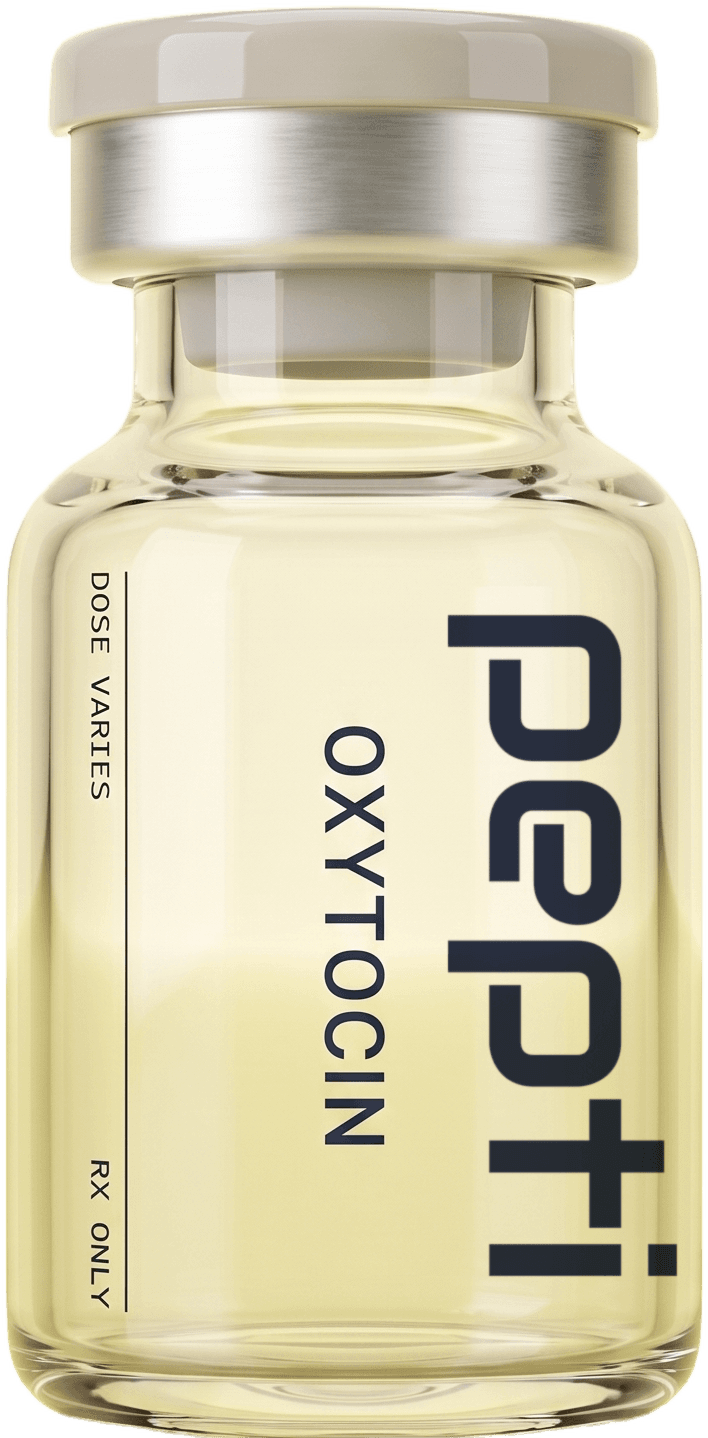
| Oxytocin | 5 mL multi-dose vial, 2 mg/mL (10 mg per vial) | 0.18 mL (18 units) subcutaneously once daily | $239/mo |
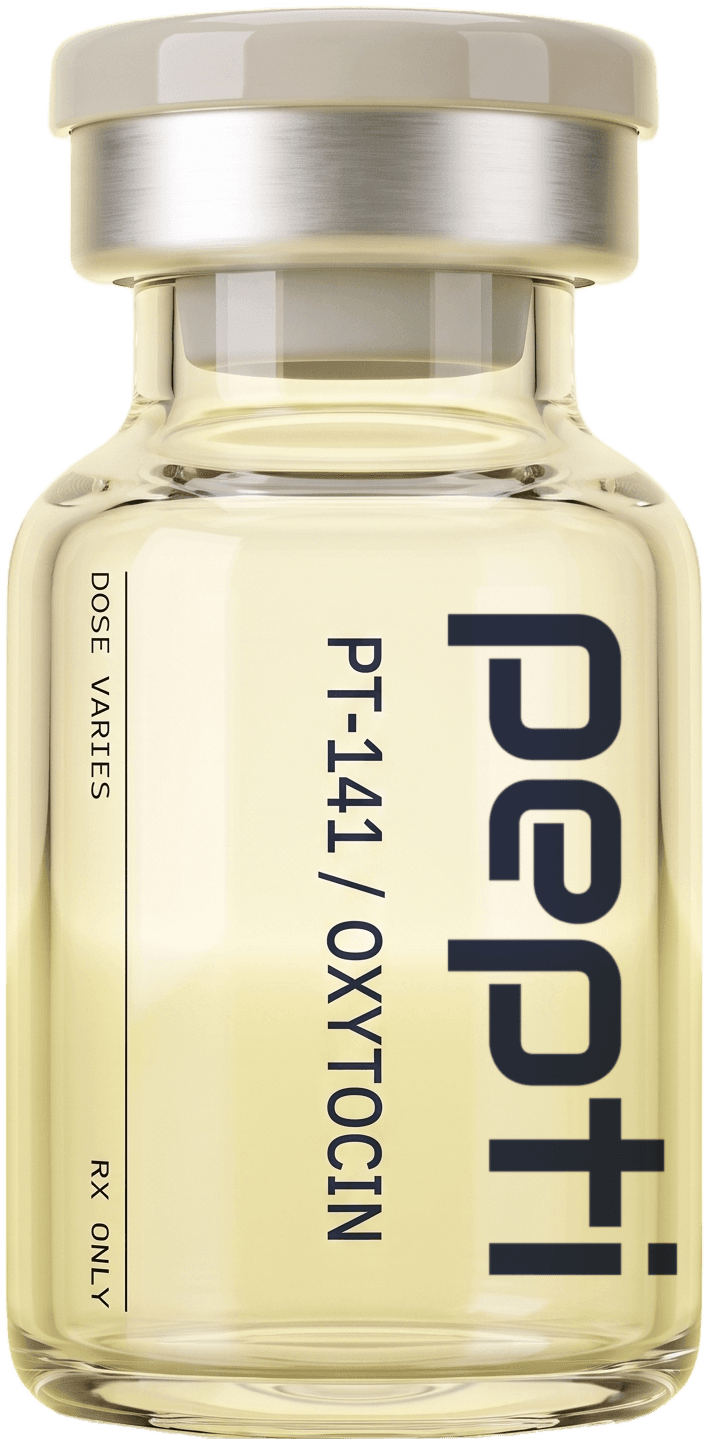
| PT-141 + Oxytocin | 5 mL: PT-141 2 mg/mL and oxytocin 1 mg/mL | 0.10 mL (10 units) 2 to 4 hours before sexual activity, no more than 8 a month | $259/mo |
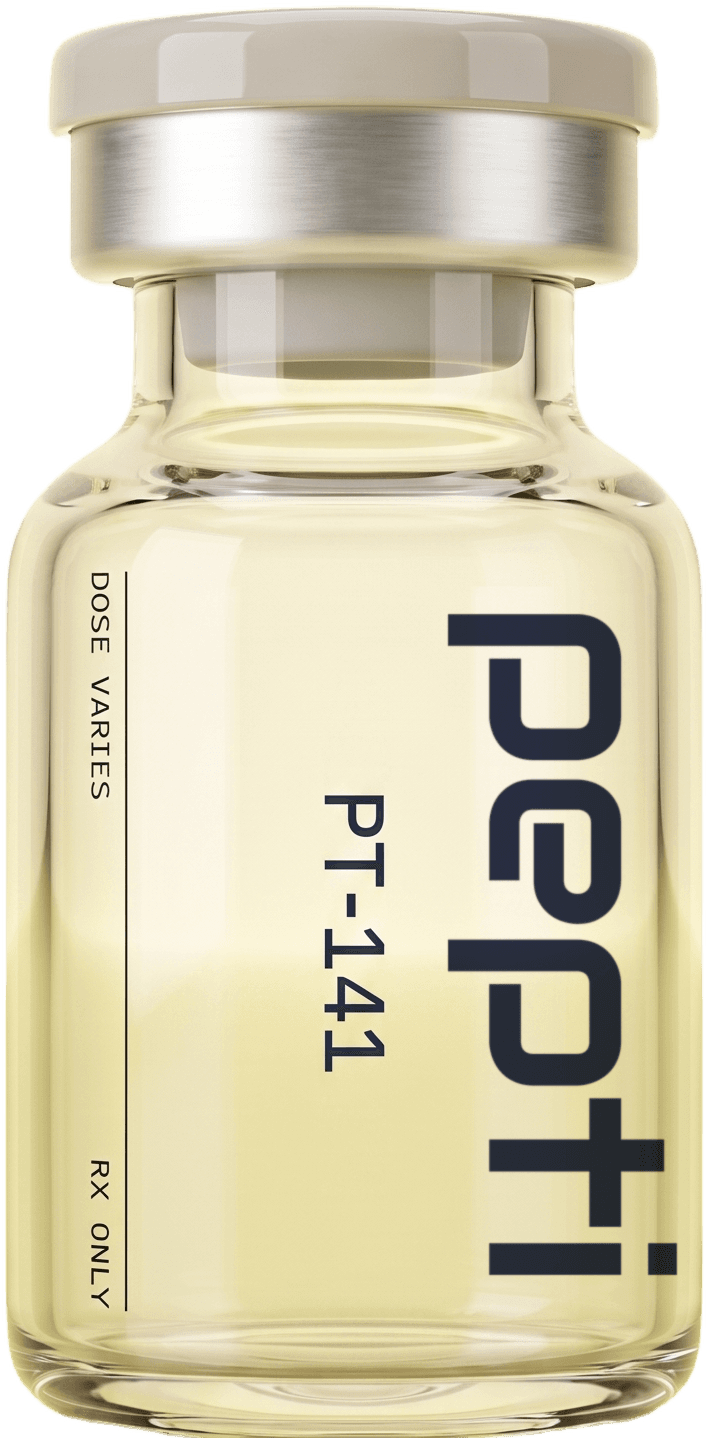
| PT-141 | 5 mL: PT-141 2 mg/mL (10 mg per vial) | Set by your physician and printed on the vial | $259/mo |
At 2 mg/mL, 0.18 mL is 0.36 mg of oxytocin per dose, about 27 doses per vial, roughly four weeks of daily use (arithmetic from the vial strength, on a U-100 insulin syringe). The full chart is in oxytocin dosage. Your physician sets your directions after reviewing your intake, and they are printed on the vial.
Every price is all-in, covering medication, physician review, refill management and shipping, with no membership fee. Pepti is cash-pay and does not bill insurance. Vials arrive as solutions ready to use, with sterile syringes and alcohol prep pads, shipped refrigerated with ice packs. Refills run every 28 days, one vial per fill.
Oxytocin for Women
Where to get oxytocin prescribed
Oxytocin cannot be bought legitimately without a prescription. Products sold "for research use only" have no accountable pharmacy behind their identity, purity, sterility or concentration. The prescription route:
- Complete a free online intake covering your history, medications, pregnancy and contraception status, and what you want help with.
- A physician licensed in your state reviews it, usually within 24 hours.
- If it is appropriate, a PCAB-accredited, FDA-registered US 503A compounding pharmacy prepares it to that prescription. Lot test results are published at /quality/lab-results.
- It ships refrigerated with your directions printed on the vial.
- Your physician stays reachable for questions and side effects.
Step by step: how to get oxytocin prescribed online. Bloodwork is not required for any Pepti treatment. If your physician wants labs for your care, they'll ask through your account.
References
What this is based on.
References
- Behnia B, Heinrichs M, Bergmann W et al.. Differential effects of intranasal oxytocin on sexual experiences and partner interactions in couples · Horm Behav (2014) · PMID 24503174
- IsHak WW, Berman DS, Peters A. Male anorgasmia treated with oxytocin · J Sex Med (2008) · PMID 18086171
- Burri A, Heinrichs M, Schedlowski M, Kruger TH. The acute effects of intranasal oxytocin administration on endocrine and sexual function in males · Psychoneuroendocrinology (2008) · PMID 18375074
- Muin DA, Wolzt M, Marculescu R et al.. Effect of long-term intranasal oxytocin on sexual dysfunction in premenopausal and postmenopausal women: a randomized trial · Fertil Steril (2015) · PMID 26151620
- Carmichael MS, Humbert R, Dixen J et al.. Plasma oxytocin increases in the human sexual response · J Clin Endocrinol Metab (1987) · PMID 3782434
- Kosfeld M, Heinrichs M, Zak PJ, Fischbacher U, Fehr E. Oxytocin increases trust in humans · Nature (2005) · PMID 15931222
- Guastella AJ, Howard AL, Dadds MR, Mitchell P, Carson DS. A randomized controlled trial of intranasal oxytocin as an adjunct to exposure therapy for social anxiety disorder · Psychoneuroendocrinology (2009) · PMID 19246160
- Sikich L, Kolevzon A, King BH et al.. Intranasal Oxytocin in Children and Adolescents with Autism Spectrum Disorder · N Engl J Med (2021) · PMID 34644471
- Yatawara CJ, Einfeld SL, Hickie IB, Davenport TA, Guastella AJ. The effect of oxytocin nasal spray on social interaction deficits observed in young children with autism: a randomized clinical crossover trial · Mol Psychiatry (2016) · PMID 26503762
- Ooi YP, Weng SJ, Kossowsky J, Gerger H, Sung M. Oxytocin and Autism Spectrum Disorders: A Systematic Review and Meta-Analysis of Randomized Controlled Trials · Pharmacopsychiatry (2017) · PMID 27574858
- Leng G, Ludwig M. Intranasal Oxytocin: Myths and Delusions · Biol Psychiatry (2016) · PMID 26049207
- Walum H, Waldman ID, Young LJ. Statistical and Methodological Considerations for the Interpretation of Intranasal Oxytocin Studies · Biol Psychiatry (2016) · PMID 26210057
Citations are provided for educational purposes. They do not constitute medical advice. Always discuss any peptide protocol with your prescribing physician.
Common questions
Oxytocin for Women, answered.
In a 2014 study of healthy couples, women on an oxytocin nasal spray reported feeling more relaxed after intercourse. In the 2015 trial in women with sexual dysfunction, oxytocin was no better than placebo. Any benefit for women is described, not established, and the injection has not been tested.
The evidence says no. The couples study found no change in sexual drive or arousal. PT-141 is the peptide with phase 3 trials for low desire in premenopausal women.
The 2014 couples study reported more intense orgasms on oxytocin across the study, with small to moderate effects, using a nasal spray. The women's trial found no difference from placebo.
The one randomised trial that included postmenopausal women found no difference from placebo. Oxytocin is not hormone therapy, and dryness or pain with sex needs its own treatment.
No. Oxytocin contracts the uterus and is not used in pregnancy outside a hospital. If you could be pregnant, tell your physician the same day.
No. Oxytocin triggers milk ejection, and there are no safety data for the compounded injection while breastfeeding.
Raise it with your physician before starting. Oxytocin is not a fertility treatment, and its obstetric pharmacology makes the conversation necessary if pregnancy is possible.
Oxytocin has no effect on reproductive hormone output, but no study has looked at contraception or the cycle directly. List your contraception on the intake and report any cycle change.
Same molecule, different product. The approved hospital injection is given by infusion or into the muscle for labour and postpartum bleeding. The compounded vial is 2 mg/mL for subcutaneous use, off-label, and not an approved product.
They are frequently prescribed together, and Pepti supplies a combined PT-141 + Oxytocin vial. Taking it alongside the single oxytocin vial adds oxytocin from two sources and needs your physician's review.
At Pepti, $239 a month, all-in, covering medication, physician review, refill management and shipping.
No. Bloodwork is not required for any Pepti treatment. If your physician wants labs for your care, they'll ask through your account. The free assessment goes to a physician licensed in your state. A consultation does not guarantee a prescription.
Related answers
Keep reading.
- What Is Oxytocin? The 10 mg Vial, Uses, Dosing & Price
- Oxytocin Side Effects: What Is Reported, What to Watch and Who Should Not Take It
- Best Place to Get Oxytocin Online: How to Choose a Prescriber
- Can You Take Oxytocin With Tirzepatide or Semaglutide?
- PE-22-28 for Men: What the Research Has Looked At, and What to Rule Out First
Next step
See what a physician recommends for you.
A licensed physician in your state reviews your intake to see whether treatment fits your history. A consultation does not guarantee a prescription.