Supplements · Reference
L-Carnitine Benefits, Injections vs Supplements, and L-Carnitine vs Acetyl-L-Carnitine
This page covers what L-carnitine and levocarnitine are, what the research describes and what it does not, injections versus supplements, acetyl-L-carnitine versus L-carnitine, safety, and how Pepti's L-carnitine injection is supplied and priced.
Medically reviewed by Dr. Gene, MD · November 4, 2026
Treatments mentioned
L-carnitine is a small molecule the body makes from the amino acids lysine and methionine, and its job is to carry long-chain fatty acids into mitochondria so they can be used for energy. The benefits people search for (weight, exercise performance, recovery, energy) come mostly from trials of oral supplements, which report a modest, reproducible effect on body weight in overweight adults who were also changing diet and activity, and smaller results for performance and fatigue. Injections deliver the full dose rather than the small fraction an oral dose absorbs, but no randomized trial has tested low-dose intramuscular L-carnitine in healthy adults. Acetyl-L-carnitine is a related acetylated form sold as a supplement; it is not what Pepti prescribes.
This page covers what L-carnitine and levocarnitine are, what the research describes and what it does not, injections versus supplements, acetyl-L-carnitine versus L-carnitine, safety, and how Pepti's L-carnitine injection is supplied and priced.
L-Carnitine Benefits, Injections vs Supplements, and L-Carnitine vs Acetyl-L-Carnitine
The short answer
| Question | Short answer |
|---|---|
| What is L-carnitine? | A transport molecule that carries long-chain fatty acids into mitochondria; not a peptide, not a stimulant |
| Is levocarnitine the same thing? | Yes. Levocarnitine is the drug name for L-carnitine, the only biologically active form |
| Where is the evidence strongest? | Carnitine deficiency, the only approved indication |
| What do the weight trials show? | A modest effect in overweight adults alongside diet and activity, almost all with oral supplements |
| Injection or supplement? | Injections skip poor oral absorption; supplements are what nearly all the trials used |
| What about acetyl-L-carnitine? | An acetylated form of carnitine sold as a supplement; a separate product from L-carnitine injection |
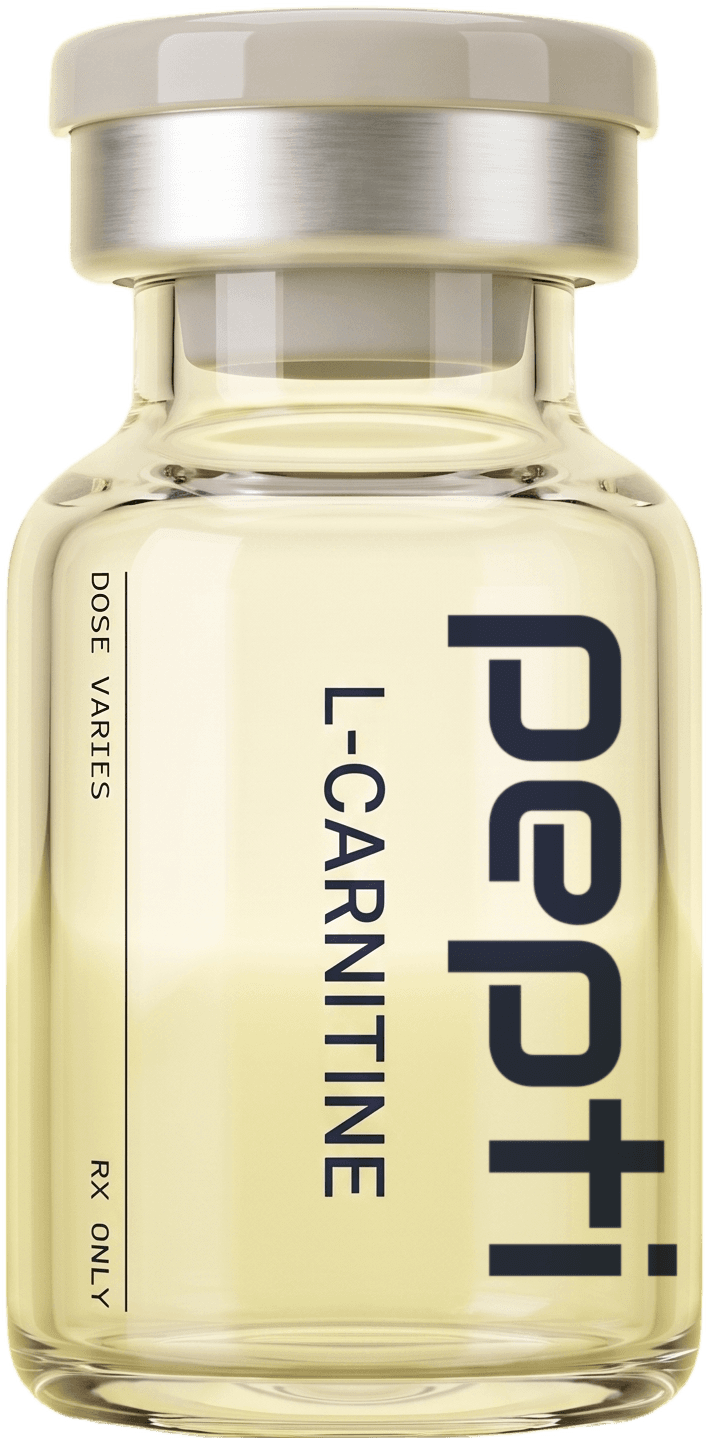
| What does Pepti supply? | L-Carnitine Injection: 10 mL multi-dose vial, L-Carnitine 2 mg/mL (20 mg L-Carnitine per vial), $219/mo |
The price is all-in, covering medication, physician review, refill management and shipping, with no separate membership fee. Current pricing always lives on the product page.
L-Carnitine Benefits, Injections vs Supplements, and L-Carnitine vs Acetyl-L-Carnitine
What is L-carnitine (levocarnitine)?
A transport molecule, not a peptide
L-carnitine is a small quaternary ammonium compound that the liver and kidneys make from lysine and methionine. Its job is narrow and well characterized: it carries long-chain fatty acids across the inner mitochondrial membrane so they can be oxidized for energy. Without it, long-chain fats cannot reach the part of the cell that burns them. Most of the body's supply sits in skeletal and heart muscle, the tissues that rely most on fat as fuel.
The body keeps its carnitine pool steady through three routes: diet, a modest rate of its own synthesis, and very efficient reabsorption by the kidneys, which take back 90 to 99 percent of what is filtered at normal concentrations, as a 2004 review in the Annals of the New York Academy of Sciences describes.
Why "L", and what levocarnitine means
Carnitine exists in two mirror-image forms. Only the L form is biologically active, and pharmaceutical carnitine is always the L form, which is why the drug is named levocarnitine. When you see "carnitine", "L-carnitine" and "levocarnitine" on labels and in search results, they refer to the same active molecule. Dietary carnitine comes mostly from red meat and, to a lesser extent, dairy.
What it is not
It is not a stimulant, not a hormone and not a thermogenic. It does not suppress appetite, and having more of it available does not make the body oxidize more fat than the demand for energy calls for. It is a cofactor in a pathway, and the pathway still has to be driven by activity. That is the single most useful thing to know before reading any claim about L-carnitine benefits. The full reference is at what is L-carnitine.
L-Carnitine Benefits, Injections vs Supplements, and L-Carnitine vs Acetyl-L-Carnitine
How L-carnitine is described to work
| Mechanism | What it means | Where the evidence comes from |
|---|---|---|
| The carnitine shuttle | Enzymes on the mitochondrial membranes attach a fatty acid to carnitine, carry it through, and release it inside for oxidation; the rate-limiting step in long-chain fat oxidation | Textbook biochemistry, and the effects of genuine deficiency |
| Buffering acetyl groups | During hard exercise, free carnitine soaks up excess acetyl groups as acetyl-carnitine, keeping energy production running and limiting lactate build-up | A 2007 review in the Journal of Physiology |
| Muscle fuel selection | Raising muscle carnitine shifted fuel use during exercise in people | A 2011 human muscle-biopsy study in the Journal of Physiology |
| Blood flow and recovery | Proposed improvement in oxygen delivery and lower markers of muscle damage after exercise | Smaller human trials summarized in a 2018 Nutrients review supported by a carnitine manufacturer |
The second row matters for the acetyl-L-carnitine question further down: acetyl-carnitine is also something the body makes from carnitine in working muscle.
L-Carnitine Benefits, Injections vs Supplements, and L-Carnitine vs Acetyl-L-Carnitine
L-carnitine benefits: what the research describes
L-carnitine has more randomized human trials than most compounds Pepti prescribes. That puts it in a different evidence tier from most peptides, with one large caveat: the trials are almost entirely oral, mostly 1 to 3 g a day for 8 to 24 weeks.
Carnitine deficiency
This is the only indication where the evidence is definitive, and the one the approved drug exists for: inborn errors of metabolism that cause secondary carnitine deficiency, and end-stage renal disease, where dialysis strips carnitine from the blood. That is replacement of something measurably missing, a different proposition from supplementing someone whose levels are normal.
L-carnitine for weight loss
Three meta-analyses of randomized trials have been published: Obesity Reviews in 2016 (nine trials, 911 participants), Pharmacological Research in 2020 (43 trials) and Clinical Nutrition ESPEN in 2020 (37 trials). Together they describe a modest effect on body weight, confined to overweight and obese adults in trials that also added diet and activity change, with the effect shrinking the longer a trial ran. Two of the three looked at body-fat percentage and waist circumference and found no consistent change. The ESPEN analysis placed the maximum oral dose response at 2,000 mg a day. Every one of those trials used oral carnitine, so the findings describe a different product and route from an injection. It is not a substitute for a medication built for weight management; see L-carnitine vs GLP-1.
Exercise performance and recovery
The clearest human result is the 2011 Journal of Physiology study. Fourteen healthy men took either 2 g of L-carnitine tartrate with 80 g of carbohydrate, or the carbohydrate alone, twice a day for 24 weeks, with muscle biopsies. Muscle carnitine rose 21 percent in the carnitine group and did not change in controls; the carnitine group used less muscle glycogen at low intensity, had lower muscle lactate at high intensity, and raised work output in a 30-minute performance trial. Two details are essential: the carbohydrate was there to raise insulin, which is what drives carnitine into muscle, and it took 24 weeks. The recovery literature consists of smaller trials measuring markers such as creatine kinase and soreness ratings rather than return-to-training times.
Energy and fatigue
A 2007 randomized trial in the American Journal of Clinical Nutrition gave 2 g of oral L-carnitine daily for six months to centenarians and reported lower physical and mental fatigue scores than placebo. In dialysis patients, the CHIEF trials (American Journal of Kidney Diseases, 2001) gave intravenous L-carnitine after each session for 24 weeks; the primary endpoint, peak oxygen uptake, was not met, and patient-rated fatigue improved on the secondary analysis. More on the fatigue picture is in peptides for energy and fatigue.
What the evidence does not establish
- That injecting carnitine produces the changes the oral trials describe. That trial has not been run.
- An effect in people whose carnitine status is already normal.
- A meaningful change in body-fat percentage or waist circumference.
- A performance benefit without prolonged loading with carbohydrate.
- Any approved use for weight, exercise or fatigue. The approved drug is approved for carnitine deficiency and nothing else.
L-Carnitine Benefits, Injections vs Supplements, and L-Carnitine vs Acetyl-L-Carnitine
L-carnitine injections vs supplements
This is the question behind most "l carnitine benefits" searches, and the answer is a trade-off rather than a winner.
| Oral supplement | Intramuscular injection | |
|---|---|---|
| Absorption | Large oral doses absorbed at roughly 14 to 18 percent; the rest is broken down by gut bacteria | Delivered in full, bypassing the gut |
| Trial evidence | Nearly all of it, at 1 to 3 g a day | None in healthy adults at low intramuscular doses; the intravenous trials are in dialysis patients |
| Muscle loading | Needed carbohydrate alongside and months of use in the 2011 study | Not studied |
| Fishy body odour | More common, from gut conversion to trimethylamine | Less of an issue, because the gut is bypassed |
| Gut and TMAO question | Gut bacteria convert dietary carnitine to TMAO (Nature Medicine, 2013) | Relevance to an injection is unclear |
| Prescription | No | Yes, with physician review |
For comparison, people absorb 54 to 87 percent of the carnitine in food; it is the large supplement doses that absorb poorly, because active transport in the gut saturates.
Which is better?
Neither route has been shown superior for the uses people actually ask about. The injection is a bioavailability and supervision choice, not a proven upgrade, and the oral form is what the evidence describes. Plasma levels after an injection rise quickly and fall back within a day or two as the kidneys clear the excess, which is one reason the injection is given on a regular weekday schedule.
L-Carnitine Benefits, Injections vs Supplements, and L-Carnitine vs Acetyl-L-Carnitine
Acetyl-L-carnitine vs L-carnitine
Acetyl-L-carnitine (also written acetylcarnitine or acetyl carnitine) is carnitine with an acetyl group attached. It is sold as a dietary supplement. The body also makes it: as described above, free carnitine in working muscle takes up excess acetyl groups as acetyl-carnitine during hard exercise.
| L-carnitine (levocarnitine) | Acetyl-L-carnitine | |
|---|---|---|
| What it is | The parent molecule | An acetylated form of carnitine |
| How it is sold | Supplement, and as an approved drug for carnitine deficiency | Supplement |
| FDA position for compounding | Meets the 503A conditions as a component of approved products with a USP monograph | Listed in Category 1 of the FDA's 503A bulk drug substances list dated 14 May 2026, the category of substances under evaluation |
| Supplied by Pepti | Yes, as an injection | No |
Category 1 is a compounding permission while a substance is evaluated, not an approval. The trial evidence summarized on this page is for L-carnitine; it should not be read across to acetyl-L-carnitine, or the other way round. If acetyl-L-carnitine is what you have been taking, list it on your intake.
L-Carnitine Benefits, Injections vs Supplements, and L-Carnitine vs Acetyl-L-Carnitine
Where L-carnitine stands with the FDA
Levocarnitine is an FDA-approved active ingredient, available as an approved injection, tablets and oral solution, for inborn errors of metabolism causing secondary carnitine deficiency and for carnitine deficiency in end-stage renal disease patients on dialysis.
Pepti's product is not that approved drug. It is compounded by a licensed pharmacy to an individual prescription, for intramuscular use, and compounded medications are not FDA approved. Because levocarnitine is a component of approved drug products and has a USP monograph, it can be compounded under section 503A without appearing on the 503A bulks list, and it is not in Category 1, 2 or 3 of the nominated-substances list. Prescribing it for weight, training or energy is off-label: common and lawful, but not an approved claim. Are peptides FDA approved explains the difference between not approved and not legal.
L-Carnitine Benefits, Injections vs Supplements, and L-Carnitine vs Acetyl-L-Carnitine
Pepti's L-carnitine injection
| Product | L-Carnitine Injection |
| How supplied | 10 mL multi-dose vial, L-Carnitine 2 mg/mL (20 mg L-Carnitine per vial) |
| Standard directions | Inject 0.50 mL (50 units) intramuscularly once daily Monday through Friday |
| Doses per vial | 20, about four weeks |
| Format | Vial and syringe; no pen |
| Price | $219 a month, all-in |
| Available in | All 50 states and DC |
How it is dosed
The volume is 0.50 mL, which is 50 units on a U-100 insulin syringe, injected into the muscle rather than the fat layer: the deltoid, the upper outer thigh or the upper outer buttock, rotated between doses. An intramuscular injection uses a longer needle than a subcutaneous one, and the pharmacy supplies the right one. Your physician sets your directions after reviewing your intake, and they are printed on the vial. See how to inject peptides safely and how long does a peptide vial last.
Shipping, storage and refills
It ships refrigerated with ice packs, with sterile syringes and alcohol prep pads. The vial is a multi-dose solution shipped ready to use. Keep it in the refrigerator, do not freeze it, and note the beyond-use date on the label, which runs from first puncture. Refills run every 28 days, one vial per fill.
L-carnitine alongside other products
L-carnitine is often prescribed alongside a GLP-1 medication or a lipotropic injection. Two things people mix up: Lipo-B contains methionine, inositol, choline and B12, and no carnitine, and Lipo-Mino-Mix-C is an MIC and B12 preparation that does not contain carnitine either. The common pairings with weight medications are in what peptides can you take with tirzepatide, and the lipotropic injections are covered in what is Lipo-B and what is Lipo-Mino-Mix.
L-Carnitine Benefits, Injections vs Supplements, and L-Carnitine vs Acetyl-L-Carnitine
Side effects and who should discuss it first
L-carnitine has one of the longer safety records of anything Pepti prescribes: the approved product has been used for decades and the supplement has been studied in thousands of trial participants. Reported effects include transient nausea and vomiting, gastritis, a fishy body odour from trimethylamine (more common with large oral doses), and, with an injection, soreness or bruising at the site.
| Situation | Why it matters |
|---|---|
| Seizure disorder | The approved product's label reports seizures in people with and without a prior history |
| Taking warfarin | The label reports INR increases; raise it at intake |
| Severe kidney impairment | Trimethylamine and TMAO can accumulate with chronic high oral dosing |
| Established cardiovascular disease | Raise the 2013 TMAO finding with your physician; its relevance to an injection is unclear |
| Diagnosed carnitine deficiency or dialysis | Specialist care with the approved product, not a compounded intramuscular vial |
| Pregnancy or breastfeeding | Not used |
| Tested athletes | Some bodies restrict injections above a certain volume regardless of contents |
Stop and contact your physician for any reaction that is severe, spreading, or involves difficulty breathing. Bloodwork is not required for any Pepti treatment. If your physician wants labs for your care, they'll ask through your account.
L-Carnitine Benefits, Injections vs Supplements, and L-Carnitine vs Acetyl-L-Carnitine
What the evidence shows, honestly
L-carnitine has a real, reproducible but modest effect on body weight in meta-analyses of oral trials, no consistent effect on body-fat percentage or waist circumference, one strong but slow muscle-loading study, and fatigue trials in specific populations. It has no trials of the low-dose intramuscular injection in healthy adults, so what the injection does in that group is extrapolated rather than measured. Acetyl-L-carnitine has its own literature, which this page does not summarize. Anyone describing L-carnitine as a fat burner or a substitute for a weight-management medication is overstating it.
L-Carnitine Benefits, Injections vs Supplements, and L-Carnitine vs Acetyl-L-Carnitine
Where to get L-carnitine injections prescribed
L-carnitine injection cannot be bought legitimately without a prescription. Sites shipping injectable carnitine with no prescription are not accountable for identity, purity, sterility or concentration. The prescription route:
- Complete a free online intake covering your history, medications and what you want help with.
- A physician licensed in your state reviews it, usually within 24 hours.
- If it is appropriate, a PCAB-accredited, FDA-registered US 503A pharmacy compounds it to that prescription. Lot test results are published at /quality/lab-results.
- It ships refrigerated with your directions printed on the vial.
- Your physician stays reachable for questions and dose changes.
Pepti is cash-pay and does not bill insurance. Step-by-step page: how to get L-carnitine prescribed online.
References
What this is based on.
References
- Jastreboff AM, Aronne LJ, Ahmad NN, et al.. Tirzepatide Once Weekly for the Treatment of Obesity (SURMOUNT-1) · New England Journal of Medicine (2022) · PMID 35658024
- Garvey WT, Frias JP, Jastreboff AM, et al.. Tirzepatide once weekly for the treatment of obesity in people with type 2 diabetes (SURMOUNT-2) · Lancet (2023) · PMID 37385275
- Frías JP, Davies MJ, Rosenstock J, et al.. Tirzepatide versus Semaglutide Once Weekly in Patients with Type 2 Diabetes (SURPASS-2) · New England Journal of Medicine (2021) · PMID 34170647
- Inagaki N, Takeuchi M, Oura T, et al.. Effects of subcutaneous tirzepatide versus placebo or semaglutide on pancreatic islet function and insulin sensitivity in adults with type 2 diabetes: a multicentre, randomised, double-blind, parallel-arm, phase 1 clinical trial · The Lancet Diabetes & Endocrinology (2022) · PMID 35468322
- Malhotra A, Grunstein RR, Fietze I, et al.. Tirzepatide for the Treatment of Obstructive Sleep Apnea and Obesity (SURMOUNT-OSA) · New England Journal of Medicine (2024) · PMID 38912654
- Nicholls SJ, Pavo I, Bhatt DL, et al.. Cardiovascular Outcomes with Tirzepatide versus Dulaglutide in Type 2 Diabetes (SURPASS-CVOT) · New England Journal of Medicine (2025) · PMID 41406444
- Aronne LJ, Sattar N, Horn DB, et al.. Continued Treatment With Tirzepatide for Maintenance of Weight Reduction in Adults With Obesity: The SURMOUNT-4 Randomized Clinical Trial · JAMA (2024) · PMID 38078870
- Pasternak B, Wintzell V, Hviid A et al.. Glucagon-like peptide 1 receptor agonist use and risk of thyroid cancer: Scandinavian cohort study · BMJ (2024) · PMID 38683947
- Quddos F, Hubshman Z, Tegge A, et al.. Semaglutide and Tirzepatide reduce alcohol consumption in individuals with obesity · Scientific Reports (2023) · PMID 38017205
- Drummond RF, Seif KE, Reece EA. Glucagon-like peptide-1 receptor agonist use in pregnancy: a review · Am J Obstet Gynecol (2025) · PMID 39181497
- Wang S, Sun J, Wang J, et al.. Does obesity based on body mass index affect semen quality? A meta-analysis and systematic review from the general population rather than the infertile population · Andrologia (2021) · PMID 34028074
- Urva S, Coskun T, Loghin C, et al.. The novel dual glucose-dependent insulinotropic polypeptide and glucagon-like peptide-1 (GLP-1) receptor agonist tirzepatide transiently delays gastric emptying similarly to selective long-acting GLP-1 receptor agonists · Diabetes, Obesity and Metabolism (2020) · PMID 32519795
Citations are provided for educational purposes. They do not constitute medical advice. Always discuss any peptide protocol with your prescribing physician.
Common questions
L-Carnitine Benefits, Injections vs Supplements, and L-Carnitine vs Acetyl-L-Carnitine, answered.
Its established role is carrying long-chain fatty acids into mitochondria, and its only approved use is carnitine deficiency. Oral trials describe a modest effect on body weight in overweight adults changing diet and activity, a shift in muscle fuel use after six months of loading with carbohydrate, and lower fatigue scores in specific populations. None of that has been tested with a low-dose injection.
Levocarnitine is the drug name for L-carnitine, the biologically active form of carnitine. As an approved drug it is indicated for carnitine deficiency. Pepti's compounded L-carnitine injection contains the same active molecule but is not the approved product.
In practice, yes. Carnitine exists in two mirror-image forms and only the L form is active, so supplements and medicines labelled carnitine are L-carnitine.
Acetyl-L-carnitine is carnitine with an acetyl group attached, sold as a supplement; the body also forms it in working muscle. L-carnitine is the parent molecule and the approved active ingredient. The L-carnitine trials on this page do not describe acetyl-L-carnitine, and Pepti does not supply acetyl-L-carnitine.
Injections skip poor oral absorption, roughly 14 to 18 percent of a large oral dose, but nearly all the trial evidence used oral supplements. Neither route has been shown superior for weight, training or energy.
Three meta-analyses of mostly oral trials report a modest effect on body weight in overweight adults who were also changing diet and activity, with no consistent change in body-fat percentage or waist circumference. It does not act on appetite and is not a substitute for a GLP-1 medication.
It is a common adjunct and they are often prescribed together. They do different jobs, use separate syringes, and no trial has tested the combination or shown that L-carnitine adds weight loss to a GLP-1. See L-carnitine vs GLP-1.
Into the muscle: 0.50 mL (50 units) once daily Monday through Friday on the standard directions, rotating between the deltoid, upper outer thigh and upper outer buttock. Your directions are printed on the vial.
The catalog lists it as a 10 mL multi-dose vial, L-Carnitine 2 mg/mL (20 mg L-Carnitine per vial). At the standard directions that is 20 doses, about four weeks.
At Pepti, $219 a month, all-in, covering medication, physician review, refill management and shipping, with no membership fee. Pepti is cash-pay and does not bill insurance.
Carnitine that is not absorbed is converted by gut bacteria to trimethylamine, which has a fish-like odour. It is dose-related and far more common with large oral doses than with injection.
No. Bloodwork is not required for any Pepti treatment. If your physician wants labs for your care, they'll ask through your account. The free assessment goes to a physician licensed in your state. A consultation does not guarantee a prescription.
Next step
See what a physician recommends for you.
A licensed physician in your state reviews your intake and decides what is appropriate. A consultation does not guarantee a prescription.