Supplements · Reference
Lipo-B (B12 + MIC): What It Is, Where to Get It Prescribed, and What It Costs
This page covers what is actually in a Lipo-B vial, what each of the four ingredients is described as doing, what the published evidence does and does not support for each of them, where the ingredients stand with the FDA's compounding rules, how the injection is dosed, and how to get it prescribed.

Reviewed by Dr. Gene, MD · Board-certified Family Medicine
Every Pepti prescription is reviewed by a licensed U.S. physician before it's dispensed — and only provided if clinically appropriate.
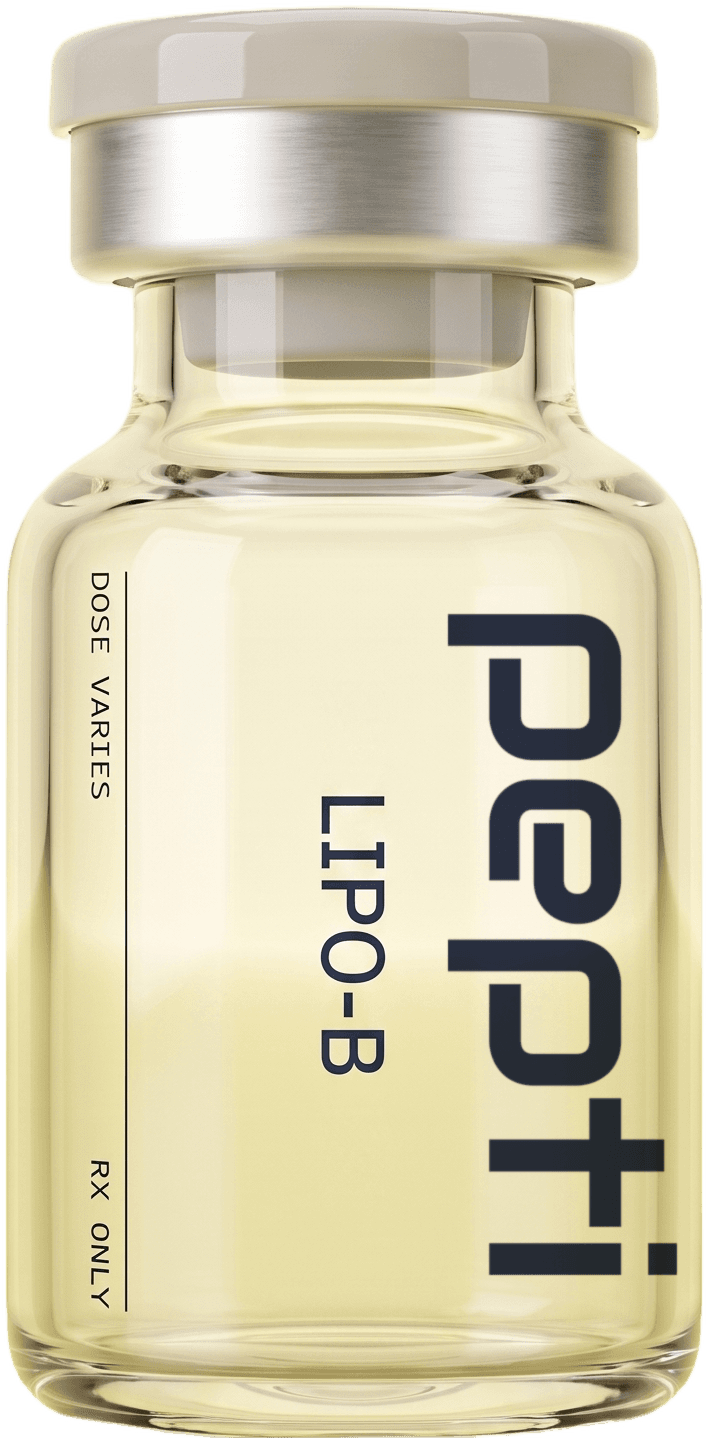
Lipo-B (B12 + MIC) is a prescription injection supplied as vial — LIPO-B 50mg/50mg/25mg/1mg/mL (10ML). The reviewed directions are: Inject 0.8 mL (80 units) intramuscularly three times weekly. That is 12 doses per vial, about 2.4 weeks at as directed. It requires a prescription from a physician licensed in your state, is compounded by a state-licensed US pharmacy, and is not FDA approved.
This page covers what is actually in a Lipo-B vial, what each of the four ingredients is described as doing, what the published evidence does and does not support for each of them, where the ingredients stand with the FDA's compounding rules, how the injection is dosed, and how to get it prescribed.
Lipo-B (B12 + MIC)
What Lipo-B actually is
A vitamin plus three nutrients, not a peptide
Lipo-B is not a peptide, a hormone or a signalling molecule. It is a sterile injectable solution of four ordinary nutrients that the body already handles every day through food: the amino acid methionine, the sugar-alcohol inositol, the essential nutrient choline, and vitamin B12. The "50mg/50mg/25mg/1mg/mL" on the label is the concentration of each per millilitre, in that order: 50 mg methionine, 50 mg inositol, 25 mg choline and 1 mg vitamin B12 in every millilitre, in a 10 mL multi-dose vial.
The B12 in Lipo-B is cyanocobalamin, the standard pharmaceutical form of the vitamin and the form used in FDA-approved B12 injections. It is converted in the body to the two active coenzyme forms, methylcobalamin and adenosylcobalamin. Pepti supplies the active methylcobalamin form on its own as a separate product, Methylcobalamin; the distinction is covered in the comparison section further down.
Because the ingredients are nutrients rather than drugs in the usual sense, the useful question is not "what does Lipo-B do?" but "what does each ingredient do, at this dose, given by this route?" Those are four different answers with four different levels of evidence, and the rest of this page keeps them separate.
Where "MIC" and "lipotropic" come from
MIC is simply the initials of methionine, inositol and choline. "Lipotropic" is an older nutrition term for substances that, in animal feeding studies from the middle of the twentieth century, were described as preventing fat from accumulating in the liver of animals fed a choline-deficient diet. Choline was the original lipotrope; methionine was grouped with it because it can donate the methyl groups the liver uses to make its own choline; inositol was added because it is a component of the phospholipids that package fat for export from the liver. A 2013 survey in Critical Reviews in Food Science and Nutrition uses the same definition, framing lipotropes as dietary compounds involved in hepatic lipid metabolism rather than as agents that act on body fat generally.
That history matters because "lipotropic" is routinely misread as "fat-burning". The original meaning is narrower and more specific: it describes liver lipid handling in deficient animals, not fat loss in people who are eating a normal diet.
What it is not
Lipo-B is not a weight-loss medication, and it is not described as one in the published literature. It does not act on appetite hormones, it does not change how much you absorb, and it is not in the same category as the GLP-1 receptor agonists that have randomised human trial evidence for weight management. It is not a stimulant, and it is not an energy drug in the sense of caffeine; whatever change in energy people report from B12 is tied to whether they were low in B12 to begin with. It is not a liver treatment for a diagnosed liver condition, which is a physician's question and is not what a compounded nutrient injection is for. And it is not a substitute for the diet and activity programme it is usually prescribed alongside.
Lipo-B (B12 + MIC)
How Lipo-B is described to work
Each ingredient has its own described biochemistry. The B12 mechanism is established human physiology. The MIC mechanisms are established biochemistry too, but the leap from "this is what the molecule does in a cell" to "injecting 40 mg of it three times a week does something you can measure" is the part the research has not made, and that distinction is made explicit under each heading.
Vitamin B12: methionine synthase and the methylation cycle
Cyanocobalamin is converted to methylcobalamin, which is the cofactor for methionine synthase, the enzyme that regenerates methionine from homocysteine and in doing so keeps the folate cycle turning. The other active form, adenosylcobalamin, is the cofactor for methylmalonyl-CoA mutase in mitochondria. When B12 is short, homocysteine and methylmalonic acid accumulate, DNA synthesis in rapidly dividing cells slows (which is why deficiency shows up as large red blood cells), and myelin maintenance suffers (which is why it also shows up as numbness, tingling and cognitive change). This is textbook human physiology, described in the New England Journal of Medicine's 2013 clinical practice review and in the 2017 Nature Reviews Disease Primers article on B12 deficiency.
The important corollary is that these are deficiency mechanisms. Once the enzymes have the cofactor they need, giving more cofactor does not make them run faster.
Choline: phosphatidylcholine and fat export from the liver
Choline is needed to make phosphatidylcholine, the phospholipid that coats very-low-density lipoprotein particles. Without enough of it the liver cannot package triglyceride for export, and fat accumulates in liver cells. This is the mechanism behind the original "lipotropic" observation in animals, and it has been reproduced in humans: controlled feeding studies in which adults were deliberately deprived of choline produced fatty liver and liver-enzyme changes that reversed when choline was restored, as reviewed in Advances in Nutrition in 2016 and in Nutrition Reviews in 2009. Choline is also the precursor of acetylcholine and a methyl donor via betaine.
The scale is worth stating plainly. The adequate intake for choline set by the US Institute of Medicine is 550 mg a day for adult men and 425 mg for adult women, and it comes from eggs, meat, fish, dairy and legumes. A 0.8 mL dose of Lipo-B contains 20 mg of choline. The injection is not a meaningful contribution to choline status in anyone eating a mixed diet.
Methionine: an essential amino acid and methyl donor
Methionine is one of the nine essential amino acids and the direct precursor of S-adenosylmethionine, the body's main methyl donor. In the lipotrope story it is included because methyl groups from methionine allow the liver to synthesise phosphatidylcholine by a second route, partially sparing dietary choline. A 0.8 mL dose supplies 40 mg of methionine. A single egg contains roughly ten times that, and a normal diet supplies on the order of a gram or more a day. No published human study describes a metabolic effect from methionine at the amount delivered by a lipotropic injection.
Inositol: a second-messenger precursor
Myo-inositol is a component of the phosphatidylinositol phospholipids and the precursor of inositol phosphate second messengers, including those downstream of the insulin receptor. That is the basis for its study in insulin-resistance conditions, and there are randomised human trials of oral myo-inositol in polycystic ovary syndrome, summarised in a 2023 meta-analysis in Reproductive Biology and Endocrinology. Those trials used oral doses in the range of 2 to 4 grams a day. A 0.8 mL dose of Lipo-B contains 40 mg, roughly one-fiftieth to one-hundredth of that, so the PCOS literature does not transfer to this product and should not be read as though it does.
Lipo-B (B12 + MIC)
What the research actually shows
B12 deficiency
This is the one ingredient with an established, guideline-level indication. B12 deficiency is common, particularly in older adults, in people taking metformin or acid-suppressing medication, in people who have had gastric or bariatric surgery, in pernicious anaemia and in vegetarians and vegans. Treatment with B12 corrects the anaemia, the elevated methylmalonic acid and homocysteine, and, if caught early enough, the neurological symptoms. The 2013 New England Journal of Medicine review and the 2017 Nature Reviews Disease Primers article both lay this out, and cyanocobalamin injection is an FDA-approved drug for exactly this purpose.
Intramuscular injection has traditionally been used because it bypasses the intrinsic-factor absorption step that is broken in pernicious anaemia. A 2018 Cochrane review comparing oral with intramuscular B12 for deficiency found that high-dose oral B12 appeared to normalise serum levels about as well as injections in the trials available, while grading the evidence as low quality. The practical reading is that injection is a legitimate route, not a uniquely necessary one for most people, and the choice between them is a physician's call.
B12 in people who are not deficient
Here the evidence points the other way, and it is worth being direct about it. The current page's original summary said it in one line: benefit in people with normal levels is limited. A 2018 randomised, double-blind, placebo-controlled trial in Clinical Nutrition ESPEN gave supplementary B12 to patients with irritable bowel syndrome or inflammatory bowel disease who were not deficient and found no reduction in fatigue compared with placebo. That is the pattern across the field: B12 relieves fatigue when fatigue is a symptom of deficiency, and does not when it is not. Nobody has shown that pushing an already-normal B12 level higher does anything, by mouth or by injection.
Choline and the liver
The human data on choline is about deficiency and adequacy, not supplementation on top of a normal diet. Depletion studies show that removing choline causes fatty liver in adults and that restoring it reverses the change. Observational work, including a 2012 cohort study in the American Journal of Clinical Nutrition, reports that lower dietary choline intake is associated with more severe liver fat in patients with non-alcoholic fatty liver disease. None of this work involved injected choline, and none of it used amounts anywhere near as small as 20 mg per dose.
Inositol and methionine
For inositol the human trial evidence is oral, gram-scale and in PCOS, as above. For methionine there is no human trial evidence of any benefit from supplementation in people eating a normal diet; if anything the animal literature runs the other way, with methionine restriction rather than supplementation being the direction of interest in metabolic research. Neither has been tested as an injected 40 mg dose.
What human data exists
There are no randomised human trials of the methionine, inositol and choline combination given as an injection, with or without B12, for weight, body composition, energy or liver fat. A PubMed search for the combination returns no controlled trials at all; what exists is the animal nutrition work behind the word "lipotropic", the deficiency literature on each nutrient individually, and decades of clinical use in weight-management clinics without a trial to anchor it.
The honest framing is therefore split. For the B12 component: established human evidence for deficiency, with FDA-approved single-ingredient products, and human trial evidence that it does not help fatigue in people who are replete. For the MIC component: plausible biochemistry, deficiency data in animals and in controlled human depletion studies, and no evidence that the small injected amounts change anything in a nourished adult. A source that tells you the MIC part "burns fat" or "boosts metabolism" is not describing the research.
What the evidence does not establish
- It does not establish that Lipo-B produces weight loss or fat loss. No trial has tested it, and no outcome claim on that point is supportable.
- It does not establish that the MIC ingredients, at these doses and by this route, have any measurable effect in people eating a normal diet.
- It does not establish that injected B12 improves energy in someone whose B12 is already normal; the controlled trial evidence says it does not.
- It does not establish an effect on liver fat from the injection; the choline-and-liver literature is about dietary adequacy, not injections.
- It does not establish efficacy for any condition as an FDA-approved product. Lipo-B as a compounded combination is not approved for anything; only single-ingredient cyanocobalamin injection is.
Lipo-B (B12 + MIC)
Where Lipo-B stands with the FDA right now
The regulatory picture for Lipo-B is simpler and more settled than for any peptide on this site, because its ingredients are nutrients with a long pharmaceutical history rather than novel compounds. It has not been affected by the peptide-focused changes of 2026: the 15 April 2026 removals from the FDA's 503A Category 2 list and the July 2026 Pharmacy Compounding Advisory Committee meeting both concerned peptides, none of which is in this product.
The three routes a compounded ingredient can take
A state-licensed 503A pharmacy may compound with a bulk substance if it meets one of three tests set by the Food, Drug, and Cosmetic Act: the substance complies with an applicable USP or NF monograph; or, if no monograph exists, it is a component of an FDA-approved drug product; or, if neither applies, it appears on the FDA's 503A bulks list. Substances nominated for that list but not yet decided are sorted into three interim categories, and the FDA has said it does not intend to act against compounding with Category 1 substances while its evaluation continues.
Where each Lipo-B ingredient sits, as of the 14 May 2026 list
Cyanocobalamin (vitamin B12) is an approved drug in its own right. Drugs@FDA lists cyanocobalamin injection 1 mg/mL under active approved applications, so it clears the approved-drug-component route without needing to be on any list. It does not appear on any of the 503A nominated-substance categories, which is what you would expect.
Choline chloride, the salt used in MIC preparations, is in Category 1, "bulk drug substances under evaluation", on the FDA's 503A categories document updated 14 May 2026. Category 1 is the interim status under which compounding is permitted while the FDA evaluates the nomination; it is not the Category 2 "significant safety risk" list. A different salt, choline bitartrate, sits in Category 3 (nominated without adequate support), which is one reason the exact salt on a pharmacy's formulation record matters.
Methionine and inositol do not appear in any of the three categories on the 14 May 2026 document. Both are long-standing compendial substances with USP–NF monographs, which is the first of the three routes above and removes the need for nomination. The only inositol entry on the categories document is "inositol hexanicotinate", a different compound (a niacin ester) in Category 3, and it is not what is in Lipo-B.
Methylcobalamin, for completeness, is also in Category 1 on the same document. That is relevant to Pepti's separate Methylcobalamin product rather than to Lipo-B, whose B12 is cyanocobalamin.
What that adds up to
Every ingredient in Lipo-B has a clear compounding pathway: an approved drug, a Category 1 substance, and two compendial nutrients. Nothing in it is flagged for safety concern. But the compounded combination itself is not an FDA-approved product and never will be in this form; compounded medications are prepared to a prescription by a licensed pharmacy, not approved as manufactured drugs. Only the single-ingredient cyanocobalamin injection is approved, and only for B12 deficiency. See are peptides FDA approved for how that distinction works generally.
Lipo-B (B12 + MIC)
Realistic expectations
These are patterns described by prescribers, not trial endpoints. What you should expect from Lipo-B depends almost entirely on your B12 status going in, and a physician decides whether it is appropriate at all.
The first one to two weeks
If your B12 was low, this is where a change is plausible: less tiredness, and in people with deficiency-related tingling or numbness, the beginning of improvement. Serum B12 rises within days of an intramuscular dose. If your B12 was normal, the controlled trial evidence says you should not expect a change in energy, and reports of feeling different in the first week are more likely to be the effect of starting a structured programme than of the vitamin.
Weeks three to eight
This is the period the injection is normally prescribed across as an adjunct to a diet and activity plan. Any change in weight over this window is the plan's, not the injection's; there is no trial evidence attributing weight change to Lipo-B, and prescribers who use it describe it as support alongside a programme rather than as the thing doing the work. The pharmacy's product page and your physician will both put it the same way.
Ongoing use
Lipo-B is prescribed as an ongoing adjunct rather than as a time-limited course. Refills follow the 28-day cycle, and your physician decides whether continuing makes sense based on how the programme is going and, if a B12 level was checked, on what it shows.
What would tell you it is not doing anything
If your fatigue did not change in the first month and your B12 was normal, the vitamin is not the answer to it, and the honest move is to look elsewhere with your physician rather than to keep injecting it. That is also the moment to ask whether a blood panel would clarify the picture.
Lipo-B (B12 + MIC)
When something else makes more sense
A reference that only recommends its own product is not much of a reference. Some honest cases where Lipo-B is not the first thing to reach for:
- Your goal is weight loss. Lipo-B has no trial evidence for weight. Semaglutide and tirzepatide are the actives with large randomised human trials for weight management, and whether one is appropriate for you is exactly the kind of decision a physician's review is for.
- You want B12 and nothing else. If a low B12 level is the actual problem, Methylcobalamin is the active form on its own, without the three lipotropic nutrients that add cost and no established benefit.
- You are interested in the lipotropic idea with carnitine rather than B12. Lipo-Mino-Mix-C is the related preparation; L-Carnitine on its own is a different conversation with its own (human) literature.
- You have not had a B12 level checked. Treating a suspected deficiency without measuring it means you never learn whether the injection was doing anything. At-home blood testing is the cheaper first step, and your physician can add a B12 level to the discussion.
- You have a diagnosed liver condition. Fatty liver disease is a medical diagnosis with its own management. A nutrient injection is not a treatment for it and should not be started on that basis.
Your physician will tell you if Lipo-B is not the right tool for what you have described. A consultation does not guarantee a prescription, and being declined is refunded.
Lipo-B (B12 + MIC)
Strengths available
| Strength | Directions |
|---|---|
| LIPO-B 50mg/50mg/25mg/1mg/mL (10ML) | Inject 0.8 mL (80 units) intramuscularly three times weekly. |
Lipo-B comes in one strength. Your physician sets the volume and frequency, and it is printed on your medication.
Lipo-B (B12 + MIC)
Dosing, and how a vial is actually used
Why the dose is measured in units
The directions are written in millilitres and in insulin-syringe units because that is what you can read off the barrel. 0.8 mL is 80 units on a U-100 syringe. You are not calculating anything; the number is printed on your medication. For the curious, that volume contains 40 mg methionine, 40 mg inositol, 20 mg choline and 0.8 mg of B12, which is arithmetic from the label rather than a separate dose.
Intramuscular, and where
Unlike most products on this site, Lipo-B is given into muscle rather than under the skin. Intramuscular is the traditional route for B12 injections and the one the pharmacy's directions specify. The usual sites are the outer upper thigh or the upper outer buttock, rotated between doses. Your directions and your physician will tell you which, and the pharmacy supplies syringes appropriate to the route. Do not switch to subcutaneous on your own; ask.
Why a vial covers a month
Twelve doses of 0.8 mL come out of a 10 mL vial (9.6 mL, with a little left for draw losses). At three injections a week, twelve doses is four weeks, which is why refills run on a 28-day cycle. One vial per fill, always; a multi-dose vial has a beyond-use date once punctured and is not something to stockpile.
Storage
Lipo-B ships refrigerated in insulated packaging with ice packs, and it should stay refrigerated. B12 is light-sensitive, so the vial should also stay in its carton or out of direct light. The beyond-use date runs from first puncture and is on the label; a vial that has been out of the fridge for an extended period, or that has changed colour or gone cloudy, should not be used, and the pharmacy can tell you how to handle that.
Lipo-B (B12 + MIC)
Safety and side effects
The ingredients in Lipo-B have long safety histories at far higher intakes than the injection delivers. Cyanocobalamin has no established upper intake limit because no toxicity has been demonstrated from excess; the body excretes what it does not use. Choline has a tolerable upper intake of 3.5 g a day, and the amount in a dose is around one two-hundredth of that. Methionine and inositol at these amounts are well within what a meal provides.
What gets reported clinically is mostly the injection itself: soreness at the intramuscular site, occasional bruising, and in some people a transient warmth or flushing. Because it is given into muscle, the injection stings more than a subcutaneous peptide shot for some people. Cyanocobalamin injection labelling notes rare hypersensitivity reactions, and it is one reason a first dose is worth doing with the physician reachable. People with a cobalt allergy should say so at intake, since cobalt is part of the cobalamin molecule.
There is one interaction that matters and is easy to miss: B12 treatment can mask the blood picture of folate deficiency and vice versa, which is why a physician reviewing your history is more useful than a form. Metformin and long-term acid suppression lower B12 absorption and are relevant background rather than contraindications.
The tested-athletes line in the table below is inherited from the site's standard wording. B vitamins, amino acids and choline are not the sort of substance anti-doping lists are aimed at, but check the current prohibited list for your sport before starting anything, and tell your physician.
Stop and contact your physician for any reaction that is severe, spreading, or involves difficulty breathing.
Lipo-B (B12 + MIC)
How Lipo-B compares
Lipo-B vs Methylcobalamin
Both deliver vitamin B12 by injection. Methylcobalamin is the active coenzyme form, given on its own; Lipo-B uses cyanocobalamin, which the body converts, and adds the three lipotropic nutrients. For treating or preventing B12 deficiency the two forms are broadly interchangeable in practice, and the choice between them is more about form preference and cost than about evidence. If B12 is the whole reason for the injection, the single-ingredient product is the simpler choice.
Lipo-B vs Lipo-Mino-Mix-C
These are sibling lipotropic preparations from the same pharmacy family. Lipo-Mino-Mix-C is the MIC base built around a different accompanying profile, and its page carries its own composition. Neither has trial evidence for weight; both are prescribed as adjuncts. Which one, if either, is your physician's call.
Lipo-B vs L-Carnitine
L-Carnitine is a different molecule with a different literature: it is involved in transporting fatty acids into mitochondria and has been studied in randomised human trials, unlike the MIC combination. It is sometimes prescribed alongside a lipotropic injection and sometimes instead of one. They are not doing the same job.
Vial only
Lipo-B is a vial and syringe product. It is not made as a pepti Pen cartridge, because the Pen is built around subcutaneous peptide dosing and Lipo-B is an intramuscular vitamin injection.
Lipo-B (B12 + MIC)
Availability and formats
| Question | Answer |
|---|---|
| Can I get it by telehealth? | Yes, where a physician licensed in your state prescribes it |
| Which states? | All 50 states and DC |
| Does it come as a pen? | No, this one is a vial and syringe only |
| Does it come as a capsule? | No |
| Does it come as a nasal spray? | No |
| Is bloodwork required first? | Not routinely; your physician decides |
Lipo-B (B12 + MIC)
Where to get Lipo-B (B12 + MIC) prescribed
Lipo-B (B12 + MIC) cannot be bought legitimately without a prescription. Sites shipping it with no prescription are selling a research-use-only product, where no pharmacy is accountable for identity, purity, sterility or concentration.
The prescription route works like this:
- Complete a medical intake covering your history, medications, allergies and what you are treating.
- A physician licensed in your state reviews it.
- If appropriate, a state-licensed, FDA-registered pharmacy compounds it to that prescription.
- It ships refrigerated with your directions printed on the vial.
- Your physician stays reachable afterwards for dose questions and side effects.
Current all-in pricing for Lipo-B (B12 + MIC) is published: medication, physician review, refill management and shipping in one figure, with no separate membership fee. What to check on any provider is in how to tell if a peptide seller is legitimate.
Lipo-B (B12 + MIC)
Who should not take it, or should discuss it first
| Situation | Why |
|---|---|
| Pregnancy or breastfeeding | Not used; safety data is absent |
| Tested athletes | Many peptides are prohibited in competition; check the current list |
Full specification
Everything on the label.
Product
Lipo-B (B12 + MIC) (Injectable)
How supplied
vial — LIPO-B 50mg/50mg/25mg/1mg/mL (10ML)
Typical directions
Inject 0.8 mL (80 units) intramuscularly three times weekly.
Dose volume
0.8 mL (80 units on a U-100 insulin syringe)
Doses per vial
12
Coverage per vial
about 2.4 weeks at as directed
Formats
Vial and syringe
Available in
All 50 states and DC
Bloodwork
Not routinely required; your physician decides
Legal status
Prescription-only, compounded, not FDA approved
Category
Supplements
References
What this is based on.
References
- Stabler SP. Clinical practice. Vitamin B12 deficiency · N Engl J Med (2013) · PMID 23301732
- Green R, Allen LH, Bjørke-Monsen AL et al.. Vitamin B12 deficiency · Nat Rev Dis Primers (2017) · PMID 28660890
- Wang H, Li L, Qin LL et al.. Oral vitamin B12 versus intramuscular vitamin B12 for vitamin B12 deficiency · Cochrane Database Syst Rev (2018) · PMID 29543316
- Scholten AM, Vermeulen E, Dhonukshe-Rutten RAM et al.. Surplus vitamin B12 use does not reduce fatigue in patients with Irritable Bowel Syndrome or inflammatory bowel disease: A randomized double-blind placebo-controlled trial · Clin Nutr ESPEN (2018) · PMID 29460813
- Sherriff JL, O'Sullivan TA, Properzi C et al.. Choline, Its Potential Role in Nonalcoholic Fatty Liver Disease, and the Case for Human and Bacterial Genes · Adv Nutr (2016) · PMID 26773011
- Zeisel SH, da Costa KA. Choline: an essential nutrient for public health · Nutr Rev (2009) · PMID 19906248
- Guerrerio AL, Colvin RM, Schwartz AK et al.. Choline intake in a large cohort of patients with nonalcoholic fatty liver disease · Am J Clin Nutr (2012) · PMID 22338037
- Greff D, Juhász AE, Váncsa S et al.. Inositol is an effective and safe treatment in polycystic ovary syndrome: a systematic review and meta-analysis of randomized controlled trials · Reprod Biol Endocrinol (2023) · PMID 36703143
- Fardet A, Chardigny JM. Plant-based foods as a source of lipotropes for human nutrition: a survey of in vivo studies · Crit Rev Food Sci Nutr (2013) · PMID 23627501
Citations are provided for educational purposes. They do not constitute medical advice. Always discuss any peptide protocol with your prescribing physician.
Common questions
Lipo-B (B12 + MIC), answered.
Through a telehealth provider where a physician licensed in your state reviews a medical intake and a licensed US pharmacy compounds the prescription. Pepti prescribes Lipo-B (B12 + MIC) in all 50 states and DC; start with the free assessment.
vial — LIPO-B 50mg/50mg/25mg/1mg/mL (10ML)
Inject 0.8 mL (80 units) intramuscularly three times weekly. Your physician sets your own dose and it is printed on your medication.
12 at the standard volume, about 2.4 weeks at as directed.
Lipo-B (B12 + MIC) is supplied as a vial, drawn with an insulin syringe. It is not available as a pen or capsule.
Not routinely, though your physician may want labs depending on your history. at-home blood testing covers hormone, metabolic and thyroid markers without a lab visit.
It is legal to prescribe and dispense in the United States with a valid prescription. It is not FDA approved: compounded medications are prepared by licensed pharmacies pursuant to a prescription rather than approved as manufactured products. See are peptides FDA approved.
Pricing is published on the Lipo-B (B12 + MIC) page as one all-in figure covering medication, physician review, refill management and shipping. What drives peptide pricing generally is in how much do peptides cost.
They are the concentration of each ingredient per millilitre, in order: 50 mg methionine, 50 mg inositol, 25 mg choline and 1 mg vitamin B12 (cyanocobalamin). A 0.8 mL dose therefore contains 40 mg, 40 mg, 20 mg and 0.8 mg respectively. The vial holds 10 mL.
There is no trial evidence that it does. No randomised human study has tested the methionine, inositol and choline combination, as an injection or otherwise, for weight or body composition. It is prescribed as an adjunct to a diet and activity programme, and any weight change over a course is attributable to the programme. Products with human trial evidence for weight management are semaglutide and tirzepatide, and a physician decides whether either is appropriate.
It is an old nutrition term for compounds that, in mid-twentieth-century animal feeding studies, were described as preventing fat accumulation in the liver of animals on a choline-deficient diet. Choline, methionine and inositol were grouped under it because of their roles in making the phospholipids the liver uses to export fat. It does not mean "fat-burning", and the original observation was about deficient animals, not about fat loss in nourished people.
If your B12 is low, correcting it relieves the fatigue that deficiency causes; that is an established indication with FDA-approved B12 injections. If your B12 is normal, a 2018 randomised placebo-controlled trial found no effect of extra B12 on fatigue, and there is no evidence that the MIC ingredients change energy at these doses. Whether you are low is a blood test question.
Cyanocobalamin, the standard pharmaceutical form used in FDA-approved B12 injections, which the body converts to the active coenzyme forms. Pepti supplies the active form separately as Methylcobalamin. For deficiency the two are broadly interchangeable in practice; the choice is your physician's.
Intramuscular is the traditional route for B12 injections, because it bypasses the intrinsic-factor absorption step that fails in pernicious anaemia and gives a reliable rise in serum B12. Pepti's directions specify intramuscular, into the outer thigh or upper outer buttock. Do not change the route on your own; ask your physician.
Yes. As of the FDA's 503A categories document updated 14 May 2026, cyanocobalamin is an approved drug, choline chloride is in Category 1 (under evaluation, compounding permitted), and methionine and inositol are compendial substances that do not appear on any category. Nothing in the formula is in Category 2, the safety-concern list, and none of the 2026 peptide changes touched it. The combination is still not an FDA-approved product.
Mostly injection-site soreness or bruising, and occasionally transient flushing or warmth. Cyanocobalamin carries a rare hypersensitivity warning, and anyone with a cobalt allergy should say so at intake. The nutrients themselves are at amounts well below what a normal diet provides, and B12 has no established upper limit. Stop and contact your physician for anything severe, spreading or involving difficulty breathing.
Next step
See what a physician recommends for you.
A licensed physician in your state reviews your intake and decides what is appropriate. A consultation does not guarantee a prescription.