Supplements · Reference
Lipo-Mino-Mix-C: What It Is, Where to Get It Prescribed, and What It Costs
This page covers what Lipo-Mino-Mix-C is, what each of its six components is and the roles researchers have described for it, what the published work does and does not establish — including the honest position on weight, which is weaker than most marketing suggests — where each component currently stands with the FDA, how a vial is dosed, and how to get it prescribed.

Reviewed by Dr. Gene, MD · Board-certified Family Medicine
Every Pepti prescription is reviewed by a licensed U.S. physician before it's dispensed — and only provided if clinically appropriate.
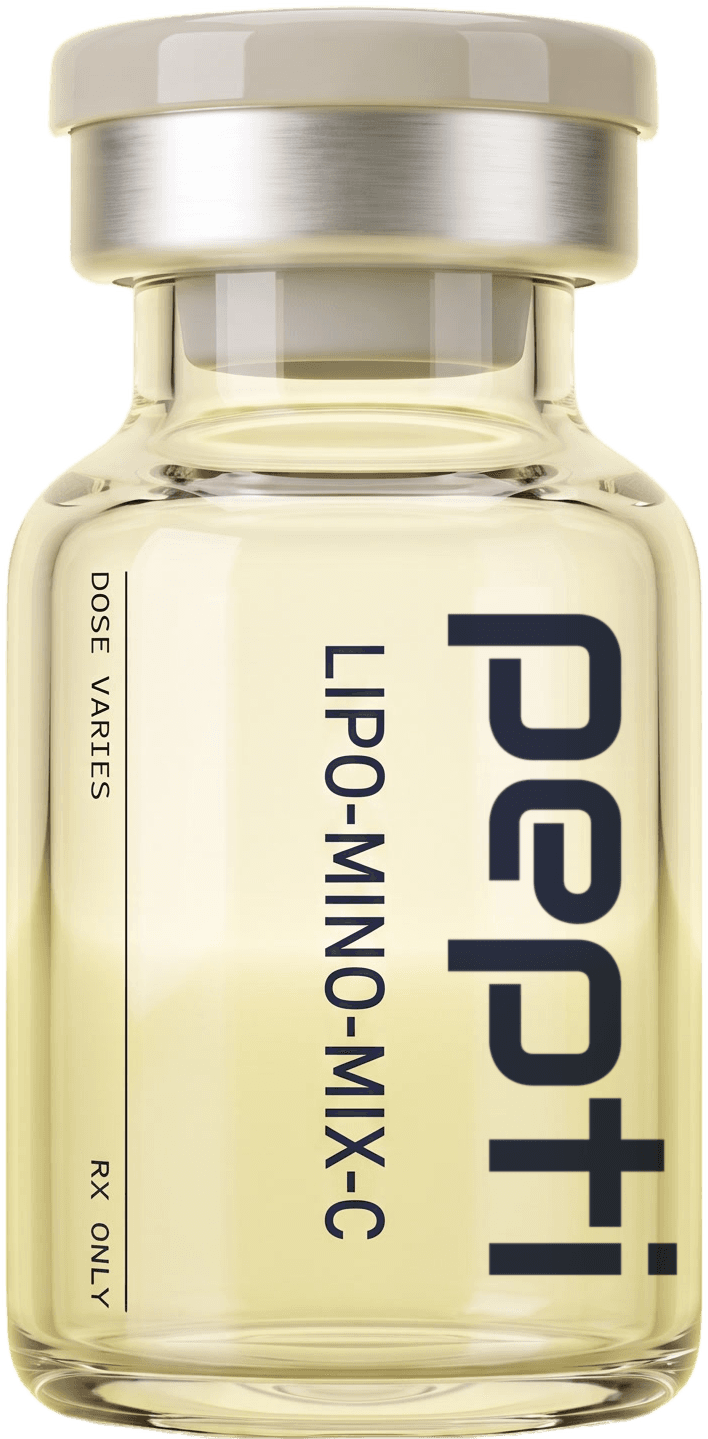
Lipo-Mino-Mix-C is a prescription injection supplied as vial — LIPO-C (MIC + B12) 10 mL. The reviewed directions are: Inject 0.8 mL (80 units) intramuscularly three times weekly. That is 12 doses per vial, about 2.4 weeks at as directed. It requires a prescription from a physician licensed in your state, is compounded by a state-licensed US pharmacy, and is not FDA approved.
This page covers what Lipo-Mino-Mix-C is, what each of its six components is and the roles researchers have described for it, what the published work does and does not establish — including the honest position on weight, which is weaker than most marketing suggests — where each component currently stands with the FDA, how a vial is dosed, and how to get it prescribed.
Lipo-Mino-Mix-C
What Lipo-Mino-Mix-C actually is
Six nutrients, one vial — and not a peptide
Lipo-Mino-Mix-C is not a peptide, and it is not a single molecule. It is a compounded mixture of three lipotropic nutrients — methionine, inositol and choline, the "MIC" on the label — with three B vitamins: pyridoxine (B6), thiamine (B1) and cyanocobalamin (B12). All six are substances the body already uses in ordinary metabolism, and all six are available in food. The pharmacy dissolves them together in a sterile 10 mL multi-dose vial to a physician's prescription.
That shapes how to read this page. A nutrient mix has to be broken into six questions with six different answers. Some of the six have decades of human evidence for a specific job; the combination, injected into people who are not deficient, has almost none.
Component What it is Where it acts Methionine An essential amino acid Methyl-group donor; precursor of S-adenosylmethionine Inositol A sugar-alcohol the body makes and takes from food Membrane phospholipids and insulin-signalling messengers Choline An essential nutrient Phosphatidylcholine; packaging fat for export from the liver Pyridoxine (B6) A water-soluble vitamin Cofactor in amino-acid metabolism, including the homocysteine pathway Thiamine (B1) A water-soluble vitamin Cofactor in carbohydrate energy metabolism Cyanocobalamin (B12) The stable, synthetic form of vitamin B12 Cofactor for the enzyme that recycles homocysteine to methionine Where the name comes from
"Lipo" is short for lipotropic. The word dates from 1930s animal nutrition research, when rats fed diets lacking choline accumulated fat in the liver and adding choline — and later methionine, which the body can route toward choline — prevented it. A lipotropic substance, in that original sense, is one that helps the liver move fat out rather than store it. "Mino" refers to the amino acid in the mix, and "MIC" is pharmacy shorthand for methionine, inositol and choline. The suffix designates the pharmacy's formulation, which here adds pyridoxine and thiamine alongside the B12.
The name describes the liver-fat biology the ingredients were first studied for. It does not describe a proven effect on body weight, and the two should not be confused.
What it is not
It is not a weight-loss medication. Nothing in it acts on appetite, gastric emptying or energy expenditure the way a GLP-1 medication does, and no randomised trial has shown that it changes weight. It is not a stimulant; the "energy" prescribers describe is the correction of a B12 or B1 shortfall where one exists. It is not a hormone, a steroid, a growth-hormone secretagogue or a peptide. And it is not a substitute for the diet and activity a weight-management program rests on.
Lipo-Mino-Mix-C
How each component is described to work
The mechanisms below are established nutritional biochemistry, worked out in animal and cell studies and confirmed in human deficiency states. What is not established is that supplying more of them, by injection, to a person who is not deficient changes what those pathways produce.
Methionine: the methyl donor at the top of the cycle
Methionine is one of the nine essential amino acids and the direct precursor of S-adenosylmethionine, the body's principal methyl-group donor. Methyl groups are needed to make phosphatidylcholine, the phospholipid that coats the particles the liver uses to export fat. A 2008 review in the Annual Review of Nutrition covers methionine metabolism in the liver, including animal work in which disrupted methionine handling leads to fat accumulation and the observation that the same enzymes are altered in human liver disease.
Inositol: a signalling sugar in the insulin pathway
Inositol, mostly as myo-inositol, is built into cell-membrane phospholipids and into the second messengers that relay part of the insulin signal inside cells. Its place in a lipotropic mix comes from older animal work in which inositol-deficient diets produced fatty liver in some species, and from a more recent human literature — almost entirely oral, at gram-level daily doses — on inositol and insulin sensitivity in women with polycystic ovary syndrome.
Choline: packaging fat for export from the liver
Choline has the clearest lipotropic mechanism. It is required to make phosphatidylcholine, which is required to assemble very-low-density lipoprotein, the particle that carries triglyceride out of the liver. When choline is short, that assembly stalls and fat stays in the liver. A 2009 review in Nutrition Reviews sets out the biology and why choline is classed as an essential nutrient.
Vitamins B6, B1 and B12: cofactors for the same pathways
The three vitamins are not lipotropic in their own right; they are included because the pathways above depend on them. B12 is the cofactor for methionine synthase, which regenerates methionine from homocysteine. B6 is the cofactor for the enzymes that route homocysteine down the alternative transsulfuration pathway. B1 is the cofactor for the enzymes that move carbohydrate through the energy cycle. In a person deficient in any of the three, the relevant pathway slows; in a person who is replete, additional vitamin is excreted.
Why "lipotropic" describes a deficiency effect
Every mechanism above describes what happens when a nutrient is missing. Choline deficiency causes fatty liver, and restoring choline resolves it. B12 deficiency causes anaemia and fatigue, and restoring B12 corrects them. That is a different claim from "more of the nutrient produces more of the effect in someone who already has enough," and the research supports the first claim far better than the second.
Lipo-Mino-Mix-C
What the research actually shows
Choline deficiency and liver fat in humans
This is the strongest human evidence for any component, and it concerns deficiency. A 1995 study in Hepatology followed adults on long-term intravenous nutrition who had developed fatty liver; when intravenous choline was added to their feeding, the steatosis resolved. A 2007 study in the American Journal of Clinical Nutrition placed healthy adults on a choline-depleted diet under controlled conditions and reported that most developed fatty liver or muscle damage, which cleared when choline was restored. These studies show choline is essential and that its absence produces liver fat. They do not show that extra choline reduces liver fat, or body fat, in a person eating a normal diet.
Vitamin B12 deficiency
B12 has the deepest clinical literature of the six. A 2013 clinical-practice review in the New England Journal of Medicine covers diagnosis and treatment of deficiency, which is common in older adults, in people on metformin or acid-suppressing medication, in vegans and in anyone with impaired absorption. Injected B12 corrects deficiency reliably. A 2005 Cochrane review reported that high-dose oral B12 was as effective as intramuscular injection at correcting deficiency in the trials available, so the injection route here is a matter of formulation rather than superior effect, except where absorption is genuinely impaired.
Inositol and insulin signalling
A 2017 meta-analysis of randomised controlled trials in Endocrine Connections pooled trials of oral myo-inositol in women with polycystic ovary syndrome and reported effects on insulin-related measures in that population. Two qualifications apply: the trials used oral inositol at gram-level daily doses, and the population was women with a specific endocrine condition. Neither maps onto an injected mix given three times a week to a general weight-management population, and no trial has tested that use.
Weight and body composition
This is the question most people arrive with, and the answer is short. There are no randomised controlled trials of lipotropic injections — this combination or any similar methionine–inositol–choline preparation — for weight loss or body composition in humans. A PubMed search for lipotropic injections and weight outcomes returns no such trial as of September 2026. The clinical use rests on the deficiency biology above, on the long history of these injections in weight-management clinics, and on prescriber experience. That is a thin basis for a weight claim, and this page does not make one.
What human data exists
Per component, because there is none for the combination:
- Choline: controlled human depletion and repletion studies, and intravenous repletion in patients on parenteral nutrition. Strong for deficiency; nothing for weight.
- Cyanocobalamin (B12): extensive human evidence for correcting deficiency, including randomised comparisons of oral and intramuscular routes. No trial shows benefit in people who are not deficient.
- Inositol: randomised trials of oral myo-inositol in women with PCOS. No injectable trials; no general-population weight trials.
- Methionine, pyridoxine and thiamine: well-characterised roles and deficiency states. No injectable trials for weight or energy in replete people.
- The six together, by injection: no randomised controlled trials in humans.
What the evidence does not establish
- That the injection reduces body weight or body fat in anyone. That trial has not been run.
- That it "supports fat metabolism" in a person whose nutrient status is already normal. The mechanisms are deficiency mechanisms.
- That injecting these nutrients does anything oral intake would not, except in people with impaired absorption of B12.
- An effect size or a timeline for any outcome. Timelines described by prescribers are clinical experience.
- Efficacy for any condition as an FDA-approved treatment. The compounded mix is not approved for anything.
Lipo-Mino-Mix-C
Where Lipo-Mino-Mix-C stands with the FDA right now
A compounded mixture has no regulatory status of its own; the FDA regulates the bulk substances a pharmacy compounds from, not the pharmacy's name for a blend. So the question is where each of the six components stands, and — unlike the peptide side of the catalog — none has been the subject of recent FDA action. The position below was checked against the FDA's own pages in September 2026.
The three routes a 503A pharmacy can use
Under section 503A, a state-licensed pharmacy may compound with a bulk substance that complies with an applicable United States Pharmacopeia or National Formulary monograph; that is a component of an FDA-approved drug product, where no monograph exists; or that appears on the FDA's 503A bulks list. Substances nominated for that list but not yet decided sit in one of three categories under the agency's interim policy: Category 1 (under evaluation, where FDA does not intend to take enforcement action), Category 2 (identified significant safety risks) and Category 3 (nominated without adequate support).
Where each component sits, as of the 14 May 2026 list
Cyanocobalamin, pyridoxine and thiamine are each the active ingredient of FDA-approved single-ingredient injections that have been on the market for decades. They can be compounded from bulk on that basis, and none of the three appears in any category of the 503A nominations list.
Choline chloride sits in Category 1 — "Bulk Drug Substances Under Evaluation" — on the FDA's 503A nominations list, updated 14 May 2026. That is the category in which the agency has said it does not intend to take enforcement action against compounding while the evaluation proceeds.
Methionine and inositol do not appear in any of the three categories on the same list; compounding of both proceeds under the monograph route rather than the bulks-list route.
None of the six is in Category 2. The May 2026 Category 2 list contains cesium chloride, domperidone, germanium sesquioxide, ibutamoren mesylate, kisspeptin-10 and quinacrine for intrauterine use — nothing found in this product. The FDA's 2026 actions on peptides — the April Category 2 removals and the July advisory committee votes — concern peptides only and touch nothing in this mix.
What that adds up to
No component of Lipo-Mino-Mix-C is restricted. Three of the six exist as FDA-approved injections in their own right; the compounded six-in-one preparation is not one of them, and it is not FDA approved as a finished product — compounded medications never are. They are prepared by a licensed pharmacy to a physician's prescription, not approved as manufactured products. See are peptides FDA approved; the same logic applies to compounded vitamins.
Lipo-Mino-Mix-C
Realistic expectations
These are patterns described by prescribers, not trial endpoints. For a nutrient mix the honest baseline is lower than for most products on this site: many people notice nothing at all, and that is the expected outcome in anyone who was not short of any of the six.
The first week
Injection-site soreness in the muscle is the commonest report. Cyanocobalamin can deepen the colour of urine, which is harmless. People who were B12- or B1-deficient sometimes describe a change in energy within days, because deficiency correction is fast; people who were not deficient generally describe nothing.
Weeks two to four
Where prescribers describe any change, it is usually the deficiency story again: less fatigue in someone whose B12 was low, steadier energy across the day. Nobody should expect the scale to move because of the injection itself. If weight is changing, it is the diet, activity or GLP-1 medication running alongside it.
Beyond a month
There is no described cumulative effect. The nutrients are water-soluble or rapidly metabolised, so the injection has to be repeated to maintain any deficiency correction. Whether continuing makes sense is a question for the physician at each refill, and often bloodwork should decide it.
If you stop
There is no withdrawal and no rebound. Anyone who was deficient will drift back toward deficiency over months unless the underlying cause — diet, absorption, a medication such as metformin — is addressed.
Lipo-Mino-Mix-C
When something else makes more sense
A lipotropic mix is the wrong tool more often than it is the right one, and a physician will say so. Some honest cases:
- Weight is the actual goal. Semaglutide and tirzepatide are the medications with large randomised trials behind them for weight; a lipotropic injection has none. If a physician prescribes a GLP-1, the mix is at most an adjunct to it.
- Only B12 is low. Methylcobalamin supplies the active form of B12 on its own, without five components you do not need.
- You want the lipotropic core without the extra vitamins. Lipo-B is the simpler MIC-plus-B12 preparation.
- The interest is carnitine. L-Carnitine is a separate injection with its own human literature; it is not a component of this mix.
- Nobody has checked your levels. At-home blood testing covers the markers that would tell a physician whether any deficiency exists. Testing first is more useful than injecting on the assumption.
- You are looking for a metabolic peptide. AOD-9604, 5-Amino-1MQ and the SHRED and PHYSIQ blends are a different conversation, with their own limited evidence.
Your physician will tell you if Lipo-Mino-Mix-C is not the right tool for what you have described. A consultation does not guarantee a prescription, and being declined is refunded.
Lipo-Mino-Mix-C
Dosing, and how a vial is actually used
| Question | Answer |
|---|---|
| Standard dose | 0.8 mL, 80 units on a U-100 insulin syringe |
| Schedule | Three times weekly, as directed |
| Doses per 10 mL vial | 12 |
| Route | Intramuscular |
| Who sets the dose | The prescribing physician; it is printed on your vial |
| Storage | Refrigerated, with a beyond-use date on the label |
Why the dose is measured in units
The directions are written in millilitres and in insulin-syringe units because that is what you can read off the barrel. 0.8 mL is 80 units on a U-100 syringe. You are not calculating anything — the number is printed on your medication. Because the six components are in fixed proportion, every dose delivers the same split; if a physician wants a different balance, the components are prescribed separately.
Intramuscular, and where
Unlike most products on this site, this one is directed into the muscle, not the fat layer — the conventional route for B-vitamin injections. The usual sites are the deltoid, the upper outer quadrant of the buttock and the outer thigh, rotated so the same spot is not used repeatedly. Needle length matters more for an intramuscular injection than a subcutaneous one; use what is supplied with your directions and ask before substituting anything.
Why a vial covers about four weeks at three times a week
A 10 mL vial at 0.8 mL per dose gives 12 doses. At the directed three times weekly, that is four weeks of dosing, which is why refills run on a 28-day cycle. One vial per fill, always — not a stockpile.
Storage
Refrigerated, and it ships that way in insulated packaging with ice packs. Beyond-use dating runs from first puncture and is on the label. B vitamins degrade with light and time and the vial is entered repeatedly, so keep it in its carton in the fridge and check the date before each dose.
Lipo-Mino-Mix-C
Safety and side effects
Each of the six components has a long safety record as an injected or oral nutrient, and the mix is generally described by prescribers as well tolerated. What gets reported is mostly the injection: muscle soreness at the site, redness, occasional bruising. Some people notice transient warmth or flushing, and cyanocobalamin commonly deepens the colour of urine.
A few points are specific to individual components. Cyanocobalamin injections carry a labelled caution for people with Leber's hereditary optic neuropathy and for anyone with a known sensitivity to cobalt or cobalamin; hypersensitivity reactions to injected B vitamins, including thiamine, are rare but documented. Pyridoxine at high cumulative doses over months is associated with sensory neuropathy, which is why the intake asks about every supplement you take, not only prescriptions. Methionine is metabolised through homocysteine, so anyone with a known homocysteine disorder should say so. Reduced kidney function changes how water-soluble vitamins are cleared and is worth discussing before starting.
There is no interaction list specific to the combination, because the trials that would produce one have not been run. That is why the intake asks for every medication you take and why a physician reviews it rather than a form.
Stop and contact your physician for any reaction that is severe, spreading, or involves difficulty breathing.
Lipo-Mino-Mix-C
How Lipo-Mino-Mix-C compares
Lipo-Mino-Mix-C vs Lipo-B
Both are built on the same methionine–inositol–choline core with B12. Lipo-B stops there; Lipo-Mino-Mix-C adds pyridoxine and thiamine. Neither has trial evidence for weight, and the choice is a physician's judgement about whether the extra B vitamins are wanted, not a question of which is stronger.
Lipo-Mino-Mix-C vs Methylcobalamin
Methylcobalamin is a single-ingredient B12 injection in the active form; the B12 in this mix is cyanocobalamin, which the body converts. For a documented B12 deficiency, a physician will usually prefer the single ingredient, and the Cochrane evidence that high-dose oral B12 corrects deficiency as well as injection applies to both.
Lipo-Mino-Mix-C vs a GLP-1 medication
They are not comparable. Semaglutide and tirzepatide are medications with large randomised controlled trials for weight; Lipo-Mino-Mix-C is a nutrient mix with none. A physician may include the mix alongside a GLP-1 program, but nobody should choose it instead of one expecting a similar result.
Lipo-Mino-Mix-C
Availability and formats
| Question | Answer |
|---|---|
| Can I get it by telehealth? | Yes, where a physician licensed in your state prescribes it |
| Which states? | All 50 states and DC |
| Does it come as a pen? | No, this one is a vial and syringe only |
| Does it come as a capsule? | No |
| Does it come as a nasal spray? | No |
| Is bloodwork required first? | Not routinely; your physician decides |
Lipo-Mino-Mix-C
Where to get Lipo-Mino-Mix-C prescribed
Lipo-Mino-Mix-C cannot be bought legitimately without a prescription. Sites shipping it with no prescription are selling a research-use-only product, where no pharmacy is accountable for identity, purity, sterility or concentration.
The prescription route works like this:
- Complete a medical intake covering your history, medications, allergies and what you are treating.
- A physician licensed in your state reviews it.
- If appropriate, a state-licensed, FDA-registered pharmacy compounds it to that prescription.
- It ships refrigerated with your directions printed on the vial.
- Your physician stays reachable afterwards for dose questions and side effects.
Current all-in pricing for Lipo-Mino-Mix-C is published: medication, physician review, refill management and shipping in one figure, with no separate membership fee. What to check on any provider is in how to tell if a peptide seller is legitimate.
Lipo-Mino-Mix-C
Who should not take it, or should discuss it first
| Situation | Why |
|---|---|
| Pregnancy or breastfeeding | Not used; safety data is absent |
| Tested athletes | Many peptides are prohibited in competition; check the current list |
Full specification
Everything on the label.
Product
Lipo-Mino-Mix-C (Injectable)
How supplied
vial — LIPO-C (MIC + B12) 10 mL
Typical directions
Inject 0.8 mL (80 units) intramuscularly three times weekly.
Dose volume
0.8 mL (80 units on a U-100 insulin syringe)
Doses per vial
12
Coverage per vial
about 2.4 weeks at as directed
Formats
Vial and syringe
Available in
All 50 states and DC
Bloodwork
Not routinely required; your physician decides
Legal status
Prescription-only, compounded, not FDA approved
Category
Supplements
References
What this is based on.
References
- Stabler SP. Clinical practice. Vitamin B12 deficiency · N Engl J Med (2013) · PMID 23301732
- Buchman AL, Dubin MD, Moukarzel AA et al.. Choline deficiency: a cause of hepatic steatosis during parenteral nutrition that can be reversed with intravenous choline supplementation · Hepatology (1995) · PMID 7590654
- Fischer LM, daCosta KA, Kwock L et al.. Sex and menopausal status influence human dietary requirements for the nutrient choline · Am J Clin Nutr (2007) · PMID 17490963
- Vidal-Alaball J, Butler CC, Cannings-John R et al.. Oral vitamin B12 versus intramuscular vitamin B12 for vitamin B12 deficiency · Cochrane Database Syst Rev (2005) · PMID 16034940
- Unfer V, Facchinetti F, Orrù B et al.. Myo-inositol effects in women with PCOS: a meta-analysis of randomized controlled trials · Endocr Connect (2017) · PMID 29042448
- Mato JM, Martínez-Chantar ML, Lu SC. Methionine metabolism and liver disease · Annu Rev Nutr (2008) · PMID 18331185
Citations are provided for educational purposes. They do not constitute medical advice. Always discuss any peptide protocol with your prescribing physician.
Common questions
Lipo-Mino-Mix-C, answered.
Through a telehealth provider where a physician licensed in your state reviews a medical intake and a licensed US pharmacy compounds the prescription. Pepti prescribes Lipo-Mino-Mix-C in all 50 states and DC; start with the free assessment.
vial — LIPO-C (MIC + B12) 10 mL
Inject 0.8 mL (80 units) intramuscularly three times weekly. Your physician sets your own dose and it is printed on your medication.
12 at the standard volume, about 2.4 weeks at as directed.
Lipo-Mino-Mix-C is supplied as a vial, drawn with an insulin syringe. It is not available as a pen or capsule.
Not routinely, though your physician may want labs depending on your history. at-home blood testing covers hormone, metabolic and thyroid markers without a lab visit.
It is legal to prescribe and dispense in the United States with a valid prescription. It is not FDA approved: compounded medications are prepared by licensed pharmacies pursuant to a prescription rather than approved as manufactured products. See are peptides FDA approved.
Pricing is published on the Lipo-Mino-Mix-C page as one all-in figure covering medication, physician review, refill management and shipping. What drives peptide pricing generally is in how much do peptides cost.
There is no randomised controlled trial showing that it does. The components are nutrients whose best-established effects are the correction of deficiency — choline for liver fat, B12 and B1 for fatigue and anaemia — not weight reduction in people who are not deficient. Physicians who include it in a weight-management program treat it as an adjunct; the weight change, where it happens, comes from the rest of the program.
No. It is a mixture of an amino acid (methionine), two nutrients (inositol and choline) and three B vitamins (B6, B1 and B12). None of them is a peptide, a hormone or a growth-hormone secretagogue.
Both contain the methionine–inositol–choline core with B12. Lipo-B stops there; Lipo-Mino-Mix-C adds pyridoxine (B6) and thiamine (B1). Neither has trial evidence for weight, and the choice is a physician's call.
Intramuscular is the conventional route for B-vitamin injections and it is what the reviewed directions specify. The usual sites are the deltoid, the upper outer buttock and the outer thigh. Follow the directions printed on your vial; if you have been told a different route for another product, do not carry it across.
Patients commonly do, and there is no described interaction between these nutrients and a GLP-1 medication. Tell your prescriber everything you take, including supplements, because pyridoxine adds up across products. On benefit, the GLP-1 is doing the work.
Cyanocobalamin, the stable synthetic form, which the body converts to the active forms. Methylcobalamin is available separately for anyone whose physician prefers the active form.
Vitamins and amino acids are not prohibited as a class, and nothing in this mix is a peptide hormone. Sports bodies do have rules on injections and infusions, so if you are a tested athlete check the current prohibited list and your sport's rules on injectable products before starting, and tell your physician.
Next step
See what a physician recommends for you.
A licensed physician in your state reviews your intake and decides what is appropriate. A consultation does not guarantee a prescription.