Anti-Aging · Reference
How Long Does SS-31 Take to Work? What the Elamipretide Trials Measured, and When
No study has measured how long SS-31 takes to work in healthy adults, so there is no timeline for energy, fatigue or ageing.
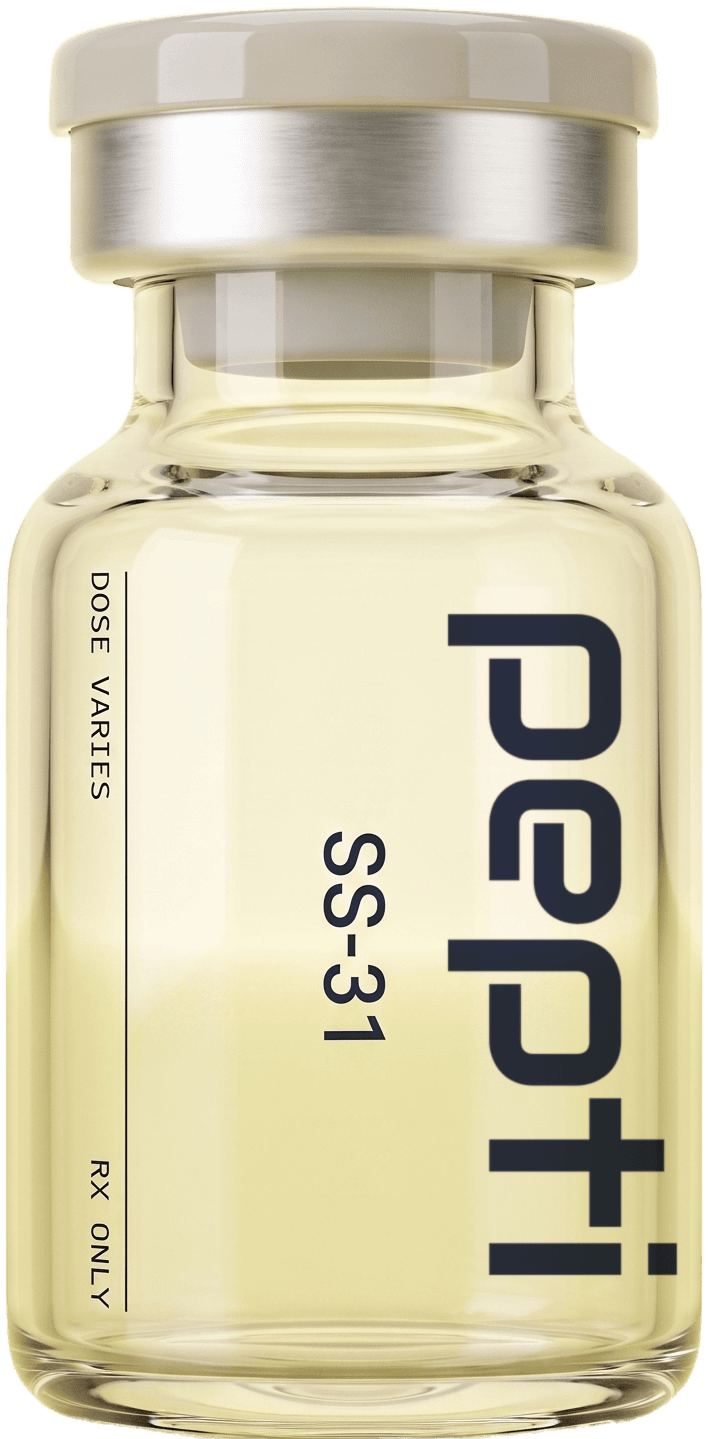
Treatments mentioned
What does exist is a human trial programme with clear durations: five days, four weeks, 28 days, 12 weeks, 24 weeks and 48 weeks of randomised treatment, plus open-label follow-up to 168 weeks, all in people with rare or serious diseases and almost all at 40 mg daily. The randomised primary endpoints were missed in every disease studied; the positive results came from open-label follow-up in Barth syndrome, reported at 36 and 168 weeks. Pepti's typical directions deliver 0.5 mg per dose, and compounded SS-31 is not FDA approved.
This page lays out each trial, how long it ran and what it found, explains why those durations cannot be applied to a compounded weekday injection, and covers what to track instead.
How Long Does SS-31 Take to Work? What the Elamipretide Trials Measured, and When
The short answer
| Trial | Who | How long it ran | What it found on the main measure |
|---|---|---|---|
| Intravenous study, Neurology, 2018 | 36 adults with primary mitochondrial myopathy | Five days | A dose-dependent walk-distance signal just short of significance |
| MMPOWER-2, 2020 | 30 adults with mitochondrial myopathy, crossover | Four weeks per arm, 40 mg daily | Walk difference not significant; patient-reported fatigue improved |
| PROGRESS-HF, Journal of Cardiac Failure, 2020 | 71 people with reduced-ejection-fraction heart failure | 28 days, 4 mg or 40 mg daily | Heart volume on MRI not different from placebo |
| TAZPOWER, Genetics in Medicine, 2021 | 12 males aged 12 to 35 with Barth syndrome, crossover | 12 weeks per arm, 40 mg daily | Neither primary endpoint met |
| TAZPOWER open-label extension | 10, then 8, of the same participants | To 36 weeks, then 168 weeks (reported 2024) | A 95.9 metre walk gain at 36 weeks, sustained at 168, with fatigue and some cardiac measures improved |
| MMPOWER-3, Neurology, 2023 | 218 people with primary mitochondrial myopathy | 24 weeks, 40 mg daily | Neither walk distance nor fatigue improved |
| ReCLAIM-2, Ophthalmology Science, 2024 | 176 people with dry macular degeneration | 48 weeks, 40 mg daily | Primary endpoints missed; a secondary retinal measure favoured treatment |
Every row is a diagnosed disease. Every row except the heart failure trial used 40 mg a day. None enrolled healthy adults.
How Long Does SS-31 Take to Work? What the Elamipretide Trials Measured, and When
What the trial durations do and do not tell you
Short trials were short by design, and mostly negative
The five-day, four-week and 28-day trials were early tests of whether anything moved quickly. The five-day intravenous study found a walking signal that fell just short of significance. The four-week crossover found a fatigue improvement that reached significance and a walk difference that did not. The 28-day heart failure trial found no difference on its main measure or on ejection fraction. None of that adds up to "SS-31 works within a month". It adds up to small, mixed signals in people who were ill.
The largest trial ran six months and was negative
MMPOWER-3 is the clearest test of the "more energy, less fatigue" idea at the full trial dose. It randomised 218 people for 24 weeks, and the walk and fatigue differences were close to zero. The authors classify it as Class I evidence that elamipretide does not improve walking distance or fatigue at 24 weeks in that population. A 2024 post hoc analysis found one genetic subgroup trended toward benefit, which is hypothesis-generating by definition. This is the trial most relevant to anyone asking about fatigue, and its answer at six months was no.
The positive results came late, and without a control group
In Barth syndrome, the randomised 12-week phase missed its endpoints. In the open-label extension that followed, participants who continued on 40 mg daily showed a 95.9 metre gain in walk distance at 36 weeks, and the 168-week report described that gain sustained, fatigue below baseline at every visit, and improved heart volumes. That extension was the basis for the FDA's September 2025 accelerated approval of the branded drug for Barth syndrome, resting on knee extensor strength as an intermediate endpoint. It is ten people with a rare genetic disorder of cardiolipin, with no placebo arm, and it is not a timeline for anyone without that disorder.
The eye trial ran nearly a year
ReCLAIM-2 treated 176 people for 48 weeks and missed its primary endpoints. A pre-specified secondary measure, progression of a specific kind of photoreceptor-layer loss, was reduced by 43 per cent. A secondary result is a reason for another trial, not a demonstrated effect, and its duration says something about how slowly retinal disease is measured rather than how fast SS-31 acts.
How Long Does SS-31 Take to Work? What the Elamipretide Trials Measured, and When
The mechanism is fast; the evidence for a felt effect is not
SS-31 binds cardiolipin, the lipid that holds the folds of the inner mitochondrial membrane in shape. In the foundational rat work, in the Journal of the American Society of Nephrology in 2013, pre-treatment protected kidney mitochondria from collapsing during a loss of blood flow, and ATP recovered much faster once blood flow returned. That is a fast effect in an acute injury model. It is the theoretical basis for every use outside the trials, and it is a mechanism, not a timeline for how a healthy person feels.
The dose matters too. Every efficacy trial except the heart failure one used 40 mg daily. Pepti's typical directions deliver 0.5 mg per dose, one eightieth of that. Even where a trial found something, its timing belongs to a dose about eighty times higher.
How Long Does SS-31 Take to Work? What the Elamipretide Trials Measured, and When
What your directions look like
| What the label shows | Value |
|---|---|
| Product | SS-31 (Elamipretide), 5 mL multi-dose vial at 2 mg/mL (10 mg per vial) |
| Typical directions | Inject 0.25 mL (25 units) subcutaneously Monday through Friday mornings |
| SS-31 per dose | 0.5 mg (2 mg/mL x 0.25 mL) |
| Doses per vial | 20, about four weeks |
| Price | $249/mo, all-in |
Refills run every 28 days, one vial per fill. Vials ship ready to use, refrigerated with ice packs, with sterile syringes and alcohol prep pads. Your physician sets your directions after reviewing your intake, and they are printed on the vial. The conversion chart is in SS-31 dosage.
How Long Does SS-31 Take to Work? What the Elamipretide Trials Measured, and When
What to track, and when to message your care team
Subjective energy is the outcome most open to expectation, and it moves with sleep, stress, illness and season. A record is the only way to tell a change from a good week.
| Keep a note of | Why |
|---|---|
| The specific thing you hope will change, written before you start | So you are not choosing afterwards from whatever moved |
| A short daily energy note, at the same time of day | Memory flatters the start and the end |
| Sleep, illness and unusual stress | The ordinary causes of tiredness |
| Injection-site redness, itching, pain or bruising | Reported by most participants in every trial; usually mild |
| Any kidney problem | The approved product's label reduces the dose in severe kidney impairment |
Tiredness most often has an ordinary cause: iron, thyroid, B12, sleep, mood or medication. Peptides for energy and fatigue covers what is usually looked at first.
Message your care team about an injection-site reaction that does not settle or anything new. Hives beyond the injection site, facial or throat swelling or difficulty breathing is an emergency: call 911, then tell your physician. The approved label warns of serious allergic reactions. More is in SS-31 side effects. Do not raise your own dose; a trial dose is not a target.
How Long Does SS-31 Take to Work? What the Elamipretide Trials Measured, and When
What the evidence shows, honestly
SS-31 has a specific, well-described mechanism and one of the largest human trial programmes of any peptide prescribed as a compound. That programme is mostly negative on its randomised primary endpoints, with one positive open-label story in Barth syndrome. There are no trials in healthy adults, for energy, fitness or ageing, and no evidence that the compounded dose does what the trial dose did.
On regulation: a branded elamipretide product received FDA accelerated approval in September 2025 for Barth syndrome only, with a confirmatory trial a condition of that approval. Since then elamipretide has been a component of an approved drug, which makes it eligible for 503A compounding subject to the FDA's "essentially a copy" rule; it has never been on the FDA's Category 2 list. The compounded vial is not the approved product, and compounded medications are not FDA approved. The benefit-by-benefit evidence is in SS-31 benefits and the reference is what is SS-31.
How Long Does SS-31 Take to Work? What the Elamipretide Trials Measured, and When
Where to get SS-31 prescribed
SS-31 cannot be bought legitimately without a prescription. Sites selling it "for research use only" are not accountable for identity, purity, sterility or concentration. The prescription route:
- Complete a free online intake covering your history, medications and what you want help with.
- A physician licensed in your state reviews it, usually within 24 hours.
- If it is appropriate, a PCAB-accredited, FDA-registered US 503A compounding pharmacy prepares it to that prescription. Lot test results are published at /quality/lab-results.
- It ships refrigerated with your directions printed on the vial.
- Your physician stays reachable for questions and side effects.
Pepti prescribes SS-31 in every state except Oklahoma, plus DC, cash-pay, with no insurance billing and no membership fee. Step by step: how to get SS-31 prescribed online.
Common questions
How Long Does SS-31 Take to Work? What the Elamipretide Trials Measured, and When, answered.
No study has measured that in healthy adults. The trials ran from five days to 48 weeks of randomised treatment in people with serious diseases, mostly at 40 mg daily, and missed their primary endpoints. The positive results came from open-label follow-up in Barth syndrome at 36 and 168 weeks.
Five days intravenously, four weeks and 28 days in early trials, 12 weeks per arm in the Barth syndrome crossover, 24 weeks in the 218-person phase 3, and 48 weeks in the macular degeneration trial. The Barth syndrome open-label extension ran to 168 weeks.
No study has measured energy in healthy people. In mitochondrial myopathy, a four-week crossover found a fatigue improvement, but the 24-week phase 3 found no difference in fatigue.
The randomised 12-week phase did not meet its endpoints, and the improvements were reported in open-label follow-up at 36 weeks and later. Without a control group, that time course cannot be separated from other changes over the same period, and it applies to a rare genetic disease.
No. The trials mostly used 40 mg daily. Pepti's typical directions deliver 0.5 mg per dose, one eightieth of that.
No. Take the dose printed on your vial, on the schedule printed on your vial. Tell your care team what you are and are not noticing.
About four weeks: 20 doses of 0.25 mL, Monday through Friday mornings.
Yes. SS-31 is the research name and elamipretide the generic name. The compounded vial is the same molecule at a different strength from the approved product.
Compounded SS-31 is not FDA approved. A branded elamipretide product has accelerated approval for Barth syndrome only.
No. Bloodwork is not required for any Pepti treatment. If your physician wants labs for your care, they'll ask through your account. The free assessment goes to a physician licensed in your state. A consultation does not guarantee a prescription.
Related answers
Keep reading.
- SS-31 (Elamipretide): What It Is, Where to Get It Prescribed, and What It Costs
- Is SS-31 (Elamipretide) Banned in Sports? WADA Status and Drug Tests
- SS-31 Peptide Benefits: What the Elamipretide Research Actually Shows
- SS-31 Peptide Dosage: How Pepti Prescribes Elamipretide, in Units, mL and mg
- How Long Does SYNAPSE Blend Take to Work? What Each Component's Studies Measured, and When
Next step
See what a physician recommends for you.
A licensed physician in your state reviews your intake to see whether treatment fits your history. A consultation does not guarantee a prescription.