Anti-Aging · Reference
SS-31 (Elamipretide) Side Effects: Injection-Site Reactions, Allergy Warnings, and What to Report
This page is a practical reference to what is reported, how often, what to watch and when to message your care team. What SS-31 is, how it is described to work, its trial results and where the compounded vial stands with the FDA are in what is SS-31.
Treatments mentioned
The main side effect of SS-31 (elamipretide) is injection-site reactions, and they are common: in the human trials they were reported by most participants, usually mildly, as itching, pain, bruising and redness at the site. In the Barth syndrome trial every treated participant had some local reaction, against two thirds on placebo, and in a four-week myopathy trial the rate was 80 per cent. Systemically, the trials report elamipretide as well tolerated across hundreds of people for up to a year. The serious warning on the FDA-approved version's label is hypersensitivity, including serious allergic reactions, and its dose is reduced in severe kidney impairment.
This page is a practical reference to what is reported, how often, what to watch and when to message your care team. What SS-31 is, how it is described to work, its trial results and where the compounded vial stands with the FDA are in what is SS-31.
SS-31 (Elamipretide) Side Effects
The short answer
| Side effect | How common in the trials | What to do |
|---|---|---|
| Injection-site reactions: itching, pain, bruising, redness | The dominant effect: every treated participant in TAZPOWER, 80% in MMPOWER-2 | Rotate sites; report anything spreading or worse after 48 hours |
| Adverse events of any kind | 86% on treatment against 71% on placebo in ReCLAIM-2 | Read the placebo column: most people on placebo reported something too |
| Hypersensitivity, including serious allergic reactions | A warning on the approved label | Hives beyond the site, swelling or trouble breathing: call 911 |
| Systemic side effects in heart failure | Adverse event rates similar across groups in PROGRESS-HF | Report anything new |
| Severe kidney impairment | The approved label reduces the dose | Tell your physician if it applies |
The product this page covers:
| Product | What is in it | Typical printed directions | Price |
|---|---|---|---|
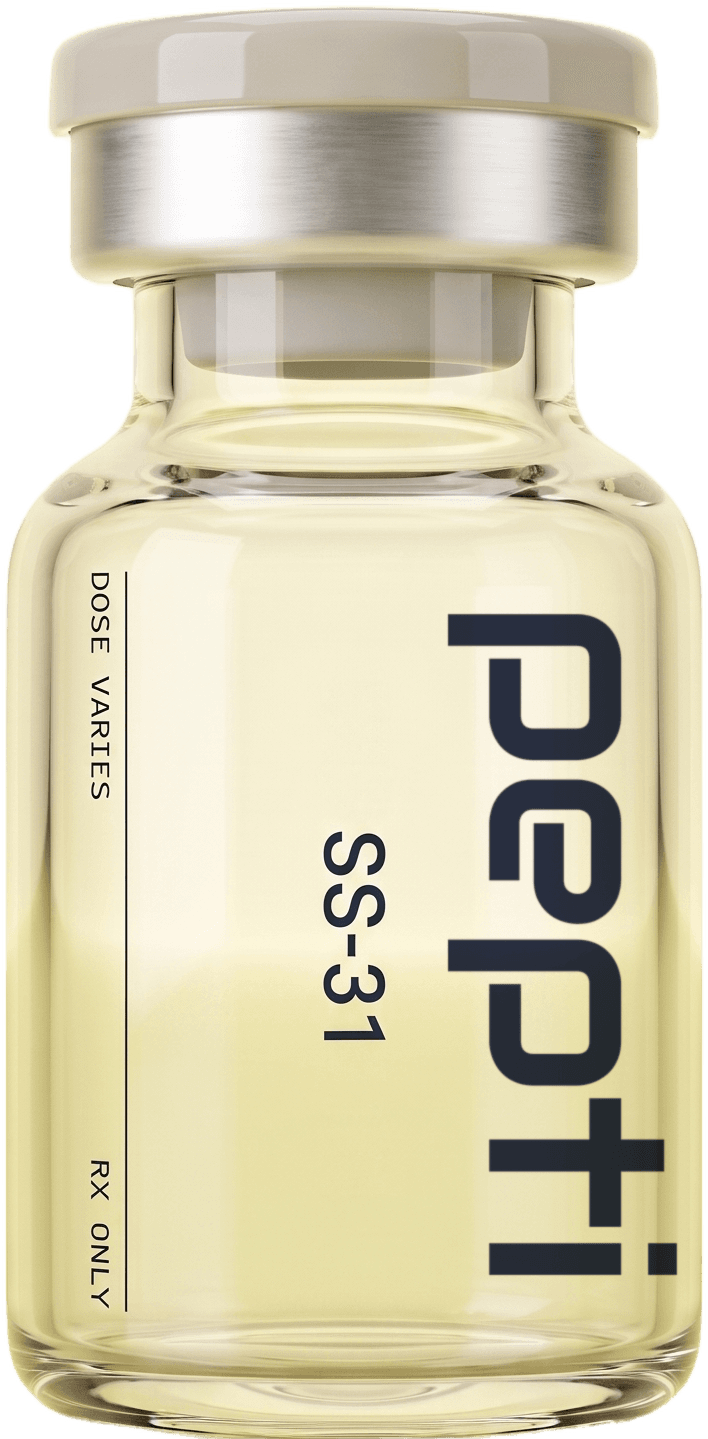
| SS-31 (Elamipretide) | 5 mL multi-dose vial, SS-31 2 mg/mL (10 mg per vial) | 0.25 mL (25 units) subcutaneously Monday through Friday mornings | $249/mo |
At 2 mg/mL, 0.25 mL is 0.5 mg of SS-31 per dose (arithmetic from the vial strength, on a U-100 insulin syringe), and a vial holds 20 doses, about four weeks of weekday dosing. Your own directions are set by your physician after reviewing your intake and are printed on the vial. The price is all-in: medication, physician review, refill management and shipping, with no membership fee. SS-31 is compounded by a PCAB-accredited, FDA-registered US 503A pharmacy. Compounded medications are not FDA approved.
SS-31 (Elamipretide) Side Effects
Why SS-31 has an unusually good safety record to draw on
SS-31 is a four-amino-acid peptide that concentrates on the inner mitochondrial membrane, where it binds a lipid called cardiolipin. Under its generic name, elamipretide, it has been through randomised, double-blind, placebo-controlled trials in four diseases, at 40 mg subcutaneously daily, for four to 48 weeks, with open-label follow-up to 168 weeks in Barth syndrome. In September 2025 the FDA granted accelerated approval to a branded elamipretide product for Barth syndrome, a rare genetic disease. That gives SS-31 a larger human safety record than almost any other compounded peptide, and an approved label to read warnings from.
Two cautions apply to every number on this page:
- The trials used 40 mg daily. The typical printed direction for the compounded vial delivers 0.5 mg on weekdays, a small fraction of that. Side-effect rates measured at the trial dose may not apply at a much lower dose, in either direction, and no study has measured them at the compounded dose.
- The trials enrolled people with diagnosed diseases. There is no safety database in healthy adults.
SS-31 (Elamipretide) Side Effects
Injection-site reactions: the side effect that dominates
What the trials recorded
| Trial | Who | What was reported |
|---|---|---|
| TAZPOWER (Genetics in Medicine, 2021) | 12 males with Barth syndrome, 40 mg daily, crossover | Every treated participant had some local reaction, against two thirds on placebo |
| MMPOWER-2 (Journal of Cachexia, Sarcopenia and Muscle, 2020) | 30 adults with primary mitochondrial myopathy, 40 mg daily for four weeks | Injection-site reactions in 80%, mostly mild |
| ReCLAIM-2 (Ophthalmology Science, 2024) | 176 adults with dry macular degeneration, 40 mg daily for 48 weeks | Adverse events of any kind in 86% against 71% on placebo; itching, pain, bruising and redness at the site the most common |
| PROGRESS-HF (Journal of Cardiac Failure, 2020) | 71 adults with heart failure, 4 mg or 40 mg daily for 28 days | Adverse event rates similar across groups |
Injection-site reactions are frequent, usually mild, and the main reason people stop. Notice the placebo figures: two thirds of people on a dummy injection in TAZPOWER had a local reaction, and 71% on placebo in ReCLAIM-2 reported some adverse event. A daily needle and a volume of fluid cause reactions on their own.
Reducing them
SS-31 is injected under the skin, into the fat layer, usually in the abdomen or outer thigh, rotating sites. The Monday-through-Friday schedule is a prescriber convention that rests the injection sites; the trials all dosed every day. A small lump that appears as you inject and softens over a day or two is fluid in the tissue. One that appears days later and is warm, spreading or more painful each day is different and needs a same-day message. Technique is in how to inject peptides safely.
| Site reaction | What it usually is | What to do |
|---|---|---|
| Redness, itching or soreness that settles in a day or two | Local irritation | Rotate sites |
| Bruising | Local, from the needle | Rotate sites |
| A small lump at the time of injection that softens | Fluid in the tissue | Normal |
| A warm, spreading or worsening site after 48 hours | Possible infection | Message your care team the same day |
| Hives spreading beyond the site | Possible allergic reaction | Stop and contact your care team; call 911 if breathing or swallowing is affected |
SS-31 (Elamipretide) Side Effects
Hypersensitivity: the serious warning
The approved elamipretide label warns of hypersensitivity reactions, including serious allergic reactions. Pepti's general side-effect guide notes that the approved label describes hypersensitivity reactions that required emergency intervention and could appear anywhere from minutes to months after starting. That timing matters: a reaction is not ruled out because the first few weeks went smoothly.
Signs to act on: hives beyond the injection site, swelling of the face, lips, tongue or throat, throat tightness, difficulty breathing, or faintness. Call 911 first. Tell your care team afterwards, because the reaction goes on your record and changes what can be prescribed to you again.
SS-31 (Elamipretide) Side Effects
The kidney point and other label details
| Label point | What it says | What it means for you |
|---|---|---|
| Severe kidney impairment | The approved label reduces the dose | Tell your physician if you have kidney disease |
| Benzyl alcohol | The approved label warns about it for neonates | Not relevant to adults; a compounded preparation may use a different preservative system, and the pharmacy label will say |
| Single-patient vial | The approved product's vial is discarded eight days after opening | The compounded vial is multi-dose; its beyond-use dating runs from first puncture and is on the label |
SS-31 (Elamipretide) Side Effects
What is not known
- Safety in healthy adults. Every randomised trial enrolled people with a diagnosed disease.
- Side effects at the compounded dose. The trials used 40 mg daily; nobody has measured what happens at 0.5 mg on weekdays.
- Interactions. There is no formal interaction list, which is why a physician reviews every medication you take.
- Very long-term use. The longest follow-up is a small Barth syndrome group for more than three years.
No withdrawal, rebound or dependency is described anywhere in the literature, and the peptide is cleared within hours.
SS-31 (Elamipretide) Side Effects
Where SS-31 stands with the FDA
Elamipretide is not on the FDA's Category 2 list of substances flagged for significant safety risk and never has been. Since September 2025 it has been a component of an FDA-approved drug, which makes it eligible for 503A compounding without a bulks-list entry, subject to the FDA's "essentially a copy" rule. The approved product is an 80 mg/mL solution given as 40 mg daily for Barth syndrome; the compounded vial is a different strength, prepared to an individual prescription, and not FDA approved. If you have Barth syndrome, the approved product through a specialist is the right path.
SS-31 (Elamipretide) Side Effects
Serious reactions: what needs urgent care
| Symptom | What it may be | What to do |
|---|---|---|
| Swelling of the face, lips or throat, widespread hives, trouble breathing, faintness | Serious allergic reaction | Call 911 first, then tell your care team |
| Chest pain | Needs emergency assessment, whatever the cause | Call 911 |
| You think you injected far more than your directions | Possible overdose | Call Poison Control at 1-800-222-1222 and message your care team |
| An injection site that is hot, spreading or worse after 48 hours | Possible infection rather than irritation | Message your care team the same day |
| A reaction that is severe or spreading | Not an expected effect | Stop and contact your care team |
SS-31 (Elamipretide) Side Effects
When to message your care team
- site reactions that are getting worse over weeks rather than settling
- itching or hives anywhere other than the injection site
- you are diagnosed with kidney disease, or told your kidney function has fallen
- you start any new medication
- you become pregnant or plan to
SS-31 (Elamipretide) Side Effects
Who should not take SS-31, or should discuss it first
| Situation | Status |
|---|---|
| Previous allergic reaction to elamipretide or an ingredient of the vial | Rules it out |
| Severe kidney impairment | Discuss first; the approved label reduces the dose |
| Barth syndrome or a diagnosed primary mitochondrial disease | Specialist care with the approved product, not a compounded vial |
| Pregnancy or breastfeeding | Not used; safety data is absent |
| Tested athletes | Check your sport's current prohibited list |
| Under 18 | Pepti prescribes to adults only |
Bloodwork is not required for any Pepti treatment. If your physician wants labs for your care, they'll ask through your account.
SS-31 (Elamipretide) Side Effects
SS-31 vs MOTS-c and NAD+ side effects
All three get called mitochondrial treatments, and their side-effect profiles differ. MOTS-c has no human safety trial; what is reported is mostly injection-site reactions and some transient jitteriness after a morning dose. NAD+ produces flushing, chest tightness, nausea and site stinging when it goes in quickly. SS-31 has the largest human safety record of the three, dominated by injection-site reactions. No trial has tested any combination. The wider category is in peptides for energy and fatigue.
SS-31 (Elamipretide) Side Effects
What the evidence shows, honestly
Elamipretide's side-effect profile is measured, not inferred: several randomised, placebo-controlled trials, hundreds of participants, up to a year of treatment, and more than three years of follow-up in a small group. It is consistent: injection-site reactions dominate, systemic effects are similar to placebo, and the approved label's serious warning is hypersensitivity. The limits are equally clear. Those trials used 40 mg daily in people with diseases, and the compounded vial is prescribed at a small fraction of that dose for uses the trials did not test. The rates on this page describe the molecule at the trial dose, not the vial at the compounded dose. The general picture is in peptide side effects: what to watch for.
SS-31 (Elamipretide) Side Effects
Where to get SS-31 prescribed
SS-31 cannot be bought legitimately without a prescription. Products sold "for research use only" have no accountable pharmacy behind their identity, purity, sterility or concentration. The prescription route:
- Complete a free online intake covering your history, medications, allergies and what you want help with.
- A physician licensed in your state reviews it, usually within 24 hours.
- If it is appropriate, a PCAB-accredited, FDA-registered US 503A compounding pharmacy prepares it to that prescription. Lot test results are published at /quality/lab-results.
- It ships refrigerated with ice packs, with sterile syringes and alcohol prep pads, and your directions printed on the vial.
- Your care team stays reachable for side effects and questions. Refills run every 28 days, one vial per fill.
Pepti is cash-pay and does not bill insurance, and prescribes SS-31 in every state except Oklahoma, plus DC The step-by-step page is how to get SS-31 prescribed online.
References
What this is based on.
References
- Szeto HH. First-in-class cardiolipin-protective compound as a therapeutic agent to restore mitochondrial bioenergetics · Br J Pharmacol (2014) · PMID 24117165
- Birk AV, Liu S, Soong Y et al.. The mitochondrial-targeted compound SS-31 re-energizes ischemic mitochondria by interacting with cardiolipin · J Am Soc Nephrol (2013) · PMID 23813215
- Reid Thompson W, Hornby B, Manuel R et al.. A phase 2/3 randomized clinical trial followed by an open-label extension to evaluate the effectiveness of elamipretide in Barth syndrome, a genetic disorder of mitochondrial cardiolipin metabolism · Genet Med (2021) · PMID 33077895
- Thompson WR, Manuel R, Abbruscato A et al.. Long-term efficacy and safety of elamipretide in patients with Barth syndrome: 168-week open-label extension results of TAZPOWER · Genet Med (2024) · PMID 38602181
- Karaa A, Bertini E, Carelli V et al.. Efficacy and Safety of Elamipretide in Individuals With Primary Mitochondrial Myopathy: The MMPOWER-3 Randomized Clinical Trial · Neurology (2023) · PMID 37268435
- Karaa A, Haas R, Goldstein A et al.. A randomized crossover trial of elamipretide in adults with primary mitochondrial myopathy · J Cachexia Sarcopenia Muscle (2020) · PMID 32096613
- Karaa A, Haas R, Goldstein A et al.. Randomized dose-escalation trial of elamipretide in adults with primary mitochondrial myopathy · Neurology (2018) · PMID 29500292
- Karaa A, Bertini E, Carelli V et al.. Genotype-specific effects of elamipretide in patients with primary mitochondrial myopathy: a post hoc analysis of the MMPOWER-3 trial · Orphanet J Rare Dis (2024) · PMID 39574155
- Ehlers JP, Hu A, Boyer D et al.. ReCLAIM-2: A Randomized Phase II Clinical Trial Evaluating Elamipretide in Age-related Macular Degeneration, Geographic Atrophy Growth, Visual Function, and Ellipsoid Zone Preservation · Ophthalmol Sci (2024) · PMID 39605874
- Butler J, Khan MS, Anker SD et al.. Effects of Elamipretide on Left Ventricular Function in Patients With Heart Failure With Reduced Ejection Fraction: The PROGRESS-HF Phase 2 Trial · J Card Fail (2020) · PMID 32068002
- Zhao C, Zhuang X, Gao J. Elamipretide: The first cardiolipin-directed mitochondrial therapeutic for Barth syndrome approved under accelerated approval · Drug Discov Ther (2026) · PMID 41260682
Citations are provided for educational purposes. They do not constitute medical advice. Always discuss any peptide protocol with your prescribing physician.
Common questions
SS-31 (Elamipretide) Side Effects, answered.
Overwhelmingly injection-site reactions: itching, pain, bruising and redness, reported by most participants in every trial and usually mild. The FDA-approved version's label also warns of hypersensitivity reactions, including serious allergic reactions.
Very common at the trial dose. Every treated participant in the Barth syndrome trial had some local reaction, against two thirds on placebo, and 80% did in a four-week myopathy trial. They were mostly mild, and they are the main reason people stop.
Its trials report it as well tolerated systemically across hundreds of people for up to a year, at 40 mg daily, in people with diseases. There is no safety database in healthy adults, and no study at the compounded dose. Long-term safety in healthy adults is not established.
Yes. The approved label warns of hypersensitivity reactions, including serious allergic reactions, which can appear from minutes to months after starting. Hives beyond the injection site, swelling of the face or throat, or trouble breathing need 911.
The approved label reduces the dose in severe kidney impairment. Tell your physician if you have kidney disease or reduced kidney function.
Neither is described as a characteristic side effect in the trial summaries on Pepti's pages. In heart failure, adverse event rates were similar to placebo. Report anything new to your care team.
Nobody knows. Every trial used 40 mg daily, and the typical compounded direction delivers 0.5 mg on weekdays. Injection-site reactions come partly from the needle and fluid themselves, so they are possible at any dose.
No withdrawal, rebound or dependency is described anywhere in the literature. The peptide is cleared within hours.
No, and it never has been. Since September 2025 elamipretide has been a component of an FDA-approved drug for Barth syndrome, which makes it eligible for 503A compounding subject to the "essentially a copy" rule. The compounded vial is not FDA approved.
For swelling of the face or throat, widespread hives, trouble breathing or faintness, call 911. If you think you injected far more than your directions, call Poison Control at 1-800-222-1222 and message your care team. For a site that is hot, spreading or worse after 48 hours, message your care team the same day. The free assessment goes to a physician licensed in your state. A consultation does not guarantee a prescription.
Next step
See what a physician recommends for you.
A licensed physician in your state reviews your intake and decides what is appropriate. A consultation does not guarantee a prescription.