Anti-Aging · Reference
SS-31 (Elamipretide): What It Is, Where to Get It Prescribed, and What It Costs
This page covers what SS-31 is, the mechanism researchers have described, what its unusually large human trial programme does and does not establish, how the 2025 approval of the branded version affects a compounded vial, how it is dosed, and how to get it prescribed.

Reviewed by Dr. Gene, MD · Board-certified Family Medicine
Every Pepti prescription is reviewed by a licensed U.S. physician before it's dispensed — and only provided if clinically appropriate.
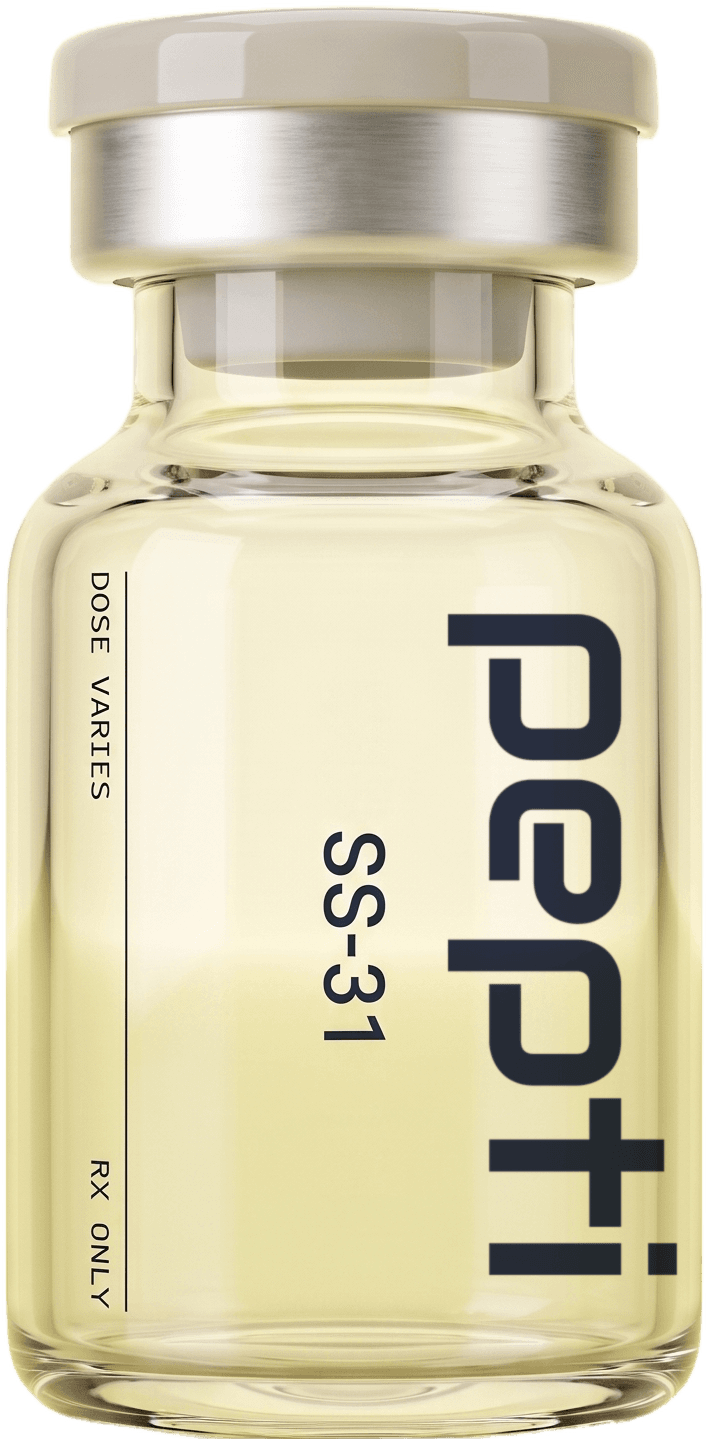
SS-31 (Elamipretide) is a prescription injection supplied as 5 mL multi-dose vial, SS-31 2 mg/mL (10 mg SS-31 per vial). The reviewed directions are: Inject 0.25 mL (25 units) subcutaneously Monday through Friday mornings. That is 20 doses per vial, about 4 weeks at Monday through Friday. It requires a prescription from a physician licensed in your state, is compounded by a state-licensed US pharmacy, and is not FDA approved.
This page covers what SS-31 is, the mechanism researchers have described, what its unusually large human trial programme does and does not establish, how the 2025 approval of the branded version affects a compounded vial, how it is dosed, and how to get it prescribed.
SS-31 (Elamipretide)
What SS-31 actually is
A four-amino-acid peptide that goes to one place in the cell
SS-31 is a tetrapeptide — four amino acids in an alternating aromatic and cationic pattern. That pattern lets it cross cell membranes freely and concentrate on the inner mitochondrial membrane without a transporter and without depending on the mitochondrion's membrane potential, so it still reaches mitochondria that are in trouble.
Once there it binds a single lipid, cardiolipin, found almost exclusively in the inner mitochondrial membrane, where it holds the membrane's folds (the cristae) in shape and organises the respiratory complexes for efficient electron transport. The 2014 review in the British Journal of Pharmacology that describes its discovery calls it a cardiolipin-protective compound. That is the whole of the mechanism, and it is more specific than most peptides can claim.
Why it has three names
The compound was developed by Hazel Szeto and Peter Schiller, so the research literature calls it SS-31; its development code was MTP-131; its generic drug name is elamipretide, and in September 2025 the FDA approved a branded version, Forzinity, for one rare genetic disease. All three names are the same molecule. What differs between a paper and a label is the dose, the formulation and the population studied, which is covered below.
What it is not
It is not a hormone, a growth hormone secretagogue or a metabolic signal in the way MOTS-c is, and it does not move anything on a standard blood panel. It is not a general antioxidant — the research describes it preventing one kind of reactive oxygen at one site. And it is not an approved treatment for ageing, fatigue, athletic performance or "mitochondrial health" in people without a mitochondrial disease. Those uses are an extrapolation from the disease work, and this page says so plainly.
SS-31 (Elamipretide)
How SS-31 is described to work
Four linked mechanisms come up across the published work. The mechanistic detail is from cell and animal studies; the human trials measured function, not mitochondrial biochemistry.
Binding cardiolipin and holding the cristae in shape
The foundational finding, in the Journal of the American Society of Nephrology in 2013, used a fluorescent analogue of the peptide to show high-affinity binding to cardiolipin. In rat kidneys subjected to ischaemia, pre-treatment protected the cristae from collapsing and prevented mitochondrial swelling. Cristae are where ATP is made; if their structure goes, so does the capacity to make energy, however much fuel is available.
Stopping cytochrome c from behaving as a peroxidase
Cytochrome c normally carries electrons along the respiratory chain. When it binds oxidised cardiolipin it starts acting as a peroxidase, oxidising the lipid it sits on in a self-reinforcing loop that damages the membrane. The 2013 work reports that the SS-31–cardiolipin complex inhibits that peroxidase activity while leaving the electron-carrying role intact. This is the specific sense in which SS-31 "reduces reactive oxygen species": preventing one source rather than mopping up afterwards.
Restoring ATP production after an energy deficit
With the cristae protected, the same animal work reports much faster recovery of ATP once blood flow returns. The 2014 review extends this to the broader claim that a cardiolipin-protective compound can restore bioenergetics across conditions that share energy failure. That claim is the theoretical basis for every off-label use; whether it holds in a given human population is what the trials tested.
Correcting the cardiolipin ratio in Barth syndrome
Barth syndrome is caused by variants in TAZ, whose product remodels cardiolipin into its mature form; affected individuals accumulate monolysocardiolipin relative to cardiolipin, and that MLCL/CL ratio is the diagnostic biomarker. The 168-week open-label extension of the Barth syndrome trial, in Genetics in Medicine in 2024, reports the ratio improving on treatment and correlating with clinical outcomes — the one human population where a mitochondrial biomarker was tracked alongside function.
SS-31 (Elamipretide)
What the research actually shows
SS-31 has more human trial data than almost any other peptide on this site. The results are mixed, and the honest reading requires holding both halves at once.
Barth syndrome (TAZPOWER)
TAZPOWER, in Genetics in Medicine in 2021, was a randomised, double-blind, placebo-controlled crossover in twelve males aged 12 to 35 with genetically confirmed Barth syndrome: 40 mg daily or placebo for 12 weeks, a washout, then the opposite. Neither primary endpoint — the six-minute walk test and the Barth Syndrome Symptom Assessment — was met in the randomised part.
Ten participants continued open-label on 40 mg daily. At 36 weeks the paper reports a 95.9-metre gain in walk distance (p = 0.024), a 2.1-point symptom improvement (p = 0.031), and improvements in knee extensor strength and some cardiac parameters. The 168-week results, in 2024, report the walk gain sustained (96.1 metres, p = 0.003), fatigue scores below baseline at every visit, and improved left ventricular volumes. Eight of ten reached the final visit.
The FDA's accelerated approval rested on knee extensor strength as an intermediate endpoint, not on the failed primaries. A confirmatory trial is a condition of approval and is running now.
Primary mitochondrial myopathy (MMPOWER)
The largest programme and the clearest negative result.
A five-day intravenous study in Neurology in 2018 (36 adults) reported a dose-dependent walk-distance signal that fell just short of significance (p = 0.053). MMPOWER-2, in the Journal of Cachexia, Sarcopenia and Muscle in 2020, was a 30-person crossover of 40 mg daily for four weeks: a 19.8-metre walk difference that did not reach significance (p = 0.083), a patient-reported fatigue improvement that did (p = 0.0006), and injection-site reactions in 80 per cent.
MMPOWER-3, in Neurology in 2023, was the pivotal phase 3: 218 participants on 40 mg daily or placebo for 24 weeks. It did not meet either primary endpoint. The walk-distance difference was −3.2 metres (p = 0.69) and the fatigue-score difference −0.07 (p = 0.37). The authors classify it as Class I evidence that elamipretide does not improve walking distance or fatigue at 24 weeks in this population.
A post hoc analysis in Orphanet Journal of Rare Diseases in 2024 found the subgroup with nuclear-DNA replisome variants (mostly POLG and TWNK) trended toward benefit (p = 0.06). That is hypothesis-generating by definition and is the basis for a further trial in that narrower group; it does not rescue the main result.
Heart failure (PROGRESS-HF)
PROGRESS-HF, in the Journal of Cardiac Failure in 2020, randomised 71 patients with reduced-ejection-fraction heart failure to placebo, 4 mg or 40 mg daily for 28 days. The primary endpoint, change in left ventricular end-systolic volume on cardiac MRI, was not different from placebo at either dose, nor was ejection fraction. Adverse event rates were similar across groups.
Dry age-related macular degeneration (ReCLAIM-2)
ReCLAIM-2, in Ophthalmology Science in 2024, randomised 176 patients with dry AMD and non-central geographic atrophy 2:1 to 40 mg daily or placebo for 48 weeks. It did not meet its primary endpoints (low-luminance visual acuity and atrophy area). On a pre-specified secondary measure, treatment was associated with a 43 per cent reduction in progression of complete ellipsoid-zone loss (nominal p = 0.0034), and more patients gained ten or more letters of low-luminance acuity (14.6 versus 2.1 per cent). The company's phase 3 eye programme is built on that endpoint.
What human data exists
Elamipretide has been studied in randomised, double-blind, placebo-controlled trials in four diseases, at 40 mg subcutaneously daily, for four to 48 weeks, with open-label follow-up to 168 weeks in Barth syndrome. The randomised primary endpoints were missed in every indication. The positive findings are the sustained open-label improvements in Barth syndrome including the strength result behind the accelerated approval, a fatigue signal in the short myopathy crossover, a genotype subgroup in the phase 3, and a photoreceptor-preservation secondary endpoint in AMD.
There are no randomised human trials of elamipretide in healthy adults, in age-related fatigue, in athletic performance or in any wellness or longevity indication. The compounded vial on this page is prescribed for uses the trials did not test, at a dose the trials did not use.
What the evidence does not establish
- It does not establish benefit in people without a mitochondrial disease.
- It does not establish that the compounded dose does what the trial dose did. The trials used 40 mg daily; the directions here deliver 0.25 mL of a 2 mg/mL solution, a small fraction of that even at the higher strength.
- It does not establish an effect on walking distance or fatigue in the largest population studied. MMPOWER-3 is a clean negative on those endpoints.
- It does not establish an effect size or timeline for any off-label use. What prescribers describe is clinical experience.
- It does not establish long-term safety in healthy adults.
SS-31 (Elamipretide)
Where SS-31 stands with the FDA right now
This is unusual among compounded peptides, because the branded and compounded versions are in different regulatory positions.
Forzinity is an FDA-approved drug for Barth syndrome
On 19 September 2025 the FDA granted accelerated approval to Forzinity (elamipretide), from Stealth BioTherapeutics, "to improve muscle strength in patients with Barth syndrome weighing at least 30 kg." The approved product is an 80 mg/mL solution given as 40 mg subcutaneously once daily, and its label carries a hypersensitivity warning and a benzyl alcohol warning for neonates. Accelerated approval means the FDA accepted knee extensor strength as an intermediate endpoint reasonably likely to predict benefit, on condition that a confirmatory trial is completed. That 72-week placebo-controlled study, 4TAZPower, dosed its first patient in July 2026; Stealth now operates as a subsidiary of Mighty Therapeutics.
Forzinity is approved for one rare disease. It is not approved for primary mitochondrial myopathy, heart failure, macular degeneration or any wellness use.
What that means for a compounded vial
The vial on this page is not Forzinity. It is prepared by a state-licensed compounding pharmacy to an individual prescription, at a different concentration, and it is not FDA approved as a finished drug product — compounded medications never are.
Under section 503A a bulk substance is eligible for compounding if it has a USP or NF monograph, is a component of an FDA-approved drug product, or appears on the 503A bulks list. Since September 2025 elamipretide satisfies the second condition on its own, so the bulks-list nomination process that governs BPC-157 and most other peptides does not apply to it in the same way. It is not on the FDA's Category 2 list of substances flagged for significant safety risk and never has been.
The condition that now applies is the FDA's "essentially a copy" rule: a 503A pharmacy may not regularly compound a drug that is essentially a copy of a commercially available approved product unless the prescriber determines that a change in strength, dosage form or route produces a significant difference for that patient, and documents it. A 2 mg/mL multi-dose vial dosed in insulin-syringe units is a different strength from an 80 mg/mL single-patient vial; whether that difference is meaningful for you is the prescriber's determination, under the same framework that governs compounded semaglutide and tirzepatide.
So as of September 2026: the active ingredient is a component of an FDA-approved drug; compounding it is available under 503A subject to the essentially-a-copy rule; the compounded product itself is not approved and not on any FDA safety-concern list.
SS-31 (Elamipretide)
Realistic expectations
These are patterns described by prescribers, not trial endpoints. The trials measured walking distance, fatigue scores, muscle strength and retinal imaging in people with specific diseases, and even there the timelines were long. Individual response varies and a physician decides whether treatment is appropriate at all.
The first two to four weeks
In MMPOWER-2, four weeks of the full trial dose produced a fatigue improvement and a walking-distance change that did not reach significance. At a compounded dose, prescribers generally describe the first vial as a tolerability period: injection-site reactions settling and subjective energy either changing or not. Noticing nothing in the first month is common and is not evidence either way.
One to three months
If the mechanism is doing anything in a given person, this is where prescribers describe subjective reports clustering — steadier energy through the day, less post-exertional fatigue. Nobody has measured this in healthy adults, and subjective energy is the outcome most susceptible to expectation.
Beyond three months
The Barth syndrome extension is the only long-duration human data; its gains accrued over 36 weeks and held to 168 weeks, at the full dose, in a population that does not resemble most people reading this page. That should temper any expectation of a fast response.
After stopping
No withdrawal, rebound or dependency is described anywhere in the literature. The peptide is cleared within hours. Whether any subjective change persists is the same open question that applies to stopping any mitochondrial intervention.
SS-31 (Elamipretide)
When something else makes more sense
A reference that only ever recommends its own product is not much of a reference. Some honest cases where SS-31 is not the first thing to reach for:
- You have Barth syndrome or a diagnosed primary mitochondrial disease. Forzinity is an approved drug with a specialist pathway. A compounded vial at a fraction of the trial dose is not a substitute for that care.
- Your fatigue has an ordinary explanation. Iron, thyroid, B12, sleep and testosterone account for far more tiredness than mitochondrial dysfunction does. At-home blood testing will find those, and methylcobalamin or NAD+ may be the more direct answer.
- You want a metabolic peptide rather than a structural one. MOTS-c works by signalling to the nucleus rather than protecting the inner membrane; the FUSION blend and EUPHORIA blend both build on it.
- Oxidative load is the concern rather than energy production. Glutathione addresses that directly and has its own human evidence.
- Exercise capacity is the goal. L-carnitine has human data on fatty-acid transport into mitochondria, a different bottleneck from the one SS-31 is described as addressing.
Your physician will tell you if SS-31 is not the right tool for what you have described. A consultation does not guarantee a prescription, and being declined is refunded.
SS-31 (Elamipretide)
Strengths available
| Strength | Directions |
|---|---|
| SS-31 (Elamipretide) 10mg/5mL | Inject 0.25 mL (25 units) subcutaneously Monday through Friday mornings. |
| SS-31 (Elamipretide) 50mg/5mL | Inject 0.25 mL (25 units) subcutaneously Monday through Friday mornings. |
A higher strength delivers more medication in the same volume. Which one you are prescribed is your physician's decision.
SS-31 (Elamipretide)
Dosing, and how a vial is actually used
Why the dose is measured in units
The directions are written in millilitres and insulin-syringe units because that is what you can read off the barrel. 0.25 mL is 25 units on a U-100 syringe. You are not calculating anything — the number is printed on your medication.
Subcutaneous, mornings, weekdays
Subcutaneous means into the fat layer, not the muscle. Abdomen and outer thigh are the usual sites, rotated. Mornings, because energy-related subjective effects are easier to judge across a day. Monday through Friday rather than daily is a prescriber convention that rests the injection sites; the trials all dosed every day.
Why a vial covers about four weeks
Twenty doses at five per week is four weeks, which is why refills run on a 28-day cycle. One vial per fill, always — not a stockpile. The compounded vial is multi-dose; the approved product's single-patient vial is discarded eight days after opening, one of several practical differences between the two.
Storage
Refrigerated, and it ships that way in insulated packaging with ice packs. Beyond-use dating runs from first puncture and is printed on the label; the pharmacy's dating governs, not the molecule's reputation for stability.
SS-31 (Elamipretide)
Safety and side effects
Elamipretide has a larger human safety record than almost any other compounded peptide, and it is consistent across every trial: injection-site reactions dominate. In TAZPOWER every treated participant had some local reaction, against two thirds on placebo. In MMPOWER-2 the rate was 80 per cent, mostly mild. In ReCLAIM-2, adverse events of any kind were reported in 86 per cent on treatment versus 71 per cent on placebo, with itching, pain, bruising and redness at the site the most common. These are frequent, usually mild, and the main reason people stop.
The approved label warns of hypersensitivity reactions, including serious allergic reactions, and reduces the dose in severe kidney impairment, which is worth telling your physician about if it applies. A compounded preparation may use a different preservative system from the approved product; the pharmacy label will say.
Systemically, the trials report elamipretide as well tolerated across hundreds of people for up to a year and a small group for more than three years. That is not a safety database in healthy adults, and there is no formal interaction list, which is why a physician reviews every medication you take.
Stop and contact your physician for any reaction that is severe, spreading, or involves difficulty breathing, swelling of the face or throat, or hives beyond the injection site.
SS-31 (Elamipretide)
How SS-31 compares
SS-31 vs MOTS-c
Both get called "mitochondrial peptides," which hides how different they are. SS-31 is a synthetic tetrapeptide that binds a lipid in the inner membrane and is described as protecting the machinery that makes ATP. MOTS-c is encoded by the mitochondrial genome and is described as a signal that travels to the nucleus and regulates metabolic genes. SS-31 has a substantial human trial programme; MOTS-c does not.
SS-31 vs NAD+
NAD+ is a substrate: it supplies a coenzyme the respiratory chain consumes. SS-31 supplies nothing; it is described as protecting the structure in which that coenzyme is used. Different bottlenecks; some prescribers use them together, though no trial has tested the combination.
SS-31 vs Forzinity
Same molecule, different products. Forzinity is approved, 80 mg/mL, 40 mg daily, for Barth syndrome, with a label and a confirmatory trial. The compounded vial is 2 mg/mL or 10 mg/mL, dosed at 0.25 mL by the directions above, prepared to your prescription, and not approved. If you have Barth syndrome, the approved product through a specialist is the right path. For any other use, neither is approved.
SS-31 (Elamipretide)
Availability and formats
| Question | Answer |
|---|---|
| Can I get it by telehealth? | Yes, where a physician licensed in your state prescribes it |
| Which states? | All 50 states and DC |
| Does it come as a pen? | No, this one is a vial and syringe only |
| Does it come as a capsule? | No |
| Does it come as a nasal spray? | No |
| Is bloodwork required first? | Not routinely; your physician decides |
SS-31 (Elamipretide)
Where to get SS-31 (Elamipretide) prescribed
SS-31 (Elamipretide) cannot be bought legitimately without a prescription. Sites shipping it with no prescription are selling a research-use-only product, where no pharmacy is accountable for identity, purity, sterility or concentration.
The prescription route works like this:
- Complete a medical intake covering your history, medications, allergies and what you are treating.
- A physician licensed in your state reviews it.
- If appropriate, a state-licensed, FDA-registered pharmacy compounds it to that prescription.
- It ships refrigerated with your directions printed on the vial.
- Your physician stays reachable afterwards for dose questions and side effects.
Current all-in pricing for SS-31 (Elamipretide) is published: medication, physician review, refill management and shipping in one figure, with no separate membership fee. What to check on any provider is in how to tell if a peptide seller is legitimate.
SS-31 (Elamipretide)
Who should not take it, or should discuss it first
| Situation | Why |
|---|---|
| Pregnancy or breastfeeding | Not used; safety data is absent |
| Tested athletes | Many peptides are prohibited in competition; check the current list |
Full specification
Everything on the label.
Product
SS-31 (Elamipretide) (Injectable)
How supplied
5 mL multi-dose vial, SS-31 2 mg/mL (10 mg SS-31 per vial)
Typical directions
Inject 0.25 mL (25 units) subcutaneously Monday through Friday mornings.
Dose volume
0.25 mL (25 units on a U-100 insulin syringe)
Doses per vial
20
Coverage per vial
about 4 weeks at Monday through Friday
Formats
Vial and syringe
Available in
All 50 states and DC
Bloodwork
Not routinely required; your physician decides
Strengths available
2
Legal status
Prescription-only, compounded, not FDA approved
Category
Anti-Aging
References
What this is based on.
References
- Szeto HH. First-in-class cardiolipin-protective compound as a therapeutic agent to restore mitochondrial bioenergetics · Br J Pharmacol (2014) · PMID 24117165
- Birk AV, Liu S, Soong Y et al.. The mitochondrial-targeted compound SS-31 re-energizes ischemic mitochondria by interacting with cardiolipin · J Am Soc Nephrol (2013) · PMID 23813215
- Reid Thompson W, Hornby B, Manuel R et al.. A phase 2/3 randomized clinical trial followed by an open-label extension to evaluate the effectiveness of elamipretide in Barth syndrome, a genetic disorder of mitochondrial cardiolipin metabolism · Genet Med (2021) · PMID 33077895
- Thompson WR, Manuel R, Abbruscato A et al.. Long-term efficacy and safety of elamipretide in patients with Barth syndrome: 168-week open-label extension results of TAZPOWER · Genet Med (2024) · PMID 38602181
- Karaa A, Bertini E, Carelli V et al.. Efficacy and Safety of Elamipretide in Individuals With Primary Mitochondrial Myopathy: The MMPOWER-3 Randomized Clinical Trial · Neurology (2023) · PMID 37268435
- Karaa A, Haas R, Goldstein A et al.. A randomized crossover trial of elamipretide in adults with primary mitochondrial myopathy · J Cachexia Sarcopenia Muscle (2020) · PMID 32096613
- Karaa A, Haas R, Goldstein A et al.. Randomized dose-escalation trial of elamipretide in adults with primary mitochondrial myopathy · Neurology (2018) · PMID 29500292
- Karaa A, Bertini E, Carelli V et al.. Genotype-specific effects of elamipretide in patients with primary mitochondrial myopathy: a post hoc analysis of the MMPOWER-3 trial · Orphanet J Rare Dis (2024) · PMID 39574155
- Ehlers JP, Hu A, Boyer D et al.. ReCLAIM-2: A Randomized Phase II Clinical Trial Evaluating Elamipretide in Age-related Macular Degeneration, Geographic Atrophy Growth, Visual Function, and Ellipsoid Zone Preservation · Ophthalmol Sci (2024) · PMID 39605874
- Butler J, Khan MS, Anker SD et al.. Effects of Elamipretide on Left Ventricular Function in Patients With Heart Failure With Reduced Ejection Fraction: The PROGRESS-HF Phase 2 Trial · J Card Fail (2020) · PMID 32068002
- Zhao C, Zhuang X, Gao J. Elamipretide: The first cardiolipin-directed mitochondrial therapeutic for Barth syndrome approved under accelerated approval · Drug Discov Ther (2026) · PMID 41260682
Citations are provided for educational purposes. They do not constitute medical advice. Always discuss any peptide protocol with your prescribing physician.
Common questions
SS-31 (Elamipretide), answered.
Through a telehealth provider where a physician licensed in your state reviews a medical intake and a licensed US pharmacy compounds the prescription. Pepti prescribes SS-31 (Elamipretide) in all 50 states and DC; start with the free assessment.
5 mL multi-dose vial, SS-31 2 mg/mL (10 mg SS-31 per vial)
Inject 0.25 mL (25 units) subcutaneously Monday through Friday mornings. Your physician sets your own dose and it is printed on your medication.
20 at the standard volume, about 4 weeks at Monday through Friday.
SS-31 (Elamipretide) is supplied as a vial, drawn with an insulin syringe. It is not available as a pen or capsule.
Not routinely, though your physician may want labs depending on your history. at-home blood testing covers hormone, metabolic and thyroid markers without a lab visit.
It is legal to prescribe and dispense in the United States with a valid prescription. It is not FDA approved: compounded medications are prepared by licensed pharmacies pursuant to a prescription rather than approved as manufactured products. See are peptides FDA approved.
Pricing is published on the SS-31 (Elamipretide) page as one all-in figure covering medication, physician review, refill management and shipping. What drives peptide pricing generally is in how much do peptides cost.
Same molecule, different product. Forzinity is the FDA-approved branded elamipretide, granted accelerated approval on 19 September 2025 to improve muscle strength in people with Barth syndrome weighing at least 30 kg, supplied at 80 mg/mL and dosed at 40 mg daily. The compounded vial on this page is a different strength, prepared to an individual prescription, and not FDA approved. Forzinity is not approved for any use outside Barth syndrome.
Mixed. The randomised parts of every trial missed their primary endpoints: TAZPOWER in Barth syndrome, MMPOWER-3 in primary mitochondrial myopathy (218 people), PROGRESS-HF in heart failure, and ReCLAIM-2 in dry macular degeneration. The positive findings are the sustained improvements in the Barth syndrome open-label extension over 168 weeks, including the strength result the FDA accepted for accelerated approval, and secondary endpoints in the myopathy and eye trials.
No. Every randomised trial enrolled people with a diagnosed disease. There are no randomised human trials of elamipretide in healthy adults, in age-related fatigue, in athletic performance or in any longevity indication.
The trials and the approved product use 40 mg daily. The directions on this page deliver 0.25 mL of a 2 mg/mL or 10 mg/mL solution, a small fraction of that. No trial shows what those doses do in any population. Your physician sets your dose and it is printed on the vial.
Injection-site reactions, overwhelmingly: redness, itching, pain and bruising, reported by most participants in every trial and usually mild. The approved product's label warns of hypersensitivity reactions including serious allergic reactions. There is no formal interaction list, which is why your physician reviews every medication you take.
It was never on it. Elamipretide does not appear on the FDA's Category 2 list and was not among the peptides removed in April 2026. Since September 2025 it has been a component of an FDA-approved drug, which makes it eligible for 503A compounding without a bulks-list entry, subject to the FDA's "essentially a copy" rule.
They work through different described mechanisms and some prescribers combine them. No trial has tested any combination. Whether one is appropriate for you is your physician's decision.
Next step
See what a physician recommends for you.
A licensed physician in your state reviews your intake and decides what is appropriate. A consultation does not guarantee a prescription.