Anti-Aging · Reference
SS-31 Peptide Benefits: What the Elamipretide Research Actually Shows
This page takes each claimed benefit in turn and says what was studied, in what, and how much weight it can bear. It is organised by benefit, not by molecule; for the biology, the FDA position and dosing in full, read what is SS-31 and SS-31 dosage.
Treatments mentioned
The benefits claimed for SS-31 (elamipretide) rest on a clear mechanism, binding cardiolipin in the inner mitochondrial membrane, and on one of the largest human trial programmes of any peptide. That programme is mixed: the randomised primary endpoints were missed in all four diseases studied, while open-label results in Barth syndrome were strong enough for an FDA accelerated approval of the branded drug in 2025. There are no human trials of SS-31 in healthy adults, for energy, fitness or ageing. SS-31 is a compounded prescription injection at Pepti; compounded medications are not FDA approved.
This page takes each claimed benefit in turn and says what was studied, in what, and how much weight it can bear. It is organised by benefit, not by molecule; for the biology, the FDA position and dosing in full, read what is SS-31 and SS-31 dosage.
SS-31 Peptide Benefits
The short answer
| Claimed benefit | What the evidence is | Strength of evidence |
|---|---|---|
| Protecting mitochondrial structure | Animal and cell (rat kidney, Journal of the American Society of Nephrology 2013) | Preclinical mechanism, well described |
| Faster recovery of cellular energy (ATP) | Animal (same 2013 work) | Preclinical only |
| Muscle strength and walking in Barth syndrome | Human: randomised crossover missed its primary endpoints (2021); open-label extension to 168 weeks reported gains (2024) | Human, open-label; basis of the 2025 accelerated approval |
| Walking and fatigue in primary mitochondrial myopathy | Human: phase 3 MMPOWER-3, 218 people, did not meet either primary endpoint (2023) | Human, negative on the main endpoints |
| Heart function in heart failure | Human: PROGRESS-HF, 71 people, primary endpoint not different from placebo (2020) | Human, negative |
| Slowing retinal damage in dry macular degeneration | Human: ReCLAIM-2, 176 people, missed primary endpoints; a secondary endpoint favoured treatment (2024) | Human, secondary endpoint only |
| More energy, less fatigue in healthy people | No human study; inferred from the mechanism and prescriber reports | No direct evidence |
| Healthy ageing, longevity | No human study | No direct evidence |
The honest summary of the table: a specific, well-characterised mechanism, a large and mostly negative randomised programme in rare and serious diseases, one positive open-label story in Barth syndrome, and nothing at all in the people who most often ask about it.
SS-31 Peptide Benefits
What SS-31 is, in one paragraph
SS-31 is a tetrapeptide, four amino acids in an alternating aromatic and cationic pattern, developed by Hazel Szeto and Peter Schiller. Its development code was MTP-131 and its generic drug name is elamipretide; all three names are the same molecule. The pattern lets it cross cell membranes and concentrate on the inner mitochondrial membrane without a transporter, where it binds a single lipid, cardiolipin, that holds the membrane's folds (the cristae) in shape and organises the respiratory complexes that make ATP. A 2014 review in the British Journal of Pharmacology calls it a cardiolipin-protective compound. It is not a hormone, not a growth hormone secretagogue, and not a general antioxidant. Every benefit below hangs off that cardiolipin story.
SS-31 Peptide Benefits
Benefit 1: Protecting mitochondrial structure
What the research describes. The foundational finding, in the Journal of the American Society of Nephrology in 2013, used a fluorescent analogue of the peptide to show high-affinity binding to cardiolipin. In rat kidneys subjected to ischaemia (loss of blood flow), pre-treatment protected the cristae from collapsing and prevented mitochondrial swelling.
The reactive oxygen angle. When cytochrome c, which normally carries electrons along the respiratory chain, binds oxidised cardiolipin, it starts acting as a peroxidase and damages the membrane it sits on. The same work reports that the SS-31 and cardiolipin complex inhibits that peroxidase activity while leaving the electron-carrying role intact. This is the specific sense in which SS-31 is said to "reduce reactive oxygen species": preventing one source at one site, rather than mopping up afterwards.
Evidence type. Animal and cell.
Strength. The best-characterised part of the SS-31 story, and more specific than most peptides can claim. It is a mechanism, not a benefit anyone has measured in a healthy person.
SS-31 Peptide Benefits
Benefit 2: Faster recovery of cellular energy
What the research describes. With the cristae protected, the 2013 animal work reports much faster recovery of ATP once blood flow returned. The 2014 review extends this to a broader idea: that a cardiolipin-protective compound could restore cellular energy production across conditions that share energy failure.
Evidence type. Animal.
What it means. That broader idea is the theoretical basis for every use of SS-31 outside the trials. Whether it holds in a given human population is exactly what the trials below tested, and in most of them it did not show up on the main endpoint.
SS-31 Peptide Benefits
Benefit 3: Barth syndrome
What the research describes. Barth syndrome is a rare genetic disorder in which cardiolipin is not remodelled into its mature form. TAZPOWER, in Genetics in Medicine in 2021, was a randomised, double-blind, placebo-controlled crossover in twelve males aged 12 to 35: 40 mg daily or placebo for 12 weeks each. Neither primary endpoint, the six-minute walk test and a symptom score, was met in the randomised part.
The open-label extension. Ten participants continued on 40 mg daily. At 36 weeks the paper reports a 95.9 metre gain in walk distance, a symptom improvement, and improvements in knee extensor strength and some cardiac measures. The 168-week results, in 2024, report the walk gain sustained, fatigue scores below baseline at every visit, improved heart volumes, and the diagnostic cardiolipin ratio improving on treatment. Eight of ten reached the final visit.
Evidence type. Human, randomised (negative) then open-label (positive).
Strength. The strongest human benefit for SS-31, and the basis for the FDA's September 2025 accelerated approval of the branded drug, which rested on knee extensor strength as an intermediate endpoint. A confirmatory trial is a condition of that approval. Open-label results in ten people with a rare disease are not evidence for anyone without it, and a compounded vial is not a substitute for specialist care in Barth syndrome.
SS-31 Peptide Benefits
Benefit 4: Walking and fatigue in primary mitochondrial myopathy
What the research describes. The largest programme. A five-day intravenous study in Neurology in 2018 (36 adults) reported a dose-dependent walk-distance signal that fell just short of significance. MMPOWER-2, in the Journal of Cachexia, Sarcopenia and Muscle in 2020, a 30-person crossover of 40 mg daily for four weeks, found a walk difference that did not reach significance and a patient-reported fatigue improvement that did.
The phase 3 result. MMPOWER-3, in Neurology in 2023, randomised 218 people to 40 mg daily or placebo for 24 weeks. It did not meet either primary endpoint: the walk and fatigue differences were close to zero. The authors classify it as Class I evidence that elamipretide does not improve walking distance or fatigue at 24 weeks in this population. A 2024 post hoc analysis in the Orphanet Journal of Rare Diseases found one genetic subgroup trended toward benefit, which is hypothesis-generating by definition.
Evidence type. Human, randomised.
What it means. This is the clearest test of the "more energy, less fatigue" idea in people with mitochondrial disease, at the full trial dose, and on its main endpoints it was negative. That matters for every fatigue claim made about SS-31.
SS-31 Peptide Benefits
Benefit 5: Heart function in heart failure
What the research describes. PROGRESS-HF, in the Journal of Cardiac Failure in 2020, randomised 71 people with reduced-ejection-fraction heart failure to placebo, 4 mg or 40 mg daily for 28 days. The primary endpoint, a heart volume measured on cardiac MRI, was not different from placebo at either dose, nor was ejection fraction. Adverse event rates were similar across groups.
Evidence type. Human, randomised.
Strength. Negative. SS-31 is not a heart failure treatment.
SS-31 Peptide Benefits
Benefit 6: Retinal health in dry macular degeneration
What the research describes. ReCLAIM-2, in Ophthalmology Science in 2024, randomised 176 people with dry age-related macular degeneration 2:1 to 40 mg daily or placebo for 48 weeks. It did not meet its primary endpoints, which measured vision in low light and the area of retinal atrophy. On a pre-specified secondary measure, treatment was associated with a 43 per cent reduction in progression of a specific kind of photoreceptor-layer loss, and more people gained ten or more letters of low-light acuity (14.6 against 2.1 per cent).
Evidence type. Human, randomised; positive on secondary endpoints only.
What it means. A secondary endpoint is a reason for a further trial, not a demonstrated benefit. SS-31 is not a treatment for macular degeneration.
SS-31 Peptide Benefits
Benefit 7: More energy and less fatigue in healthy people
What the research describes. Nothing directly. No study has measured energy or fatigue in healthy adults given SS-31. The claim is an extrapolation from the mechanism and from the disease trials, where the fatigue result was positive in one short crossover and negative in the phase 3.
What prescribers report. Some people describe steadier energy through the day or less tiredness after exertion over the first months; many notice nothing, which is normal. These are patterns described by prescribers, not trial endpoints, and subjective energy is the outcome most open to expectation.
Evidence type. None direct.
What it means. Tiredness most often has an ordinary cause: iron, thyroid, B12, sleep, mood, medication. Peptides for energy and fatigue sets out what a physician looks at first and where SS-31 sits alongside NAD+ and MOTS-c.
SS-31 Peptide Benefits
Benefit 8: Healthy ageing and longevity
What the research describes. No human study. There are no randomised human trials of elamipretide in healthy adults, in age-related fatigue, in athletic performance or in any longevity indication. The ageing claim comes from the idea that mitochondrial function declines with age and the mechanism might counter that.
Evidence type. None direct in people.
Strength. An inference, not a finding. Peptides for longevity and anti-aging puts SS-31 alongside the other compounds discussed for ageing and the evidence each has.
SS-31 Peptide Benefits
What the evidence does not establish
- A benefit in people without a mitochondrial disease. Every randomised trial enrolled people with a diagnosed disease.
- That the compounded dose does what the trial dose did. The trials used 40 mg daily; Pepti's typical directions deliver 0.5 mg, one eightieth of that.
- An effect on walking or fatigue in the largest population studied. MMPOWER-3 is a clean negative on those endpoints.
- An effect size or timeline for any use outside the trials.
- Long-term safety in healthy adults.
SS-31 Peptide Benefits
How SS-31 differs from the other "mitochondrial" options
| Product | Described mechanism | Human evidence | Price |
|---|---|---|---|
| SS-31 | Binds cardiolipin, protects the inner membrane where ATP is made | Large disease trial programme, mostly negative primaries | $249/mo |
| MOTS-c | Mitochondrial-encoded signal that activates AMPK | No randomised human trials | $259/mo |
| NAD+ | A coenzyme the energy pathways consume | See NAD+ benefits | $249/mo |
| Glutathione | The cell's main antioxidant | See glutathione benefits | $199/mo |
Prices are all-in, covering medication, physician review, refill management and shipping, with no separate membership fee. Some prescribers combine these, since they work through different described mechanisms; no trial has tested any combination. The MOTS-c evidence is set out in MOTS-c benefits.
SS-31 Peptide Benefits
Side effects, in brief
| What is reported | When | What to do |
|---|---|---|
| Injection-site redness, itching, pain or bruising | Common; reported by most participants in every trial, usually mild | Rotate sites |
| Hives beyond the site, facial or throat swelling, breathing difficulty | Uncommon; the approved label warns of serious allergic reactions | Emergency care first (call 911), then tell your physician |
The trials report elamipretide as well tolerated across hundreds of people for up to a year, at 40 mg daily. There is no formal interaction list, which is why the intake asks for every medication you take, and kidney impairment is worth raising because the approved label reduces the dose in severe cases. SS-31 is not used in pregnancy or breastfeeding. Elamipretide is not named on the 2026 WADA Prohibited List; a tested athlete should still confirm with their anti-doping organisation first.
SS-31 Peptide Benefits
How Pepti supplies SS-31
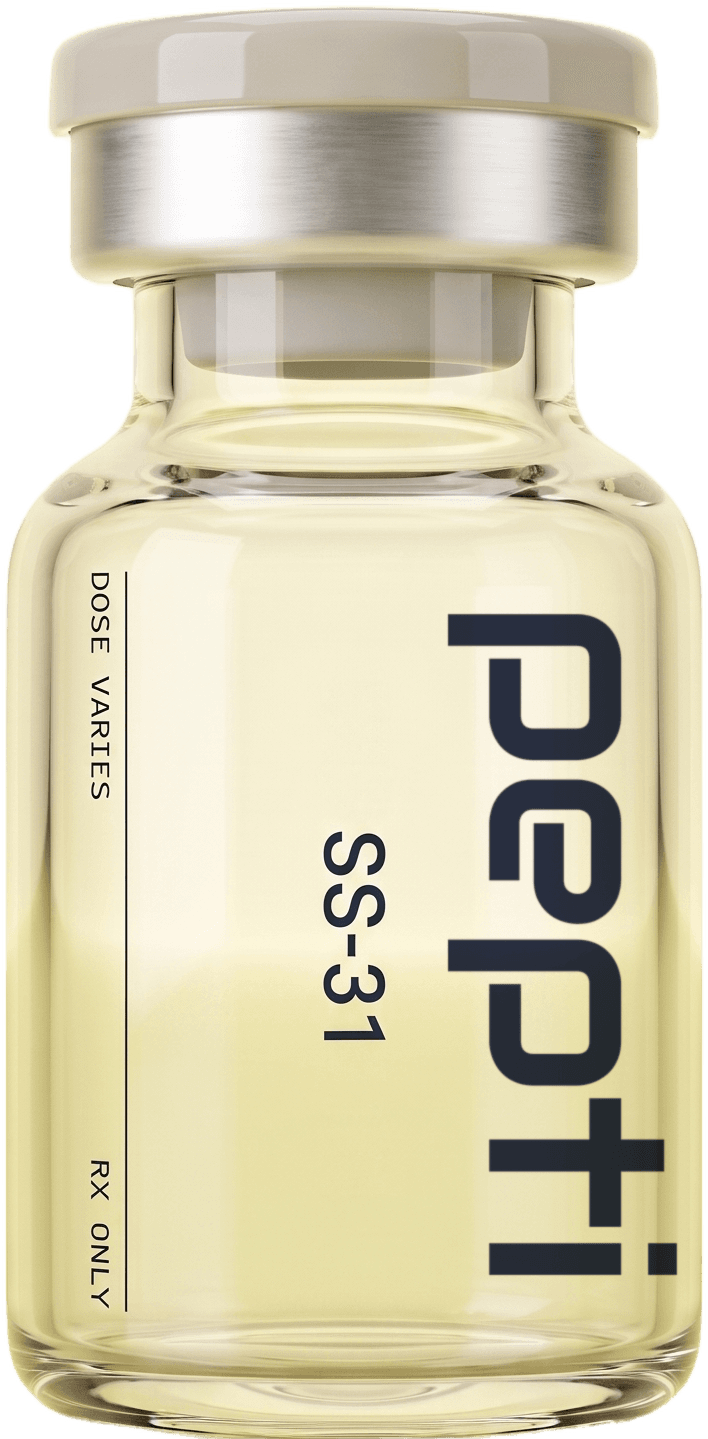
SS-31 (Elamipretide) is a 5 mL multi-dose vial at 2 mg/mL (10 mg per vial), $249 a month all-in. The typical directions are 0.25 mL (25 units) subcutaneously Monday through Friday mornings, 20 doses, about four weeks; the full conversion is in SS-31 dosage. Pepti is cash-pay and does not bill insurance. Vials ship ready to use, refrigerated with ice packs, with sterile syringes and alcohol prep pads, and refills run every 28 days, one vial per fill. Your physician sets your directions after reviewing your intake, and they are printed on the vial.
The compounded vial is not the FDA-approved elamipretide product, which is approved only for Barth syndrome. Since September 2025 elamipretide has been a component of an approved drug, which makes it eligible for 503A compounding subject to the FDA's "essentially a copy" rule; it has never been on the FDA's Category 2 list.
SS-31 Peptide Benefits
Where to get SS-31 prescribed
SS-31 cannot be bought legitimately without a prescription. Sites selling it "for research use only" are not accountable for identity, purity, sterility or concentration. The prescription route:
- Complete a free online intake covering your history, medications and what you want help with.
- A physician licensed in your state reviews it, usually within 24 hours.
- If it is appropriate, a PCAB-accredited, FDA-registered US 503A compounding pharmacy prepares it to that prescription. Lot test results are published at /quality/lab-results.
- It ships refrigerated with your directions printed on the vial.
- Your physician stays reachable for questions and side effects.
Pepti prescribes SS-31 in every state except Oklahoma, plus DC The step-by-step page is how to get SS-31 prescribed online.
References
What this is based on.
References
- Lee C, Zeng J, Drew BG et al.. The mitochondrial-derived peptide MOTS-c promotes metabolic homeostasis and reduces obesity and insulin resistance · Cell Metab (2015) · PMID 25738459
- Reynolds JC, Lai RW, Woodhead JST et al.. MOTS-c is an exercise-induced mitochondrial-encoded regulator of age-dependent physical decline and muscle homeostasis · Nat Commun (2021) · PMID 33473109
- Kim KH, Son JM, Benayoun BA et al.. The Mitochondrial-Encoded Peptide MOTS-c Translocates to the Nucleus to Regulate Nuclear Gene Expression in Response to Metabolic Stress · Cell Metab (2018) · PMID 29983246
- Zempo H, Kim SJ, Fuku N et al.. A pro-diabetogenic mtDNA polymorphism in the mitochondrial-derived peptide, MOTS-c · Aging (Albany NY) (2021) · PMID 33468709
- Ramanjaneya M, Bettahi I, Jerobin J et al.. Mitochondrial-Derived Peptides Are Down Regulated in Diabetes Subjects · Front Endocrinol (Lausanne) (2019) · PMID 31214116
- Cataldo LR, Fernández-Verdejo R, Santos JL et al.. Plasma MOTS-c levels are associated with insulin sensitivity in lean but not in obese individuals · J Investig Med (2018) · PMID 29593067
- Lu H, Wei M, Zhai Y et al.. MOTS-c peptide regulates adipose homeostasis to prevent ovariectomy-induced metabolic dysfunction · J Mol Med (Berl) (2019) · PMID 30725119
- Ming W, Lu G, Xin S et al.. Mitochondria related peptide MOTS-c suppresses ovariectomy-induced bone loss via AMPK activation · Biochem Biophys Res Commun (2016) · PMID 27237975
- Knoop A, Thomas A, Thevis M. Development of a mass spectrometry based detection method for the mitochondrion-derived peptide MOTS-c in plasma samples for doping control purposes · Rapid Commun Mass Spectrom (2019) · PMID 30394592
- Ozkaya DY, Haymana C, Demirci I et al.. MOTS-C levels in individuals with and without obesity and its association with inflammation, insulin resistance and endothelial dysfunction · Arch Endocrinol Metab (2025) · PMID 41004666
- Richie JP Jr, Nichenametla S, Neidig W et al.. Randomized controlled trial of oral glutathione supplementation on body stores of glutathione · Eur J Nutr (2015) · PMID 24791752
- Allen J, Bradley RD. Effects of oral glutathione supplementation on systemic oxidative stress biomarkers in human volunteers · J Altern Complement Med (2011) · PMID 21875351
Citations are provided for educational purposes. They do not constitute medical advice. Always discuss any peptide protocol with your prescribing physician.
Common questions
SS-31 Peptide Benefits, answered.
In animal and cell work, SS-31 binds cardiolipin, protects the structure of the inner mitochondrial membrane and speeds recovery of ATP after injury. In people, open-label results in Barth syndrome were the basis of a 2025 FDA accelerated approval of the branded drug, but randomised trials in mitochondrial myopathy, heart failure and macular degeneration missed their primary endpoints. There are no trials in healthy adults.
It concentrates on the inner mitochondrial membrane and binds cardiolipin, the lipid that holds the membrane's folds in shape. The research describes it protecting that structure and stopping cytochrome c from damaging the membrane, which is the basis for the claim that it supports cellular energy production.
No study has measured energy in healthy people given SS-31. In mitochondrial myopathy, a short trial found a fatigue improvement, but the 218-person phase 3 found no difference in fatigue at 24 weeks. Some people describe steadier energy; others notice nothing.
There is no human study of SS-31 for ageing or longevity. The claim is an inference from the mechanism. No trial has enrolled healthy older adults.
Mixed. The randomised parts missed their primary endpoints in Barth syndrome, primary mitochondrial myopathy, heart failure and dry macular degeneration. The positive findings are the sustained open-label gains in Barth syndrome over 168 weeks, a fatigue signal in one short crossover, a genetic subgroup, and a secondary retinal endpoint.
Yes. SS-31 is the research name, MTP-131 was the development code, and elamipretide is the generic drug name. The compounded vial is the same molecule at a different strength from the approved product, and it is not FDA approved.
No trial has tested it in athletes or healthy adults. In the largest trial, in mitochondrial myopathy, it did not improve walking distance at 24 weeks.
No. Both get called mitochondrial peptides, but SS-31 is a synthetic tetrapeptide that binds a membrane lipid, while MOTS-c is encoded by mitochondrial DNA and acts as a metabolic signal. SS-31 has a large human trial programme; MOTS-c has none.
Injection-site reactions, overwhelmingly: redness, itching, pain and bruising, reported by most trial participants and usually mild. The approved product's label warns of hypersensitivity reactions. Serious allergic reactions need emergency care.
Compounded SS-31 is not FDA approved; compounded medications are not FDA approved. A branded elamipretide product was granted accelerated approval in September 2025 for Barth syndrome only.
At Pepti, the SS-31 vial is $249 a month, all-in, covering medication, physician review, refill management and shipping.
No. Bloodwork is not required for any Pepti treatment. If your physician wants labs for your care, they'll ask through your account. The free assessment goes to a physician licensed in your state. A consultation does not guarantee a prescription.
Next step
See what a physician recommends for you.
A licensed physician in your state reviews your intake and decides what is appropriate. A consultation does not guarantee a prescription.