Anti-Aging · Reference
SS-31 Peptide Dosage: How Pepti Prescribes Elamipretide, in Units, mL and mg
This page explains the SS-31 peptide dosage Pepti prescribes, what the units on the syringe mean, a chart that converts units to millilitres and milligrams, how long a vial lasts, why the morning weekday schedule is used, what the trials dosed and why that is not your dose, and the side effects to know about. It covers how Pepti's SS-31 is typically prescribed, not protocols from the internet. Nothing here is a reason to change your own dose.
Treatments mentioned
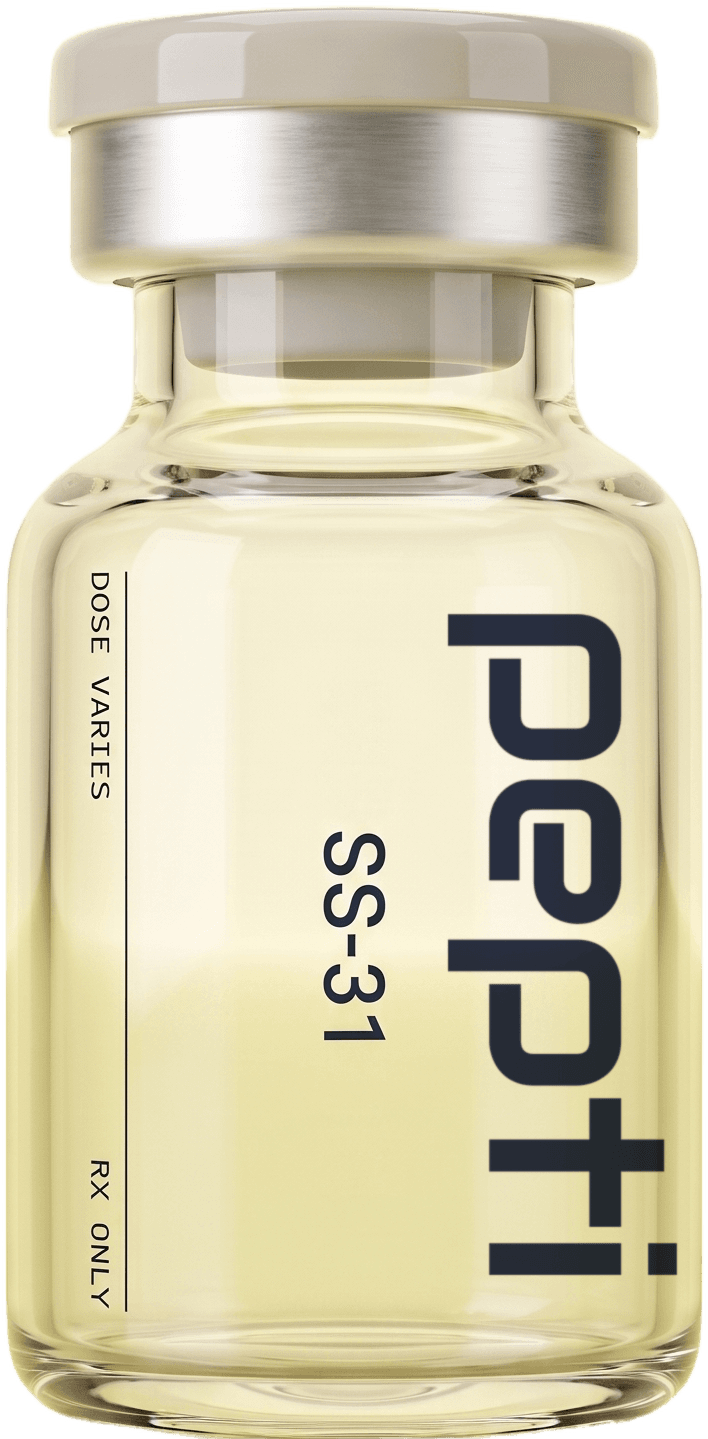
At Pepti, SS-31 (elamipretide) is typically prescribed as 0.25 mL, which is 25 units on a U-100 insulin syringe, injected under the skin Monday through Friday mornings. The vial is 5 mL at 2 mg/mL, so each dose carries 0.5 mg of SS-31 and the vial holds 20 doses, about four weeks. The clinical trials used 40 mg a day, a different dose for a different purpose, and no trial shows what the compounded dose does. Your physician sets your directions after reviewing your intake, and your exact dose is printed on the vial.
This page explains the SS-31 peptide dosage Pepti prescribes, what the units on the syringe mean, a chart that converts units to millilitres and milligrams, how long a vial lasts, why the morning weekday schedule is used, what the trials dosed and why that is not your dose, and the side effects to know about. It covers how Pepti's SS-31 is typically prescribed, not protocols from the internet. Nothing here is a reason to change your own dose.
SS-31 Peptide Dosage
The short answer
| Product | Vial | Typical directions | SS-31 per dose | Doses per vial | Price |
|---|---|---|---|---|---|
| SS-31 (Elamipretide) | 5 mL, 2 mg/mL (10 mg per vial) | Inject 0.25 mL (25 units) subcutaneously Monday through Friday mornings | 0.5 mg | 20 | $249/mo |
The price is all-in, covering medication, physician review, refill management and shipping, with no separate membership fee. Pepti is cash-pay and does not bill insurance. SS-31 is supplied as a vial drawn with an insulin syringe; there is no Pen version and it is not part of any Pepti blend. These are the typical printed directions; your own directions are the ones on your vial.
SS-31 Peptide Dosage
SS-31 dosage in units, mL and mg
Pepti's directions are written in two forms, millilitres and units, because prescriptions are written in millilitres and insulin syringes are marked in units. On a U-100 insulin syringe, 1 unit is 0.01 mL, so 100 units is 1 mL and 25 units is 0.25 mL. A unit is a volume mark on the barrel, not a measure of how strong the medication is.
The milligram figure comes from the concentration on the label. Pepti's SS-31 is supplied at 2 mg/mL, so:
| What you read | Value | Where it comes from |
|---|---|---|
| Dose volume | 0.25 mL | Printed on the vial |
| On a U-100 insulin syringe | 25 units | 0.25 mL x 100 units per mL |
| Concentration | 2 mg/mL | Printed on the vial |
| SS-31 per dose | 0.5 mg | 2 mg/mL x 0.25 mL |
| Total in the vial | 10 mg in 5 mL | Printed on the vial |
| Doses per vial | 20 | 5 mL divided by 0.25 mL |
That arithmetic is a way to read a label, not a way to set a dose. A vial labelled 10 mg is not a 10 mg dose: it is twenty 0.5 mg doses. If your label and your syringe seem to disagree, do not dose; message your care team. How long does a peptide vial last explains every number on a vial label in more detail.
SS-31 Peptide Dosage
SS-31 dosage chart: units to mL to mg
Dosing figures for SS-31 online mix milligrams, micrograms and units, and the numbers only line up if you know the concentration. The chart below is the conversion for a 2 mg/mL vial, drawn with a U-100 insulin syringe. It is math only. It is not a menu of doses, and the only line that applies to you is the one that matches the number printed on your vial.
| Syringe mark (U-100) | Volume | SS-31 from a 2 mg/mL vial |
|---|---|---|
| 5 units | 0.05 mL | 0.1 mg |
| 10 units | 0.1 mL | 0.2 mg |
| 15 units | 0.15 mL | 0.3 mg |
| 20 units | 0.2 mL | 0.4 mg |
| 25 units (Pepti's typical directions) | 0.25 mL | 0.5 mg |
| 30 units | 0.3 mL | 0.6 mg |
| 40 units | 0.4 mL | 0.8 mg |
| 50 units | 0.5 mL | 1 mg |
| 100 units | 1 mL | 2 mg |
The rule behind every row: units divided by 100 gives millilitres, and millilitres multiplied by 2 gives milligrams. A chart written for another concentration gives different milligrams for the same units, which is the main reason not to dose from a chart, including this one.
SS-31 Peptide Dosage
How long an SS-31 vial lasts
At Pepti's typical directions, one 10 mg vial lasts four weeks:
| Step | Value |
|---|---|
| Dose | 25 units, 0.25 mL, 0.5 mg |
| Doses per week | 5 (Monday through Friday) |
| Doses per vial | 20 (5 mL divided by 0.25 mL) |
| SS-31 used | 20 x 0.5 mg = 10 mg, the whole vial |
| Time per vial | 20 doses divided by 5 per week = 4 weeks |
Four weeks is why refills run every 28 days, one vial per fill. Vials are multi-dose solutions shipped ready to use, refrigerated with ice packs, with sterile syringes and alcohol prep pads. Nothing is mixed at home. Keep the vial in the fridge between doses, and follow the beyond-use date printed on the label, which runs from first puncture. How to store peptides covers storage.
If a vial runs short before the refill, message your care team rather than adjusting anything yourself. If you miss a dose, follow your directions and do not take two doses to make up for one.
SS-31 Peptide Dosage
When SS-31 is taken
In the morning
Pepti's SS-31 directions say mornings. The reason given by prescribers is practical: the subjective effects people describe with SS-31 are about energy through the day, and those are easier to judge when the dose is taken at the start of it. Nothing in the trials tested morning against evening dosing.
Monday through Friday
The five-days-on, two-off pattern is a prescriber convention that rests the injection sites, and it makes the vial arithmetic clean: 20 doses at five a week is exactly four weeks. It is not derived from a trial; every elamipretide trial dosed every day. Weekends off are part of the schedule, not missed doses.
Under the skin
Subcutaneous means into the fat layer, not the muscle. Abdomen and outer thigh are the usual sites, rotated so the same spot is not used repeatedly. Rotation matters more with SS-31 than with most peptides, because injection-site reactions are its dominant side effect. Technique is covered in how to inject peptides safely.
Directions say What it means in practice 0.25 mL (25 units) Draw to the 25 mark on a U-100 insulin syringe Subcutaneously Into the fat layer, abdomen or outer thigh, rotating sites Monday through Friday Five doses a week, weekends off Mornings Early in the day 20 doses per vial About four weeks, then the next refill
SS-31 Peptide Dosage
What the trials used, and why that is not your dose
SS-31 has more human trial data than almost any other compounded peptide, and the trial dose is quoted online as if it were a protocol. It was a dose chosen for people with specific diseases:
| Study | Who | How it was dosed |
|---|---|---|
| Neurology, 2018 | 36 adults with primary mitochondrial myopathy | Five days of intravenous dosing at escalating doses |
| PROGRESS-HF, Journal of Cardiac Failure, 2020 | 71 people with reduced-ejection-fraction heart failure | Placebo, 4 mg or 40 mg subcutaneously daily for 28 days |
| MMPOWER-2, Journal of Cachexia, Sarcopenia and Muscle, 2020 | 30 adults with primary mitochondrial myopathy, crossover | 40 mg subcutaneously daily for four weeks |
| TAZPOWER, Genetics in Medicine, 2021 and 2024 | 12 males aged 12 to 35 with Barth syndrome | 40 mg daily for 12 weeks, then open-label to 168 weeks |
| MMPOWER-3, Neurology, 2023 | 218 adults with primary mitochondrial myopathy | 40 mg subcutaneously daily for 24 weeks |
| ReCLAIM-2, Ophthalmology Science, 2024 | 176 people with dry age-related macular degeneration | 40 mg subcutaneously daily for 48 weeks |
The FDA-approved elamipretide product, granted accelerated approval in September 2025 for one rare genetic disease, Barth syndrome, in people weighing at least 30 kg, is an 80 mg/mL solution given as 40 mg once daily. Its label reduces the dose in severe kidney impairment, which is worth raising on your intake if it applies.
Two honest points follow. First, the randomised primary endpoints were missed in every one of those diseases; the positive findings are the open-label Barth syndrome results, a fatigue signal in the short myopathy crossover, a genotype subgroup and a secondary eye endpoint. Second, Pepti's typical 0.5 mg dose is one eightieth of 40 mg, prescribed for uses the trials did not test, and no study shows what that dose does in any population. That is why your directions come from a physician who has reviewed your intake, not from a trial table. The evidence, one claimed benefit at a time, is in SS-31 benefits.
SS-31 Peptide Dosage
Compounded SS-31 and the approved product
The vial Pepti supplies is not the approved product. It is prepared by a PCAB-accredited, FDA-registered US 503A compounding pharmacy to an individual prescription, at a different concentration, as a multi-dose vial; the approved product's single-patient vial is discarded eight days after opening. Compounded medications are not FDA approved.
Since September 2025, elamipretide has been a component of an FDA-approved drug, which makes it eligible for 503A compounding without a bulks-list entry, subject to the FDA's "essentially a copy" rule. It is not on the FDA's Category 2 list and never has been. The full history is in what is SS-31.
SS-31 Peptide Dosage
What changes the directions
Your physician sets your directions after reviewing your intake. Things that can lead to different directions, or a different product, include:
| What can change | How it shows up |
|---|---|
| Your medical history | A diagnosed mitochondrial disease, kidney impairment, or pregnancy or breastfeeding change the conversation |
| Your other medications | There is no formal interaction list, so the intake asks for everything you take |
| How you respond | Injection-site reactions or any allergic-type reaction go to your physician, who may revise your directions |
| What you are looking for | Some goals fit a different product better, such as NAD+, MOTS-c or glutathione |
When directions change, the new numbers are printed on the new label. Never carry a number over from a previous fill. Bloodwork is not required for any Pepti treatment. If your physician wants labs for your care, they'll ask through your account.
SS-31 Peptide Dosage
Side effects, in summary
Elamipretide's safety record comes from the trials above, and it is consistent: injection-site reactions dominate.
| What is reported | How often | What to do |
|---|---|---|
| Injection-site redness, itching, pain or bruising | Very common in the trials; 80 per cent in MMPOWER-2, every treated participant in TAZPOWER | Rotate sites; report it if it does not settle |
| Hives beyond the injection site, facial or throat swelling, breathing difficulty | Uncommon; the approved label warns of serious allergic reactions | Emergency care first (call 911), then tell your physician |
Those trial rates were recorded at 40 mg daily, not at Pepti's compounded dose. Systemically, the trials report elamipretide as well tolerated across hundreds of people for up to a year and a small group for more than three years. That is not a safety database in healthy adults. SS-31 is not used in pregnancy or breastfeeding. Elamipretide is not named on the 2026 WADA Prohibited List, but a tested athlete should confirm with their anti-doping organisation and tell their physician before starting; see do peptides show up on a drug test.
SS-31 Peptide Dosage
Where to get SS-31 prescribed
SS-31 cannot be bought legitimately without a prescription. Sites selling it "for research use only" are not accountable for what is in the vial: identity, purity, sterility and concentration are untested, so even the concentration your units chart depends on is unknown. The prescription route:
- Complete a free online intake covering your history, medications and what you want help with.
- A physician licensed in your state reviews it, usually within 24 hours.
- If it is appropriate, a PCAB-accredited, FDA-registered US 503A compounding pharmacy prepares it to that prescription. Lot test results are published at /quality/lab-results.
- It ships refrigerated with your directions printed on the vial.
- Your physician stays reachable for questions and dose changes.
Pepti prescribes SS-31 in every state except Oklahoma, plus DC Step by step: how to get SS-31 prescribed online. Where it sits alongside other options: peptides for energy and fatigue and MOTS-c benefits.
Common questions
SS-31 Peptide Dosage, answered.
At Pepti, SS-31 is typically prescribed as 0.25 mL, which is 25 units on a U-100 insulin syringe, injected subcutaneously Monday through Friday mornings. From the 2 mg/mL vial that is 0.5 mg per dose. Your physician sets your directions after reviewing your intake, and your exact dose is printed on the vial.
The amount printed on your vial, on the schedule printed on your vial. Pepti's typical directions are 25 units five mornings a week. If you have questions about your dose, message your care team.
The number printed on your vial. Pepti's typical directions are 25 units, which is 0.25 mL on a U-100 insulin syringe, where 1 unit is 0.01 mL.
From a 2 mg/mL vial, 0.5 mg. 10 units is 0.2 mg and 50 units is 1 mg. Those figures only hold at 2 mg/mL.
40 mg subcutaneously once daily in the main trials, with 4 mg also tested in one heart failure trial and intravenous dosing in a five-day 2018 study. The approved product for Barth syndrome is also 40 mg daily. Those doses were for people with specific diseases, and the randomised primary endpoints were missed in every indication.
The compounded vial is prescribed for different uses at a different strength. Pepti's typical 0.5 mg dose is one eightieth of the 40 mg trial dose, and no trial shows what it does. Your directions are set by a physician after reviewing your intake, not taken from a trial.
Pepti's directions say Monday through Friday mornings, so that the energy-related effects people describe are easier to judge across the day. Follow the timing on your label.
About four weeks. A 10 mg vial at 25 units (0.5 mg) five mornings a week is 20 injections, which uses the whole vial in four weeks, matching the 28-day refill.
No. Pepti vials are multi-dose solutions shipped ready to use, with sterile syringes and alcohol prep pads. Nothing is reconstituted at home.
No. Take the dose printed on your vial, on the schedule printed on your vial. Injection-site reactions are the main side effect, and they were seen in most trial participants. If you have questions about your dose, message your care team.
Bloodwork is not required for any Pepti treatment. If your physician wants labs for your care, they'll ask through your account. The free assessment goes to a physician licensed in your state. A consultation does not guarantee a prescription.
Next step
See what a physician recommends for you.
A licensed physician in your state reviews your intake and decides what is appropriate. A consultation does not guarantee a prescription.