— Recovery · Reference
Vial vs Pen: Which Should You Choose for Peptide Injections?
This page covers what each format physically is, how a dose is measured in each, where the errors come from, what the published device research shows, how storage and beyond-use dating differ, where each stands with the FDA, and how to decide. It is about the container and the device, not any one peptide; the reference pages cover the molecules.
— Treatments mentioned
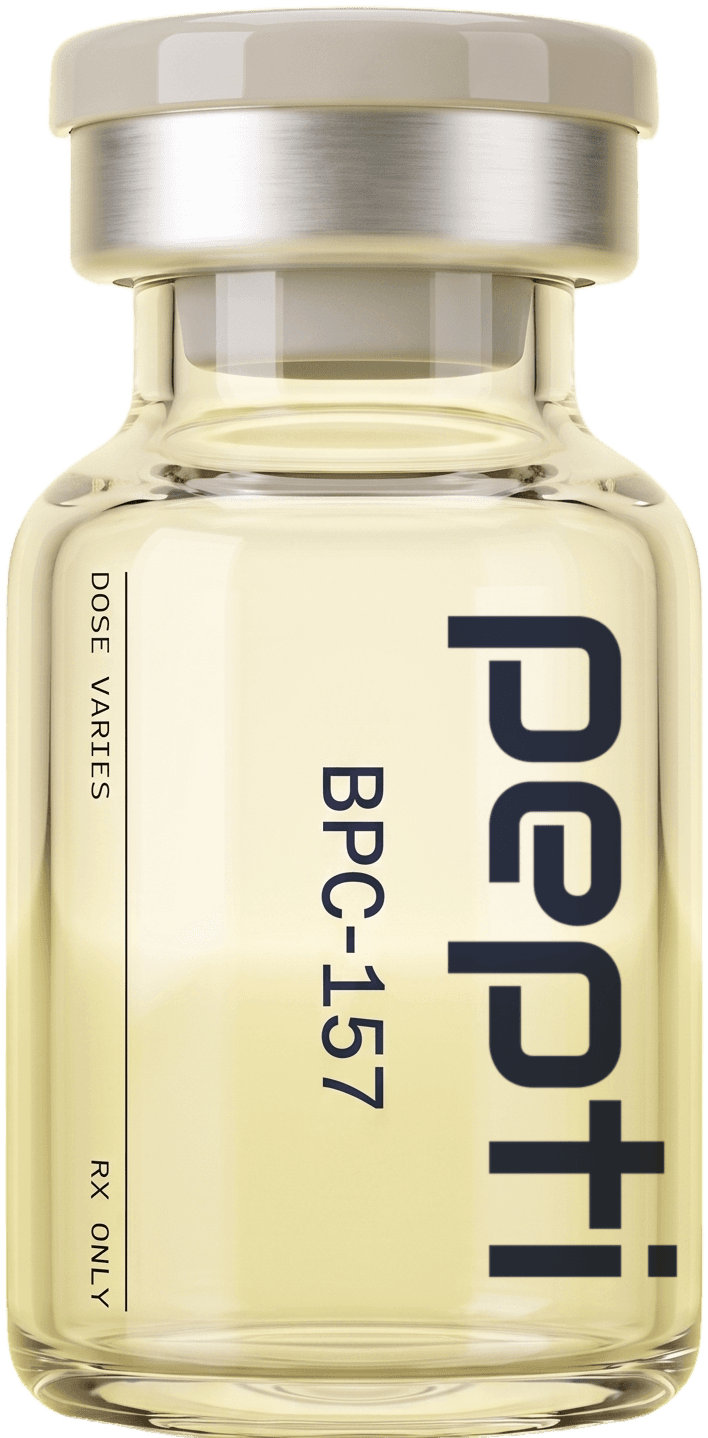
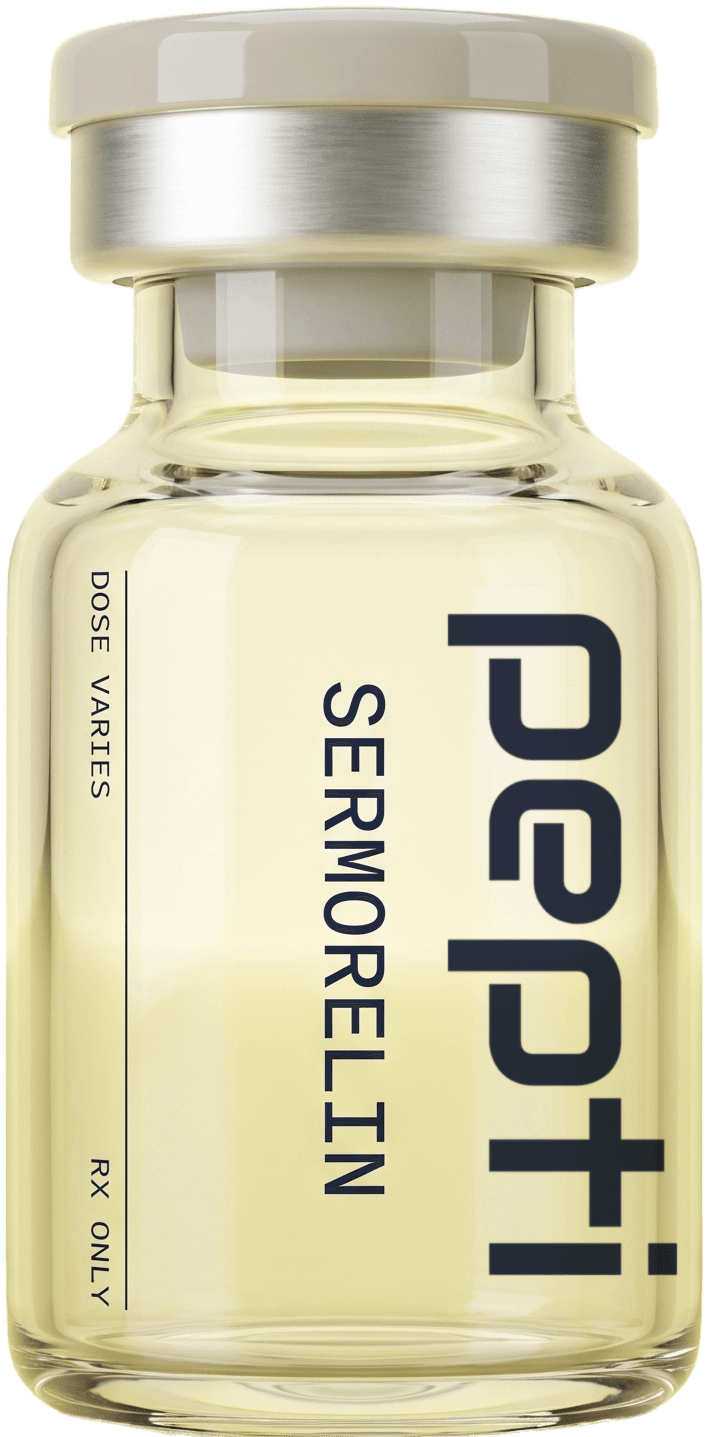
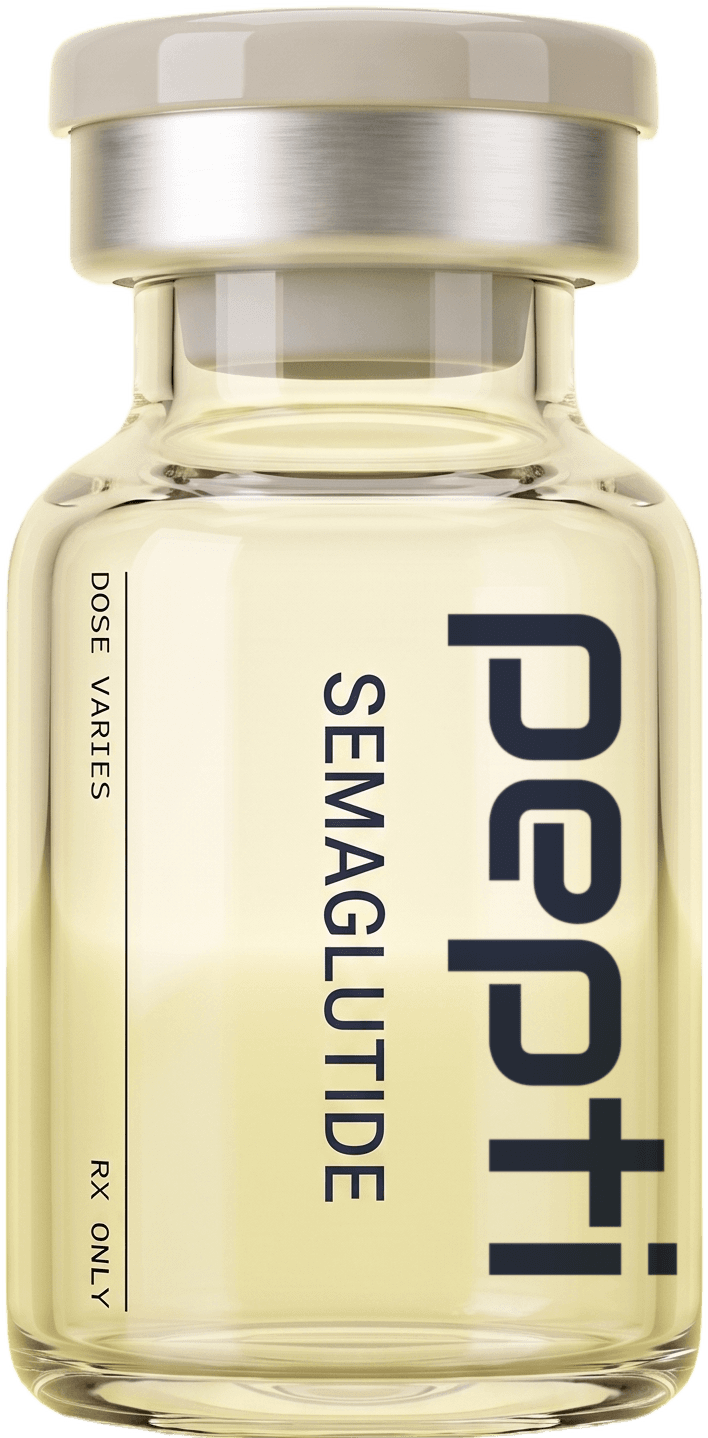
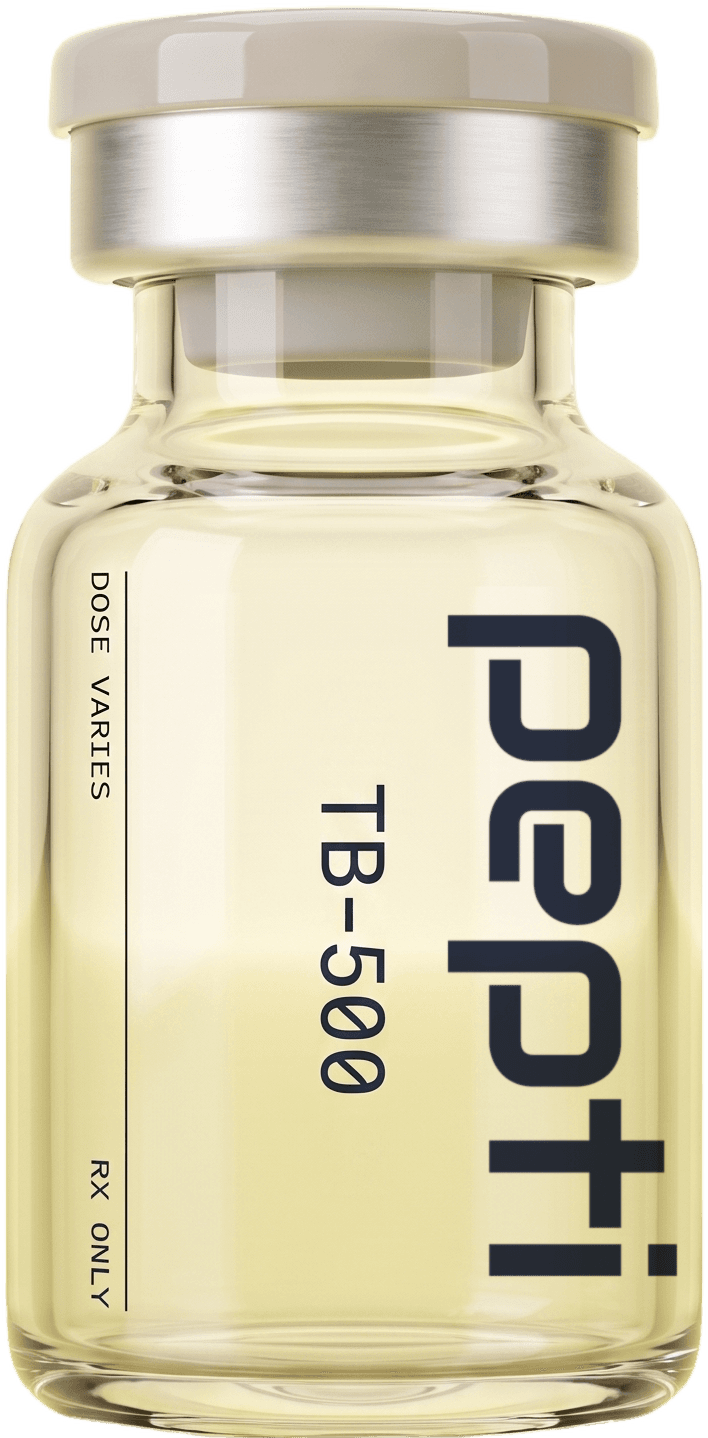
Both formats deliver the same medication under the same prescription; the difference is how the dose is measured, how much you carry, and what it costs. A vial is a multi-dose container you draw from with a U-100 insulin syringe, reading a volume off the barrel. A Pen is a pre-filled cartridge in a device that measures the dose mechanically when you turn a dial. The vial is the lower price on every product that offers both, and it is available across the catalogue. Pen availability varies by product, some cartridges are periodically sold out, and the format and price that apply to you are confirmed at checkout rather than assumed.
This page covers what each format physically is, how a dose is measured in each, where the errors come from, what the published device research shows, how storage and beyond-use dating differ, where each stands with the FDA, and how to decide. It is about the container and the device, not any one peptide; the reference pages cover the molecules.
— Vial vs Pen
The short answer
| If this describes you | Choose | Why |
|---|---|---|
| Cost is the deciding factor | Vial | The vial is the lower price on every product offering both |
| You have never injected before | Pen, where available | Dialling a number removes the step most people find intimidating |
| Poor near vision or unsteady hands | Pen, where available | Reading 25 units on a syringe barrel is harder than it sounds |
| You travel frequently | Pen, where available | One device and a few tips, rather than a vial and a box of syringes |
| Your physician wants an unusual volume | Vial | A syringe accommodates volumes a dial may not |
| You are on a product with no pen version | Vial | Most of the catalogue is vial only |
| You are already comfortable drawing a dose | Vial | The format you already handle well, at the lower price |
| You want the dose taken out of your hands | Pen, where available | A dial repeats mechanically; four people drawing by eye will not |
Both routes carry the same all-in monthly pricing structure covering medication, physician review, refill management and shipping. The vial price and, where one exists, the pen price sit side by side on each product page and on its /cost page, and checkout confirms whichever you pick. What sits inside a monthly figure is broken down in how much do peptides cost.
— Vial vs Pen
The vial and syringe, in full
— What a multi-dose vial is
A multi-dose vial is a small glass container with a rubber stopper, filled by the compounding pharmacy to your prescription and sealed. It holds more than one dose; you puncture the stopper with a fresh syringe each time and draw out the volume printed on your pharmacy label. It ships refrigerated, in insulated packaging with ice packs, with syringes and alcohol prep pads in the box. Your directions are printed on the label and repeated in your account.
Every injectable in the Pepti catalog is supplied as a vial: the products that also come in the pen, such as BPC-157 and sermorelin, and everything that does not, such as semaglutide, tirzepatide, TB-500, GHK-Cu and the four-peptide blends.
— How a dose is measured
The syringe supplied is a U-100 insulin syringe, graduated in units where 100 units is 1 mL. One unit is 0.01 mL, so a sig written as 0.25 mL is drawn to the 25-unit line. Your label states both the volume and the unit count; you are matching the plunger tip to a printed line, not converting anything. The technique, from cleaning the stopper to expelling air, is in how to inject peptides safely.
— Where the errors come from
Three things go wrong with a vial and syringe, and all three are in the drawing-up step rather than the injection:
- Misreading the barrel. The graduations are fine, the plunger tip is small, and a small draw is a short distance on the barrel. In poor light or with imperfect near vision, being off by a few units is easy.
- Air. A bubble drawn in with the medication takes up volume the label expected to be medication. Drawing, tapping and expelling exists to fix this, and it is a learned skill.
- The unit and milliliter mix-up. A sig of 0.25 mL and a syringe reading 25 units are the same thing, but a person under stress can confuse them. Pepti labels carry both numbers to close that gap.
None of these is exotic; people manage insulin this way for decades. But each is a step where the patient, not the device, is the measuring instrument. Traveling means the vial in a cold pouch, enough syringes for the trip, and somewhere to dispose of them.
— Storage and the beyond-use date
A vial is refrigerated as its label directs. The date on that label is a beyond-use date, not a manufacturer's expiration date: the FDA describes a beyond-use date as "the date beyond which a drug product should not be used," and for a multi-dose container the clock runs from the point the container is punctured or opened. The pharmacy assigns that date under the sterile compounding standard, USP General Chapter <797>, which the FDA describes as the chapter that "specifically addresses sterile compounding." The practical consequence is that a vial is not a stockpile: it is sized to be used within its beyond-use window, which is why Pepti fills one vial per refill. Detail is in how to store peptides.
— Who the vial suits
Anyone for whom price is the deciding factor, anyone who already draws a dose comfortably, anyone on a product with no pen version, and anyone whose physician has written a volume that does not land on a whole dial increment. It is also the format that is always there when a cartridge is temporarily sold out.
— Vial vs Pen
The pepti Pen, in full
— What the device is
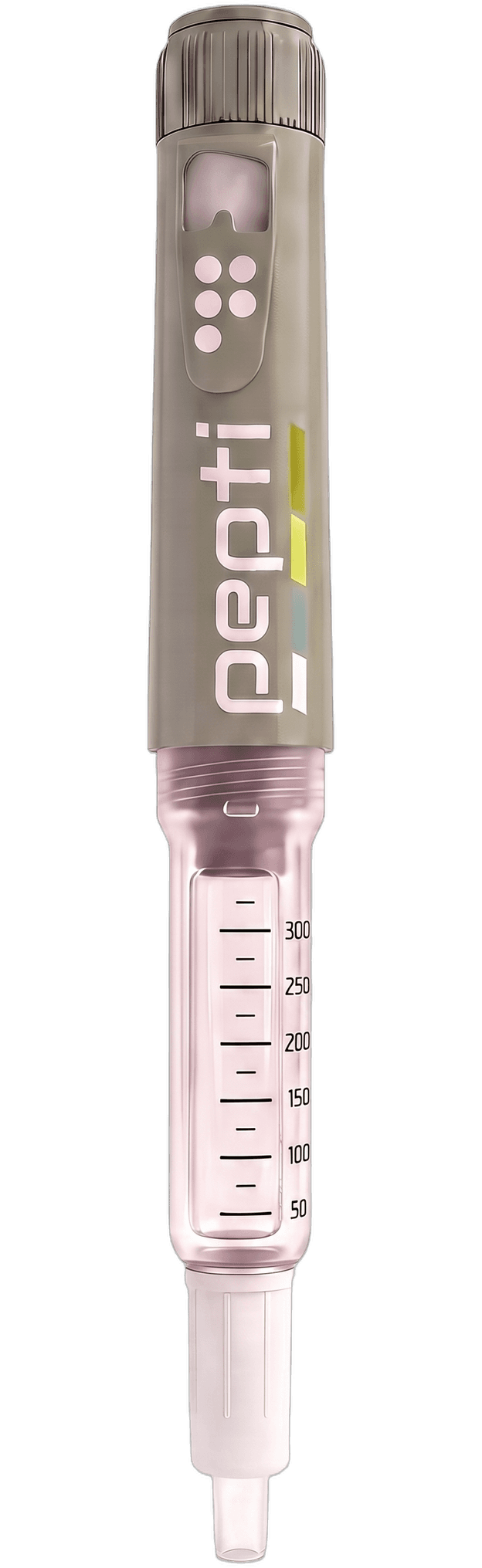
The pepti Pen is a reusable auto-injector. Your medication does not come in the pen; it comes in a pre-filled cartridge, filled and sealed by the pharmacy to your prescription, that clicks into the pen. You attach a fresh tip, turn the dial to the number on your pharmacy label, press the pen against the skin of the abdomen or thigh, and the device delivers the dose. The injector ships free with your first cartridge and is yours to keep; after that you pay for the monthly cartridge, which arrives with fresh tips. The device is rated for years of use; the cartridge is the consumable.
— What 510(k) clearance means, and what it does not
The injector is a 510(k)-cleared device. A 510(k) is, in the FDA's words, "a premarket submission made to FDA to demonstrate that the device to be marketed is as safe and effective, that is, substantially equivalent, to a legally marketed device," and a device may not be marketed until the FDA finds it substantially equivalent and issues an order that "clears" it for commercial distribution.
Clearance is a device finding, about the injector as hardware judged against a predicate. It says nothing about the medication inside the cartridge: a compounded peptide in a cleared injector is still a compounded peptide, and compounded drugs are not FDA approved.
— How a dose is measured
The dial moves in clicks, and one click is one IU, which is 0.01 mL, the same increment as one unit on the U-100 syringe. A sig of 0.25 mL is 25 units on the syringe and 25 clicks on the dial. The dial covers 0 to 60 IU per injection, and your pharmacy label states the dose in the units the dial uses. The measuring is done by the mechanism, not by your eye; a dial set to 25 delivers the same volume in a hotel bathroom as at your kitchen table.
— Where the errors come from
A pen removes the drawing-up errors and introduces a shorter list of its own: dialling the wrong number, which is a reading error checked by looking at the window before pressing; not priming a fresh tip as instructed, which can short the first dose; and leaving a tip on between doses, when tips are single-use and removing them keeps the cartridge sealed. Each is covered in the dosing video in your account. Injection technique, site rotation and aftercare are the same as for a vial.
— The cartridge, the tips and the refill rhythm
The cartridge is filled by the pharmacy to your prescription and typically covers four to five weeks at the prescribed dose, so a fresh cartridge ships about every 28 days, or on the schedule your physician sets. Tips are included with every cartridge; use a fresh one for each injection. If your physician changes your dose, you dial the new number on the same pen; if a new dose needs more medication than a cartridge covers, the refill date moves or your physician approves an additional cartridge at the pharmacy's cost. Your physician's chart carries the pharmacy's fill records, lot data and tracking for every cartridge, exactly as it does for a vial.
— Storage and handling of a cartridge
The cartridge is refrigerated as the pharmacy label directs, in the pen or out of it; the pen itself needs no refrigeration. The cartridge carries its own beyond-use date, assigned by the pharmacy under the same USP <797> framework as a vial, and its handling directions are not identical to a vial's; the label governs. Letting it sit at room temperature for a few minutes before injecting is more comfortable, and it stays out of direct sun and heat like any peptide.
— Which products come in the pen, and where it ships
At the time of writing the pen line includes BPC-157, sermorelin, NAD+, PT-141, MOTS-c, thymosin alpha-1, the BPC-157 + TB-500 stack and KLOW. One product is pen-only: CJC-1295 / Ipamorelin / Sermorelin is compounded as a cartridge and has no vial. Semaglutide and tirzepatide are not in the pen; they ship as a vial and are dosed weekly. The live list, including any cartridge temporarily sold out, is on the pen page and each product page.
The pen is sold into every state Pepti serves except Alabama, where orders ship as a vial. Your physician must be licensed in your state either way, and the pharmacy must be licensed to dispense into it.
— Who the pen suits
First-time injectors, anyone with poor near vision or unsteady hands, frequent travelers, and anyone who finds the drawing-up sequence enough of a barrier that they skip doses. It is a convenience premium over the vial, and the product page shows both prices so you can decide.
— Vial vs Pen
Side by side
| Vial and syringe | Pen cartridge | |
|---|---|---|
| How you measure the dose | Draw to a marking on a U-100 insulin syringe | Turn the dial to the number, then press |
| What can go wrong | Misreading the barrel, drawing the wrong volume, a unit and millilitre mix-up | Dialling the wrong number, not priming as instructed |
| Repeatability between doses | Depends on your eyes, your light and your technique | Mechanical, the same every time |
| What you handle each dose | New syringe, alcohol swab, the vial | New pen tip, alcohol swab, the device |
| What you carry | Vial plus a box of syringes | The device plus tips |
| Discretion | Visibly an injection | Looks like a marker pen |
| Sharps disposal | Yes, syringes | Yes, pen tips |
| Price | Lower, on every product offering both | A premium per refill |
| Availability | Every injectable in the catalogue | Varies by product, and confirmed at checkout |
| Dose flexibility | High, any volume you can read | Constrained to the dial increments |
| Storage | Per your vial label | Per the cartridge's own directions, which differ from a vial's |
— Vial vs Pen
Where the pen genuinely wins
First-time injectors. Nearly all of the anxiety about starting self-injection is about drawing an accurate dose out of a vial: the arithmetic, the bubbles, the squinting at a barrel. A dial removes that step entirely. The injection itself, a short fine needle into subcutaneous fat, is the same in both formats and is the part most people find easier than they expected.
Repeatability, especially at small volumes. A syringe dose is a judgement about where a plunger tip sits against a printed line. Done in a hurry, in poor light, at the end of a long day, it varies, and the smaller the dose the shorter the distance being read. A dial does not have an opinion about the light, and its click resolution does not get harder to use as the dose gets smaller.
Travel and discretion. One device and a strip of tips is less to carry, less to explain and less to lose than a vial and a box of syringes. The cartridge travels in a small insulated pouch with an ice pack and goes back in a refrigerator on arrival, and the pen is considerably less conspicuous in a shared bathroom or a hotel room.
People who dislike the ritual. Some patients do not mind injecting but dislike the drawing-up sequence enough that adherence suffers. A format someone will actually use every day beats a cheaper one they skip. This is the point on which the device research is clearest, and it is covered below.
— Vial vs Pen
Where the vial wins
Cost. On every product that offers both, the vial is the lower price. Over twelve months of treatment that difference is real money, and if cost is what would make you stop treatment, it is the deciding factor. A format you can sustain beats one you cannot.
Availability. Every injectable in the catalog is available as a vial. Only a subset is available as a pen, and cartridge availability can change, including cartridges being temporarily sold out while the vial is unaffected. If continuity matters more than convenience, the vial is the format that is always there.
Dose flexibility. Where a physician wants a volume that does not correspond neatly to a dial increment, or expects to adjust in small steps over the first weeks, a syringe accommodates it more easily.
Multi-ingredient blends and weekly GLP-1s. The blends exist so that several peptides arrive in one preparation. KLOW and the BPC-157 + TB-500 stack are in the pen line; the four-peptide blends such as ASCEND and TITAN are vial only. Semaglutide and tirzepatide are weekly, vial-only medications, so for a GLP-1 patient the choice is already made, and a once-weekly draw is a different proposition from a daily one.
— Vial vs Pen
What does not change between formats
| Same in both | |
|---|---|
| The medication | Same molecule, same prescription |
| The pharmacy | Same licensed, FDA-registered compounding pharmacy |
| The physician review | Same intake, same prescriber licensed in your state |
| Your dose | Your sig is your sig. If it is 0.25 mL, that is 25 units on a U-100 syringe or the equivalent dial setting |
| Regulatory status | Neither format is FDA approved. Compounded medications are not FDA approved |
| Site rotation and technique | Subcutaneous, rotate every dose, never share a device or a vial |
| The subscription | Both are ongoing treatment with refills, not a single purchase |
The injection technique itself is covered in how to inject peptides safely. Note one difference: a cartridge carries its own storage and handling directions which are not the same as a multi-dose vial's, and those directions govern. See how to store peptides.
Why "the same medication" is literally true
The pharmacy compounds the peptide to your physician's prescription and then fills it into whichever container you chose: the same pharmacy, the same batch testing for identity, purity, potency, sterility and endotoxins before release, and the same lot documentation in your chart. Certificates of analysis are described on the quality page and published at lab results. Nothing about the format changes what the peptide is or what the research on it shows: BPC-157 in a cartridge is BPC-157, and sermorelin in a vial is sermorelin. And in neither container is it FDA approved. The FDA states that it "does not verify the safety, effectiveness or quality of compounded drugs before they are marketed." The injector's 510(k) clearance is a separate fact about a separate object.
— Vial vs Pen
Mixing formats in one plan
Formats mix. A plan can carry a pen cartridge for one medication and a vial for another, each at its own catalog price, under one physician review and one refill schedule; BPC-157 or NAD+ in the pen and semaglutide weekly from a vial is a common shape. Use a separate pen for each pen medication so cartridges are never mixed up; an injector ships free with the first cartridge of each.
— Vial vs Pen
Switching between them
When a switch takes effect
You switch at a refill. Choose the other format in the cart or message your physician through your account before the next refill is prepared, and the next shipment arrives in the new format at that format's price. Because the pharmacy prepares a cartridge or a vial to order, a switch cannot be applied to a fill already compounded, and switching between refills means paying for a second fill. Moving from vial to pen, the injector ships free with that first cartridge; moving back, keep the pen. A dose change is not a format change: on the pen you dial the new number, on a vial you draw to the new line, and the new label carries both.
If a cartridge is sold out
If the pen version of your medication is temporarily unavailable, the vial is the continuous option. The sig translates directly, because a unit on the syringe and a click on the dial are the same volume. Confirm the format and the price at checkout rather than assuming either carries over from a previous order.
— Vial vs Pen
What the evidence shows, honestly
Pen devices have a long track record in insulin administration, and that literature is the only controlled evidence on pen versus vial and syringe. It was produced with approved insulin pens in people with diabetes, not with compounded peptide cartridges, so it is a reasonable basis for expecting the format to help and it is not evidence about any Pepti product. With that stated, here is what it found.
— Dose accuracy at the bench
A 2009 study in Diabetes Technology and Therapeutics had healthcare professionals, some experienced with insulin and some not, deliver a 10-unit dose into a pad using either a syringe and vial or a prefilled pen, and weighed what came out. The pen was more accurate in both groups, and the spread of delivered doses was widest among inexperienced users drawing from a vial; those users also rated the pen easier to handle. A second 2009 study in The Diabetes Educator, a randomized crossover of 232 pen-naive patients, reported the same pattern: pens were preferred on ease of use, discretion, dose confidence and convenience, and the doses patients prepared with a pen were more accurate than those they drew with a syringe. The bench finding translates most directly, because it is about the measuring method rather than the drug.
— Preference in randomized crossover trials
A 2014 trial in Diabetes Technology and Therapeutics randomized 405 insulin-naive adults with type 2 diabetes to two weeks on a pen and two weeks on vial and syringe, in either order. Patients significantly preferred the pen and their clinicians recommended it, while blood glucose control and the rate of low blood sugar were comparable between formats over the following months. A smaller 2014 crossover study in Endocrine Practice, in 31 patients discharged from hospital on insulin glargine, reported that patients found the pen more convenient and that glycemic control was better during the pen phase. People who try both mostly choose the pen, and the effect of the insulin itself was the same or slightly better, consistent with people taking more of their doses.
— Adherence in claims data
A 2006 analysis in Clinical Therapeutics of US managed-care claims followed 1,156 adults with type 2 diabetes who switched from vial and syringe insulin to a prefilled pen, and reported adherence, measured as days covered by a filled prescription, rising from 62 percent to 69 percent after the switch. A 2007 analysis in Pharmacotherapy of a different insulin, in 486 privately insured patients, reported the same direction. These are before-and-after claims studies, not randomized trials, so they show an association rather than proving the device caused it.
— What that evidence is not
It is not evidence that a peptide works better from a pen; nothing about the container changes the molecule, and none of these studies involved a compounded peptide. It is evidence about the format class, produced with other devices, not about the pepti Pen specifically. And it does not establish that a vial is inaccurate in competent hands: the same bench study reported experienced users drawing within a small margin of the target. What can be said without qualification is narrower: the medication, the pharmacy, the prescription and the physician are the same either way, so the choice is about handling, adherence and cost rather than efficacy. Response varies between people regardless of how the dose is delivered.
— Vial vs Pen
Sharps, sharing and disposal
A used syringe is a sharp and a used pen tip is a sharp. The FDA's home-disposal guidance is to "place all needles and other sharps in a sharps disposal container immediately after they have been used," and to follow your community's guidelines for the container once it is about three-quarters full. Loose sharps do not go in household trash, the toilet or recycling. An FDA-cleared sharps container is the recommended option; where one is not available, the FDA accepts a heavy-duty plastic household container with a tight, puncture-resistant lid. A portable sharps container for travel is a good idea in either format.
A vial, a cartridge, a pen and a tip are for one patient and one prescription. Do not share a pen even with a fresh tip, do not share a vial even with a fresh syringe, and do not recap or reuse a tip or a syringe. Each patient completes their own assessment and receives their own device and fill.
— Vial vs Pen
Where each format stands with the FDA right now
— The medication, in both containers
Every peptide in the pen line is a compounded prescription medication, prepared by a state-licensed, FDA-registered 503A pharmacy under a physician's prescription, and compounded drugs are not FDA approved. Where each individual peptide stands with the FDA's 503A bulk drug substances list is a molecule question that has moved for several compounds in 2026; it is kept current on each reference page, for example what is BPC-157, what is sermorelin and what is thymosin alpha-1. The container does not change the substance or its status.
— The injector
The pepti Pen is a 510(k)-cleared device: the FDA found it substantially equivalent to a legally marketed predicate and cleared it for commercial distribution. The site describes it as produced in a cGMP, ISO 13485:2016 facility with ISO 11608-compatible needles and cartridges. Clearance is not approval, and it is not an FDA statement about any medication.
— The pharmacy and USP <797>
Both the vial and the cartridge are sterile preparations, and the FDA treats USP General Chapter <797> as the chapter that "specifically addresses sterile compounding." The FDA's compounding guidance refers to <797> for the conditions under which sterile compounding is performed and beyond-use dates are assigned. The beyond-use date on your label is the pharmacy's application of that framework to your fill.
— References
What this is based on.
References
- Chang CH, Tsai WC, Hsu YH, Pang JH. Pentadecapeptide BPC 157 enhances the growth hormone receptor expression in tendon fibroblasts · Molecules (2014) · PMID 25415472
- Krivic A, Anic T, Seiwerth S, et al.. Achilles detachment of rat and stable gastric pentadecapeptide BPC 157 · Journal of Orthopaedic Research (2006) · PMID 16583442
- Sikiric P, Seiwerth S, Rucman R, et al.. Stable gastric pentadecapeptide BPC 157: novel therapy in gastrointestinal tract · Current Pharmaceutical Design (2011) · PMID 21548867
- Cerovecki T, Bojanic I, Brcic L, Radic B, et al.. Pentadecapeptide BPC 157 (PL 14736) improves ligament healing in the rat · J Orthop Res (2010) · PMID 20225319
- Sikiric P, Seiwerth S, Rucman R, Turkovic B, et al.. Stable gastric pentadecapeptide BPC 157-NO-system relation · Curr Pharm Des (2014) · PMID 23755725
- Cox HD, Miller GD, Eichner D. Detection and in vitro metabolism of the confiscated peptides BPC 157 and MGF R23H · Drug Test Anal (2017) · PMID 28035768
- Thomas A, Görgens C, Guddat S et al.. Simplifying and expanding the screening for peptides <2 kDa by direct urine injection, liquid chromatography, and ion mobility mass spectrometry · J Sep Sci (2016) · PMID 26578461
- Farrar JT, Young JP Jr, LaMoreaux L, Werth JL et al.. Clinical importance of changes in chronic pain intensity measured on an 11-point numerical pain rating scale · Pain (2001) · PMID 11690728
- Meyer JD, Ho B, Manning MC. Effects of conformation on the chemical stability of pharmaceutically relevant polypeptides · Pharm Biotechnol (2002) · PMID 11987755
- Xu C, Sun L, Ren F, Huang P, et al.. Preclinical Safety Evaluation of Body Protective Compound-157, a Potential Drug for Treating Various Wounds · Regul Toxicol Pharmacol (2020) · PMID 32334036
- He L, Feng D, Guo H, et al.. Pharmacokinetics, distribution, metabolism, and excretion of body-protective compound 157, a potential drug for treating various wounds, in rats and dogs · Front Pharmacol (2022) · PMID 36588717
- Lee E, Padgett B. Intra-Articular Injection of BPC 157 for Multiple Types of Knee Pain · Altern Ther Health Med (2021) · PMID 34324435
Citations are provided for educational purposes. They do not constitute medical advice. Always discuss any peptide protocol with your prescribing physician.
— Common questions
Vial vs Pen, answered.
Not clinically. It is the same medication under the same prescription, from the same pharmacy. The pen measures the dose mechanically and is easier to travel with; the vial is the lower price and is available on every injectable. The device research, all of it on insulin pens, reports better dose consistency and higher adherence with pens and equal drug effect. Choose on handling and cost.
Yes, on every product that offers both, because a pre-filled cartridge is a different preparation and ships with tips. The reusable injector itself is free with your first cartridge, so the premium is per refill, not per device. The exact figure for each product is on its product page and its /cost page, and is confirmed at checkout.
It varies by product and it changes, including cartridges being temporarily sold out. At the time of writing the line includes BPC-157, sermorelin, NAD+, PT-141, MOTS-c, thymosin alpha-1, the BPC-157 + TB-500 stack and KLOW, with CJC-1295 / Ipamorelin / Sermorelin pen-only; the GLP-1s are not in the pen. The pen page and each product page state whether a Pen version is currently available and at what price, and checkout confirms it. The vial is available across the catalogue.
Yes, at a refill. Choose the pen in the cart or tell your physician through your account before the refill is prepared, since the pharmacy prepares a different product and the price changes. The injector ships free with that first cartridge. Switching between refills means paying for a second fill.
Slightly, for some people, mostly because pen tips are short and fine and there is no drawing-up step to lengthen the process; the pen fires at a low press force and most people report feeling very little. Injection-site tenderness happens with both, and site rotation matters more than format.
Yes. Your physician sets the dose and the sig applies either way. A 0.25 mL dose is 25 units on a U-100 insulin syringe or 25 clicks on the pen dial, because one unit and one click are both 0.01 mL. Your label states the number in the units your format uses.
Yes. Pen tips are sharps and go in a sharps container, never household rubbish and never recapped for reuse. The FDA recommends an FDA-cleared sharps container and accepts a heavy-duty plastic household container with a puncture-resistant lid where one is not available.
Start with the vial if cost matters and a syringe does not bother you. Start with the Pen, where it is available for your medication, if you are new to injecting or travel often. Neither choice is permanent, and you can change at a refill.
No. A vial ships with syringes and prep pads; a cartridge ships with tips sized for it. Use a fresh syringe or a fresh tip for every injection.
Use a separate pen for each medication so cartridges are never mixed up; an injector ships free with the first cartridge of each.
Yes. A pen cartridge for one medication and a vial for another, each at its own catalog price, under one physician review and one refill schedule.
The pen is sold into every state Pepti serves except Alabama, where orders ship as a vial. Your physician must be licensed in your state in either format, and the pharmacy must be licensed to dispense into it.
The injector is a 510(k)-cleared device: the FDA found it substantially equivalent to a legally marketed predicate and cleared it for sale. The compounded medication in the cartridge is not FDA approved, because compounded drugs are not, and that is equally true of the vial. Clearance of the device is not approval of the drug.
No. The cartridge is designed to be used in the injector. If you need to move to a syringe, switch to the vial format at your next refill and your physician will confirm how the sig translates.
Refrigerated, as the pharmacy label directs, in the pen or out of it; the pen itself needs no refrigeration. The cartridge carries a beyond-use date assigned by the pharmacy, and its handling directions differ from a vial's. Follow the label, and see how to store peptides. The free assessment goes to a physician licensed in your state. A consultation does not guarantee a prescription.
— Next step
See what a physician
recommends for you.
A licensed physician in your state reviews your intake and decides what is appropriate. A consultation does not guarantee a prescription.
Important legal & safety information
The assessment process available on the Pepti website asks a series of medical questions, and the answers provided are reviewed by an independent licensed physician affiliated with our partner physician network. The licensed providers have established exclusionary criteria, and the answers provided determine if the individual is screened out of eligibility for treatment. The licensed clinicians retain the sole decision to prescribe peptide therapy and other compounded medications to patients. Treatment may be denied at the physician's sole discretion. If a prescription is not approved, you will not be charged for the medication.
Pharmacy Providers. Pepti is a technology platform and is not a healthcare provider, pharmacy, or prescriber. All medications offered through the platform are compounded by independent FDA-registered 503A or 503B compounding pharmacies based on a valid prescription written by a licensed physician for an individual patient. Compounded medications are not FDA-approved as products. The active pharmaceutical ingredients used by our partner pharmacies are sourced from FDA-registered facilities. Compounded medications may not undergo the same testing or quality control as commercially manufactured FDA-approved drugs.
Results vary. Results from peptide therapy and other compounded treatments vary based on individual factors, including age, weight, medical history, adherence to the prescribed protocol, lifestyle factors, and physiological response. Pepti makes no guarantee of any specific outcome. Statements about peptide therapy and compounded medications offered through the platform have not been evaluated by the Food and Drug Administration. These products are not intended to diagnose, treat, cure, or prevent any disease.
Product images. Product photographs and renderings shown on this website are for illustrative purposes only. The appearance of vials, packaging, labeling, and other materials you receive may vary and is determined by the dispensing compounding pharmacy.
Off-label use.Many peptides offered through the platform are prescribed for off-label use. “Off-label” means the medication is being prescribed for a use, dose, or patient population that is not specifically approved by the FDA. Off-label prescribing is legal and common in U.S. medical practice when supported by clinical experience and judgment.
Mailing & shipping. Pepti currently dispenses prescription medication to patients in all 50 states and Washington, D.C.. All orders ship in unbranded, tamper-evident packaging via expedited delivery from our partner compounding pharmacies. Temperature-sensitive medications ship with insulated packaging and ice packs. Shipping is included at no additional cost. We do not currently ship medication outside all 50 states and Washington, D.C., internationally, or to APO/FPO addresses.
Not for emergencies. Pepti is not designed for medical emergencies. If you are experiencing a medical emergency, call 911 or go to your nearest emergency room immediately. For urgent but non-emergency medical questions, contact your primary care provider or use an urgent care service.
No doctor-patient relationship with Pepti. Your use of the platform does not create a doctor-patient relationship between you and pepti LLC. A doctor-patient relationship is established only between you and the independent licensed physician who reviews your intake and prescribes your treatment. The physicians who use the platform are independent contractors and are solely responsible for the medical care they provide.
Prescription medications. All prescription products require a valid prescription from a licensed healthcare provider. By using the platform, you acknowledge that you are at least 18 years old and that the information you provide is true, accurate, current, and complete. Providing false information may result in inappropriate treatment recommendations or denial of service.
Cosmetic & wellness products.Certain products offered through Pepti — including skincare, hair care, body care, supplements, men's grooming, sports recovery, and sexual wellness products — are cosmetic or dietary supplement products, not prescription medications. These products do not require a prescription and are not reviewed or prescribed by a physician. Statements regarding dietary supplements have not been evaluated by the Food and Drug Administration. These products are not intended to diagnose, treat, cure, or prevent any disease. Results vary by individual. Consult your healthcare provider before starting any new supplement or topical product, especially if you are pregnant, nursing, or taking other medications.
pepti LLC · Delaware Limited Liability Company · 131 Continental Dr, Suite 305, Newark, DE 19713 · For media or partnership inquiries, email hello@hellopepti.com. For patient support, email support@hellopepti.com. For privacy and HIPAA inquiries, email privacy@hellopepti.com.