Weight Loss · Reference
Tirzepatide Dosing Chart: Every Dose Step, Units to Draw, and Price
This page is the full chart: the vial behind each dose, what the units mean, how stepping up works, which side effects tend to appear at each step, what it costs, and the questions people search most about tirzepatide dosing. It describes how Pepti prescribes tirzepatide. It is not a set of instructions for choosing or changing your own dose.
Medically reviewed by Dr. Gene, MD · November 4, 2026
Treatments mentioned
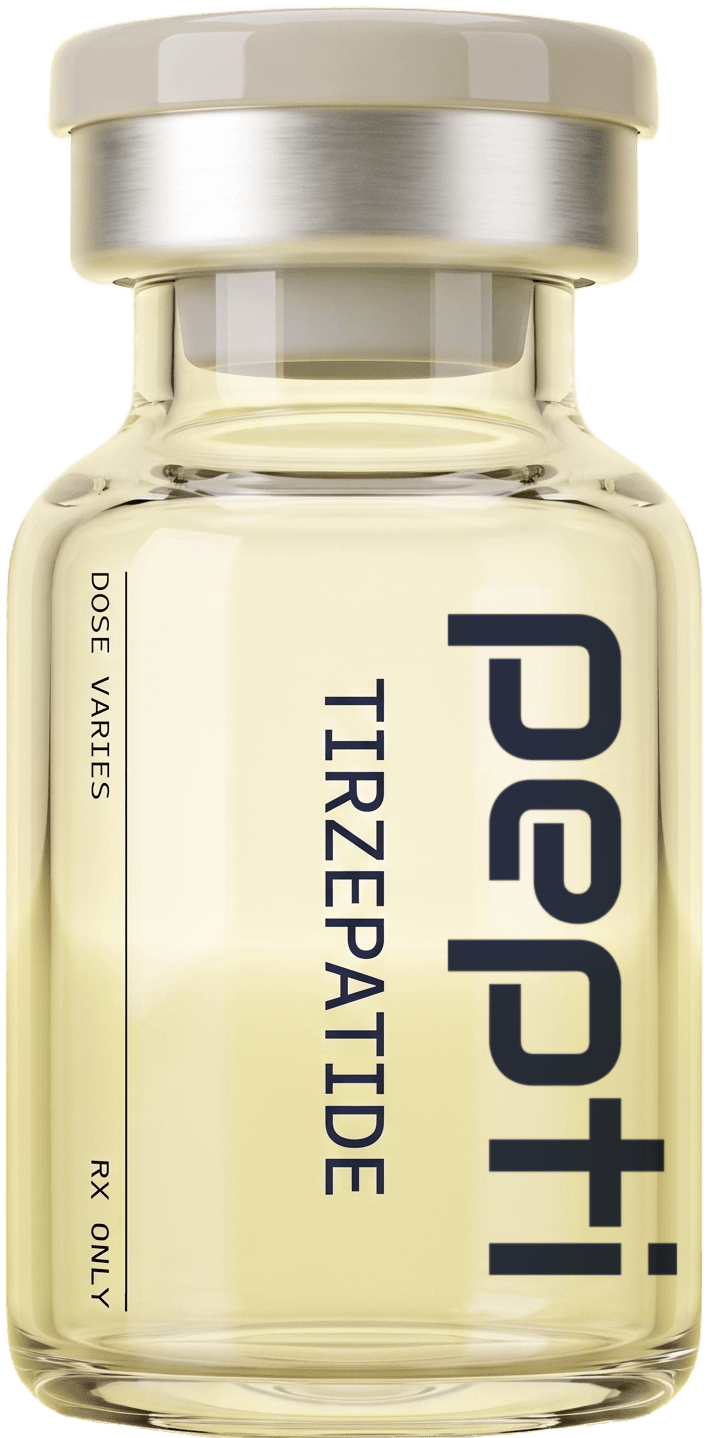
Pepti prescribes tirzepatide on a six-step weekly ladder: 2.5 mg, 5 mg, 7.5 mg, 10 mg, 12.5 mg and 15 mg, each supplied as its own 2 mL vial. At every step the dose is the same draw, 0.50 mL, which is 50 units on a U-100 insulin syringe, once weekly; the dose changes because the vial strength changes, not because you draw more. Your physician sets your dose after reviewing your intake and moves you up the ladder, and your exact dose and units are printed on the vial. The monthly price runs from $159 at 2.5 mg to $319 at 15 mg.
This page is the full chart: the vial behind each dose, what the units mean, how stepping up works, which side effects tend to appear at each step, what it costs, and the questions people search most about tirzepatide dosing. It describes how Pepti prescribes tirzepatide. It is not a set of instructions for choosing or changing your own dose.
Tirzepatide Dosing Chart
The short answer
| Weekly dose | Pepti vial | Concentration | Directions on the vial | Monthly price |
|---|---|---|---|---|
| 2.5 mg | 10 mg per 2 mL, with glycine | 5 mg/mL | Inject 0.50 mL (50 units) once weekly | $159 |
| 5 mg | 20 mg per 2 mL | 10 mg/mL | Inject 0.50 mL (50 units) once weekly | $179 |
| 7.5 mg | 30 mg per 2 mL, with glycine | 15 mg/mL | Inject 0.50 mL (50 units) once weekly | $189 |
| 10 mg | 40 mg per 2 mL | 20 mg/mL | Inject 0.50 mL (50 units) once weekly | $239 |
| 12.5 mg | 50 mg per 2 mL | 25 mg/mL | Inject 0.50 mL (50 units) once weekly | $249 |
| 15 mg | 60 mg per 2 mL | 30 mg/mL | Inject 0.50 mL (50 units) once weekly | $319 |
Every price is all-in: medication, physician review, refill management and shipping, with no membership fee. Each vial holds four weekly doses, one 28-day fill. Glycine, an amino acid, is included in the 2.5 mg and 7.5 mg vials. Tirzepatide is compounded by a PCAB-accredited, FDA-registered US 503A pharmacy. Compounded medications are not FDA approved.
Tirzepatide Dosing Chart
How Pepti prescribes tirzepatide
Tirzepatide is a once-weekly injection that acts on two receptors, GIP and GLP-1. It is started low and increased in steps, because the stomach side effects cluster around the start and each increase. The background on the molecule and its trials is in what is tirzepatide.
At Pepti the sequence works like this:
- You complete a free online intake covering your history, medications and goals.
- A physician licensed in your state reviews it, usually within 24 hours, and sets your starting dose.
- A state-licensed, FDA-registered US pharmacy compounds the vial for that dose, with your directions printed on it.
- As treatment goes on, your physician reviews how you are doing and moves you up the ladder, holds you at a step, or adjusts your plan.
- Each 28-day refill is one vial, at whatever dose your physician has set for that fill.
The chart above is the menu of steps. Where you start, how long you stay at a step, and where you settle are set by your physician for you. A higher step is not a better step, and many people settle below the top.
Tirzepatide Dosing Chart
Why every tirzepatide dose is 50 units
This is the single most useful fact about Pepti's tirzepatide: you draw to the same line at every dose.
Each of the six vials is dose-specific. The pharmacy concentrates it so that 0.50 mL delivers exactly the weekly dose on the label. That works out as follows:
| Weekly dose | Concentration | 0.50 mL delivers | Units on a U-100 syringe | Doses per 2 mL vial |
|---|---|---|---|---|
| 2.5 mg | 5 mg/mL | 2.5 mg | 50 | 4 |
| 5 mg | 10 mg/mL | 5 mg | 50 | 4 |
| 7.5 mg | 15 mg/mL | 7.5 mg | 50 | 4 |
| 10 mg | 20 mg/mL | 10 mg | 50 | 4 |
| 12.5 mg | 25 mg/mL | 12.5 mg | 50 | 4 |
| 15 mg | 30 mg/mL | 15 mg | 50 | 4 |
So when your dose goes up, the line you draw to does not move. What changes is the vial in your refrigerator. Dosing errors are the most common problem the FDA has reported with compounded incretin medications, and a fixed volume removes most of the arithmetic that causes them.
What "units" means on a U-100 syringe
Prescriptions are written in millilitres, and insulin syringes are marked in units. U-100 is a concentration standard, 100 units per millilitre, so on a U-100 insulin syringe 1 unit is 0.01 mL. That conversion never changes:
Directions in mL On a U-100 syringe 0.25 mL 25 units 0.50 mL 50 units 1.0 mL 100 units, the whole barrel A unit here is a volume mark on the barrel, not a measure of how much tirzepatide you are getting. Fifty units from the 2.5 mg vial and fifty units from the 15 mg vial are the same volume and very different amounts of medication. That is why the units alone never tell you your dose; the vial label does.
A new dose step means a new vial
You never move up a step by drawing more from the vial you already have. Drawing 100 units from a 2.5 mg vial would not be "5 mg done carefully"; it is an improvised dose from a vial dispensed for a different direction, and improvised volumes are how people lose track of what they took. When your physician moves you to a new step, the pharmacy sends the vial for that step with its own label. Until it arrives, your current vial's directions are the ones that apply.
Is 15 mg weekly or the whole vial?
Weekly. The 15 mg vial holds 60 mg in 2 mL at 30 mg/mL. Each 0.50 mL draw is one 15 mg weekly dose, and the vial holds four of them. The same logic applies at every step: the milligram figure in the dose column is per week, and the larger figure on the vial is the whole vial. More on reading a label is in how long does a peptide vial last.
Tirzepatide Dosing Chart
How stepping up works
The approved tirzepatide label sets out the schedule that Pepti's ladder follows. It starts at 2.5 mg once weekly for four weeks, described as a dose for getting used to the medication rather than a maintenance dose, then increases in 2.5 mg steps after at least four weeks on the current dose, to a maximum of 15 mg weekly.
Two things follow from that, and both matter more than the top number.
"At least four weeks" is a floor, not a deadline
Four weeks is the minimum time at a step before an increase is considered. It is not a schedule that moves you up automatically every month. Because each Pepti vial covers four weekly doses, a step lines up naturally with one 28-day fill, but staying on the same step for several fills is normal. The approved label directs prescribers to consider a lower maintenance dose when a higher one is not tolerated, and 5 mg, 10 mg and 15 mg are all approved maintenance doses.
If side effects have not settled at your current step, tell your care team before your next refill. Your physician reviews how you are doing and sets the dose for that fill. Never change, skip, split or increase your own dose.
What the ladder looks like in practice
| Step | What it is for | What usually happens next |
|---|---|---|
| 2.5 mg | Starting dose, getting used to the medication | Your physician reviews how the first weeks went |
| 5 mg | First maintenance-level step | Held or stepped up, depending on how you are doing |
| 7.5 mg | Intermediate step | Same review |
| 10 mg | Maintenance-level step | Many people settle at a step below the top |
| 12.5 mg | Intermediate step | Same review |
| 15 mg | Maximum weekly dose | No higher step exists |
These are the roles of the steps, not a timeline. Some people stay at a lower step for a long time; some move up steadily; some do not tolerate tirzepatide at all.
Tirzepatide Dosing Chart
Tirzepatide side effects by dose step
Tirzepatide slows the rate at which the stomach empties, most after the first dose and after each increase, and less with each week at the same strength. That is why the common side effects, nausea, diarrhea, constipation, vomiting, reflux and early fullness, cluster in the days after starting and after each step up. The approved label states that most nausea, vomiting and diarrhea occurred during dose escalation and decreased over time.
| Step | Pepti vial | What patients commonly describe |
|---|---|---|
| 2.5 mg | 10 mg per 2 mL, with glycine | First noticeable appetite change; first queasy days for some |
| 5 mg | 20 mg per 2 mL | Often the first real step up; nausea and fullness can return for a few days |
| 7.5 mg | 30 mg per 2 mL, with glycine | Another few days of adjustment after the step |
| 10 mg | 40 mg per 2 mL | Same pattern |
| 12.5 mg | 50 mg per 2 mL | Same pattern |
| 15 mg | 60 mg per 2 mL | Same pattern; constipation was reported less often at 15 mg than at 5 mg |
The rates on the approved weight-management label barely move between steps. Nausea was reported by 25% of people at 5 mg, 29% at 10 mg and 28% at 15 mg, against 8% on placebo. How fast the dose climbs matters more than where it ends up, which is why holding a step is the main adjustment when side effects have not settled.
Serious side effects are uncommon but specific: severe, persistent abdominal pain that may be pancreatitis, gallbladder pain, dehydration from vomiting, and allergic reactions. The full list, the rates against placebo, what helps the stomach side effects and what to report the same day are in tirzepatide side effects. For birth control pills, the label advises a non-oral or backup method for four weeks after starting and four weeks after each dose increase, because slower stomach emptying reduces absorption.
Tirzepatide Dosing Chart
Price per dose step
Pepti prices tirzepatide by dose, because a higher step is a stronger vial with more medication in it.
| Weekly dose | Vial contents | Monthly price, all-in |
|---|---|---|
| 2.5 mg | 10 mg | $159 |
| 5 mg | 20 mg | $179 |
| 7.5 mg | 30 mg | $189 |
| 10 mg | 40 mg | $239 |
| 12.5 mg | 50 mg | $249 |
| 15 mg | 60 mg | $319 |
Each price covers one vial per 28-day fill, the physician review, refill management and refrigerated shipping with ice packs, sterile syringes and alcohol prep pads. There is no membership fee. Pepti is cash-pay and does not bill insurance. When your physician moves you to a new step, the new step's price applies from that fill. More detail is on the tirzepatide cost page.
Tirzepatide Dosing Chart
Missed doses
The approved tirzepatide label says a missed dose can be taken as soon as possible within 4 days (96 hours) of the missed dose; if more than 4 days have passed, skip it and take the next dose on the regularly scheduled day. Never take two doses close together to catch up. After two or more missed weeks, tolerance to the stomach side effects fades, and restarting at the previous step can feel like starting again, so message your care team before restarting after a gap. The detail is in what if I miss a dose of tirzepatide.
Tirzepatide Dosing Chart
Storage and the vial in practice
Tirzepatide ships refrigerated with ice packs and is kept refrigerated between weekly doses. Do not freeze it. Beyond-use dating runs from first puncture and is printed on the label. Subcutaneous means into the fat layer; abdomen, thigh and upper arm are the usual sites, rotated. Tirzepatide is supplied as a vial drawn with an insulin syringe, not as a pen. Technique is covered in how to inject peptides safely and storage in how to store peptides.
Tirzepatide Dosing Chart
What the evidence shows, honestly
The dose ladder is not invented for compounding. The steps, the four-week minimum at each step and the 15 mg maximum come from the approved tirzepatide label, which rests on large randomized trials of the manufactured product. What those trials do not cover is the compounded preparation: a compounded vial contains the same molecule at the same weekly doses, but no trial has been run on it, and compounded medications are not FDA approved. The quality of any vial rests on the pharmacy that made it, which is why lot test results are published at /quality/lab-results.
Nothing on this page sets anyone's dose. Your physician sets your dose after reviewing your intake, and your directions are printed on the vial.
Tirzepatide Dosing Chart
Where to get tirzepatide prescribed
Tirzepatide cannot be bought legitimately without a prescription. Products sold "for research use only" have no pharmacy accountable for identity, purity, sterility or concentration, and a vial with an unknown concentration makes every unit count on this page meaningless. The prescription route:
- Complete a free online intake covering your history, medications and what you want help with.
- A physician licensed in your state reviews it, usually within 24 hours.
- If it is appropriate, a state-licensed, FDA-registered US pharmacy compounds it to that prescription.
- It ships refrigerated with ice packs, sterile syringes and alcohol prep pads, with your directions printed on the vial.
- Your care team stays reachable for side effects and dose questions. Refills run every 28 days, one vial per fill.
Bloodwork is not required for any Pepti treatment. If your physician wants labs for your care, they'll ask through your account. The step-by-step page is how to get tirzepatide prescribed online.
References
What this is based on.
References
- Jastreboff AM, Aronne LJ, Ahmad NN, et al.. Tirzepatide Once Weekly for the Treatment of Obesity (SURMOUNT-1) · New England Journal of Medicine (2022) · PMID 35658024
- Garvey WT, Frias JP, Jastreboff AM, et al.. Tirzepatide once weekly for the treatment of obesity in people with type 2 diabetes (SURMOUNT-2) · Lancet (2023) · PMID 37385275
- Frías JP, Davies MJ, Rosenstock J, et al.. Tirzepatide versus Semaglutide Once Weekly in Patients with Type 2 Diabetes (SURPASS-2) · New England Journal of Medicine (2021) · PMID 34170647
- Inagaki N, Takeuchi M, Oura T, et al.. Effects of subcutaneous tirzepatide versus placebo or semaglutide on pancreatic islet function and insulin sensitivity in adults with type 2 diabetes: a multicentre, randomised, double-blind, parallel-arm, phase 1 clinical trial · The Lancet Diabetes & Endocrinology (2022) · PMID 35468322
- Malhotra A, Grunstein RR, Fietze I, et al.. Tirzepatide for the Treatment of Obstructive Sleep Apnea and Obesity (SURMOUNT-OSA) · New England Journal of Medicine (2024) · PMID 38912654
- Nicholls SJ, Pavo I, Bhatt DL, et al.. Cardiovascular Outcomes with Tirzepatide versus Dulaglutide in Type 2 Diabetes (SURPASS-CVOT) · New England Journal of Medicine (2025) · PMID 41406444
- Aronne LJ, Sattar N, Horn DB, et al.. Continued Treatment With Tirzepatide for Maintenance of Weight Reduction in Adults With Obesity: The SURMOUNT-4 Randomized Clinical Trial · JAMA (2024) · PMID 38078870
- Pasternak B, Wintzell V, Hviid A et al.. Glucagon-like peptide 1 receptor agonist use and risk of thyroid cancer: Scandinavian cohort study · BMJ (2024) · PMID 38683947
- Quddos F, Hubshman Z, Tegge A, et al.. Semaglutide and Tirzepatide reduce alcohol consumption in individuals with obesity · Scientific Reports (2023) · PMID 38017205
- Drummond RF, Seif KE, Reece EA. Glucagon-like peptide-1 receptor agonist use in pregnancy: a review · Am J Obstet Gynecol (2025) · PMID 39181497
- Wang S, Sun J, Wang J, et al.. Does obesity based on body mass index affect semen quality? A meta-analysis and systematic review from the general population rather than the infertile population · Andrologia (2021) · PMID 34028074
- Urva S, Coskun T, Loghin C, et al.. The novel dual glucose-dependent insulinotropic polypeptide and glucagon-like peptide-1 (GLP-1) receptor agonist tirzepatide transiently delays gastric emptying similarly to selective long-acting GLP-1 receptor agonists · Diabetes, Obesity and Metabolism (2020) · PMID 32519795
Citations are provided for educational purposes. They do not constitute medical advice. Always discuss any peptide protocol with your prescribing physician.
Common questions
Tirzepatide Dosing Chart, answered.
Pepti's ladder has six weekly steps: 2.5 mg, 5 mg, 7.5 mg, 10 mg, 12.5 mg and 15 mg. The approved label starts at 2.5 mg for four weeks and increases in 2.5 mg steps after at least four weeks on the current dose. Your physician sets your dose after reviewing your intake and moves you up the ladder; your dose is printed on the vial.
At every Pepti step, 50 units on a U-100 insulin syringe, which is 0.50 mL, once weekly. Each vial is concentrated so that 50 units delivers that vial's weekly dose. Always follow the units printed on your vial.
2.5 mg is 50 units from the 5 mg/mL vial; 5 mg is 50 units from 10 mg/mL; 7.5 mg is 50 units from 15 mg/mL; 10 mg is 50 units from 20 mg/mL; 12.5 mg is 50 units from 25 mg/mL; 15 mg is 50 units from 30 mg/mL. The draw is the same; the vial changes.
2.5 mg once weekly, from the 10 mg per 2 mL vial at 5 mg/mL, drawn at 50 units. It is a dose for getting used to the medication rather than a maintenance dose. The monthly price at 2.5 mg is $159.
At least four weeks, which is one Pepti vial. That is a minimum, not a schedule: many people stay on a step for several fills, and some settle below the top. Your physician reviews how you are doing before each change.
15 mg once weekly, from the 60 mg per 2 mL vial at 30 mg/mL, drawn at 50 units. The monthly price at 15 mg is $319. No higher step exists on the ladder.
No. A new dose step means a new vial with its own label. Drawing more from your current vial is an improvised dose. If you think your dose should change, message your care team; your physician sets your dose after reviewing how you are doing.
From Pepti's 5 mg vial, which is 20 mg per 2 mL at 10 mg/mL, 5 mg is 0.50 mL, or 50 units. From a vial at a different concentration it would be a different number of units, which is why you follow the label on the vial in hand.
Yes. "Trizepatide" and "terzepedide" are common misspellings of tirzepatide, the once-weekly GIP and GLP-1 medication. Everything on this page applies.
Not as much as people expect. On the approved label, nausea was 25% at 5 mg and 28% at 15 mg, and constipation was lower at 15 mg than at 5 mg. Side effects cluster in the days after each step up, which is why holding a step is the usual adjustment. See tirzepatide side effects.
$159 a month at 2.5 mg, $179 at 5 mg, $189 at 7.5 mg, $239 at 10 mg, $249 at 12.5 mg and $319 at 15 mg. Each price is all-in for one vial per 28-day fill, covering medication, physician review, refill management and shipping.
The approved label says take it within 4 days (96 hours) of the missed dose; past 4 days, skip it and take the next dose on your usual day. Never take two doses to make up one. See what if I miss a dose of tirzepatide. The free assessment goes to a physician licensed in your state. A consultation does not guarantee a prescription.
Next step
See what a physician recommends for you.
A licensed physician in your state reviews your intake and decides what is appropriate. A consultation does not guarantee a prescription.