Weight Loss · Reference
Tirzepatide Side Effects: Common, Serious, and What to Report
This page is a practical side-effects reference: what to expect, when, what helps, and what to report. The bigger question of overall safety, including the long-term trial record and the FDA status of compounded tirzepatide, is covered in is tirzepatide safe.
Medically reviewed by Dr. Gene, MD · November 4, 2026
Treatments mentioned
The most common tirzepatide side effects are nausea, diarrhea, constipation, vomiting, reflux and reduced appetite, and they cluster in the days after starting and after each dose increase. In the trials behind the approved weight-management label, most were mild to moderate, and about one person in twenty stopped because of a side effect. The serious ones are uncommon but specific: severe abdominal pain that may be pancreatitis, gallbladder pain, dehydration from vomiting, and allergic reactions. A personal or family history of medullary thyroid carcinoma or MEN 2, pregnancy and breastfeeding rule tirzepatide out.
This page is a practical side-effects reference: what to expect, when, what helps, and what to report. The bigger question of overall safety, including the long-term trial record and the FDA status of compounded tirzepatide, is covered in is tirzepatide safe.
Tirzepatide Side Effects
The short answer
| Side effect | How common on the approved label | When it usually shows up | What to do |
|---|---|---|---|
| Nausea | 25 to 29% against 8% on placebo | Days after starting or stepping up | Smaller meals, eat slowly, report it |
| Diarrhea | 19 to 23% against 8% | Around dose increases | Fluids, report if persistent |
| Constipation | 11 to 17% against 5% | Can persist at a steady dose | Fluid, fiber, movement; report it by name |
| Vomiting | 8 to 13% against 2% | Around dose increases | Report it; vomiting that will not stop is a same-day call |
| Reflux, burping, early fullness | 4 to 10% against 1 to 5% | Early weeks and after increases | Earlier last meal, stay upright after eating |
| Injection-site redness or itching | 6 to 8% against 2% | Any time | Rotate sites |
| Severe abdominal pain, often into the back | Uncommon | Any time | Same-day medical care; possible pancreatitis |
The medication this page covers:
| Product | What is in it | Price |
|---|---|---|
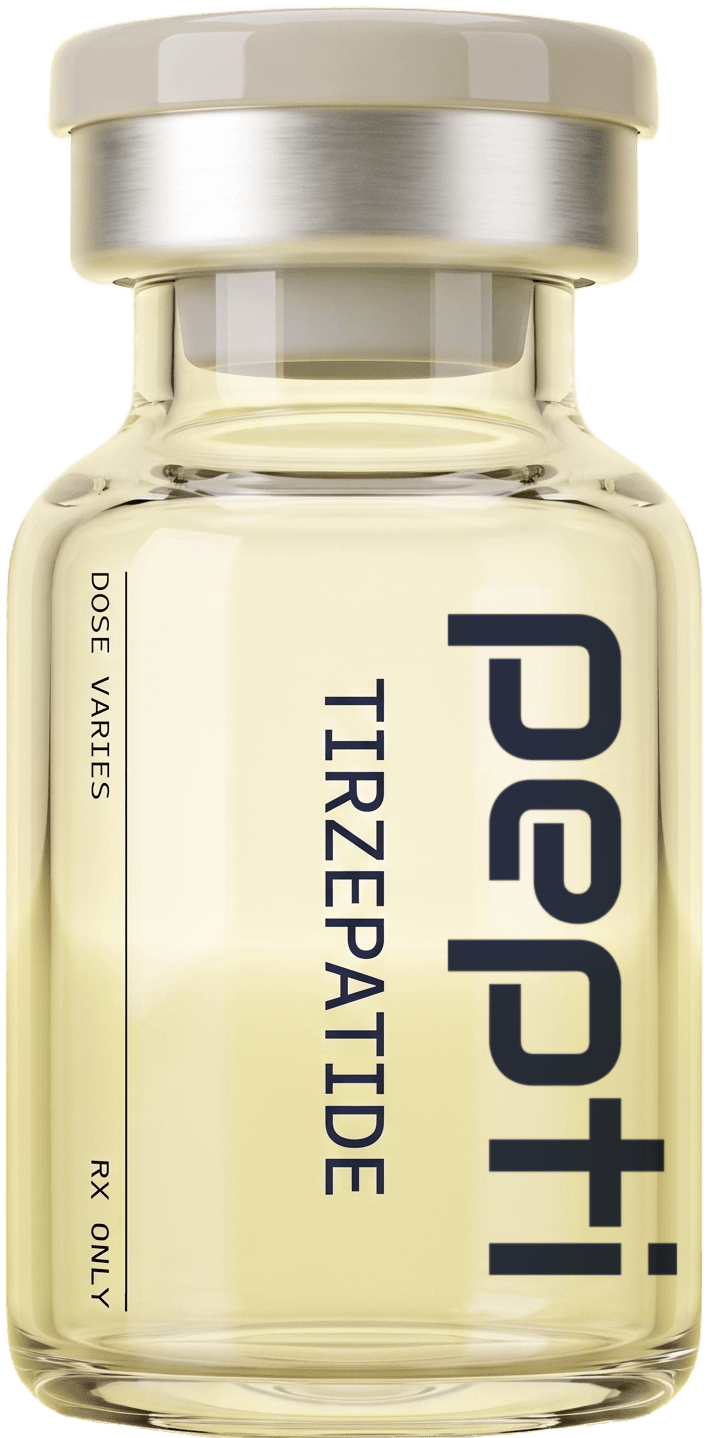
| Tirzepatide | Dose-specific 2 mL vials at six strengths, 2.5 mg to 15 mg weekly; the 2.5 mg and 7.5 mg vials include glycine, an amino acid | From $159/mo, priced by dose |
The price is all-in: medication, physician review, refill management and shipping, with no membership fee. Pepti's tirzepatide is compounded by a PCAB-accredited, FDA-registered US 503A pharmacy. Compounded medications are not FDA approved, and the side-effect rates on this page come from the trials of the approved manufactured product, which contains the same molecule.
Tirzepatide Side Effects
Common tirzepatide side effects
Nearly every common side effect follows from one action: tirzepatide slows the rate at which the stomach empties, most after the first dose and after each increase, less with each week at the same strength. Food stays in the stomach longer, so the old portion size now overshoots, and nausea, reflux, burping and early fullness follow. It also acts on appetite centers in the brain, which is why reduced appetite is listed as a side effect as well as being the point of the treatment.
The full list from the approved label
These figures pool two placebo-controlled trials in 2,519 adults treated for up to 72 weeks, by maintenance strength.
Side effect 5 mg 10 mg 15 mg Placebo Nausea 25% 29% 28% 8% Diarrhea 19% 21% 23% 8% Constipation 17% 14% 11% 5% Vomiting 8% 11% 13% 2% Abdominal pain 9% 9% 10% 5% Dyspepsia (indigestion) 9% 9% 10% 4% The rest of the list, reported across the three strengths:
Side effect Tirzepatide Placebo Injection-site reactions 6 to 8% 2% Fatigue 5 to 7% 3% Hypersensitivity, mostly rash and itching About 5% 3% Burping, hair loss, reflux 4 to 5% each 1 to 2% Dizziness 4 to 5% 2% Low blood pressure 1.6% 0.1% Some gastrointestinal side effect was reported by 56% of people on any strength and 30% on placebo. Two things are worth noticing. The placebo column is not zero: 8% of people on a dummy injection reported nausea, so not every queasy day on tirzepatide is the drug. And the rates barely move between 5 mg and 15 mg, while constipation actually falls at higher strengths. How fast the dose climbs matters more than where it ends up.
The type 2 diabetes label reads differently
In the trials for type 2 diabetes the reported rates were lower: nausea 12 to 18% against 4%, diarrhea 12 to 17% against 9%, decreased appetite 5 to 11% against 1%, vomiting 5 to 9% against 2%. Rates are specific to the population studied, which is one reason your own experience will not match a table exactly.
How many people stop
Across the two weight-management trials, 4.8%, 6.3% and 6.7% of people on 5, 10 and 15 mg stopped permanently because of a side effect, against 3.4% on placebo. Stopping specifically for a gastrointestinal reason ran 1.9%, 3.3% and 4.3% against 0.5%, and most of those stops happened in the first few months, during dose escalation.
Tirzepatide Side Effects
When side effects show up in the dose ladder
Tirzepatide is started low and stepped up, and the steps are where most side effects happen. The approved label states that most nausea, vomiting and diarrhea occurred during dose escalation and decreased over time. The approved schedule starts at 2.5 mg weekly for four weeks, a dose for getting used to the medication rather than a maintenance dose, then rises in 2.5 mg steps after at least four weeks at each strength, to a maximum of 15 mg.
| Rung | Pepti vial | What patients commonly describe |
|---|---|---|
| 2.5 mg, the starting dose | 10 mg per 2 mL, with glycine | First noticeable appetite change; first queasy days for some |
| 5 mg | 20 mg per 2 mL | Often the first real step up; nausea and fullness can return for a few days |
| 7.5 mg | 30 mg per 2 mL, with glycine | Another few days of adjustment after the step |
| 10 mg | 40 mg per 2 mL | Same pattern; many people settle at a strength below the top |
| 12.5 mg | 50 mg per 2 mL | Same pattern |
| 15 mg, the maximum | 60 mg per 2 mL | Same pattern; constipation was reported less often here than at 5 mg |
Every Pepti tirzepatide vial is drawn at 0.50 mL (50 units on a U-100 insulin syringe) once weekly, at every strength. When the dose changes, the vial changes and the line you draw to stays the same. Your directions are printed on the vial.
These are patterns, not timelines. Some people barely notice a step up, some feel every one, and a few cannot tolerate tirzepatide at all. All three are real outcomes.
Why holding a rung is normal
The approved schedule requires at least four weeks on a strength before any increase, and "at least" is a floor, not a deadline. The label directs prescribers to consider a lower maintenance dose when a higher one is not tolerated, and 5, 10 and 15 mg are all approved maintenance doses. If side effects have not settled, tell your care team: holding at the current strength, or stepping back, is the most powerful adjustment available, and your physician sets your directions after reviewing how you are doing. Never change your own dose.
Missed doses bring side effects back
The tolerance your stomach builds fades when doses stop. The approved label says a missed dose can be taken within four days (96 hours); after that, skip it and take the next dose on your usual day. Do not take two doses to make up one. The detail is in what if I miss a dose of tirzepatide.
Tirzepatide Side Effects
Tirzepatide GI side effects and what helps
The stomach side effects are the ones most people deal with, and they are the ones you can do most about. These measures are grounded in the mechanism and in clinical experience rather than in trials that randomized people to eating advice, so treat them as sensible rather than proven.
| Symptom | What usually helps | When to tell your care team |
|---|---|---|
| Nausea | Smaller portions, stop at the first sense of fullness, eat slowly, protein first, avoid fried and very fatty meals | If it stops you eating properly, or is not easing at the same strength |
| Constipation | Fluid, fiber, regular movement | If it persists; say "constipation" specifically, because the answer is different from nausea |
| Diarrhea | Fluids, plain meals | If it lasts more than a day or two, or you feel dizzy |
| Reflux and burping | An earlier last meal, staying upright after eating, skipping alcohol | If it is waking you or not responding |
| Early fullness | Smaller, more frequent meals | If you are not getting enough protein or fluid |
| Vomiting | Small sips of fluid | Same day if you cannot keep fluids down |
The dehydration link
Vomiting and diarrhea matter beyond comfort because they drain fluid. The approved label records post-marketing reports of acute kidney injury, some needing dialysis, mostly in people whose vomiting or diarrhea led to dehydration. Tirzepatide is not toxic to the kidney; the risk runs through fluid loss. Low blood pressure was also reported more often on tirzepatide (1.6% against 0.1%), more so in people taking blood-pressure medication. Dark urine, not passing urine, light-headedness on standing, or not keeping fluids down are reasons to contact your care team the same day.
Medication for nausea
Pepti physicians can prescribe ondansetron where they judge it appropriate for you. It is not a default, and it treats the symptom rather than the cause: if the dose has climbed faster than your stomach can adapt, the adjustment to the schedule is still the main answer. More on managing this is in GLP-1 nausea: how to manage it.
Tirzepatide Side Effects
Serious side effects of tirzepatide: what to report urgently
Serious side effects are uncommon. They matter because recognizing them early is what changes the outcome.
| Symptom | What it may be | What to do |
|---|---|---|
| Severe, persistent abdominal pain, sometimes into the back, with or without vomiting | Acute pancreatitis | Seek medical care the same day; stop the medication if pancreatitis is suspected |
| Pain under the right ribs, especially with fever or yellowing skin or eyes | Gallstones or gallbladder inflammation | Seek care the same day |
| Vomiting or diarrhea that stops you keeping fluids down | Dehydration, with a risk to the kidneys | Contact your care team the same day |
| Swollen, painful abdomen, vomiting that will not stop, no gas or stool passing | Bowel obstruction or ileus | Emergency care |
| Swelling of the face, lips or throat, widespread rash, trouble breathing | Serious allergic reaction | Emergency care first, then tell your care team |
| A lump in the neck, persistent hoarseness, trouble swallowing | The thyroid symptoms the label asks people to watch for | Contact your physician promptly |
| Shakiness, sweating, confusion, if you also take insulin or a sulfonylurea | Low blood sugar | Treat it, then report it |
| Sudden change in vision | Needs assessment | Urgent eye care and a message to your care team |
How rare the serious ones are
In the pooled weight-management trials, confirmed acute pancreatitis occurred in 0.2% of people on tirzepatide and 0.2% on placebo. Gallstones were reported in 1.1% against 1%, gallbladder inflammation in 0.7% against 0.2%, and gallbladder removal in 0.2% against none. Severe gastrointestinal reactions ran 1.7% to 3.1% across strengths against 1%. Serious allergic reactions were reported in 0.1% of trial participants against none on placebo, with anaphylaxis and angioedema reported after approval.
Low blood sugar
Tirzepatide prompts insulin release only when glucose is high, so on its own it rarely drives blood sugar dangerously low, though the label notes it has been reported in adults without diabetes. The risk rises with insulin or a sulfonylurea: in a trial of adults with type 2 diabetes, blood glucose below 54 mg/dL occurred in 10.3% of those also taking a sulfonylurea against 2.1% of those not. That is why your full medication list belongs on the intake.
The thyroid warning
The approved label carries a boxed warning because tirzepatide caused thyroid C-cell tumors in rats. Whether it does so in people is unknown. It is the reason a personal or family history of medullary thyroid carcinoma or MEN 2 rules tirzepatide out, and it is discussed in full in is tirzepatide safe.
Before surgery or sedation
Because the stomach empties more slowly, there have been rare reports of aspiration under general anesthesia or deep sedation with food still in the stomach. Tell every provider you take tirzepatide before any planned procedure, including a colonoscopy or dental sedation, and let them and your prescriber plan around it.
Tirzepatide Side Effects
Tirzepatide side effects in women
The trial labels do not publish a separate side-effect table for women, so there is no sourced figure for how much more or less often women feel nausea. What the label does carry is a set of points that apply specifically to women.
| Topic | What the approved label says | What it means in practice |
|---|---|---|
| Birth control pills | Slowed stomach emptying reduced absorption of an oral contraceptive after a single 5 mg dose | Switch to a non-oral method, or add a barrier method, for four weeks after starting and four weeks after each dose increase |
| Fertility | Weight reduction can bring back ovulation in people who had stopped ovulating | Pregnancy is possible even if it was not before; plan contraception from the start |
| Pregnancy | Not used; stop when pregnancy is recognized | Tell your care team straight away if you become pregnant |
| Breastfeeding | Effects on a breastfed infant are unstudied | Not prescribed while breastfeeding |
| Hair thinning | Hair loss 4 to 5% against 1 to 2% on placebo | Generally tied to the pace of weight change; report it and keep protein intake up |
The contraception point is the one most often missed. Non-oral methods such as a ring, patch, implant or IUD are not affected by slower stomach emptying. More on this is in do peptides affect fertility and can you take peptides while pregnant.
Tirzepatide Side Effects
Who should not take tirzepatide
| Situation | Status |
|---|---|
| Personal or family history of medullary thyroid carcinoma | Rules it out |
| Multiple endocrine neoplasia type 2 (MEN 2) | Rules it out |
| Previous serious allergic reaction to tirzepatide or an ingredient of the vial | Rules it out |
| Pregnancy, or trying to become pregnant | Not used |
| Breastfeeding | Not used |
| Severe gastroparesis | Not recommended; it slows an already slow stomach |
| Previous pancreatitis | Not automatic, but it needs careful discussion |
| Active gallbladder disease | Needs discussion |
| Taking insulin or a sulfonylurea | Possible, with the other medication reviewed for low blood sugar |
| Taking another GLP-1 medication, including semaglutide | Not combined; tirzepatide and semaglutide are alternatives, never a pair |
| Under 18 | Pepti prescribes to adults only |
Bloodwork is not required for any Pepti treatment. If your physician wants labs for your care, they'll ask through your account.
Tirzepatide Side Effects
Tirzepatide vs semaglutide side effects
The two share the same side-effect categories, the same serious risks and the same contraindications. The percentages on their labels come from different trials in different populations, and both labels say they cannot be compared directly. In the one trial that compared tirzepatide with semaglutide 1 mg in type 2 diabetes, nausea ran 17 to 22% on tirzepatide against 18% on semaglutide. The full comparison is in semaglutide vs tirzepatide, the semaglutide version of this page is semaglutide side effects, and the class overview is GLP-1 side effects.
Tirzepatide Side Effects
What the evidence shows, honestly
The side-effect profile of tirzepatide is documented rather than guessed at: it comes from randomized, placebo-controlled trials in thousands of adults, plus reports gathered after approval. That is far more than any other compounded peptide has behind it.
Three limits are worth stating. First, the trial rates belong to the approved manufactured product. A compounded vial contains the same molecule, so the same side effects apply, but no trial has been run on a compounded preparation. Second, the advice on portions and meal composition is sensible and low-risk but has not been tested in trials. Third, rare events reported after approval come from voluntary reports, so their true frequency cannot be calculated.
Any claim that a compounded version, an added vitamin or a particular brand of syringe makes tirzepatide gentler on the stomach has no trial behind it.
Tirzepatide Side Effects
Where to get tirzepatide prescribed
Tirzepatide cannot be bought legitimately without a prescription. Sites selling it "for research use only" are not accountable for identity, purity, sterility or concentration, and a vial with an unknown concentration adds a dosing-error risk on top of the side effects above. The prescription route:
- Complete a free online intake covering your history, medications and what you want help with.
- A physician licensed in your state reviews it, usually within 24 hours.
- If it is appropriate, a state-licensed, FDA-registered US pharmacy compounds it to that prescription. Lot test results are published at /quality/lab-results.
- It ships refrigerated with ice packs, with sterile syringes and alcohol prep pads, and your directions printed on the vial.
- Your care team stays reachable for side effects and dose questions. Refills run every 28 days, one vial per fill.
Pepti is cash-pay and does not bill insurance. The step-by-step page is how to get tirzepatide prescribed online.
References
What this is based on.
References
- Jastreboff AM, Aronne LJ, Ahmad NN, et al.. Tirzepatide Once Weekly for the Treatment of Obesity (SURMOUNT-1) · New England Journal of Medicine (2022) · PMID 35658024
- Garvey WT, Frias JP, Jastreboff AM, et al.. Tirzepatide once weekly for the treatment of obesity in people with type 2 diabetes (SURMOUNT-2) · Lancet (2023) · PMID 37385275
- Frías JP, Davies MJ, Rosenstock J, et al.. Tirzepatide versus Semaglutide Once Weekly in Patients with Type 2 Diabetes (SURPASS-2) · New England Journal of Medicine (2021) · PMID 34170647
- Inagaki N, Takeuchi M, Oura T, et al.. Effects of subcutaneous tirzepatide versus placebo or semaglutide on pancreatic islet function and insulin sensitivity in adults with type 2 diabetes: a multicentre, randomised, double-blind, parallel-arm, phase 1 clinical trial · The Lancet Diabetes & Endocrinology (2022) · PMID 35468322
- Malhotra A, Grunstein RR, Fietze I, et al.. Tirzepatide for the Treatment of Obstructive Sleep Apnea and Obesity (SURMOUNT-OSA) · New England Journal of Medicine (2024) · PMID 38912654
- Nicholls SJ, Pavo I, Bhatt DL, et al.. Cardiovascular Outcomes with Tirzepatide versus Dulaglutide in Type 2 Diabetes (SURPASS-CVOT) · New England Journal of Medicine (2025) · PMID 41406444
- Aronne LJ, Sattar N, Horn DB, et al.. Continued Treatment With Tirzepatide for Maintenance of Weight Reduction in Adults With Obesity: The SURMOUNT-4 Randomized Clinical Trial · JAMA (2024) · PMID 38078870
- Pasternak B, Wintzell V, Hviid A et al.. Glucagon-like peptide 1 receptor agonist use and risk of thyroid cancer: Scandinavian cohort study · BMJ (2024) · PMID 38683947
- Quddos F, Hubshman Z, Tegge A, et al.. Semaglutide and Tirzepatide reduce alcohol consumption in individuals with obesity · Scientific Reports (2023) · PMID 38017205
- Drummond RF, Seif KE, Reece EA. Glucagon-like peptide-1 receptor agonist use in pregnancy: a review · Am J Obstet Gynecol (2025) · PMID 39181497
- Wang S, Sun J, Wang J, et al.. Does obesity based on body mass index affect semen quality? A meta-analysis and systematic review from the general population rather than the infertile population · Andrologia (2021) · PMID 34028074
- Urva S, Coskun T, Loghin C, et al.. The novel dual glucose-dependent insulinotropic polypeptide and glucagon-like peptide-1 (GLP-1) receptor agonist tirzepatide transiently delays gastric emptying similarly to selective long-acting GLP-1 receptor agonists · Diabetes, Obesity and Metabolism (2020) · PMID 32519795
Citations are provided for educational purposes. They do not constitute medical advice. Always discuss any peptide protocol with your prescribing physician.
Common questions
Tirzepatide Side Effects, answered.
Nausea, diarrhea, constipation, vomiting, indigestion and abdominal pain. On the approved weight-management label, nausea was reported by 25 to 29% of people against 8% on placebo, and some gastrointestinal side effect by 56% against 30%. Most were mild to moderate and happened during dose increases.
The same as in men, plus a few points specific to women. Tirzepatide can reduce absorption of birth control pills for four weeks after starting and after each increase, so a non-oral or backup method is advised in those windows. It is not used in pregnancy or while breastfeeding, and weight reduction can restore ovulation. Hair thinning was reported in 4 to 5% against 1 to 2% on placebo.
Yes. "Trizepidtide" and "trizepatide" are common misspellings of tirzepatide, the once-weekly GIP and GLP-1 medication. Everything on this page applies.
The approved label reports that most nausea, vomiting and diarrhea happened during dose escalation and decreased over time. Patients commonly describe the worst days right after a dose step, easing at the same strength, but there is no fixed timeline. Side effects that are not easing are a reason to message your care team rather than wait.
Not as much as people expect. On the approved label, nausea was 25% at 5 mg and 28% at 15 mg, and constipation was lower at 15 mg than at 5 mg. The pace of increases matters more than the final strength, which is why a step is held if side effects have not settled.
Hair loss was reported in 4 to 5% of people against 1 to 2% on placebo. It is generally tied to the pace of weight change rather than to a direct effect on hair. Report it, and keep protein intake up.
Severe, persistent abdominal pain, especially into the back; a swollen painful abdomen with vomiting and no gas or stool; swelling of the face, lips or throat or trouble breathing; and being unable to keep fluids down. Right-sided upper abdominal pain with fever or yellowing skin needs same-day care.
Ask your care team. Pepti physicians can prescribe ondansetron where they judge it appropriate, but whether it suits you depends on your history and other medications. Adjusting the pace of dose increases is usually the bigger lever.
It can, mainly in the first weeks after starting or increasing, because slower stomach emptying changes how quickly pills are absorbed. Birth control pills are the main example, and the label singles out narrow-window drugs such as warfarin for monitoring. Insulin and sulfonylureas raise the risk of low blood sugar.
There is no evidence for that. It contains the same molecule, so the same side effects apply. Compounded medications are not FDA approved, and what differs is the preparation, which is why the pharmacy and its lot testing matter. See is tirzepatide safe. The free assessment goes to a physician licensed in your state. A consultation does not guarantee a prescription.
Next step
See what a physician recommends for you.
A licensed physician in your state reviews your intake and decides what is appropriate. A consultation does not guarantee a prescription.