Anti-Aging · Reference
Where to Buy NAD+ Online: Injection, Nasal Spray, IV and Oral Compared
Four different things are sold as NAD+. This explains what NAD+ is, which forms need a prescription, how to buy the injectable legitimately, what it costs, and the red flags.

Reviewed by Dr. Gene, MD · Board-certified Family Medicine
Every Pepti prescription is reviewed by a licensed U.S. physician before it's dispensed — and only provided if clinically appropriate.
Treatments mentioned
Injectable and nasal NAD+ are compounded prescription products, so buying them online legitimately means a telehealth provider where a physician licensed in your state prescribes and a licensed US compounding pharmacy fills the order. Oral NAD precursors sold in supplement shops are a different category and need no prescription. IV infusions are a clinic service given in person. Research-use-only NAD+ vials exist too, shipped under a not-for-human-use label with no pharmacy behind them. Compounded NAD+ is not FDA approved, and the marketing around this molecule runs well ahead of the human evidence, which is the most useful thing to know before you buy any version of it.
Where to Buy NAD+ Online
The short answer
| If you want | The product | What is in it | Price |
|---|---|---|---|
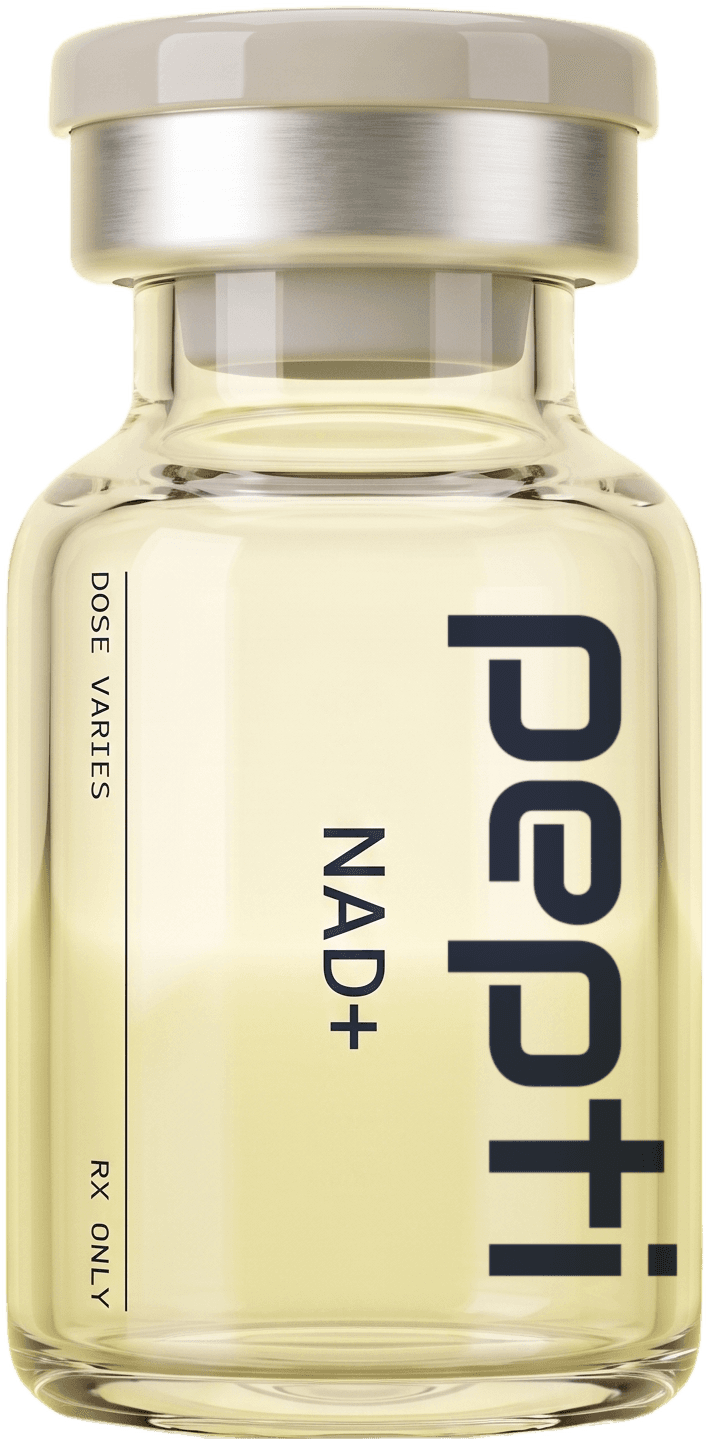
| The standard injectable strength | NAD+ Injection | 1000 mg NAD+ in a 10 mL vial (100 mg/mL) | Cost page |
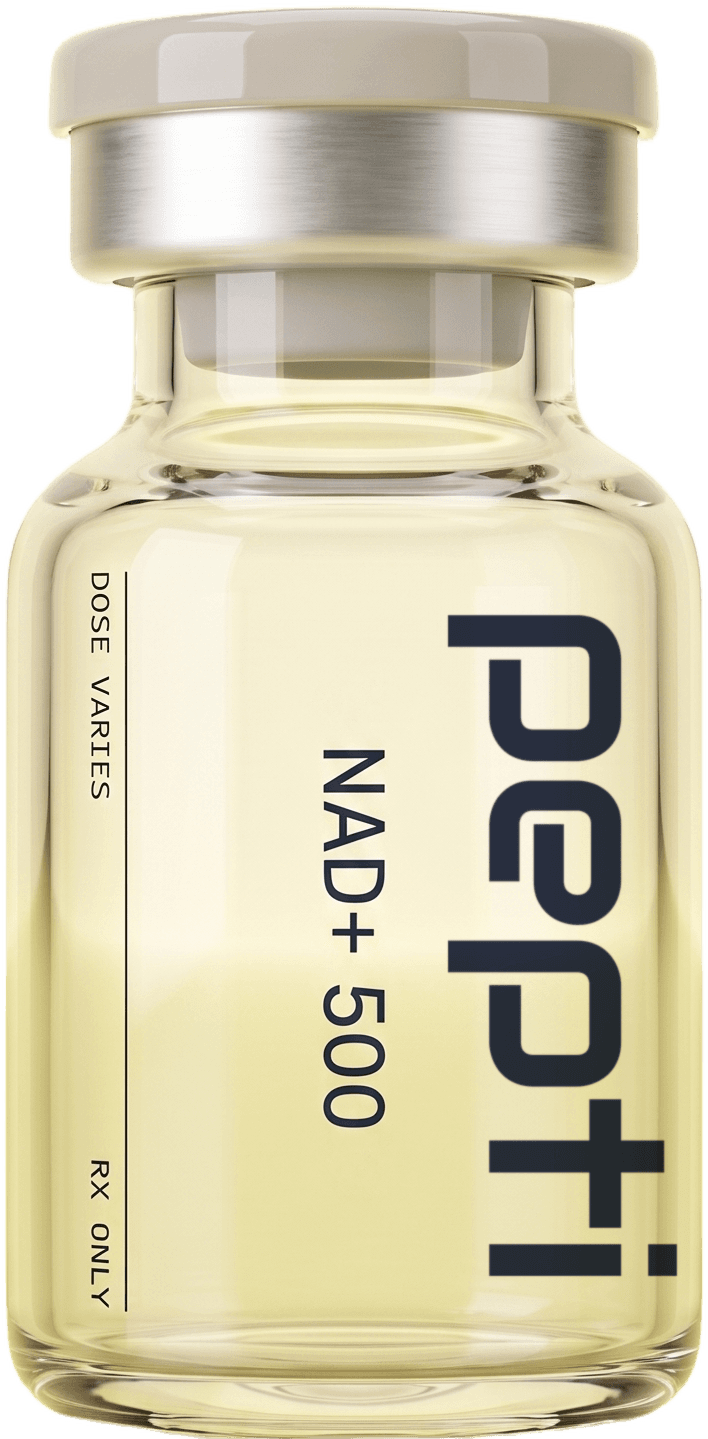
| A lower injectable strength to start | NAD+ 500 mg | 500 mg NAD+ in a 10 mL vial (50 mg/mL) | Cost page |
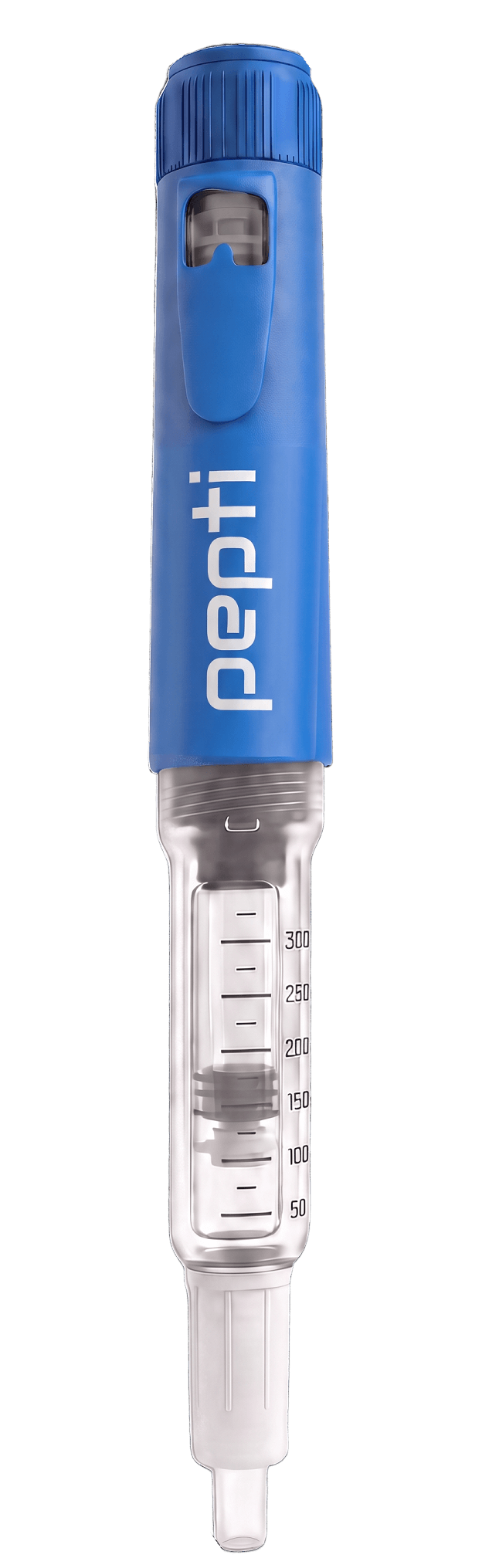
| Injectable without a syringe | NAD+ as the Pen | 3 mL cartridge containing 600 mg NAD+ | Product page |
| No needle at all | NAD+ Nasal Spray | 300 mg NAD+ in a 25 mL bottle (12 mg/mL) | Cost page |
| An oral option | A retail NR or NMN supplement | Varies by brand | Not a prescription |
Prices are all-in per month and include medication, physician review, refill management and shipping. It is a subscription that refills until you cancel it in your account.
What "buying NAD+ online" actually means
Four different things are sold under one name, and a search for "buy NAD+ online" returns all of them mixed together. Two, NAD+ Injection and NAD+ Nasal Spray, are prescription medications compounded to order, so the online part is the consultation and the checkout, not the drug. The IV infusion is not bought online at all: a clinic takes the booking on a website, but the product is hours in a chair with a cannula. And the oral precursor capsule is a dietary supplement any retailer can sell. This page keeps the four apart, because the decision is different for each.
Where to Buy NAD+ Online
What NAD+ actually is
NAD+ is nicotinamide adenine dinucleotide, a coenzyme present in every cell. It is not a peptide, despite being sold beside them, and it is not a stimulant.
Its first job is carrying electrons through the reactions that convert nutrients into usable energy. Its second is being consumed as a substrate by sirtuins and PARP enzymes, which are involved in DNA repair and cellular stress responses. Levels are reported to decline with age, and that observation is the basis of the entire clinical interest in giving it back. Whether raising it produces the outcomes people want is a separate question, and an open one. There is more in what NAD+ injection is and peptides for energy and fatigue.
A coenzyme, and where the body gets it
The body does not take up NAD+ ready-made from food in any meaningful amount. It builds the molecule from tryptophan, from niacin, and, in adult tissue mostly, by recycling nicotinamide through nicotinamide mononucleotide (NMN); nicotinamide riboside (NR) enters the same salvage pathway a step earlier. That is why NMN and NR are the "precursors" sold in capsules, and a 2018 review in Cell Metabolism lays out that biology. The age decline rests on work like a 2012 PLOS ONE study that measured NAD+ in human skin across age groups and reported lower levels in older tissue, and a 2015 review in Science that framed the NAD-consuming enzymes as the likely reason. That is the basis for the category; it is not evidence that putting NAD+ back changes how a person ages.
What it is not
It is not a vitamin, although it is made from one. It is not a hormone, and it does not bind a receptor the way a peptide does. It is not NMN or NR, so a trial of a capsule cannot be read as a trial of the injection. And it is not an approved treatment for any diagnosed condition: no NAD+ product, in any form, has an FDA-approved indication, and compounded NAD+ is not FDA approved.
Where to Buy NAD+ Online
The four routes, compared
| Injection | Nasal spray | IV infusion | Oral precursor | |
|---|---|---|---|---|
| Prescription required | Yes | Yes | Yes, and administered in a clinic | No |
| Where you get it | Compounding pharmacy, shipped to you | Compounding pharmacy, shipped to you | In person, per session | Retailers |
| What you are giving | NAD+ itself | NAD+ itself | NAD+ itself | A precursor the body converts |
| Typical cost structure | One monthly all-in price | One monthly all-in price | Priced per session, often the most expensive route | Per bottle |
| Main drawback | Injections, and discomfort if pushed too fast | Absorption via nasal route is less characterised | Time in a chair, cost per session, infusion reactions | Weakest link between dose and blood level |
| Availability | Broad | Varies, because the pharmacy that makes nasal preparations is not licensed everywhere | Clinic dependent | Broad |
Nasal and injectable are not interchangeable doses. A physician decides which form fits, and the nasal spray is often the answer for someone who will not inject.
The subcutaneous injection, and the 500 mg vial
NAD+ Injection is a multi-dose vial of NAD+ in sterile solution, drawn into an insulin syringe and injected into the fat layer of the abdomen or thigh. The reviewed directions on the product page are three injections per week, and one vial covers about four weeks at that rhythm. It is the form Pepti prescribes in all 50 states and DC. The same medication comes as a pre-filled cartridge for the Pepti Pen, dosed in clicks rather than drawn with a syringe; Pen availability by state is shown at checkout.
NAD+ Injection (500 mg) is the same molecule at half the concentration in the same vial size. It exists because the characteristic reaction to NAD+ tracks with how much enters the circulation how quickly, and a lower concentration at the same volume is one way a physician can start someone gently. Which vial you receive is your physician's decision. It has its own reference page.
The nasal spray
NAD+ Nasal Spray is a metered bottle instilled into each nostril, twice daily on the reviewed directions. It is chosen by people who will not inject, and by physicians who want a lower, more frequent exposure. The caveat is that nasal absorption of NAD+ in humans has not been characterised: the intranasal work is in rats, including a 2007 study in Frontiers in Bioscience and a 2012 study in the Journal of Neurotrauma, and the general pharmacology of nasal delivery, reviewed in the Journal of Controlled Release in 2003, says large charged molecules cross the nasal lining poorly. It is available in fewer states than the injection, because the pharmacy that compounds it is licensed in a subset of them; the current count is on the product page. Details in what NAD+ nasal spray is.
The IV infusion in a clinic
An intravenous infusion delivers NAD+ into a vein over hours, in person, under supervision, so the "online" part is a booking form. The one published human study of NAD+ given directly, a 2019 pilot in Frontiers in Aging Neuroscience, used this route: a six-hour infusion in healthy participants, measuring what happened to the molecule in blood and urine. It is also the route most associated with the flushing and chest-tightness reaction, which is why it is infused so slowly.
The oral precursor capsule
NR and NMN capsules are sold as dietary supplements. They are the form with the randomised human trials, described below. What they are not is NAD+: the capsule contains a precursor, and the body has to convert it. A 2016 study in Nature Communications reported that NR is orally bioavailable and raises NAD+ metabolites in blood in mice and humans, and a 2017 open-label study in PLOS ONE reported the same in healthy volunteers. So the capsule does something measurable in blood; whether that reaches the tissues people care about is the open question. Comparing the four routes by milligrams is the most common mistake in NAD+ marketing: the infusion goes straight into plasma, the injection enters through fat at whatever pace it is pushed, the spray has to cross the nasal lining, and the capsule is a different molecule.
Where to Buy NAD+ Online
The one practical thing nobody tells NAD+ buyers
Pushing NAD+ too quickly is uncomfortable. People commonly describe flushing, chest tightness, a wave of nausea or an urge to cough when a dose goes in fast, and it settles when the pace slows. It is the reason your directions specify a pace rather than just a volume, the reason a lower strength exists as a starting point, and the reason the first dose is usually a smaller one.
That is also a useful test of a seller. A provider that ships NAD+ with no instruction about pace has never had the conversation with a patient. Tolerability detail is in is NAD+ safe.
What the reaction is, and what it is not
The reaction happens during the dose rather than afterwards, and it passes within minutes once the pace slows. It is widely reported with intravenous infusion and in milder form with subcutaneous NAD+ Injection given quickly. It is not an allergy and not a sign of a bad vial. What is not part of that pattern is severe chills, rigors or vomiting that do not settle; those should be reported to your physician, and the FDA has separately flagged that reactions of that kind can point to a contaminated ingredient rather than to NAD+ itself, covered under sourcing below.
Where to Buy NAD+ Online
Prescription versus "research use only"
| Prescription from a US compounding pharmacy | "Research use only" vial | |
|---|---|---|
| Who decided you should take it | A physician licensed in your state | Nobody |
| Concentration | Specified and compounded to it | Whatever the sticker says |
| Sterility | USP sterile-compounding standards, state board oversight | No requirement |
| Directions, including pace | Printed on the vial for you | None |
| Cold chain | Shipped refrigerated | Varies |
| Someone to contact | Your prescriber | No one |
| Cost | Higher, and it includes everything above | Lower |
The full version of that comparison is in research peptides vs prescription peptides.
What the pharmacy is accountable for
A state-licensed 503A compounding pharmacy prepares NAD+ Injection against a specific prescription, under a state board of pharmacy, to sterile-compounding standards, and puts its own name and phone number on the label. If the concentration is wrong, the sterility fails or the vial arrives warm, there is a licensed entity responsible. A research-use-only vial is sold with a clause saying it is not for human use, which is exactly the clause that removes every one of those obligations. "The same molecule" says nothing about what is in the vial: the grade of the starting powder, whether it was filtered and tested for endotoxin, whether the sticker matches the contents, and whether the solution has degraded, which NAD+ does readily with heat, light and the wrong pH.
The ingredient question the FDA raised
NAD+ has a sourcing problem most compounded products do not, because the same powder is also sold as a food ingredient. In October 2024 the FDA reminded compounders that it was aware of food-grade NAD+ being used to make sterile intravenous products, and that food-grade ingredients are not suitable for sterile compounding without appropriate processing because of the risk of contamination with microbes and endotoxins. The reactions the FDA described as consistent with excess endotoxin, severe chills, shaking and vomiting, are the ones a buyer should never accept as "just how NAD+ feels." That notice was about ingredient grade at the pharmacy, not the molecule; for a buyer it means the sterility and endotoxin lines on a certificate of analysis matter more for NAD+ than for almost any other product here. Pepti's sourcing standards are on the quality page.
Where to Buy NAD+ Online
How to buy it legitimately, step by step
- Complete a medical intake covering history, medications, allergies and what you are trying to change. Fatigue has many causes and most of them are not NAD+ related, so expect questions about sleep, thyroid, iron and mood.
- A physician licensed in your state reviews it, may request labs, and can decline.
- A prescription is written for a strength, a volume and a pace.
- A state-licensed, FDA-registered compounding pharmacy fills the prescription and ships the vial or bottle cold, labelled with the strength and the pace you were given.
- You can message the prescriber afterwards, including about dose pace, which is the most common first question.
Step 1: the intake, and why it asks about things other than NAD+
Most people arrive at NAD+ because of fatigue, low drive or a feeling of running slow, and the list of things that produce that picture is long: poor sleep, an underactive thyroid, low iron or B12, depression, sleep apnea, a medication side effect. A physician who prescribes NAD+ without asking about those is not doing the job. The free assessment is where it starts.
Step 2: physician review, labs, and the possibility of a no
Bloodwork is not routinely required for NAD+ Injection, but your physician may want it depending on your history, and at-home blood testing is available if they do. The physician can decline, and a consultation does not guarantee a prescription; being declined is refunded. A service that never declines is not reviewing anything.
Step 3: the prescription, and what it specifies
An NAD+ prescription specifies the product (the standard vial, NAD+ Injection (500 mg), the Pen cartridge or NAD+ Nasal Spray), the volume per dose, the frequency, and the pace at which to give it. The dosing is only ever what is on the product page, and it is the physician's decision. If you want the lower strength to start, say so at intake.
Step 4: compounding, and what "FDA-registered" means
The pharmacy prepares your NAD+ Injection to that prescription and ships it refrigerated with your name, the strength and your directions on the label. Pepti's NAD+ products are compounded at a US FDA-registered pharmacy. Registration is a real, checkable status for a drug establishment; it is not approval. Compounded drugs are not FDA approved, and the FDA does not verify their safety, effectiveness or quality before they are marketed.
Step 5: the first month, refills, and what is not required
The vial arrives cold, goes in the refrigerator, and the first dose is usually a smaller one given slowly. Refills run on a 28-day cycle, one vial per fill, until you cancel in your account. The prescriber stays reachable, and the first message most people send is about pace. There is no in-person visit and no mandatory lab panel unless your physician wants one, and no provider should require a "loading protocol," a bundle of vials up front, or an IV session before you are "allowed" the injection. Each of those is a sales structure, not a clinical one.
Where to Buy NAD+ Online
What a legitimate provider shows you
The prescriber's license, and how to check it
A telehealth provider should be able to tell you that the physician reviewing your intake is licensed in your state, and you can verify any physician through your state medical board's public license lookup with a name. A provider that describes a "medical team" with no named licensee, or will not say who reviews your file, has answered the question.
The pharmacy's identity and state license
Ask which pharmacy will compound your NAD+ Injection and in which state it holds its license; every state board of pharmacy publishes a lookup. A pharmacy shipping into your state must be licensed or registered as a non-resident pharmacy there, which is also why the nasal spray is available in fewer states than the injection, and a legitimate provider will tell you that rather than ship anyway.
Certificates of analysis, and the line that matters for NAD+
A certificate of analysis is a laboratory's report on a specific lot: identity, concentration, and for an injectable, sterility and bacterial endotoxin. For NAD+ specifically, the endotoxin result is the line that matters most, for the reason the FDA's 2024 reminder spelled out. A purity percentage alone, which is what research sellers advertise, says nothing about whether a vial is safe to inject. Pepti publishes certificates for NAD+ at lab results, the standards behind them on the quality page, and how to read one in how to read a certificate of analysis.
The label, and a way back to the prescriber
A prescription label carries your name, the drug, the strength, the volume, the directions including pace, the pharmacy's name and phone number, the prescriber's name, the date and a beyond-use date. A research vial carries a product name, a milligram figure and a disclaimer. If the vial that arrives has no name on it and no pharmacy identified, you did not receive a prescription, whatever the checkout page said. Afterwards there should be a way to message the physician about a reaction or a dose question; that pathway is what a research seller's "not for human use" clause removes.
Where to Buy NAD+ Online
Red flags when buying NAD+
| What you see | What it tells you |
|---|---|
| Injectable NAD+ with no prescription | Research-chemical seller, whatever the branding suggests |
| Claims about reversing ageing, repairing DNA damage in you, or adding years | Far beyond what the human data supports |
| Addiction or detox treatment claims | A clinical setting question, not a mail-order one |
| "FDA approved" on compounded NAD+ | Untrue |
| An IV clinic quoting a price that excludes the infusion fee | The headline is not the cost |
| No mention of how fast to push the dose | Nobody there has treated a patient with it |
| Oral NMN sold as identical to an injection | Different molecule, different route, different exposure |
| Certificates of analysis with no lab name | See how to read a certificate of analysis |
Broader checks are in how to tell if a peptide seller is legitimate.
The "FDA approved" claim
This is the easiest to check and the most common. No NAD+ product has an FDA-approved indication, and compounded drugs are not FDA approved by definition. A seller who says otherwise is wrong about the one fact that is public and simple, which is a poor sign for the facts that are not.
Age-reversal, DNA-repair and detox claims
The mechanism behind the longevity claims is real biology: NAD+ is a substrate for the sirtuin and PARP enzymes involved in DNA repair, described in a 2017 review in Trends in Molecular Medicine. The claims are not: no human trial of any NAD+ product has measured aging, lifespan or DNA repair in a person and reported a change. A seller who converts "NAD+ is used by DNA-repair enzymes" into "NAD+ repairs your DNA" has made the jump the evidence has not. Addiction and "detox" marketing is a different problem: whatever a physician chooses to do in a supervised clinic, it is not a mail-order decision, and if that is the problem you are trying to solve it belongs with a physician in person.
Where to Buy NAD+ Online
What it costs
| Line item | Included in the all-in price | Typical research-chemical purchase | Typical IV clinic |
|---|---|---|---|
| Medication | Yes | Yes | Yes |
| Physician review and prescription | Yes | None | Usually, per visit |
| Compounding by a licensed pharmacy | Yes | None | Yes |
| Directions including pace | Yes | None | Given in the chair |
| Refrigerated shipping | Yes | Sometimes | Not applicable |
| Refill management | Yes | You reorder | You rebook |
| Someone to ask when something feels wrong | Yes | No | During the session |
Pepti's current figures are on the NAD+ Injection cost page, the NAD+ 500 mg cost page and the NAD+ Nasal Spray cost page, as one monthly charge rather than a medication price with review and shipping added at checkout. The Pen is priced on the NAD+ Injection product page. IV infusions are priced per session by the clinic; the number to ask for is the all-in figure per session including the infusion fee, multiplied by the sessions being proposed.
A research vial that costs a fraction of the prescription price is not a bargain on the same product. It is cheaper because it does not include a physician, a pharmacist, sterile compounding, an endotoxin result, cold-chain shipping, a label with your name and a pace on it, or anyone to message afterwards.
Where to Buy NAD+ Online
Where NAD+ stands with the FDA right now
Category 1 on the list updated 14 May 2026
The FDA keeps a list of bulk drug substances nominated for use in compounding under section 503A, sorted into three categories. In the version updated 14 May 2026, nicotinamide adenine dinucleotide (NAD) sits in Category 1, "Bulk Drug Substances Under Evaluation," and so does its reduced form, nicotinamide adenine dinucleotide disodium reduced (NADH). A separate salt form, beta-nicotinamide adenine dinucleotide disodium salt trihydrate, is in Category 3, meaning that particular nomination was filed without enough supporting information for the FDA to evaluate it. Neither NAD nor NADH is in Category 2, which as of the May 2026 update contains six substances, none of them NAD-related.
What Category 1 means, and what it does not
Category 1 substances "may be eligible for inclusion on the 503A bulks list, were nominated with sufficient supporting information for FDA to evaluate them, and do not appear on any other list," and the FDA "does not intend to take action against a compounder for compounding drugs using bulk drug substances listed in category 1, provided that the conditions described in the guidance document are met." That interim policy is the basis on which a state-licensed 503A pharmacy compounds NAD+ Injection and NAD+ Nasal Spray to a prescription today. It is not approval, and it is not the FDA saying the substance is safe or effective; it is the FDA saying the evaluation is open and the substance has not been flagged.
The 2019 proposed rule
The FDA's own review of the NAD nomination did not go the substance's way. A proposed rule published in the Federal Register on 5 September 2019 listed both NAD and NADH among the substances the agency had considered and proposed not to include on the 503A bulks list. That rule has not been finalised for NAD as of September 2026, which is why the substance remains in Category 1 and compoundable under the interim policy. A seller telling you the FDA "supports" NAD+ is describing a pending evaluation whose only formal proposal so far went the other way.
What NAD+ was not part of in 2026
In April 2026 the FDA moved twelve peptides out of Category 2 after their nominations were withdrawn, and on 23–24 July 2026 the Pharmacy Compounding Advisory Committee reviewed several of them. NAD+ was not among the twelve, because it was never in Category 2, and it was not on the July agenda. Pages written about "the FDA peptide ban" or "peptides back on the market" in 2026 are about other compounds. NAD+ is not a peptide and its regulatory status did not change this year.
Not FDA approved, in any form
No NAD+ product, injectable, nasal, intravenous or oral, is an FDA-approved drug. The compounded forms are prepared by licensed pharmacies pursuant to a prescription rather than approved as manufactured products, and the FDA does not verify the safety, effectiveness or quality of compounded drugs before they are marketed. The oral precursors are sold under dietary supplement rules, which is a different regime and not an approval either.
Where to Buy NAD+ Online
Anti-doping: a separate question
NAD+ is not named anywhere on the World Anti-Doping Agency's 2026 Prohibited List, in effect from 1 January 2026, and neither are NR or NMN. The list does contain an open class, S0, covering "any pharmacological substance which is not addressed by any of the subsequent sections of the List and with no current approval by any governmental regulatory health authority for human therapeutic use." Whether a compounded NAD+ product falls inside that wording is a question for your sport's anti-doping body, not for a seller. A tested athlete should ask before starting and tell their physician.
Where to Buy NAD+ Online
What the evidence shows, honestly
NAD+ biology is well described. The decline with age is documented, the enzymes that consume it are well characterised, and the preclinical literature on raising it is large.
The human outcome data is the weak part. Trials in people are mostly small, mostly on oral precursors rather than injected NAD+, and mostly measuring blood markers rather than how someone feels or functions a year later. Almost every strong claim you will read about NAD+ is an extrapolation from cell or animal work. It is not FDA approved in compounded form. People commonly describe more stable energy over a few weeks, and that is patient report, not a trial endpoint. Response varies.
If that sounds lukewarm, it is meant to. A provider selling NAD+ with certainty is selling you the certainty, not the molecule.
The one human study of NAD+ itself
There are no randomised controlled trials of subcutaneous NAD+ Injection in humans, and none of NAD+ Nasal Spray. The only published study of NAD+ given directly to people is the 2019 pilot in Frontiers in Aging Neuroscience: a six-hour intravenous infusion in healthy participants. It reported that plasma NAD+ did not rise for the first two hours of the infusion, with a metabolite pattern consistent with the molecule being broken down as fast as it arrived. The likeliest reading is that infused NAD+ is degraded outside cells into fragments that tissues rebuild through the same salvage pathway a precursor feeds. That is a hypothesis from one small study, and nothing equivalent has been published for the subcutaneous or nasal routes.
The precursor trials, described by population
The randomised human trials are of NR and NMN capsules, reported here because they are the best evidence on what raising NAD+ in people does, not because they are trials of the injection. A 2018 trial in Nature Communications by Martens and colleagues reported NR well tolerated in healthy middle-aged and older adults and raising NAD+ in blood cells. A 2018 trial in the American Journal of Clinical Nutrition by Dollerup and colleagues gave obese, insulin-resistant men NR or placebo for twelve weeks and reported no improvement in insulin sensitivity, glucose metabolism or body composition. A 2021 trial in Science by Yoshino and colleagues gave postmenopausal women with prediabetes NMN for ten weeks and reported increased skeletal-muscle insulin sensitivity. A 2023 GeroScience trial in eighty healthy middle-aged adults and a 2019 trial in Scientific Reports in healthy overweight adults both reported dose-dependent rises in blood NAD+ with no safety signal. The NADPARK phase I trial in Cell Metabolism in 2022 reported higher brain NAD on spectroscopy after thirty days of NR in newly diagnosed Parkinson's patients, and the 2024 NICE trial in Nature Communications reported a modest improvement in six-minute walk distance after six months of NR in peripheral artery disease, with a confirmatory trial called for. The pattern: precursors reliably raise blood NAD+; functional effects are small, inconsistent, and strongest in older or metabolically impaired participants.
What it does not establish
- That NAD+ Injection raises tissue NAD+ in humans; nobody has measured it.
- An effect on energy, cognition, aging or longevity in people, for any route.
- That the nasal spray delivers a meaningful dose; the intranasal work is in rats.
- A timeline. What prescribers describe is patient report over a few weeks, not a trial endpoint.
- An approved use for anything.
References
What this is based on.
References
- Massudi H, Grant R, Braidy N, et al.. Age-associated changes in oxidative stress and NAD+ metabolism in human tissue · PLOS ONE (2012) · PMID 22848760
- Yoshino J, Baur JA, Imai SI. NAD+ Intermediates: The Biology and Therapeutic Potential of NMN and NR · Cell Metabolism (2018) · PMID 29249689
- Verdin E. NAD⁺ in aging, metabolism, and neurodegeneration · Science (2015) · PMID 26785480
- Martens CR, Denman BA, Mazzo MR, et al.. Chronic nicotinamide riboside supplementation is well-tolerated and elevates NAD+ in healthy middle-aged and older adults · Nature Communications (2018) · PMID 29599478
- Dollerup OL, Christensen B, Svart M, et al.. A randomized placebo-controlled clinical trial of nicotinamide riboside in obese men: safety, insulin-sensitivity, and lipid-mobilizing effects · American Journal of Clinical Nutrition (2018) · PMID 29992272
- Yoshino M, Yoshino J, Kayser BD, et al.. Nicotinamide mononucleotide increases muscle insulin sensitivity in prediabetic women · Science (2021) · PMID 33888596
- Yi L, Maier AB, Tao R, et al.. The efficacy and safety of β-nicotinamide mononucleotide (NMN) supplementation in healthy middle-aged adults: a randomized, multicenter, double-blind, placebo-controlled, parallel-group, dose-dependent clinical trial · GeroScience (2023) · PMID 36482258
- Brakedal B, Dölle C, Riemer F, et al.. The NADPARK study: A randomized phase I trial of nicotinamide riboside supplementation in Parkinson's disease · Cell Metabolism (2022) · PMID 35235774
- McDermott MM, Martens CR, Domanchuk KJ, et al.. Nicotinamide riboside for peripheral artery disease: the NICE randomized clinical trial · Nature Communications (2024) · PMID 38871717
- Shiffman S, Stone AA, Hufford MR. Ecological momentary assessment · Annu Rev Clin Psychol (2008) · PMID 18509902
- Conze D, Brenner C, Kruger CL. Safety and Metabolism of Long-term Administration of NIAGEN (Nicotinamide Riboside Chloride) in a Randomized, Double-Blind, Placebo-controlled Clinical Trial of Healthy Overweight Adults · Scientific Reports (2019) · PMID 31278280
- Nacarelli T, Lau L, Fukumoto T, et al.. NAD+ metabolism governs the proinflammatory senescence-associated secretome · Nature Cell Biology (2019) · PMID 30778219
Citations are provided for educational purposes. They do not constitute medical advice. Always discuss any peptide protocol with your prescribing physician.
Common questions
Where to Buy NAD+ Online, answered.
For injectable and nasal NAD+, yes. Oral NR and NMN supplements are sold without one, and research-use-only vials ship without one under a label that says they are not for human use. A prescription is what puts a licensed physician and a licensed pharmacy behind the vial.
Pepti's current all-in monthly figures are on the NAD+ Injection cost page, the NAD+ 500 mg cost page and the NAD+ Nasal Spray cost page; each covers medication, physician review, refills and shipping, and the Pen is priced on the product page. IV infusions are priced per session and are usually the most expensive route.
They deliver the same molecule differently. Injection is done at home on your own schedule; IV is given in a clinic and takes hours per session. Neither has strong outcome trials behind it, so the practical difference is convenience and cost rather than proven superiority.
It avoids needles, which is why people choose it. Absorption through the nasal route is less characterised than a subcutaneous injection, so treat them as different options rather than equivalent doses. Details in what NAD+ nasal spray is.
Most often because the dose went in too fast. Flushing, chest tightness or nausea that settles when the pace slows is the commonly described pattern. Follow the pace in your directions and message your prescriber if it persists. Severe chills, shaking or vomiting that do not settle are not part of that pattern and should be reported to your physician.
No. It is a coenzyme made of two nucleotides. It is grouped with peptides commercially rather than chemically.
You can, and it is a legitimate choice. The trade-off is that oral precursors rely on conversion, and the link between what you swallow and what reaches tissue is the least certain part of the whole NAD+ story.
Yes, with a prescription. NAD+ Injection is compounded by state-licensed pharmacies under the FDA's interim policy for Category 1 substances, where NAD sits on the 503A nominated-substances list most recently updated 14 May 2026. It is legal to prescribe and dispense; it is not FDA approved.
No. No NAD+ product in any form has an FDA-approved indication, and compounded drugs are never FDA approved as finished products. A seller using the words "FDA approved" about NAD+ is wrong.
No. NAD+ was never in Category 2, so it was not among the twelve peptides moved out of it in April 2026, and it was not on the July 2026 advisory committee agenda. It sits in Category 1, under evaluation, and is compoundable under the FDA's interim policy.
Identity, concentration, and for the injection, sterility and bacterial endotoxin, with a named laboratory and a lot number. The endotoxin line matters most for NAD+, because the FDA has warned that food-grade NAD+ powder used without appropriate processing carries that risk. Pepti's certificates are at lab results.
NAD+ Injection and NAD+ Injection (500 mg) are prescribed in all 50 states and DC. NAD+ Nasal Spray is available in a subset of states because the pharmacy that compounds it is licensed in fewer of them; the current list is on the product page. Pen availability by state is shown at checkout.
NAD+ is not named on the WADA 2026 Prohibited List, and neither are NR or NMN. The list's S0 class covers unapproved substances in general terms, so a tested athlete should confirm with their sport's anti-doping body before starting a compounded product and tell their physician. The free assessment goes to a physician licensed in your state. A consultation does not guarantee a prescription.
Next step
See what a physician recommends for you.
A licensed physician in your state reviews your intake and decides what is appropriate. A consultation does not guarantee a prescription.