Anti-Aging · Reference
GHK-Cu for Men: What the Research Has Looked At, and What It Does Not Do
This page covers what GHK-Cu is, what research has and has not looked at in men, the questions that come up most for men (hair, skin, testosterone, sport and fertility), the copper cautions, and how Pepti supplies it. For the benefit-by-benefit evidence see GHK-Cu benefits; for the product reference, what is GHK-Cu.
The one randomized trial involving GHK in men was a 2016 study in the Annals of Dermatology: 45 men with pattern hair loss used a topical complex of 5-aminolevulinic acid and GHK, without copper, for six months, and it reported an increase in hair count with no significant change in hair length or thickness. It did not test GHK-Cu, it was not an injection, and no randomized trial has tested injectable GHK-Cu in men or in anyone. GHK-Cu is not a hormone: it does not change testosterone, growth hormone or IGF-1, and nothing in its research describes an effect on DHT, the hormone signal behind male pattern hair loss. Compounded GHK-Cu is a prescription injection and is not FDA approved.
This page covers what GHK-Cu is, what research has and has not looked at in men, the questions that come up most for men (hair, skin, testosterone, sport and fertility), the copper cautions, and how Pepti supplies it. For the benefit-by-benefit evidence see GHK-Cu benefits; for the product reference, what is GHK-Cu.
GHK-Cu for Men
The short answer
| Question | What the research shows | Strength of evidence |
|---|---|---|
| Has GHK been studied in men? | One randomized trial of a topical GHK combination, without copper, in 45 men with pattern hair loss (Annals of Dermatology, 2016) | A single small trial of a different product, not the injection |
| Has injectable GHK-Cu been tested in men? | No randomized trial in either sex | None |
| Does it raise testosterone? | No; it is not a hormone or a secretagogue | Clear: not its mechanism |
| Does it act on DHT and pattern hair loss? | Nothing in its literature describes an effect on DHT | Not its mechanism |
| Skin quality | Topical cosmetic studies, mostly in women with photoaged facial skin, over 8 to 12 weeks | Small human studies of creams, not the injection |
| Is it prohibited in sport? | Not named on anti-doping lists, but growth-factor categories are written broadly | Check your sport's current list |
The honest summary: one relevant trial in men, of a different product applied to the scalp, and nothing yet on the injection itself.
GHK-Cu for Men
What GHK-Cu is, in one paragraph
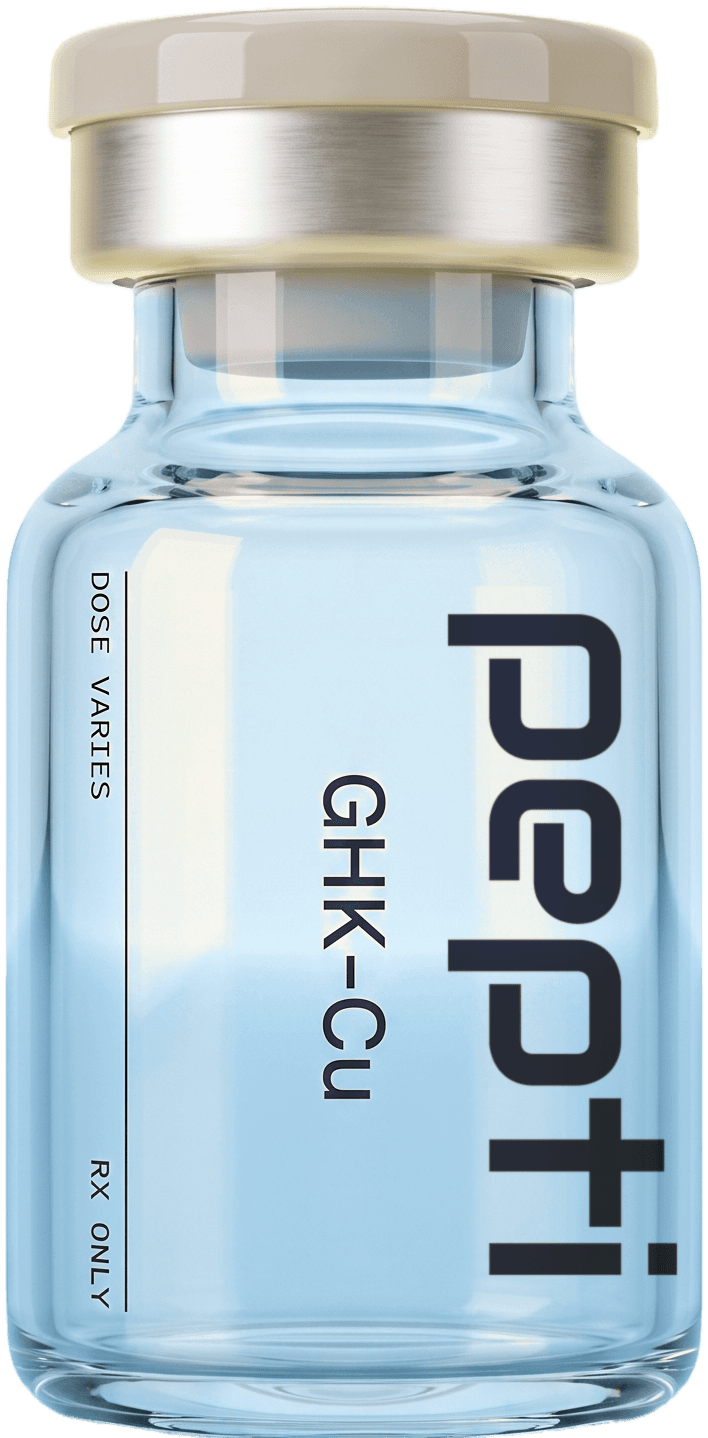
GHK-Cu is a tripeptide, glycine, histidine and lysine, with a copper ion bound to it. It was first described in 1973 as a component of human plasma, occurs naturally in plasma, saliva and urine, and its plasma level is described as falling with age. Its proposed role is as a copper carrier, delivering copper to enzymes that cross-link collagen and elastin and to antioxidant defense. It is not a hormone, does not act on hormone receptors, and does not change growth hormone, IGF-1 or testosterone. It is not a steroid. The solution is blue because copper complexes are blue.
GHK-Cu for Men
What research has looked at in men
The 2016 hair trial
This is the study most often quoted when GHK comes up for men, and it is worth reading precisely. A randomized, placebo-controlled trial in the Annals of Dermatology in 2016 enrolled 45 men with pattern hair loss and tested a topical complex of 5-aminolevulinic acid and GHK, at two concentrations, against placebo for six months. Both treated groups showed an increase in hair count; hair length and thickness did not change significantly.
What it shows. That a topical product containing GHK changed one measured hair outcome in a small group of men.
What it does not show. The peptide was not bound to copper, so it was not GHK-Cu. It was a combination with another active ingredient. It was applied to the scalp, not injected. And it tells you nothing directly about what injectable GHK-Cu does for hair.
The rest of the hair research
The remaining follicle work is cells and animals. A 1991 paper reported hair-follicle-stimulating properties of copper-peptide complexes in mice; a 1993 review reported follicle enlargement with a copper-binding peptide in rats; and a 2007 paper in Archives of Pharmacal Research reported that a related copper tripeptide, AHK-Cu, lengthened human hair follicles kept alive in a dish. There is no human trial of GHK-Cu, topical or injected, with hair growth as its endpoint.
Skin research was mostly in women
The human skin studies of GHK-Cu are cosmetic studies of creams, mostly in women with photoaged facial skin over 8 to 12 weeks, reporting changes in density, firmness and fine lines. Most appeared in conference proceedings and industry-funded reports. They are not described as reporting separate findings for men, and none used the injection.
GHK-Cu for Men
What changes for men
Pattern hair loss is a hormone problem GHK-Cu does not touch
Male pattern hair loss, receding temples and a thinning crown over years, is driven by genetically sensitive follicles responding to dihydrotestosterone (DHT). Nothing in the GHK-Cu literature describes an effect on that signal, so GHK-Cu is not a treatment for androgenetic hair loss and not a substitute for established hair-loss medications, which act on the hormone pathway and have decades of randomized evidence. A physician may reasonably prescribe both, but not one in place of the other. Telogen effluvium, shedding all over two to four months after an illness or other shock, is a different problem again. Peptides for hair growth walks through the four patterns and where a peptide fits.
Testosterone and testosterone therapy
GHK-Cu does not change testosterone and does not act on the hypothalamic, pituitary or gonadal axis. If you are on testosterone therapy, list it on your intake and tell whoever prescribes it that you are adding GHK-Cu; the general principle in can you take peptides with testosterone is that every prescriber involved should know about the other. If low testosterone is the real question, GHK-Cu is not the tool; see peptides for testosterone.
Tested sport
GHK-Cu is not named on anti-doping lists the way growth hormone secretagogues are, but the growth-factor categories of those lists are written broadly around tissue, vascular and collagen effects rather than around named molecules. If you are in a testing pool, check the current prohibited list for your sport before starting and tell your physician you are tested. This matters more for the GHK-Cu blends: GLOW and KLOW also contain BPC-157 and TB-500, both named on the WADA Prohibited List at all times. See is BPC-157 banned.
Fertility
GHK-Cu has no human fertility data at all, in men or women. Nothing in its research describes an effect on sperm, on the reproductive hormone axis or on conception, which is an absence of data rather than evidence of safety. If you and a partner are trying to conceive, tell your physician. Do peptides affect fertility covers the conversation.
Supplements, zinc and the liver
Zinc and copper compete. Long-term high-dose zinc is a recognized cause of copper deficiency, so your physician cannot judge your copper balance without knowing your zinc dose, including zinc inside multi-ingredient supplements. Iron and high-dose vitamin C belong on the intake too. The liver is the body's copper exit route, so liver disease and heavy alcohol use narrow the margin for added copper; see can you drink alcohol on GHK-Cu. Do not change your supplements on your own in either direction.
GHK-Cu for Men
What the evidence does not establish
- That injectable GHK-Cu changes hair, skin or anything else in men. Those trials have not been run.
- That the 2016 topical result transfers to an injection. It was a non-copper GHK combination on the scalp.
- Any effect on testosterone, DHT or male pattern hair loss. None is described.
- That subcutaneous GHK-Cu reaches skin or hair follicles at a concentration that does anything. That human pharmacokinetic work has not been published.
- A timeline. Prescribers describe skin goals over weeks and hair goals over months as clinical experience, and many people notice nothing.
- Long-term injectable safety. It has not been studied.
GHK-Cu for Men
Side effects and considerations
Nothing in the published research suggests the profile differs between men and women.
| What is reported or relevant | How often | What to do |
|---|---|---|
| Injection-site redness, itching, stinging or a small lump | Common | Rotate sites; mention it at follow-up |
| A faint blue-green mark at the site | Common | Copper that has not yet dispersed; clears on its own |
| Nausea or a metallic taste | Uncommon | Message your care team |
| Headache or light-headedness after dosing | Uncommon | Message your care team, especially if you take blood-pressure medication |
| Persistent vomiting, abdominal pain, yellowing skin or eyes, or new confusion | Not reported at prescribed doses | The pattern of copper excess; stop and contact your care team the same day |
| Facial or throat swelling, widespread rash, difficulty breathing | Rare | Call 911 or go to emergency care first, then tell your care team |
Who should not take GHK-Cu, or should discuss it first: anyone with Wilson's disease or another copper-metabolism disorder, significant liver disease, high-dose zinc use, another GHK-Cu product already, or an active or recent cancer. Full detail is in is GHK-Cu safe.
GHK-Cu for Men
How Pepti supplies GHK-Cu
| Product | What is in it | Typical directions | Price |
|---|---|---|---|
| GHK-Cu | 5 mL multi-dose vial, GHK-Cu 10 mg/mL (50 mg per vial) | 0.25 mL (25 units) once daily Monday through Friday | $239/mo |
| GLOW | 50 mg GHK-Cu, 10 mg BPC-157, 10 mg TB-500 in 5 mL | 0.25 mL (25 units) Monday through Friday mornings | $259/mo |
| KLOW Blend | 50 mg GHK-Cu, 10 mg KPV, 10 mg BPC-157, 10 mg TB-500 in 5 mL | 0.25 mL (25 units) Monday through Friday mornings | $259/mo |
| RADIANCE Blend | 50 mg GHK-Cu, 10 mg tesamorelin in 5 mL | 0.25 mL (25 units) once daily Monday through Friday | $249/mo |
Each 0.25 mL dose carries 2.5 mg of GHK-Cu, and every vial holds 20 doses, about four weeks at five a week, so refills run every 28 days, one vial per fill. Two GHK-Cu products at once doubles the copper. Your physician sets your directions after reviewing your intake, and they are printed on the vial. The unit math is in GHK-Cu dosage.
Every price is all-in, covering medication, physician review, refill management and shipping, with no membership fee. Pepti is cash-pay and does not bill insurance. Vials arrive as solutions ready to use, with sterile syringes and alcohol prep pads, shipped refrigerated with ice packs.
GHK-Cu for Men
Where to get GHK-Cu prescribed
GHK-Cu cannot be bought legitimately without a prescription. Sites selling it "for research use only" are not accountable for identity, purity, sterility or concentration. The prescription route:
- Complete a free online intake covering your history, medications, supplements, testosterone therapy if any, whether you are a tested athlete, and what you want help with.
- A physician licensed in your state reviews it, usually within 24 hours.
- If it is appropriate, a PCAB-accredited, FDA-registered US 503A compounding pharmacy prepares it to that prescription. Lot test results are published at /quality/lab-results.
- It ships refrigerated with your directions printed on the vial.
- Your care team stays reachable for questions and side effects.
Step by step: how to get GHK-Cu prescribed online. Bloodwork is not required for any Pepti treatment. If your physician wants labs for your care, they'll ask through your account.
References
What this is based on.
References
- Maquart FX, Pickart L, Laurent M, et al.. Stimulation of collagen synthesis in cultured fibroblasts by GHK-Cu · FEBS Letters (1988) · PMID 3169264
- Pickart L, Margolina A. GHK peptide as a natural modulator of multiple cellular pathways in skin regeneration · BioMed Research International (2015) · PMID 26236730
- Pickart L, Margolina A. Regenerative and protective actions of the GHK-Cu peptide in the light of the new gene data · International Journal of Molecular Sciences (2018) · PMID 29986520
- Pickart L. The human tri-peptide GHK and tissue remodeling · Journal of Biomaterials Science, Polymer Edition (2008) · PMID 18644225
- Pickart L, Thaler MM. Tripeptide in human serum which prolongs survival of normal liver cells and stimulates growth in neoplastic liver · Nature: New Biology (1973) · PMID 4349963
- Lane TF, et al.. SPARC is a source of copper-binding peptides that stimulate angiogenesis · Journal of Cell Biology (1994) · PMID 7514608
- Maquart FX, et al.. In vivo stimulation of connective tissue accumulation by the tripeptide-copper complex glycyl-L-histidyl-L-lysine-Cu2+ in rat experimental wounds · Journal of Clinical Investigation (1993) · PMID 8227353
- Mulder GD, et al.. Enhanced healing of ulcers in patients with diabetes by topical treatment with glycyl-l-histidyl-l-lysine copper · Wound Repair and Regeneration (1994) · PMID 17147644
- Siméon A, et al.. Expression and activation of matrix metalloproteinases in wounds: modulation by the tripeptide-copper complex glycyl-L-histidyl-L-lysine-Cu2+ · Journal of Investigative Dermatology (1999) · PMID 10383745
- Siméon A, et al.. The tripeptide-copper complex glycyl-L-histidyl-L-lysine-Cu2+ stimulates matrix metalloproteinase-2 expression by fibroblast cultures · Life Sciences (2000) · PMID 11045606
- Miller TR, et al.. Effects of topical copper tripeptide complex on CO2 laser-resurfaced skin · Archives of Facial Plastic Surgery (2006) · PMID 16847171
- Pyo HK, et al.. The effect of tripeptide-copper complex on human hair growth in vitro · Archives of Pharmacal Research (2007) · PMID 17703734
Citations are provided for educational purposes. They do not constitute medical advice. Always discuss any peptide protocol with your prescribing physician.
Common questions
GHK-Cu for Men, answered.
Research has looked at GHK in men once: a 2016 randomized trial of a topical GHK combination, without copper, in 45 men with pattern hair loss, which reported an increase in hair count. No trial has tested injectable GHK-Cu in men, so any benefit for men is described, not established.
Not in the way established hair-loss medications do. Pattern hair loss is driven by DHT, and nothing in the GHK-Cu literature describes an effect on it. The one trial in men used a non-copper topical GHK combination. There is no human trial of GHK-Cu, topical or injected, with hair growth as its endpoint.
No. GHK-Cu is not a hormone or a secretagogue, does not act on hormone receptors, and does not change testosterone, growth hormone or IGF-1.
No interaction is described, and GHK-Cu does not act on the hormone axis, but no study has looked at the combination. List it on your intake and tell whoever prescribes your testosterone. See can you take peptides with testosterone.
They are not doing the same job. Those medications act on the hormone and follicle pathways behind pattern loss; GHK-Cu acts on the tissue environment. Raise both with your physician rather than treating a peptide as a substitute.
The human skin studies were small cosmetic studies of creams, mostly in women with photoaged facial skin, over 8 to 12 weeks. They did not report separate findings for men and none used the injection. See GHK-Cu topical vs injection.
It is not named on anti-doping lists, but growth-factor categories are written broadly, so tested athletes should check their sport's current list first. The GLOW and KLOW blends also contain BPC-157 and TB-500, which are named on the WADA Prohibited List at all times.
There is no human fertility data for GHK-Cu, in men or women. Nothing in its research describes an effect on sperm or the reproductive hormone axis. If you are trying to conceive with a partner, tell your physician.
The same as for women: mostly injection-site redness, itching or a small lump, sometimes a faint blue-green mark, and occasionally nausea, a metallic taste or light-headedness. Persistent vomiting, abdominal pain, jaundice or new confusion is a same-day call.
At Pepti, GHK-Cu is $239 a month, all-in, covering medication, physician review, refill management and shipping. GLOW and KLOW are $259 a month and RADIANCE is $249 a month.
No. Bloodwork is not required for any Pepti treatment. If your physician wants labs for your care, they'll ask through your account. The free assessment goes to a physician licensed in your state. A consultation does not guarantee a prescription.
Next step
See what a physician recommends for you.
A licensed physician in your state reviews your intake and decides what is appropriate. A consultation does not guarantee a prescription.