— Anti-Aging · Reference
GHK-Cu: What It Is, Where to Get It Prescribed, and What It Costs
This page covers what GHK-Cu is, the pathways researchers have described, what the published work does and does not establish — keeping the topical skin research and the injectable research separate — where it currently stands with the FDA, how it is dosed, and how to get it prescribed.
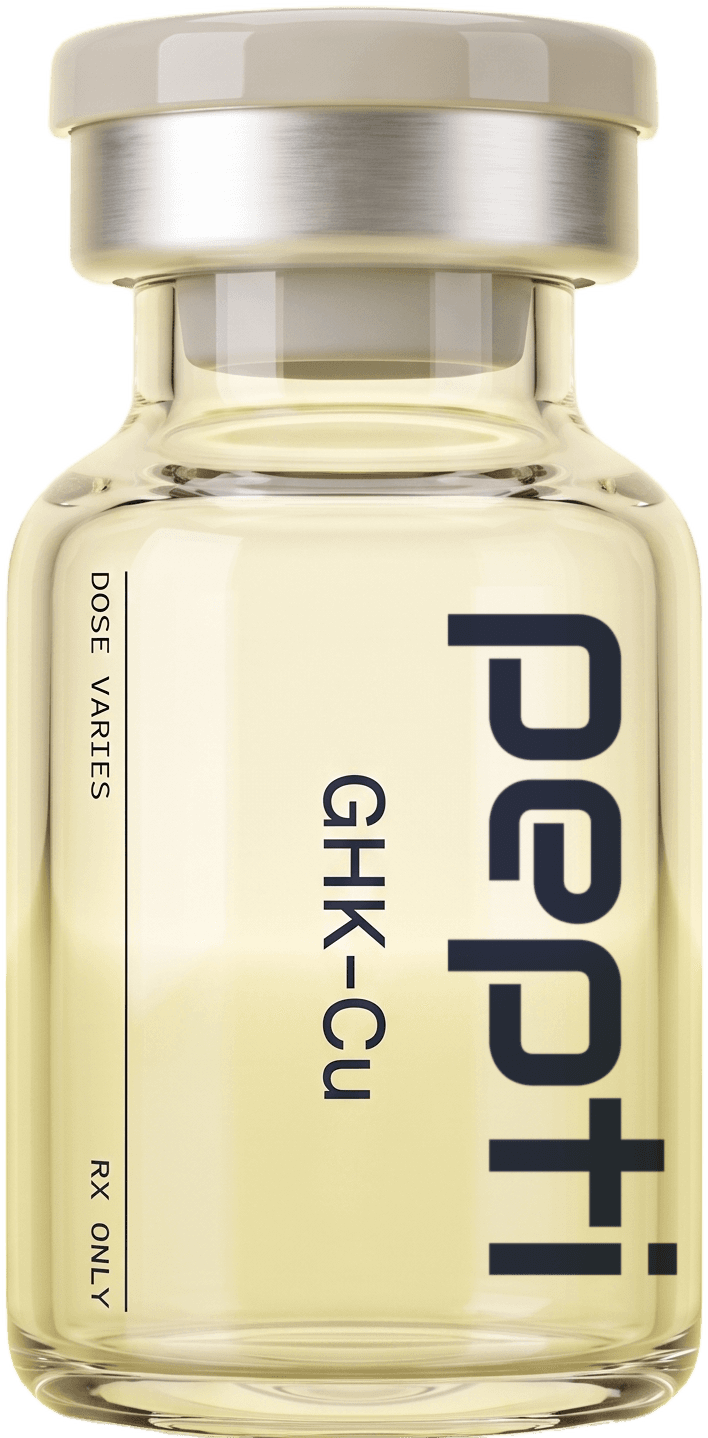
GHK-Cu is a prescription injection supplied as 5 mL multi-dose vial, GHK-Cu 10 mg/mL (50 mg GHK-Cu per vial). The reviewed directions are: Inject 0.25 mL (25 units) subcutaneously once daily Monday through Friday. That is 20 doses per vial, about 4 weeks at Monday through Friday. It requires a prescription from a physician licensed in your state, is compounded by a state-licensed US pharmacy, and is not FDA approved.
This page covers what GHK-Cu is, the pathways researchers have described, what the published work does and does not establish — keeping the topical skin research and the injectable research separate — where it currently stands with the FDA, how it is dosed, and how to get it prescribed.
— GHK-Cu
What GHK-Cu actually is
— A three-amino-acid fragment found in your own plasma
GHK is a tripeptide — glycine, histidine, lysine — and GHK-Cu is that tripeptide with a copper ion bound to it. It was first described in 1973, in a Nature: New Biology paper, as a component of human plasma that prolonged the survival of liver cells in culture. It occurs naturally in plasma, saliva and urine, and the reviews describe its plasma concentration falling with age, from roughly 200 ng/mL in a person's twenties to around 80 ng/mL by their sixties. Whether that decline causes anything, or is simply a marker of ageing, has not been shown. The same GHK motif also sits inside larger proteins, including collagen and SPARC, which is the basis for the idea that GHK is a signal released when tissue is being remodelled.
— Why the copper matters
GHK binds copper(II) with high affinity, and it is the copper complex — not the bare tripeptide — that most of the research is built around. Copper is a cofactor for the enzymes that cross-link collagen and elastin and for antioxidant defence. The proposed role of GHK is as a carrier: holding copper in a form that is not free and reactive, and delivering it to cells that need it. The copper in a dose is small and chelated, unlike copper taken as a mineral supplement.
— What it is not
GHK-Cu is not a hormone and does not act on hormone receptors. It is not a growth hormone secretagogue and does not change growth hormone, IGF-1 or testosterone. It is not a steroid, a filler, a retinoid or an exfoliant. And the injectable is not the cream: most of what is written online about "GHK-Cu results" refers to topical cosmetic use, and those findings do not transfer automatically to an injection.
— GHK-Cu
How GHK-Cu is described to work
Five lines of mechanism recur in the literature, and almost all of the detail comes from cell culture and animal studies. The reviews that pull it together — BioMed Research International 2015, International Journal of Molecular Sciences 2018, Journal of Biomaterials Science 2008 — share an author who has studied the peptide longest, which is worth knowing when weighing them.
— Collagen and extracellular matrix synthesis
The oldest and best-replicated finding. A 1988 FEBS Letters paper reported that GHK-Cu stimulated collagen synthesis in cultured human fibroblasts at very low concentrations, and later cell work extended this to elastin, proteoglycans and glycosaminoglycans. In rats, a 1993 Journal of Clinical Investigation paper reported increased accumulation of connective tissue in experimental wound chambers treated with the copper complex. This is the mechanism the skin and wound research rests on.
— Remodelling: matrix metalloproteinases and their inhibitors
Building tissue is only half of remodelling; the other half is clearing damaged matrix. Two papers from the same group — Journal of Investigative Dermatology 1999 in rat wounds, Life Sciences 2000 in fibroblast cultures — describe GHK-Cu modulating matrix metalloproteinase expression and activation, and the reviews describe it shifting the balance between MMPs and their tissue inhibitors. The proposed picture is a peptide that tunes turnover in both directions rather than simply adding collagen.
— Angiogenesis
A 1994 Journal of Cell Biology paper reported that copper-binding GHK fragments released from SPARC stimulated angiogenesis — new blood-vessel growth — in vitro and in vivo. This is part of the wound-healing story, and it is also why a cancer history is something to raise with your physician, as it is with BPC-157.
— Antioxidant and anti-inflammatory signalling
A 2012 review in Oxidative Medicine and Cellular Longevity collected cell and animal work describing GHK-Cu reducing oxidative stress markers, and a 2012 Acta Poloniae Pharmaceutica paper reported the copper complexes reducing TNF-alpha-driven IL-6 secretion in cultured human dermal fibroblasts. The injected mouse work below sits on the same theme. These are cell and animal observations about signalling, not evidence about inflammatory conditions in people.
— Broad gene-expression effects
A 2012 Genome Medicine paper is the reason GHK is discussed as more than a skin peptide. Using the Broad Institute's Connectivity Map, the authors found that GHK's gene-expression signature ran opposite to the signature of emphysema-related lung destruction, and in cultured lung fibroblasts from patients they reported GHK restoring contraction and collagen remodelling. The 2018 International Journal of Molecular Sciences review argues from the same database that GHK alters expression of a large number of genes rather than acting through one pathway. That is a computational and cell-level finding, not a demonstration in a person.
— GHK-Cu
What the research actually shows
The evidence divides by route. Topical GHK-Cu has human data in skin and wounds. Injectable GHK-Cu has animal data, and has not been tested in a human trial. Reading the two as one body of evidence is the most common error made about this peptide.
— Skin quality — topical, human
Cosmetic-science studies in human volunteers have evaluated GHK-Cu creams, mostly in women with photoaged facial skin over 8 to 12 weeks, and reported changes in skin density, thickness, firmness, fine lines and clarity measured by instruments and by dermatologists. Most of that work appeared in conference proceedings and industry-funded reports rather than peer-reviewed journals; the 2015 BioMed Research International review summarises it. A 2006 Archives of Facial Plastic Surgery paper examined topical copper tripeptide after CO2 laser resurfacing in a small number of patients. In short: real human data, small studies, topical route, cosmetic endpoints.
— Wound healing — topical, human and animal
The most clinically serious human study is a 1994 paper in Wound Repair and Regeneration, which reported improved closure of ulcers in patients with diabetes treated with a topical GHK-Cu gel. Animal wound work reports faster closure and better collagen organisation with topical or locally applied GHK-Cu. Again, this is skin-surface application, not systemic injection.
— Hair — cell culture
A 2007 Archives of Pharmacal Research paper reported that a tripeptide-copper complex affected the growth of human hair follicles kept in culture, and the reviews describe follicle-size and growth-phase effects in animal models. There is no human trial of GHK-Cu, topical or injected, with hair growth as its endpoint. Anything more specific than "follicle biology in the dish" overstates it.
— Lung and systemic tissue — injectable, animal
This is the body of work most relevant to a subcutaneous injection, and it is entirely preclinical. Mouse studies describe intraperitoneal or systemic GHK-Cu reducing inflammatory markers and structural damage in models of acute lung injury (Oncotarget 2016), bleomycin-induced fibrosis (Life Sciences 2020) and cigarette-smoke emphysema (Frontiers in Molecular Biosciences 2022). They establish that systemic GHK-Cu does something measurable in rodents, not what it does in a person.
— What human data exists
This is the part to understand before starting. There are no randomised controlled trials of injectable GHK-Cu in humans. The human evidence that exists is topical: cosmetic studies in photoaged skin and one study of a topical gel in diabetic ulcers. Prescribers who use the injectable for skin, hair and tissue-quality goals have clinical experience, and that is what the "realistic expectations" below are drawn from.
The honest framing is: well characterised in cells and animals, human-studied as a topical, used clinically as an injection on the strength of mechanism plus experience. That is a reasonable basis for a physician to prescribe it; it is not "proven to work when injected."
— What the evidence does not establish
- It does not establish that subcutaneous GHK-Cu reaches skin, hair follicles or connective tissue at a concentration that does anything; that human pharmacokinetic work has not been published.
- It does not establish an effect size or a timeline for the injectable in people. Everything in that direction is prescriber experience.- It does not establish long-term safety data for continuous injectable use over years.
- It does not establish efficacy for any condition as an FDA-approved treatment. It is not approved for anything.
— GHK-Cu
Where GHK-Cu stands with the FDA right now
This has changed in 2026 and older summaries online are wrong.
In September 2023 the FDA placed a group of peptides, including injectable GHK-Cu, in Category 2 of its interim 503A bulk drug substances list — the category for nominated substances flagged as raising significant safety concerns. Non-injectable GHK-Cu sat separately in Category 1, the list of substances under evaluation for which the FDA exercises enforcement discretion.
On 15 April 2026 the FDA announced the removal of twelve peptides from Category 2, and injectable GHK-Cu was one of them. At the same time it removed GHK-Cu from Category 1 because the nomination that had placed it there was withdrawn, and said that Pharmacy Compounding Advisory Committee consultation on the peptide is planned before the end of February 2027.
GHK-Cu was not on the agenda of the committee's 23–24 July 2026 meeting, which considered BPC-157, KPV, TB-500, MOTS-c, emideltide, Semax and epitalon. The FDA has said the committee will convene again before the end of February 2027 to review five further peptides — GHK-Cu, Melanotan II, LL-37, Dihexa and PEG-MGF — for the 503A Bulks List.
So the accurate description as of September 2026 is: no longer in Category 2, not yet on the 503A Bulks List, with a formal advisory-committee review scheduled. It is still not an FDA-approved drug product, and compounded medications never are.
— GHK-Cu
Realistic expectations
These are patterns described by prescribers, not trial endpoints; there is no human trial of the injectable to set a timeline from. Individual response varies and a physician decides whether treatment is appropriate at all.
— The first two weeks
Most people notice nothing in this window, and that is expected. Collagen synthesis and matrix turnover are slow processes; nothing in the research suggests an acute effect to feel. Injection-site reactions, if they occur, show up here.
— Weeks three to eight
This is where prescribers describe changes in skin texture and hydration, where they are reported at all. It lines up loosely with the 8-to-12-week windows of the topical cosmetic studies, though those were a different route. A vial covers about four weeks at Monday-through-Friday dosing, so this window spans two fills.
— Two to three months and beyond
Hair-related goals are described by prescribers as slower than skin goals, because the hair cycle itself runs in months. Anyone expecting a visible hair change inside a single vial is expecting something no evidence supports. There is no withdrawal and no rebound described in the literature after a course ends.
— GHK-Cu
When something else makes more sense
A reference that only ever recommends its own product is not much of a reference. Some honest cases where GHK-Cu on its own is not the first thing to reach for:
- Your goal is a recovering injury, not skin or connective-tissue quality. BPC-157 and TB-500 are what prescribers reach for first there, and the BPC-157 + TB-500 stack combines them.
- You want skin, hair and recovery covered together. The KLOW blend and GLOW combine GHK-Cu with BPC-157 and TB-500 in one vial, which is how many prescribers actually use it.
- The priority is general ageing rather than skin. The ETERNAL blend pairs GHK-Cu with BPC-157, TB-500 and epithalon; the REVIVE blend pairs it with a growth-hormone secretagogue combination.
- You are already using a topical. A cosmetic GHK-Cu cream is over the counter and has the human skin data behind it. Whether an injection adds anything on top is untested and a question for your physician. Your physician will tell you if GHK-Cu is not the right tool for what you have described. A consultation does not guarantee a prescription, and being declined is refunded.
— GHK-Cu
Strengths available
| Strength | Directions |
|---|---|
| GHK-Cu 50mg/5mL | Inject 0.25 mL (25 units) subcutaneously once daily Monday through Friday. |
| GHK-Cu 100mg/10mL | Inject 0.50 mL (50 units) subcutaneously once daily Monday through Friday. |
A higher strength delivers more medication in the same volume. Which one you are prescribed is your physician's decision.
— GHK-Cu
Dosing, and how a vial is actually used
— Why the dose is measured in units
The directions are written in millilitres and in insulin-syringe units because that is what you can read off the barrel. 0.25 mL is 25 units on a U-100 syringe. You are not calculating anything — the number is printed on your medication, and your physician sets it.
— Subcutaneous, and where
Subcutaneous means into the fat layer, not the muscle. Abdomen and thigh are the usual sites, rotated so the same spot is not used repeatedly. GHK-Cu solutions are blue — that is the copper complex, not a contaminant.
— Why Monday through Friday
The directions specify weekdays, not seven days. Twenty doses at five per week is four weeks, which is why refills run on a 28-day cycle. One vial per fill, always — not a stockpile. The two-day break is a prescribing convention; there is no human pharmacokinetic study of injected GHK-Cu to derive a schedule from.
— Storage
Refrigerated, and it ships that way in insulated packaging with ice packs. Beyond-use dating runs from first puncture and is on the label. A marked colour change is a reason to call the pharmacy rather than inject.
— GHK-Cu
Safety and side effects
Topical GHK-Cu has a long cosmetic safety record and the reviews describe it as non-irritating and non-sensitising in the skin studies. Injectable GHK-Cu has animal safety data and prescriber experience, and no human safety trial. What gets reported clinically is mostly injection-site: redness, mild soreness, occasional bruising, occasionally a transient blue tint. Some people report a headache or light-headedness early on.
The copper is the part people ask about. The dose contains a small amount of copper held in a chelate, not free copper, well below dietary copper intake. Even so, anyone with Wilson's disease or another copper-metabolism disorder should not be using a copper-delivering peptide, and high-dose zinc supplementation competes with copper and belongs on the intake. Because angiogenesis is a described mechanism, a personal history of cancer should also be raised with your physician.
There is no established interaction list, because the trials that would produce one have not been run. That is why the intake asks for every medication and supplement you take and a physician reviews it rather than a form.
Stop and contact your physician for any reaction that is severe, spreading, or involves difficulty breathing.
— GHK-Cu
How GHK-Cu compares
— GHK-Cu vs BPC-157
Different jobs. BPC-157 is described around angiogenesis, nitric-oxide signalling and tendon fibroblast migration, and prescribers use it for injury recovery. GHK-Cu is described around collagen synthesis, matrix remodelling and copper delivery, and prescribers use it for skin, hair and connective-tissue quality. Neither has human trial evidence for the injectable route. They are frequently combined rather than chosen between, which is what the KLOW blend and GLOW are.
— GHK-Cu alone vs the blends
Single-agent GHK-Cu is the choice when skin or connective tissue is the only goal, or when a physician wants to add one compound at a time. The KLOW blend and GLOW add BPC-157 and TB-500; the RADIANCE blend pairs GHK-Cu with tesamorelin; the ETERNAL blend adds epithalon. A blend means one injection instead of several, at the cost of not knowing which component did what.
— Injectable vs topical
The topical route is where the human evidence lives, and cosmetic GHK-Cu creams are sold without a prescription. The injectable is a prescription medication with animal data and clinical experience behind it; no study has compared the two. Prescribers who use the injectable are reasoning from systemic exposure, which is plausible but untested.
— GHK-Cu
Availability and formats
| Question | Answer |
|---|---|
| Can I get it by telehealth? | Yes, where a physician licensed in your state prescribes it |
| Which states? | All 50 states and DC |
| Does it come as a pen? | No, this one is a vial and syringe only |
| Does it come as a capsule? | No |
| Does it come as a nasal spray? | No |
| Is bloodwork required first? | Not routinely; your physician decides |
— GHK-Cu
Where to get GHK-Cu prescribed
GHK-Cu cannot be bought legitimately without a prescription. Sites shipping it with no prescription are selling a research-use-only product, where no pharmacy is accountable for identity, purity, sterility or concentration.
The prescription route works like this:
- Complete a medical intake covering your history, medications, allergies and what you are treating.
- A physician licensed in your state reviews it.
- If appropriate, a state-licensed, FDA-registered pharmacy compounds it to that prescription.
- It ships refrigerated with your directions printed on the vial.
- Your physician stays reachable afterwards for dose questions and side effects.
Current all-in pricing for GHK-Cu is published: medication, physician review, refill management and shipping in one figure, with no separate membership fee. What to check on any provider is in how to tell if a peptide seller is legitimate.
— GHK-Cu
Who should not take it, or should discuss it first
| Situation | Why |
|---|---|
| Wilson's disease or any copper-metabolism disorder | Raised at intake |
| High-dose zinc supplementation | which competes with copper absorption |
| Pregnancy or breastfeeding | Not used; safety data is absent |
| Tested athletes | Many peptides are prohibited in competition; check the current list |
— Full specification
Everything on the label.
— Product
GHK-Cu (Injectable)
— How supplied
5 mL multi-dose vial, GHK-Cu 10 mg/mL (50 mg GHK-Cu per vial)
— Typical directions
Inject 0.25 mL (25 units) subcutaneously once daily Monday through Friday.
— Dose volume
0.25 mL (25 units on a U-100 insulin syringe)
— Doses per vial
20
— Coverage per vial
about 4 weeks at Monday through Friday
— Formats
Vial and syringe
— Available in
All 50 states and DC
— Bloodwork
Not routinely required; your physician decides
— Strengths available
2
— Legal status
Prescription-only, compounded, not FDA approved
— Category
Anti-Aging
— References
What this is based on.
References
- Maquart FX, Pickart L, Laurent M, et al.. Stimulation of collagen synthesis in cultured fibroblasts by GHK-Cu · FEBS Letters (1988) · PMID 3169264
- Pickart L, Margolina A. GHK peptide as a natural modulator of multiple cellular pathways in skin regeneration · BioMed Research International (2015) · PMID 26236730
- Pickart L, Margolina A. Regenerative and protective actions of the GHK-Cu peptide in the light of the new gene data · International Journal of Molecular Sciences (2018) · PMID 29986520
- Pickart L. The human tri-peptide GHK and tissue remodeling · Journal of Biomaterials Science, Polymer Edition (2008) · PMID 18644225
- Pickart L, Thaler MM. Tripeptide in human serum which prolongs survival of normal liver cells and stimulates growth in neoplastic liver · Nature: New Biology (1973) · PMID 4349963
- Lane TF, et al.. SPARC is a source of copper-binding peptides that stimulate angiogenesis · Journal of Cell Biology (1994) · PMID 7514608
- Maquart FX, et al.. In vivo stimulation of connective tissue accumulation by the tripeptide-copper complex glycyl-L-histidyl-L-lysine-Cu2+ in rat experimental wounds · Journal of Clinical Investigation (1993) · PMID 8227353
- Mulder GD, et al.. Enhanced healing of ulcers in patients with diabetes by topical treatment with glycyl-l-histidyl-l-lysine copper · Wound Repair and Regeneration (1994) · PMID 17147644
- Siméon A, et al.. Expression and activation of matrix metalloproteinases in wounds: modulation by the tripeptide-copper complex glycyl-L-histidyl-L-lysine-Cu2+ · Journal of Investigative Dermatology (1999) · PMID 10383745
- Siméon A, et al.. The tripeptide-copper complex glycyl-L-histidyl-L-lysine-Cu2+ stimulates matrix metalloproteinase-2 expression by fibroblast cultures · Life Sciences (2000) · PMID 11045606
- Miller TR, et al.. Effects of topical copper tripeptide complex on CO2 laser-resurfaced skin · Archives of Facial Plastic Surgery (2006) · PMID 16847171
- Pyo HK, et al.. The effect of tripeptide-copper complex on human hair growth in vitro · Archives of Pharmacal Research (2007) · PMID 17703734
Citations are provided for educational purposes. They do not constitute medical advice. Always discuss any peptide protocol with your prescribing physician.
— Common questions
GHK-Cu, answered.
Through a telehealth provider where a physician licensed in your state reviews a medical intake and a licensed US pharmacy compounds the prescription. Pepti prescribes GHK-Cu in all 50 states and DC; start with the free assessment.
5 mL multi-dose vial, GHK-Cu 10 mg/mL (50 mg GHK-Cu per vial)
Inject 0.25 mL (25 units) subcutaneously once daily Monday through Friday. Your physician sets your own dose and it is printed on your medication.
20 at the standard volume, about 4 weeks at Monday through Friday.
GHK-Cu is supplied as a vial, drawn with an insulin syringe. It is not available as a pen or capsule.
Not routinely, though your physician may want labs depending on your history. at-home blood testing covers hormone, metabolic and thyroid markers without a lab visit.
It is legal to prescribe and dispense in the United States with a valid prescription. It is not FDA approved: compounded medications are prepared by licensed pharmacies pursuant to a prescription rather than approved as manufactured products. See are peptides FDA approved.
Pricing is published on the GHK-Cu page as one all-in figure covering medication, physician review, refill management and shipping. What drives peptide pricing generally is in how much do peptides cost.
No. Injectable GHK-Cu was placed in Category 2 of the FDA's interim 503A bulk substances list in September 2023, and on 15 April 2026 the FDA removed it from Category 2 along with eleven other peptides. It is not yet on the 503A Bulks List; the Pharmacy Compounding Advisory Committee is due to review it before the end of February 2027. It remains legal to prescribe and dispense.
Yes for the topical route: cosmetic studies of GHK-Cu creams in photoaged skin, and a 1994 study of a topical gel in diabetic ulcers. For the injectable there are no randomised controlled trials in humans; the evidence is animal studies plus clinical prescribing experience. A source that quotes the cream studies as proof for the injection is conflating two routes.
No study has compared them. The cream has the human data; the injection has systemic exposure, animal data and prescriber experience. Which makes sense for you is a conversation with your physician.
Cell-culture work describes effects on human hair follicles kept in a dish, and the reviews describe follicle changes in animal models. There is no human trial of GHK-Cu, topical or injected, with hair growth as the endpoint. Prescribers who use it for hair describe a months-long goal, not something visible within one vial.
That is the copper. GHK bound to copper(II) forms a blue-violet complex, so the solution in the vial is blue. It is normal, not a sign of contamination.
There is no trial-established timeline for the injectable in humans. Prescribers generally describe skin texture changes, where they occur, over roughly three to eight weeks, and hair-related goals over months. The topical cosmetic studies ran 8 to 12 weeks, but that was a different route.
Most commonly injection-site reactions — redness, mild soreness, occasional bruising, sometimes a faint transient blue tint from the copper complex. Some people report an early headache or light-headedness. There is no human safety trial of the injectable and no established interaction list, which is why your physician reviews every medication and supplement you take.
— Next step
See what a physician
recommends for you.
A licensed physician in your state reviews your intake and decides what is appropriate. A consultation does not guarantee a prescription.
Important legal & safety information
The assessment process available on the Pepti website asks a series of medical questions, and the answers provided are reviewed by an independent licensed physician affiliated with our partner physician network. The licensed providers have established exclusionary criteria, and the answers provided determine if the individual is screened out of eligibility for treatment. The licensed clinicians retain the sole decision to prescribe peptide therapy and other compounded medications to patients. Treatment may be denied at the physician's sole discretion. If a prescription is not approved, you will not be charged for the medication.
Pharmacy Providers. Pepti is a technology platform and is not a healthcare provider, pharmacy, or prescriber. All medications offered through the platform are compounded by independent FDA-registered 503A or 503B compounding pharmacies based on a valid prescription written by a licensed physician for an individual patient. Compounded medications are not FDA-approved as products. The active pharmaceutical ingredients used by our partner pharmacies are sourced from FDA-registered facilities. Compounded medications may not undergo the same testing or quality control as commercially manufactured FDA-approved drugs.
Results vary. Results from peptide therapy and other compounded treatments vary based on individual factors, including age, weight, medical history, adherence to the prescribed protocol, lifestyle factors, and physiological response. Pepti makes no guarantee of any specific outcome. Statements about peptide therapy and compounded medications offered through the platform have not been evaluated by the Food and Drug Administration. These products are not intended to diagnose, treat, cure, or prevent any disease.
Product images. Product photographs and renderings shown on this website are for illustrative purposes only. The appearance of vials, packaging, labeling, and other materials you receive may vary and is determined by the dispensing compounding pharmacy.
Off-label use.Many peptides offered through the platform are prescribed for off-label use. “Off-label” means the medication is being prescribed for a use, dose, or patient population that is not specifically approved by the FDA. Off-label prescribing is legal and common in U.S. medical practice when supported by clinical experience and judgment.
Mailing & shipping. Pepti currently dispenses prescription medication to patients in all 50 states and Washington, D.C.. All orders ship in unbranded, tamper-evident packaging via expedited delivery from our partner compounding pharmacies. Temperature-sensitive medications ship with insulated packaging and ice packs. Shipping is included at no additional cost. We do not currently ship medication outside all 50 states and Washington, D.C., internationally, or to APO/FPO addresses.
Not for emergencies. Pepti is not designed for medical emergencies. If you are experiencing a medical emergency, call 911 or go to your nearest emergency room immediately. For urgent but non-emergency medical questions, contact your primary care provider or use an urgent care service.
No doctor-patient relationship with Pepti. Your use of the platform does not create a doctor-patient relationship between you and pepti LLC. A doctor-patient relationship is established only between you and the independent licensed physician who reviews your intake and prescribes your treatment. The physicians who use the platform are independent contractors and are solely responsible for the medical care they provide.
Prescription medications. All prescription products require a valid prescription from a licensed healthcare provider. By using the platform, you acknowledge that you are at least 18 years old and that the information you provide is true, accurate, current, and complete. Providing false information may result in inappropriate treatment recommendations or denial of service.
Cosmetic & wellness products.Certain products offered through Pepti — including skincare, hair care, body care, supplements, men's grooming, sports recovery, and sexual wellness products — are cosmetic or dietary supplement products, not prescription medications. These products do not require a prescription and are not reviewed or prescribed by a physician. Statements regarding dietary supplements have not been evaluated by the Food and Drug Administration. These products are not intended to diagnose, treat, cure, or prevent any disease. Results vary by individual. Consult your healthcare provider before starting any new supplement or topical product, especially if you are pregnant, nursing, or taking other medications.
pepti LLC · Delaware Limited Liability Company · 131 Continental Dr, Suite 305, Newark, DE 19713 · For media or partnership inquiries, email hello@hellopepti.com. For patient support, email support@hellopepti.com. For privacy and HIPAA inquiries, email privacy@hellopepti.com.