Anti-Aging · Reference
Why Is GHK-Cu Blue? The Copper Behind the Colour, and When a Vial Looks Wrong
This page explains where the colour comes from, why the shade can vary, which Pepti products are blue, why a product photo may not match the vial in your hand, and what to do when a vial looks wrong.
Medically reviewed by Dr. Gene, MD · November 4, 2026
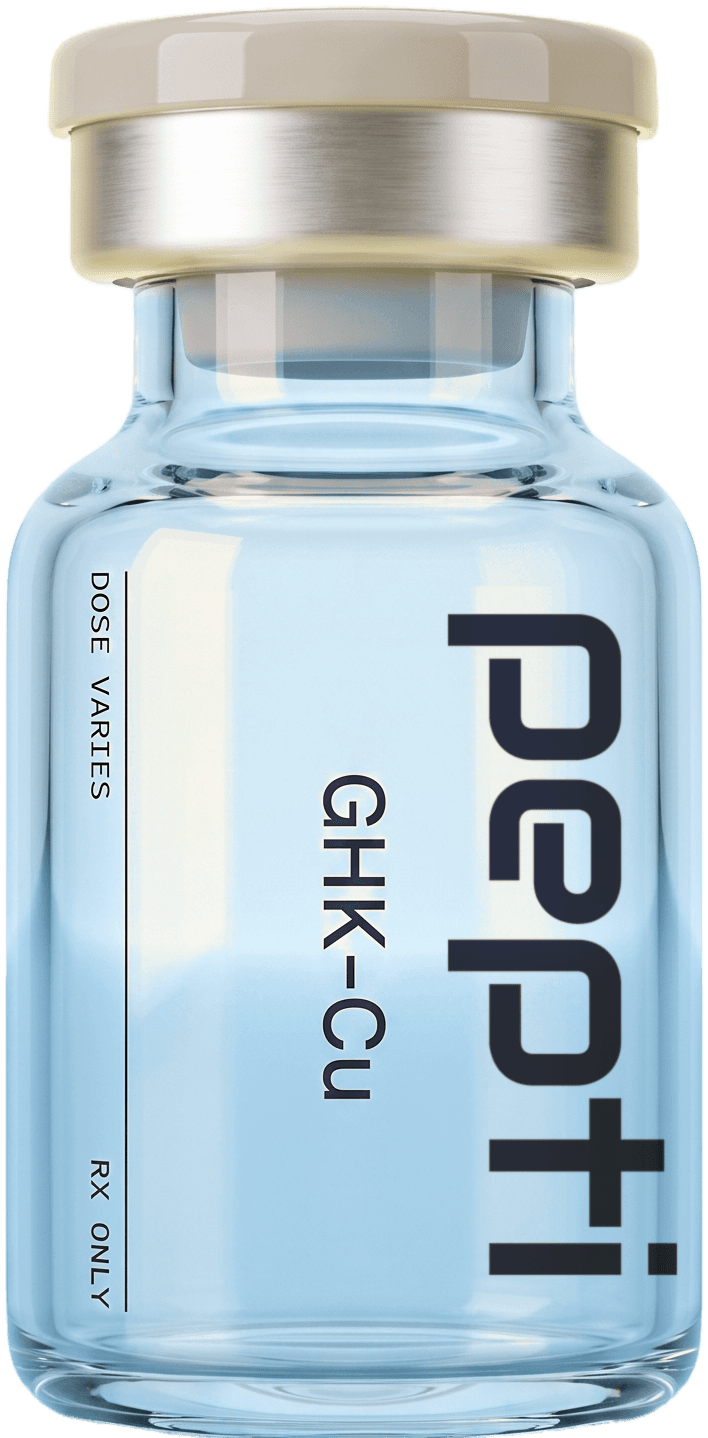
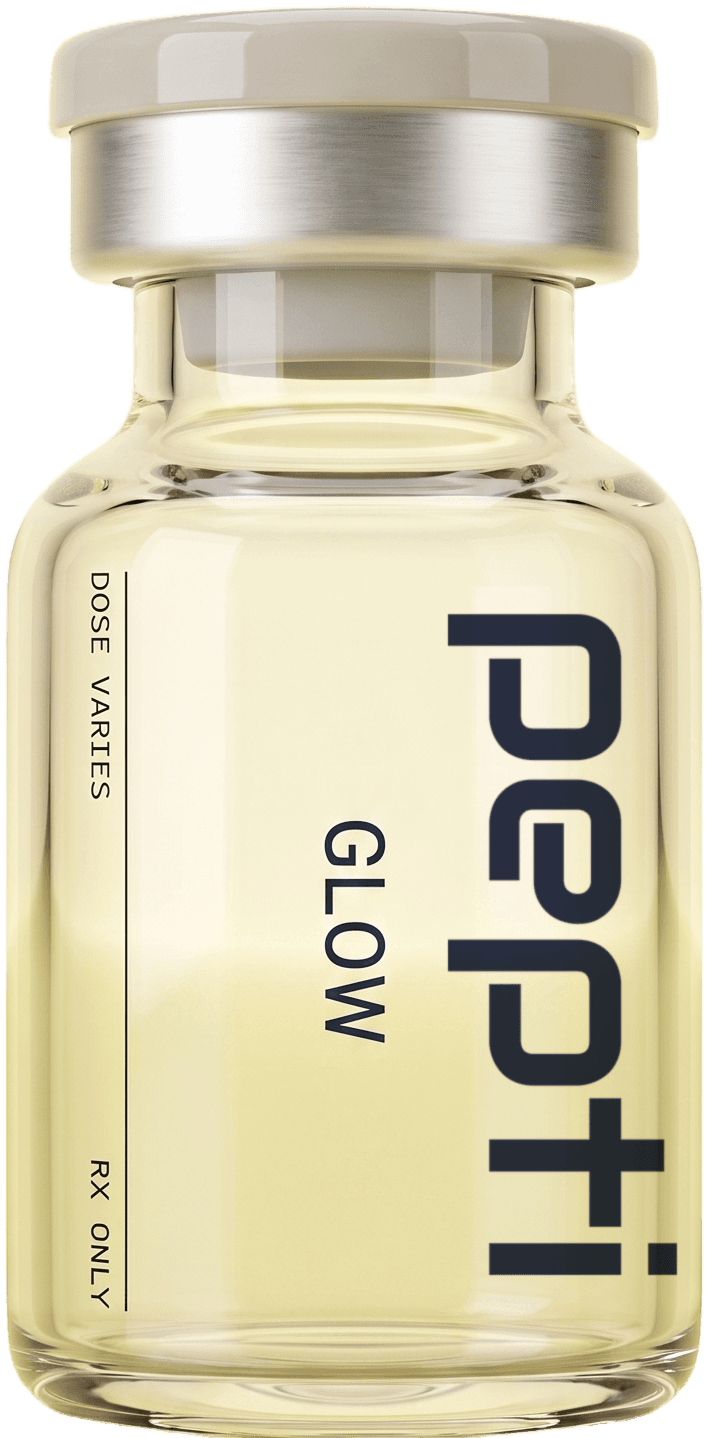
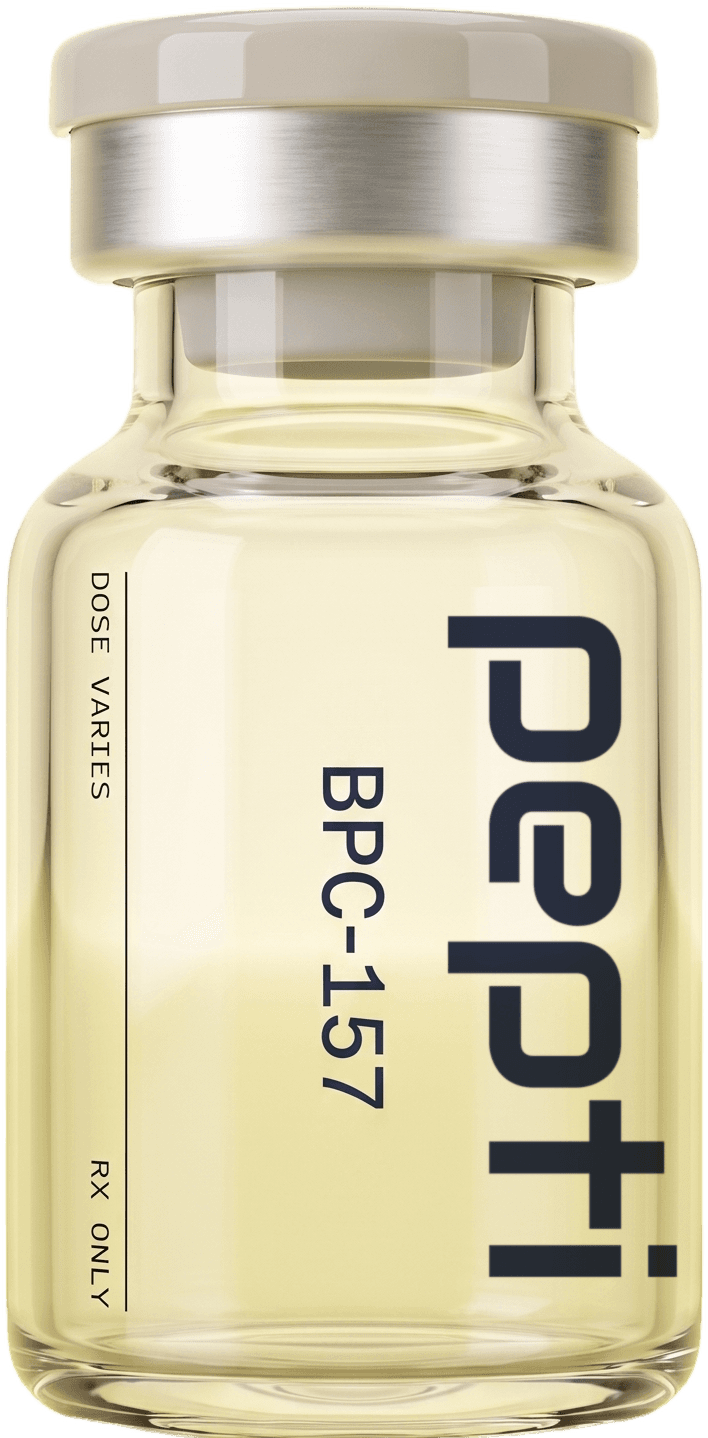
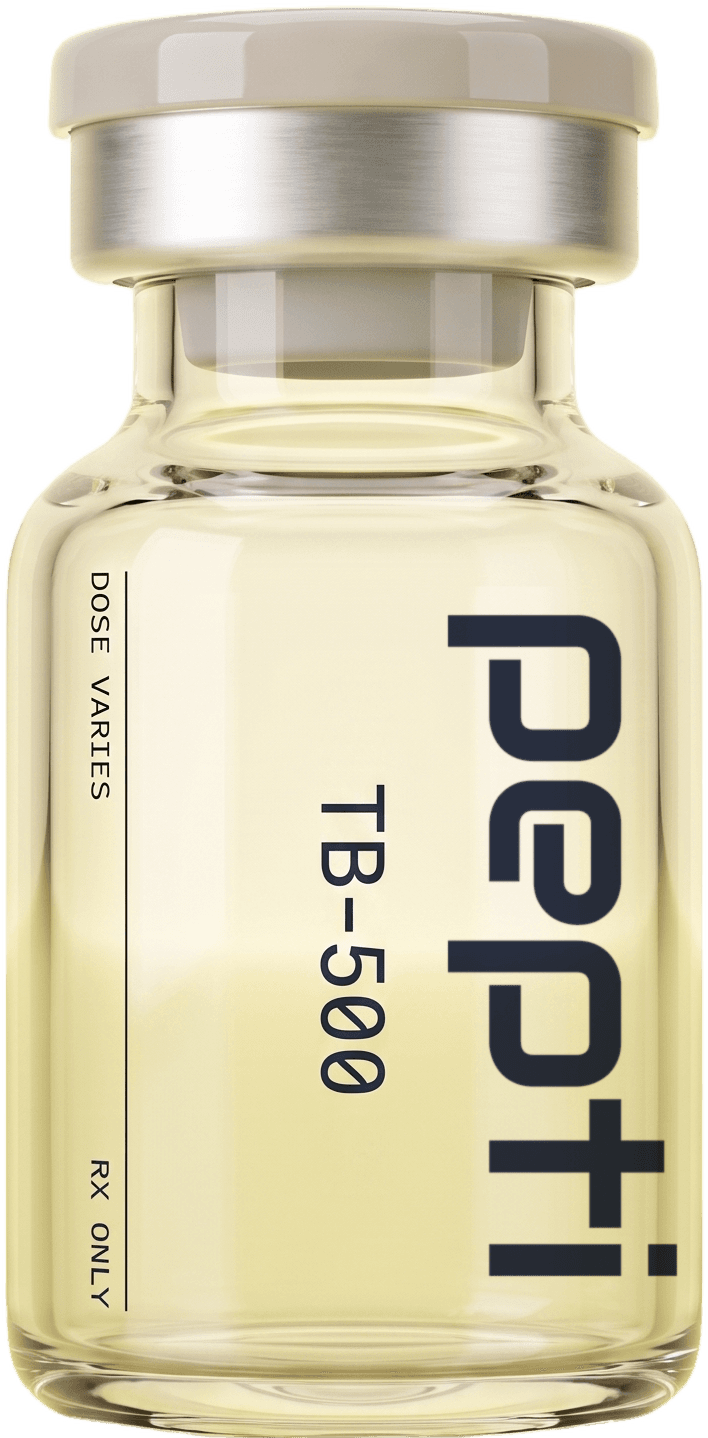
GHK-Cu is blue because of the copper. GHK is a three-amino-acid peptide that binds a copper(II) ion, and copper(II) complexes are typically blue, so a GHK-Cu solution is blue, sometimes described as blue-violet or blue-green. The colour is expected and is not a sign of contamination. GLOW, KLOW and every other blend that contains GHK-Cu is blue for the same reason. What is not expected is cloudiness, visible particles, or a colour different from the one you were dispensed: any of those is a reason not to use the vial and to message your care team.
This page explains where the colour comes from, why the shade can vary, which Pepti products are blue, why a product photo may not match the vial in your hand, and what to do when a vial looks wrong.
Why Is GHK-Cu Blue? The Copper Behind the Colour, and When a Vial Looks Wrong
The short answer
| What you see | What it means | What to do |
|---|---|---|
| A clear blue solution | The copper(II) bound to GHK, behaving as expected | Use it as directed on the vial |
| A deeper or paler blue than you expected | Shade depends on how much copper complex is in each millilitre, the light and the glass | Compare it with the strength on your label; if it differs from what you were dispensed before, ask |
| Blue in GLOW, KLOW or another blend | The GHK-Cu component; every GHK-Cu blend at Pepti carries 50 mg of it | Expected |
| A yellow or different colour in a product photo | Photos and labels may not show the solution's true colour | Go by the vial in your hand |
| Cloudiness, particles or a colour change from what you received | Not expected | Do not use it. Photograph it and message your care team |
| A faint blue-green mark at the injection site | Copper that has not yet dispersed | Clears on its own; a hot, spreading or worsening site needs a same-day message |
Why Is GHK-Cu Blue? The Copper Behind the Colour, and When a Vial Looks Wrong
Where the colour comes from
GHK is a peptide that carries copper
GHK is a tripeptide, glycine, histidine and lysine, that occurs naturally in human plasma, saliva and urine. It was first described in 1973, in a Nature: New Biology paper, as a plasma component that prolonged the survival of liver cells in culture. GHK binds copper(II) with high affinity, one copper ion per tripeptide, and it is that copper complex, GHK-Cu, that most of the research is built around and that a prescription vial contains.
The copper is held tightly enough that GHK-Cu behaves as a copper delivery vehicle rather than as free copper in solution. That is the difference between a copper peptide and a copper salt, and it is the reason the live reference pages describe the copper in a dose as small and chelated rather than free and reactive. More on the molecule is in what is GHK-Cu.
Why copper(II) looks blue
This is general chemistry rather than anything specific to peptides. Compounds in which copper is in its +2 state, copper(II), are typically blue. They absorb light toward the red and orange end of the visible spectrum, and what passes through to your eye is the blue end. Copper sulfate solution in a school laboratory is the familiar example. When GHK binds copper(II), the complex keeps that property, so the solution in the vial is blue.
The bare GHK tripeptide, without copper, has no reason to be blue. The colour belongs to the copper, which is also why it is the most visible sign that the copper is there.
The colour is not a quality grade
A blue vial is a vial behaving as expected. A bluer vial is not a stronger or better product in any sense you can judge by eye, and a paler one is not a weaker one unless its label says a different strength. The things that matter about a vial, its identity, purity, sterility and concentration, are not visible through glass. They are what the pharmacy tests, and lot results are published at /quality/lab-results. How to read one is in how to read a peptide certificate of analysis.
Why Is GHK-Cu Blue? The Copper Behind the Colour, and When a Vial Looks Wrong
Why the shade varies
How deep a coloured solution looks depends mostly on how much of the coloured substance is in each millilitre, and on how much liquid the light passes through. A more concentrated solution looks deeper; the same solution in a thinner layer looks paler. Lighting matters too: a vial under a warm kitchen bulb, against a white sheet of paper, and in daylight can look like three different blues.
| Factor | Effect on what you see |
|---|---|
| Concentration of GHK-Cu per mL | More copper complex per millilitre looks deeper |
| How much liquid the light passes through | A full vial looks deeper than the thin layer in a syringe |
| Lighting | Warm indoor light shifts colours toward green or yellow; daylight is truer |
| Background and glass | A white background shows the colour most honestly |
That is why the solution drawn into a syringe often looks noticeably paler than the same solution in the vial. The useful comparison is your vial against the strength on its label and against the vials you have been dispensed before, not against a photograph or another person's vial.
Every single-agent GHK-Cu vial and every GHK-Cu blend in the Pepti vial range carries GHK-Cu at the same 10 mg/mL, so they share the same copper concentration. If a new fill looks clearly different from your previous one, read the label first: if the strength has not changed and the colour has, that is worth a message.
Why Is GHK-Cu Blue? The Copper Behind the Colour, and When a Vial Looks Wrong
Which Pepti products are blue
GHK-Cu is an ingredient in more Pepti products than any other single peptide, and each one carries a full 50 mg of it per vial.
| Product | What is in the vial | Price |
|---|---|---|
| GHK-Cu | 50 mg GHK-Cu in 5 mL (10 mg/mL) | $239/mo |
| RADIANCE Blend | 50 mg GHK-Cu, 10 mg tesamorelin in 5 mL | $249/mo |
| GLOW | 50 mg GHK-Cu, 10 mg BPC-157, 10 mg TB-500 in 5 mL | $259/mo |
| KLOW | 50 mg GHK-Cu, 10 mg KPV, 10 mg BPC-157, 10 mg TB-500 in 5 mL | $259/mo |
| REVIVE Blend | 50 mg GHK-Cu, 6 mg CJC-1295, 12 mg ipamorelin, 2 mg TB-500 in 5 mL | $279/mo |
| ETERNAL Blend | 50 mg GHK-Cu, 10 mg BPC-157, 10 mg TB-500, 10 mg epithalon in 5 mL | $279/mo |
| EUPHORIA Blend | 10 mg MOTS-c, 10 mg BPC-157, 50 mg GHK-Cu, 2 mg kisspeptin in 5 mL | $279/mo |
Every price is all-in, covering medication, physician review, refill management and shipping, with no separate membership fee. KLOW is also available as a 3 mL pre-filled pen cartridge holding the same 50 mg of GHK-Cu with the same three other peptides, and it carries the copper too.
GLOW and KLOW look blue because of their GHK-Cu
By mass, GLOW is mostly a GHK-Cu preparation: 50 of the 70 mg in the vial. KLOW adds 10 mg of KPV to the same three. In both, the copper complex is what you see. The BPC-157, TB-500 and KPV in those vials do not carry copper. The difference between the two blends is in KLOW vs GLOW, and each is covered in what is GLOW and what is the KLOW blend.
Two blue vials can mean two copper doses
Because every blend carries a full GHK-Cu dose, someone on GLOW who adds standalone GHK-Cu, or who is on KLOW and adds ETERNAL, is doubling the copper. If you are dispensed two blue vials, it is worth checking that your physician knows about both. More on that is in is GHK-Cu safe.
Why Is GHK-Cu Blue? The Copper Behind the Colour, and When a Vial Looks Wrong
"Why is it yellow in your pictures?"
Patients ask this, and it is a fair question. Product photos and labels may not show the solution's true colour. A photo is shaped by lighting, the camera, editing and the label and packaging around the vial, and some product imagery is designed to show the brand rather than the liquid. None of that tells you what is in a particular vial.
The vial in your hand is what matters. If it is a clear blue solution and the label matches your prescription, the colour is what GHK-Cu looks like. If you are unsure, message your care team with a photo of the vial in daylight against a white background, and the label visible. That is quicker and more reliable than comparing it with an image online.
Why Is GHK-Cu Blue? The Copper Behind the Colour, and When a Vial Looks Wrong
When a vial looks wrong
The blue colour is expected. Several other things are not, and none of them is something to reason your way past.
| What you notice | Why it matters | What to do |
|---|---|---|
| Cloudiness or haze | Not how the solution should look | Do not use it |
| Visible particles, flakes or strands | Not how the solution should look | Do not use it |
| A colour change from what you received | Something about the vial is different from when it was dispensed | Do not use it |
| A stopper that looks damaged | The seal is the vial's protection | Do not use it |
| The shipment arrived warm | Cold-chain failure | Do not use it; photograph the packaging and the vial |
| The vial was left out and you do not know for how long | Unknown exposure | Message your care team and say honestly how long |
In each case: photograph the vial, keep it, and message your care team. Do not shake a cloudy vial to redissolve whatever is in it, do not draw through a filter to remove particles, and do not warm it to see whether it clears. Each of those destroys the evidence and none of them addresses the cause.
Looking right is not the same as being in date
The reverse does not hold. A peptide solution can lose potency without looking any different, and there is no home test for that. A blue, clear vial past its beyond-use date, or one that has been stored outside the conditions on its label, is not made usable by its colour. The beyond-use date is assigned by the pharmacy, printed on the label, and runs from first puncture. Write the first-use date on the carton the day you first puncture the stopper.
Storage, briefly
GHK-Cu ships refrigerated in insulated packaging with ice packs. Keep the vial in the main body of the refrigerator, in its carton, upright, away from the back wall where accidental freezing happens and away from the door. The carton is the light protection. Do not freeze it unless your directions say so. Your vial label is the rule for your preparation; the general picture is in how to store peptides.
Why Is GHK-Cu Blue? The Copper Behind the Colour, and When a Vial Looks Wrong
The blue mark at the injection site
Some people notice a faint blue or blue-green tint at the injection site. That is copper that has not yet dispersed, and it clears on its own; people who have not been told about it often assume it is a bruise. Injection-site redness, itching or a small lump are also commonly reported and usually fade over a day or two with site rotation.
A site that is hot, spreading or worse after 48 hours is something different and needs a same-day message. Facial or throat swelling, a widespread rash or breathing difficulty after an injection is an emergency first and a message to your prescriber second. Technique and site rotation are covered in how to inject peptides safely.
Why Is GHK-Cu Blue? The Copper Behind the Colour, and When a Vial Looks Wrong
Where to get GHK-Cu prescribed
GHK-Cu cannot be bought legitimately without a prescription. Sites selling it "for research use only" are not accountable for what is in the vial: identity, purity, sterility and concentration are untested, and a blue colour proves none of them. The prescription route:
- Complete a free online intake covering your history, medications and what you want help with.
- A physician licensed in your state reviews it, usually within 24 hours.
- If it is appropriate, a state-licensed, FDA-registered US pharmacy compounds it to that prescription. Lot test results are published at /quality/lab-results.
- It ships refrigerated with your directions printed on the vial.
- Your physician stays reachable for questions and dose changes.
GHK-Cu is a compounded medication, and compounded medications are not FDA approved. Pepti prescribes it in all 50 states and DC. Step-by-step pages: how to get GHK-Cu prescribed online and how to get KLOW prescribed online. What to check on any provider is in how to tell if a peptide seller is legitimate.
References
What this is based on.
References
- Maquart FX, Pickart L, Laurent M, et al.. Stimulation of collagen synthesis in cultured fibroblasts by GHK-Cu · FEBS Letters (1988) · PMID 3169264
- Pickart L, Margolina A. GHK peptide as a natural modulator of multiple cellular pathways in skin regeneration · BioMed Research International (2015) · PMID 26236730
- Pickart L, Margolina A. Regenerative and protective actions of the GHK-Cu peptide in the light of the new gene data · International Journal of Molecular Sciences (2018) · PMID 29986520
- Pickart L. The human tri-peptide GHK and tissue remodeling · Journal of Biomaterials Science, Polymer Edition (2008) · PMID 18644225
- Pickart L, Thaler MM. Tripeptide in human serum which prolongs survival of normal liver cells and stimulates growth in neoplastic liver · Nature: New Biology (1973) · PMID 4349963
- Lane TF, et al.. SPARC is a source of copper-binding peptides that stimulate angiogenesis · Journal of Cell Biology (1994) · PMID 7514608
- Maquart FX, et al.. In vivo stimulation of connective tissue accumulation by the tripeptide-copper complex glycyl-L-histidyl-L-lysine-Cu2+ in rat experimental wounds · Journal of Clinical Investigation (1993) · PMID 8227353
- Mulder GD, et al.. Enhanced healing of ulcers in patients with diabetes by topical treatment with glycyl-l-histidyl-l-lysine copper · Wound Repair and Regeneration (1994) · PMID 17147644
- Siméon A, et al.. Expression and activation of matrix metalloproteinases in wounds: modulation by the tripeptide-copper complex glycyl-L-histidyl-L-lysine-Cu2+ · Journal of Investigative Dermatology (1999) · PMID 10383745
- Siméon A, et al.. The tripeptide-copper complex glycyl-L-histidyl-L-lysine-Cu2+ stimulates matrix metalloproteinase-2 expression by fibroblast cultures · Life Sciences (2000) · PMID 11045606
- Miller TR, et al.. Effects of topical copper tripeptide complex on CO2 laser-resurfaced skin · Archives of Facial Plastic Surgery (2006) · PMID 16847171
- Pyo HK, et al.. The effect of tripeptide-copper complex on human hair growth in vitro · Archives of Pharmacal Research (2007) · PMID 17703734
Citations are provided for educational purposes. They do not constitute medical advice. Always discuss any peptide protocol with your prescribing physician.
Common questions
Why Is GHK-Cu Blue? The Copper Behind the Colour, and When a Vial Looks Wrong, answered.
Because of the copper. GHK binds a copper(II) ion, and copper(II) complexes are typically blue, so the solution is blue, sometimes described as blue-violet or blue-green. It is expected and is not a sign of contamination.
Yes. A clear blue solution is what GHK-Cu looks like. Cloudiness, particles or a colour change from what you received are not normal, and are a reason to message your care team rather than inject.
Both contain 50 mg of GHK-Cu per vial, and the copper complex is what gives the solution its colour. The same applies to RADIANCE, REVIVE, ETERNAL and EUPHORIA, which all carry GHK-Cu.
Product photos and labels may not show the solution's true colour; lighting, cameras, editing and packaging all change what an image shows. The vial in your hand is what matters. If you are unsure about it, send your care team a photo in daylight against a white background.
Shade depends on concentration, how much liquid the light passes through and the lighting. A syringe looks paler than a full vial. Check the strength on the label first; if it has not changed and the colour clearly has, message your care team before using it.
Do not use it. Photograph the vial, keep it, and message your care team. Do not shake it, filter it or warm it.
Not in any way you can judge by eye. Your dose is the volume printed on your vial, and the strength is on the label. Colour is not a measure of potency or quality.
Yes. Potency loss is not visible, and there is no home test for it. That is why the beyond-use date and the storage conditions on the label matter more than appearance.
That is copper that has not yet dispersed, and it clears on its own. A site that is hot, spreading or worse after 48 hours needs a same-day message.
Keep it in its carton in the refrigerator, which is its light protection, and follow the storage line on your label. More is in how to store peptides.
No. Bloodwork is not required for any Pepti treatment. If your physician wants labs for your care, they'll ask through your account. The free assessment goes to a physician licensed in your state. A consultation does not guarantee a prescription.
Next step
See what a physician recommends for you.
A licensed physician in your state reviews your intake and decides what is appropriate. A consultation does not guarantee a prescription.