Anti-Aging · Reference
Glutathione Benefits: What the Research Actually Shows
This page goes benefit by benefit, names the route and the population behind each finding, and then covers side effects, FDA status and how Pepti supplies it. For the full product reference, see what is glutathione.
Medically reviewed by Dr. Gene, MD · November 4, 2026
Treatments mentioned
Glutathione is the body's main antioxidant inside cells, and unlike most compounds sold for wellness it has real randomized human trials, but they were done by mouth, by vein, by nose and on the skin, not by the under-the-skin injection that is usually prescribed. The best-supported findings are that oral glutathione taken for months raised body stores in a six-month trial, and that intravenous glutathione reduced nerve damage from one chemotherapy drug in a 1995 trial. Its controlled trials in Parkinson's disease did not beat placebo. There are no randomized trials of subcutaneous glutathione, so every benefit below is something research describes, not something an injection can promise.
This page goes benefit by benefit, names the route and the population behind each finding, and then covers side effects, FDA status and how Pepti supplies it. For the full product reference, see what is glutathione.
Glutathione Benefits
The short answer
| Claimed benefit | What the evidence is | Strength of evidence |
|---|---|---|
| Antioxidant defense | Human tissue biochemistry | The role is established; whether extra glutathione changes outcomes is not |
| Raising body glutathione stores | Human (randomized oral trials) | Moderate for oral use over months; not measured for injection |
| Detox and liver support | Human biochemistry; one uncontrolled oral pilot in fatty liver | Weak for supplementing |
| Immune cell function | Human (one oral trial, secondary endpoint) | Preliminary |
| Healthy aging and physical function | Human (one randomized trial of glycine plus NAC, its building blocks) | Promising, but not a glutathione trial |
| Energy and fatigue | No trials of glutathione for fatigue | Not studied |
| Parkinson's disease | Human (intravenous and intranasal randomized trials) | Controlled trials did not beat placebo |
| Nerve protection during cisplatin chemotherapy | Human (one 1995 randomized intravenous trial) | Real, but specific to that drug and population |
| Skin tone | Human (three small oral and topical trials) | Small and short; no evidence for injection, and not a use Pepti prescribes for |
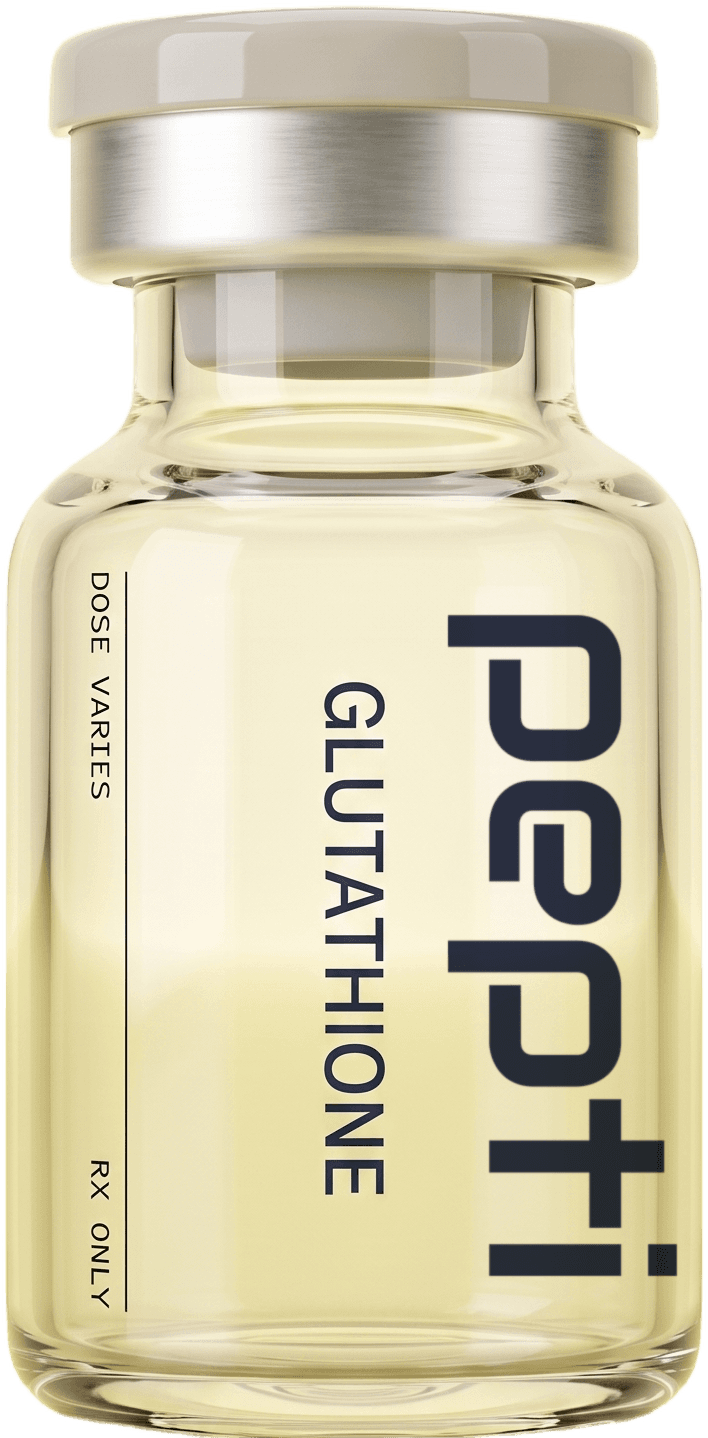
Pepti supplies Glutathione as a 5 mL vial at 200 mg/mL (1000 mg per vial) for $199/mo, all-in.
Glutathione Benefits
What glutathione is, briefly
Glutathione is a tripeptide: three amino acids, glutamate, cysteine and glycine. Every nucleated cell makes it, and it is the most abundant small thiol in the body; a 2013 review in Biochimica et Biophysica Acta notes that cysteine supply usually caps how much a cell can make. The active form is reduced glutathione (GSH). When it neutralizes a reactive molecule it becomes glutathione disulfide (GSSG), and the enzyme glutathione reductase converts it back using NADPH. The GSH to GSSG ratio is a standard laboratory measure of oxidative stress. Glutathione does not bind a receptor, so the real question is never "what does it do" but "does giving more from outside change anything, and by which route."
Glutathione Benefits
Benefit by benefit
1. Antioxidant defense
What the research describes. The cysteine in glutathione donates an electron to peroxides and free radicals, which is what most people mean by "antioxidant." It is also the cofactor for glutathione peroxidases, which break down peroxides. In the body's energy chain, glutathione is the cleanup crew for the reactive oxygen species the mitochondria leak.
What it does not show. A 2009 review in Biological Chemistry lists low glutathione as a feature of many human diseases while noting it is usually a marker of oxidative stress rather than a proven cause. The biochemistry is solid; evidence that supplementing it produces clinical outcomes is weaker.
2. Raising body glutathione stores
What the research describes. A 2015 randomized, double-blind, placebo-controlled trial in the European Journal of Nutrition gave 54 non-smoking adults 250 or 1,000 mg of oral glutathione daily for six months. The high-dose group ended 30 to 35 percent above baseline in red cells, plasma and lymphocytes. A 2018 pilot in the European Journal of Clinical Nutrition reported similar rises with a liposomal form in 12 adults.
What it does not show. A 1992 study found a single oral dose did not raise plasma glutathione, and a 2011 randomized trial of 500 mg twice daily for four weeks in 40 adults found no change; four weeks may be too short. In the 2015 trial, levels returned to baseline within a month of stopping. For the injection, nothing has been measured: a 1991 study found high-dose intravenous glutathione rose sharply in plasma and cleared within minutes to an hour, and whether a small subcutaneous dose raises tissue glutathione is unknown.
3. Detox and liver support
What the research describes. "Detox" has a precise meaning here. Glutathione S-transferases attach glutathione to reactive drug breakdown products and toxins so they can be excreted. The familiar example is acetaminophen: an overdose becomes dangerous when the liver runs out of glutathione, which is why the antidote is a glutathione precursor. On supplementing, a 2017 open-label pilot in BMC Gastroenterology gave 34 people with non-alcoholic fatty liver disease 300 mg oral glutathione daily for four months after a diet-and-exercise run-in, and liver enzyme (ALT) and triglyceride levels fell.
What it does not show. The fatty liver study had no control group, so the result cannot be separated from continued lifestyle change. "Detox" in the marketing sense, a general cleanse, is not something any trial has measured.
4. Immune cell function
What the research describes. Immune cells depend on their internal glutathione. In the 2015 six-month oral trial, natural killer cell activity more than doubled compared with placebo at three months, measured as a secondary endpoint. The proposed mechanism is repletion rather than stimulation: depleted immune cells perform poorly and replete ones perform normally.
What it does not show. It is one oral trial and a secondary measure. No trial has tested glutathione against infections or any immune outcome. If immune support is the goal, thymosin alpha-1 has a much larger human evidence base; see peptides for immune support.
5. Healthy aging and physical function
What the research describes. The strongest controlled evidence that restoring low glutathione changes physiology did not use glutathione itself. A 2023 randomized, placebo-controlled trial in the Journals of Gerontology gave 24 older adults glycine plus N-acetylcysteine (GlyNAC), its building blocks, or placebo for 16 weeks. It reported correction of baseline glutathione deficiency, lower oxidative-stress markers, better mitochondrial markers, and improved gait speed and grip strength.
What it does not show. It is a small trial of precursors taken by mouth, in older adults who started out deficient. It says nothing directly about glutathione injections in people with normal levels.
6. Energy and fatigue
What the research describes. Glutathione comes up in fatigue conversations because of its role in mitochondrial cleanup, and the GlyNAC trial above reported better mitochondrial markers.
What it does not show. There are no randomized human trials of injectable glutathione for fatigue. Fatigue often has a findable cause; see peptides for energy and fatigue.
7. Parkinson's disease
What the research describes. This is where the intravenous data lives. A 1996 open-label study gave nine people with early untreated Parkinson's disease 600 mg intravenously twice daily for 30 days and reported a 42 percent fall in disability scores.
What it does not show. When the question was tested properly, the effect did not hold. A 2009 randomized, double-blind, placebo-controlled pilot in Movement Disorders gave 21 patients 1,400 mg intravenously three times a week for four weeks and found no significant difference from placebo on the standard rating scale. A 2017 phase IIb trial of intranasal glutathione in 45 patients found every arm improved, placebo included, and neither dose beat it. Glutathione is not a treatment for Parkinson's disease.
8. Nerve protection during chemotherapy
What the research describes. A 1995 randomized, double-blind, placebo-controlled trial in the Journal of Clinical Oncology gave intravenous glutathione alongside cisplatin to people with advanced gastric cancer and reported less peripheral nerve damage without loss of the chemotherapy's effect. It is a genuine controlled result.
What it does not show. It applies to people receiving one specific nerve-damaging drug, by vein, under oncology care. It is not a reason for anyone else to take glutathione, and it is not a use Pepti prescribes for.
9. Skin
What the research describes. Glutathione comes up in skin conversations for tone and oxidative stress. Three small randomized trials in healthy volunteers, two oral and one topical, measured skin pigment over periods no longer than three months, with modest and inconsistent results.
What it does not show. There is no controlled evidence for injected glutathione and skin. A 2016 review in the Indian Journal of Dermatology, Venereology and Leprology is openly skeptical of how far marketing has outrun the evidence. Pepti does not prescribe glutathione for skin lightening. If skin structure is the concern, GHK-Cu has the more skin-specific research; see peptides for skin.
Glutathione Benefits
What the evidence shows, honestly
Glutathione is unusual in this category: it has randomized human trials, and an honest reading of them is mixed. Oral use over months raises body stores. Intravenous use protected nerves in one chemotherapy trial and did not beat placebo in Parkinson's disease. The skin trials are small and short. The precise position for the product most people are prescribed: there are no randomized controlled trials of subcutaneous glutathione. That route rests on the pharmacology of the molecule, on tolerability shown in intravenous trials at far higher doses, and on prescribing experience. A prescriber who says subcutaneous glutathione "works like an IV" is extrapolating, and so is one who says it does not.
It is also fair to ask why injection is being recommended over oral glutathione or N-acetylcysteine, since the oral evidence is the larger body of work. The case for injection is bypassing breakdown in the gut. Neither route has trial evidence for disease outcomes in a general population.
Glutathione Benefits
Glutathione side effects
Glutathione has an unusually deep tolerability record for a compounded injectable: the 2009 intravenous trial reported adverse events similar to placebo at 1,400 mg three times weekly, and the six-month oral trial reported no safety signal.
| How often | What is reported | What to do |
|---|---|---|
| Common | Injection-site redness, mild soreness, occasional bruising | Rotate sites between abdomen and thigh |
| Uncommon | Brief light-headedness or nausea after a dose | Report it to your care team |
| Caution | Asthma | Tell your physician; inhaled glutathione has been reported to provoke bronchospasm |
| Stop and call | Fever, chills or shaking shortly after a dose | Not an expected side effect; contact your physician the same day |
| Stop and get help | Facial or throat swelling, widespread rash, difficulty breathing | Emergency care first, then tell your physician |
The fever-and-chills row has a history. On 7 June 2019 the FDA warned compounders about a dietary-supplement-grade glutathione powder that had been used to make intravenous injections: testing found bacterial endotoxin at up to five times the appropriate limit, and eight patients had reactions ranging from chills and nausea to low blood pressure and hospitalization. The problem was the ingredient, not glutathione, and it is why a sterile injectable must come from a pharmacy accountable for endotoxin testing.
Glutathione is a cofactor in the metabolism of many drugs, and there is no established interaction list for the subcutaneous route, so list everything you take on your intake. It is not used in pregnancy or breastfeeding, where safety data is absent. The injection goes into the fat layer and must never be injected into a vein. Glutathione is not named on the 2026 WADA Prohibited List, but tested athletes should check with their governing body first.
Glutathione Benefits
Where glutathione stands with the FDA
As of the FDA's document dated 14 May 2026, glutathione is in 503A Category 1, "Bulk Drug Substances Under Evaluation," under which state-licensed pharmacies may compound it while the FDA completes its review. It was never in Category 2, the safety-concern category, so the April 2026 peptide removals did not involve it. It is also in Category 1 of the separate 503B list dated 21 March 2025. Compounded glutathione is not FDA approved.
Glutathione Benefits
How Pepti supplies it
| Detail | Glutathione |
|---|---|
| Product | Glutathione, injectable |
| What is in the vial | 5 mL multi-dose vial, 200 mg/mL (1000 mg glutathione) |
| Standard directions | 0.41 mL (41 units) subcutaneously three times per week |
| Doses per vial | 12, about four weeks |
| Format | Vial and syringe only; no pen, capsule or nasal spray |
| Price | $199/mo, all-in |
The price covers medication, physician review, refill management and shipping, with no membership fee, and Pepti does not bill insurance. Refills run every 28 days, one vial per fill. The vial arrives as a solution ready to use, with directions printed on it, sterile syringes and alcohol prep pads, shipped refrigerated with ice packs. Reduced glutathione oxidizes on contact with air, so keep the vial cold and capped. Lot test results are at /quality/lab-results.
Glutathione is often prescribed alongside NAD+ Injection ($249/mo); the evidence behind that one is in NAD+ benefits.
Glutathione Benefits
Where to get glutathione prescribed
Glutathione injections cannot be bought legitimately without a prescription, and the 2019 FDA alert shows what happens when the ingredient is wrong. The prescription route:
- Complete a free online intake covering your history, medications and what you want help with.
- A physician licensed in your state reviews it, usually within 24 hours.
- If it is appropriate, a PCAB-accredited, FDA-registered US 503A pharmacy compounds it to that prescription. Lot test results are published at /quality/lab-results.
- It ships refrigerated with your directions printed on the vial.
- Your physician stays reachable for questions and dose changes.
Pepti prescribes glutathione in all 50 states and DC. Step by step: how to get glutathione prescribed online.
References
What this is based on.
References
- Richie JP Jr, Nichenametla S, Neidig W et al.. Randomized controlled trial of oral glutathione supplementation on body stores of glutathione · Eur J Nutr (2015) · PMID 24791752
- Allen J, Bradley RD. Effects of oral glutathione supplementation on systemic oxidative stress biomarkers in human volunteers · J Altern Complement Med (2011) · PMID 21875351
- Sinha R, Sinha I, Calcagnotto A et al.. Oral supplementation with liposomal glutathione elevates body stores of glutathione and markers of immune function · Eur J Clin Nutr (2018) · PMID 28853742
- Witschi A, Reddy S, Stofer B, Lauterburg BH. The systemic availability of oral glutathione · Eur J Clin Pharmacol (1992) · PMID 1362956
- Aebi S, Assereto R, Lauterburg BH. High-dose intravenous glutathione in man. Pharmacokinetics and effects on cyst(e)ine in plasma and urine · Eur J Clin Invest (1991) · PMID 1907548
- Arjinpathana N, Asawanonda P. Glutathione as an oral whitening agent: a randomized, double-blind, placebo-controlled study · J Dermatolog Treat (2012) · PMID 20524875
- Weschawalit S, Thongthip S, Phutrakool P, Asawanonda P. Glutathione and its antiaging and antimelanogenic effects · Clin Cosmet Investig Dermatol (2017) · PMID 28490897
- Watanabe F, Hashizume E, Chan GP, Kamimura A. Skin-whitening and skin-condition-improving effects of topical oxidized glutathione: a double-blind and placebo-controlled clinical trial in healthy women · Clin Cosmet Investig Dermatol (2014) · PMID 25378941
- Sonthalia S, Daulatabad D, Sarkar R. Glutathione as a skin whitening agent: Facts, myths, evidence and controversies · Indian J Dermatol Venereol Leprol (2016) · PMID 27088927
- Sechi G, Deledda MG, Bua G et al.. Reduced intravenous glutathione in the treatment of early Parkinson's disease · Prog Neuropsychopharmacol Biol Psychiatry (1996) · PMID 8938817
- Hauser RA, Lyons KE, McClain T, Carter S, Perlmutter D. Randomized, double-blind, pilot evaluation of intravenous glutathione in Parkinson's disease · Mov Disord (2009) · PMID 19230029
- Mischley LK, Lau RC, Shankland EG, Wilbur TK, Padowski JM. Phase IIb Study of Intranasal Glutathione in Parkinson's Disease · J Parkinsons Dis (2017) · PMID 28436395
Citations are provided for educational purposes. They do not constitute medical advice. Always discuss any peptide protocol with your prescribing physician.
Common questions
Glutathione Benefits, answered.
A tripeptide of glutamate, cysteine and glycine that every cell makes. It is the main antioxidant inside cells and a cofactor for the enzymes that neutralize peroxides and help the liver clear drugs and toxins.
Research describes its role as the main antioxidant inside cells and in liver detoxification. In randomized human trials, oral glutathione raised body stores over six months, and intravenous glutathione reduced nerve damage from cisplatin chemotherapy. Its Parkinson's trials did not beat placebo, and there are no trials of the subcutaneous injection.
The case for injection is that it avoids breakdown in the gut. No randomized trial has tested subcutaneous glutathione, and whether it raises tissue glutathione has not been measured, so the injection's benefits are inferred from the molecule and from other routes.
Mostly injection-site redness, mild soreness or bruising, and sometimes brief light-headedness or nausea. Fever, chills or shaking after a dose are not expected and should be reported the same day. People with asthma should tell their physician.
Glutathione is central to how the liver clears drugs and toxins. One open-label oral pilot in fatty liver disease reported lower liver enzymes and triglycerides, but with no control group it cannot separate glutathione from diet and exercise.
One six-month oral trial reported natural killer cell activity more than doubling compared with placebo at three months. That is a single secondary measure, not evidence against any infection.
There are no trials of glutathione for fatigue. A 2023 trial of glycine plus N-acetylcysteine in older adults reported better mitochondrial markers and physical function, but that used its building blocks, by mouth.
There is no controlled evidence for injected glutathione and skin, and Pepti does not prescribe glutathione for skin lightening. The few trials that measured skin pigment were small, short and used oral or topical forms.
Oral glutathione has more trial evidence: a six-month randomized trial found it raised body stores. Injection bypasses the gut, but has never been tested in a trial. It is a fair question to raise with your physician.
They are often prescribed together. Your physician sets your directions after reviewing your intake, and both are listed on it so they can be reviewed together.
No. It is in 503A Category 1, under FDA evaluation, and compounded medications are not FDA approved. It is compounded by a licensed US pharmacy against a valid prescription.
No. Bloodwork is not required for any Pepti treatment. If your physician wants labs for your care, they'll ask through your account. The free assessment goes to a physician licensed in your state. A consultation does not guarantee a prescription.
Next step
See what a physician recommends for you.
A licensed physician in your state reviews your intake and decides what is appropriate. A consultation does not guarantee a prescription.