Weight Loss · Reference
Semaglutide Dosing Chart: Every Dose Step, Units to Draw, and Price
This page is the full chart: the vial behind each dose, why the units differ, how stepping up works, which side effects tend to appear along the way, what each step costs, and the questions people search most about semaglutide dosing. It describes how Pepti prescribes semaglutide. It is not a set of instructions for choosing or changing your own dose.
Medically reviewed by Dr. Gene, MD · November 4, 2026
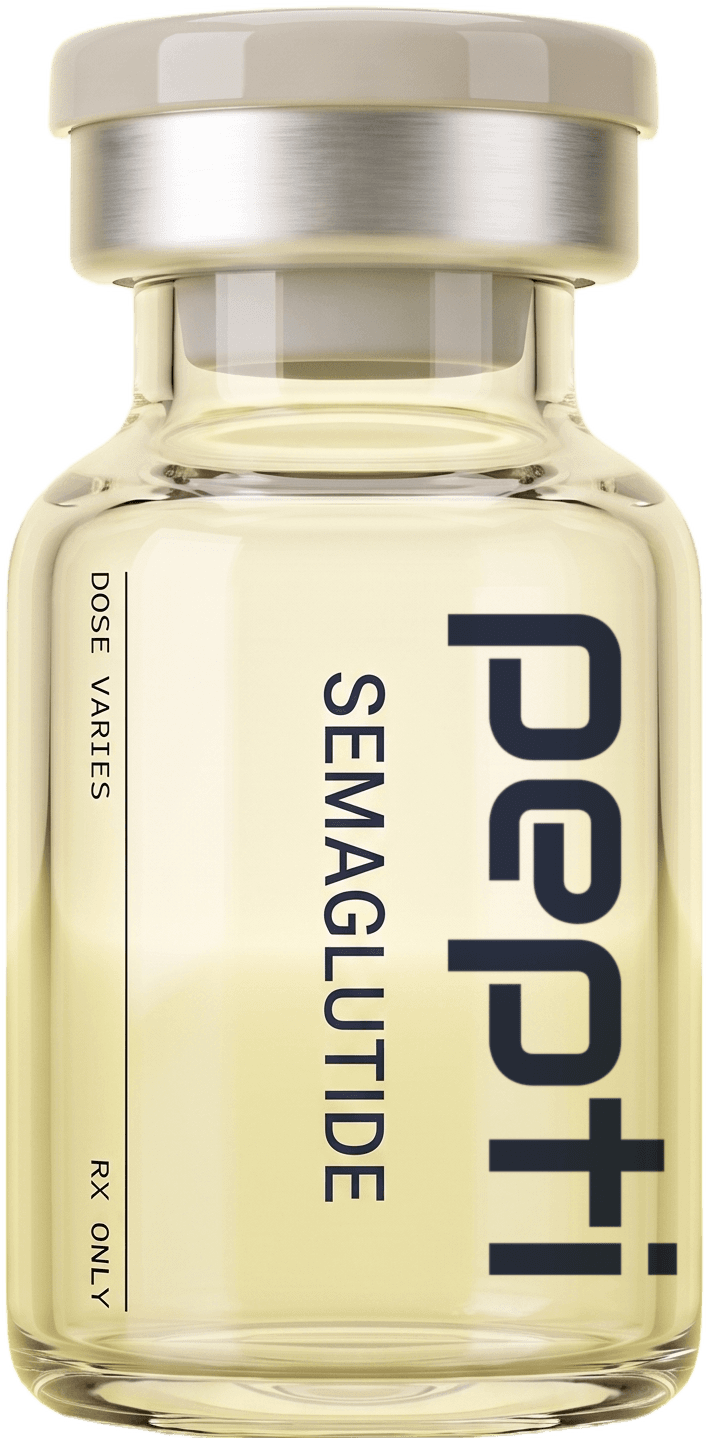
Treatments mentioned
Pepti prescribes semaglutide on a six-step weekly ladder: 0.25 mg, 0.5 mg, 1 mg, 1.7 mg, 2 mg and 2.5 mg, each dispensed as its own vial with its own directions. Unlike tirzepatide, the number of units you draw changes from step to step: 25 units at 0.25 mg, 50 at 0.5 mg and 1 mg, 68 at 1.7 mg, 40 at 2 mg and 50 at 2.5 mg, on a U-100 insulin syringe once weekly. Your physician sets your dose after reviewing your intake and moves you up the ladder, and your exact dose and units are printed on the vial. The monthly price runs from $99 at 0.25 mg to $199 at 2.5 mg.
This page is the full chart: the vial behind each dose, why the units differ, how stepping up works, which side effects tend to appear along the way, what each step costs, and the questions people search most about semaglutide dosing. It describes how Pepti prescribes semaglutide. It is not a set of instructions for choosing or changing your own dose.
Semaglutide Dosing Chart
The short answer
| Weekly dose | Pepti vial | Concentration | Directions on the vial | Monthly price |
|---|---|---|---|---|
| 0.25 mg | 1 mg per 1 mL | 1 mg/mL | Inject 0.25 mL (25 units) once weekly | $99 |
| 0.5 mg | 2 mg per 2 mL | 1 mg/mL | Inject 0.50 mL (50 units) once weekly | $109 |
| 1 mg | 4 mg per 2 mL | 2 mg/mL | Inject 0.50 mL (50 units) once weekly | $129 |
| 1.7 mg | 7.5 mg per 3 mL | 2.5 mg/mL | Inject 0.68 mL (68 units) once weekly | $179 |
| 2 mg | 10 mg per 2 mL | 5 mg/mL | Inject 0.40 mL (40 units) once weekly | $189 |
| 2.5 mg | 10 mg per 2 mL | 5 mg/mL | Inject 0.50 mL (50 units) once weekly | $199 |
Every price is all-in: medication, physician review, refill management and shipping, with no membership fee. Each step is dispensed as one vial per 28-day fill. Semaglutide is compounded by a PCAB-accredited, FDA-registered US 503A pharmacy and contains no B12. Compounded medications are not FDA approved.
Semaglutide Dosing Chart
How Pepti prescribes semaglutide
Semaglutide is a once-weekly GLP-1 receptor agonist, a modified copy of a hormone the gut releases after eating. It is started at the lowest strength and stepped up, because the stomach side effects are worst in the days after starting and after each increase. The background on the molecule and its trials is in what is semaglutide, and the class is explained in what is a GLP-1.
At Pepti the sequence works like this:
- You complete a free online intake covering your history, medications and goals.
- A physician licensed in your state reviews it, usually within 24 hours, and sets your starting dose.
- A state-licensed, FDA-registered US pharmacy compounds the vial for that dose, with your directions printed on it.
- As treatment goes on, your physician reviews how you are doing and moves you up the ladder, holds you at a step, or adjusts your plan.
- Each 28-day refill is one vial, at whatever dose your physician has set for that fill.
The chart above is the menu of steps. Where you start, how long you stay at a step, and where you settle are set by your physician for you. A higher step is not a better step.
Semaglutide Dosing Chart
Why the units change at every step
This is the one thing to understand about Pepti's semaglutide before anything else: the number of units is not the dose, and it does not climb steadily as the dose climbs.
Each strength is a separate vial at its own concentration, made so that one weekly dose is a single draw. Because the concentrations differ, so do the draws:
| Weekly dose | Concentration | Draw in mL | Units on a U-100 syringe | Change from the step before |
|---|---|---|---|---|
| 0.25 mg | 1 mg/mL | 0.25 mL | 25 | Starting step |
| 0.5 mg | 1 mg/mL | 0.50 mL | 50 | Units go up |
| 1 mg | 2 mg/mL | 0.50 mL | 50 | Units stay the same, vial is stronger |
| 1.7 mg | 2.5 mg/mL | 0.68 mL | 68 | Units go up |
| 2 mg | 5 mg/mL | 0.40 mL | 40 | Units go down, vial is stronger |
| 2.5 mg | 5 mg/mL | 0.50 mL | 50 | Units go up |
Read the last two rows twice. Moving from 1.7 mg to 2 mg, the dose goes up and the units go down, from 68 to 40, because the 2 mg vial is twice as concentrated. Someone who carried "68 units" over to the new vial would be drawing far more than prescribed. Someone who assumed a higher dose always means more units would make the same mistake in the other direction at a different step. The only safe rule is the one on the label: follow the units printed on the vial in hand, and never carry a number over from a previous fill.
What "units" means on a U-100 syringe
Prescriptions are written in millilitres, and insulin syringes are marked in units. U-100 is a concentration standard, 100 units per millilitre, so on a U-100 insulin syringe 1 unit is 0.01 mL. That conversion never changes:
Directions in mL On a U-100 syringe 0.25 mL 25 units 0.40 mL 40 units 0.50 mL 50 units 0.68 mL 68 units 1.0 mL 100 units, the whole barrel A unit is a volume mark on the barrel, not a measure of how much semaglutide you are getting. Fifty units from the 0.5 mg vial and fifty units from the 2.5 mg vial are the same volume and five times apart in medication. That is why units alone never tell you your dose; the vial label does.
A new dose step means a new vial
You never move up a step by drawing more from the vial you already have. When your physician moves you to a new step, the pharmacy sends the vial for that step with its own label. That includes the 2 mg and 2.5 mg steps: both use a 10 mg per 2 mL vial at 5 mg/mL, but each is dispensed as its own fill with its own directions, 40 units for one and 50 for the other. Until a new vial arrives, your current vial's directions are the ones that apply. Never change, skip, split or increase your own dose.
Is the milligram figure weekly or the whole vial?
The dose column is weekly. The figure on the vial is the whole vial. The 1.7 mg step, for example, comes in a vial holding 7.5 mg in 3 mL at 2.5 mg/mL, and each 0.68 mL draw is one 1.7 mg weekly dose. More on reading a label is in how long does a peptide vial last.
Semaglutide Dosing Chart
How stepping up works
Treatment starts at the lowest strength, 0.25 mg, which is a dose for getting used to the medication rather than a treatment dose. Your physician steps the dose up, typically at roughly four-week intervals as tolerance allows, which lines up with one vial per 28-day fill.
The approved semaglutide label for weight management describes the same pattern: four weeks each at 0.25 mg, 0.5 mg, 1 mg and 1.7 mg once weekly before a maintenance dose. It also builds in room to slow down. If a dose is not tolerated during escalation, the next increase can be delayed for four weeks.
Holding a step is normal
Roughly four weeks is the earliest point an increase is considered, not a schedule that moves you up automatically. Staying on a step for several fills is ordinary, and it is the main adjustment when side effects have not settled. If they have not, tell your care team before your next refill. Your physician reviews how you are doing and sets the dose for that fill.
| Step | What it is for | What usually happens next |
|---|---|---|
| 0.25 mg | Starting dose, getting used to the medication | Your physician reviews how the first weeks went |
| 0.5 mg | Second step | Held or stepped up, depending on how you are doing |
| 1 mg | Third step | Same review |
| 1.7 mg | Fourth step | Same review |
| 2 mg | Higher step | Same review |
| 2.5 mg | Top of Pepti's ladder | No higher step exists |
These are the roles of the steps, not a timeline. Some people stay at a lower step for a long time, some move up steadily, and some do not tolerate semaglutide at all.
Semaglutide Dosing Chart
Semaglutide side effects by dose step
Semaglutide slows the rate at which the stomach empties and acts on appetite centers in the brain. Nearly every common side effect is that mechanism at work: nausea, diarrhea, vomiting, constipation, abdominal pain, early fullness and reflux. The approved label states that gastrointestinal reactions increased during dose escalation, and it instructs prescribers to follow the escalation schedule to minimize them.
| Point in treatment | What patients commonly describe |
|---|---|
| First days at 0.25 mg | Early fullness, some queasiness, appetite change |
| First days after each step up | The peak of it: nausea, fullness, sometimes reflux |
| Weeks at the same step | Usually easing |
| After two or more missed doses | Tolerance fades, so restarting can feel like the beginning again |
In the weight-management trials, nausea was reported by 44% of adults on semaglutide against 16% on placebo, and most gastrointestinal effects were mild to moderate and transient. Read the placebo column too: not everything you feel is the drug.
Serious side effects are uncommon but specific: pancreatitis, gallbladder disease, dehydration that can injure the kidneys, and allergic reactions. The full list, the rates against placebo, what helps nausea and constipation and what to report the same day are in semaglutide side effects, with the class overview in GLP-1 side effects.
Semaglutide Dosing Chart
Price per dose step
Pepti prices semaglutide by dose, because a higher step is a vial with more medication in it.
| Weekly dose | Vial contents | Monthly price, all-in |
|---|---|---|
| 0.25 mg | 1 mg in 1 mL | $99 |
| 0.5 mg | 2 mg in 2 mL | $109 |
| 1 mg | 4 mg in 2 mL | $129 |
| 1.7 mg | 7.5 mg in 3 mL | $179 |
| 2 mg | 10 mg in 2 mL | $189 |
| 2.5 mg | 10 mg in 2 mL | $199 |
Each price covers one vial per 28-day fill, the physician review, refill management and refrigerated shipping with ice packs, sterile syringes and alcohol prep pads. There is no membership fee. Pepti is cash-pay and does not bill insurance. When your physician moves you to a new step, the new step's price applies from that fill. More detail is on the semaglutide cost page.
Semaglutide Dosing Chart
Missed doses
The approved semaglutide label for weight management counts back from the next dose rather than forward from the missed one. If the next scheduled dose is more than 2 days away, the missed dose is taken as soon as possible; if it is less than 2 days away, the missed dose is skipped and dosing resumes on the regular day. Never take two doses close together to catch up. The same label says that if 2 or more consecutive doses are missed, escalation restarts at a lower dose to reduce gastrointestinal side effects, so message your care team before restarting after a gap. The detail, including how the windows differ between medications, is in what if I miss a dose of tirzepatide or semaglutide.
Semaglutide Dosing Chart
Storage and the vial in practice
Semaglutide ships refrigerated with ice packs and is kept refrigerated. A vial that has frozen should not be used. Beyond-use dating runs from first puncture and is printed on the label. Subcutaneous means into the fat layer; abdomen, thigh and upper arm are the usual sites, rotated, on the same day each week. Semaglutide is supplied as a vial drawn with an insulin syringe, not as a pen. Technique is covered in how to inject peptides safely and storage in how to store peptides.
Semaglutide Dosing Chart
What the evidence shows, honestly
Semaglutide has the largest human evidence base of any product Pepti prescribes, and the practice of starting low and stepping up comes from the approved label and the trials behind it. Those trials studied the approved manufactured product. A compounded vial contains the same active ingredient, but no trial has been run on a compounded preparation, and compounded medications are not FDA approved.
One risk is specific to compounded vials: dosing error. The FDA has received reports of people drawing the wrong amount from multi-dose vials. That is the reason Pepti prints each dose in both millilitres and syringe units for the exact vial you receive, and the reason this page keeps repeating that units change between steps. If a label does not match what you expected, do not inject; message your care team. Lot test results are published at /quality/lab-results.
Nothing on this page sets anyone's dose. Your physician sets your dose after reviewing your intake, and your directions are printed on the vial.
Semaglutide Dosing Chart
Where to get semaglutide prescribed
Semaglutide cannot be bought legitimately without a prescription. Products sold "for research use only" have no pharmacy accountable for identity, purity, sterility or concentration, and without a reliable concentration no unit count means anything. The prescription route:
- Complete a free online intake covering your history, medications and what you want help with.
- A physician licensed in your state reviews it, usually within 24 hours.
- If it is appropriate, a state-licensed, FDA-registered US pharmacy compounds it to that prescription.
- It ships refrigerated with ice packs, sterile syringes and alcohol prep pads, with your directions printed on the vial.
- Your care team stays reachable for side effects and dose questions. Refills run every 28 days, one vial per fill.
Bloodwork is not required for any Pepti treatment. If your physician wants labs for your care, they'll ask through your account. The step-by-step page is how to get semaglutide prescribed online.
References
What this is based on.
References
- Wilding JPH, Batterham RL, Calanna S, et al.. Once-Weekly Semaglutide in Adults with Overweight or Obesity (STEP 1) · New England Journal of Medicine (2021) · PMID 33567185
- Lincoff AM, Brown-Frandsen K, Colhoun HM, et al.. Semaglutide and Cardiovascular Outcomes in Obesity without Diabetes (SELECT) · New England Journal of Medicine (2023) · PMID 37952131
- Wadden TA, Bailey TS, Billings LK, et al.. Effect of subcutaneous semaglutide vs placebo as an adjunct to intensive behavioral therapy on body weight in adults with overweight or obesity (STEP 3) · JAMA (2021) · PMID 33625476
- Rubino D, Abrahamsson N, Davies M, et al.. Effect of Continued Weekly Subcutaneous Semaglutide vs Placebo on Weight Loss Maintenance in Adults With Overweight or Obesity: The STEP 4 Randomized Clinical Trial · JAMA (2021) · PMID 33755728
- Marso SP, Bain SC, Consoli A, et al.. Semaglutide and Cardiovascular Outcomes in Patients with Type 2 Diabetes (SUSTAIN-6) · New England Journal of Medicine (2016) · PMID 27633186
- Davies M, Færch L, Jeppesen OK, et al.. Semaglutide 2.4 mg once a week in adults with overweight or obesity, and type 2 diabetes (STEP 2): a randomised, double-blind, double-dummy, placebo-controlled, phase 3 trial · The Lancet (2021) · PMID 33667417
- Garvey WT, Batterham RL, Bhatta M, et al.. Two-year effects of semaglutide in adults with overweight or obesity: the STEP 5 trial · Nature Medicine (2022) · PMID 36216945
- Rubino DM, Greenway FL, Khalid U, et al.. Effect of Weekly Subcutaneous Semaglutide vs Daily Liraglutide on Body Weight in Adults With Overweight or Obesity Without Diabetes: The STEP 8 Randomized Clinical Trial · JAMA (2022) · PMID 35015037
- Aronne LJ, Horn DB, le Roux CW, et al.. Tirzepatide as Compared with Semaglutide for the Treatment of Obesity (SURMOUNT-5) · New England Journal of Medicine (2025) · PMID 40353578
- Sanyal AJ, Newsome PN, Kliers I, et al.. Phase 3 Trial of Semaglutide in Metabolic Dysfunction-Associated Steatohepatitis (ESSENCE) · New England Journal of Medicine (2025) · PMID 40305708
- Wilding JPH, Batterham RL, Davies M, Van Gaal LF, Kandler K et al.. Weight regain and cardiometabolic effects after withdrawal of semaglutide: The STEP 1 trial extension · Diabetes Obes Metab (2022) · PMID 35441470
- Batsis JA, Gavras A, Gross DC, Cheever CR, Da Silva BR et al.. Effect of Incretin-Based and Nonpharmacologic Weight Loss on Body Composition: A Systematic Review · Ann Intern Med (2026) · PMID 41996180
Citations are provided for educational purposes. They do not constitute medical advice. Always discuss any peptide protocol with your prescribing physician.
Common questions
Semaglutide Dosing Chart, answered.
Pepti's ladder has six weekly steps: 0.25 mg, 0.5 mg, 1 mg, 1.7 mg, 2 mg and 2.5 mg. Treatment starts at 0.25 mg, and your physician steps the dose up, typically at roughly four-week intervals as tolerance allows. Your dose is printed on the vial.
It depends on the step, which is why you always follow the units printed on your vial. On Pepti's ladder: 25 units at 0.25 mg, 50 units at 0.5 mg, 50 units at 1 mg, 68 units at 1.7 mg, 40 units at 2 mg and 50 units at 2.5 mg, on a U-100 insulin syringe.
0.25 mg is 25 units from a 1 mg/mL vial; 0.5 mg is 50 units from 1 mg/mL; 1 mg is 50 units from 2 mg/mL; 1.7 mg is 68 units from 2.5 mg/mL; 2 mg is 40 units from 5 mg/mL; 2.5 mg is 50 units from 5 mg/mL.
Because the new vial is more concentrated. Moving from 1.7 mg to 2 mg on Pepti's ladder, the vial goes from 2.5 mg/mL to 5 mg/mL, so the draw goes from 68 units to 40 units. Never carry a number over from a previous fill; read the new label.
0.25 mg once weekly, from a 1 mg per 1 mL vial, drawn at 0.25 mL, which is 25 units. It is a dose for getting used to the medication rather than a treatment dose. The monthly price at 0.25 mg is $99.
Typically at least four weeks, which is one Pepti vial, and often longer. Holding a step is normal, and the approved label allows the next increase to be delayed for four weeks if a dose is not tolerated. Your physician reviews how you are doing before each change.
2.5 mg once weekly, from a 10 mg per 2 mL vial at 5 mg/mL, drawn at 0.50 mL, which is 50 units. The monthly price at 2.5 mg is $199.
No. A new dose step means a new vial with its own label. Drawing more from your current vial is an improvised dose. If you think your dose should change, message your care team; your physician sets your dose after reviewing how you are doing.
From Pepti's 0.25 mg vial at 1 mg/mL, it is 0.25 mL, or 25 units on a U-100 syringe. From a vial at a different concentration it would be a different volume, which is why you follow the label on the vial in hand.
$99 a month at 0.25 mg, $109 at 0.5 mg, $129 at 1 mg, $179 at 1.7 mg, $189 at 2 mg and $199 at 2.5 mg. Each price is all-in for one vial per 28-day fill, covering medication, physician review, refill management and shipping.
They tend to peak in the days after each step up and ease at a steady step. The approved label states that gastrointestinal reactions increased during dose escalation, which is why holding a step is the usual adjustment. See semaglutide side effects.
The approved weight-management label says take it if your next scheduled dose is more than 2 days away, and skip it if it is less than 2 days away. Never take two doses to make up one. After 2 or more consecutive missed doses, message your care team before restarting. The free assessment goes to a physician licensed in your state. A consultation does not guarantee a prescription.
Next step
See what a physician recommends for you.
A licensed physician in your state reviews your intake and decides what is appropriate. A consultation does not guarantee a prescription.