— Weight Loss · Reference
Semaglutide: What It Is, Where to Get It Prescribed, and What It Costs
This page covers what semaglutide is, how it works, what the large human trials do and do not establish, the difference between the approved brands and a compounded vial, where it stands with the FDA as of September 2026, how it is dosed, and how to get it prescribed.
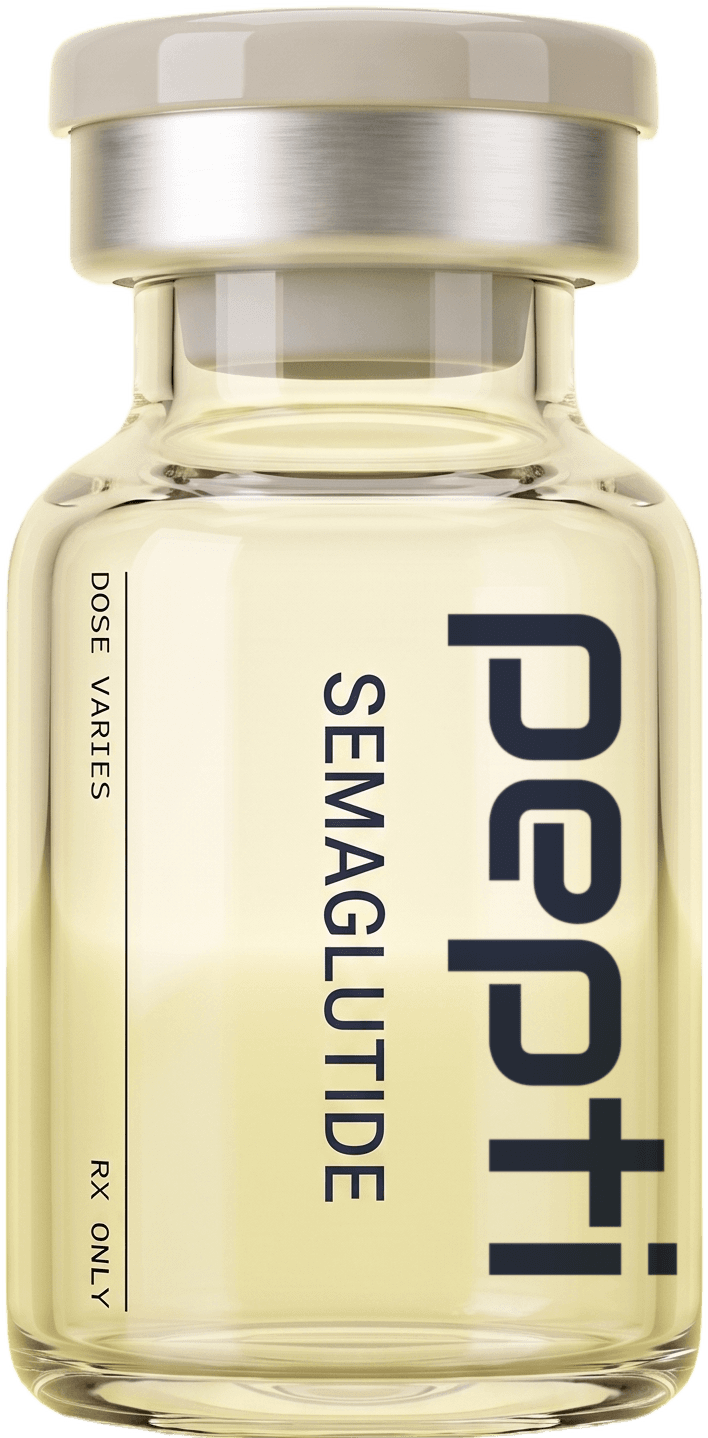
— Treatments mentioned
Semaglutide is a prescription injection supplied as dose-specific vials (Semaglutide): 0.25mg → 1 mg per 1 mL vial (1 mg/mL). It requires a prescription from a physician licensed in your state, is compounded by a state-licensed US pharmacy, and is not FDA approved.
This page covers what semaglutide is, how it works, what the large human trials do and do not establish, the difference between the approved brands and a compounded vial, where it stands with the FDA as of September 2026, how it is dosed, and how to get it prescribed.
— Semaglutide
What semaglutide actually is
— A modified copy of a gut hormone
Semaglutide is a GLP-1 receptor agonist: a synthetic analogue of glucagon-like peptide-1, a hormone released by the small intestine after a meal. Native GLP-1 is cleared within minutes by the enzyme DPP-4, which is why the hormone itself was never a practical drug. Semaglutide keeps most of the native sequence and changes three things: an unnatural amino acid at position 8 that blocks DPP-4, a substitution at position 34, and a fatty-acid chain at position 26 that binds the peptide to albumin. Those changes stretch the half-life to roughly a week, which is what makes once-weekly injection possible.
It is not a stimulant. It works on receptors the body already uses to register that a meal has been eaten.
— Where the name and the brands come from
Semaglutide was developed by Novo Nordisk and is sold in the United States under three brand names, each with its own FDA approval: Ozempic, a weekly injection for type 2 diabetes (5 December 2017); Rybelsus, a daily tablet for type 2 diabetes (20 September 2019); and Wegovy, the higher-dose weekly injection for chronic weight management (4 June 2021). Wegovy's label has since grown: cardiovascular risk reduction (8 March 2024), non-cirrhotic MASH with fibrosis (15 August 2025), an oral 25 mg tablet (22 December 2025) and a 7.2 mg injection sold as Wegovy HD (19 March 2026).
The compounded product Pepti prescribes contains the same active ingredient, prepared by a state-licensed pharmacy to an individual prescription. It is not any of those brands and does not carry their approval.
— What it is not
It is not a substitute for eating and moving differently; every large trial ran it alongside a reduced-calorie diet and increased activity. It is not a short course with a permanent result: the trial that stopped the drug and kept watching reported most of the weight coming back. It is not for type 1 diabetes. And it is not interchangeable with tirzepatide, which acts on two receptors rather than one.
— Semaglutide
How semaglutide is described to work
Unlike most peptides on this site, the mechanisms here are established in humans. Four actions are consistently described.
— Glucose-dependent insulin release
GLP-1 receptors on pancreatic beta cells trigger insulin secretion only when blood glucose is elevated; the signal switches off as glucose normalises, which is why semaglutide on its own rarely drives blood sugar too low. It also suppresses glucagon, which tells the liver to release stored glucose. This is the original diabetes mechanism, demonstrated in the SUSTAIN programme.
— Slower gastric emptying
Semaglutide slows the rate at which the stomach empties, particularly early in treatment. Fullness lasts longer and post-meal glucose rises more gradually. The same action explains the most common side effects (nausea, fullness, constipation) and is why anaesthesiologists ask about GLP-1 use before a procedure.
— Appetite signalling in the brain
GLP-1 receptors in the hypothalamus and brainstem regulate hunger and satiety, and human feeding studies describe reduced hunger, fewer cravings and lower energy intake. Patients most often describe "food noise" going quiet rather than feeling forcibly full. In the weight-management trials this mechanism carries most of the weight change.
— Effects beyond weight
SELECT reported fewer major cardiovascular events in people without diabetes, with the effect appearing before much weight had been lost, so investigators describe it as partly independent of weight. ESSENCE reported improved liver histology in MASH. How much of either is weight-mediated remains open.
— Semaglutide
What the research actually shows
Semaglutide has the largest human evidence base of any product in this catalogue, by a wide margin. Every trial below studied the branded product; the compounded version shares the active ingredient, not the trials.
— Weight management: the STEP programme
STEP 1, in the New England Journal of Medicine in 2021, randomised 1,961 adults with overweight or obesity and no diabetes to weekly semaglutide at the full trial dose or placebo for 68 weeks, both with lifestyle intervention. Mean weight change was −14.9% against −2.4%.
STEP 2, in The Lancet in 2021, ran the same design in 1,210 adults with type 2 diabetes: −9.6% against −3.4%. STEP 3, in JAMA in 2021, added intensive behavioural therapy for 611 adults: −16.0% against −5.7%. STEP 5, in Nature Medicine in 2022, followed 304 adults for two years: −15.2% against −2.6%. STEP 8, in JAMA in 2022, compared weekly semaglutide with daily liraglutide: −15.8% against −6.4%.
— What happens on stopping: STEP 4
STEP 4, in JAMA in 2021, is the trial worth reading before starting. 803 adults reached the maintenance dose over 20 weeks and were then randomised to continue or switch to placebo for 48 weeks. Those who continued lost a further 7.9%; those switched to placebo regained 6.9%, along with most of the improvements in blood pressure and lipids. Semaglutide works while it is being taken, in the way a blood-pressure medication does.
— Diabetes and cardiovascular outcomes: SUSTAIN-6 and SELECT
SUSTAIN-6, in the New England Journal of Medicine in 2016, randomised 3,297 people with type 2 diabetes at high cardiovascular risk to semaglutide or placebo for 104 weeks. Major adverse cardiovascular events occurred in 6.6% against 8.9%. The same trial reported more diabetic retinopathy complications (3.0% against 1.8%), the source of the label's retinopathy warning.
SELECT, in the New England Journal of Medicine in 2023, is the largest trial of the compound: 17,604 adults aged 45 and over with established cardiovascular disease and a BMI of 27 or more, without diabetes, followed for a mean of 39.8 months. Cardiovascular death, heart attack or stroke occurred in 6.5% against 8.0%, a 20% relative reduction, and the basis of the March 2024 cardiovascular indication.
— Liver: ESSENCE
ESSENCE, in the New England Journal of Medicine in 2025, randomised 1,197 people with biopsy-confirmed MASH and stage 2 or 3 fibrosis to semaglutide or placebo. At 72 weeks, 62.9% of the semaglutide group had resolution of steatohepatitis without worsening fibrosis against 34.3%, and 36.8% had fibrosis improvement against 22.4%. The trial continues to 240 weeks; the August 2025 liver approval rests on this interim result.
— Head to head with tirzepatide: SURMOUNT-5
SURMOUNT-5, in the New England Journal of Medicine in 2025, randomised 751 adults with obesity and no diabetes to tirzepatide or semaglutide at maximum tolerated doses for 72 weeks; tirzepatide produced −20.2% against −13.7%. It was open-label, a limitation, but the direction is consistent with the two drugs' separate trials.
— What human data exists
Multiple large randomised placebo-controlled phase 3 trials in obesity, type 2 diabetes and established cardiovascular disease; a two-year maintenance trial; a withdrawal trial; a liver-histology trial; one head-to-head against tirzepatide; and post-marketing experience in millions of patients. This is the standard of evidence a drug needs for FDA approval, and semaglutide has it several times over.
— What the evidence does not establish
- It does not establish that a compounded vial performs identically to the branded pen. No trial has tested compounded semaglutide; the case that the same molecule at the same dose behaves the same way is pharmacological inference.
- It does not establish what happens after stopping, beyond most weight returning within a year.
- It does not establish benefit below the trial BMI thresholds (27 with a weight-related condition, or 30).
- It does not establish safety in pregnancy.
- Trial figures are averages at the full trial dose with lifestyle support; an individual on a lower dose without that support should not expect the trial number.
— Semaglutide
Where semaglutide stands with the FDA right now
This is the most misreported topic in the category. The position as of 24 September 2026, with sources:
— The approved brands
Semaglutide is an FDA-approved active ingredient. Ozempic, Rybelsus and Wegovy are approved drug products, with the label expansions dated above.
— The shortage years, 2022 to 2025
Semaglutide injection went onto the FDA's drug shortage list in 2022, and while a drug is on that list federal law allows compounding pharmacies to prepare it. On 21 February 2025 the FDA declared the shortage resolved, giving 503A pharmacies until 22 April 2025 and 503B outsourcing facilities until 22 May 2025 to stop compounding, distributing and dispensing products that are essentially copies of the approved ones.
— Where compounding stands now
Shortage-based compounding has ended. What remains is the ordinary 503A pathway that exists for every drug: a state-licensed pharmacy may compound for an identified patient where the prescriber has determined that the compounded product differs from the commercial one in a way that matters for that patient, such as a strength or dosage form that is not sold. The FDA updated its guidance on what counts as "essentially a copy" on 1 April 2026, noting that semaglutide appears on neither the 503B bulks list nor the shortage list.
On 30 April 2026 the FDA proposed to exclude semaglutide, tirzepatide and liraglutide from the 503B bulks list, having not identified a clinical need for outsourcing facilities to compound them from bulk substances. That is a proposal, not a final rule: it was published in the Federal Register on 1 May 2026, the comment period was extended to 30 July 2026, and no final determination had been published as of the date above. It concerns 503B facilities, which make large batches without patient-specific prescriptions; it does not by itself change the 503A framework under which a pharmacy compounds for a named patient.
The FDA has also policed marketing: warning letters to telehealth companies in September 2025, 30 more on 3 March 2026 and 25 in June 2026, objecting to websites implying a compounded product was equivalent to or approved like the brand, or hiding which pharmacy made it. That is why this page says plainly: compounded semaglutide is not FDA approved and is not Wegovy or Ozempic.
So the accurate description today is: an approved active ingredient; no more shortage-based compounding; patient-specific 503A compounding on a physician's prescription still lawful where the prescriber documents the clinical reason; and a pending 503B proposal that would not directly change that.
— Semaglutide
Realistic expectations
These are patterns described by prescribers and by the trial populations, not guarantees. The trials ran the full maintenance dose with lifestyle support, so results at lower doses vary.
— The first four weeks
Treatment starts at the lowest strength, a tolerance dose rather than a treatment dose. Most people notice reduced appetite within one to two weeks; gastrointestinal effects cluster in the days after each step up. Weight change in the first month is modest and not a measure of what the drug will do at maintenance dose.
— Months two to four
Dose escalation continues at roughly monthly intervals as tolerated, and the appetite effect becomes consistent. In the STEP trials weight loss was steepest through roughly week 20.
— Months four to twelve
Weight loss continues but slows; in STEP 1 the curve flattened around week 60. A plateau is the drug reaching equilibrium, not stopping working. This is where physicians consider holding, stepping up, or reconsidering the plan.
— Beyond a year
STEP 5 reported weight maintained at two years on continued treatment. STEP 4 reported most weight returning within a year of stopping. Semaglutide is a maintenance treatment, and the long-term plan is something to agree with your physician early.
— Semaglutide
When something else makes more sense
A reference that only recommends its own product is not much of a reference. Some cases where semaglutide is not the first thing to reach for:
- A personal or family history of medullary thyroid carcinoma or MEN 2. GLP-1 receptor agonists are contraindicated. A physician will not prescribe it.
- A history of pancreatitis. Needs careful discussion; the physician may decide against any GLP-1 agonist.
- You want the larger effect the head-to-head reported. Tirzepatide acts on GIP as well as GLP-1 receptors and outperformed semaglutide in SURMOUNT-5. Which is right for you weighs tolerability and history as well as effect size.
- Your goal is body composition rather than substantial weight loss. Someone near a healthy weight is not the STEP population. Tesamorelin, CJC-1295 / Ipamorelin or the SHRED blend are a different conversation with a much thinner evidence base.
- You want a non-GLP-1 adjunct. AOD-9604, 5-Amino-1MQ, L-carnitine and Lipo-B do not act on GLP-1 receptors; their evidence is far thinner, and your physician will say so.
- Pregnant, planning pregnancy, or breastfeeding. Not used.
Your physician will tell you if semaglutide is not the right tool for what you have described. A consultation does not guarantee a prescription, and being declined is refunded.
— Semaglutide
Strengths available
| Strength | Directions |
|---|---|
| Semaglutide 0.25mg weekly — 1mg/1mL | Inject 0.25 mL (25 units) subcutaneously once weekly. |
| Semaglutide 0.5mg weekly — 2mg/2mL | Inject 0.50 mL (50 units) subcutaneously once weekly. |
| Semaglutide 1mg weekly — 4mg/2mL | Inject 0.50 mL (50 units) subcutaneously once weekly. |
| Semaglutide 1.7mg weekly — 7.5mg/3mL | Inject 0.68 mL (68 units) subcutaneously once weekly. |
| Semaglutide 2mg weekly — 10mg/2mL | Inject 0.40 mL (40 units) subcutaneously once weekly. |
| Semaglutide 2.5mg weekly — 10mg/2mL | Inject 0.50 mL (50 units) subcutaneously once weekly. |
A higher strength delivers more medication in the same volume. Which one you are prescribed is your physician's decision.
— Semaglutide
Dosing, and how a vial is actually used
— Why the vials are dose-specific
Semaglutide is the one product on this site where the vial changes as the dose changes. Each strength is a separate vial concentrated so that one weekly dose is a single draw: 0.25 mL for the 0.25 mg rung, 0.50 mL for the 0.5 mg and 1 mg rungs, 0.68 mL for 1.7 mg, 0.40 mL for 2 mg and 0.50 mL for 2.5 mg. The volume is printed on your medication.
— Why the dose is measured in units
Directions are written in millilitres and insulin-syringe units because that is what you read off the barrel: 0.25 mL is 25 units on a U-100 syringe. Because concentration differs between vials, the units for one strength are not the units for another; never carry a number over from a previous fill.
— Once weekly, subcutaneous, and stepping up
Subcutaneous means into the fat layer: abdomen, thigh or upper arm, rotated. Once weekly means the same day each week. Treatment starts at the lowest strength and the physician steps up, typically at roughly four-week intervals as tolerance allows; never on your own.
— Why a vial covers about four weeks
At one draw per week, each dose-specific vial holds about four weekly doses, which is why refills run on a 28-day cycle and why a step up arrives as a new vial. One vial per fill, always.
— Storage
Refrigerated, and it ships that way in insulated packaging with ice packs. Beyond-use dating runs from first puncture and is on the label. A vial that has frozen should not be used.
— Semaglutide
Safety and side effects
Semaglutide's safety profile is well characterised, because the trials that produce one have been run. The most common effects are gastrointestinal: nausea, diarrhoea, vomiting, constipation and abdominal pain, most often during dose escalation and usually easing as the body adjusts. In STEP 1, gastrointestinal events were the main reason for discontinuation, at 4.5% against 0.8% for placebo.
Less common but important: acute pancreatitis (seek care for severe, persistent abdominal pain), gallbladder disease, and dehydration that can affect kidney function. On insulin or a sulfonylurea, low blood sugar is possible; SUSTAIN-6 reported more diabetic retinopathy complications, so eye history is asked about. Slower gastric emptying can change how oral medications are absorbed, and any anaesthesiologist or surgeon should know you are taking it. The approved labels carry a warning about thyroid C-cell tumours seen in rodent studies, the basis for the medullary thyroid carcinoma and MEN 2 contraindication, and advise monitoring for changes in mood.
Compounded semaglutide should be prepared from semaglutide itself; the FDA has stated that salt forms such as semaglutide sodium or acetate are not the approved active ingredient. What to ask of any provider is on the quality page.
Stop and contact your physician for any reaction that is severe, spreading, or involves difficulty breathing, and for severe abdominal pain or persistent vomiting.
— Semaglutide
How semaglutide compares
— Compounded semaglutide vs Ozempic and Wegovy
Same active ingredient; different product. Ozempic and Wegovy are FDA-approved drugs made by their manufacturer in a fixed-dose pen. Compounded semaglutide is prepared by a state-licensed pharmacy to an individual prescription, is not FDA approved as a finished product, and has not been the subject of any of the trials above. The strengths on this page are not the branded strengths, the kind of patient-specific difference a prescriber documents when compounding is appropriate. A physician who considers the branded product the right choice for you will say so.
— Semaglutide vs tirzepatide
Semaglutide acts on the GLP-1 receptor alone; tirzepatide acts on GLP-1 and GIP receptors. In SURMOUNT-5 tirzepatide produced more weight loss. Semaglutide has the longer track record, the larger outcomes trials (SELECT, ESSENCE) and the lower price. Side-effect profiles are similar. Which one a physician prescribes depends on history, tolerability, goals and cost rather than the head-to-head figure alone.
— Semaglutide vs a growth hormone secretagogue
Not alternatives. Semaglutide changes appetite and energy intake, with large human trials behind it. Tesamorelin, sermorelin and CJC-1295 / Ipamorelin act on the growth hormone axis and are described around body composition, with much thinner human evidence. Someone whose problem is appetite and weight is in semaglutide's territory; someone near a healthy weight is not.
— Semaglutide
Availability and formats
| Question | Answer |
|---|---|
| Can I get it by telehealth? | Yes, where a physician licensed in your state prescribes it |
| Which states? | All 50 states and DC |
| Does it come as a pen? | No, this one is a vial and syringe only |
| Does it come as a capsule? | No |
| Does it come as a nasal spray? | No |
| Is bloodwork required first? | Usually, for this medication |
— Semaglutide
Where to get Semaglutide prescribed
Semaglutide cannot be bought legitimately without a prescription. Sites shipping it with no prescription are selling a research-use-only product, where no pharmacy is accountable for identity, purity, sterility or concentration.
The prescription route works like this:
- Complete a medical intake covering your history, medications, allergies and what you are treating.
- A physician licensed in your state reviews it and will usually want baseline bloodwork before prescribing this one.
- If appropriate, a state-licensed, FDA-registered pharmacy compounds it to that prescription.
- It ships refrigerated with your directions printed on the vial.
- Your physician stays reachable afterwards for dose questions and side effects.
Current all-in pricing for Semaglutide is published: medication, physician review, refill management and shipping in one figure, with no separate membership fee. What to check on any provider is in how to tell if a peptide seller is legitimate.
— Semaglutide
Who should not take it, or should discuss it first
| Situation | Why |
|---|---|
| Personal or family history of medullary thyroid carcinoma or MEN 2 | Raised at intake |
| Pregnancy or breastfeeding | Raised at intake |
| History of pancreatitis needs careful discussion | Raised at intake |
| Pregnancy or breastfeeding | Not used; safety data is absent |
| Tested athletes | Many peptides are prohibited in competition; check the current list |
— Full specification
Everything on the label.
— Product
Semaglutide (Injectable)
— How supplied
dose-specific vials (Semaglutide): 0.25mg → 1 mg per 1 mL vial (1 mg/mL); 0.5mg → 2 mg per 2 mL vial (1 mg/mL); 1mg → 4 mg per 2 mL vial (2 mg/mL); 1.7mg → 7.5 mg per 3 mL vial (2.5 mg/mL); 2mg → 10 mg per 2 mL vial (5 mg/mL); 2.5mg → 10 mg per 2 mL vial (5 mg/mL)
— Formats
Vial and syringe
— Available in
All 50 states and DC
— Bloodwork
Commonly required before prescribing
— Strengths available
6
— Legal status
Prescription-only, compounded, not FDA approved
— Category
Weight Loss
— References
What this is based on.
References
- Wilding JPH, Batterham RL, Calanna S, et al.. Once-Weekly Semaglutide in Adults with Overweight or Obesity (STEP 1) · New England Journal of Medicine (2021) · PMID 33567185
- Lincoff AM, Brown-Frandsen K, Colhoun HM, et al.. Semaglutide and Cardiovascular Outcomes in Obesity without Diabetes (SELECT) · New England Journal of Medicine (2023) · PMID 37952131
- Wadden TA, Bailey TS, Billings LK, et al.. Effect of subcutaneous semaglutide vs placebo as an adjunct to intensive behavioral therapy on body weight in adults with overweight or obesity (STEP 3) · JAMA (2021) · PMID 33625476
- Rubino D, Abrahamsson N, Davies M, et al.. Effect of Continued Weekly Subcutaneous Semaglutide vs Placebo on Weight Loss Maintenance in Adults With Overweight or Obesity: The STEP 4 Randomized Clinical Trial · JAMA (2021) · PMID 33755728
- Marso SP, Bain SC, Consoli A, et al.. Semaglutide and Cardiovascular Outcomes in Patients with Type 2 Diabetes (SUSTAIN-6) · New England Journal of Medicine (2016) · PMID 27633186
- Davies M, Færch L, Jeppesen OK, et al.. Semaglutide 2.4 mg once a week in adults with overweight or obesity, and type 2 diabetes (STEP 2): a randomised, double-blind, double-dummy, placebo-controlled, phase 3 trial · The Lancet (2021) · PMID 33667417
- Garvey WT, Batterham RL, Bhatta M, et al.. Two-year effects of semaglutide in adults with overweight or obesity: the STEP 5 trial · Nature Medicine (2022) · PMID 36216945
- Rubino DM, Greenway FL, Khalid U, et al.. Effect of Weekly Subcutaneous Semaglutide vs Daily Liraglutide on Body Weight in Adults With Overweight or Obesity Without Diabetes: The STEP 8 Randomized Clinical Trial · JAMA (2022) · PMID 35015037
- Aronne LJ, Horn DB, le Roux CW, et al.. Tirzepatide as Compared with Semaglutide for the Treatment of Obesity (SURMOUNT-5) · New England Journal of Medicine (2025) · PMID 40353578
- Sanyal AJ, Newsome PN, Kliers I, et al.. Phase 3 Trial of Semaglutide in Metabolic Dysfunction-Associated Steatohepatitis (ESSENCE) · New England Journal of Medicine (2025) · PMID 40305708
- Wilding JPH, Batterham RL, Davies M, Van Gaal LF, Kandler K et al.. Weight regain and cardiometabolic effects after withdrawal of semaglutide: The STEP 1 trial extension · Diabetes Obes Metab (2022) · PMID 35441470
- Batsis JA, Gavras A, Gross DC, Cheever CR, Da Silva BR et al.. Effect of Incretin-Based and Nonpharmacologic Weight Loss on Body Composition: A Systematic Review · Ann Intern Med (2026) · PMID 41996180
Citations are provided for educational purposes. They do not constitute medical advice. Always discuss any peptide protocol with your prescribing physician.
— Common questions
Semaglutide, answered.
Through a telehealth provider where a physician licensed in your state reviews a medical intake and a licensed US pharmacy compounds the prescription. Pepti prescribes Semaglutide in all 50 states and DC; start with the free assessment.
dose-specific vials (Semaglutide): 0.25mg → 1 mg per 1 mL vial (1 mg/mL); 0.5mg → 2 mg per 2 mL vial (1 mg/mL); 1mg → 4 mg per 2 mL vial (2 mg/mL); 1.7mg → 7.5 mg per 3 mL vial (2.5 mg/mL); 2mg → 10 mg per 2 mL vial (5 mg/mL); 2.5mg → 10 mg per 2 mL vial (5 mg/mL)
Semaglutide is supplied as a vial, drawn with an insulin syringe. It is not available as a pen or capsule.
Usually yes for this medication. A physician will generally want baseline labs before prescribing, and at-home blood testing covers hormone, metabolic and thyroid markers without a lab visit.
It is legal to prescribe and dispense in the United States with a valid prescription. It is not FDA approved: compounded medications are prepared by licensed pharmacies pursuant to a prescription rather than approved as manufactured products. See are peptides FDA approved.
Pricing is published on the Semaglutide page as one all-in figure covering medication, physician review, refill management and shipping. What drives peptide pricing generally is in how much do peptides cost.
Same active ingredient, different product. Ozempic and Wegovy are FDA-approved drugs made by their manufacturer; compounded semaglutide is prepared by a state-licensed pharmacy to your individual prescription and is not FDA approved. The STEP, SUSTAIN and SELECT trials were run on the branded product.
No, but the rules changed. Compounding was permitted while semaglutide was on the FDA's shortage list from 2022. The FDA declared the shortage resolved on 21 February 2025, and shortage-based compounding ended on 22 April 2025 for 503A pharmacies and 22 May 2025 for 503B facilities. Patient-specific compounding on a physician's prescription, where the prescriber documents a clinical reason, remains lawful. On 30 April 2026 the FDA proposed excluding semaglutide from the 503B bulks list; that concerns large-batch outsourcing facilities, and no final determination has been published as of September 2026.
In STEP 1, adults with obesity and no diabetes on the full trial dose with lifestyle support lost a mean of 14.9% of body weight over 68 weeks, against 2.4% on placebo. In adults with type 2 diabetes (STEP 2) the figure was 9.6%. Those are trial averages on the branded product; individual results vary.
STEP 4 reported that people switched to placebo regained about two-thirds of the weight they had lost within a year, along with most of the changes in blood pressure and lipids. Semaglutide is a maintenance treatment; how long to stay on it is a decision to make with your physician.
In the one head-to-head trial, SURMOUNT-5, tirzepatide produced more weight loss over 72 weeks (20.2% against 13.7%). Semaglutide has the larger body of outcomes evidence, including SELECT, and the lower price. Which is appropriate is your physician's decision.
Most commonly nausea, diarrhoea, vomiting, constipation and abdominal pain, especially during dose escalation. Less common but important: pancreatitis, gallbladder disease, dehydration affecting the kidneys, low blood sugar with insulin or sulfonylureas, and diabetic retinopathy complications in people with diabetes. It carries a rodent thyroid C-cell tumour warning, which is why a personal or family history of medullary thyroid carcinoma or MEN 2 rules it out.
Because Pepti's semaglutide is supplied as dose-specific vials, each concentrated so that one weekly dose is a single draw. A step up arrives as a new vial with new directions printed on it. Never carry over the units from an earlier strength.
— Next step
See what a physician
recommends for you.
A licensed physician in your state reviews your intake and decides what is appropriate. A consultation does not guarantee a prescription.
Important legal & safety information
The assessment process available on the Pepti website asks a series of medical questions, and the answers provided are reviewed by an independent licensed physician affiliated with our partner physician network. The licensed providers have established exclusionary criteria, and the answers provided determine if the individual is screened out of eligibility for treatment. The licensed clinicians retain the sole decision to prescribe peptide therapy and other compounded medications to patients. Treatment may be denied at the physician's sole discretion. If a prescription is not approved, you will not be charged for the medication.
Pharmacy Providers. Pepti is a technology platform and is not a healthcare provider, pharmacy, or prescriber. All medications offered through the platform are compounded by independent FDA-registered 503A or 503B compounding pharmacies based on a valid prescription written by a licensed physician for an individual patient. Compounded medications are not FDA-approved as products. The active pharmaceutical ingredients used by our partner pharmacies are sourced from FDA-registered facilities. Compounded medications may not undergo the same testing or quality control as commercially manufactured FDA-approved drugs.
Results vary. Results from peptide therapy and other compounded treatments vary based on individual factors, including age, weight, medical history, adherence to the prescribed protocol, lifestyle factors, and physiological response. Pepti makes no guarantee of any specific outcome. Statements about peptide therapy and compounded medications offered through the platform have not been evaluated by the Food and Drug Administration. These products are not intended to diagnose, treat, cure, or prevent any disease.
Product images. Product photographs and renderings shown on this website are for illustrative purposes only. The appearance of vials, packaging, labeling, and other materials you receive may vary and is determined by the dispensing compounding pharmacy.
Off-label use.Many peptides offered through the platform are prescribed for off-label use. “Off-label” means the medication is being prescribed for a use, dose, or patient population that is not specifically approved by the FDA. Off-label prescribing is legal and common in U.S. medical practice when supported by clinical experience and judgment.
Mailing & shipping. Pepti currently dispenses prescription medication to patients in all 50 states and Washington, D.C.. All orders ship in unbranded, tamper-evident packaging via expedited delivery from our partner compounding pharmacies. Temperature-sensitive medications ship with insulated packaging and ice packs. Shipping is included at no additional cost. We do not currently ship medication outside all 50 states and Washington, D.C., internationally, or to APO/FPO addresses.
Not for emergencies. Pepti is not designed for medical emergencies. If you are experiencing a medical emergency, call 911 or go to your nearest emergency room immediately. For urgent but non-emergency medical questions, contact your primary care provider or use an urgent care service.
No doctor-patient relationship with Pepti. Your use of the platform does not create a doctor-patient relationship between you and pepti LLC. A doctor-patient relationship is established only between you and the independent licensed physician who reviews your intake and prescribes your treatment. The physicians who use the platform are independent contractors and are solely responsible for the medical care they provide.
Prescription medications. All prescription products require a valid prescription from a licensed healthcare provider. By using the platform, you acknowledge that you are at least 18 years old and that the information you provide is true, accurate, current, and complete. Providing false information may result in inappropriate treatment recommendations or denial of service.
Cosmetic & wellness products.Certain products offered through Pepti — including skincare, hair care, body care, supplements, men's grooming, sports recovery, and sexual wellness products — are cosmetic or dietary supplement products, not prescription medications. These products do not require a prescription and are not reviewed or prescribed by a physician. Statements regarding dietary supplements have not been evaluated by the Food and Drug Administration. These products are not intended to diagnose, treat, cure, or prevent any disease. Results vary by individual. Consult your healthcare provider before starting any new supplement or topical product, especially if you are pregnant, nursing, or taking other medications.
pepti LLC · Delaware Limited Liability Company · 131 Continental Dr, Suite 305, Newark, DE 19713 · For media or partnership inquiries, email hello@hellopepti.com. For patient support, email support@hellopepti.com. For privacy and HIPAA inquiries, email privacy@hellopepti.com.