Intimacy · Reference
Kisspeptin vs PT-141: Mechanism, Evidence, Dosing, Cost, and Which One Fits
This page explains each on its own terms, puts them side by side, covers what the research does and does not show, where each stands with the FDA, how each is dosed, what each costs at Pepti, how kisspeptin relates to hCG and gonadorelin, and where the PT-141 + Oxytocin vial fits.
Medically reviewed by Dr. Gene, MD · November 4, 2026
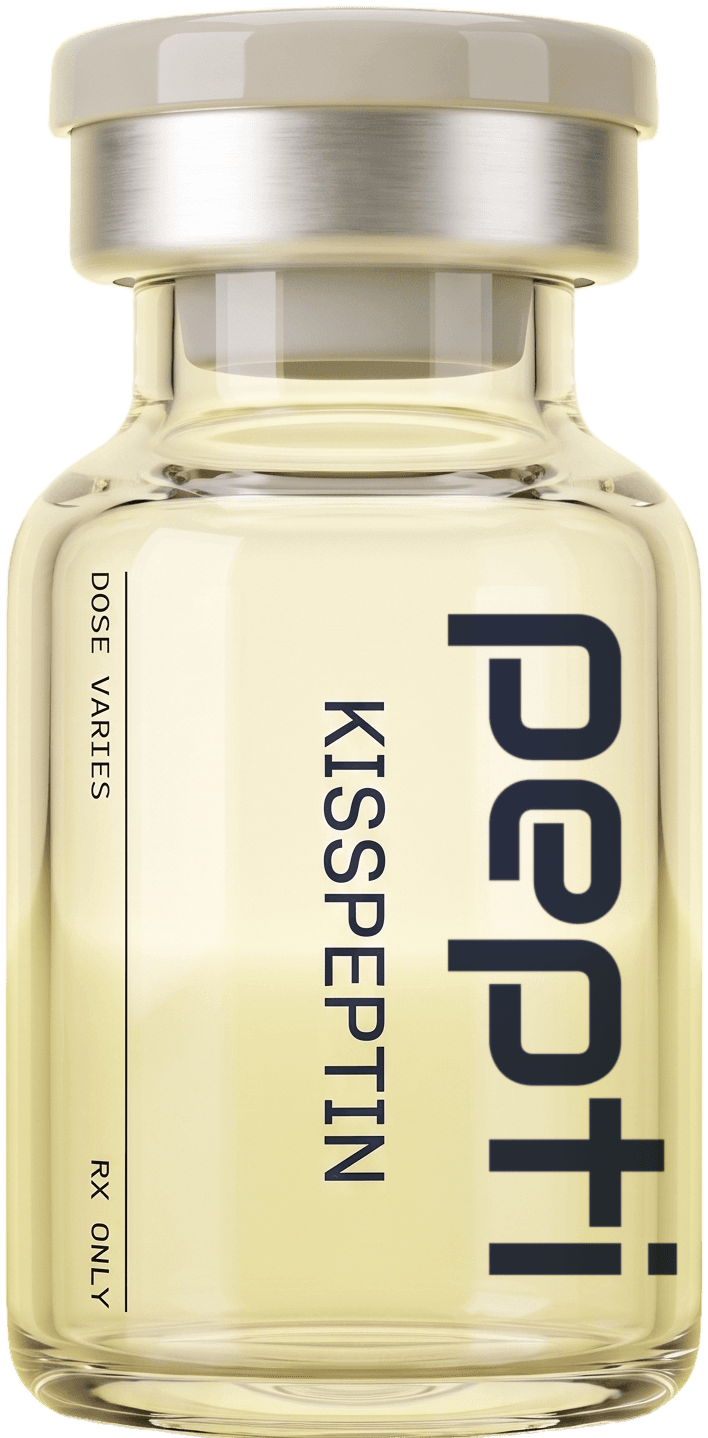
Treatments mentioned
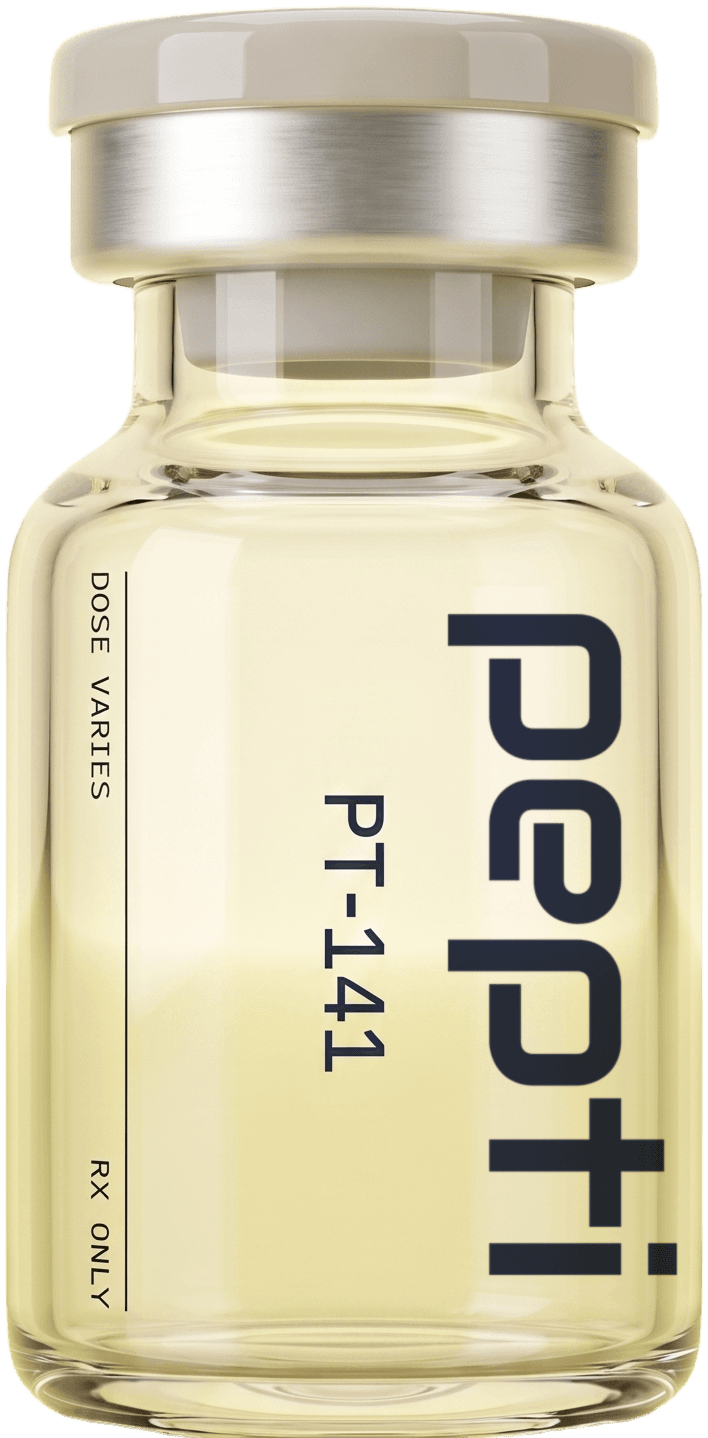
Kisspeptin and PT-141 are both prescribed around low sexual desire, but they act on different systems and are used on different rhythms. PT-141 (bremelanotide) activates melanocortin receptors in the brain, is taken on the occasion a few hours before intimacy, and is the active ingredient of an FDA-approved drug with two phase 3 trials in premenopausal women behind it. Kisspeptin works upstream of the reproductive hormones, prompting the body's own LH and testosterone, is dosed on weekdays, and its desire evidence is two small single-session trials with a related form. Both are prescription-only, compounded by a licensed US pharmacy, and the compounded versions are not FDA approved.
This page explains each on its own terms, puts them side by side, covers what the research does and does not show, where each stands with the FDA, how each is dosed, what each costs at Pepti, how kisspeptin relates to hCG and gonadorelin, and where the PT-141 + Oxytocin vial fits.
Kisspeptin vs PT-141
The short answer
| If your main goal is | The usual prescription | What is in it | Price |
|---|---|---|---|
| Low desire on its own, with hormones not in question | PT-141 | 10 mg PT-141 (bremelanotide) in a 5 mL vial, or a 10 mg Pen cartridge | $259/mo |
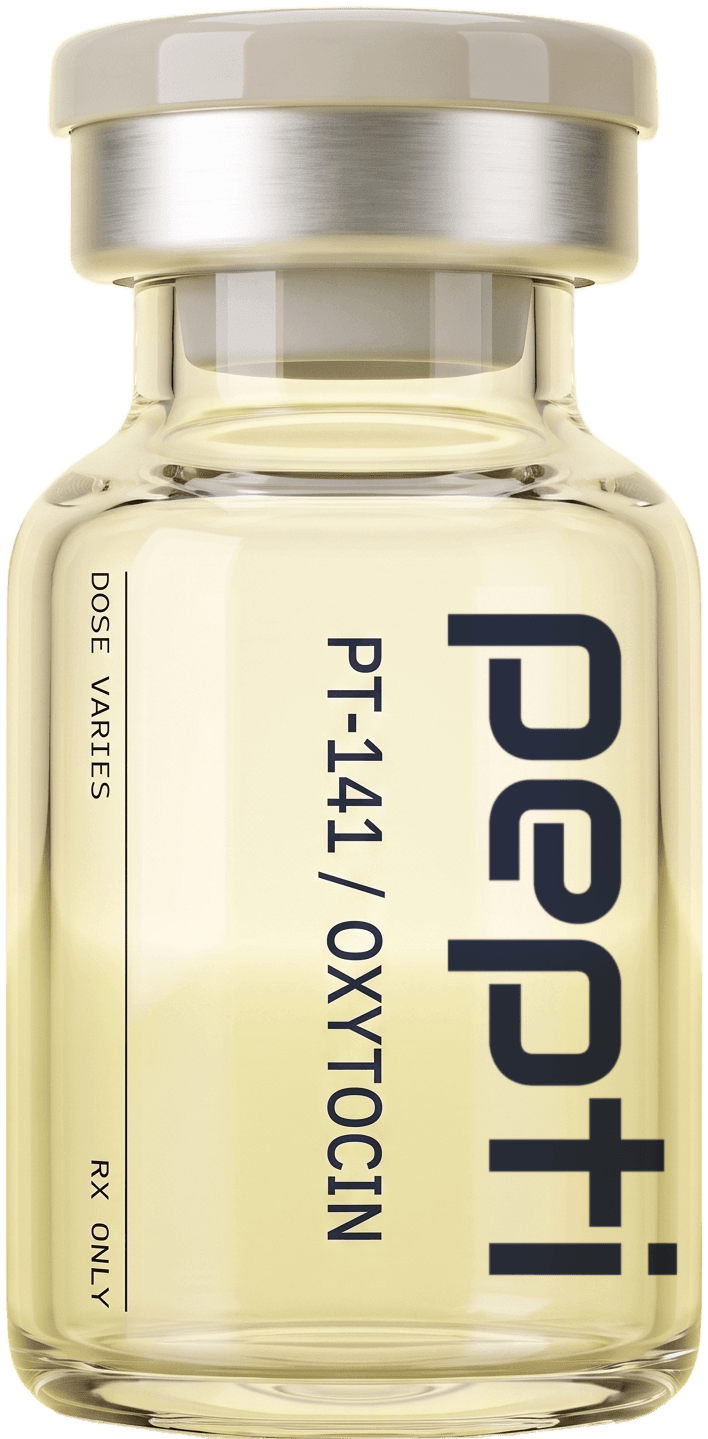
| Desire plus closeness and the after-part of intimacy | PT-141 + Oxytocin | 10 mg PT-141 and 5 mg oxytocin in a 5 mL vial | $259/mo |
| Low desire that may be tied to the hormonal axis | Kisspeptin | 10 mg kisspeptin-10 in a 5 mL vial | $229/mo |
| Libido as one part of energy, recovery and skin goals | EUPHORIA Blend | 10 mg MOTS-c, 10 mg BPC-157, 50 mg GHK-Cu and 2 mg kisspeptin | $279/mo |
| Closeness and connection, with no complaint about desire | Oxytocin | 10 mg oxytocin in a 5 mL vial | $239/mo |
Every figure is an all-in monthly price covering the medication, physician review, refill management and shipping. There is no separate membership fee. Current pricing always lives on each product page; the table is a guide to which product fits which goal.
Kisspeptin vs PT-141
PT-141 on its own terms
What it is
PT-141 is the development code for bremelanotide, a cyclic peptide of seven amino acids. It is a synthetic analogue of alpha-melanocyte-stimulating hormone (alpha-MSH), one of the melanocortin hormones the body uses to signal pigmentation, appetite, inflammation and sexual arousal. It binds the same receptor family alpha-MSH does but lasts far longer in the body. It is not a PDE5 inhibitor like sildenafil or tadalafil, and it does not raise testosterone or oestrogen. The full reference is at what is PT-141.
How PT-141 is described to work
- Melanocortin receptors, mainly MC4R. The approved product's prescribing information ranks its potency as MC1R, MC4R, MC3R, MC5R, MC2R, with MC1R and MC4R the two that matter at therapeutic doses. MC4R is the receptor implicated in sexual function.
- Dopamine in the medial preoptic area. A 2007 paper in the Journal of Sexual Medicine and a 2022 review in CNS Spectrums describe bremelanotide increasing dopamine release in a hypothalamic region tied to sexual motivation in female rats. The model is that it raises the "wanting" side of desire rather than the physical response. The approved label itself says the mechanism for desire is unknown, so this is the leading explanation, not a settled one.
- Central, not vascular. Two 2004 human studies in the International Journal of Impotence Research reported erectile responses in men without visual sexual stimulation, the signature of a drug acting in the brain rather than on blood flow.
- MC1R and pigmentation. Its strongest affinity is for the melanocyte receptor, which is why focal skin darkening is a labelled warning and why dose frequency is capped.
What human data exists for PT-141
Study Who What was reported 2016 phase 2b, Women's Health 327 premenopausal women analysed More satisfying sexual events per month at 1.25 to 1.75 mg than placebo (+0.7 vs +0.2) RECONNECT, two phase 3 trials, Obstetrics & Gynecology 2019 1,267 premenopausal women with acquired, generalised HSDD, 24 weeks Desire scores improved 0.30 and 0.42 points more than placebo; distress improved 0.37 and 0.29 points more 52-week open-label extension, 2019 684 women who chose to continue No new safety signals Two 2004 studies, International Journal of Impotence Research Healthy men and men with mild-to-moderate erectile dysfunction Statistically significant erectile responses, including in men who responded inadequately to sildenafil 2022 pooled safety analysis, Journal of Women's Health Roughly 3,500 subjects across 43 studies Safety pattern consistent with the trials Those phase 3 differences are modest in absolute size: real, but not dramatic. There is no phase 3 trial in men, no late-phase data in postmenopausal women, and no trial of a compounded 2 mg/mL vial; the trials used a 1.75 mg autoinjector.
Kisspeptin vs PT-141
Kisspeptin on its own terms
What it is
Kisspeptin is a family of peptides encoded by the KISS1 gene. A precursor is cut into kisspeptin-54 and shorter fragments that share the same ten-amino-acid tail, which binds the receptor KISS1R (older papers call it GPR54). The product at Pepti is kisspeptin-10, the shortest active form, not the full-length kisspeptin-54 used in most human trials. The full reference is at what is kisspeptin.
How kisspeptin is described to work
- Stimulating GnRH neurons. Kisspeptin acts on the hypothalamic neurons that make gonadotropin-releasing hormone (GnRH). GnRH tells the pituitary to release LH and FSH, which drive testosterone in the testes and oestrogen and ovulation in the ovaries. A 2005 JCEM paper reported intravenous kisspeptin-54 raising LH, FSH and testosterone in healthy men; 2011 work with kisspeptin-10 reported more frequent LH pulses and a rise in testosterone.
- Sexual and emotional processing. Kisspeptin receptors also sit in limbic regions. A 2017 Journal of Clinical Investigation fMRI study in healthy men reported greater activation in response to sexual and couple-bonding images during a kisspeptin-54 infusion, alongside reduced negative mood.
- Intermittent exposure matters. Continuous exposure produces a surge and then a fade, called tachyphylaxis; spaced dosing held the response in the Imperial College studies. That is why a kisspeptin schedule is built around gaps.
Kisspeptin is not testosterone and adds no hormone from outside. It is not a treatment for erectile dysfunction.
What human data exists for kisspeptin
Study Who What was reported 2005 and 2011, JCEM Healthy men, intravenous kisspeptin-54 and kisspeptin-10 Acute rises in LH and testosterone within hours 2013, Clinical Endocrinology Men with type 2 diabetes and mild biochemical hypogonadism LH and testosterone stimulated by intravenous kisspeptin-10 2022, JAMA Network Open Premenopausal women with HSDD, single kisspeptin-54 infusion Increased activation in sexual-processing brain regions on fMRI 2023, JAMA Network Open Men with HSDD, single kisspeptin-54 infusion Greater brain activation to sexual stimuli and a measurable increase in penile tumescence vs placebo The physiology is well mapped in people, and the two HSDD trials are randomised and placebo-controlled. They are also small, single-session and intravenous, with a different form. There are no randomised trials of a subcutaneous kisspeptin-10 course taken over weeks, which is how it is prescribed.
Kisspeptin vs PT-141
Head to head
| PT-141 | Kisspeptin | |
|---|---|---|
| What it is | Bremelanotide, a cyclic alpha-MSH analogue | Kisspeptin-10, the shortest active fragment of a hypothalamic hormone |
| Where it acts | Melanocortin receptors in the brain, mainly MC4R | KISS1R on GnRH neurons, plus limbic brain regions |
| Touches the hormone axis? | No | Yes, prompts the body's own LH and testosterone |
| How it is used | On the occasion, 2 to 4 hours before activity | Scheduled, once daily on weekdays |
| Strongest human evidence | Two phase 3 RCTs in 1,267 premenopausal women | Two small single-session RCTs with kisspeptin-54 by infusion |
| Evidence in men | Early-phase erectile-response studies | One single-session fMRI and tumescence trial |
| Approved product with this molecule | Yes, for premenopausal women with HSDD | No |
| Headline side effect | Nausea, plus a transient blood-pressure rise | Mostly minor: injection-site redness, flushing, headache |
| FDA bulks list | Not on it; compoundable as an approved-drug active | Kisspeptin-10 in Category 2 |
| WADA 2026 list | Not named | Named under S2.2.1, prohibited in males |
| Vial at Pepti | 5 mL, 2 mg/mL (10 mg), or a 10 mg Pen cartridge | 5 mL, 2 mg/mL (10 mg) |
| Standard directions | 0.50 mL (50 units), 2 to 4 hours before, no more than 4 doses a month | 0.25 mL (25 units) once daily, Monday to Friday |
| Doses per vial | 10 | 20, about 4 weeks |
| Price at Pepti | $259 a month | $229 a month |
The real difference is where the problem sits
People ask which is "stronger." No study has compared them, so that question has no answer. The useful difference is location. PT-141 acts on the desire circuit directly and does not care what your hormones are doing; it was trialled in women whose low desire was not explained by a medication, a relationship problem or another condition. Kisspeptin acts at the top of the hormone axis and on limbic brain regions, which makes it the logical conversation when low desire arrives with the wider hormonal picture.
Kisspeptin vs PT-141
Who suits which
PT-141 first
PT-141 is the usual starting point when desire is the isolated complaint and hormones are not in question. It has by far the larger trial record and is taken only when wanted. It is not suitable for anyone with uncontrolled blood pressure or heart disease.
Kisspeptin
Kisspeptin suits the person whose low desire came with fatigue, low mood or loss of morning erections, and whose physician wants to work with the body's own axis rather than add a hormone from outside. It is not a substitute for testosterone therapy, and it makes no sense for someone already on testosterone, which suppresses the very system kisspeptin acts on. See can you take peptides with testosterone.
PT-141 + Oxytocin
PT-141 + Oxytocin puts both in one vial at 0.10 mL per dose, no more than 8 doses a month. The rationale prescribers give is that PT-141 covers desire and initiation while oxytocin is aimed at the orgasmic phase and closeness afterwards. That is a rationale, not a finding: oxytocin's controlled human evidence for sexual function is small, intranasal and mostly null, and no study has tested whether it adds anything to PT-141. If desire is the whole problem, PT-141 alone is the more targeted prescription. See what is PT-141 + Oxytocin and what is oxytocin.
The broader picture of all three intimacy peptides is in peptides for libido.
Kisspeptin vs PT-141
Kisspeptin vs hCG and gonadorelin
People researching kisspeptin often run into hCG and gonadorelin. Neither is a Pepti product, and our reference library does not cover them in depth, so this section stays at a high level.
| Kisspeptin | hCG | Gonadorelin | |
|---|---|---|---|
| Where it sits | Top of the axis, upstream of GnRH | Outside the scope of our references | Outside the scope of our references |
| Where it appears in kisspeptin research | Tested as an IVF trigger in kisspeptin-54 form | The usual IVF trigger that kisspeptin-54 was tested in place of | Not part of the published work we cover |
| Available at Pepti | Yes | No | No |
The one direct link in the published kisspeptin work is IVF. A 2014 Journal of Clinical Investigation paper tested a single subcutaneous kisspeptin-54 injection in place of the usual hCG trigger, with follow-up studies in 2015 and 2017. The idea was to prompt a woman's own LH surge rather than substitute for it. That work is investigational, used kisspeptin-54 under fertility-clinic monitoring, and is a reproductive endocrinologist's territory, not a wellness prescription. Kisspeptin at Pepti is not a fertility treatment. For hCG or gonadorelin, the conversation belongs with the physician who manages your hormones.
Kisspeptin vs PT-141
When neither is the right first step
| Situation | What makes more sense |
|---|---|
| Erection quality is the issue and desire is intact | A conventional PDE5 inhibitor, which has far larger trials for that job |
| Low desire started with a new medication, depression or anxiety | Your physician looks at the cause first; these were trial exclusions |
| You are already on testosterone | Kisspeptin is not used alongside it; tell your physician |
| Uncontrolled blood pressure or heart disease | PT-141 is not appropriate |
Kisspeptin vs PT-141
Where each stands with the FDA
The two are in very different positions. As of the FDA pages checked in September 2026:
| PT-141 (bremelanotide) | Kisspeptin-10 | |
|---|---|---|
| Approved product with this molecule | Yes, approved 21 June 2019 for premenopausal women with acquired, generalised HSDD | No |
| 503A bulks list | Not on any category; compoundable as a component of an FDA-approved drug | Placed in Category 2 on 29 September 2023 |
| Advisory committee | Not reviewed, because it never needed the bulks list | 29 October 2024: voted 0 for and 11 against adding it, for secondary hypogonadism in men |
| April 2026 changes | Not affected | Not moved out of Category 2 |
| Main restriction | A pharmacy may not regularly compound an essential copy of the approved product | FDA enforcement discretion for nominated substances does not extend to Category 2 |
The FDA's stated concerns about kisspeptin-10 are immunogenicity with injected use, incomplete characterisation of impurities and limited subcutaneous safety data. Category 2 is an interim policy position, not a ban on the molecule, and no final rule has been issued. Compounded PT-141 at Pepti is a 2 mg/mL multi-dose vial or Pen cartridge with physician-set directions, not the fixed 1.75 mg autoinjector. Neither compounded vial is FDA approved; compounded medications never are. Are peptides FDA approved explains the difference.
Kisspeptin vs PT-141
Dosing, side by side
Both are injected under the skin (subcutaneously) into the abdomen or thigh, rotating sites. The rhythm is the big difference.
PT-141 is 0.50 mL, which is 50 units on a U-100 insulin syringe, 2 to 4 hours before sexual activity, no more than 4 doses a month, and never more than one dose in 24 hours. A vial holds 10 doses and is used on occasions rather than on a calendar, so the beyond-use date on the label governs replacement. It also comes as a pre-filled Pen cartridge with a reusable click-dial injector.
Kisspeptin is 0.25 mL, 25 units, once daily Monday to Friday. The two days off each week are deliberate, to avoid the fading response seen with continuous exposure. Twenty doses covers about four weeks, which is why refills run every 28 days, one vial at a time.
You do not need to calculate anything: your directions are printed on the vial, and your physician sets them after reviewing your intake. Both ship refrigerated with ice packs. Bloodwork is not required for any Pepti treatment. If your physician wants labs for your care, they'll ask through your account.
Kisspeptin vs PT-141
Side effects
PT-141. Because the same molecule carries an FDA label, its profile is well described. In the phase 3 trials nausea was reported by 40% of women versus 1.3% on placebo, and 8% left the trial because of it; flushing (20%), injection-site reactions (13%), headache (11%) and vomiting (5%) followed. Nausea improved for most people by the second dose. Each dose causes a transient blood-pressure rise of about 6 mmHg systolic and 3 mmHg diastolic, peaking two to four hours after the dose. Focal hyperpigmentation of the face, gums or breasts was reported in 1% of women dosing up to eight times a month, much more often with daily dosing, and is not always reversible. It can reduce absorption of oral medicines taken around the same time, and should not be used with oral naltrexone.
Kisspeptin. Across the human studies kisspeptin-54 is described as well tolerated, and the HSDD trials reported no serious adverse events attributed to it. What prescribers report with the injection is mostly minor: injection-site redness or soreness, brief flushing, headache and occasional nausea. Repeated subcutaneous kisspeptin-10 over months has not been studied, which is the gap the FDA flagged.
For both, stop and contact your physician for any reaction that is severe, spreading, or involves chest pain or difficulty breathing.
Kisspeptin vs PT-141
Who should not take either, or should discuss it first
| Situation | Why |
|---|---|
| Pregnancy, breastfeeding or trying to conceive | Not used; kisspeptin acts directly on the reproductive axis |
| Uncontrolled hypertension or heart disease | PT-141 transiently raises blood pressure |
| Taking oral naltrexone | PT-141 can sharply reduce its exposure |
| Personal history of hormone-sensitive cancer | Kisspeptin stimulates sex-hormone production |
| Already on testosterone | Kisspeptin acts on the system testosterone suppresses |
| Tested athletes | Kisspeptin is named on the 2026 WADA list for males; check your sport's current list |
Kisspeptin vs PT-141
What the evidence shows, honestly
PT-141 has the strongest human evidence of any peptide in this category: two phase 3 randomised trials with modest but real effects on desire and distress in premenopausal women, a year-long extension and a large pooled safety analysis. Evidence in men is early-phase, and the compounded vial itself has not been trialled. Kisspeptin has well-mapped physiology in people and two small randomised desire trials, but those used kisspeptin-54, intravenously, in a single session. Nothing establishes that a weekday subcutaneous kisspeptin-10 course changes desire or sustains testosterone in daily life.
Kisspeptin vs PT-141
Where to get Kisspeptin or PT-141 prescribed
Neither can be bought legitimately without a prescription. Sites selling them "for research use only" are not accountable for what is in the vial: identity, purity, sterility and concentration are untested. The prescription route:
- Complete a free online intake covering your history, medications and what you want help with.
- A physician licensed in your state reviews it, usually within 24 hours.
- If it is appropriate, a state-licensed, FDA-registered US pharmacy compounds it to that prescription. Lot test results are published at /quality/lab-results.
- It ships refrigerated with your directions printed on the vial.
- Your physician stays reachable for questions and dose changes.
Pepti prescribes both in all 50 states and DC. Step-by-step pages: how to get PT-141 prescribed online and how to get Kisspeptin prescribed online. What to check on any provider is in where to buy PT-141 online.
References
What this is based on.
References
- Simon JA, Kingsberg SA, Portman D, Williams LA, Krop J, Jordan R, Lucas J, Clayton AH. Long-Term Safety and Efficacy of Bremelanotide for Hypoactive Sexual Desire Disorder · Obstetrics & Gynecology (2019) · PMID 31599847
- Clayton AH, Althof SE, Kingsberg S, DeRogatis LR, Kroll R, Goldstein I, Kaminetsky J, Spana C, Lucas J, Jordan R, Portman DJ. Bremelanotide for female sexual dysfunctions in premenopausal women: a randomized, placebo-controlled dose-finding trial · Women's Health (London) (2016) · PMID 27181790
- Clayton AH, Kingsberg SA, Portman D, Sadiq A, Krop J, Jordan R, Lucas J, Simon JA. Safety Profile of Bremelanotide Across the Clinical Development Program · Journal of Women's Health (2022) · PMID 35147466
- Pfaus JG, Sadiq A, Spana C, Clayton AH. The neurobiology of bremelanotide for the treatment of hypoactive sexual desire disorder in premenopausal women · CNS Spectrums (2022) · PMID 33455598
- Diamond LE, Earle DC, Rosen RC, Willett MS, Molinoff PB. Double-blind, placebo-controlled evaluation of the safety, pharmacokinetic properties and pharmacodynamic effects of intranasal PT-141, a melanocortin receptor agonist, in healthy males and patients with mild-to-moderate erectile dysfunction · International Journal of Impotence Research (2004) · PMID 14963471
- Rosen RC, Diamond LE, Earle DC, Shadiack AM, Molinoff PB. Evaluation of the safety, pharmacokinetics and pharmacodynamic effects of subcutaneously administered PT-141, a melanocortin receptor agonist, in healthy male subjects and in patients with an inadequate response to Viagra · International Journal of Impotence Research (2004) · PMID 14999221
- Diamond LE, Earle DC, Garcia WD, Spana C. Co-administration of low doses of intranasal PT-141, a melanocortin receptor agonist, and sildenafil to men with erectile dysfunction results in an enhanced erectile response · Urology (2005) · PMID 15833522
- Molinoff PB, Shadiack AM, Earle D, Diamond LE, Quon CY. PT-141: a melanocortin agonist for the treatment of sexual dysfunction · Annals of the New York Academy of Sciences (2003) · PMID 12851303
- Kingsberg SA, Clayton AH, Portman D, et al.. Bremelanotide for the Treatment of Hypoactive Sexual Desire Disorder: Two Randomized Phase 3 Trials · Obstetrics & Gynecology (2019) · PMID 31599840
- Thompson IM, Tangen CM, Goodman PJ, Probstfield JL, Moinpour CM, Coltman CA. Erectile dysfunction and subsequent cardiovascular disease · JAMA (2005) · PMID 16414947
- Nehra A, Jackson G, Miner M, Billups KL et al.. The Princeton III Consensus recommendations for the management of erectile dysfunction and cardiovascular disease · Mayo Clin Proc (2012) · PMID 22862865
- Carani C, Isidori AM, Granata A, Carosa E, Maggi M, Lenzi A, Jannini EA. Multicenter study on the prevalence of sexual symptoms in male hypo- and hyperthyroid patients · J Clin Endocrinol Metab (2005) · PMID 16204360
Citations are provided for educational purposes. They do not constitute medical advice. Always discuss any peptide protocol with your prescribing physician.
Common questions
Kisspeptin vs PT-141, answered.
PT-141 has the larger evidence base for desire, with two phase 3 trials in premenopausal women, and is the usual first choice when desire is the isolated complaint. Kisspeptin is the one with a hormonal mechanism, considered when low desire comes with the wider hormonal picture. No study has compared them directly.
PT-141 activates melanocortin receptors in the brain and is used a few hours before intimacy. Kisspeptin acts at the top of the reproductive axis, prompting the body's own LH and testosterone, and is dosed on weekdays. They work on different systems.
In healthy men, single intravenous doses of kisspeptin-54 and kisspeptin-10 are reported to raise LH and testosterone within hours. No trial has measured what a subcutaneous kisspeptin-10 course does over weeks, and continuous exposure blunts the response. It is not a substitute for testosterone therapy.
Some physicians consider both because they act on different systems, but no study has tested the combination. Starting with one makes it easier to tell what is doing what.
Early-phase randomised studies in men reported erectile responses to PT-141, including in men who responded poorly to sildenafil. There is no phase 3 trial in men and no approved indication for men; prescribing it to men is off-label use of an approved active.
Kisspeptin works upstream, prompting the body's own GnRH, LH and FSH. In published IVF research, a kisspeptin-54 injection was tested in place of the usual hCG trigger. Neither hCG nor gonadorelin is a Pepti product, and kisspeptin at Pepti is not a fertility treatment.
There is no evidence that it is. PT-141 alone carries the trial evidence; oxytocin's controlled evidence for sexual function is small and mostly null, and the combination has never been studied. The blend is for people whose physician wants to address closeness as well as desire.
PT-141's side effects are better documented and more noticeable: nausea in 40% of women in the phase 3 trials, flushing, headache and a transient blood-pressure rise. Kisspeptin is described as well tolerated in its studies, with mostly minor injection-site effects, though repeated subcutaneous use has not been studied over months.
At Pepti, Kisspeptin is $229 a month and PT-141 is $259 a month, all-in, including the medication, physician review, refill management and shipping. PT-141 + Oxytocin is $259 a month.
Yes, with a valid prescription, as a compounded medication. Kisspeptin-10 sits in Category 2 of the FDA's interim 503A bulks list, which is a policy position rather than a ban, and no final rule has been issued. It is named on the 2026 WADA prohibited list for males, so tested athletes should check before starting.
No. Bloodwork is not required for any Pepti treatment. If your physician wants labs for your care, they'll ask through your account. The free assessment goes to a physician licensed in your state. A consultation does not guarantee a prescription.
Next step
See what a physician recommends for you.
A licensed physician in your state reviews your intake and decides what is appropriate. A consultation does not guarantee a prescription.