Weight Loss · Reference
How to Inject Tirzepatide: Step by Step, Where to Inject, and Site Rotation
This page is a practical walkthrough: what to lay out, the steps in order, where to inject tirzepatide and how to rotate, what people get wrong, and what to do when something does not look right. General technique for every injectable is in how to inject peptides safely.

Treatments mentioned
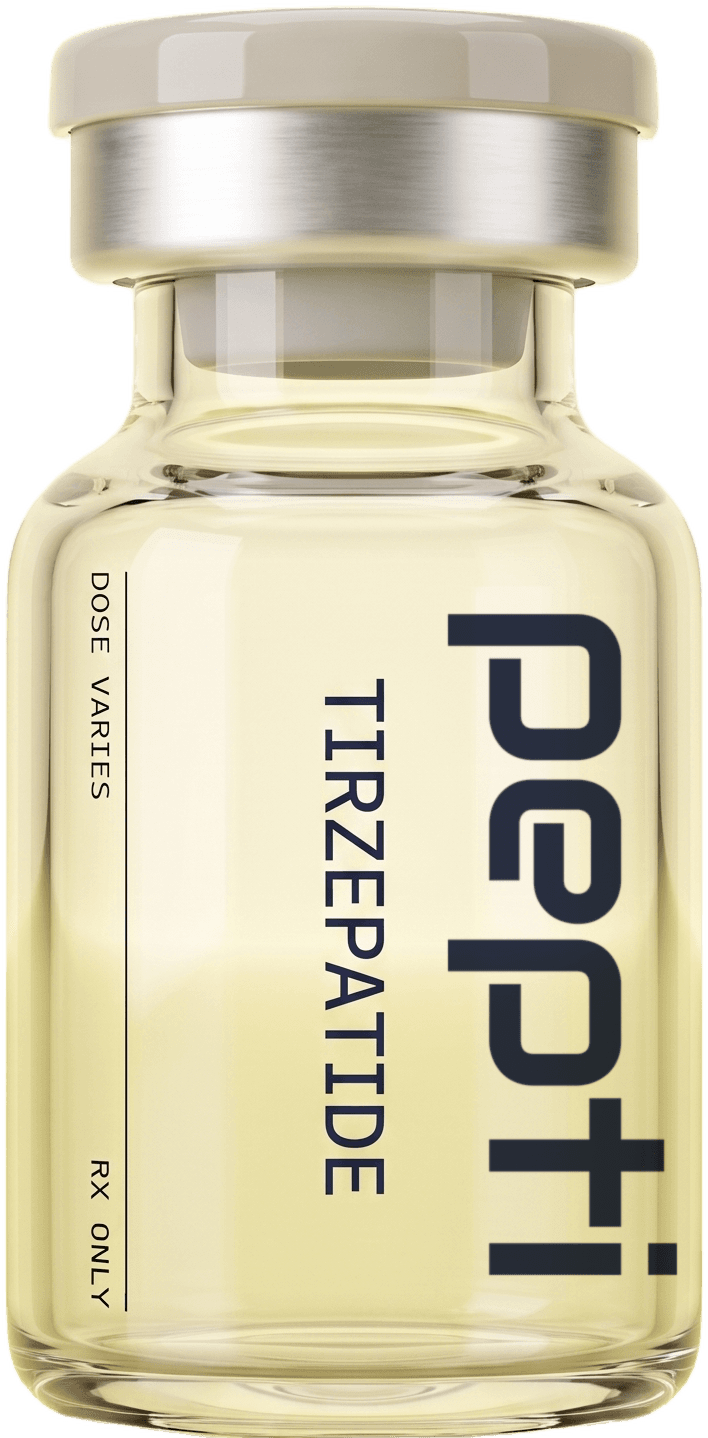
Tirzepatide is injected once weekly, on the same day each week, under the skin (subcutaneously) into the fat layer of the abdomen, thigh or upper arm, rotating the site every time. At Pepti it comes as a vial drawn with a U-100 insulin syringe, and the direction on every strength is the same: inject 0.50 mL, which is 50 units, subcutaneously once weekly. Wash your hands, swab the stopper, draw to 50 units, clear bubbles, swab the site, pinch a fold of skin, inject slowly, and drop the syringe straight into a sharps container. Your physician sets your directions after reviewing your intake, and the ones printed on your vial are the ones that apply.
This page is a practical walkthrough: what to lay out, the steps in order, where to inject tirzepatide and how to rotate, what people get wrong, and what to do when something does not look right. General technique for every injectable is in how to inject peptides safely.
How to Inject Tirzepatide
The short answer
| Question | Answer |
|---|---|
| How often | Once weekly, on the same day each week |
| Route | Subcutaneous: into the fat layer under the skin, not the muscle |
| Where to inject tirzepatide | Abdomen (at least two inches from the navel), front or outer thigh, or the back of the upper arm |
| How much | At Pepti, 0.50 mL (50 units on a U-100 insulin syringe) at every strength |
| Supplied as | A dose-specific 2 mL vial, four weekly doses, with sterile syringes and alcohol prep pads |
| Storage | Refrigerated; do not freeze |
| After injecting | Syringe straight into a sharps container, never recapped |
Tirzepatide is from $159 a month, all-in: medication, physician review, refill management and shipping, with no membership fee. It is compounded by a PCAB-accredited, FDA-registered US 503A pharmacy. Compounded medications are not FDA approved.
How to Inject Tirzepatide
Before you start: read the label
Check four things on the vial before the needle comes out of its wrapper.
| On the label | Why it matters |
|---|---|
| Your name and "tirzepatide" | It is a patient-specific compounded preparation; read the name every time rather than recognising the box |
| The strength and concentration, for example 20 mg per 2 mL (10 mg/mL) | Tells you which dose step this vial is |
| The direction, in mL and units | At Pepti: inject 0.50 mL (50 units) subcutaneously once weekly |
| The beyond-use date | Runs from first puncture; write the first-use date on the carton |
If the label does not match what you expected, or the direction and syringe markings seem to disagree, do not inject. Message your care team. Unit conversions are explained in tirzepatide units to mg.
How to Inject Tirzepatide
What to lay out
On a clean, dry surface in good light, away from the sink:
- The tirzepatide vial, from the refrigerator
- One new U-100 insulin syringe
- Two alcohol prep pads, one for the stopper and one for the skin
- Gauze or a cotton ball
- A sharps container within reach
Pepti ships sterile syringes and alcohol prep pads with every vial.
How to Inject Tirzepatide
How to inject tirzepatide, step by step
- Wash and dry your hands.
- Check the vial. Your name, the medication, the beyond-use date, and that the solution is clear with no visible particles. If anything looks wrong, stop and message your care team.
- Swab the rubber stopper with an alcohol pad and let it air dry. Wet alcohol carried into the vial is a contamination route, and it stings.
- Open a new syringe. Never use one twice.
- Draw 50 units of air into the syringe, insert the needle through the centre of the stopper, and push the air into the vial. This stops the vial pulling toward a vacuum and makes the draw accurate.
- Turn the vial upside down and draw slowly to 50 units. Keep the needle tip below the liquid line.
- Clear bubbles. Tap the barrel to float large bubbles to the top, push them back into the vial, and redraw to 50. Read the flat front edge of the plunger tip against the 50 mark, with the syringe vertical at eye level.
- Clean the injection site with a fresh alcohol pad and let it dry.
- Pinch a fold of skin, insert the needle, and inject slowly and steadily. Insert at the angle your clinician described. Count to five before withdrawing, then release the pinch. Do not rub the site.
- Drop the syringe into the sharps container immediately. Do not recap it.
A small spot of blood is normal; press gently with gauze. Put the vial back in the refrigerator straight away.
The steps people get wrong
Not letting the alcohol dry. It is the commonest reason an injection stings. Ten seconds of air drying fixes it; blowing on it re-contaminates.
Skipping the air. Without it the plunger fights you and the draw is hard to read.
Pushing fast. A fast push is what produces an ache and a drop leaking back out. Slow and steady, then count to five.
Reading the barrel at an angle. That biases every dose in the same direction. Vertical, eye level, front edge of the plunger tip.
How to Inject Tirzepatide
Where to inject tirzepatide
| Site | Where exactly | Notes |
|---|---|---|
| Abdomen | Anywhere on the belly at least two inches from the navel | The most used site and the easiest to reach; avoid scars and stretch marks |
| Thigh | The front and outer part of the thigh, a hand's width above the knee and below the hip | Easy to reach seated |
| Upper arm | The back of the upper arm | Usually easier with another person doing it |
All three are subcutaneous sites: the needle goes into the fat layer, not the muscle. Pinching lifts the fat clear of the muscle and gives a short needle a clean target. Use thumb and forefinger only; a whole-hand grip drags muscle into the fold.
How to rotate injection sites
Rotate every week. Two rotations matter, and doing only one of them is the usual failure:
- Between regions: abdomen one week, thigh the next, for example.
- Within a region: each injection at least an inch from the last, in a pattern you can reproduce, such as four quadrants around the navel or the points of a clock face.
Which pattern you use does not matter; having one does. A paper grid on the refrigerator with a square per week doubles as a rotation record and a reminder of which day you dosed.
Why rotation matters
Repeatedly injecting the same spot produces lipohypertrophy: thickened, rubbery tissue that absorbs unevenly. In insulin users it is the best-documented complication of self-injection, with a 2021 meta-analysis in Therapie pooling 45 studies and 26,865 participants and finding it in 41.8%. A dose delivered into thickened tissue is not reliably the dose that was written. Once a month, feel over the areas you use with flat fingertips for anything raised or firmer than the tissue around it. If you find something, stop injecting there and tell your care team.
Places not to inject
Avoid scars, stretch marks, moles, bruises, and skin that is tender, red or hard. Stay two inches from the navel. Do not inject into a vein or a muscle; tirzepatide is directed subcutaneously.
How to Inject Tirzepatide
Same day each week
Pick a day and keep it. If your current day stops working, the approved tirzepatide labels allow the weekly day to change as long as at least 3 days (72 hours) separate two doses. Ask your care team how to make the change rather than shortening an interval yourself, because changing the day on your own is how people accidentally stack doses.
A missed dose has a specific answer on the approved label: it can be taken within 4 days (96 hours) of the missed day; after that, skip it and take the next dose on your regular day. Never take two doses close together. Details are in what if I miss a dose of tirzepatide.
How to Inject Tirzepatide
Injection-site reactions and when to get help
Redness or itching at the site was reported in 6 to 8% of people on tirzepatide against 2% on placebo in the approved weight-management trials. Rotating sites is the main fix.
| What you notice | What it usually means | What to do |
|---|---|---|
| A small bruise or spot of blood | A nicked capillary | Gentle pressure; nothing else |
| Mild redness or itching that settles | A common local reaction | Rotate sites; mention it if it keeps happening |
| A site that is red, hot, swollen or more painful over several days | Possible infection | Message your care team with a photograph |
| A drop leaking out after the needle comes out | Withdrew too fast | Do not redose; slow down and count to five next time |
| Hives away from the site, swelling of the face, lips or throat, trouble breathing | Possible serious allergic reaction | Call 911 |
| You injected more than your directions | Possible dosing error | Poison Control at 1-800-222-1222, 911 for severe symptoms, and message your care team; see GLP-1 overdose |
The common stomach side effects and the warning signs to report the same day are in tirzepatide side effects.
How to Inject Tirzepatide
Storage between doses
Keep the vial in the main body of the refrigerator, on a middle shelf, in its carton, away from the coldest back wall and the warm door. Do not freeze it. Take it out, draw the dose, and put it back. If it was left out or arrived warm, do not use it; message your care team. More in how to store compounded GLP-1.
How to Inject Tirzepatide
Sharps disposal
Put each used syringe into an FDA-cleared sharps container immediately. If you do not have one, the FDA allows a heavy-duty plastic household container, such as a laundry detergent bottle, with a tight-fitting puncture-resistant lid, kept upright and labelled. When it is about three-quarters full, follow your community's disposal guidelines; a pharmacy is the fastest place to ask. Never put loose needles in the trash or recycling, and never share a vial or syringe.
How to Inject Tirzepatide
What the evidence shows, honestly
Subcutaneous self-injection is one of the best-established routes in medicine, and the technique here is standard practice drawn from insulin administration, where the evidence on needles, rotation and lipohypertrophy comes from large trials and meta-analyses. The abdomen, thigh and upper arm are the usual subcutaneous sites for tirzepatide. That evidence is about technique and the manufactured product. Pepti's tirzepatide is a compounded vial containing the same molecule, drawn by syringe rather than clicked from a pen, and compounded medications are not FDA approved. Good technique makes sure the prescribed dose arrives; it does not decide what that dose should be. Lot test results are published at /quality/lab-results.
How to Inject Tirzepatide
Where to get tirzepatide prescribed
- Complete a free online intake covering your history, medications and what you want help with.
- A physician licensed in your state reviews it, usually within 24 hours.
- If it is appropriate, a state-licensed, FDA-registered US pharmacy compounds the vial for your dose, with your directions printed on it.
- It ships refrigerated with ice packs, sterile syringes and alcohol prep pads.
- Your care team stays reachable for technique, side effect and dose questions. Refills run every 28 days, one vial per fill.
Pepti is cash-pay and does not bill insurance. Bloodwork is not required for any Pepti treatment. If your physician wants labs for your care, they'll ask through your account. The step-by-step page is how to get tirzepatide prescribed online, and the dose ladder is in the tirzepatide dosing chart.
References
What this is based on.
References
- Jastreboff AM, Aronne LJ, Ahmad NN, et al.. Tirzepatide Once Weekly for the Treatment of Obesity (SURMOUNT-1) · New England Journal of Medicine (2022) · PMID 35658024
- Garvey WT, Frias JP, Jastreboff AM, et al.. Tirzepatide once weekly for the treatment of obesity in people with type 2 diabetes (SURMOUNT-2) · Lancet (2023) · PMID 37385275
- Frías JP, Davies MJ, Rosenstock J, et al.. Tirzepatide versus Semaglutide Once Weekly in Patients with Type 2 Diabetes (SURPASS-2) · New England Journal of Medicine (2021) · PMID 34170647
- Inagaki N, Takeuchi M, Oura T, et al.. Effects of subcutaneous tirzepatide versus placebo or semaglutide on pancreatic islet function and insulin sensitivity in adults with type 2 diabetes: a multicentre, randomised, double-blind, parallel-arm, phase 1 clinical trial · The Lancet Diabetes & Endocrinology (2022) · PMID 35468322
- Malhotra A, Grunstein RR, Fietze I, et al.. Tirzepatide for the Treatment of Obstructive Sleep Apnea and Obesity (SURMOUNT-OSA) · New England Journal of Medicine (2024) · PMID 38912654
- Nicholls SJ, Pavo I, Bhatt DL, et al.. Cardiovascular Outcomes with Tirzepatide versus Dulaglutide in Type 2 Diabetes (SURPASS-CVOT) · New England Journal of Medicine (2025) · PMID 41406444
- Aronne LJ, Sattar N, Horn DB, et al.. Continued Treatment With Tirzepatide for Maintenance of Weight Reduction in Adults With Obesity: The SURMOUNT-4 Randomized Clinical Trial · JAMA (2024) · PMID 38078870
- Pasternak B, Wintzell V, Hviid A et al.. Glucagon-like peptide 1 receptor agonist use and risk of thyroid cancer: Scandinavian cohort study · BMJ (2024) · PMID 38683947
- Quddos F, Hubshman Z, Tegge A, et al.. Semaglutide and Tirzepatide reduce alcohol consumption in individuals with obesity · Scientific Reports (2023) · PMID 38017205
- Drummond RF, Seif KE, Reece EA. Glucagon-like peptide-1 receptor agonist use in pregnancy: a review · Am J Obstet Gynecol (2025) · PMID 39181497
- Wang S, Sun J, Wang J, et al.. Does obesity based on body mass index affect semen quality? A meta-analysis and systematic review from the general population rather than the infertile population · Andrologia (2021) · PMID 34028074
- Urva S, Coskun T, Loghin C, et al.. The novel dual glucose-dependent insulinotropic polypeptide and glucagon-like peptide-1 (GLP-1) receptor agonist tirzepatide transiently delays gastric emptying similarly to selective long-acting GLP-1 receptor agonists · Diabetes, Obesity and Metabolism (2020) · PMID 32519795
Citations are provided for educational purposes. They do not constitute medical advice. Always discuss any peptide protocol with your prescribing physician.
Common questions
How to Inject Tirzepatide, answered.
The abdomen, thigh and upper arm are the usual subcutaneous sites, and all three work the same way: the needle goes into the fat layer. The abdomen, at least two inches from the navel, is the most used because it is easy to reach and pinch. Rotating between them matters more than which you choose.
Yes. The abdomen is the most common site. Stay at least two inches from the navel, avoid scars and stretch marks, and move to a new spot each week.
Yes. Use the front and outer part of the thigh, a hand's width above the knee and below the hip.
Yes, the back of the upper arm. It is harder to pinch and reach on yourself, so many people use it only when someone else is helping.
At Pepti, 50 units (0.50 mL) on a U-100 insulin syringe once weekly, at every strength. Always follow the units printed on your vial. See tirzepatide units to mg.
Insert at the angle your clinician described. With very short needles some clinicians direct a straight 90-degree injection with no pinch at all; your directions cover it.
Your directions say once weekly; what matters most is keeping the same day each week. To change the day, ask your care team; the approved labels require at least 3 days (72 hours) between doses.
Most people describe a small insulin-syringe injection as minor. Letting the alcohol dry, using a new needle every time and injecting slowly remove most avoidable stinging.
No. Press gently with gauze if there is a spot of blood, but do not massage the site.
No. Reuse blunts the needle, damages tissue and risks contaminating your vial. Use a new syringe for every injection.
It usually just stings more. Pinch more skin next time, and message your care team if you are unsure or the site is not settling. The free assessment goes to a physician licensed in your state. A consultation does not guarantee a prescription.
Next step
See what a physician recommends for you.
A licensed physician in your state reviews your intake and decides what is appropriate. A consultation does not guarantee a prescription.