Weight Loss · Reference
Tirzepatide Units to mg: Dosing in Units on a U-100 Syringe, With Conversion Charts
This page is conversion math only. It explains the formula, shows the units for every Pepti tirzepatide vial, gives a units-to-mg chart for each concentration, and answers the questions people search about tirzepatide dosing in units. It does not set or change anyone's dose.

Treatments mentioned
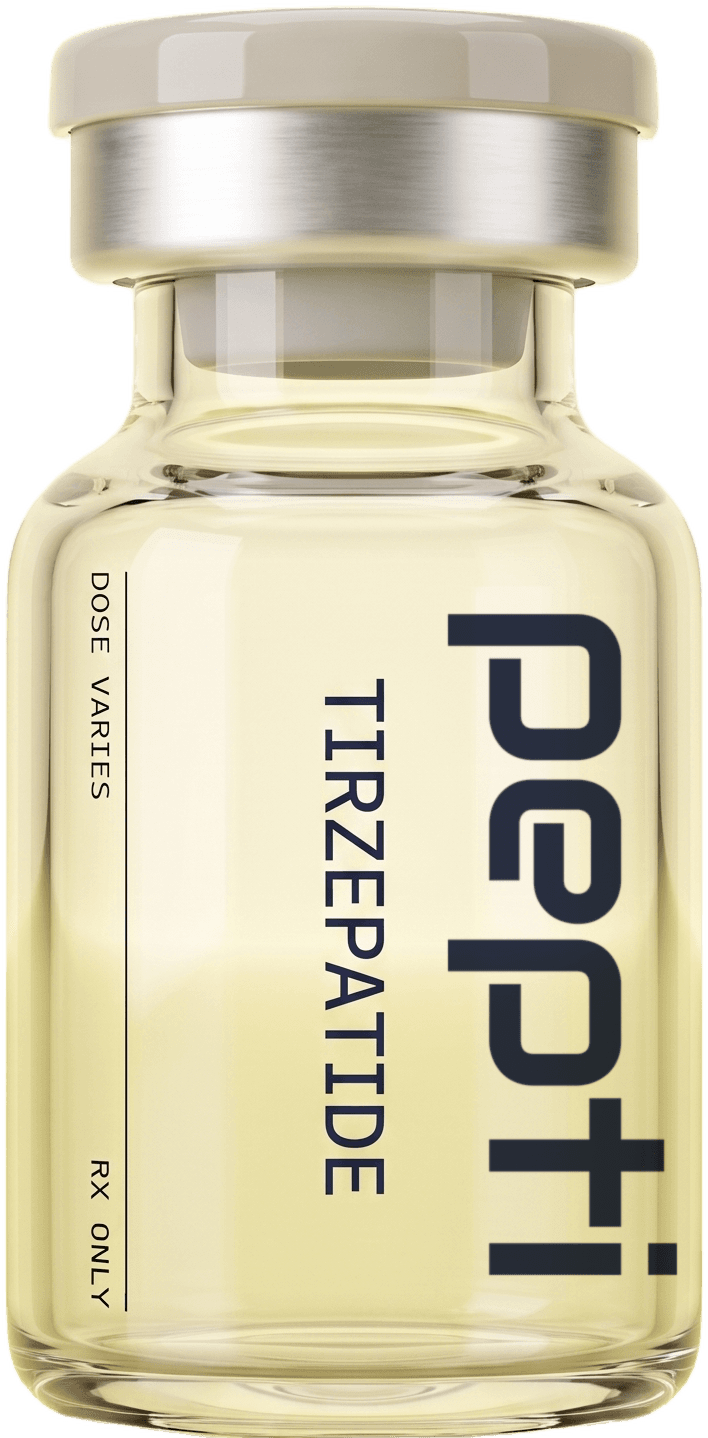
On a U-100 insulin syringe, 1 unit is 0.01 mL, so the milligrams in a tirzepatide draw are the units divided by 100, multiplied by the vial's concentration in mg/mL. At Pepti, every tirzepatide dose is drawn at 50 units (0.50 mL) once weekly, because each strength is its own vial concentrated so that 50 units delivers that week's dose: 2.5 mg from the 5 mg/mL vial up to 15 mg from the 30 mg/mL vial. So 2.5 mg of tirzepatide is 50 units from a 5 mg/mL vial, and a different number of units from any other concentration. Your physician sets your directions after reviewing your intake, and the units printed on the vial in your hand are the ones that apply.
This page is conversion math only. It explains the formula, shows the units for every Pepti tirzepatide vial, gives a units-to-mg chart for each concentration, and answers the questions people search about tirzepatide dosing in units. It does not set or change anyone's dose.
Tirzepatide Units to mg
The short answer
| Weekly dose on the label | Pepti vial | Concentration | Draw in mL | Units on a U-100 syringe | Doses per vial |
|---|---|---|---|---|---|
| 2.5 mg | 10 mg per 2 mL, with glycine | 5 mg/mL | 0.50 mL | 50 | 4 |
| 5 mg | 20 mg per 2 mL | 10 mg/mL | 0.50 mL | 50 | 4 |
| 7.5 mg | 30 mg per 2 mL, with glycine | 15 mg/mL | 0.50 mL | 50 | 4 |
| 10 mg | 40 mg per 2 mL | 20 mg/mL | 0.50 mL | 50 | 4 |
| 12.5 mg | 50 mg per 2 mL | 25 mg/mL | 0.50 mL | 50 | 4 |
| 15 mg | 60 mg per 2 mL | 30 mg/mL | 0.50 mL | 50 | 4 |
The direction printed on every one of these vials reads: inject 0.50 mL (50 units) subcutaneously once weekly. Each 2 mL vial holds four weekly doses, one 28-day fill. Tirzepatide is from $159 a month, all-in: medication, physician review, refill management and shipping, with no membership fee. It is compounded by a PCAB-accredited, FDA-registered US 503A pharmacy. Compounded medications are not FDA approved.
Tirzepatide Units to mg
The formula: units to mL to mg
Three numbers are involved, and only one of them is the dose.
| Number | Where it comes from | What it measures |
|---|---|---|
| Units | The markings on a U-100 insulin syringe | Volume. 100 units is 1 mL, so 1 unit is 0.01 mL |
| mL | The prescription, converted from units | Volume |
| mg/mL | The vial label | How much tirzepatide is in each mL of that vial |
The conversion runs in two steps:
- Units to mL: divide the units by 100. 50 units is 0.50 mL. 25 units is 0.25 mL.
- mL to mg: multiply the mL by the vial concentration. 0.50 mL from a 5 mg/mL vial is 2.5 mg.
Run backwards, the same arithmetic turns a milligram dose into units: mg divided by concentration gives mL, and mL times 100 gives units. For 2.5 mg from a 5 mg/mL vial, that is 2.5 divided by 5, which is 0.50 mL, which is 50 units.
The step people skip is the second one. A unit is a volume mark on a barrel, not an amount of tirzepatide. Fifty units from the 2.5 mg vial and fifty units from the 15 mg vial are the same volume and six times apart in medication. That is why a number of units, on its own, never tells you a dose.
mg per unit at each Pepti concentration
Because 1 unit is 0.01 mL, each unit carries one hundredth of the vial's concentration:
| Vial concentration | Tirzepatide in 1 unit | Tirzepatide in 10 units | Tirzepatide in 50 units |
|---|---|---|---|
| 5 mg/mL | 0.05 mg | 0.5 mg | 2.5 mg |
| 10 mg/mL | 0.10 mg | 1 mg | 5 mg |
| 15 mg/mL | 0.15 mg | 1.5 mg | 7.5 mg |
| 20 mg/mL | 0.20 mg | 2 mg | 10 mg |
| 25 mg/mL | 0.25 mg | 2.5 mg | 12.5 mg |
| 30 mg/mL | 0.30 mg | 3 mg | 15 mg |
This table is arithmetic, labelled as such. It is useful as a sanity check on a label, not as a menu of doses.
Tirzepatide Units to mg
How many units is 2.5 mg of tirzepatide?
It depends entirely on the vial. From Pepti's 2.5 mg vial, which is 10 mg in 2 mL at 5 mg/mL, 2.5 mg is 0.50 mL, or 50 units. The same 2.5 mg from a vial at a different concentration is a different volume:
| Vial concentration | Volume holding 2.5 mg | Units on a U-100 syringe |
|---|---|---|
| 5 mg/mL (Pepti's 2.5 mg vial) | 0.50 mL | 50 |
| 10 mg/mL | 0.25 mL | 25 |
| 15 mg/mL | 0.167 mL | about 16.7 |
| 20 mg/mL | 0.125 mL | 12.5 |
| 25 mg/mL | 0.10 mL | 10 |
| 30 mg/mL | 0.083 mL | about 8.3 |
Math only. Pepti does not dispense 2.5 mg doses from any vial except the 5 mg/mL one, and nobody should improvise a dose by drawing a calculated volume from a stronger vial. The table exists because people who read "2.5 mg is 50 units" online, then use a vial at another concentration, are exactly the people the FDA has described drawing several times the intended amount.
Why the same dose can be a different number of units
Compounded GLP-1 concentrations differ between pharmacies, and the same pharmacy may make several strengths. A unit count only transfers between two vials if they have the same concentration. That is the whole reason Pepti prints the direction in both mL and units for the specific vial you are sent, with the concentration on the label beside it.
Tirzepatide Units to mg
Tirzepatide dosing in units: why every Pepti dose is 50 units
Each of Pepti's six tirzepatide vials is dose-specific. The pharmacy concentrates it so that 0.50 mL delivers exactly the weekly dose on the label, which means the line you draw to is the same at every step.
| What changes when your dose goes up | What does not change |
|---|---|
| The vial you are sent | The draw: 0.50 mL, 50 units |
| The concentration on the label | Once weekly, subcutaneously |
| The milligrams in each 50-unit draw | Four doses per 2 mL vial, one 28-day fill |
So when your physician moves you up a step, the pharmacy sends the vial for that step, and you keep drawing to 50 units. Dosing errors are the most common problem the FDA has reported with compounded incretin medications, and a fixed volume removes most of the arithmetic that causes them. The full ladder, with what each step is for, is in the tirzepatide dosing chart.
A new dose means a new vial, never a bigger draw
You never move to a higher dose by drawing more from the vial you have. Drawing 100 units from the 5 mg/mL vial is not "5 mg done carefully"; it is an improvised dose from a vial labelled for a different direction. Until a new vial arrives, the directions on your current vial are the ones that apply. Never change, skip, split or increase your own dose. If you think your dose should change, message your care team.
Is the milligram figure weekly or the whole vial?
The dose figure is weekly; the larger figure is the whole vial. The 15 mg vial holds 60 mg in 2 mL at 30 mg/mL. Each 50-unit draw is one 15 mg weekly dose, and the vial holds four of them. Reading the total contents as the dose is one of the label mistakes the FDA has specifically flagged with compounded vials, because compounders often print the per-mL figure and the total in a different order from manufactured products.
Tirzepatide Units to mg
How long one vial lasts
Divide the vial volume by the volume of one dose:
| Vial volume | Dose volume | Doses per vial | Schedule | Lasts |
|---|---|---|---|---|
| 2 mL | 0.50 mL (50 units) | 4 | Once weekly | 4 weeks |
That is true at every strength, which is why tirzepatide refills run every 28 days, one vial per fill. A vial also carries a beyond-use date that runs from first puncture, printed on the label, so a vial is not something to stretch. More on reading labels and doses per vial is in how long does a peptide vial last.
Tirzepatide Units to mg
Reading the syringe so the units are right
Getting the math right only matters if the draw matches it.
- Use a U-100 insulin syringe. The 100-units-per-mL rule applies only to U-100 syringes.
- Hold the syringe vertical at eye level and read the flat front edge of the plunger tip against the 50 mark, not the raised ring behind it.
- Clear large bubbles. If 3 of your 50 units are air, you have drawn less medication than you read.
- Say the number out loud as you draw, and read the label every time rather than your memory.
Barrel sizes differ, commonly 0.3 mL (30 units), 0.5 mL (50 units) and 1 mL (100 units). A 50-unit draw fills a 0.5 mL barrel to its top line and sits at the halfway mark on a 1 mL barrel. Whichever arrives, read it by number, not by where the plunger "usually" sits. The full walkthrough is in how to inject tirzepatide, and the general rules for syringes are in insulin syringe units explained.
Tirzepatide Units to mg
When the numbers do not add up
| What you notice | What it usually means | What to do |
|---|---|---|
| The units on a new vial differ from the last one | A different preparation or concentration | Read the new label; never reuse the old number |
| Your directions and syringe markings seem to disagree | A unit and mL mix-up, the most consequential error here | Do not inject. Message your care team |
| Someone tells you your dose is a figure that does not match the label math | One of you has the concentration wrong | Message your care team before the next dose |
| The vial runs short before four doses | Something in the draw or the fill needs checking | Message your care team; do not adjust anything yourself |
| You think you drew or injected more than your directions | Possible dosing error | See GLP-1 overdose: call Poison Control at 1-800-222-1222, 911 for severe symptoms, and message your care team |
Tirzepatide Units to mg
What the evidence shows, honestly
The conversion on this page is not a matter of evidence; it is arithmetic fixed by the U-100 standard and the concentration on the label. What the evidence does cover is the dose ladder itself: the 2.5 mg start, the 2.5 mg steps and the 15 mg weekly maximum come from the approved tirzepatide label, built on large randomized trials of the manufactured product. A compounded vial contains the same molecule at the same weekly doses, but no trial has been run on the compounded preparation, and compounded medications are not FDA approved.
The risk that is specific to compounded vials is the one this page is about. The FDA has documented adverse events, some requiring hospitalization, linked to people measuring and self-administering incorrect doses from compounded GLP-1 vials, and to clinicians miscalculating conversions between milligrams, units and millilitres. Fixed 50-unit draws, directions printed in both mL and units, and the concentration on every label are how Pepti designs around it. Lot test results are published at /quality/lab-results.
Tirzepatide Units to mg
Where to get tirzepatide prescribed
Tirzepatide cannot be bought legitimately without a prescription. Products sold "for research use only" have no pharmacy accountable for identity, purity, sterility or concentration, and without a reliable concentration every unit calculation on this page is meaningless. The prescription route:
- Complete a free online intake covering your history, medications and what you want help with.
- A physician licensed in your state reviews it, usually within 24 hours.
- If it is appropriate, a state-licensed, FDA-registered US pharmacy compounds the vial for your dose, with your directions printed on it in mL and units.
- It ships refrigerated with ice packs, sterile syringes and alcohol prep pads.
- Your care team stays reachable for side effects and dose questions. Refills run every 28 days, one vial per fill.
Pepti is cash-pay and does not bill insurance. Bloodwork is not required for any Pepti treatment. If your physician wants labs for your care, they'll ask through your account. The step-by-step page is how to get tirzepatide prescribed online, and the molecule itself is covered in what is tirzepatide.
References
What this is based on.
References
- Jastreboff AM, Aronne LJ, Ahmad NN, et al.. Tirzepatide Once Weekly for the Treatment of Obesity (SURMOUNT-1) · New England Journal of Medicine (2022) · PMID 35658024
- Garvey WT, Frias JP, Jastreboff AM, et al.. Tirzepatide once weekly for the treatment of obesity in people with type 2 diabetes (SURMOUNT-2) · Lancet (2023) · PMID 37385275
- Frías JP, Davies MJ, Rosenstock J, et al.. Tirzepatide versus Semaglutide Once Weekly in Patients with Type 2 Diabetes (SURPASS-2) · New England Journal of Medicine (2021) · PMID 34170647
- Inagaki N, Takeuchi M, Oura T, et al.. Effects of subcutaneous tirzepatide versus placebo or semaglutide on pancreatic islet function and insulin sensitivity in adults with type 2 diabetes: a multicentre, randomised, double-blind, parallel-arm, phase 1 clinical trial · The Lancet Diabetes & Endocrinology (2022) · PMID 35468322
- Malhotra A, Grunstein RR, Fietze I, et al.. Tirzepatide for the Treatment of Obstructive Sleep Apnea and Obesity (SURMOUNT-OSA) · New England Journal of Medicine (2024) · PMID 38912654
- Nicholls SJ, Pavo I, Bhatt DL, et al.. Cardiovascular Outcomes with Tirzepatide versus Dulaglutide in Type 2 Diabetes (SURPASS-CVOT) · New England Journal of Medicine (2025) · PMID 41406444
- Aronne LJ, Sattar N, Horn DB, et al.. Continued Treatment With Tirzepatide for Maintenance of Weight Reduction in Adults With Obesity: The SURMOUNT-4 Randomized Clinical Trial · JAMA (2024) · PMID 38078870
- Pasternak B, Wintzell V, Hviid A et al.. Glucagon-like peptide 1 receptor agonist use and risk of thyroid cancer: Scandinavian cohort study · BMJ (2024) · PMID 38683947
- Quddos F, Hubshman Z, Tegge A, et al.. Semaglutide and Tirzepatide reduce alcohol consumption in individuals with obesity · Scientific Reports (2023) · PMID 38017205
- Drummond RF, Seif KE, Reece EA. Glucagon-like peptide-1 receptor agonist use in pregnancy: a review · Am J Obstet Gynecol (2025) · PMID 39181497
- Wang S, Sun J, Wang J, et al.. Does obesity based on body mass index affect semen quality? A meta-analysis and systematic review from the general population rather than the infertile population · Andrologia (2021) · PMID 34028074
- Urva S, Coskun T, Loghin C, et al.. The novel dual glucose-dependent insulinotropic polypeptide and glucagon-like peptide-1 (GLP-1) receptor agonist tirzepatide transiently delays gastric emptying similarly to selective long-acting GLP-1 receptor agonists · Diabetes, Obesity and Metabolism (2020) · PMID 32519795
Citations are provided for educational purposes. They do not constitute medical advice. Always discuss any peptide protocol with your prescribing physician.
Common questions
Tirzepatide Units to mg, answered.
From Pepti's 2.5 mg vial at 5 mg/mL, 50 units (0.50 mL) on a U-100 insulin syringe. From a vial at another concentration it is a different number of units: 25 units at 10 mg/mL, for example. Always follow the units printed on your own vial.
Divide the units by 100 to get mL, then multiply by the vial's concentration in mg/mL. 50 units from a 10 mg/mL vial is 0.50 mL times 10, which is 5 mg.
From Pepti's 5 mg vial, which is 20 mg in 2 mL at 10 mg/mL, 50 units. From a 5 mg/mL vial the same 5 mg would be 100 units, a full 1 mL barrel, which is why a new dose step comes as a new vial rather than a bigger draw.
At Pepti, 50 units every time, from the 15, 20, 25 and 30 mg/mL vials respectively. Each vial is concentrated so that 0.50 mL is that week's dose.
At Pepti, 50 units on a U-100 insulin syringe, once weekly, at every strength from 2.5 mg to 15 mg. The dose changes because the vial strength changes. Your units are printed on your vial.
It depends on the vial: 0.5 mg at 5 mg/mL, 1 mg at 10 mg/mL, and up to 3 mg at 30 mg/mL. Ten units is 0.10 mL; the concentration decides the milligrams.
Fifty units is a volume, 0.50 mL, not an amount of medication. At Pepti it is the standard weekly draw at every strength. Whether it is 2.5 mg or 15 mg depends on which vial it comes from.
No. Read the new label every time. At Pepti the tirzepatide draw is 50 units at every step, but a vial from anywhere else, or any other medication, may be a different concentration.
Four, at 0.50 mL (50 units) once weekly, which is four weeks and one 28-day refill.
A U-100 insulin syringe, which is what Pepti ships with every vial alongside alcohol prep pads. The units-to-mL rule on this page applies only to U-100 syringes.
If it is still in the syringe, push the excess back into the vial before removing the needle and redraw to your mark. If you have already injected more than your directions, call Poison Control at 1-800-222-1222, call 911 for severe symptoms, and message your care team. The free assessment goes to a physician licensed in your state. A consultation does not guarantee a prescription.
Next step
See what a physician recommends for you.
A licensed physician in your state reviews your intake and decides what is appropriate. A consultation does not guarantee a prescription.