Anti-Aging · Reference
FOXO4-DRI Benefits: What the Senolytic Research Actually Shows
This page goes benefit by benefit: what each claim is, what was studied, in what, and how strong it is. It also gives the dosage printed on the vial. For the full specification, the chemistry and the FDA position, read what is FOXO4-DRI.
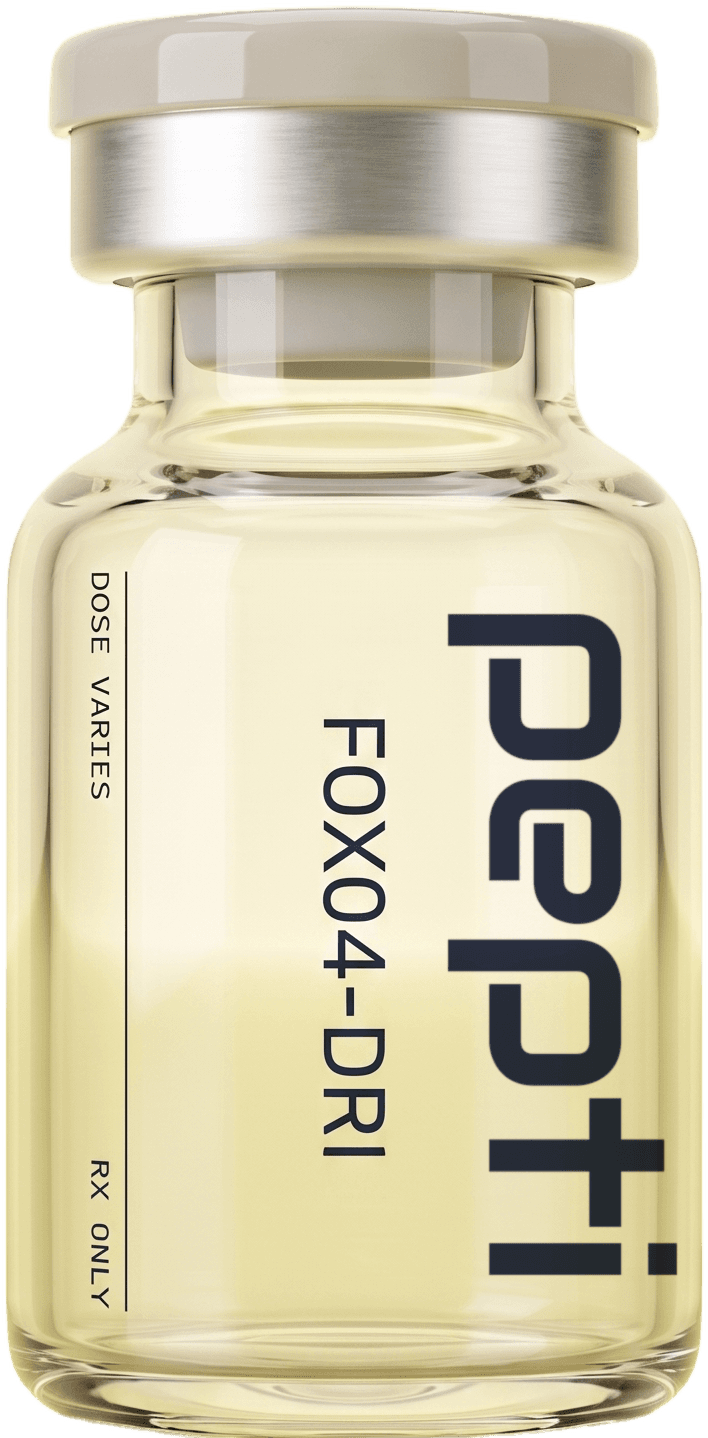
Treatments mentioned
Every benefit claimed for FOXO4-DRI comes from mouse and cell studies: there are no human trials of any kind, randomised or otherwise. The research describes a designed peptide that disrupts the FOXO4 and p53 interaction senescent cells use to stay alive, so those cells undergo their own programmed death, and a 2017 paper in Cell reported restored fitness, fur density and kidney function in aged and fast-aging mice after a short course. Later studies report effects on aged mouse testes, lung fibrosis, scar tissue cells and blood vessels. None of it has been tested in a person, and FOXO4-DRI is a compounded prescription; compounded medications are not FDA approved.
This page goes benefit by benefit: what each claim is, what was studied, in what, and how strong it is. It also gives the dosage printed on the vial. For the full specification, the chemistry and the FDA position, read what is FOXO4-DRI.
FOXO4-DRI Benefits
The short answer
| Claimed benefit | What the evidence is | Strength of evidence |
|---|---|---|
| Clearing senescent cells selectively | Mouse and cell work (Cell, 2017); human chondrocytes in a dish (2021); structural confirmation of the target (Nature Communications, 2025) | Well-defined mechanism; no human data |
| Protection against chemotherapy toxicity | Mice given doxorubicin (Cell, 2017) | Animal only |
| Fitness, fur density and kidney function in old age | Fast-aging and naturally aged mice (Cell, 2017) | Animal only |
| Testosterone and sperm quality | Aged mice (Aging, 2020; Experimental Gerontology, 2024); observational human tissue | Animal only; the human part was tissue analysis, not treatment |
| Less fibrosis and scar tissue | Mouse lung fibrosis (2023); human keloid tissue in a dish (2025) | Animal and cell |
| Blood vessel aging | Aged and induced-aging mice (2026) | Animal only |
| Fewer inflammatory secretions from old cells | Aged mouse Leydig cells (2024) | Animal and cell |
| Any effect on human aging, appearance or energy | None | No evidence |
Read the last row first. "FOXO4-DRI benefits" describes what happened in mice and in cells. No study has measured any outcome in a person who took it.
FOXO4-DRI Benefits
What FOXO4-DRI is
| What it is | A designed peptide that copies a stretch of FOXO4 and acts as a decoy for p53 |
| Where it came from | The laboratory of Peter de Keizer at Erasmus University Medical Center, Rotterdam; described in Cell in 2017 (Baar and colleagues) |
| What "DRI" means | D-retro-inverso: built from mirror-image D-amino acids in reverse order, so proteases do not recognise it and it lasts longer |
| How it gets into cells | A short cell-penetrating tail borrowed from the HIV TAT protein |
| Class | An experimental senolytic: a compound designed to remove senescent cells |
A senescent cell is one that has stopped dividing permanently, usually after damage or too many divisions, but has not died. It sits in tissue and secretes inflammatory signals, a pattern called the senescence-associated secretory phenotype. The senolytic hypothesis is that removing these cells improves the tissue around them. FOXO4-DRI is one of the compounds designed to test that hypothesis. It is not a hormone, not a growth hormone secretagogue, not an antioxidant and not a mitochondrial peptide, and it has no described action on healthy dividing cells.
FOXO4-DRI Benefits
Benefit 1: Clearing senescent cells (the mechanism)
What the research describes. In the 2017 Cell paper, the de Keizer group reports that FOXO4 is expressed at high levels in senescent cells and binds p53 there, keeping it from triggering the cell's own death programme. FOXO4-DRI competes for that interaction. When it binds p53, FOXO4 cannot, and the paper describes p53 leaving the nucleus and triggering apoptosis. A 2025 paper in Nature Communications (Bourgeois and colleagues) solved structural models showing FOXO4-DRI binds the disordered transactivation domain of p53, the region FOXO4 itself uses. Later cell work describes the downstream steps: phosphorylated p53 exported from the nucleus, followed by BAX and cleaved caspase-3.
Selectivity. The 2017 paper reports that the peptide induced apoptosis in senescent cells but not in proliferating cells in culture. A 2021 study in Frontiers in Bioengineering and Biotechnology on human chondrocytes expanded in a dish reports that the peptide selectively removed the senescent fraction while sparing the rest.
Evidence type. Cell and mouse, plus human cells outside the body.
What it means. The mechanism is unusually well defined for a compounded peptide, because it was engineered around a specific molecular interaction. A well-defined mechanism is not the same as a demonstrated benefit in people.
FOXO4-DRI Benefits
Benefit 2: Protection against chemotherapy toxicity
What the research describes. The first thing the 2017 Cell paper tested was doxorubicin, a chemotherapy drug that induces senescence and causes side effects partly through it. The paper reports that FOXO4-DRI neutralised doxorubicin-induced toxicity in mice, measured by liver toxicity markers and physical wellbeing, under conditions where the peptide itself was well tolerated.
Evidence type. Animal.
What it means. This is the cleanest experiment in the literature, because senescence was induced deliberately and the comparison is direct. It is not a reason to use FOXO4-DRI during cancer treatment; a cancer history is a reason to discuss it carefully first, because the compound acts on p53.
FOXO4-DRI Benefits
Benefit 3: Fitness, fur and kidney function in aged mice
What the research describes. The same paper treated two kinds of aged mice: a strain that ages rapidly because of a DNA repair defect, and ordinary old mice. In both, the authors report restored fitness measured by running-wheel activity, fur density, and kidney function measured as a reduction in urinary albumin.
Evidence type. Animal.
The caveat that matters. Treatment was a short course of intermittent intraperitoneal injection, not weeks of subcutaneous dosing, and effects were measured over days to a few weeks. A mouse ages in two years. There is no established way to translate those findings, or their timelines, to people. These are the findings that made the compound famous, and they are mouse findings.
FOXO4-DRI Benefits
Benefit 4: Testosterone and sperm quality
What the research describes. A group in China has published two studies on the aging male reproductive system. The first, in Aging in 2020, reports that FOXO4 is expressed in human Leydig cells, that its nuclear localisation in tissue from elderly men correlated with lower testosterone synthesis, and that in aged mice FOXO4-DRI cleared senescent Leydig cells and was associated with improved testosterone secretion. The second, in Experimental Gerontology in 2024, reports improved sperm quality and spermatogenesis in naturally aged mice, with reduced secretory-phenotype output from Leydig cells.
Evidence type. Animal, plus observational analysis of human tissue.
What it means. No person has been treated. FOXO4-DRI is not a hormone or a hormone-releasing peptide. If testosterone is the concern, that is a conversation with a physician about the cause, not a reason to start a senolytic.
FOXO4-DRI Benefits
Benefit 5: Fibrosis and scar tissue
What the research describes. A 2023 paper in Naunyn-Schmiedeberg's Archives of Pharmacology reports that in a bleomycin-induced lung fibrosis model in mice, FOXO4-DRI was associated with milder pathological change and less collagen deposition, and describes reduced extracellular matrix production in activated fibroblasts. A 2025 paper in Communications Biology describes senescent fibroblasts in human keloid tissue and reports that FOXO4-DRI induced their apoptosis in keloid organ cultures and cell models.
Evidence type. Animal and cell. The keloid tissue was human but was studied in a dish after removal, which is different from treating a person.
FOXO4-DRI Benefits
Benefit 6: Blood vessel aging
What the research describes. A 2026 paper in Frontiers in Bioengineering and Biotechnology reports that FOXO4-DRI injection in naturally aged and induced-aging mice was associated with reduced aortic aging markers and improved aortic function, and describes the p53 pathway in stressed endothelial cells.
Evidence type. Animal and cell. It is the most recent addition to the literature.
The counterweight. A 2023 study in Circulation reported that eliminating senescent cells in the lung vessels of mice, using senolytic interventions, worsened pulmonary hypertension rather than improving it. That is a finding about senolytics as a class in one tissue, in mice, and it is the clearest published example of a senolytic doing something unexpected. Anyone with pulmonary hypertension or significant lung disease should raise it with their physician.
FOXO4-DRI Benefits
Benefit 7: Fewer inflammatory secretions from old cells
What the research describes. Senescent cells matter not only because they take up space but because of what they secrete: a mix of cytokines, proteases and growth factors the field considers damaging to surrounding tissue. The 2024 mouse work on aged Leydig cells describes FOXO4-DRI reducing these secretions after senescent cells were cleared, with a knock-on effect on neighbouring cells in co-culture.
Evidence type. Animal and cell.
What it means. The logic is that removing the source removes the signal. Whether that happens in a person, and whether it would be noticeable, has not been studied. Some prescribers look at inflammatory markers before and after; whether that is meaningful for this compound has not been studied either.
FOXO4-DRI Benefits
What the evidence does not establish
- That FOXO4-DRI clears senescent cells in humans. Every senolytic observation is from mice or cultured cells.
- Any effect on human aging, lifespan, healthspan, appearance, energy, or any other outcome a person might hope for.
- A dose, a schedule or a route for humans. The mouse work used intermittent intraperitoneal injection over days.
- Safety in humans, short-term or long-term.
- What happens with repeated courses, or whether senescent cells re-accumulate and how fast.
- Anything about the compounded product specifically. The published work used research-grade peptide in a laboratory.
The honest framing: a well-defined mechanism, a small number of mouse and cell studies that are consistent with each other, and no human data. Anyone describing it as proven, or citing human results, is describing something that does not exist.
Where FOXO4-DRI stands with the FDA
As of September 2026 the FDA has not evaluated FOXO4-DRI at all. It does not appear in Category 1, 2 or 3 of the FDA's 503A nominated-substances document updated 14 May 2026, is not on the significant-safety-risk page, and was not on the agenda of the July 2026 advisory committee meeting or the one announced for before the end of February 2027. It is not on the 503A Bulks List. It has simply not been through the process, and it is not an FDA-approved drug.
FOXO4-DRI Benefits
Side effects, in brief
| What is known | What it means |
|---|---|
| Well tolerated in mice at the doses used | A mouse record, not a human one |
| Injection-site redness, mild soreness, occasional bruising | What gets reported clinically; rotate sites |
| No published human safety data | No adverse-event series, pharmacokinetics or follow-up |
| Acts on p53, the central tumour-suppressor protein | A cancer history is discussed carefully first |
| Senolytics worsened pulmonary hypertension in mice (2023) | Lung disease is raised with your physician |
| A reaction that is severe, spreading, or involves difficulty breathing | Stop and contact your physician; call 911 for breathing difficulty |
Because the peptide carries a cell-penetrating sequence and is built from D-amino acids, its behaviour in the body is less predictable than a natural peptide's, and immune reactions to unusual peptide chemistry are a theoretical concern that has not been studied in people. Pregnancy and breastfeeding are not appropriate; safety data is absent. See can peptides cause cancer.
FOXO4-DRI Benefits
FOXO4-DRI dosage, and how Pepti supplies it
| FOXO4-DRI vial | |
|---|---|
| What is in it | 5 mL multi-dose vial, FOXO4-DRI 2 mg/mL (10 mg per vial) |
| Directions printed on it | Inject 0.25 mL (25 units) subcutaneously once daily Monday through Friday |
| Per dose | 0.5 mg |
| Doses | 20, about 4 weeks |
| Price | $229/mo |
Your physician sets your directions after reviewing your intake, and the directions printed on your vial are the ones that apply. The weekday schedule reflects how prescribers structure an intermittent course, not a regimen established by research. The conversion chart is in FOXO4-DRI dosage. The price is all-in, covering medication, physician review, refill management and shipping, with no separate membership fee. Pepti is cash-pay and does not bill insurance. Vials are multi-dose solutions shipped ready to use, refrigerated with ice packs, with sterile syringes and alcohol prep pads. Refills run every 28 days, one vial per fill.
When something else makes more sense
| Situation | What makes more sense |
|---|---|
| You want something with human data behind it | NAD+, $249/mo, or tesamorelin, $249/mo, both studied in people |
| Energy and metabolism are the goal | MOTS-c, $259/mo, or SS-31, $249/mo, aimed at mitochondria |
| A broad longevity stack | ETERNAL, $279/mo, or Epithalon, $249/mo, a different hypothesis about aging |
| Skin and connective tissue | GHK-Cu, $239/mo |
| A cancer history, lung disease or a serious chronic illness | A conversation with your physician before anything is prescribed |
The wider landscape is in peptides for longevity and anti-aging.
FOXO4-DRI Benefits
Where to get FOXO4-DRI prescribed
FOXO4-DRI cannot be bought legitimately without a prescription. Sites selling it "for research use only" are not accountable for identity, purity, sterility or concentration; see research peptides vs prescription peptides. The prescription route:
- Complete a free online intake covering your history, medications and what you want help with.
- A physician licensed in your state reviews it, usually within 24 hours.
- If it is appropriate, a PCAB-accredited, FDA-registered US 503A compounding pharmacy prepares it to that prescription. Lot test results are published at /quality/lab-results.
- It ships refrigerated with your directions printed on the vial.
- Your physician stays reachable for questions and side effects.
Pepti prescribes FOXO4-DRI in every state except Oklahoma, plus DC The product page is FOXO4-DRI.
References
What this is based on.
References
- Baar MP, Brandt RMC, Putavet DA et al.. Targeted Apoptosis of Senescent Cells Restores Tissue Homeostasis in Response to Chemotoxicity and Aging · Cell (2017) · PMID 28340339
- Bourgeois B, Spreitzer E, Platero-Rochart D et al.. The disordered p53 transactivation domain is the target of FOXO4 and the senolytic compound FOXO4-DRI · Nature Communications (2025) · PMID 40593617
- Zhang C, Xie Y, Chen H et al.. FOXO4-DRI alleviates age-related testosterone secretion insufficiency by targeting senescent Leydig cells in aged mice · Aging (Albany NY) (2020) · PMID 31959736
- Huang Y, He Y, Makarcyzk MJ et al.. Senolytic Peptide FOXO4-DRI Selectively Removes Senescent Cells From in vitro Expanded Human Chondrocytes · Frontiers in Bioengineering and Biotechnology (2021) · PMID 33996787
- Liu Y, Hou Q, Wang R et al.. FOXO4-D-Retro-Inverso targets extracellular matrix production in fibroblasts and ameliorates bleomycin-induced pulmonary fibrosis in mice · Naunyn-Schmiedeberg's Archives of Pharmacology (2023) · PMID 37074394
- Li Y, Zhang C, Cheng H et al.. FOXO4-DRI improves spermatogenesis in aged mice through reducing senescence-associated secretory phenotype secretion from Leydig cells · Experimental Gerontology (2024) · PMID 39025385
- Hu Z, Li F, Hu C et al.. FOXO4-DRI regulates endothelial cell senescence via the P53 signaling pathway · Frontiers in Bioengineering and Biotechnology (2026) · PMID 41625068
- Kong YX, Li ZS, Liu YB et al.. FOXO4-DRI induces keloid senescent fibroblast apoptosis by promoting nuclear exclusion of upregulated p53-serine 15 phosphorylation · Communications Biology (2025) · PMID 39994346
- Born E, Lipskaia L, Breau M et al.. Eliminating Senescent Cells Can Promote Pulmonary Hypertension Development and Progression · Circulation (2023) · PMID 36515093
Citations are provided for educational purposes. They do not constitute medical advice. Always discuss any peptide protocol with your prescribing physician.
Common questions
FOXO4-DRI Benefits, answered.
In mice, a 2017 Cell paper reported that FOXO4-DRI cleared senescent cells and restored fitness, fur density and kidney function in aged and fast-aging animals, and protected against chemotherapy toxicity. Later mouse and cell studies report effects on testes, lung fibrosis, scar tissue cells and blood vessels. There are no human trials, so no benefit has been shown in people.
No published evidence supports that in humans. The aging findings are mouse outcomes after a short intraperitoneal course, and there is no established way to translate them to people.
No. There are no randomised or non-randomised human trials, and no human dose, pharmacokinetic or safety study. Human cells have been studied in a dish, and one study analysed human tissue observationally.
A compound designed to remove senescent cells: cells that have permanently stopped dividing but have not died, and that secrete inflammatory signals. FOXO4-DRI is one of several senolytic candidates studied in animals; none is an approved drug.
Not in any human study, because there are none. A 2020 mouse study reported improved testosterone secretion in aged mice after senescent Leydig cells were cleared. FOXO4-DRI is not a hormone or a hormone-releasing peptide.
There is no skin study in people. The closest work is a 2025 study of human keloid scar tissue in a dish, where FOXO4-DRI induced death of senescent fibroblasts. For skin goals, GHK-Cu has a larger research base.
No human study has measured it. The mouse studies ran over days to a few weeks after a short course, and mouse timelines do not translate to people. Senescent cell clearance, if it happens, is not something a person would feel, and most people should expect to notice nothing during a first vial.
The directions printed on the vial are: inject 0.25 mL (25 units on a U-100 insulin syringe) subcutaneously once daily Monday through Friday. At 2 mg/mL, that is 0.5 mg per dose, and a vial holds 20 doses.
The safety record is a mouse record: the peptide was well tolerated at the doses used. There is no published human safety data. What gets reported clinically is mostly injection-site reactions. A cancer history and lung disease are discussed first.
No. Compounded medications are not FDA approved, and the FDA has not evaluated FOXO4-DRI in any category. It is legal to prescribe and compound.
At Pepti, FOXO4-DRI is $229 a month, all-in, covering medication, physician review, refill management and shipping.
No. Bloodwork is not required for any Pepti treatment. If your physician wants labs for your care, they'll ask through your account. The free assessment goes to a physician licensed in your state. A consultation does not guarantee a prescription.
Next step
See what a physician recommends for you.
A licensed physician in your state reviews your intake and decides what is appropriate. A consultation does not guarantee a prescription.