Supplements · Reference
B12 Injection Benefits: What the Research Actually Shows
This page goes benefit by benefit, names the study and population behind each, and then covers side effects, FDA status and how Pepti supplies B12. For the product references, see what is methylcobalamin and what is Lipo-B.
The benefit of a B12 injection that research firmly supports is correcting B12 deficiency: replacing B12 corrects the anemia, lowers the markers that build up, and improves or halts the nerve symptoms deficiency causes. The benefits most often advertised, more energy, weight loss and sharper focus in people whose B12 is already normal, are not supported; a 2018 randomized placebo-controlled trial found extra B12 did not reduce fatigue in people who were not deficient, and no trial has tested MIC or lipotropic injections for weight. So every benefit below is something research describes in a specific group, not something an injection can promise you.
This page goes benefit by benefit, names the study and population behind each, and then covers side effects, FDA status and how Pepti supplies B12. For the product references, see what is methylcobalamin and what is Lipo-B.
B12 Injection Benefits
The short answer
| Claimed benefit | What the evidence is | Strength of evidence |
|---|---|---|
| Correcting B12 deficiency and its anemia | Guidelines, reviews and decades of practice | Definitive, in people who are deficient |
| Nerve symptoms of deficiency | Clinical reviews; recovery depends on how long damage was present | Strong, in deficiency |
| Lowering homocysteine and methylmalonic acid | Established human physiology | Strong, in deficiency |
| More energy, less fatigue | One 2018 randomized trial in people not deficient; one small 1973 pilot | Not supported unless deficient |
| Diabetic neuropathy | 2026 meta-analysis of 13 trials of B vitamins | Small effects on some scores, none on pain; not recommended routinely |
| Protecting B12 status on metformin | Long-term cohort follow-up (2016) | Strong that metformin lowers B12; testing recommended |
| Weight loss (B12 or MIC injections) | No trials of the combination | Not studied |
| Mood and memory | Part of the deficiency picture | Only in deficiency |
| Methylcobalamin over cyanocobalamin | 2015 review | Not supported |
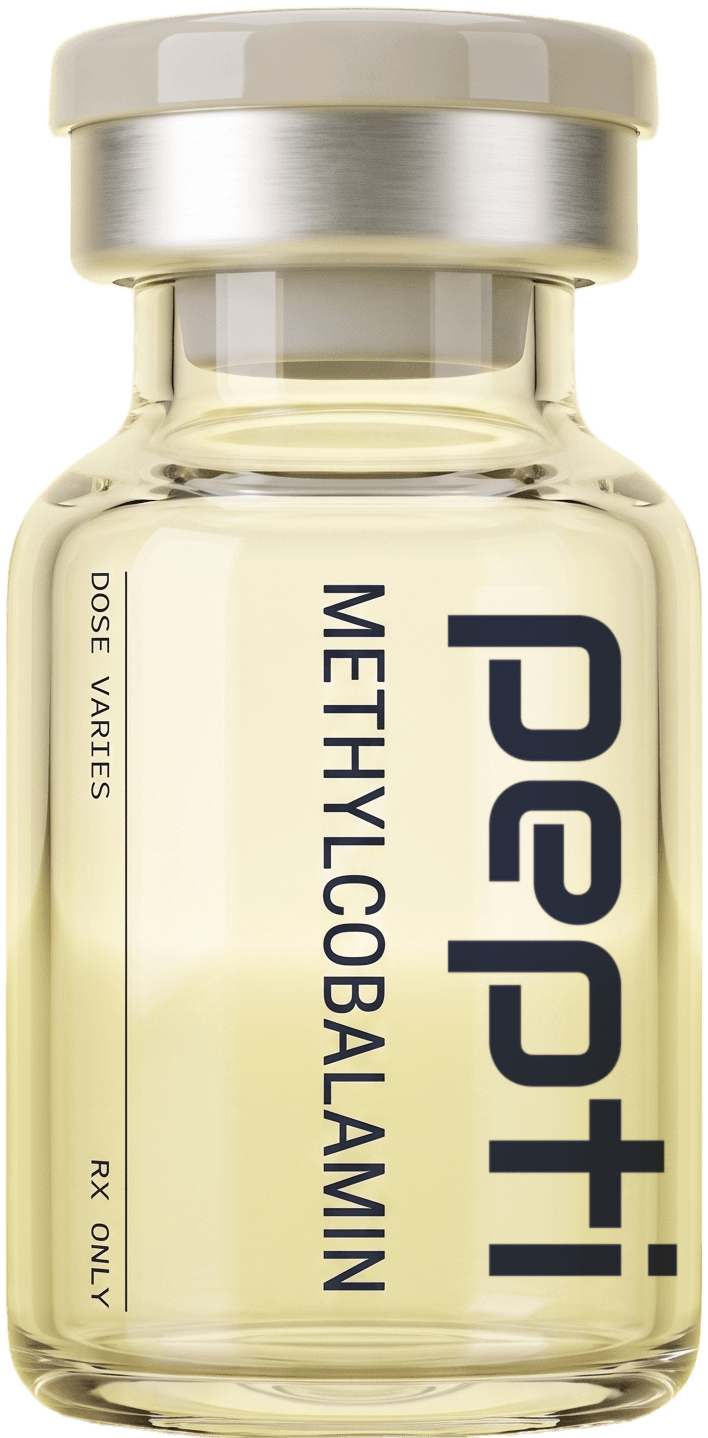
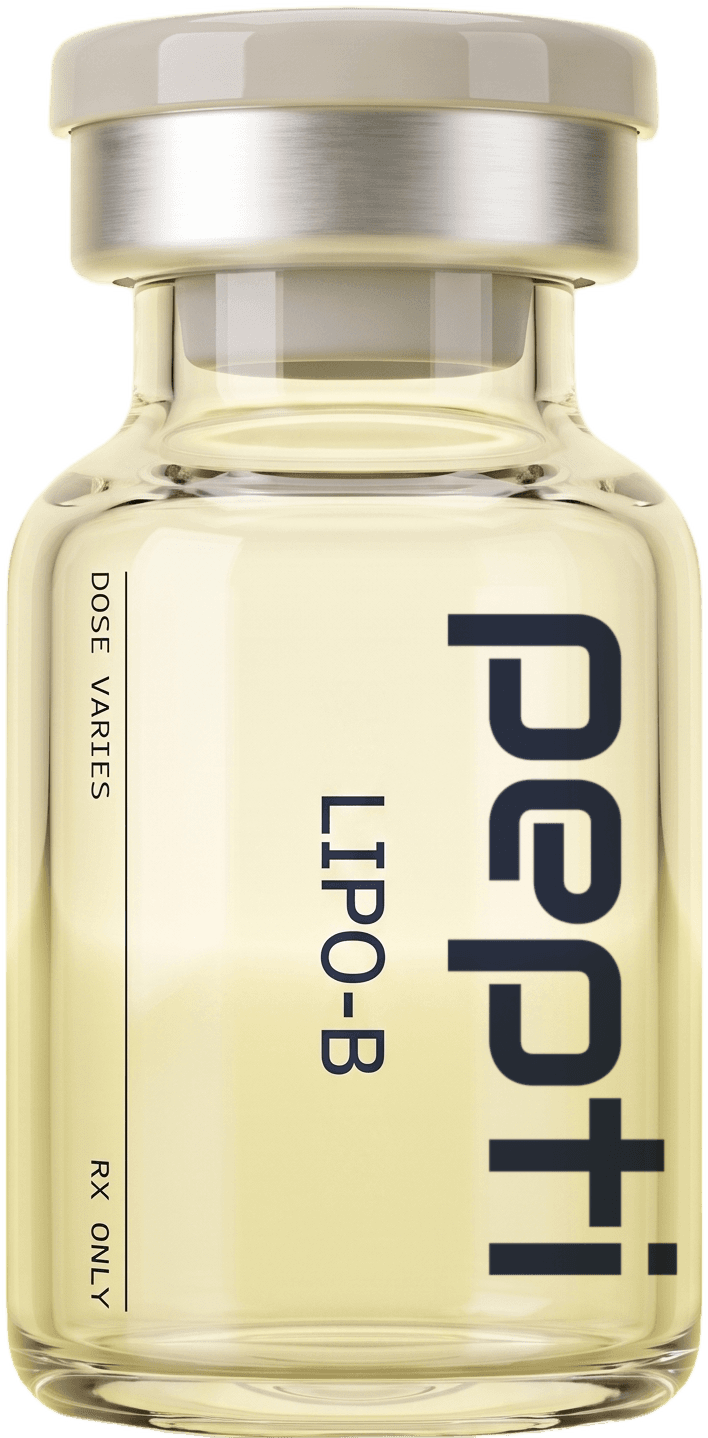
Pepti supplies B12 as Methylcobalamin, a 5 mL vial at 2 mg/mL, for $229/mo, and as Lipo-B, B12 plus methionine, inositol and choline in a 10 mL vial, for $209/mo, all-in.
B12 Injection Benefits
What B12 is, briefly
Vitamin B12, or cobalamin, is a large molecule built around a cobalt atom. Humans cannot make it; bacteria do, animal foods concentrate it, and the liver keeps a reserve that typically lasts years. Inside cells it has two jobs. As methylcobalamin it lets methionine synthase recycle homocysteine into methionine, which feeds the body's main methyl donor and keeps folate usable for making DNA. As adenosylcobalamin it lets a mitochondrial enzyme convert methylmalonyl-CoA to succinyl-CoA. Unlike most compounds sold for wellness, this is textbook human physiology, not animal speculation. The real question is never what B12 does in the body, but whether giving more changes anything for the person receiving it.
B12 Injection Benefits
Benefit by benefit
1. Correcting B12 deficiency and anemia
What the research describes. This is where the evidence is definitive. Without working methionine synthase, rapidly dividing cells, bone marrow above all, cannot make DNA properly, and deficiency produces large, immature red cells: megaloblastic anemia. Replacing B12 corrects it. The British Society for Haematology guideline (British Journal of Haematology, 2014) and the Mayo Clinic Proceedings review "The Many Faces of Cobalamin Deficiency" (2019) cover diagnosis and management in detail. Cyanocobalamin injection is an FDA-approved drug for exactly this purpose.
What it does not show. That benefit belongs to people who are deficient. In someone whose B12 is adequate, the enzymes already have the cofactor they need, and giving more does not make them run faster.
2. Nerve symptoms of deficiency
What the research describes. B12 maintains myelin, the insulating layer around nerve fibers. Deficiency produces a recognizable pattern: numbness and tingling in the hands and feet, loss of position sense, unsteady walking, and in advanced cases damage to the spinal cord called subacute combined degeneration. The New England Journal of Medicine review from 2013 and the Nature Reviews Disease Primers review from 2017 both stress that these nerve symptoms can appear before, or entirely without, any change in the blood count. Replacing B12 improves or halts them.
What it does not show. Nerve recovery is slow, described as continuing for six months or longer, and damage present for more than a year may only partly recover. And it applies to nerve damage caused by deficiency, not to nerve pain from other causes.
3. Lowering homocysteine and methylmalonic acid
What the research describes. When B12 is short, homocysteine and methylmalonic acid accumulate, and they are the markers used to confirm a borderline deficiency; methylmalonic acid is the most specific. Replacing B12 brings both down.
What it does not show. A lower homocysteine number in a deficient person is a sign the deficiency is corrected. The sources behind this page do not show that pushing homocysteine lower in someone who is not deficient changes any outcome.
4. Energy and fatigue
What the research describes. This is the benefit most people are asking about. Fatigue caused by the anemia of B12 deficiency lifts as the blood count recovers, over several weeks.
What it does not show. In people with normal B12 there is no convincing trial evidence that injected B12 improves energy, mood or exercise capacity. A 2018 randomized, double-blind, placebo-controlled trial in Clinical Nutrition ESPEN gave extra B12 to patients with irritable bowel syndrome or inflammatory bowel disease who were not deficient and found no reduction in fatigue compared with placebo. The closest thing to a direct test of B12 for tiredness, a small pilot in the British Journal of Nutrition in 1973, is half a century old and was never followed by a properly powered trial showing benefit. People who feel better after a shot when their levels were fine are most likely describing expectation, or a borderline deficiency nobody had found. Fatigue often has another findable cause; see peptides for energy and fatigue.
5. Diabetic neuropathy
What the research describes. Methylcobalamin has been studied in diabetic peripheral neuropathy, mostly in small trials from Asia, often alongside another treatment. A 2026 review and meta-analysis in the Journal of Clinical Medicine pooled thirteen randomized trials of B-vitamin supplementation (834 participants) and reported small improvements in some neuropathy scores and in sural nerve conduction.
What it does not show. The same analysis found no significant effect on pain by standard scales, and enough inconsistency and risk of bias that the authors declined to recommend routine use. Diabetes guidelines do not list B12 as a neuropathy treatment for people who are not deficient.
6. Protecting B12 status on metformin and in other risk groups
What the research describes. Long-term metformin use is associated with lower B12 levels and more deficiency; the Diabetes Prevention Program Outcomes Study (Journal of Clinical Endocrinology & Metabolism, 2016) reported this over more than a decade of follow-up, and the American Diabetes Association recommends periodic B12 testing for people on metformin. Deficiency is also common among vegetarians and especially vegans (Nutrition Reviews, 2013; European Journal of Clinical Nutrition, 2014), older adults, people after stomach or bowel surgery, and people on long-term acid suppression. When the cause is permanent, B12 is maintenance rather than a course.
What it does not show. Being in a risk group is a reason to check, not proof of deficiency. And for many deficient people without a serious absorption problem, high-dose oral B12 works too (see benefit 9).
7. Weight loss, and what MIC injections add
What the research describes. B12 often appears in weight-management injections such as Lipo-B, alongside methionine, inositol and choline, the "MIC" in MIC injections. The case for those three rests on the old "lipotropic" observation: in mid-twentieth-century animal feeding studies, choline prevented fat building up in the livers of choline-deficient animals. In humans, controlled feeding studies in which adults were deprived of choline produced fatty liver that reversed when choline was restored (reviewed in Advances in Nutrition, 2016, and Nutrition Reviews, 2009). Oral myo-inositol has randomized trials in polycystic ovary syndrome, summarized in a 2023 meta-analysis in Reproductive Biology and Endocrinology.
What it does not show. There are no randomized human trials of the methionine, inositol and choline combination given as an injection, with or without B12, for weight, body composition, energy or liver fat. The doses are also far from the studied ones: a 0.8 mL Lipo-B dose holds 20 mg of choline against an adequate intake of 425 to 550 mg a day, and 40 mg of inositol against PCOS trials that used 2 to 4 grams a day by mouth. "Lipotropic" does not mean fat-burning. If weight management is the goal, semaglutide (from $99/mo) and tirzepatide (from $159/mo) are the actives with large randomized human trials for that purpose.
8. Mood, memory and focus
What the research describes. Mood and memory changes are part of the neurological picture of deficiency, and they belong to the same pathway as the nerve symptoms above.
What it does not show. No randomized trial shows B12 injections improve cognition, mood or performance in people with normal B12 status. New or worsening memory problems deserve a medical work-up, of which B12 is one part.
9. Injection versus oral B12
What the research describes. Oral B12 needs stomach acid, intrinsic factor and a healthy end of the small intestine. An injection bypasses all three, which is the real reason injections exist. Two Cochrane reviews (2005, updated 2018) compared the routes: the 2018 update found three trials with 153 participants and concluded, on low-quality evidence, that oral and intramuscular B12 had similar effects on serum levels. A 1998 trial in Blood randomized 38 newly deficient patients to 2 mg oral daily or a standard intramuscular schedule and reported prompt, indistinguishable correction.
What it does not show. That injection is better for everyone. Injections are the clear choice when absorption is unreliable, as in pernicious anemia or after a gastric bypass, when nerve symptoms make fast repletion the priority, or when tablets have not worked.
10. Methylcobalamin versus cyanocobalamin
What the research describes. Methylcobalamin is one of the two working forms, which is why it is called "active" B12. It carries no cyanide group, which is the reason cyanocobalamin is avoided in the rare inherited Leber's hereditary optic neuropathy.
What it does not show. A 2015 review in Molecular Nutrition & Food Research concluded that the coenzyme forms are not likely to be superior to cyanocobalamin or hydroxocobalamin for preventing or treating deficiency, because cells strip the upper group from every form and rebuild the coenzymes themselves. No trial shows methylcobalamin outperforming cyanocobalamin on any clinical outcome.
B12 Injection Benefits
What the evidence shows, honestly
B12 is unusual among the products on this site: its human evidence is large and points one way. Randomized trials and decades of practice establish that B12 replacement, oral or injected, in any common form, corrects deficiency and its consequences. What the human data does not do is support B12 as a general tonic. No randomized trial shows B12 injections improve energy, cognition or performance in people with normal B12 status, no trial has tested MIC injections for weight, and none shows methylcobalamin beating cyanocobalamin. A provider who sells B12 shots for energy or fat loss without mentioning deficiency is describing marketing, not research.
B12 Injection Benefits
B12 injection side effects
B12 has no established upper intake level, and excess is excreted in urine. What gets reported is mostly the injection.
| How often | What is reported | What to do |
|---|---|---|
| Common | Stinging, soreness or bruising at the site; intramuscular shots can sting more | Rotate sites |
| Less common | Acne-like eruptions, mild diarrhea, headache, brief warmth or flushing | Message your care team if it persists |
| Caution | Treating a severe established deficiency anemia can lower potassium | Physicians watch for this early on |
| Caution | Nitrous oxide inactivates B12; high-dose folic acid can mask deficiency | List both on your intake |
| Stop and get help | Facial or throat swelling, widespread rash, difficulty breathing | Call 911, then tell your physician |
Anyone with a cobalt allergy should say so at intake, since cobalt is part of the molecule. The full list is in B12 side effects.
B12 Injection Benefits
Where B12 stands with the FDA
Cyanocobalamin injection is an FDA-approved prescription drug for B12 deficiency. Methylcobalamin is not an approved drug product; as of the FDA's 503A list updated 14 May 2026 it is in Category 1, "Bulk Drug Substances Under Evaluation," under which state-licensed pharmacies may compound it. In Lipo-B, choline chloride is also in Category 1, and methionine and inositol are compendial substances. Compounded medications, including Pepti's B12 products, are not FDA approved.
B12 Injection Benefits
How Pepti supplies it
| Detail | Methylcobalamin | Lipo-B |
|---|---|---|
| Product | Methylcobalamin (Active B12) | Lipo-B (B12 + MIC) |
| What is in the vial | 5 mL, 2 mg/mL (10 mg) | 10 mL; per mL 50 mg methionine, 50 mg inositol, 25 mg choline, 1 mg B12 |
| Standard directions | 1.25 mL (125 units) intramuscularly once weekly | 0.8 mL (80 units) intramuscularly three times weekly |
| Doses per vial | 4, about four weeks | 12, about four weeks |
| Price | $229/mo, all-in | $209/mo, all-in |
Prices cover medication, physician review, refill management and shipping, with no membership fee, and Pepti does not bill insurance. Refills run every 28 days, one vial per fill. Vials arrive as solutions ready to use with directions printed on them, sterile syringes and alcohol prep pads, shipped refrigerated with ice packs. The units-to-mg arithmetic is in B12 dosage, and the product comparison is in B12 injections.
B12 Injection Benefits
Where to get B12 injections prescribed
- Complete a free online intake covering your history, medications and what you want help with.
- A physician licensed in your state reviews it, usually within 24 hours.
- If it is appropriate, a PCAB-accredited, FDA-registered US 503A pharmacy compounds it to that prescription. Lot test results are published at /quality/lab-results.
- It ships refrigerated with your directions printed on the vial.
- Your physician stays reachable for questions and dose changes.
Pepti prescribes Methylcobalamin and Lipo-B in every state except Oklahoma, plus DC
Common questions
B12 Injection Benefits, answered.
In people who are deficient, replacing B12 corrects the anemia, lowers homocysteine and methylmalonic acid, and improves or halts nerve symptoms. Injection bypasses the gut, which matters when absorption is the problem. In people with normal B12, research has not shown benefits for energy, mood or weight.
Only when fatigue comes from deficiency. A 2018 randomized placebo-controlled trial gave extra B12 to people who were not deficient and found no reduction in fatigue.
There is no trial evidence that they do. B12 is not a weight-loss medication, and the MIC combination in lipotropic shots has never been tested for weight in a randomized trial.
The research behind methionine, inositol and choline is about deficiency and liver fat handling in animals and in choline-depleted adults, and oral inositol in grams for PCOS. None of it tested a MIC injection, and the injected amounts are small. Their B12 is the ingredient with an established clinical job.
For many deficient people, the Cochrane evidence says high-dose oral B12 raises levels about as well. Injections are the clear choice when absorption is unreliable or when nerve symptoms make fast repletion the priority.
It helps nerve damage caused by B12 deficiency. For diabetic neuropathy, a 2026 meta-analysis found small effects on some scores but none on pain, and the authors did not recommend routine use.
Not on the evidence. A 2015 review found the coenzyme forms are not likely to be superior to cyanocobalamin for deficiency, because cells rebuild the working forms from any form of B12.
Memory and mood changes are part of B12 deficiency, and correcting deficiency addresses them. No trial shows B12 improves memory or mood in people with normal levels.
People with deficiency, especially when absorption is the problem: pernicious anemia, stomach or bowel surgery, Crohn's disease, long-term acid suppression or metformin, and strictly plant-based diets.
There is no promised timeline. In deficiency, the deficiency literature describes the blood count responding over weeks and nerves over months. If you were not deficient, no change is expected.
Bloodwork is not required for any Pepti treatment. If your physician wants labs for your care, they'll ask through your account. The free assessment goes to a physician licensed in your state. A consultation does not guarantee a prescription.
Next step
See what a physician recommends for you.
A licensed physician in your state reviews your intake and decides what is appropriate. A consultation does not guarantee a prescription.