Supplements · Reference
Methylcobalamin (Active B12): What It Is, Where to Get It Prescribed, and What It Costs
This page covers what methylcobalamin is, how vitamin B12 works in the body, what the published research does and does not establish, how it differs from the FDA-approved cyanocobalamin injection, where it stands with the FDA, how it is dosed, and how to get it prescribed.

Reviewed by Dr. Gene, MD · Board-certified Family Medicine
Every Pepti prescription is reviewed by a licensed U.S. physician before it's dispensed — and only provided if clinically appropriate.
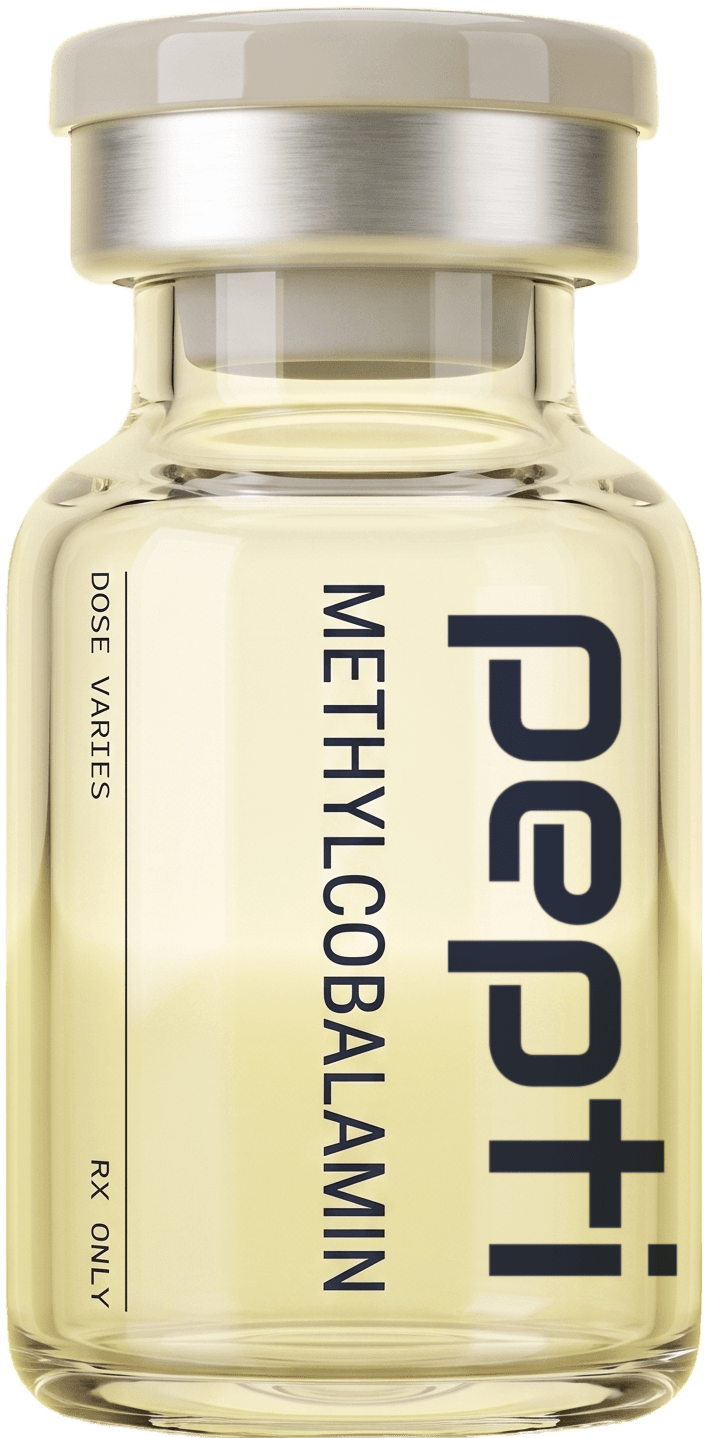
Methylcobalamin (Active B12) is a prescription injection supplied as vial — Methylcobalamin B12 10mg/5mL 2mg/mL (5mL). The reviewed directions are: Inject 1.25 mL (125 units) intramuscularly once weekly. That is 4 doses per vial, about 4 weeks at once weekly. It requires a prescription from a physician licensed in your state, is compounded by a state-licensed US pharmacy, and is not FDA approved.
This page covers what methylcobalamin is, how vitamin B12 works in the body, what the published research does and does not establish, how it differs from the FDA-approved cyanocobalamin injection, where it stands with the FDA, how it is dosed, and how to get it prescribed.
Methylcobalamin (Active B12)
What methylcobalamin actually is
One of the two forms of B12 your cells actually use
Vitamin B12, or cobalamin, is a large molecule built around a single cobalt atom. The group attached on top of that cobalt — the "upper ligand" — is what distinguishes the forms on labels: cyanocobalamin carries a cyanide group, hydroxocobalamin a hydroxyl group, methylcobalamin a methyl group. Inside the cell only two forms do any work: methylcobalamin, the cofactor for methionine synthase, and adenosylcobalamin, the cofactor for methylmalonyl-CoA mutase. Every other form is converted into one of those two first.
That is why methylcobalamin is called "active" or "coenzyme" B12. It is a description of chemistry, not a claim about how well it works once injected — a distinction that runs through this whole page.
Where it comes from and why the naming is confusing
Humans cannot make B12. Bacteria synthesise it, animal foods concentrate it, and the liver keeps a reserve that typically lasts years. The methylcobalamin in a pharmacy vial is a purified synthetic version of the same molecule found in food and in your own tissues. "Vitamin B12" on a supplement label almost always means cyanocobalamin — a stable, inexpensive form that does not occur in nature but is easily converted by the body. Methylcobalamin is sold as "mecobalamin" in Japan, where it has been a prescription drug for decades.
What it is not
It is not a stimulant, and there is no mechanism by which it would make a person with adequate B12 feel more energetic. It is not a weight-loss drug, although it appears in weight-management injections such as Lipo-B as a B-vitamin component. And it is not a treatment for nerve pain of any cause — the neurological literature concerns nerves damaged by B12 deficiency.
Methylcobalamin (Active B12)
How methylcobalamin is described to work
Unlike most compounds on this site, what follows is established human physiology, not animal or cell speculation.
Methionine synthase and the methylation cycle
Methylcobalamin is the cofactor that lets methionine synthase convert homocysteine back into methionine. Methionine becomes S-adenosylmethionine, the body's main methyl donor for DNA, neurotransmitters, membrane phospholipids and myelin. When B12 is short, homocysteine accumulates; an elevated level is one of the markers physicians use to confirm a functional deficiency.
Methylmalonyl-CoA mutase and the second pathway
The other active form, adenosylcobalamin, handles a separate mitochondrial reaction, converting methylmalonyl-CoA to succinyl-CoA. When B12 is deficient, methylmalonic acid builds up, and it is the most specific blood marker of true deficiency. Injected methylcobalamin supplies this pathway too, because cells strip the upper ligand off whatever form arrives and rebuild both coenzymes from the core molecule.
The folate trap and red blood cells
Without working methionine synthase, folate gets stuck in a form the cell cannot use for DNA synthesis. Rapidly dividing cells — bone marrow above all — suffer first, which is why B12 deficiency produces large, immature red cells (megaloblastic anaemia). It is also why folic acid given alone to a B12-deficient person can improve the blood count while nerve damage continues.
Myelin and the nervous system
The methylation cycle maintains myelin, the insulating layer around nerve fibres. Deficiency produces a recognisable pattern: numbness and tingling in the hands and feet, loss of position sense, unsteady gait, in advanced cases damage to the spinal cord (subacute combined degeneration), and mood and memory changes. The New England Journal of Medicine review from 2013 and the Nature Reviews Disease Primers review from 2017 both stress that neurological symptoms can appear before, or entirely without, any change in the blood count.
Why an injection bypasses the absorption problem
Oral B12 needs stomach acid to free it from food, intrinsic factor from the stomach lining to carry it, and a healthy terminal ileum to absorb it. Pernicious anaemia (autoimmune loss of intrinsic factor), stomach or bowel surgery, Crohn's disease, long-term acid suppression and metformin all interfere. An intramuscular injection enters the blood regardless of what the gut is doing. That is the actual reason injections exist — not because injected B12 is stronger.
Methylcobalamin (Active B12)
What the research actually shows
Deficiency
This is where the evidence is definitive. Correcting B12 deficiency corrects megaloblastic anaemia, lowers methylmalonic acid and homocysteine, and improves or halts the neurological picture, with the degree of nerve recovery depending on how long the damage has been present. The British Society for Haematology guideline (British Journal of Haematology, 2014) and the Mayo Clinic Proceedings review "The Many Faces of Cobalamin Deficiency" (2019) cover diagnosis and management in detail. Deficiency is common among vegetarians and especially vegans (Nutrition Reviews, 2013; European Journal of Clinical Nutrition, 2014), in long-term metformin users (Diabetes Prevention Program Outcomes Study, Journal of Clinical Endocrinology & Metabolism, 2016), in older adults, after gastric or bowel surgery, and with long-term acid suppression.
Injection versus oral replacement
Two Cochrane reviews (2005, updated 2018) examined the randomised trials comparing oral with intramuscular B12 for deficiency. The 2018 update found three trials with 153 participants and concluded, on low-quality evidence, that oral and intramuscular B12 had similar effects on serum levels. The best-known single trial, in Blood in 1998, randomised 38 newly diagnosed deficient patients to 2 mg oral daily or a standard intramuscular schedule and reported that correction of blood and neurological abnormalities was prompt and indistinguishable.
The honest reading: for many deficient people, high-dose oral B12 works. Injections are the clear choice when absorption is unreliable, when neurological symptoms make rapid repletion the priority, or when tablets have not worked.
Methylcobalamin versus other forms
The question most people arrive with — is methylcobalamin better than cyanocobalamin? — has been examined directly. A 2015 review in Molecular Nutrition & Food Research concluded that the coenzyme forms "are not likely to be superior" to cyano- or hydroxocobalamin for preventing or treating deficiency, because cells remove the upper ligand from every form and rebuild the coenzymes themselves. What can honestly be said for methylcobalamin is narrower: it carries no cyanide group (trivial for almost everyone, though cyanocobalamin is avoided in the rare inherited optic neuropathy called Leber's disease), and some patients and prescribers prefer it on that basis.
Diabetic and other neuropathies
Methylcobalamin has been studied in diabetic peripheral neuropathy, mostly in small trials from Asia, often alongside another treatment. A 2026 review and meta-analysis in the Journal of Clinical Medicine pooled thirteen randomised trials of B-vitamin supplementation (834 participants) and reported small improvements in some neuropathy scores and in sural nerve conduction, no significant effect on pain by standard scales, and enough heterogeneity and risk of bias that the authors declined to recommend routine use. Diabetes guidelines do not list B12 as a neuropathy treatment for people who are not deficient.
Energy and fatigue in people who are not deficient
This is the claim worth being most careful about. B12 injections are widely marketed for energy, and the biochemistry gives a plausible story: no B12, no methylation, tired cells. But the story only holds if B12 is actually short. In people with normal levels there is no convincing trial evidence that injected B12 improves energy, mood or exercise capacity. The closest thing to a direct test — a small pilot study of B12 for tiredness in the British Journal of Nutrition in 1973 — is half a century old and has never been followed by a properly powered trial showing benefit. People who feel better after an injection when their levels were fine are most likely describing expectation, or a borderline deficiency that had gone undetected.
What human data exists
A great deal, and it points one way. Randomised trials and decades of practice establish that B12 replacement — oral or injected, any common form — corrects deficiency and its consequences. What the human data does not do is support B12 as a general tonic. No randomised trial shows methylcobalamin injections improve energy, cognition or performance in people with normal B12 status, and none shows methylcobalamin outperforming cyanocobalamin on any clinical outcome.
What the evidence does not establish
- That methylcobalamin is clinically superior to cyanocobalamin or hydroxocobalamin. The review literature argues the opposite.
- Any benefit for energy, fatigue or cognition in people whose B12 status is normal.
- B12 as a treatment for neuropathy not caused by B12 deficiency.
- A weight-loss effect, even when B12 appears in weight-management injections.
Methylcobalamin (Active B12)
Where methylcobalamin stands with the FDA right now
Two very similar molecules sit in different regulatory positions, and it is worth being exact.
Cyanocobalamin injection is an FDA-approved prescription drug, marketed under approved abbreviated new drug applications and listed in FDA's Drugs@FDA database as an approved injectable.
Methylcobalamin is not. No FDA-approved drug product contains methylcobalamin as its active ingredient; the only US labels listing it are dietary supplements and homeopathic products. A compounding pharmacy therefore cannot rely on it being a component of an approved drug, so its status depends on the FDA's 503A bulk drug substances list.
As of the FDA's list updated 14 May 2026, methylcobalamin appears in Category 1 of the 503A bulk drug substances nominated for use in compounding — "Bulk Drug Substances Under Evaluation." Category 1 means the substance was nominated with sufficient information for FDA to evaluate it and is covered by FDA's interim enforcement policy: the agency does not intend to take action against a state-licensed pharmacy or physician compounding with it, provided the conditions in the guidance are met. It is not in Category 2 (identified significant safety risks), and it was not among the substances affected by the April 2026 removals or the July 2026 Pharmacy Compounding Advisory Committee votes on peptides.
So the accurate description today is: legal to compound and dispense on prescription under FDA's interim policy, under evaluation for the final 503A bulks list, and not an FDA-approved drug product — compounded medications never are.
Methylcobalamin (Active B12)
Realistic expectations
These are patterns described by prescribers and in the deficiency literature, not trial endpoints. Response depends almost entirely on whether a deficiency was present to begin with.
The first week or two
If you were deficient, this is when the blood picture starts to respond: the marrow begins producing normal red cells within days and reticulocytes rise within about a week. Some people describe feeling better in this window; others notice nothing yet. If you were not deficient, the vitamin is stored or excreted and there is no expected change.
Weeks two to eight
In deficiency, haemoglobin recovers over several weeks and methylmalonic acid and homocysteine normalise. Fatigue caused by anaemia lifts as the blood count does. Numbness and tingling, when caused by deficiency, begin to improve here but move more slowly than the blood.
Months, for nerves
Nerve recovery is the slow part. The neurological literature describes improvement continuing for six months or longer, and warns that damage present for more than a year may only partially recover — which is why physicians treat neurological deficiency promptly.
Ongoing, when the cause is permanent
Pernicious anaemia, a gastrectomy, a bypass, a strictly plant-based diet or long-term metformin do not go away. In those cases B12 is maintenance rather than a course, and the weekly injection may move to a less frequent schedule once stores are rebuilt. Your physician decides that from your levels, not the calendar.
Methylcobalamin (Active B12)
When something else makes more sense
A reference that only ever recommends its own product is not much of a reference. Some honest cases where a methylcobalamin injection is not the first thing to reach for:
- You have never had your B12 measured. The sensible first step for "I'm tired" is a blood test, not an injection. At-home blood testing can check B12 along with the thyroid, iron and metabolic markers that far more often explain fatigue.
- Your levels are normal and the goal is energy. There is no good evidence that B12 helps here. If a physician thinks a metabolic support makes sense, NAD+ or L-carnitine are different conversations with different evidence bases.
- B12 is part of a weight-management plan. Lipo-B (B12 + MIC) combines B12 with methionine, inositol and choline in one weekly injection, and Lipo-Mino-Mix-C is the related lipotropic blend. If the plan is semaglutide or tirzepatide, B12 is a possible add-on, not the treatment.
- A physician prefers the approved product. Cyanocobalamin injection is FDA approved and does the same job in deficiency. If your physician prescribes that instead, they are not short-changing you.
- The goal is antioxidant support rather than a vitamin gap. Glutathione is the product physicians reach for there.
Your physician will tell you if methylcobalamin is not the right tool for what you have described. A consultation does not guarantee a prescription, and being declined is refunded.
Methylcobalamin (Active B12)
Dosing, and how a vial is actually used
Why the dose is measured in units
The directions are written in millilitres and in insulin-syringe units because that is what you can read off the barrel. 1.25 mL is 125 units on a U-100 syringe. At the vial's concentration of 2 mg/mL, that volume is 2.5 mg of methylcobalamin per injection. You are not calculating anything — the number is printed on your medication and your physician sets it.
Intramuscular, and where
Unlike most products on this site, methylcobalamin is directed intramuscularly — into the muscle, not the fat layer under the skin. The usual sites are the outer thigh and the upper outer buttock. Intramuscular injection uses a longer needle than a subcutaneous one, and your pharmacy supplies syringes and needles appropriate to the directions. Rotate sites between weeks. A brief sting and a slightly sore site the next day are normal. Do not change the route your physician prescribed; if it is a problem for you, raise it with them.
Why a vial covers about four weeks
Four doses at once weekly is four weeks, which is why refills run on a 28-day cycle. One vial per fill, always — not a stockpile.
Storage
Methylcobalamin is light-sensitive: keep the vial in its carton, out of direct light, at the temperature printed on the label. The beyond-use date is on the label; a multi-dose vial is discarded after that date regardless of how much is left.
Methylcobalamin (Active B12)
Safety and side effects
B12 is a water-soluble vitamin with no established upper intake level — excess is excreted in urine, and toxicity from the vitamin itself is not described. What gets reported with injections is mostly injection-site: stinging, soreness, occasional bruising. Less commonly people report acne-like eruptions, mild diarrhoea or headache. Rare but documented with cobalamin injections of any form are allergic reactions, including anaphylaxis.
Two situations need physician attention. Treating a severe, established B12-deficiency anaemia can cause potassium to fall as the marrow ramps up production, which is why physicians sometimes check electrolytes early on. And high-dose folic acid can correct the anaemia of B12 deficiency while nerve damage continues, so folate and B12 are assessed together.
Interactions are few but real. Nitrous oxide — dental or recreational — inactivates B12 and can precipitate neurological deficiency in someone with low stores. Metformin, acid suppressants and colchicine reduce absorption of oral B12. Tell your physician about all of them on the intake.
Stop and contact your physician for any reaction that is severe, spreading, or involves difficulty breathing.
Methylcobalamin (Active B12)
How methylcobalamin compares
Methylcobalamin vs cyanocobalamin injection
Same vitamin, different upper ligand, different regulatory status. Cyanocobalamin injection is FDA approved, inexpensive and the standard in US practice; the body converts it to the coenzyme forms. Methylcobalamin arrives already in one, but cells strip and rebuild the ligand regardless, and the review literature does not find it clinically superior. Reasons a physician might choose methylcobalamin: avoiding the cyanide group, a patient with Leber's hereditary optic neuropathy, or patient preference. Reasons to choose cyanocobalamin: it is the approved product with the longest track record. Neither is wrong.
Methylcobalamin vs oral B12
For deficiency without a serious absorption problem, the Cochrane evidence says high-dose oral B12 works about as well as injections. Injections win when absorption is the problem — pernicious anaemia, bowel surgery, gastric bypass — or when neurological symptoms make rapid repletion the priority.
Methylcobalamin vs Lipo-B
Lipo-B is B12 plus methionine, inositol and choline, prescribed as part of a weight-management plan rather than for B12 replacement. If the aim is to correct or maintain B12 status, methylcobalamin alone is the more direct tool; if the aim is a supporting injection alongside a weight plan, Lipo-B is what that product is for.
Methylcobalamin (Active B12)
Availability and formats
| Question | Answer |
|---|---|
| Can I get it by telehealth? | Yes, where a physician licensed in your state prescribes it |
| Which states? | All 50 states and DC |
| Does it come as a pen? | No, this one is a vial and syringe only |
| Does it come as a capsule? | No |
| Does it come as a nasal spray? | No |
| Is bloodwork required first? | Not routinely; your physician decides |
Methylcobalamin (Active B12)
Where to get Methylcobalamin (Active B12) prescribed
Methylcobalamin (Active B12) cannot be bought legitimately without a prescription. Sites shipping it with no prescription are selling a research-use-only product, where no pharmacy is accountable for identity, purity, sterility or concentration.
The prescription route works like this:
- Complete a medical intake covering your history, medications, allergies and what you are treating.
- A physician licensed in your state reviews it.
- If appropriate, a state-licensed, FDA-registered pharmacy compounds it to that prescription.
- It ships refrigerated with your directions printed on the vial.
- Your physician stays reachable afterwards for dose questions and side effects.
Current all-in pricing for Methylcobalamin (Active B12) is published: medication, physician review, refill management and shipping in one figure, with no separate membership fee. What to check on any provider is in how to tell if a peptide seller is legitimate.
Methylcobalamin (Active B12)
Who should not take it, or should discuss it first
| Situation | Why |
|---|---|
| Pregnancy or breastfeeding | Not used; safety data is absent |
| Tested athletes | Many peptides are prohibited in competition; check the current list |
Full specification
Everything on the label.
Product
Methylcobalamin (Active B12) (Injectable)
How supplied
vial — Methylcobalamin B12 10mg/5mL 2mg/mL (5mL)
Typical directions
Inject 1.25 mL (125 units) intramuscularly once weekly.
Dose volume
1.25 mL (125 units on a U-100 insulin syringe)
Doses per vial
4
Coverage per vial
about 4 weeks at once weekly
Formats
Vial and syringe
Available in
All 50 states and DC
Bloodwork
Not routinely required; your physician decides
Legal status
Prescription-only, compounded, not FDA approved
Category
Supplements
References
What this is based on.
References
- Stabler SP. Clinical practice. Vitamin B12 deficiency · N Engl J Med (2013) · PMID 23301732
- Devalia V, Hamilton MS, Molloy AM. Guidelines for the diagnosis and treatment of cobalamin and folate disorders · Br J Haematol (2014) · PMID 24942828
- Wolffenbuttel BHR, Wouters HJCM, Heiner-Fokkema MR, van der Klauw MM. The Many Faces of Cobalamin (Vitamin B12) Deficiency · Mayo Clin Proc Innov Qual Outcomes (2019) · PMID 31193945
- Kuzminski AM, Del Giacco EJ, Allen RH, Stabler SP, Lindenbaum J. Effective treatment of cobalamin deficiency with oral cobalamin · Blood (1998) · PMID 9694707
- Obeid R, Fedosov SN, Nexo E. Cobalamin coenzyme forms are not likely to be superior to cyano- and hydroxyl-cobalamin in prevention or treatment of cobalamin deficiency · Mol Nutr Food Res (2015) · PMID 25820384
- Aroda VR, Edelstein SL, Goldberg RB, et al.. Long-term Metformin Use and Vitamin B12 Deficiency in the Diabetes Prevention Program Outcomes Study · J Clin Endocrinol Metab (2016) · PMID 26900641
- Pawlak R, Parrott SJ, Raj S, Cullum-Dugan D, Lucus D. How prevalent is vitamin B12 deficiency among vegetarians? · Nutr Rev (2013) · PMID 23356638
- Pawlak R, Lester SE, Babatunde T. The prevalence of cobalamin deficiency among vegetarians assessed by serum vitamin B12: a review of literature · Eur J Clin Nutr (2014) · PMID 24667752
- Ellis FR, Nasser S. A pilot study of vitamin B12 in the treatment of tiredness · Br J Nutr (1973) · PMID 4583554
- Mandra EV, Parfenov VA, Stupin VA, Silina EV. Vitamin B Supplementation for Diabetic Peripheral Neuropathy: A Review and Meta-Analysis · J Clin Med (2026) · PMID 42452619
- Vaucher P, Druais PL, Waldvogel S, Favrat B. Effect of iron supplementation on fatigue in nonanemic menstruating women with low ferritin: a randomized controlled trial · CMAJ (2012) · PMID 22777991
- Stuber MJ, Moutzouri E, Feller M, et al.. Effect of Thyroid Hormone Therapy on Fatigability in Older Adults With Subclinical Hypothyroidism: A Nested Study Within a Randomized Placebo-Controlled Trial · The Journals of Gerontology. Series A, Biological Sciences and Medical Sciences (2020) · PMID 32577745
Citations are provided for educational purposes. They do not constitute medical advice. Always discuss any peptide protocol with your prescribing physician.
Common questions
Methylcobalamin (Active B12), answered.
Through a telehealth provider where a physician licensed in your state reviews a medical intake and a licensed US pharmacy compounds the prescription. Pepti prescribes Methylcobalamin (Active B12) in all 50 states and DC; start with the free assessment.
vial — Methylcobalamin B12 10mg/5mL 2mg/mL (5mL)
Inject 1.25 mL (125 units) intramuscularly once weekly. Your physician sets your own dose and it is printed on your medication.
4 at the standard volume, about 4 weeks at once weekly.
Methylcobalamin (Active B12) is supplied as a vial, drawn with an insulin syringe. It is not available as a pen or capsule.
Not routinely, though your physician may want labs depending on your history. at-home blood testing covers hormone, metabolic and thyroid markers without a lab visit.
It is legal to prescribe and dispense in the United States with a valid prescription. It is not FDA approved: compounded medications are prepared by licensed pharmacies pursuant to a prescription rather than approved as manufactured products. See are peptides FDA approved.
Pricing is published on the Methylcobalamin (Active B12) page as one all-in figure covering medication, physician review, refill management and shipping. What drives peptide pricing generally is in how much do peptides cost.
Both are vitamin B12; they differ only in the group attached to the cobalt atom. Cyanocobalamin is the stable synthetic form in most supplements and in the FDA-approved injection, and the body converts it to the active forms. Methylcobalamin is one of those active forms supplied directly. Cells strip and rebuild that group either way, and the review literature does not find methylcobalamin clinically superior for deficiency. The practical differences are the absence of the cyanide group and regulatory status: cyanocobalamin injection is FDA approved, methylcobalamin is compounded.
Because no manufacturer has taken methylcobalamin through FDA approval as a drug in the United States. It is available here only as a dietary supplement or, on prescription, as a compounded injection. FDA lists methylcobalamin in Category 1 of its 503A bulk drug substances list (updated 14 May 2026): under evaluation, and usable by compounding pharmacies under FDA's interim policy. A physician can prescribe either form.
There is no convincing evidence that it will. Fatigue caused by B12 deficiency responds to replacement; fatigue in someone with adequate B12 has not been shown in placebo-controlled trials to respond to B12 injections. The honest first step for tiredness is a blood test to see whether B12 — or something more common, such as thyroid, iron or sleep — is the explanation.
A serum B12 level is the usual first test, but it has a grey zone; methylmalonic acid and homocysteine are used to confirm borderline results. Symptoms include fatigue, numbness or tingling in the hands and feet, unsteadiness, memory or mood changes, a sore tongue and, later, anaemia. Neurological symptoms can occur without any anaemia, which is why a low-normal result with symptoms is worth discussing with a physician.
Long-term metformin use is associated with lower B12 levels and a higher rate of deficiency; the Diabetes Prevention Program Outcomes Study reported this over more than a decade of follow-up, and the American Diabetes Association recommends periodic B12 testing for people on metformin. Proton-pump inhibitors and H2 blockers have a similar, smaller effect.
The one to know about is nitrous oxide, used in dental anaesthesia and recreationally, which inactivates B12 and can precipitate nerve damage in someone with low stores. Metformin, acid suppressants and colchicine reduce absorption of oral B12. High-dose folic acid can correct the anaemia of B12 deficiency while nerve damage continues, so the two are assessed together. Your physician reviews every medication and supplement you take.
Next step
See what a physician recommends for you.
A licensed physician in your state reviews your intake and decides what is appropriate. A consultation does not guarantee a prescription.