Weight Loss · Reference
AOD-9604 Benefits: What the Research Actually Shows
This page takes each claimed benefit in turn and says what was studied, in what, and how much weight it can bear. It is organised by benefit, not by molecule; for the biology, dosing and the FDA history in full, read what is AOD-9604.
Treatments mentioned
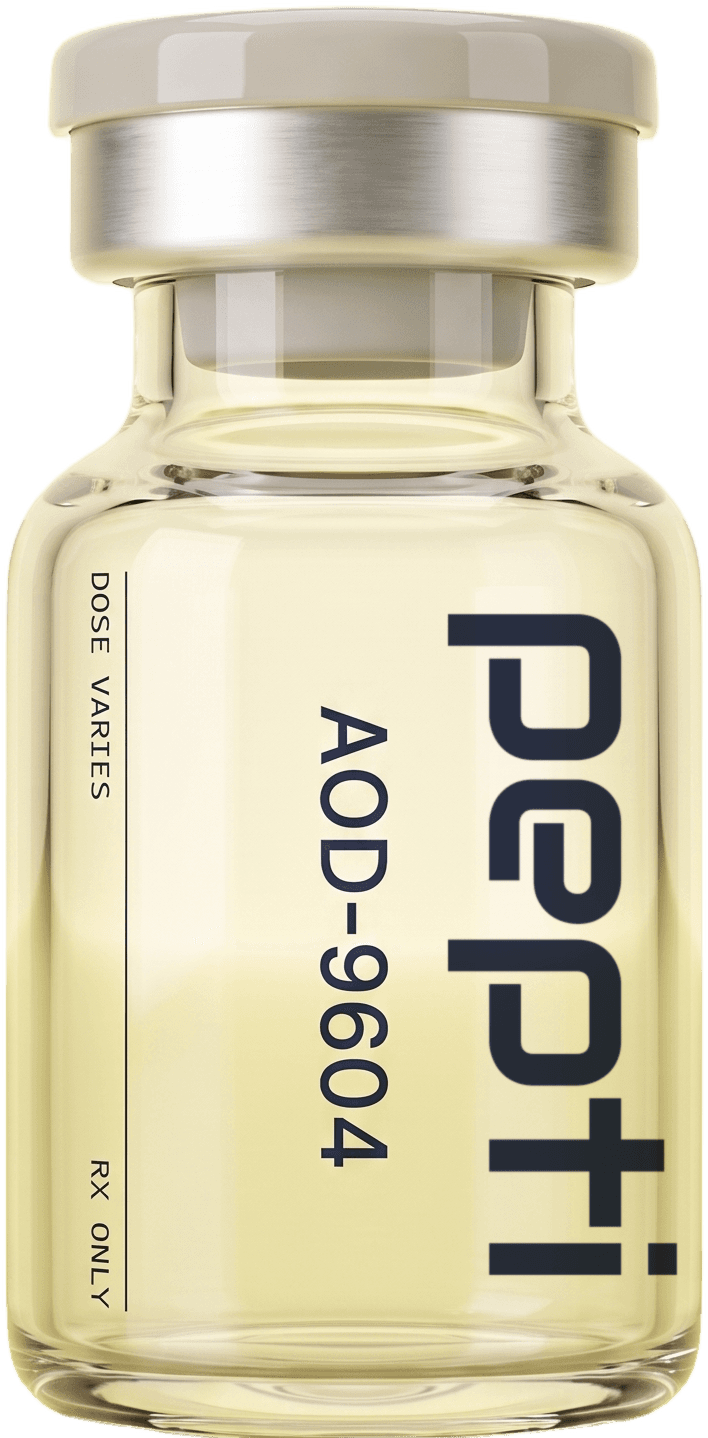
The benefits claimed for AOD-9604, more fat breakdown, less weight gain, no effect on blood sugar and support for joints, come mostly from rat, mouse and rabbit studies. Unusually for a compounded peptide, AOD-9604 has also been through six randomised, placebo-controlled human trials, and the largest of them did not find statistically significant weight loss over placebo. What the human trials did report is about safety and pharmacology: no change in IGF-1, no impairment of glucose tolerance and no antibodies detected. AOD-9604 is a compounded prescription injection at Pepti; compounded medications are not FDA approved, and no human trial has used the injected route.
This page takes each claimed benefit in turn and says what was studied, in what, and how much weight it can bear. It is organised by benefit, not by molecule; for the biology, dosing and the FDA history in full, read what is AOD-9604.
AOD-9604 Benefits
The short answer
| Claimed benefit | What the evidence is | Strength of evidence |
|---|---|---|
| More fat breakdown (lipolysis) and fat oxidation | Animal (obese rats, Hormone Research 2000; obese mice, International Journal of Obesity 2001) | Preclinical only |
| Less weight gain | Animal (obese rats and mice, 2000 and 2001) | Preclinical only |
| Weight loss in people | Human: six randomised trials, oral and intravenous; the largest, OPTIONS, found no significant difference from placebo | Tested in humans and not supported |
| "The fat effect without the growth effect" | Cell (no binding to the growth hormone receptor, 2001); human (IGF-1 unchanged across the trials) | The best supported claim, as a description of what it does not do |
| No harm to blood sugar or insulin sensitivity | Animal (rats and mice, 2000 and 2001); human (glucose tolerance not impaired in the trials) | A safety finding with human support, not a treatment benefit |
| A short-term rise in circulating fatty acids | Human (the intravenous studies, within hours of a dose) | Human, but a blood marker only |
| Joint and cartilage support | Animal (rabbits, injected into the knee, Annals of Clinical and Laboratory Science 2015) | One animal study, a different route |
| Waist circumference | Human (a 300-person oral study reported as a conference abstract) | Weak; the FDA's reviewers called the differences small and of unclear meaning |
The honest summary of the table: a coherent rodent story, a negative human result for the thing the peptide was designed to do, and no human study at all of the subcutaneous injection that is actually prescribed.
AOD-9604 Benefits
What AOD-9604 is, in one paragraph
Human growth hormone is a protein of 191 amino acids. AOD-9604 is a synthetic copy of the last fifteen of them, positions 177 to 191, with a tyrosine added at the front, making a 16-amino-acid peptide; it is the same molecule people call "hGH fragment 176-191". AOD stands for Anti-Obesity Drug. It came out of biochemistry work at Monash University in Melbourne and was developed in the late 1990s by an Australian company, Metabolic Pharmaceuticals, as an oral obesity treatment. The idea was to keep the part of growth hormone that seemed to act on fat and leave behind its growth and blood-sugar effects. It is not growth hormone, not a growth hormone secretagogue, and not an appetite drug. The FDA's 2024 review noted that its molecular target has never been identified.
AOD-9604 Benefits
Benefit 1: More fat breakdown and fat oxidation
What the research describes. The founding paper, from the Monash group in Hormone Research in 2000, gave obese Zucker rats the fragment orally for 19 days and reported increased lipolytic activity in their fat tissue when tested. A 2001 paper in the International Journal of Obesity gave obese and lean mice growth hormone, the fragment or saline by mini-pump for 14 days, and reported increased whole-body fat oxidation and higher plasma glycerol in the treated obese animals. Glycerol is a marker of fat cells releasing their stored contents.
The proposed route. A 2001 paper in Endocrinology compared the fragment in ordinary obese mice and in mice lacking the beta-3 adrenergic receptor, a receptor on fat cells that drives fat breakdown and heat production. In ordinary obese mice, treatment was associated with more beta-3 receptors in white and brown fat; in the knockout mice, the effects were absent. The reading is that the fragment depends on that receptor system rather than the growth hormone receptor. The FDA's reviewers called this a reasonable inference, not an established mechanism.
Evidence type. Animal.
Strength. Consistent across a small number of rodent studies from closely connected groups. The FDA's 2024 review noted that none of the animal studies established a dose-response relationship and that the statistics were not corrected for multiple comparisons.
AOD-9604 Benefits
Benefit 2: Less weight gain, and the human trials
What the research describes in animals. Across the Zucker rat and obese mouse work, chronic treatment reduced weight gain compared with controls. The effects were meaningful in those animals.
What happened in people. Between roughly 2001 and 2007 the company ran six randomised, double-blind, placebo-controlled trials in Australia, enrolling close to 900 people, mostly with obesity.
| Study | Who | Route | What was reported |
|---|---|---|---|
| Intravenous dose-escalation | 15 men | Intravenous | Free fatty acids rose within hours; no significant weight loss against placebo |
| Second intravenous study | 23 men | Intravenous | No significant weight loss against placebo |
| Two short oral studies | 17 and 36 men | Oral | No significant weight loss against placebo |
| 12-week oral study, reported as a conference abstract | 300 men and women with obesity | Oral, five daily doses | Weight loss slightly greater than placebo at every dose, largest at the lowest dose; waist circumference reduced. The FDA's reviewers described the differences as small and of unclear meaning |
| OPTIONS, 24 weeks | 536 enrolled, 502 randomised, adults with obesity | Oral, 0.25, 0.5 or 1 mg daily, with a supervised diet and exercise program | No statistically significant weight loss versus placebo at 12 or 24 weeks |
On 21 February 2007 the company announced that the OPTIONS results did not support AOD-9604 as an obesity treatment and ended development for that use. Its own statement said the overall population did not respond consistently.
Evidence type. Human, randomised and placebo-controlled.
Strength. This is the most tested claim on the page, and the test came back negative. The biggest and best-designed human trial, run by the company that invented the peptide, found no significant weight loss over placebo. Anyone describing AOD-9604 as a trial-backed fat-loss peptide is describing trials that reached the opposite conclusion. If weight loss is the goal, the best peptides for weight loss sets out the medications with human evidence for it.
AOD-9604 Benefits
Benefit 3: "The fat effect without the growth effect"
What the research describes. The 2001 International Journal of Obesity paper tested the fragment in cells engineered to carry the human growth hormone receptor. It did not compete with growth hormone for the receptor and did not drive cell proliferation. Across the six human trials, IGF-1, the main growth factor growth hormone raises, did not change on treatment.
Evidence type. Cell, with human support on the specific point of IGF-1.
What it means. This is the best supported statement about AOD-9604, and it is a statement about what it does not do. It is why AOD-9604 is described as leaving the growth hormone axis alone, and why someone who wants to avoid raising growth hormone or IGF-1 might look at it. It is also why it is paired, in blends, with peptides that do act on that axis. The contrast with a peptide that raises growth hormone is set out in AOD-9604 vs tesamorelin.
AOD-9604 Benefits
Benefit 4: No harm to blood sugar or insulin sensitivity
What the research describes. In the 2000 rat study, euglycaemic clamp testing found no adverse effect on insulin sensitivity, in contrast to what chronic growth hormone does. In the 2001 mouse study, unlike growth hormone, the fragment did not raise blood glucose or reduce insulin secretion. In the human trials, glucose tolerance was not impaired.
Evidence type. Animal, with human support.
What it means. This is often presented online as a metabolic benefit. It is more accurately a safety finding: AOD-9604 did not cause the blood-sugar problems that full-length growth hormone causes. No study has shown that it improves blood sugar or insulin sensitivity in people. The intravenous trials did record unspecified low blood sugar among reported effects, so anyone who takes a glucose-lowering medication should list it on the intake.
AOD-9604 Benefits
Benefit 5: A rise in circulating fatty acids
What the research describes. The two small intravenous studies reported a rise in circulating free fatty acids within hours of a dose.
Evidence type. Human, short-term.
What it means. It is a blood marker consistent with fat being released from storage, measured in a handful of men given the peptide into a vein. It did not translate into significant weight loss in those studies, and it has never been measured after a subcutaneous injection. It is the reasoning some prescribers give for directing a morning dose before eating; that is a rationale, not a trial result.
AOD-9604 Benefits
Benefit 6: Joint and cartilage support
What the research describes. A 2015 paper in Annals of Clinical and Laboratory Science injected AOD-9604 into the knees of rabbits with collagenase-induced osteoarthritis, weekly for four to seven weeks, with or without hyaluronic acid. Treated joints scored better on gross and microscopic cartilage assessment than saline-treated joints, and the combination with hyaluronic acid scored better than either alone.
Evidence type. Animal.
Strength. One study, in one animal model, by injection directly into the joint, not under the skin. There is no human study of AOD-9604 for any joint condition and no study of subcutaneous dosing for joints. This is the entire basis of the joint claims attached to the peptide.
AOD-9604 Benefits
Benefit 7: Body composition over the long term
What the research describes. Nothing directly. No human study has measured body composition after subcutaneous AOD-9604, and the longest trial of any route ran 24 weeks.
What prescribers report. Where prescribers describe change at all, it is modest and framed as support for a diet and training program that is already working, not as a driver of results on its own. These are patterns described by prescribers, not trial endpoints, and nobody can attach a number or a timeline to them.
Evidence type. None direct.
AOD-9604 Benefits
What the evidence does not establish
- Weight loss in humans. The largest trial found none over placebo, and the smaller ones found nothing significant.
- An effect size or a timeline for body composition change by subcutaneous injection, because that has never been studied in people.
- Any effect on joints or cartilage in humans.
- That AOD-9604 improves blood sugar. The trials report it did not worsen glucose tolerance, which is a different statement.
- Long-term safety beyond the 24 weeks of the longest trial.
- Efficacy for any condition as an FDA-approved treatment. It is not approved for anything.
The FDA reached the same reading. In 2023 it placed AOD-9604 in Category 2 of its interim 503A bulk substances list; it left that category on 27 September 2024 when the nominations were withdrawn. On 4 December 2024 the FDA's Pharmacy Compounding Advisory Committee voted 0 to 12 against adding it to the 503A Bulks List, having evaluated it for obesity, and the FDA's briefing document cited a lack of evidence of effectiveness by any route, the failed OPTIONS trial, and the absence of human data for the subcutaneous route. That vote is a recommendation, the FDA has not issued a final rule, and AOD-9604 remains legal for a physician to prescribe and a licensed pharmacy to compound. Some sources claim FDA "GRAS" status for AOD-9604; as of September 2026 there is no GRAS notice for it in the FDA's inventory, and it would have no bearing on a prescription injection in any case.
AOD-9604 Benefits
Side effects, in brief
| What is reported | Where it comes from | What to do |
|---|---|---|
| Injection-site redness, mild soreness, occasional bruising | What prescribers report with the injection | Rotate sites |
| Headache, fatigue, dizziness, low blood sugar | The intravenous trials | Report it if it persists |
| Headache, diarrhea, flatulence, increased appetite, nausea | The oral trials, more so at the highest dose | Report it if it persists |
| A reaction that is severe, spreading, or involves difficulty breathing | Rare | Emergency care first, then tell your physician |
Adverse events in the trials were similarly distributed between AOD-9604 and placebo, and no serious adverse event was judged related to treatment. AOD-9604 is not used in pregnancy or breastfeeding. It is prohibited at all times under the WADA List as a growth hormone fragment, and anti-doping laboratories have published a urine detection method for it; see peptides for athletes. The full list, with the FDA's caveats, is in AOD-9604 side effects.
AOD-9604 Benefits
How Pepti supplies AOD-9604
| Product | What is in it | Typical directions | Price |
|---|---|---|---|
| AOD-9604 | 5 mL multi-dose vial, 2 mg/mL (10 mg AOD-9604) | 0.25 mL (25 units) subcutaneously once daily Monday through Friday; 0.5 mg per dose, 20 doses, about 4 weeks | $229/mo |
| SHRED Blend | 10 mg AOD-9604, 6 mg CJC-1295, 10 mg ipamorelin, 10 mg MOTS-c in 5 mL | 0.25 mL (25 units) once daily Monday through Friday | $279/mo |
| PHYSIQ Blend | 10 mg each of tesamorelin, ipamorelin, AOD-9604 and MOTS-c in 5 mL | 0.25 mL (25 units) Monday through Friday nights at bedtime | $289/mo |
Every price is all-in, covering medication, physician review, refill management and shipping, with no separate membership fee. Pepti is cash-pay and does not bill insurance. Vials are multi-dose solutions shipped ready to use, refrigerated with ice packs, with sterile syringes and alcohol prep pads. Refills run every 28 days, one vial per fill. Your physician sets your directions after reviewing your intake, and they are printed on the vial. The unit and milligram arithmetic is in AOD-9604 dosage.
AOD-9604 Benefits
Where to get AOD-9604 prescribed
AOD-9604 cannot be bought legitimately without a prescription. Sites selling it "for research use only" are not accountable for identity, purity, sterility or concentration. The prescription route:
- Complete a free online intake covering your history, medications and what you want help with.
- A physician licensed in your state reviews it, usually within 24 hours.
- If it is appropriate, a PCAB-accredited, FDA-registered US 503A compounding pharmacy prepares it to that prescription. Lot test results are published at /quality/lab-results.
- It ships refrigerated with your directions printed on the vial.
- Your physician stays reachable for questions and side effects.
Pepti prescribes AOD-9604 in every state except Oklahoma, plus DC The step-by-step page is how to get AOD-9604 prescribed online.
References
What this is based on.
References
- Heffernan M, Summers RJ, Thorburn A et al.. The effects of human GH and its lipolytic fragment (AOD9604) on lipid metabolism following chronic treatment in obese mice and beta(3)-AR knock-out mice · Endocrinology (2001) · PMID 11713213
- Ng FM, Sun J, Sharma L et al.. Metabolic studies of a synthetic lipolytic domain (AOD9604) of human growth hormone · Hormone Research (2000) · PMID 11146367
- Heffernan MA, Thorburn AW, Fam B et al.. Increase of fat oxidation and weight loss in obese mice caused by chronic treatment with human growth hormone or a modified C-terminal fragment · International Journal of Obesity and Related Metabolic Disorders (2001) · PMID 11673763
- Wilding J. AOD-9604 Metabolic · Current Opinion in Investigational Drugs (2004) · PMID 15134286
- Kwon DR, Park GY. Effect of Intra-articular Injection of AOD9604 with or without Hyaluronic Acid in Rabbit Osteoarthritis Model · Annals of Clinical and Laboratory Science (2015) · PMID 26275694
- Cox HD, Smeal SJ, Hughes CM et al.. Detection and in vitro metabolism of AOD9604 · Drug Testing and Analysis (2015) · PMID 25208511
- Orlovius AK, Thomas A, Schänzer W et al.. AOD-9604 does not influence the WADA hGH isoform immunoassay · Drug Testing and Analysis (2013) · PMID 24124033
- Mendias CL, Awan TM. Safety and Efficacy of Approved and Unapproved Peptide Therapies for Musculoskeletal Injuries and Athletic Performance · Sports Medicine (2026) · PMID 41966639
Citations are provided for educational purposes. They do not constitute medical advice. Always discuss any peptide protocol with your prescribing physician.
Common questions
AOD-9604 Benefits, answered.
In obese rats and mice, AOD-9604 was reported to increase fat breakdown and fat oxidation and to reduce weight gain without the blood-sugar effects of growth hormone. In a rabbit study, injections into the knee improved cartilage scores. In people, six randomised trials reported no change in IGF-1 and no impairment of glucose tolerance, but the largest found no significant weight loss over placebo.
It was tested for exactly that and the result was negative. The OPTIONS trial gave 502 adults with obesity oral AOD-9604 or placebo for 24 weeks alongside diet and exercise, and found no statistically significant weight loss versus placebo. The positive fat-loss findings are in rodents.
It is a fragment of growth hormone that, in animal work, increased fat breakdown and fat oxidation, possibly through beta-3 adrenergic receptors on fat cells. It does not bind the growth hormone receptor in cell work, and it did not raise IGF-1 in the human trials. The FDA's 2024 review noted its molecular target has never been identified.
No study has measured abdominal or visceral fat after AOD-9604 injections. A 300-person oral study reported a reduction in waist circumference in a conference abstract, and the FDA's reviewers called the differences small and of unclear meaning. For visceral fat specifically, tesamorelin is the peptide with human trial data; see AOD-9604 vs tesamorelin.
One 2015 study in rabbits with osteoarthritis reported better cartilage scores after weekly injections directly into the knee, especially with hyaluronic acid. There is no human study of AOD-9604 for any joint condition, and no study of subcutaneous dosing for joints.
No. It is a fragment of growth hormone, not a stimulus for it, and IGF-1 did not change across the six human trials. That is the main reason it is described as having "the fat effect without the growth effect".
In rats and mice it did not cause the rise in blood glucose or fall in insulin sensitivity that growth hormone does, and in the human trials glucose tolerance was not impaired. The intravenous trials did record low blood sugar among reported effects, so list any glucose-lowering medication on your intake.
Yes, more than for most compounded peptides: six randomised, placebo-controlled trials enrolling close to 900 people. They used oral or intravenous dosing, not the subcutaneous injection that is prescribed, and the largest found no significant weight loss over placebo.
There is no human result to anchor a timeline, because no trial found a significant effect and none used the injected route. Prescribers describe any change as modest and gradual, alongside diet and training.
No. It has no FDA-approved product, and compounded medications are not FDA approved. In December 2024 the FDA's advisory committee voted 0 to 12 against adding it to the 503A Bulks List for obesity; the FDA has not issued a final rule, and it remains legal to prescribe.
At Pepti, the AOD-9604 vial is $229 a month, all-in, covering medication, physician review, refill management and shipping. SHRED is $279 a month and PHYSIQ is $289 a month.
No. Bloodwork is not required for any Pepti treatment. If your physician wants labs for your care, they'll ask through your account. The free assessment goes to a physician licensed in your state. A consultation does not guarantee a prescription.
Next step
See what a physician recommends for you.
A licensed physician in your state reviews your intake and decides what is appropriate. A consultation does not guarantee a prescription.