Weight Loss · Reference
AOD-9604: What It Is, Where to Get It Prescribed, and What It Costs
This page covers what AOD-9604 is, the pathways researchers have described, what the published work and the one real clinical development program do and do not establish, where it currently stands with the FDA, how it is dosed, and how to get it prescribed.

Reviewed by Dr. Gene, MD · Board-certified Family Medicine
Every Pepti prescription is reviewed by a licensed U.S. physician before it's dispensed — and only provided if clinically appropriate.
Treatments mentioned
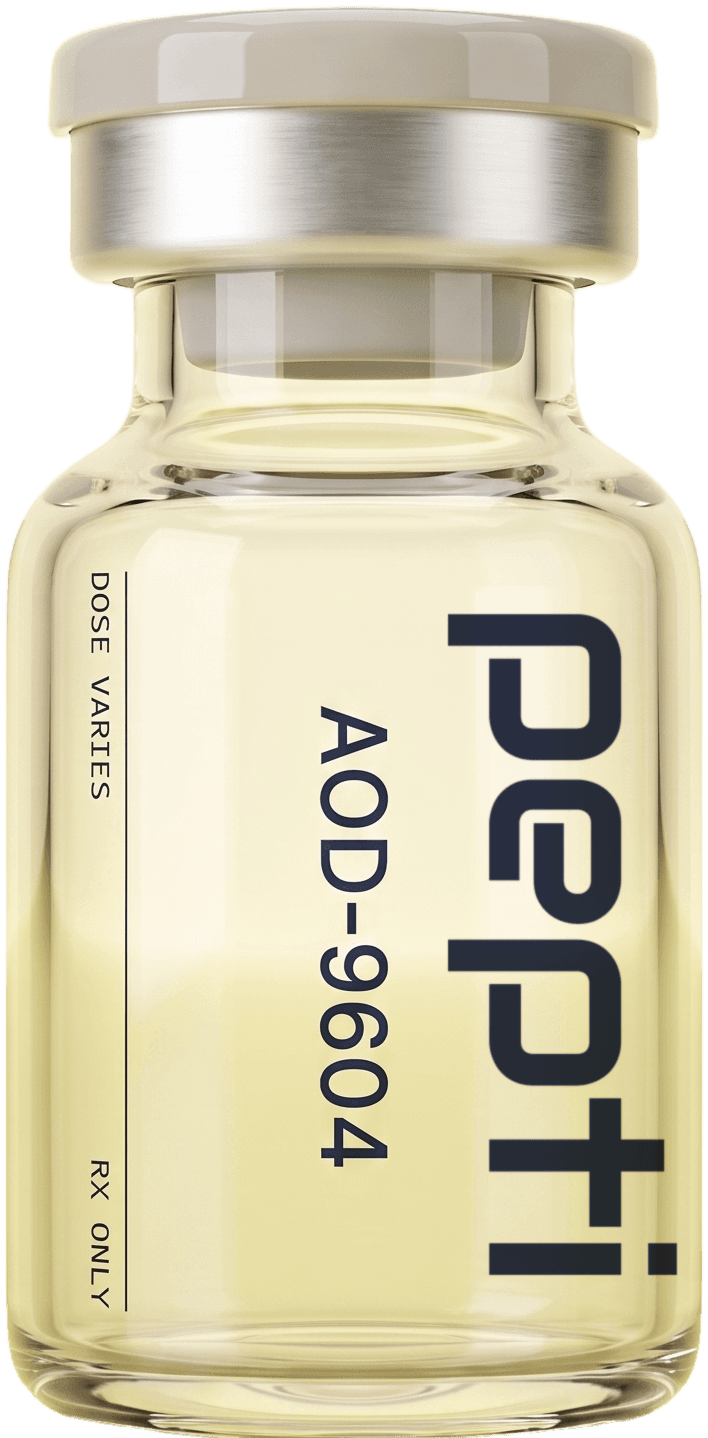
AOD-9604 is a prescription injection supplied as 5 mL multi-dose vial, AOD-9604 2 mg/mL (10 mg AOD-9604 per vial). The reviewed directions are: Inject 0.25 mL (25 units) subcutaneously once daily Monday through Friday. That is 20 doses per vial, about 4 weeks at Monday through Friday. It requires a prescription from a physician licensed in your state, is compounded by a state-licensed US pharmacy, and is not FDA approved.
This page covers what AOD-9604 is, the pathways researchers have described, what the published work and the one real clinical development program do and do not establish, where it currently stands with the FDA, how it is dosed, and how to get it prescribed.
AOD-9604
What AOD-9604 actually is
The tail end of growth hormone, plus one amino acid
Human growth hormone is a protein of 191 amino acids. AOD-9604 is a synthetic copy of the last fifteen of them — positions 177 to 191, the C-terminal end — with an extra tyrosine added at the front, which makes it a hexadecapeptide of sixteen amino acids joined by a single disulphide bridge. It is often called "hGH fragment 176–191" online; the numbering differs by one depending on whether the added tyrosine is counted, but it is the same molecule.
That region of growth hormone is the part that, in the early animal work, seemed to carry the hormone's effect on fat tissue. The whole point of the fragment was to keep that piece and leave the rest behind.
Where the name comes from
AOD stands for Anti-Obesity Drug. The compound came out of biochemistry work at Monash University in Melbourne and was developed and patented in the late 1990s by an Australian company, Metabolic Pharmaceuticals, as an oral obesity treatment. The number is a compound code, not a dose or a strength. The company's clinical program is the most important thing to understand about this peptide, and it is covered in full below, because it is one of the few compounded peptides that has actually been through randomised, placebo-controlled human trials — and the result was negative for weight loss.
What it is not
It is not growth hormone, and it does not behave like it. Cell work reports that it does not bind the growth hormone receptor, animal work reports it does not cause the rise in blood glucose or the fall in insulin sensitivity that full-length growth hormone does, and the human trials reported no change in IGF-1. It is not a growth hormone secretagogue either — it does not prompt the pituitary to release anything, which is what sermorelin, ipamorelin and CJC-1295 / Ipamorelin are for. It is not an appetite drug: nothing in the research describes an effect on hunger or satiety, which is the mechanism behind semaglutide and tirzepatide. And it is not an anabolic agent.
AOD-9604
How AOD-9604 is described to work
Four ideas recur in the published work. All of the mechanistic detail is from animal and cell studies, and the FDA's own 2024 review noted that the molecular target of the peptide has never been identified.
The "lipolytic domain" hypothesis
The founding idea, set out in a 2000 paper in Hormone Research from the Monash group, is that growth hormone's effect on fat tissue lives in its C-terminal region and can be separated from its growth-promoting and diabetogenic effects. In that paper, obese Zucker rats given the fragment orally for 19 days gained substantially less weight than controls, their fat tissue showed increased lipolytic activity when tested, and euglycaemic clamp testing found no adverse effect on insulin sensitivity — in contrast to what chronic growth hormone does.
Beta-3 adrenergic receptors in fat tissue
The paper on file for this page, in Endocrinology in 2001, compared the fragment with full-length growth hormone in obese mice and in mice lacking the beta-3 adrenergic receptor, a receptor on fat cells that drives fat breakdown and heat production. In ordinary obese mice, chronic treatment reduced weight gain and was associated with increased expression of beta-3 receptors in white and brown fat. In the knockout mice, those effects were absent. The proposed reading is that the fragment acts through, or at least depends on, that receptor system rather than on the growth hormone receptor.
Fat oxidation and glycerol release in obese mice
A companion 2001 paper in the International Journal of Obesity gave obese and lean mice either growth hormone, the fragment, or saline by mini-pump for 14 days. Both growth hormone and the fragment reduced weight gain in the obese animals, and this was associated with increased whole-body fat oxidation and higher plasma glycerol, which is a marker of fat cells releasing their contents. Unlike growth hormone, the fragment did not raise blood glucose or reduce insulin secretion.
No signal through the growth hormone receptor
The same 2001 paper tested the fragment in cells engineered to carry the human growth hormone receptor. It did not compete with growth hormone for the receptor and did not drive cell proliferation. That is the laboratory basis for the claim, repeated everywhere online, that AOD-9604 "has the fat effect without the growth effect." The human trials are consistent with it on the specific point of IGF-1, which did not change on treatment, and on glucose tolerance, which was not impaired.
What is still unknown
The FDA's reviewers, going through this literature in 2024, made a point worth repeating: none of the animal studies established a dose-response relationship, the statistics were not corrected for multiple comparisons, and the actual receptor or binding site has not been found. "Works through beta-3 receptors" is a reasonable inference from the knockout data; it is not an established mechanism.
AOD-9604
What the research actually shows
Obese rodents
This is where the case was built. Across the Zucker rat and ob/ob mouse work, chronic treatment reduced weight gain, increased markers of fat breakdown and fat oxidation, and did not produce the glucose and insulin problems seen with growth hormone. The effect sizes were meaningful in those animals. The problem, as the next sections show, is that this did not carry over to people at the doses tested.
A rabbit model of osteoarthritis
A 2015 paper in Annals of Clinical and Laboratory Science injected AOD-9604 into the knees of rabbits with collagenase-induced osteoarthritis, weekly for four to seven weeks, with or without hyaluronic acid. Treated joints scored better on gross and microscopic cartilage assessment than saline-treated joints, and the combination with hyaluronic acid scored better than either alone. This is the origin of the joint and cartilage claims attached to the peptide. It is one study, in one animal model, by intra-articular injection — not subcutaneous — and there is no human study of AOD-9604 for any joint condition.
The Metabolic Pharmaceuticals obesity program
Between roughly 2001 and 2007 the company ran six randomised, double-blind, placebo-controlled trials in Australia, enrolling close to 900 people in total, mostly with obesity. The early studies were small: a 15-man intravenous dose-escalation study, a 23-man intravenous study, and two short oral studies of 17 and 36 men. The intravenous studies reported a rise in circulating free fatty acids within hours of a dose, but no statistically significant weight loss against placebo over the few weeks involved.
The fifth study gave 300 men and women with obesity oral AOD-9604 at one of five daily doses, or placebo, for 12 weeks. It was reported as a conference abstract rather than a full paper; the abstract described weight loss slightly greater than placebo at every dose, with the largest effect at the lowest dose, and a reduction in waist circumference. The FDA's reviewers later described the differences as small and of unclear meaning.
The sixth and decisive study, called OPTIONS, enrolled 536 adults with obesity (502 randomised) and gave them 0.25, 0.5 or 1 mg of oral AOD-9604 or placebo once daily for 24 weeks, on top of a dietitian-supervised diet and exercise program. The primary endpoint was statistically significant weight loss versus placebo at 12 weeks; the trial was powered to detect a difference of 1.8 kg. It did not find one. On 21 February 2007 the company announced that the results did not support the commercial viability of AOD-9604 as an obesity treatment and terminated development for that condition. The company's own statement said weight loss versus placebo at 12 and 24 weeks was too low to reach statistical significance and that the overall population did not respond consistently.
That is the honest summary: the biggest and best-designed human trial of this peptide, run by the company that invented it, found no significant weight loss over placebo.
What human data exists
Unusually for a compounded peptide, there are real randomised human trials — six of them. What they establish is mostly about safety and pharmacology: no change in IGF-1, no impairment of glucose tolerance, no anti-AOD-9604 antibodies detected in the subjects tested, and no serious adverse event judged related to treatment. A 2013 paper in the Journal of Endocrinology and Metabolism, written by people connected to the company, summarises that safety data across all six studies.
Two limits matter. First, every one of those trials used intravenous or oral AOD-9604. There is no published human trial of the subcutaneous injection that is actually prescribed, which the FDA specifically noted in 2024. Second, the efficacy result for obesity was negative. Anyone presenting AOD-9604 as a "clinically proven" fat-loss peptide is describing trials that reached the opposite conclusion.
What the evidence does not establish
- It does not establish weight loss in humans. The largest trial found none over placebo, and the smaller ones found nothing significant.
- It does not establish an effect size or a timeline for body composition change by subcutaneous injection, because that has never been studied in people.
- It does not establish any effect on joints or cartilage in humans. That claim rests on one rabbit study using intra-articular injection.
- It does not establish long-term safety beyond the 24 weeks of the longest trial.
- It does not establish efficacy for any condition as an FDA-approved treatment. It is not approved for anything.
AOD-9604
Where AOD-9604 stands with the FDA right now
AOD-9604 has a longer regulatory history than most compounded peptides, and most of what is online about it is stale. As verified on 24 September 2026:
It was placed in Category 2 of the FDA's interim 503A bulk drug substances list in 2023, the category for nominated substances the agency flags as raising significant safety concerns. The FDA's stated concerns were immunogenicity risk for certain routes, peptide impurities and characterisation, limited safety information, and serious adverse events it had identified as possibly associated with the peptide without clear causality.
It left Category 2 on 27 September 2024, when the nominations behind it were withdrawn. It was not one of the twelve peptides removed from Category 2 on 15 April 2026 — it had already gone eighteen months earlier, alongside CJC-1295, ipamorelin acetate and thymosin alpha-1. The FDA said it would nonetheless evaluate the substance on its own initiative and take it to its advisory committee.
On 4 December 2024 the FDA's Pharmacy Compounding Advisory Committee voted 0 in favour and 12 against adding AOD-9604 (free base) and AOD-9604 acetate to the 503A Bulks List. The use evaluated was obesity. The FDA's briefing document concluded there was a lack of evidence of effectiveness for obesity by any route, citing the failed OPTIONS trial, that no human data existed for the subcutaneous route, and that safety information was insufficient.
Where that leaves it today. The FDA's safety-risks page, current as of 22 April 2026, now lists AOD-9604 under "bulk drug substances nominated but withdrawn," not in Category 2. The interim 503A list updated 14 May 2026 does not show it in Category 1, 2 or 3; Category 2 is down to six substances, none of them peptides prescribed for body composition. It was not on the committee's 23–24 July 2026 agenda, which covered BPC-157, KPV, TB-500, MOTS-c, emideltide, Semax and epitalon, and it is not among the five peptides scheduled for review before the end of February 2027. The FDA has not issued a final rule either adding it to or excluding it from the 503A Bulks List.
On the "GRAS" claim. Some sources say AOD-9604 has FDA GRAS ("generally recognised as safe") status as an oral ingredient. As of September 2026 there is no GRAS notice for AOD-9604 in the FDA's GRAS Notice Inventory, and the FDA's 2024 review, which consulted that inventory, did not identify one. Whatever GRAS status was asserted for the oral ingredient after the obesity program ended was not an FDA "no questions" letter, and it has no bearing on a prescription injection in any case.
So the accurate description is: out of Category 2 since September 2024, a unanimous negative advisory committee recommendation for the obesity use in December 2024, no final FDA rule, nothing scheduled. It remains legal for a physician to prescribe and a licensed pharmacy to compound. It is not an FDA-approved drug product, and compounded medications never are.
AOD-9604
Realistic expectations
These are patterns described by prescribers, not trial endpoints — and for this peptide the trial endpoints are the more important thing to hold in mind. Individual response varies and a physician decides whether treatment is appropriate at all.
The first two weeks
Nothing measurable should be expected. The intravenous studies reported changes in circulating fatty acids within hours of a dose, but that is a blood marker, not a change in body composition. Most people report nothing in this window, which is normal.
Weeks two to eight
If prescribers describe change at all, it is in this window and it is modest — usually framed as support for a diet and training program that is already producing results, not as a driver of results on its own. A vial is sized at four weeks of Monday-to-Friday dosing, and a physician will usually want to see at least two fills before forming a view.
Beyond the first course
There is no withdrawal or rebound described in the literature. Whether there is anything to maintain depends on whether anything changed, and the honest position is that the human evidence does not predict that it will for most people.
What the trials imply about expectations
The OPTIONS trial gave 502 people with obesity a supervised diet and exercise program with or without oral AOD-9604 for six months, and the peptide did not add significant weight loss on top of the program. Anyone whose primary goal is meaningful weight loss should start from that fact. Injection is a different route from the oral tablets used in the trials, and physicians who prescribe it are relying on the animal mechanism and their own clinical judgement, not on a human result that the trials failed to produce.
AOD-9604
When something else makes more sense
A reference that only ever recommends its own product is not much of a reference. Some honest cases where AOD-9604 is not the first thing to reach for:
- You need to lose a meaningful amount of weight. Semaglutide and tirzepatide have large randomised human trials and FDA-approved branded versions behind them. AOD-9604 has a large randomised human trial that found no effect. That comparison is not close.
- The goal is visceral (abdominal) fat specifically. Tesamorelin is the active ingredient of an FDA-approved product for excess abdominal fat in a specific population, with human trial data on visceral fat. It works through the growth hormone axis rather than around it, which is a different conversation to have with your physician.
- You want it alongside growth-hormone-axis peptides. The SHRED blend and the PHYSIQ blend both contain AOD-9604 with secretagogues and MOTS-c in one vial. Whether a blend or a single agent makes sense is your physician's decision.
- Your interest is metabolic rather than fat-focused. MOTS-c and 5-Amino-1MQ are described around different pathways — mitochondrial signalling and NNMT respectively — and may be the better fit for what you are describing.
- The problem is a joint. The rabbit cartilage study is not a reason to choose AOD-9604 for a knee. BPC-157 and TB-500 are the peptides prescribers actually reach for in soft-tissue and joint contexts, and a structural problem is a surgical question.
Your physician will tell you if AOD-9604 is not the right tool for what you have described. A consultation does not guarantee a prescription, and being declined is refunded.
AOD-9604
Strengths available
| Strength | Directions |
|---|---|
| AOD-9604 10mg/5mL | Inject 0.25 mL (25 units) subcutaneously once daily Monday through Friday. |
| AOD-9604 15mg/5mL | Inject 0.25 mL (25 units) subcutaneously once daily Monday through Friday. |
A higher strength delivers more medication in the same volume. Which one you are prescribed is your physician's decision.
AOD-9604
Dosing, and how a vial is actually used
Why the dose is measured in units
The directions are written in millilitres and in insulin-syringe units because that is what you can read off the barrel. 0.25 mL is 25 units on a U-100 syringe. You are not calculating anything — the number is printed on your medication.
Subcutaneous, and why Monday through Friday
Subcutaneous means into the fat layer, not the muscle. Abdomen and thigh are the usual sites, rotated so the same spot is not used repeatedly. The five-days-on, two-days-off pattern is a prescribing convention rather than anything derived from the trials, which used daily oral tablets; it is common across peptide protocols and gives injection sites a rest. Some prescribers direct the injection in the morning before eating, on the theory that it fits the fasted-state fatty-acid changes seen in the intravenous studies. Your directions will say.
Why a vial covers about four weeks
20 doses at Monday through Friday is four weeks, which is why refills run on a 28-day cycle. One vial per fill, always — not a stockpile. Both strengths are the same 5 mL volume with more peptide in it, so the dose volume and the number of doses per vial do not change.
Storage
Refrigerated, and it ships that way in insulated packaging with ice packs. The peptide's disulphide bridge and its tendency, like most peptides, to aggregate if mishandled are the reasons the pharmacy's storage directions matter. Beyond-use dating runs from first puncture and is on the label.
AOD-9604
Safety and side effects
AOD-9604 has more human safety data than most compounded peptides, because of the six company-run trials. Across them, the most commonly reported effects on intravenous dosing were headache, fatigue, dizziness and unspecified low blood sugar; on oral dosing, headache, diarrhoea, flatulence, increased appetite and nausea, more so at the highest oral dose. Adverse events were reported as similarly distributed between peptide and placebo groups. No anti-AOD-9604 antibodies were detected in the subjects tested, IGF-1 did not change, and glucose tolerance was not impaired. Metabolic Pharmaceuticals later ran chronic oral toxicology in rats and monkeys, and genotoxicity assays, and reported no concern; the FDA's reviewers read the same package as inconclusive because the published summary lacked data tables.
Two things from the FDA's 2024 review are worth knowing. First, five serious adverse events in the 300-patient, 12-week oral study were cancers of various types, which the investigators judged unrelated to treatment and which did not occur in the highest-dose group; the FDA noted the published summary did not contain enough detail to confirm that judgement either way. Second, no human trial has used the subcutaneous route, and the FDA's general concern about injected peptides — that they can provoke an immune response and that peptide impurities and aggregation add to that risk — applies here as it does to every compounded peptide injection.
What gets reported clinically is mostly injection-site: redness, mild soreness, occasional bruising. There is no established interaction list, because trials designed to produce one have not been run. That is why the intake asks for every medication you take and why a physician reviews it rather than a form.
Stop and contact your physician for any reaction that is severe, spreading, or involves difficulty breathing.
AOD-9604
How AOD-9604 compares
AOD-9604 vs semaglutide and tirzepatide
Different mechanism, different evidence, different price. Semaglutide and tirzepatide act on appetite and gut hormone receptors, have FDA-approved branded versions with large randomised trials showing substantial weight loss, and are the reference standard for medical weight management. AOD-9604 is described around fat-cell signalling in animals and its human obesity trials were negative. It is not a substitute for a GLP-1 medication, and a physician will not present it as one.
AOD-9604 vs tesamorelin
Both are connected to growth hormone, from opposite directions. Tesamerelin is a growth-hormone-releasing hormone analogue that raises the body's own growth hormone and IGF-1, and its approved product has human trial data on visceral fat in a specific population. AOD-9604 is a fragment of growth hormone that, by design and by the trial data, does not raise IGF-1 at all. Someone wanting to avoid any effect on the growth hormone axis would look at AOD-9604; someone wanting the visceral fat evidence would look at tesamorelin. They are not interchangeable.
AOD-9604 alone vs the SHRED and PHYSIQ blends
The SHRED blend combines AOD-9604 with CJC-1295, ipamorelin and MOTS-c; the PHYSIQ blend combines it with tesamorelin, ipamorelin and MOTS-c. Both put the fragment alongside peptides that do act on the growth hormone axis, which is a deliberate choice rather than an accident: the fragment on its own leaves that axis alone. A single-agent vial is the simpler and cheaper option and the one to start with if the physician wants to see what one compound does before adding others.
Vial only
AOD-9604 is not available as a pepti Pen cartridge, a capsule or a nasal spray. The oral tablets used in the company's trials are not a compounded format Pepti supplies, and the trial result gives no reason to prefer them.
AOD-9604
Availability and formats
| Question | Answer |
|---|---|
| Can I get it by telehealth? | Yes, where a physician licensed in your state prescribes it |
| Which states? | All 50 states and DC |
| Does it come as a pen? | No, this one is a vial and syringe only |
| Does it come as a capsule? | No |
| Does it come as a nasal spray? | No |
| Is bloodwork required first? | Not routinely; your physician decides |
AOD-9604
Where to get AOD-9604 prescribed
AOD-9604 cannot be bought legitimately without a prescription. Sites shipping it with no prescription are selling a research-use-only product, where no pharmacy is accountable for identity, purity, sterility or concentration.
The prescription route works like this:
- Complete a medical intake covering your history, medications, allergies and what you are treating.
- A physician licensed in your state reviews it.
- If appropriate, a state-licensed, FDA-registered pharmacy compounds it to that prescription.
- It ships refrigerated with your directions printed on the vial.
- Your physician stays reachable afterwards for dose questions and side effects.
Current all-in pricing for AOD-9604 is published: medication, physician review, refill management and shipping in one figure, with no separate membership fee. What to check on any provider is in how to tell if a peptide seller is legitimate.
AOD-9604
Who should not take it, or should discuss it first
| Situation | Why |
|---|---|
| Pregnancy or breastfeeding | Not used; safety data is absent |
| Tested athletes | Many peptides are prohibited in competition; check the current list |
Full specification
Everything on the label.
Product
AOD-9604 (Injectable)
How supplied
5 mL multi-dose vial, AOD-9604 2 mg/mL (10 mg AOD-9604 per vial)
Typical directions
Inject 0.25 mL (25 units) subcutaneously once daily Monday through Friday.
Dose volume
0.25 mL (25 units on a U-100 insulin syringe)
Doses per vial
20
Coverage per vial
about 4 weeks at Monday through Friday
Formats
Vial and syringe
Available in
All 50 states and DC
Bloodwork
Not routinely required; your physician decides
Strengths available
2
Legal status
Prescription-only, compounded, not FDA approved
Category
Weight Loss
References
What this is based on.
References
- Heffernan M, Summers RJ, Thorburn A et al.. The effects of human GH and its lipolytic fragment (AOD9604) on lipid metabolism following chronic treatment in obese mice and beta(3)-AR knock-out mice · Endocrinology (2001) · PMID 11713213
- Ng FM, Sun J, Sharma L et al.. Metabolic studies of a synthetic lipolytic domain (AOD9604) of human growth hormone · Hormone Research (2000) · PMID 11146367
- Heffernan MA, Thorburn AW, Fam B et al.. Increase of fat oxidation and weight loss in obese mice caused by chronic treatment with human growth hormone or a modified C-terminal fragment · International Journal of Obesity and Related Metabolic Disorders (2001) · PMID 11673763
- Wilding J. AOD-9604 Metabolic · Current Opinion in Investigational Drugs (2004) · PMID 15134286
- Kwon DR, Park GY. Effect of Intra-articular Injection of AOD9604 with or without Hyaluronic Acid in Rabbit Osteoarthritis Model · Annals of Clinical and Laboratory Science (2015) · PMID 26275694
- Cox HD, Smeal SJ, Hughes CM et al.. Detection and in vitro metabolism of AOD9604 · Drug Testing and Analysis (2015) · PMID 25208511
- Orlovius AK, Thomas A, Schänzer W et al.. AOD-9604 does not influence the WADA hGH isoform immunoassay · Drug Testing and Analysis (2013) · PMID 24124033
- Mendias CL, Awan TM. Safety and Efficacy of Approved and Unapproved Peptide Therapies for Musculoskeletal Injuries and Athletic Performance · Sports Medicine (2026) · PMID 41966639
Citations are provided for educational purposes. They do not constitute medical advice. Always discuss any peptide protocol with your prescribing physician.
Common questions
AOD-9604, answered.
Through a telehealth provider where a physician licensed in your state reviews a medical intake and a licensed US pharmacy compounds the prescription. Pepti prescribes AOD-9604 in all 50 states and DC; start with the free assessment.
5 mL multi-dose vial, AOD-9604 2 mg/mL (10 mg AOD-9604 per vial)
Inject 0.25 mL (25 units) subcutaneously once daily Monday through Friday. Your physician sets your own dose and it is printed on your medication.
20 at the standard volume, about 4 weeks at Monday through Friday.
AOD-9604 is supplied as a vial, drawn with an insulin syringe. It is not available as a pen or capsule.
Not routinely, though your physician may want labs depending on your history. at-home blood testing covers hormone, metabolic and thyroid markers without a lab visit.
It is legal to prescribe and dispense in the United States with a valid prescription. It is not FDA approved: compounded medications are prepared by licensed pharmacies pursuant to a prescription rather than approved as manufactured products. See are peptides FDA approved.
Pricing is published on the AOD-9604 page as one all-in figure covering medication, physician review, refill management and shipping. What drives peptide pricing generally is in how much do peptides cost.
For obesity, yes. Metabolic Pharmaceuticals ran six randomised, placebo-controlled trials of oral and intravenous AOD-9604 in Australia. The largest, with 536 people enrolled and 24 weeks of daily oral dosing on top of a diet and exercise program, did not find statistically significant weight loss versus placebo, and the company ended development for obesity in February 2007. The trials did report a clean safety profile — no IGF-1 change, no antibodies, no related serious adverse events — which is why the peptide is still discussed at all.
No. It was placed in Category 2 of the FDA's 503A bulk substances list in 2023 and removed from it on 27 September 2024 after the nomination was withdrawn. On 4 December 2024 the FDA's Pharmacy Compounding Advisory Committee voted 0–12 against adding it to the 503A Bulks List for obesity; that is a recommendation, and the FDA has not issued a final rule. It is currently listed by the FDA as "nominated but withdrawn," not in any category, and it remains legal for a physician to prescribe.
No. It is a fragment of growth hormone, not a stimulus for it. Cell work reports it does not bind the growth hormone receptor, and across the six human trials IGF-1 did not change on treatment. If raising growth hormone is the aim, that is what secretagogues like sermorelin, ipamorelin and tesamorelin are for.
Yes. AOD-9604 is the C-terminal fragment of human growth hormone — amino acids 177 to 191 — with a tyrosine added at the front. Depending on whether the added tyrosine is counted, sources call it 176–191 or 177–191. Same molecule.
AOD-9604 is prohibited in sport by the World Anti-Doping Agency as a growth hormone fragment, and anti-doping laboratories have published urine detection methods for the peptide and a stable metabolite of it. If you are a tested athlete, check the current prohibited list for your sport before starting anything, and tell your physician.
They work through unrelated mechanisms and some prescribers do combine them, but there is no trial of the combination and no reason from the evidence to expect AOD-9604 to add to a GLP-1 medication's effect. Whether a combination is appropriate for you is your physician's decision, and the GLP-1 medication is the one with the evidence.
One 2015 study in a rabbit model of osteoarthritis reported better cartilage scores after weekly injections directly into the joint, especially combined with hyaluronic acid. There is no human study of AOD-9604 for any joint condition and no study of subcutaneous dosing for joints. A physician considering a joint problem is more likely to discuss BPC-157 or TB-500.
The company's trials used oral tablets, and the largest of them found no significant weight loss versus placebo. So the honest answer is that oral AOD-9604 was tested properly and did not work for obesity at the doses studied. Pepti supplies AOD-9604 as a subcutaneous injection, which is the route prescribers use; it has not been tested in a human trial by that route.
Next step
See what a physician recommends for you.
A licensed physician in your state reviews your intake and decides what is appropriate. A consultation does not guarantee a prescription.