Anti-Aging · Reference
What Happens When You Stop Glutathione? What the Research Shows
No withdrawal syndrome or rebound has been described when glutathione is stopped, and your cells keep making their own, because every nucleated cell synthesizes it.
Treatments mentioned
The one trial that measured what happens after stopping, a six-month oral study published in 2015, found that the rise in body stores returned to baseline within a month of the last dose. Nothing comparable has been measured for the under-the-skin injection, so for injections the honest answer is that the effect is described as maintained while glutathione is being given, not as something that resets a baseline. If you are thinking about stopping, message your care team first so your refills and records match.
This page covers what the research says about stopping glutathione, why there is nothing to "come off," what has not been measured for the injection, and how stopping works with Pepti's refills. Nothing here is a reason to change your own dose or schedule.
What Happens When You Stop Glutathione? What the Research Shows
The short answer
| Question | Answer | Where it comes from |
|---|---|---|
| Is there a withdrawal syndrome? | None has been described | No study or clinical report describes one |
| Does the body keep making glutathione? | Yes; every nucleated cell synthesizes it | Human biochemistry |
| Do body stores drop after stopping? | In the 2015 oral trial, levels returned to baseline within a month | European Journal of Nutrition, 2015 |
| Has stopping the injection been studied? | No | There are no randomized trials of subcutaneous glutathione |
| Does it need tapering? | No taper is described; your directions are what apply | Pepti's directions are a fixed schedule |
| What should I do before stopping? | Message your care team | Keeps refills and your record accurate |
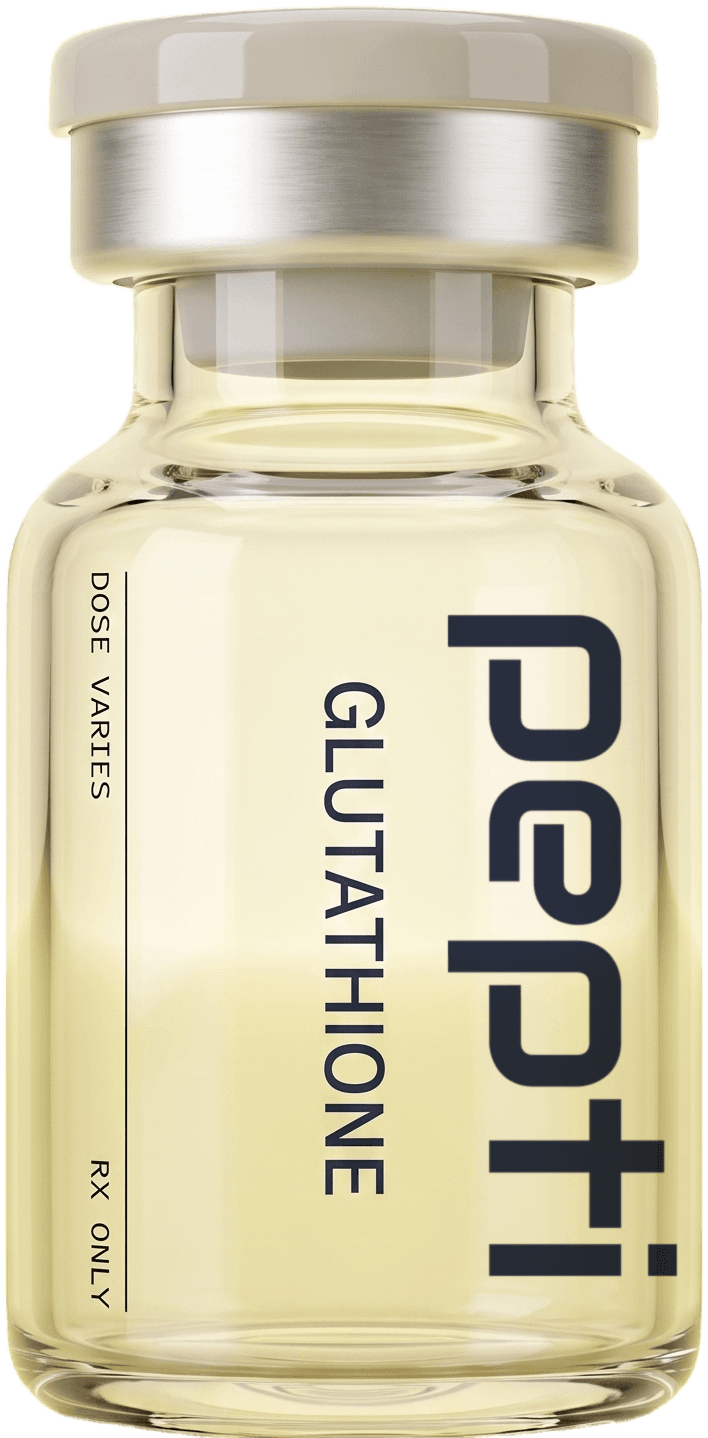
Pepti supplies Glutathione as a 5 mL vial at 200 mg/mL (1000 mg per vial) for $199/mo, all-in. The typical directions are 0.41 mL (41 units) subcutaneously three times per week, 12 doses per vial.
What Happens When You Stop Glutathione? What the Research Shows
Why there is nothing to "come off"
Glutathione is a tripeptide of three amino acids: glutamate, cysteine and glycine. Every nucleated cell makes it, and it is the most abundant small thiol in the body. A 2013 review in Biochimica et Biophysica Acta notes that cysteine supply usually caps how much a cell can make. The active form, reduced glutathione (GSH), is consumed and regenerated continuously: when it neutralizes a reactive molecule it becomes glutathione disulfide (GSSG), and the enzyme glutathione reductase converts it back using NADPH.
That has two consequences for stopping:
| Property | What it means when you stop |
|---|---|
| It does not bind a receptor | There is no receptor to become desensitized or to rebound |
| It is not a hormone, stimulant or sedative | There is no hormone axis to recover and no effect that would wear off abruptly |
| The body makes and recycles it | Your own synthesis carries on whether or not you inject |
| It is a working molecule rather than a signal | Stopping removes an outside supply; it does not switch anything off |
The broader picture across peptides is in what happens when you stop taking peptides: none of them produce physical dependence or a withdrawal syndrome in the way that word is usually meant, and for cofactors the body consumes continuously, levels return to what its own synthesis sustains.
What Happens When You Stop Glutathione? What the Research Shows
What the research shows about stopping
The one trial that measured it
A 2015 randomized, double-blind, placebo-controlled trial in the European Journal of Nutrition gave 54 non-smoking adults 250 or 1,000 mg of oral glutathione daily for six months. In the high-dose group, glutathione in red cells, plasma and lymphocytes ended 30 to 35 percent above baseline, and natural killer cell activity more than doubled compared with placebo at three months, measured as a secondary endpoint. After a one-month washout, levels had returned to baseline.
That is the clearest description in the literature of what stopping does: the extra glutathione that supplementation added was gone within a month, and levels went back to where they started. The trial did not report levels falling below baseline.
What it does not show
The 2015 trial was oral. It says nothing directly about the injection, for two reasons. First, there are no randomized controlled trials of subcutaneous glutathione, so no one has measured whether the injection raises tissue glutathione to begin with. Second, a 1991 study found that high-dose intravenous glutathione rose sharply in plasma and cleared within minutes to an hour, and whether a small subcutaneous dose behaves the same way has not been measured. Without a measured rise, there is no measured fall to describe.
| What is known | What is not known |
|---|---|
| Oral glutathione over months raised body stores in one trial | Whether subcutaneous glutathione raises tissue glutathione |
| Those stores returned to baseline within a month of stopping | How quickly anything changes after stopping the injection |
| No withdrawal or rebound has been described | Long-term effects of years of continuous injection |
| The body keeps synthesizing its own glutathione | Whether stopping feels like anything at all for a given person |
Prescribers describe glutathione as maintained while it is being given rather than something that resets a baseline, and that matches the one trial that measured it.
What Happens When You Stop Glutathione? What the Research Shows
What people notice when they stop
There is no study of what stopping glutathione feels like, so this section cannot list symptoms. What can be said is what is expected not to happen. Glutathione has no stimulant, sedative or pain-relieving action, so stopping it is not expected to produce a crash, rebound fatigue, insomnia or pain. Most people notice nothing in the first several doses of glutathione, and by the same logic there is no reason to expect a sharp change when doses end.
If you notice something new after stopping, it is worth telling your care team rather than assuming it is the glutathione. Fatigue, for example, often has a findable cause; see peptides for energy and fatigue.
What Happens When You Stop Glutathione? What the Research Shows
Stopping, and Pepti's refills
Treatment here is long-term, and refills run every 28 days, one vial per fill. A vial is 12 doses at three a week, so a vial used on schedule lines up with the next shipment. That matters for stopping in two ways.
First, a refill that quietly never gets placed is an unplanned stop that nobody recorded. If you want to stop, message your care team so your subscription and your record match what you are actually doing. Second, if the reason is something a prescriber can address, saying so gives them the chance.
| Reason you want to stop | What to tell your care team |
|---|---|
| A side effect | What it is and when it started; do not change the dose yourself |
| Fever, chills or shaking after a dose | Stop dosing and contact your physician the same day; this is not an expected side effect |
| You are pregnant or trying to conceive | Glutathione is not used in pregnancy or breastfeeding, where safety data is absent |
| Cost | Say so; it is part of the conversation |
| You started a new medication | List it; glutathione is a cofactor in the metabolism of many drugs and there is no established interaction list |
| You no longer want it | Tell them, so refills stop cleanly |
Facial or throat swelling, a widespread rash or difficulty breathing after a dose need emergency care first (call 911), then tell your physician.
Leftover medication
If you stop partway through a vial, do not keep it for later past its beyond-use date. Beyond-use dating, printed on the label, runs from first puncture, and reduced glutathione oxidizes on contact with air. How to store peptides covers in-use dating.
What Happens When You Stop Glutathione? What the Research Shows
Can I measure what happens?
Whole-blood glutathione and the GSH to GSSG ratio are measurable, and the ratio is a standard laboratory measure of oxidative stress. They are not routine. Bloodwork is not required for any Pepti treatment. If your physician wants labs for your care, they'll ask through your account.
What Happens When You Stop Glutathione? What the Research Shows
Glutathione and the FDA
Glutathione is in 503A Category 1 on the FDA's list dated 14 May 2026, "Bulk Drug Substances Under Evaluation," under which state-licensed pharmacies may compound it while the FDA completes its review. It was never in Category 2. Compounded glutathione is not FDA approved, and compounded medications are not FDA approved. More detail is in what is glutathione.
What Happens When You Stop Glutathione? What the Research Shows
Where to get glutathione prescribed
If you are starting again after a stop, or starting for the first time, glutathione injections cannot be bought legitimately without a prescription. The prescription route:
- Complete a free online intake covering your history, medications and what you want help with.
- A physician licensed in your state reviews it, usually within 24 hours.
- If it is appropriate, a PCAB-accredited, FDA-registered US 503A compounding pharmacy prepares it to that prescription. Lot test results are published at /quality/lab-results.
- It ships refrigerated with your directions printed on the vial.
- Your physician stays reachable for questions and dose changes.
Step by step: how to get glutathione prescribed online. Dosing detail is in glutathione dosage, and the evidence is in glutathione benefits.
References
What this is based on.
References
- Richie JP Jr, Nichenametla S, Neidig W et al.. Randomized controlled trial of oral glutathione supplementation on body stores of glutathione · Eur J Nutr (2015) · PMID 24791752
- Allen J, Bradley RD. Effects of oral glutathione supplementation on systemic oxidative stress biomarkers in human volunteers · J Altern Complement Med (2011) · PMID 21875351
- Sinha R, Sinha I, Calcagnotto A et al.. Oral supplementation with liposomal glutathione elevates body stores of glutathione and markers of immune function · Eur J Clin Nutr (2018) · PMID 28853742
- Witschi A, Reddy S, Stofer B, Lauterburg BH. The systemic availability of oral glutathione · Eur J Clin Pharmacol (1992) · PMID 1362956
- Aebi S, Assereto R, Lauterburg BH. High-dose intravenous glutathione in man. Pharmacokinetics and effects on cyst(e)ine in plasma and urine · Eur J Clin Invest (1991) · PMID 1907548
- Arjinpathana N, Asawanonda P. Glutathione as an oral whitening agent: a randomized, double-blind, placebo-controlled study · J Dermatolog Treat (2012) · PMID 20524875
- Weschawalit S, Thongthip S, Phutrakool P, Asawanonda P. Glutathione and its antiaging and antimelanogenic effects · Clin Cosmet Investig Dermatol (2017) · PMID 28490897
- Watanabe F, Hashizume E, Chan GP, Kamimura A. Skin-whitening and skin-condition-improving effects of topical oxidized glutathione: a double-blind and placebo-controlled clinical trial in healthy women · Clin Cosmet Investig Dermatol (2014) · PMID 25378941
- Sonthalia S, Daulatabad D, Sarkar R. Glutathione as a skin whitening agent: Facts, myths, evidence and controversies · Indian J Dermatol Venereol Leprol (2016) · PMID 27088927
- Sechi G, Deledda MG, Bua G et al.. Reduced intravenous glutathione in the treatment of early Parkinson's disease · Prog Neuropsychopharmacol Biol Psychiatry (1996) · PMID 8938817
- Hauser RA, Lyons KE, McClain T, Carter S, Perlmutter D. Randomized, double-blind, pilot evaluation of intravenous glutathione in Parkinson's disease · Mov Disord (2009) · PMID 19230029
- Mischley LK, Lau RC, Shankland EG, Wilbur TK, Padowski JM. Phase IIb Study of Intranasal Glutathione in Parkinson's Disease · J Parkinsons Dis (2017) · PMID 28436395
Citations are provided for educational purposes. They do not constitute medical advice. Always discuss any peptide protocol with your prescribing physician.
Common questions
What Happens When You Stop Glutathione? What the Research Shows, answered.
No withdrawal or rebound has been described, and your cells keep making their own. In a six-month oral trial, the rise in body stores returned to baseline within a month of stopping. Stopping the injection has not been studied.
None has been described. Glutathione does not bind a receptor and is not a hormone, stimulant or sedative, so there is nothing for the body to adjust back from.
In the 2015 oral trial, levels that had risen with supplementation went back to baseline within a month. The trial did not report them falling below baseline. For the injection, levels have not been measured before or after stopping.
No such effect has been described. Every nucleated cell synthesizes glutathione, and the trial that measured stopping found levels returned to baseline, not below it.
No taper is described in the research or in Pepti's directions. Message your care team before stopping so your refills and record match.
The only measurement is from the oral trial, where added body stores were gone within a month. Nothing comparable exists for the injection.
Yes, with a current prescription. Do not use a leftover vial past the beyond-use date printed on its label; it runs from first puncture.
Yes. Fever, chills or shaking shortly after a dose are not an expected side effect. Stop dosing and contact your physician the same day.
No harm from stopping has been described, and no withdrawal syndrome has been reported. Tell your care team when you stop so refills end cleanly.
Bloodwork is not required for any Pepti treatment. If your physician wants labs for your care, they'll ask through your account. The free assessment goes to a physician licensed in your state. A consultation does not guarantee a prescription.
Related answers
Keep reading.
- Glutathione: What It Is, Where to Get It Prescribed, and What It Costs
- Glutathione Benefits: What the Research Actually Shows
- Best Place to Get Glutathione Injections Online: How to Choose a Prescriber
- Best Time to Take Glutathione: Morning, Night, and What the Directions Say
- What Is Peptide Therapy? How It Works, What It Is Used For, and What It Costs
Next step
See what a physician recommends for you.
A licensed physician in your state reviews your intake to see whether treatment fits your history. A consultation does not guarantee a prescription.