Anti-Aging · Reference
Glutathione Dosage: How Pepti Prescribes the Injection, in Units, mL and mg
This page explains the glutathione dosage Pepti prescribes, what the units on the syringe mean, a dosage chart that converts units to millilitres and milligrams, how often it is taken, how long a vial lasts, the doses used in published research and why they are not your dose, what can change your directions, and the side effects to know about. Nothing here is a reason to change your own dose.
Treatments mentioned
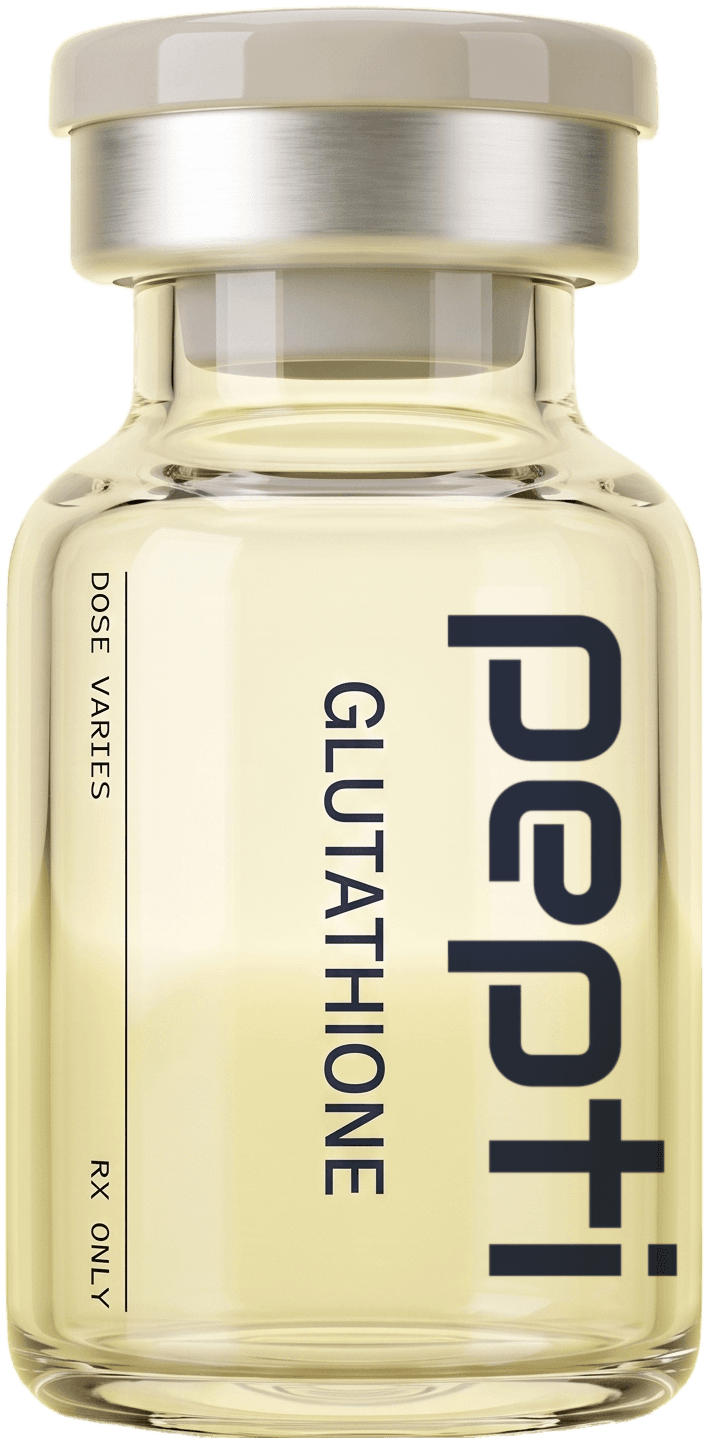
At Pepti, glutathione is prescribed as 0.41 mL, which is 41 units on a U-100 insulin syringe, injected under the skin three times a week. The vial is 5 mL at 200 mg/mL, so each dose carries 82 mg of glutathione and the vial holds 12 doses, about four weeks. Your physician sets your directions after reviewing your intake, and your exact dose and units are printed on the vial. The glutathione doses quoted online usually come from oral or intravenous trials, which used different routes and much larger amounts, and none of them tested the under-the-skin injection.
This page explains the glutathione dosage Pepti prescribes, what the units on the syringe mean, a dosage chart that converts units to millilitres and milligrams, how often it is taken, how long a vial lasts, the doses used in published research and why they are not your dose, what can change your directions, and the side effects to know about. Nothing here is a reason to change your own dose.
Glutathione Dosage
The short answer
| Product | Vial | Typical directions | Glutathione per dose | Doses per vial | Price |
|---|---|---|---|---|---|
| Glutathione | 5 mL, 200 mg/mL (1000 mg per vial) | Inject 0.41 mL (41 units) subcutaneously three times per week | 82 mg | 12 | $199/mo |
The price is all-in, covering medication, physician review, refill management and shipping, with no separate membership fee. Pepti is cash-pay and does not bill insurance. These are the typical printed directions; your own directions are the ones on your vial.
Glutathione Dosage
Glutathione dosage in units, mL and mg
Pepti's directions are written in two forms, millilitres and units, because prescriptions are written in millilitres and insulin syringes are marked in units. On a U-100 insulin syringe, 1 unit is 0.01 mL, so 100 units is 1 mL and 41 units is 0.41 mL. A unit is a volume mark on the barrel, not a measure of how strong the medication is.
The milligram figure comes from the concentration. Pepti's glutathione is supplied at 200 mg/mL, a concentrated solution, so small volumes carry large amounts:
| What you read | Value | Where it comes from |
|---|---|---|
| Dose volume | 0.41 mL | Printed on the vial |
| On a U-100 insulin syringe | 41 units | 0.41 mL x 100 units per mL |
| Concentration | 200 mg/mL | Printed on the vial |
| Glutathione per dose | 82 mg | 200 mg/mL x 0.41 mL |
| Total in the vial | 1000 mg in 5 mL | Printed on the vial |
| Doses per vial | 12 | 5 mL divided by 0.41 mL, whole doses only |
That arithmetic is a way to read a label, not a way to set a dose. A vial labelled 1000 mg is not a 1000 mg dose: it is twelve 82 mg doses. If your label and your syringe seem to disagree, do not dose; message your care team. How long does a peptide vial last explains every number on a vial label in more detail.
Glutathione Dosage
Glutathione dosage chart: units to mL to mg
The chart below is the conversion for a 200 mg/mL vial, drawn with a U-100 insulin syringe. It is math only. It is not a menu of doses, and the only line that applies to you is the one that matches the number printed on your vial.
| Syringe mark (U-100) | Volume | Glutathione from a 200 mg/mL vial |
|---|---|---|
| 10 units | 0.1 mL | 20 mg |
| 20 units | 0.2 mL | 40 mg |
| 25 units | 0.25 mL | 50 mg |
| 30 units | 0.3 mL | 60 mg |
| 41 units (Pepti's typical directions) | 0.41 mL | 82 mg |
| 50 units | 0.5 mL | 100 mg |
| 75 units | 0.75 mL | 150 mg |
| 100 units | 1 mL | 200 mg |
The rule behind every row: units divided by 100 gives millilitres, and millilitres multiplied by 200 gives milligrams, which is the same as units multiplied by 2. A chart written for a different concentration gives different milligrams for the same units, so a glutathione chart from another clinic, or for a research powder, does not transfer to this vial. That is the main reason not to dose from a chart, including this one.
Glutathione is supplied as a vial and syringe only. There is no pen cartridge, so the syringe units are always how the dose is measured.
Glutathione Dosage
How long a glutathione vial lasts
At Pepti's typical directions, one 1000 mg vial lasts about four weeks:
| Step | Value |
|---|---|
| Dose | 41 units, 0.41 mL, 82 mg |
| Doses per week | 3 |
| Doses per vial | 12 (5 mL divided by 0.41 mL, whole doses only) |
| Glutathione used | 12 x 82 mg = 984 mg of the 1000 mg |
| Time per vial | 12 doses divided by 3 per week = 4 weeks |
Four weeks is why refills run every 28 days, one vial per fill. A small remainder stays in the vial because the last partial dose cannot be drawn accurately. If a vial runs short before the refill, message your care team rather than adjusting anything yourself. If you miss a dose, follow your directions and do not take two doses to make up for one.
Glutathione Dosage
How and when glutathione is taken
Three times a week
Pepti's directions say three times per week. The spacing between doses is in your directions. Three-times-weekly dosing is shared with NAD+, the other larger-volume injection in the catalog, and the vial is sized so that 12 doses land on the 28-day refill.
Under the skin, never into a vein
Subcutaneous means into the fat layer, not into muscle and never into a vein. Abdomen and thigh are the usual sites, rotated so the same spot is not used repeatedly. At 41 units, the glutathione draw is larger than most peptide doses, so injecting slowly and steadily matters more. Technique is in how to inject peptides safely, and the full guide to the injection itself is in glutathione injections.
Directions say What it means in practice 0.41 mL (41 units) Draw to the 41 mark on a U-100 insulin syringe Subcutaneously Into the fat layer, abdomen or thigh, rotating sites Three times per week Three doses a week, spaced as your directions say 12 doses per vial About four weeks, then the next refill Storage between doses
Keep the vial refrigerated, capped and in its carton. Reduced glutathione oxidizes on contact with air and is among the constituents prescribers flag as light sensitive. Vials ship refrigerated with ice packs, as a multi-dose solution ready to use, with sterile syringes and alcohol prep pads. Nothing is mixed at home. Follow the beyond-use date printed on the label, which runs from first puncture. How to store peptides covers storage.
Glutathione Dosage
What the trials used, and why that is not your dose
Glutathione has more human trials than most compounded injectables, and the doses in them are often quoted online as if they were injection protocols. They were oral, intravenous or intranasal, and none was subcutaneous:
| Study | Route | Who | How it was dosed |
|---|---|---|---|
| European Journal of Nutrition, 2015, randomized | Oral | 54 non-smoking adults | 250 mg or 1,000 mg daily for six months; body stores rose in the high-dose group |
| Journal of Alternative and Complementary Medicine, 2011, randomized | Oral | 40 adults | 500 mg twice daily for four weeks; no change |
| Journal of Dermatological Treatment, 2012, randomized | Oral | 60 medical students | 500 mg daily for four weeks; skin melanin index measured |
| BMC Gastroenterology, 2017, open-label | Oral | 34 people with fatty liver disease | 300 mg daily for four months, no control group |
| Progress in Neuro-Psychopharmacology and Biological Psychiatry, 1996, open-label | Intravenous | 9 people with early Parkinson's disease | 600 mg twice daily for 30 days |
| Movement Disorders, 2009, randomized | Intravenous | 21 people with Parkinson's disease | 1,400 mg three times a week for four weeks; no difference from placebo |
The honest reading is that there is no human dosing study of subcutaneous glutathione at all. Oral doses pass through the gut, where glutathione is exposed to digestive breakdown (a single oral dose did not raise plasma glutathione in a 1992 study), so oral milligrams do not translate into injected milligrams. Intravenous doses of 600 mg to 1,400 mg rose sharply in plasma and cleared within minutes to an hour in a 1991 study; a 0.41 mL subcutaneous dose is a small fraction of those amounts, one reason the intravenous findings should not be assumed to transfer. These trials also measured laboratory markers and disease scores in specific populations, not how people feel. That is why your directions come from a physician who has reviewed your intake, not from a study table. The evidence, claim by claim, is in glutathione benefits.
Glutathione Dosage
What changes the directions
Your physician sets your directions after reviewing your intake. Things that can lead to different directions include:
| What can change | How it shows up |
|---|---|
| Your medical history | Asthma, liver or kidney disease, pregnancy or breastfeeding change the conversation |
| Your other medications | Glutathione is a cofactor in the metabolism of many drugs and there is no established interaction list, so the intake asks for everything you take |
| Pairing with NAD+ | Some people are prescribed NAD+ Injection alongside it; each has its own label |
| How you respond | Side effects go to your care team, who may revise your directions |
When directions change, the new numbers are printed on the new label. Never carry a number over from a previous fill. Bloodwork is not required for any Pepti treatment. If your physician wants labs for your care, they'll ask through your account.
Glutathione Dosage
Side effects, in summary
The full list is in glutathione side effects. Glutathione has an unusually deep tolerability record: the 2009 intravenous trial reported adverse events similar to placebo at 1,400 mg three times weekly, and the six-month oral trial reported no safety signal.
| What is reported | How often | What to do |
|---|---|---|
| Injection-site redness, mild soreness, occasional bruising | Common | Rotate sites |
| Brief light-headedness or nausea after a dose | Uncommon | Report it to your care team; do not change the dose yourself |
| Fever, chills or shaking shortly after a dose | Not expected | Stop and contact your physician the same day |
| Facial or throat swelling, widespread rash, difficulty breathing | Rare | Emergency care first (call 911), then tell your physician |
Glutathione is in 503A Category 1 on the FDA's list dated 14 May 2026, "Bulk Drug Substances Under Evaluation," and was never in Category 2. Compounded glutathione is not FDA approved, and compounded medications are not FDA approved.
Glutathione Dosage
Where to get glutathione prescribed
Glutathione injections cannot be bought legitimately without a prescription. Sites selling vials "for research use only" are not accountable for identity, purity, sterility or concentration, so even the concentration your units chart depends on is unknown. In 2019 the FDA warned about a supplement-grade glutathione powder used to make injections that contained bacterial endotoxin. The prescription route:
- Complete a free online intake covering your history, medications and what you want help with.
- A physician licensed in your state reviews it, usually within 24 hours.
- If it is appropriate, a PCAB-accredited, FDA-registered US 503A compounding pharmacy prepares it to that prescription. Lot test results are published at /quality/lab-results.
- It ships refrigerated with your directions printed on the vial.
- Your physician stays reachable for questions and dose changes.
Pepti prescribes glutathione in every state except Oklahoma, plus DC Step by step: how to get glutathione prescribed online. The full product reference is what is glutathione.
References
What this is based on.
References
- Richie JP Jr, Nichenametla S, Neidig W et al.. Randomized controlled trial of oral glutathione supplementation on body stores of glutathione · Eur J Nutr (2015) · PMID 24791752
- Allen J, Bradley RD. Effects of oral glutathione supplementation on systemic oxidative stress biomarkers in human volunteers · J Altern Complement Med (2011) · PMID 21875351
- Sinha R, Sinha I, Calcagnotto A et al.. Oral supplementation with liposomal glutathione elevates body stores of glutathione and markers of immune function · Eur J Clin Nutr (2018) · PMID 28853742
- Witschi A, Reddy S, Stofer B, Lauterburg BH. The systemic availability of oral glutathione · Eur J Clin Pharmacol (1992) · PMID 1362956
- Aebi S, Assereto R, Lauterburg BH. High-dose intravenous glutathione in man. Pharmacokinetics and effects on cyst(e)ine in plasma and urine · Eur J Clin Invest (1991) · PMID 1907548
- Arjinpathana N, Asawanonda P. Glutathione as an oral whitening agent: a randomized, double-blind, placebo-controlled study · J Dermatolog Treat (2012) · PMID 20524875
- Weschawalit S, Thongthip S, Phutrakool P, Asawanonda P. Glutathione and its antiaging and antimelanogenic effects · Clin Cosmet Investig Dermatol (2017) · PMID 28490897
- Watanabe F, Hashizume E, Chan GP, Kamimura A. Skin-whitening and skin-condition-improving effects of topical oxidized glutathione: a double-blind and placebo-controlled clinical trial in healthy women · Clin Cosmet Investig Dermatol (2014) · PMID 25378941
- Sonthalia S, Daulatabad D, Sarkar R. Glutathione as a skin whitening agent: Facts, myths, evidence and controversies · Indian J Dermatol Venereol Leprol (2016) · PMID 27088927
- Sechi G, Deledda MG, Bua G et al.. Reduced intravenous glutathione in the treatment of early Parkinson's disease · Prog Neuropsychopharmacol Biol Psychiatry (1996) · PMID 8938817
- Hauser RA, Lyons KE, McClain T, Carter S, Perlmutter D. Randomized, double-blind, pilot evaluation of intravenous glutathione in Parkinson's disease · Mov Disord (2009) · PMID 19230029
- Mischley LK, Lau RC, Shankland EG, Wilbur TK, Padowski JM. Phase IIb Study of Intranasal Glutathione in Parkinson's Disease · J Parkinsons Dis (2017) · PMID 28436395
Citations are provided for educational purposes. They do not constitute medical advice. Always discuss any peptide protocol with your prescribing physician.
Common questions
Glutathione Dosage, answered.
At Pepti, glutathione is typically prescribed as 0.41 mL, which is 41 units on a U-100 insulin syringe, injected subcutaneously three times a week. From the 200 mg/mL vial that is 82 mg per dose. Your physician sets your directions after reviewing your intake, and your exact dose is printed on the vial.
The amount printed on your vial, on the schedule printed on your vial. Pepti's typical directions are 41 units three times a week, but your own directions are set by your physician after reviewing your intake. If you have questions about your dose, message your care team.
The number printed on your vial. Pepti's typical directions are 41 units, which is 0.41 mL on a U-100 insulin syringe.
From a 200 mg/mL vial, 82 mg. 25 units is 50 mg and 50 units is 100 mg. Those figures only hold at 200 mg/mL; a different concentration gives different milligrams for the same units.
Pepti's typical directions are three times a week, with the spacing in your directions. Twelve doses per vial at three a week is about four weeks.
About four weeks. A 1000 mg vial at 41 units (82 mg) three times a week is 12 injections, matching the 28-day refill.
Oral trials used 250 mg to 1,000 mg a day, and intravenous trials in Parkinson's disease used 600 mg twice daily or 1,400 mg three times a week. No study has tested subcutaneous glutathione, so none of those numbers is an injection dose.
There is no trial that defines an effective subcutaneous dose, so no one can say what amount is enough for a given person. Your directions are set by your physician after reviewing your intake. If you have questions about your dose, message your care team.
No. Take the dose printed on your vial, on the schedule printed on your vial. If you have questions about your dose, message your care team.
No. Pepti vials are multi-dose solutions shipped ready to use, with sterile syringes and alcohol prep pads. Nothing is reconstituted at home.
Bloodwork is not required for any Pepti treatment. If your physician wants labs for your care, they'll ask through your account. The free assessment goes to a physician licensed in your state. A consultation does not guarantee a prescription.
Next step
See what a physician recommends for you.
A licensed physician in your state reviews your intake and decides what is appropriate. A consultation does not guarantee a prescription.