Recovery · Reference
KPV Peptide Dosage: How Pepti Prescribes It, in Units, mL and mg
This page explains the KPV peptide dosage Pepti prescribes, what the units on the syringe mean, a chart that converts units to millilitres and milligrams, every Pepti product that contains KPV, when it is taken, how long a vial lasts, what can change your directions, and the side effects to know about. It covers how Pepti prescribes KPV, not dosing protocols from the internet. Nothing here is a reason to change your own dose.
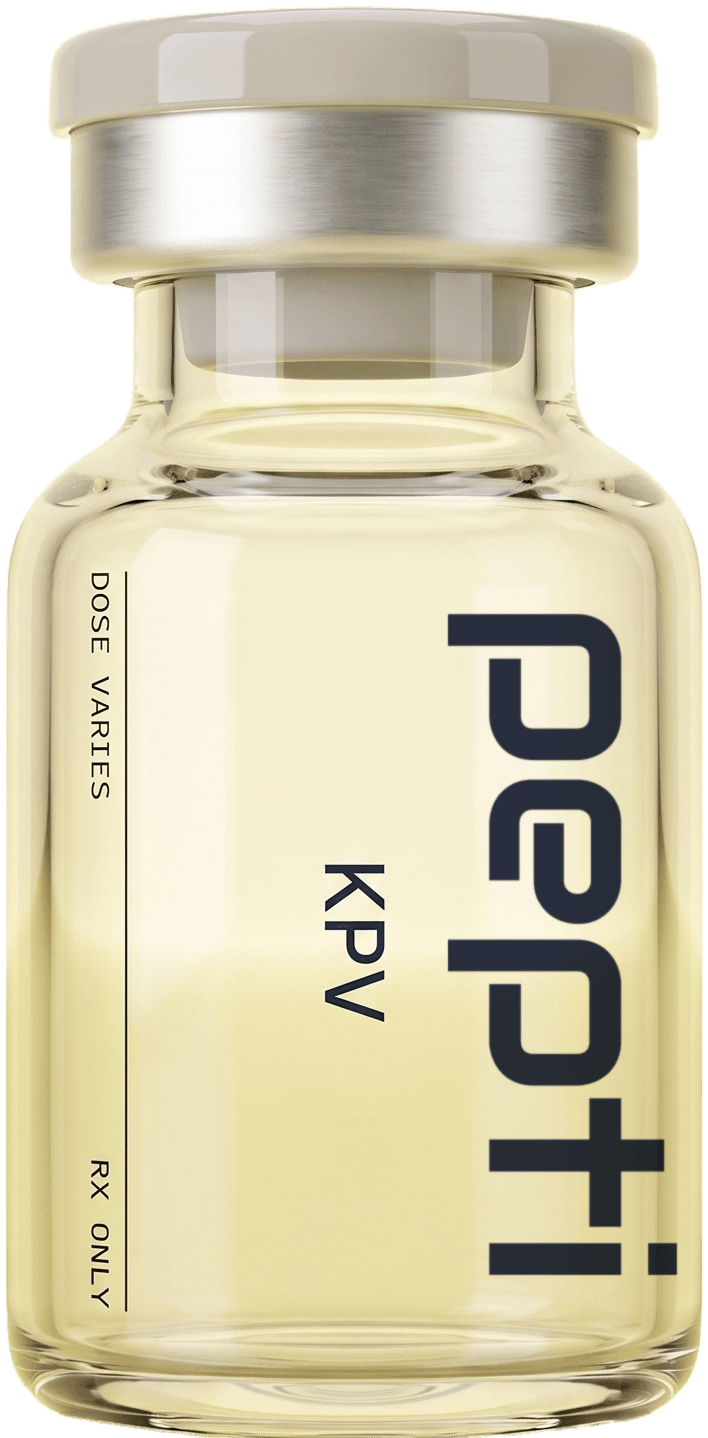
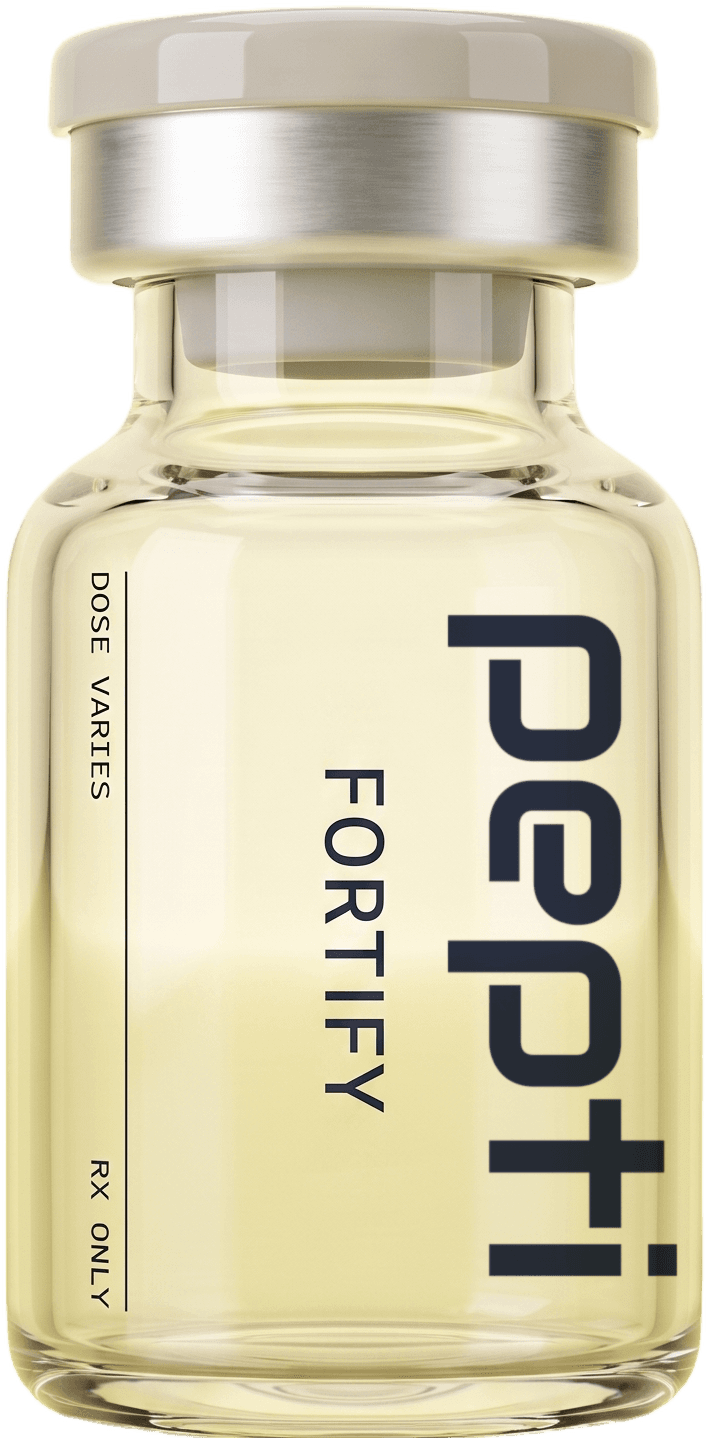
At Pepti, KPV is prescribed as 0.25 mL, which is 25 units on a U-100 insulin syringe, injected under the skin once daily Monday through Friday. The vial is 5 mL at 2 mg/mL, so each 0.25 mL dose carries 0.5 mg of KPV and the vial holds 20 doses, about four weeks. Your physician sets your directions after reviewing your intake, and your exact dose and units are printed on the vial. KPV also appears in three Pepti blends; all of them use the same 25 unit draw, but one of them, FORTIFY, carries a smaller amount of KPV per dose.
This page explains the KPV peptide dosage Pepti prescribes, what the units on the syringe mean, a chart that converts units to millilitres and milligrams, every Pepti product that contains KPV, when it is taken, how long a vial lasts, what can change your directions, and the side effects to know about. It covers how Pepti prescribes KPV, not dosing protocols from the internet. Nothing here is a reason to change your own dose.
KPV Peptide Dosage
The short answer
| Product | Vial | Typical directions | KPV per dose | Doses per vial | Price |
|---|---|---|---|---|---|
| KPV | 5 mL, 2 mg/mL (10 mg per vial) | Inject 0.25 mL (25 units) subcutaneously once daily Monday through Friday | 0.5 mg | 20 | $229/mo |
Every price is all-in, covering medication, physician review, refill management and shipping, with no separate membership fee. Pepti is cash-pay and does not bill insurance. These are the typical printed directions; your own directions are the ones on your vial.
KPV Peptide Dosage
KPV dosage in units, mL and mg
Pepti's directions are written in two forms, millilitres and units, because prescriptions are written in millilitres and insulin syringes are marked in units. On a U-100 insulin syringe, 1 unit is 0.01 mL, so 100 units is 1 mL and 25 units is 0.25 mL. A unit is a volume mark on the barrel, not a measure of how strong the medication is.
The milligram figure comes from the concentration on the label. Pepti's KPV is supplied at 2 mg/mL, so:
| What you read | Value | Where it comes from |
|---|---|---|
| Dose volume | 0.25 mL | Printed on the vial |
| On a U-100 insulin syringe | 25 units | 0.25 mL x 100 units per mL |
| Concentration | 2 mg/mL | Printed on the vial |
| KPV per dose | 0.5 mg (500 mcg) | 2 mg/mL x 0.25 mL |
| Total in the vial | 10 mg in 5 mL | Printed on the vial |
| Doses per vial | 20 | 5 mL divided by 0.25 mL |
| How long the vial lasts | About 4 weeks | 20 doses at 5 a week |
That arithmetic is a way to read a label, not a way to set a dose. A vial labelled 10 mg is not a 10 mg dose: it is twenty 0.5 mg doses. If your label and your syringe seem to disagree, do not dose; message your care team. How long does a peptide vial last explains every number on a vial label in more detail.
KPV Peptide Dosage
KPV dosage chart: units to mL to mg
KPV doses online are quoted in micrograms, milligrams and units interchangeably, and those numbers only line up if you know the concentration of the vial they came from. The chart below is the conversion for a 2 mg/mL vial, drawn with a U-100 insulin syringe. It is math only. It is not a menu of doses, and the only line that applies to you is the one that matches the number printed on your vial.
| Syringe mark (U-100) | Volume | KPV from a 2 mg/mL vial |
|---|---|---|
| 10 units | 0.10 mL | 0.2 mg (200 mcg) |
| 20 units | 0.20 mL | 0.4 mg (400 mcg) |
| 25 units | 0.25 mL | 0.5 mg (500 mcg), Pepti's typical printed direction |
| 30 units | 0.30 mL | 0.6 mg (600 mcg) |
| 50 units | 0.50 mL | 1.0 mg (1,000 mcg) |
At 2 mg/mL, every unit on the syringe carries 0.02 mg, or 20 mcg, of KPV. A unit figure from any other source only means the same thing if that vial was also 2 mg/mL, which is why you read your own label rather than a chart, including this one.
KPV Peptide Dosage
KPV dosage chart: every Pepti product that contains it
KPV is prescribed on its own and inside three blends. Each is a 5 mL vial drawn at 0.25 mL, 20 doses per vial. The KPV per dose is computed from each vial's concentration.
| Product | KPV per vial | What else is in it | Typical directions | KPV per dose | Price |
|---|---|---|---|---|---|
| KPV | 10 mg (2 mg/mL) | Nothing | 0.25 mL (25 units) once daily Monday through Friday | 0.5 mg | $229/mo |
| KLOW Blend | 10 mg (2 mg/mL) | 50 mg GHK-Cu, 10 mg BPC-157, 10 mg TB-500 | 0.25 mL (25 units) Monday through Friday mornings | 0.5 mg | $259/mo |
| ELEVATE Blend | 10 mg (2 mg/mL) | 5 mg semax, 5 mg selank, 10 mg BPC-157 | 0.25 mL (25 units) once daily Monday through Friday | 0.5 mg | $249/mo |
| FORTIFY Blend | 2 mg (0.4 mg/mL) | 5 mg thymosin alpha-1, 5 mg BPC-157, 1 mg LL-37 | 0.25 mL (25 units) once daily Monday through Friday | 0.1 mg | $289/mo |
Two things stand out. First, the volume never changes: every product in the chart is 25 units. Second, FORTIFY is the one product where the same 25 units carries much less KPV, a fifth of the amount in the others, because its vial holds KPV at 0.4 mg/mL. That is the clearest example of why a unit number means nothing without the concentration on the label.
In a blend, every ingredient is in fixed proportion. One draw delivers all of them in the ratio the pharmacy compounded, and there is no way to take more KPV and less of something else from the same vial. If a different balance is wanted, that is a different prescription. On its own, KPV is one variable, which makes it easier to tell whether it is doing anything; a blend is a convenience, not a stronger version. The KLOW split is in KLOW dosage.
KPV Peptide Dosage
When KPV is taken
Once daily, Monday through Friday
Pepti's KPV directions say once daily, Monday through Friday, with weekends off. The two days off are part of the schedule as reviewed, not something to fill in on your own. Twenty doses at five a week is four weeks, which lines each vial up with a 28-day refill. Inside KLOW, the label says mornings.
Under the skin
Subcutaneous means into the fat layer, not the muscle. Abdomen and thigh are the usual sites, rotated so the same spot is not used repeatedly. The mechanisms described for KPV are systemic, so there is no particular reason to inject near a sore area. Technique is covered in how to inject peptides safely.
Directions say What it means in practice 0.25 mL (25 units) Draw to the 25 mark on a U-100 insulin syringe Subcutaneously Into the fat layer, abdomen or thigh, rotating sites Once daily One injection a day on dosing days Monday through Friday Five doses a week, weekends off 20 doses per vial About four weeks, then the next refill Injected, not oral
Much of the mouse gut research gave KPV orally in drinking water, because the PepT1 transporter in the intestinal lining carries it into cells. Those were research formulations, and the oral and subcutaneous routes have not been compared. Pepti supplies KPV as an injection, and a dose from an oral study does not translate into units on a syringe.
KPV Peptide Dosage
Storage and refills
Vials are multi-dose solutions shipped ready to use, refrigerated with ice packs, with sterile syringes and alcohol prep pads. Nothing is mixed at home. Once punctured, keep the vial in the refrigerator between doses; beyond-use dating runs from first puncture and is printed on the label. One vial per fill, every 28 days. How to store peptides covers storage.
If a vial runs short before the refill, message your care team rather than adjusting anything yourself. If you miss a weekday dose, follow your directions and do not take two doses to make up for one.
KPV Peptide Dosage
What changes the directions
Your physician sets your directions after reviewing your intake. Things that can lead to different directions, or a different product, include:
| What can change | How it shows up |
|---|---|
| KPV alone or in a blend | Each blend has its own label; FORTIFY carries 0.1 mg of KPV per dose |
| Your goal | A specific injury may point to BPC-157; skin appearance to GHK-Cu |
| Your medical history | A diagnosed inflammatory condition on prescribed treatment, or red-flag gut symptoms, change the conversation |
| Your other medications | Immunosuppressants or biologic therapy should be raised specifically |
| How you respond | Side effects you report go to your physician, who may revise your directions |
When directions change, the new numbers are printed on the new label. Never carry a number over from a previous fill. Bloodwork is not required for any Pepti treatment. If your physician wants labs for your care, they'll ask through your account.
KPV Peptide Dosage
Side effects, in summary
The full picture is in KPV side effects.
| What is reported | How often | What to do |
|---|---|---|
| Injection-site redness, mild soreness, occasional bruising | The most common | Rotate sites |
| Mild nausea early on | Some people | Message your care team if it persists |
| Transient headache or light-headedness | Some people | Message your care team if it persists |
| Skin darkening | Not expected | KPV lacks the pigment-driving part of alpha-MSH |
| Facial or throat swelling, spreading rash, breathing difficulty | Rare with any injected peptide | Call 911 or go to emergency care first, then tell your care team |
KPV is not a replacement for prescribed treatment of a diagnosed inflammatory condition. It is not used in pregnancy or breastfeeding. Blood in the stool, unintentional weight loss, persistent vomiting or symptoms that wake you at night need investigation before any peptide.
KPV Peptide Dosage
What the evidence shows, honestly
There is no human dose for KPV, because there are no human studies of KPV. The FDA's review for its July 2026 advisory committee found no published studies in which KPV products were used in humans. Every dose in the research literature is a mouse or cell dose, much of it given orally, and none of it maps onto a number of units.
What Pepti prints on the vial is a prescribing convention: a small subcutaneous dose on weekdays, sized so a vial lasts four weeks. It is a reasonable basis for a physician to prescribe, on the strength of a coherent preclinical anti-inflammatory story and clinical experience. It is not evidence that 0.5 mg is better than any other amount, and any page that quotes an "optimal" KPV dose for people has no trial behind it. The research is set out benefit by benefit in KPV benefits.
KPV is a compounded prescription, and compounded medications are not FDA approved. The FDA removed KPV from Category 2 of its 503A bulks list in April 2026, and on 23 July 2026 its Pharmacy Compounding Advisory Committee voted 8 to 6, with one abstention, to recommend adding it to the 503A Bulks List. The FDA's final determination is pending, and it remains legal to prescribe and dispense.
KPV Peptide Dosage
Where to get KPV prescribed
KPV cannot be bought legitimately without a prescription. Sites selling it "for research use only" are not accountable for what is in the vial: identity, purity, sterility and concentration are untested, and an unknown concentration makes any unit number meaningless. The prescription route:
- Complete a free online intake covering your history, medications and what you want help with.
- A physician licensed in your state reviews it, usually within 24 hours.
- If it is appropriate, a PCAB-accredited, FDA-registered US 503A compounding pharmacy prepares it to that prescription. Lot test results are published at /quality/lab-results.
- It ships refrigerated with your directions printed on the vial.
- Your physician stays reachable for questions and dose changes.
Pepti prescribes KPV in every state except Oklahoma, plus DC Step by step: how to get KPV prescribed online. The full product reference is what is KPV, and how it compares with the most common repair peptide is in KPV vs BPC-157.
References
What this is based on.
References
- Dalmasso G, Charrier-Hisamuddin L, Nguyen HT et al.. PepT1-mediated tripeptide KPV uptake reduces intestinal inflammation · Gastroenterology (2008) · PMID 18061177
- Kannengiesser K, Maaser C, Heidemann J et al.. Melanocortin-derived tripeptide KPV has anti-inflammatory potential in murine models of inflammatory bowel disease · Inflamm Bowel Dis (2008) · PMID 18092346
- Xiao B, Xu Z, Viennois E et al.. Orally Targeted Delivery of Tripeptide KPV via Hyaluronic Acid-Functionalized Nanoparticles Efficiently Alleviates Ulcerative Colitis · Mol Ther (2017) · PMID 28143741
- Land SC. Inhibition of cellular and systemic inflammation cues in human bronchial epithelial cells by melanocortin-related peptides: mechanism of KPV action and a role for MC3R agonists · Int J Physiol Pathophysiol Pharmacol (2012) · PMID 22837805
- Cutuli M, Cristiani S, Lipton JM et al.. Antimicrobial effects of alpha-MSH peptides · J Leukoc Biol (2000) · PMID 10670585
- Schaible EV, Steinsträßer A, Jahn-Eimermacher A et al.. Single administration of tripeptide α-MSH(11-13) attenuates brain damage by reduced inflammation and apoptosis after experimental traumatic brain injury in mice · PLoS One (2013) · PMID 23940690
- Bonfiglio V, Camillieri G, Avitabile T et al.. Effects of the COOH-terminal tripeptide alpha-MSH(11-13) on corneal epithelial wound healing: role of nitric oxide · Exp Eye Res (2006) · PMID 16965771
Citations are provided for educational purposes. They do not constitute medical advice. Always discuss any peptide protocol with your prescribing physician.
Common questions
KPV Peptide Dosage, answered.
At Pepti, 0.25 mL, which is 25 units on a U-100 insulin syringe, injected subcutaneously once daily Monday through Friday. From the 2 mg/mL vial that is 0.5 mg per dose. Your physician sets your directions after reviewing your intake, and your exact dose is printed on the vial.
The number printed on your vial. Pepti's typical directions are 25 units, which is 0.25 mL on a U-100 insulin syringe, where 1 unit is 0.01 mL.
From a 2 mg/mL vial, 500 mcg, which is 0.5 mg. In the FORTIFY Blend, which holds KPV at 0.4 mg/mL, the same 25 units carries 100 mcg.
Twenty. A 5 mL vial divided by 0.25 mL per dose is 20 doses, about four weeks at five days a week.
The charts above convert units to millilitres and milligrams for a 2 mg/mL vial, and list every Pepti product that contains KPV with its directions and KPV per dose. Your own label is the one that applies.
Standalone KPV is directed once daily Monday through Friday without a stated time. KLOW, which contains KPV, is directed in the morning; follow the timing on your label.
No. Take the dose printed on your vial, on the schedule printed on your vial. There is no human study that tells anyone what any KPV dose does, let alone a higher one. If you have questions about your dose, message your care team.
No. The oral doses in the literature come from mice given research formulations in drinking water. The routes have not been compared, and an oral figure does not convert into units on a syringe.
The volume is the same in every Pepti product that contains KPV: 0.25 mL, 25 units. The KPV per dose is 0.5 mg in KPV, KLOW and ELEVATE, and 0.1 mg in FORTIFY.
No. Pepti vials are multi-dose solutions shipped ready to use, with sterile syringes and alcohol prep pads. Nothing is reconstituted at home.
Bloodwork is not required for any Pepti treatment. If your physician wants labs for your care, they'll ask through your account. The free assessment goes to a physician licensed in your state. A consultation does not guarantee a prescription.
Next step
See what a physician recommends for you.
A licensed physician in your state reviews your intake and decides what is appropriate. A consultation does not guarantee a prescription.