— Recovery · Reference
KPV: What It Is, Where to Get It Prescribed, and What It Costs
This page covers what KPV is, the pathways researchers have described, what the published work does and does not establish, where it currently stands with the FDA, how it is dosed, and how to get it prescribed.
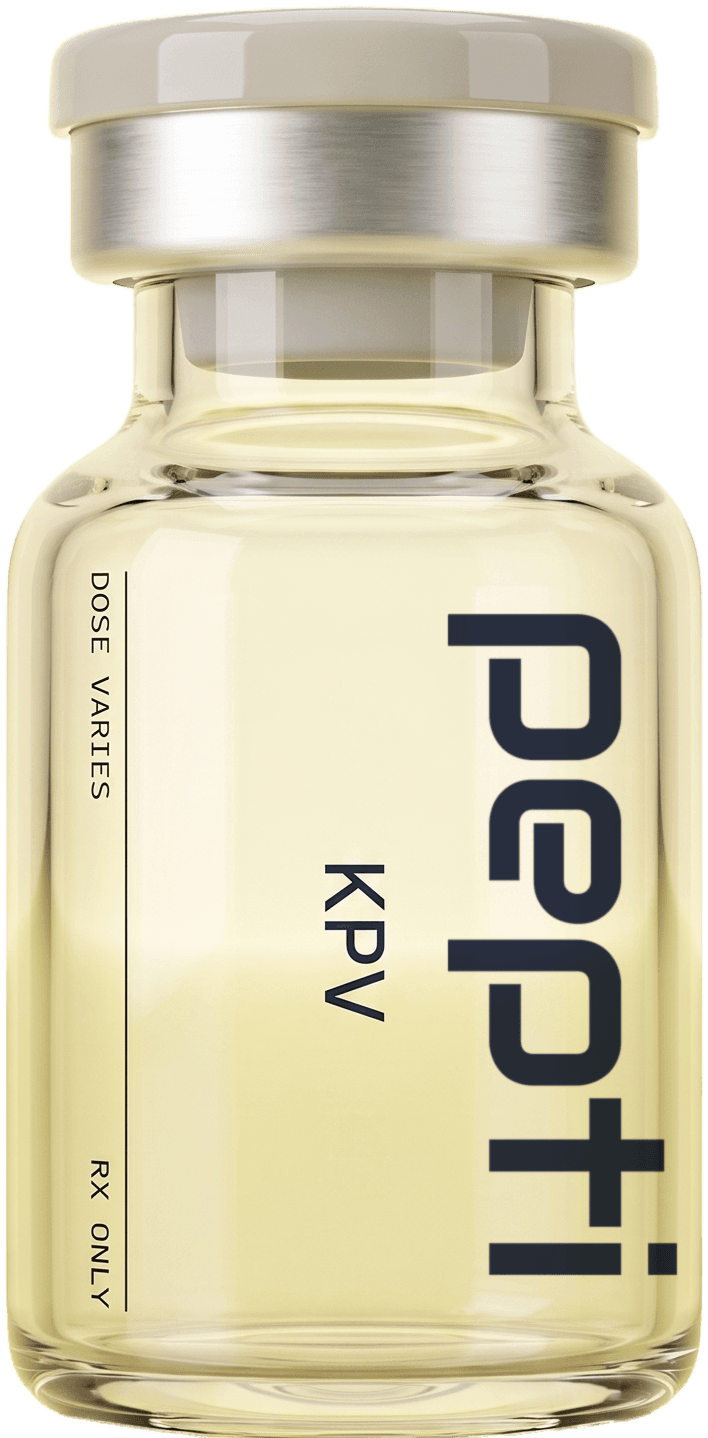
KPV is a prescription injection supplied as 5 mL multi-dose vial, KPV 2 mg/mL (10 mg KPV per vial). The reviewed directions are: Inject 0.25 mL (25 units) subcutaneously once daily Monday through Friday. That is 20 doses per vial, about 4 weeks at Monday through Friday. It requires a prescription from a physician licensed in your state, is compounded by a state-licensed US pharmacy, and is not FDA approved.
This page covers what KPV is, the pathways researchers have described, what the published work does and does not establish, where it currently stands with the FDA, how it is dosed, and how to get it prescribed.
— KPV
What KPV actually is
— The last three amino acids of a hormone the body already makes
KPV is a tripeptide — three amino acids, lysine-proline-valine, which is where the name comes from. It is the C-terminal end of alpha-melanocyte-stimulating hormone (alpha-MSH), a thirteen-amino-acid hormone the body makes from the precursor pro-opiomelanocortin. In the literature it is often written as alpha-MSH(11-13), positions eleven to thirteen of the parent molecule.
That parentage matters. Alpha-MSH is best known for driving pigmentation, but it has a second, well-documented role as an anti-inflammatory signal the body uses to keep immune responses in check. KPV is an attempt to isolate that second role from the first.
— Why the fragment was isolated in the first place
Researchers working on alpha-MSH noticed that its anti-inflammatory effects tracked with the C-terminal end of the molecule. A 2008 review in Endocrine Reviews sets this out: the three-amino-acid tail retained much of the anti-inflammatory and protective activity of the parent hormone in cell and animal models, while pigmentation depends on a different part of the sequence. Isolating KPV keeps the signalling of interest and leaves the tanning behind.
It is not a hormone in its own right and it is not a steroid. It does not suppress any hormone production of your own and carries no anabolic activity.
— What it is not
It is not a corticosteroid and it is not a substitute for one; a patient on prescribed treatment for a diagnosed inflammatory disease should not be swapping that treatment for a peptide. It is not a painkiller; nothing in the literature describes an analgesic mechanism. And it is not a tanning peptide — that is Melanotan II, a different molecule.
— KPV
How KPV is described to work
Five things come up repeatedly in the published work. All of the mechanistic detail below is from animal and cell studies.
— Getting inside the cell through PepT1
The most specific mechanism described is how KPV enters cells. A 2008 paper in Gastroenterology reported that KPV is carried into intestinal epithelial cells by PepT1, the transporter the gut lining uses to absorb small peptides from food, and that its effect on inflammatory signalling depended on the transporter being present. This is unusual for a peptide — most act at a receptor on the cell surface — and it is the basis for the claim that KPV works from inside the cell.
— Interrupting NF-kB and MAPK signalling
Once inside, KPV is described as interfering with two of the main intracellular pathways that turn an inflammatory trigger into an inflammatory response: NF-kB and MAPK. NF-kB is the switch that, when activated, moves into the nucleus and starts transcription of pro-inflammatory genes. The Gastroenterology work and a 2008 paper in Inflammatory Bowel Diseases both describe reduced NF-kB activation in cells and in inflamed mouse colon.
— Lower output of TNF-alpha, IL-6 and other cytokines
The downstream result, in the cell and mouse work, is less production of the cytokines that drive and sustain inflammation — TNF-alpha, IL-6, IL-1beta, IL-8 and others depending on the model. This is a "less fuel on the fire" description rather than a "puts the fire out" one.
— Acting without the classic melanocortin receptor
Alpha-MSH works largely through melanocortin receptors, and the melanocortin-1 receptor is the one that drives pigmentation. A 2012 paper in the International Journal of Physiology, Pathophysiology and Pharmacology examined KPV in a human bronchial epithelial cell line and described it inhibiting cytokine-driven NF-kB activation through a route that did not depend on that receptor. That is why KPV is described as anti-inflammatory without being a pigmenting agent.
— A direct antimicrobial effect
An older line of work, reported in the Journal of Leukocyte Biology in 2000, described alpha-MSH and the KPV fragment reducing colony formation of Staphylococcus aureus and germination of Candida albicans in the laboratory. This is a test-tube observation, not a treatment claim, but it is part of why "wound healing" was one of the two uses the FDA's advisory committee considered in 2026.
— KPV
What the research actually shows
— Inflammatory bowel models
This is the deepest and most consistent body of work. The 2008 Inflammatory Bowel Diseases paper reported reduced weight loss and reduced histological inflammation in mice with chemically induced colitis and in IL-10-deficient mice, a model of chronic colitis. The 2008 Gastroenterology paper reported that KPV given orally in drinking water reduced the severity of two different chemically induced colitis models, and tied the effect to the PepT1 transporter.
A 2017 paper in Molecular Therapy packaged KPV in hyaluronic-acid-coated nanoparticles designed to reach inflamed colon, and reported reduced colitis in mice at a far lower total dose than free peptide in drinking water. That is a formulation study — no compounding pharmacy supplies that delivery system — but it is the most recent substantial preclinical work on the compound.
— Skin and other epithelial inflammation
The Endocrine Reviews 2008 summary covers alpha-MSH and its C-terminal fragment in models of skin inflammation, including contact hypersensitivity in mice, and in cultured keratinocytes. The direction of effect is the same as in the gut: less cytokine output and less NF-kB activation. The KPV-specific skin literature is thinner than the gut literature, and much of it is on the parent hormone rather than the tripeptide alone.
— Airway, brain and other tissues
The 2012 human bronchial epithelial cell work above is the main airway study. A 2013 paper in PLoS One reported that a single dose of alpha-MSH(11-13) after experimental traumatic brain injury in mice reduced lesion volume and markers of inflammation and cell death. These are single studies in single models; they do not establish KPV as a treatment in those tissues.
— What human data exists
This is the part worth reading before starting. There are no randomised controlled trials of KPV in humans, and no published human trials of KPV as a single agent of any design. The nearest thing to human data is work on human cell lines — intestinal epithelial, T-cell and bronchial epithelial — which shows the mechanism operates in human cells but says nothing about what happens when a person injects it.
That is a narrower evidence base than BPC-157, which at least has early-phase human work for inflammatory bowel indications. For KPV the honest framing is "well characterised in cells and mice, used clinically on the strength of that, not studied in people."
— What the evidence does not establish
- It does not establish an effect in any human condition, an effect size or a timeline. A mouse with chemically induced colitis is not a person with an inflammatory condition, and the human trial has not been run.
- It does not establish that injecting it does what putting it in a mouse's drinking water does. Most of the gut work used the oral route deliberately, because of the PepT1 transporter; the subcutaneous route prescribers use has not been compared.
- It does not establish long-term safety over months or years of use.
- It does not establish efficacy for any condition as an FDA-approved treatment. It is not approved for anything.
— KPV
Where KPV stands with the FDA right now
This moved twice in 2026 and most of what is online is out of date.
KPV was placed in Category 2 of the FDA's 503A bulk drug substances list in 2023, the category for substances with identified safety concerns. On 15 April 2026 the FDA announced it was removing KPV from Category 2, along with eleven other peptides including BPC-157, TB-500, GHK-Cu and Semax, with the removal taking effect seven days later on 22 April. The stated reason was that the original nominations had been withdrawn, and the FDA was careful to say that removal does not by itself establish that a substance meets the criteria for compounding under section 503A.
On 23 July 2026 the FDA's Pharmacy Compounding Advisory Committee voted 8–6, with one abstention, to recommend adding KPV (free base and acetate) to the 503A Bulks List, after reviewing it for wound healing and inflammatory conditions. The FDA's own reviewers had recommended against inclusion in their briefing document, citing the thinness of the safety and efficacy data; the committee voted in favour anyway. A committee vote is a recommendation. The FDA issues its own determination after weighing the vote, public comment and its scientific review, and formal addition requires rulemaking. That determination is still pending as of September 2026.
So the accurate description today is: no longer restricted, recommended for the positive list by the advisory committee, awaiting final FDA action. It is still not an FDA-approved drug product, and compounded medications never are.
— KPV
Realistic expectations
These are patterns described by prescribers, not trial endpoints — with KPV there are no human trial endpoints at all. Individual response varies and a physician decides whether treatment is appropriate in the first place.
— The first one to two weeks
Prescribers generally describe this as a settling-in window. Where people report anything, it is usually background inflammation being quieter rather than a specific change. Many people notice nothing at all in the first two weeks, which is normal and not a sign the course is failing.
— Weeks two to four
This is the window most courses are built around and the reason a vial is sized at about four weeks of Monday-to-Friday dosing. If a change in the underlying complaint is going to be noticed, prescribers describe it as tending to show here. Gut-related complaints are the ones most often described as responding, which fits where the animal work is strongest.
— Beyond the first vial
Whether a second vial is prescribed depends on what happened during the first. A physician who sees a clear change will often continue; one who sees nothing after a full vial will usually reconsider rather than repeat. There is no research on prolonged use.
— After the course
There is no withdrawal and no rebound described in the literature; KPV does not shut down a system that then has to restart. Whether any benefit persists after stopping depends on what was driving the inflammation to begin with, which is the same question that applies to any anti-inflammatory approach.
— KPV
When something else makes more sense
Some honest cases where KPV is not the first thing to reach for:
- You have a diagnosed inflammatory disease on prescribed treatment. KPV is not a replacement for what a gastroenterologist, dermatologist or rheumatologist has put you on. Discuss it with that specialist and with your Pepti physician rather than switching.
- The problem is a specific injury rather than inflammation in general. A sore tendon, a strained muscle or a recovering surgical site is more directly the territory of BPC-157 or TB-500, whose animal work is about tissue repair.
- The gut lining itself is the concern. BPC-157 was originally characterised for protection of the gut lining and has the deeper literature there. The FORTIFY blend combines KPV with BPC-157, Thymosin Alpha-1 and LL-37 for people who want both.
- Immune function is the bigger question than inflammation. Thymosin Alpha-1 is described around immune regulation rather than damping inflammatory signalling.
- Skin appearance is the priority. GHK-Cu and the KLOW blend are aimed at skin and connective tissue more directly than KPV is.
Your physician will tell you if KPV is not the right tool for what you have described. A consultation does not guarantee a prescription, and being declined is refunded.
— KPV
Strengths available
| Strength | Directions |
|---|---|
| KPV 10mg/5mL | Inject 0.25 mL (25 units) subcutaneously once daily Monday through Friday. |
| KPV 15mg/5mL | Inject 0.25 mL (25 units) subcutaneously once daily Monday through Friday. |
A higher strength delivers more medication in the same volume. Which one you are prescribed is your physician's decision.
— KPV
Dosing, and how a vial is actually used
— Why the dose is measured in units
The directions are written in millilitres and in insulin-syringe units because that is what you can actually read off the barrel. 0.25 mL is 25 units on a U-100 syringe. You are not calculating anything — the number is printed on your medication.
— Subcutaneous, and where
Subcutaneous means into the fat layer, not the muscle. Abdomen and thigh are the usual sites, rotated so the same spot is not used repeatedly. The mechanisms described for KPV are systemic, so there is no particular reason to inject near a sore area.
— Why a vial covers about four weeks
The directions are Monday through Friday, not seven days a week. Five doses a week for four weeks is 20 doses, which is exactly what a vial holds at 0.25 mL per dose, and why refills run on a 28-day cycle. The weekend gap is part of the schedule as reviewed, not something to fill in on your own. One vial per fill, always — not a stockpile.
— Storage
Refrigerated, and it ships that way in insulated packaging with ice packs. Once punctured, keep the vial in the refrigerator between doses. Beyond-use dating runs from first puncture and is printed on the label.
— KPV
Safety and side effects
KPV is generally described as well tolerated in the published animal work, which has not reported toxicity at the doses studied, and it is a fragment of a hormone the body produces continuously. What gets reported clinically is mostly injection-site: redness, mild soreness, occasional bruising. Some people report mild nausea or a transient headache early on.
The caveat is that there are no human trials, so "well tolerated" means "nothing concerning has emerged from animal work or prescribing experience," not "tested and shown safe."
There is no established interaction list, because the trials that would produce one have not been run. That is why the intake asks for every medication you take and why a physician reviews it rather than a form. Anyone on immunosuppressants or biologic therapy should raise that specifically.
Stop and contact your physician for any reaction that is severe, spreading, or involves difficulty breathing.
— KPV
How KPV compares
— KPV vs BPC-157
Different jobs, often confused because both come up for gut complaints. BPC-157 is described around blood vessel growth, cell migration and protection of the gut lining — a repair story. KPV is described around damping the signalling that produces inflammatory cytokines — an immune-signalling story. BPC-157 has early-phase human work; KPV has none. They are frequently prescribed together, and the FORTIFY blend puts them in one vial.
— KPV vs Thymosin Alpha-1
Thymosin Alpha-1 is a much larger peptide described around immune regulation — T-cell activity and immune surveillance — with a substantial human literature in countries where it is an approved product. KPV is small, acts inside the cell, and has no human literature. If the question is "my immune system needs support," Thymosin Alpha-1 is the more direct conversation; if it is "my body is producing more inflammatory signalling than it should," KPV is. A physician may suggest either, or both.
— KPV alone vs KPV in a blend
— KPV
Availability and formats
| Question | Answer |
|---|---|
| Can I get it by telehealth? | Yes, where a physician licensed in your state prescribes it |
| Which states? | All 50 states and DC |
| Does it come as a pen? | No, this one is a vial and syringe only |
| Does it come as a capsule? | No |
| Does it come as a nasal spray? | No |
| Is bloodwork required first? | Not routinely; your physician decides |
— KPV
Where to get KPV prescribed
KPV cannot be bought legitimately without a prescription. Sites shipping it with no prescription are selling a research-use-only product, where no pharmacy is accountable for identity, purity, sterility or concentration.
The prescription route works like this:
- Complete a medical intake covering your history, medications, allergies and what you are treating.
- A physician licensed in your state reviews it.
- If appropriate, a state-licensed, FDA-registered pharmacy compounds it to that prescription.
- It ships refrigerated with your directions printed on the vial.
- Your physician stays reachable afterwards for dose questions and side effects.
Current all-in pricing for KPV is published: medication, physician review, refill management and shipping in one figure, with no separate membership fee. What to check on any provider is in how to tell if a peptide seller is legitimate.
— KPV
Who should not take it, or should discuss it first
| Situation | Why |
|---|---|
| Pregnancy or breastfeeding | Not used; safety data is absent |
| Tested athletes | Many peptides are prohibited in competition; check the current list |
— Full specification
Everything on the label.
— Product
KPV (Injectable)
— How supplied
5 mL multi-dose vial, KPV 2 mg/mL (10 mg KPV per vial)
— Typical directions
Inject 0.25 mL (25 units) subcutaneously once daily Monday through Friday.
— Dose volume
0.25 mL (25 units on a U-100 insulin syringe)
— Doses per vial
20
— Coverage per vial
about 4 weeks at Monday through Friday
— Formats
Vial and syringe
— Available in
All 50 states and DC
— Bloodwork
Not routinely required; your physician decides
— Strengths available
2
— Legal status
Prescription-only, compounded, not FDA approved
— Category
Recovery
— References
What this is based on.
References
- Dalmasso G, Charrier-Hisamuddin L, Nguyen HT et al.. PepT1-mediated tripeptide KPV uptake reduces intestinal inflammation · Gastroenterology (2008) · PMID 18061177
- Kannengiesser K, Maaser C, Heidemann J et al.. Melanocortin-derived tripeptide KPV has anti-inflammatory potential in murine models of inflammatory bowel disease · Inflamm Bowel Dis (2008) · PMID 18092346
- Xiao B, Xu Z, Viennois E et al.. Orally Targeted Delivery of Tripeptide KPV via Hyaluronic Acid-Functionalized Nanoparticles Efficiently Alleviates Ulcerative Colitis · Mol Ther (2017) · PMID 28143741
- Land SC. Inhibition of cellular and systemic inflammation cues in human bronchial epithelial cells by melanocortin-related peptides: mechanism of KPV action and a role for MC3R agonists · Int J Physiol Pathophysiol Pharmacol (2012) · PMID 22837805
- Cutuli M, Cristiani S, Lipton JM et al.. Antimicrobial effects of alpha-MSH peptides · J Leukoc Biol (2000) · PMID 10670585
- Schaible EV, Steinsträßer A, Jahn-Eimermacher A et al.. Single administration of tripeptide α-MSH(11-13) attenuates brain damage by reduced inflammation and apoptosis after experimental traumatic brain injury in mice · PLoS One (2013) · PMID 23940690
- Bonfiglio V, Camillieri G, Avitabile T et al.. Effects of the COOH-terminal tripeptide alpha-MSH(11-13) on corneal epithelial wound healing: role of nitric oxide · Exp Eye Res (2006) · PMID 16965771
Citations are provided for educational purposes. They do not constitute medical advice. Always discuss any peptide protocol with your prescribing physician.
— Common questions
KPV, answered.
Through a telehealth provider where a physician licensed in your state reviews a medical intake and a licensed US pharmacy compounds the prescription. Pepti prescribes KPV in all 50 states and DC; start with the free assessment.
5 mL multi-dose vial, KPV 2 mg/mL (10 mg KPV per vial)
Inject 0.25 mL (25 units) subcutaneously once daily Monday through Friday. Your physician sets your own dose and it is printed on your medication.
20 at the standard volume, about 4 weeks at Monday through Friday.
KPV is supplied as a vial, drawn with an insulin syringe. It is not available as a pen or capsule.
Not routinely, though your physician may want labs depending on your history. at-home blood testing covers hormone, metabolic and thyroid markers without a lab visit.
It is legal to prescribe and dispense in the United States with a valid prescription. It is not FDA approved: compounded medications are prepared by licensed pharmacies pursuant to a prescription rather than approved as manufactured products. See are peptides FDA approved.
Pricing is published on the KPV page as one all-in figure covering medication, physician review, refill management and shipping. What drives peptide pricing generally is in how much do peptides cost.
No. It was placed in Category 2 of the FDA's 503A bulk substances list in 2023, and the FDA announced its removal from Category 2 on 15 April 2026, effective 22 April. On 23 July 2026 the FDA's Pharmacy Compounding Advisory Committee voted 8–6 to recommend adding it to the 503A Bulks List; the FDA's final determination is pending. It remains legal to prescribe and dispense.
No. There are no randomised controlled trials of KPV in humans and no published human trials of any design. The evidence is cell work — including human intestinal, T-cell and bronchial epithelial cell lines — and mouse models of colitis, skin inflammation and brain injury.
There is no trial-established timeline, because there are no human trials. Prescribers generally describe the first two weeks as a settling-in window and any noticeable change, where it happens, as tending to show over weeks two to four — which is why a vial is sized at about four weeks.
No. Pigmentation from alpha-MSH depends on the melanocortin-1 receptor and on a part of the hormone that KPV does not contain. Cell research describes KPV acting through a route that does not depend on that receptor. The tanning peptide is Melanotan II, a different molecule.
They are frequently prescribed together, because one is described around tissue repair and the other around inflammatory signalling. Pepti supplies the combination in the FORTIFY blend alongside Thymosin Alpha-1 and LL-37. Whether a combination is appropriate for you is your physician's decision.
Most commonly injection-site reactions — redness, mild soreness, occasional bruising. Some people report mild nausea or a transient headache early on. Animal work has not reported toxicity at the doses studied, but there are no human trials. There is no established interaction list, which is why your physician reviews every medication you take.
Much of the animal gut work gave KPV orally, because the PepT1 transporter in the intestinal lining carries it into cells directly. That does not mean an oral product is available or equivalent; the published oral work used research formulations. Pepti supplies KPV as an injection, the route the prescribing and the pharmacy's preparation are built around.
Many peptides are prohibited in competition by anti-doping bodies. If you are a tested athlete, check the current prohibited list for your sport before starting anything, and tell your physician.
— Next step
See what a physician
recommends for you.
A licensed physician in your state reviews your intake and decides what is appropriate. A consultation does not guarantee a prescription.
Important legal & safety information
The assessment process available on the Pepti website asks a series of medical questions, and the answers provided are reviewed by an independent licensed physician affiliated with our partner physician network. The licensed providers have established exclusionary criteria, and the answers provided determine if the individual is screened out of eligibility for treatment. The licensed clinicians retain the sole decision to prescribe peptide therapy and other compounded medications to patients. Treatment may be denied at the physician's sole discretion. If a prescription is not approved, you will not be charged for the medication.
Pharmacy Providers. Pepti is a technology platform and is not a healthcare provider, pharmacy, or prescriber. All medications offered through the platform are compounded by independent FDA-registered 503A or 503B compounding pharmacies based on a valid prescription written by a licensed physician for an individual patient. Compounded medications are not FDA-approved as products. The active pharmaceutical ingredients used by our partner pharmacies are sourced from FDA-registered facilities. Compounded medications may not undergo the same testing or quality control as commercially manufactured FDA-approved drugs.
Results vary. Results from peptide therapy and other compounded treatments vary based on individual factors, including age, weight, medical history, adherence to the prescribed protocol, lifestyle factors, and physiological response. Pepti makes no guarantee of any specific outcome. Statements about peptide therapy and compounded medications offered through the platform have not been evaluated by the Food and Drug Administration. These products are not intended to diagnose, treat, cure, or prevent any disease.
Product images. Product photographs and renderings shown on this website are for illustrative purposes only. The appearance of vials, packaging, labeling, and other materials you receive may vary and is determined by the dispensing compounding pharmacy.
Off-label use.Many peptides offered through the platform are prescribed for off-label use. “Off-label” means the medication is being prescribed for a use, dose, or patient population that is not specifically approved by the FDA. Off-label prescribing is legal and common in U.S. medical practice when supported by clinical experience and judgment.
Mailing & shipping. Pepti currently dispenses prescription medication to patients in all 50 states and Washington, D.C.. All orders ship in unbranded, tamper-evident packaging via expedited delivery from our partner compounding pharmacies. Temperature-sensitive medications ship with insulated packaging and ice packs. Shipping is included at no additional cost. We do not currently ship medication outside all 50 states and Washington, D.C., internationally, or to APO/FPO addresses.
Not for emergencies. Pepti is not designed for medical emergencies. If you are experiencing a medical emergency, call 911 or go to your nearest emergency room immediately. For urgent but non-emergency medical questions, contact your primary care provider or use an urgent care service.
No doctor-patient relationship with Pepti. Your use of the platform does not create a doctor-patient relationship between you and pepti LLC. A doctor-patient relationship is established only between you and the independent licensed physician who reviews your intake and prescribes your treatment. The physicians who use the platform are independent contractors and are solely responsible for the medical care they provide.
Prescription medications. All prescription products require a valid prescription from a licensed healthcare provider. By using the platform, you acknowledge that you are at least 18 years old and that the information you provide is true, accurate, current, and complete. Providing false information may result in inappropriate treatment recommendations or denial of service.
Cosmetic & wellness products.Certain products offered through Pepti — including skincare, hair care, body care, supplements, men's grooming, sports recovery, and sexual wellness products — are cosmetic or dietary supplement products, not prescription medications. These products do not require a prescription and are not reviewed or prescribed by a physician. Statements regarding dietary supplements have not been evaluated by the Food and Drug Administration. These products are not intended to diagnose, treat, cure, or prevent any disease. Results vary by individual. Consult your healthcare provider before starting any new supplement or topical product, especially if you are pregnant, nursing, or taking other medications.
pepti LLC · Delaware Limited Liability Company · 131 Continental Dr, Suite 305, Newark, DE 19713 · For media or partnership inquiries, email hello@hellopepti.com. For patient support, email support@hellopepti.com. For privacy and HIPAA inquiries, email privacy@hellopepti.com.