Anti-Aging · Reference
Is Glutathione a Peptide? Yes, a Tripeptide, but Not a Signalling One
This page explains what makes glutathione a peptide, how it differs from the signalling peptides, the reduced and oxidised forms, how it compares with NAD+ and GHK-Cu, how Pepti supplies it, and what the research shows, route by route.
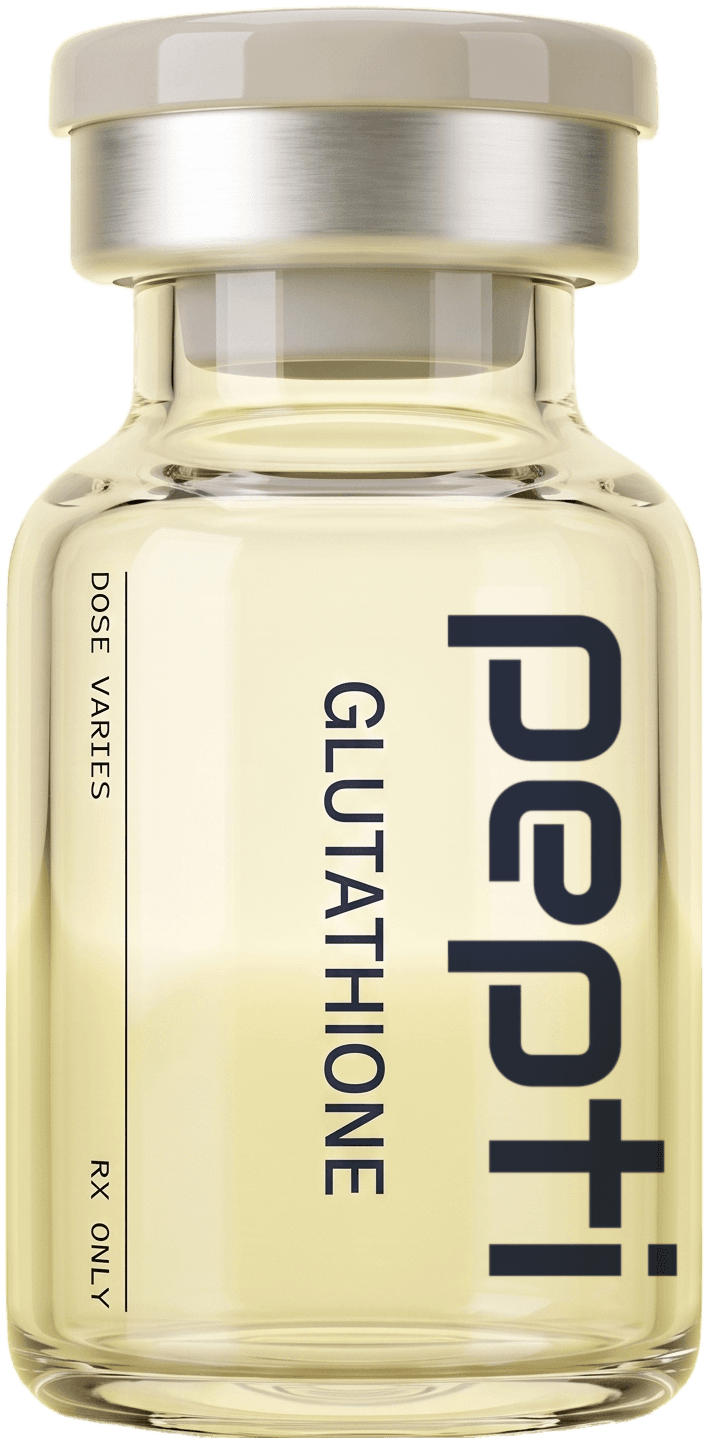
Yes. Glutathione is a peptide: a tripeptide made of three amino acids, glutamate, cysteine and glycine, which every nucleated cell in the body makes for itself. It is the most abundant small thiol in the body and works as an antioxidant and a cofactor for detoxifying enzymes. What sets it apart from most peptides in a prescription catalog is that it does not bind a receptor or act as a signal; it is a working molecule that cells use up and regenerate continuously. So it is a peptide by chemistry, but it behaves more like a nutrient than like BPC-157 or semaglutide.
This page explains what makes glutathione a peptide, how it differs from the signalling peptides, the reduced and oxidised forms, how it compares with NAD+ and GHK-Cu, how Pepti supplies it, and what the research shows, route by route.
Is Glutathione a Peptide? Yes, a Tripeptide, but Not a Signalling One
The short answer
| Question | Answer |
|---|---|
| Is glutathione a peptide? | Yes, a tripeptide |
| Made of | Glutamate, cysteine and glycine |
| Made in the body? | Yes, by every nucleated cell |
| Does it bind a receptor? | No; it is consumed and regenerated, not a signal |
| What it does | Neutralizes reactive oxygen species; cofactor for glutathione peroxidases and S-transferases |
| Active form | Reduced glutathione, GSH |
| How Pepti supplies it | Glutathione, 1000 mg in a 5 mL vial (200 mg/mL), $199/mo |
| Randomized human trials | By mouth, by vein and on the skin; none of the subcutaneous route |
| FDA status | Category 1, under evaluation, on the FDA's 503A list dated 14 May 2026; not FDA approved |
Every price is all-in, covering medication, physician review, refill management and shipping, with no separate membership fee.
Is Glutathione a Peptide? Yes, a Tripeptide, but Not a Signalling One
Why glutathione counts as a peptide
A peptide is a chain of amino acids joined by peptide bonds. Two make a dipeptide, three a tripeptide. Glutathione is three: glutamate, cysteine and glycine. That puts it in the same size class as two other tripeptides in the catalog, GHK-Cu (glycine, histidine, lysine, with a copper ion) and KPV (lysine, proline, valine).
The cysteine is what matters. Its sulfur-containing thiol group is the part that donates an electron to neutralize a peroxide or free radical, which is what most people mean by "antioxidant". Cysteine supply usually caps how much glutathione a cell can make, as a 2013 review in Biochimica et Biophysica Acta describes.
A peptide, but not a signal
Most peptides prescribed as medications are signals. They mimic or modify a hormone or messenger and act by binding a receptor: semaglutide at the GLP-1 receptor, sermorelin at the GHRH receptor, ipamorelin at the ghrelin receptor. Glutathione does none of that.
| A signalling peptide, such as BPC-157 or sermorelin | Glutathione | |
|---|---|---|
| Size | 15 and 29 amino acids | 3 amino acids |
| How it acts | Binds a receptor or pathway and changes what a cell does | Used up directly in chemical reactions, then regenerated |
| Where it works | Usually on a specific tissue or gland | Inside essentially every cell |
| Body's own levels | Usually low, released in pulses or locally | Millimolar concentrations inside cells |
| The clinical question | What does it do? | Does giving more from outside change anything, and by which route? |
That last row is the practical difference. Because cells already carry a lot of glutathione and make their own, the question with supplementing it is not what it does, which is established biochemistry, but whether extra from outside raises the levels that matter.
Is Glutathione a Peptide? Yes, a Tripeptide, but Not a Signalling One
Reduced and oxidised glutathione
| Form | What it is |
|---|---|
| GSH, reduced glutathione | The active form, which donates electrons. The compounded injection is this form |
| GSSG, glutathione disulfide | The oxidised form, two glutathione molecules joined after neutralizing a reactive species |
| The GSH to GSSG ratio | A standard laboratory measure of oxidative stress |
The enzyme glutathione reductase converts GSSG back to GSH using NADPH. Reduced glutathione oxidizes on exposure to air, which is one reason the vial stays cold and capped.
Is Glutathione a Peptide? Yes, a Tripeptide, but Not a Signalling One
How glutathione compares with NAD+ and GHK-Cu
Glutathione is often prescribed or asked about alongside these two, and the three are different kinds of molecule.
| Glutathione | NAD+ Injection | GHK-Cu | |
|---|---|---|---|
| A peptide? | Yes, a tripeptide | No; a coenzyme made of two nucleotides | Yes, a tripeptide with a copper ion |
| Role | The working antioxidant inside cells | Carries electrons in energy metabolism; fuels sirtuin and PARP enzymes | Described around collagen and tissue signalling in cell work |
| Human evidence | Randomized trials by mouth, by vein and on the skin | No randomized trials of the subcutaneous injection; oral precursor trials exist | Human studies are topical and cosmetic |
| Pepti vial | 1000 mg in 5 mL | 1000 mg in 10 mL | 50 mg in 5 mL |
| Price | $199/mo | $249/mo | $239/mo |
NAD+ is related to glutathione in one specific way: NADPH, made from the same family of molecules, is what regenerates reduced glutathione. Some physicians prescribe the two together. Why NAD+ is not a peptide is covered in is NAD a peptide.
Is Glutathione a Peptide? Yes, a Tripeptide, but Not a Signalling One
How Pepti supplies glutathione
| How supplied | 5 mL multi-dose vial, glutathione 200 mg/mL (1000 mg per vial) |
| Standard directions | Inject 0.41 mL (41 units) subcutaneously three times per week |
| Glutathione per dose at that volume | 82 mg |
| Doses per vial | 12, about 4 weeks |
| Format | Vial and syringe |
| Shipping | Refrigerated, with ice packs, sterile syringes and alcohol prep pads |
| Refills | Every 28 days, one vial per fill |
| Price | $199/mo, all-in |
Your physician sets your directions after reviewing your intake, and the ones printed on your vial apply. Subcutaneous means into the fat layer, not a vein; glutathione must never be injected into a vein. Twelve doses at three a week is four weeks. More on reading the label is in how long does a peptide vial last.
Is Glutathione a Peptide? Yes, a Tripeptide, but Not a Signalling One
What the evidence shows, honestly
Glutathione has more randomized human research than most compounded products, but by routes other than the one usually prescribed.
| Route | What the research reported | Limits |
|---|---|---|
| By mouth | A 2015 six-month randomized trial of 1,000 mg daily in 54 adults raised stores in red cells, plasma and lymphocytes by 30 to 35 percent | A single dose did not raise plasma levels in 1992; a four-week trial in 2011 found no change; levels returned to baseline within a month of stopping |
| By vein | A 1995 randomized trial reported less nerve damage alongside the chemotherapy drug cisplatin | Specific to that drug and population; a 2009 Parkinson's pilot did not beat placebo |
| On the skin | A small 2014 trial of a topical lotion on melanin index | Small and short; not a use Pepti prescribes for |
| Under the skin | None | No randomized trials of subcutaneous glutathione |
The precise position: there are no randomized controlled trials of subcutaneous glutathione. The route rests on the molecule's pharmacology, on tolerability shown in intravenous trials at far higher doses, and on prescribing experience. Whether a small subcutaneous dose raises tissue glutathione has not been measured. Benefit by benefit, the picture is in glutathione benefits.
Where it stands with the FDA
Glutathione is in Category 1, "Bulk Drug Substances Under Evaluation", of the FDA's 503A list dated 14 May 2026, and was never in the safety-concern Category 2, so the April 2026 changes to that category did not involve it. In June 2019 the FDA published an alert about a dietary-supplement-grade glutathione powder that had been used for intravenous injections and was contaminated with bacterial endotoxin; that was about ingredient sourcing, not the molecule. Compounded glutathione is not FDA approved.
Side effects
What is reported with subcutaneous use is mostly at the injection site: redness, mild soreness, occasional bruising, and sometimes brief lightheadedness or nausea after a dose. Fever, chills or shaking shortly after a dose are not expected; contact your physician the same day. Swelling of the face or throat, a spreading rash or difficulty breathing need emergency care: call 911. Mention asthma on your intake, since inhaled glutathione has been reported to provoke bronchospasm. It is not used in pregnancy or breastfeeding.
Is Glutathione a Peptide? Yes, a Tripeptide, but Not a Signalling One
Where to get glutathione prescribed
Glutathione injections cannot be bought legitimately without a prescription. A supplement-grade powder is not a sterile injectable, which is exactly what the 2019 FDA alert was about. The prescription route:
- Complete a free online intake covering your history, medications and what you want help with.
- A physician licensed in your state reviews it, usually within 24 hours.
- If it is appropriate, a PCAB-accredited, FDA-registered US 503A pharmacy compounds it to that prescription. Lot test results are published at /quality/lab-results.
- It ships refrigerated with your directions printed on the vial.
- Your physician stays reachable for questions and dose changes.
Pepti prescribes glutathione in every state except Oklahoma, plus DC and does not bill insurance. Step by step: how to get glutathione prescribed online. The full reference is what is glutathione.
References
What this is based on.
References
- Richie JP Jr, Nichenametla S, Neidig W et al.. Randomized controlled trial of oral glutathione supplementation on body stores of glutathione · Eur J Nutr (2015) · PMID 24791752
- Allen J, Bradley RD. Effects of oral glutathione supplementation on systemic oxidative stress biomarkers in human volunteers · J Altern Complement Med (2011) · PMID 21875351
- Sinha R, Sinha I, Calcagnotto A et al.. Oral supplementation with liposomal glutathione elevates body stores of glutathione and markers of immune function · Eur J Clin Nutr (2018) · PMID 28853742
- Witschi A, Reddy S, Stofer B, Lauterburg BH. The systemic availability of oral glutathione · Eur J Clin Pharmacol (1992) · PMID 1362956
- Aebi S, Assereto R, Lauterburg BH. High-dose intravenous glutathione in man. Pharmacokinetics and effects on cyst(e)ine in plasma and urine · Eur J Clin Invest (1991) · PMID 1907548
- Arjinpathana N, Asawanonda P. Glutathione as an oral whitening agent: a randomized, double-blind, placebo-controlled study · J Dermatolog Treat (2012) · PMID 20524875
- Weschawalit S, Thongthip S, Phutrakool P, Asawanonda P. Glutathione and its antiaging and antimelanogenic effects · Clin Cosmet Investig Dermatol (2017) · PMID 28490897
- Watanabe F, Hashizume E, Chan GP, Kamimura A. Skin-whitening and skin-condition-improving effects of topical oxidized glutathione: a double-blind and placebo-controlled clinical trial in healthy women · Clin Cosmet Investig Dermatol (2014) · PMID 25378941
- Sonthalia S, Daulatabad D, Sarkar R. Glutathione as a skin whitening agent: Facts, myths, evidence and controversies · Indian J Dermatol Venereol Leprol (2016) · PMID 27088927
- Sechi G, Deledda MG, Bua G et al.. Reduced intravenous glutathione in the treatment of early Parkinson's disease · Prog Neuropsychopharmacol Biol Psychiatry (1996) · PMID 8938817
- Hauser RA, Lyons KE, McClain T, Carter S, Perlmutter D. Randomized, double-blind, pilot evaluation of intravenous glutathione in Parkinson's disease · Mov Disord (2009) · PMID 19230029
- Mischley LK, Lau RC, Shankland EG, Wilbur TK, Padowski JM. Phase IIb Study of Intranasal Glutathione in Parkinson's Disease · J Parkinsons Dis (2017) · PMID 28436395
Citations are provided for educational purposes. They do not constitute medical advice. Always discuss any peptide protocol with your prescribing physician.
Common questions
Is Glutathione a Peptide? Yes, a Tripeptide, but Not a Signalling One, answered.
Yes. It is a tripeptide of glutamate, cysteine and glycine. It differs from most prescription peptides in that it works as an antioxidant inside cells rather than as a signal that binds a receptor.
No. It is three amino acids long, far below the roughly 40-amino-acid line where peptides end and proteins begin.
No. It is made of three amino acids joined together. Cysteine, one of the three, is the one that gives it its antioxidant activity.
No. A hormone is released by one tissue to signal another. Glutathione is made and used inside essentially every cell and does not bind a receptor.
No. NAD+ is a coenzyme made of nucleotides, not a peptide. The two are related through NADPH, which regenerates reduced glutathione, and are sometimes prescribed together.
Yes. Every nucleated cell makes it. The compounded injection is reduced glutathione prepared by a licensed pharmacy. See are peptides natural.
Yes, from glutamate, cysteine and glycine, with cysteine supply usually the limiting factor. A 2023 trial gave older adults glycine plus N-acetylcysteine, its building blocks, by mouth and reported correction of baseline glutathione deficiency.
Unlike most peptides, glutathione has trials by mouth. A six-month trial at 1,000 mg daily raised body stores; a single dose and a four-week course did not. See can you take peptides without needles.
$199 a month, all-in, covering medication, physician review, refill management and shipping.
No. Bloodwork is not required for any Pepti treatment. If your physician wants labs for your care, they'll ask through your account. The free assessment goes to a physician licensed in your state. A consultation does not guarantee a prescription.
Next step
See what a physician recommends for you.
A licensed physician in your state reviews your intake and decides what is appropriate. A consultation does not guarantee a prescription.