Muscle · Reference
IGF-1 LR3 Dosage: How Pepti Prescribes It, in Units, mL and mcg
This page explains the IGF-1 LR3 dosage Pepti prescribes, what the units on the syringe mean, a conversion chart for the vial strength, the ASCEND blend that also contains it, when it is taken, what can change your directions, and the cautions that matter more for this peptide than for most. It covers how Pepti prescribes IGF-1 LR3, not online protocols. Nothing here is a reason to change your own dose.
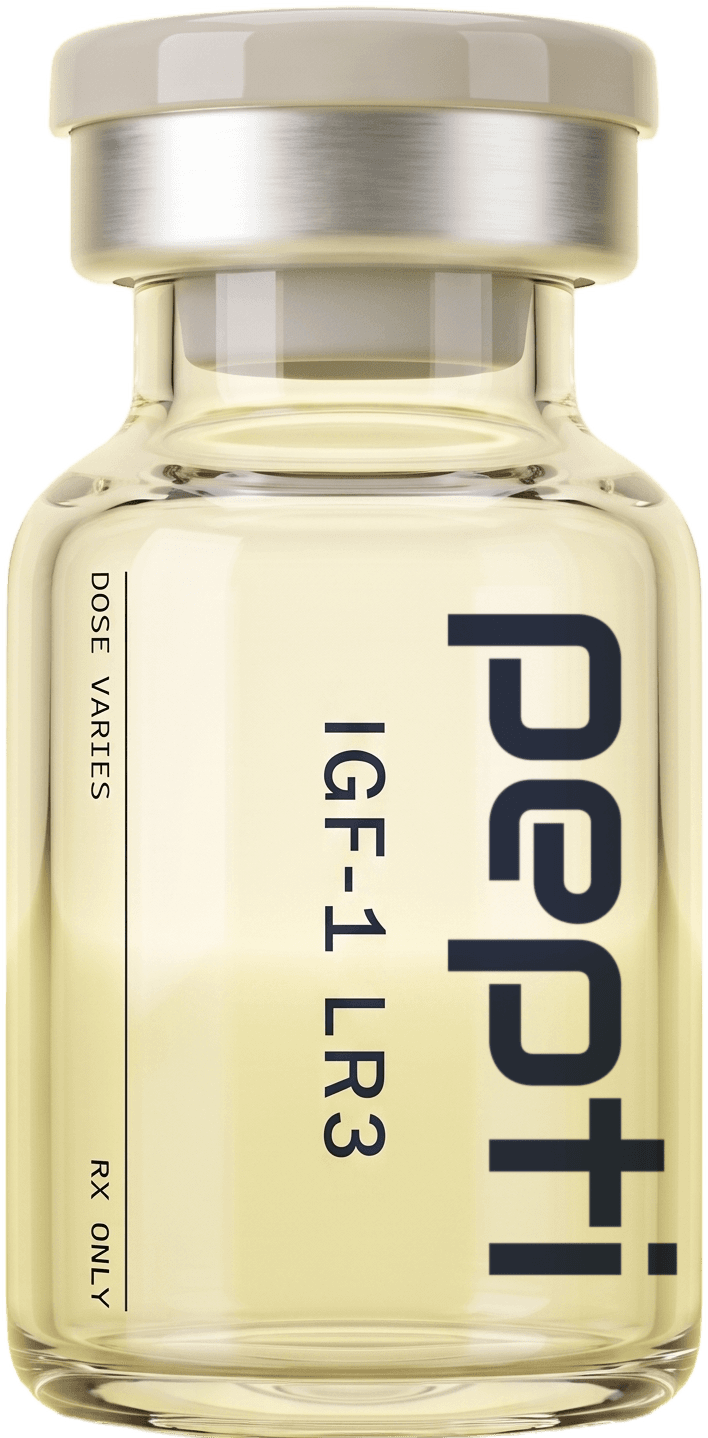
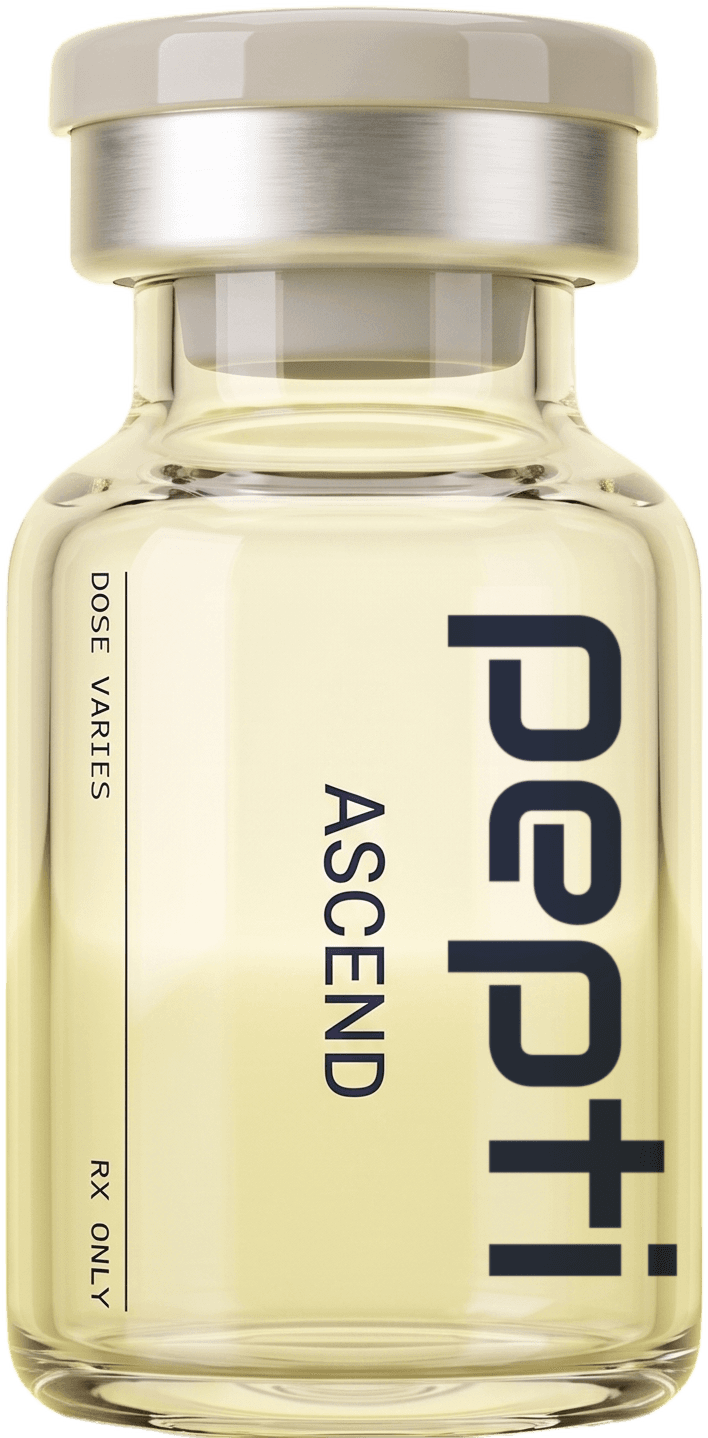
At Pepti, IGF-1 LR3 is prescribed as 0.25 mL, which is 25 units on a U-100 insulin syringe, injected under the skin Monday through Friday nights at bedtime. The vial is 5 mL at 200 mcg/mL, so each 0.25 mL dose carries 50 mcg of IGF-1 LR3 and the vial holds 20 doses, about four weeks. Your physician sets your directions after reviewing your intake, and your exact dose and units are printed on the vial. There are no human trials of IGF-1 LR3, so there is no published human dose to compare against, and the side effect to know before the first dose is low blood sugar.
This page explains the IGF-1 LR3 dosage Pepti prescribes, what the units on the syringe mean, a conversion chart for the vial strength, the ASCEND blend that also contains it, when it is taken, what can change your directions, and the cautions that matter more for this peptide than for most. It covers how Pepti prescribes IGF-1 LR3, not online protocols. Nothing here is a reason to change your own dose.
IGF-1 LR3 Dosage
The short answer
| Product | Vial | Directions | Per dose | Doses per vial | Price |
|---|---|---|---|---|---|
| IGF-1 LR3 | 5 mL, IGF-1 LR3 200 mcg/mL (1000 mcg per vial) | Inject 0.25 mL (25 units) subcutaneously Monday through Friday nights at bedtime | 50 mcg | 20 | $259/mo |
| ASCEND Blend | 5 mL: CJC-1295 1.2 mg/mL, ipamorelin 2.4 mg/mL, tesamorelin 2 mg/mL, IGF-1 LR3 0.2 mg/mL | Inject 0.25 mL (25 units) subcutaneously Monday through Friday nights at bedtime | 50 mcg IGF-1 LR3, plus the other three | 20 | $289/mo |
Every price is all-in, covering medication, physician review, refill management and shipping, with no separate membership fee. Pepti is cash-pay and does not bill insurance. Your own directions are the ones printed on your vial.
IGF-1 LR3 Dosage
IGF-1 LR3 dosage in units, mL and mcg
Pepti's directions are written in two forms, millilitres and units, because prescriptions are written in millilitres and insulin syringes are marked in units. On a U-100 insulin syringe, 1 unit is 0.01 mL, so 100 units is 1 mL and 25 units is 0.25 mL. A unit is a volume mark on the barrel, not a measure of how strong the medication is.
IGF-1 LR3 is measured in micrograms (mcg) rather than milligrams, because the amounts are small: 1000 mcg is 1 mg. The microgram figure comes from the concentration on the label. The vial is supplied at 200 mcg/mL, so:
| What you read | Value | Where it comes from |
|---|---|---|
| Dose volume | 0.25 mL | Printed on the vial |
| On a U-100 insulin syringe | 25 units | 0.25 mL x 100 units per mL |
| Concentration | 200 mcg/mL | Printed on the vial |
| IGF-1 LR3 per dose | 50 mcg (0.05 mg) | 200 mcg/mL x 0.25 mL |
| Total in the vial | 1000 mcg (1 mg) in 5 mL | Printed on the vial |
| Doses per vial | 20 | 5 mL divided by 0.25 mL |
Conversion chart at 200 mcg/mL (math only)
This table is arithmetic for reading a syringe against this vial's concentration. It is not a dosing guide; the only dose that applies to you is the one printed on your vial.
| Units on a U-100 syringe | mL | IGF-1 LR3 at 200 mcg/mL |
|---|---|---|
| 5 units | 0.05 mL | 10 mcg |
| 10 units | 0.10 mL | 20 mcg |
| 15 units | 0.15 mL | 30 mcg |
| 20 units | 0.20 mL | 40 mcg |
| 25 units | 0.25 mL | 50 mcg (Pepti's typical printed direction) |
A vial labelled 1000 mcg is not a 1000 mcg dose: it is twenty 50 mcg doses. If your label and your syringe seem to disagree, do not dose; message your care team. How long does a peptide vial last explains every number on a vial label in more detail.
IGF-1 LR3 Dosage
How long one vial lasts
At the printed direction, 0.25 mL five nights a week:
| Step | Arithmetic | Result |
|---|---|---|
| Doses in the vial | 5 mL divided by 0.25 mL | 20 doses |
| Doses per week | Monday through Friday | 5 |
| Weeks per vial | 20 divided by 5 | 4 weeks |
| Refill cycle | One vial per fill | Every 28 days |
That is why refills run every 28 days, one vial per fill, not a stockpile.
IGF-1 LR3 Dosage
IGF-1 LR3 in the ASCEND blend
The ASCEND Blend puts IGF-1 LR3 in one vial with three growth hormone secretagogues: 6 mg CJC-1295, 12 mg ipamorelin and 10 mg tesamorelin, plus 1 mg IGF-1 LR3, in 5 mL. At 0.2 mg/mL, the same 0.25 mL draw carries 50 mcg of IGF-1 LR3, the same amount as the single vial, along with 0.3 mg CJC-1295, 0.6 mg ipamorelin and 0.5 mg tesamorelin (arithmetic from the label). Its printed directions are the same: 0.25 mL (25 units) Monday through Friday nights at bedtime, 20 doses per vial.
In a blend, every ingredient is in fixed proportion. One draw delivers all four in the ratio the pharmacy compounded, and there is no way to take more IGF-1 LR3 and less of something else from the same vial; a different balance is a different prescription. The same blood-sugar and cancer-history cautions apply to the blend. The tesamorelin dose is covered in tesamorelin dosage, and the blend's side effects in ASCEND blend side effects.
IGF-1 LR3 Dosage
When IGF-1 LR3 is taken
Nights at bedtime, Monday through Friday
The printed directions specify Monday through Friday at bedtime, a five-days-on, two-off rhythm that prescribers use for this peptide. The weekday schedule is a prescriber convention rather than something derived from trials, because there are no human trials of IGF-1 LR3 to derive it from. It also makes the arithmetic clean: 20 doses at five a week is exactly four weeks.
Food and blood sugar
IGF-1 can lower blood glucose. The approved native IGF-1 product is labelled to be given close to a meal or snack, and it advises against driving or strenuous activity for two to three hours after a dose until a tolerated dose is established. Your own directions on timing and food are the ones to follow. If they are unclear, ask your care team before the first dose rather than after.
Under the skin
Subcutaneous means into the fat layer, not the muscle. Abdomen and thigh are the usual sites, rotated so the same spot is not used repeatedly. Technique is covered in how to inject peptides safely.
Directions say What it means in practice 0.25 mL (25 units) Draw to the 25 mark on a U-100 insulin syringe Subcutaneously Into the fat layer, abdomen or thigh, rotating sites Monday through Friday Five doses a week, weekends off Nights at bedtime Shortly before sleep, following any food instruction on your directions 20 doses per vial About four weeks, then the next refill
IGF-1 LR3 Dosage
Why there is no "standard" human dose to compare against
IGF-1 LR3 is a laboratory analogue of IGF-1, first described in 1992: the 70 amino acids of human IGF-1 plus a 13-amino-acid extension and one substitution, arginine for glutamate at position 3, that sharply reduces binding to the IGF binding proteins. More of it stays free and active, which is why it is described as more potent per microgram than native IGF-1 in cell work.
There are no randomised controlled trials of IGF-1 LR3 in humans, and essentially no published human clinical studies of it at all. The human dosing data for IGF-1 belongs to the native hormone, mecasermin, an approved biologic for children with severe primary IGF-1 deficiency, dosed by weight and titrated against blood glucose under specialist supervision. Those doses do not transfer to the analogue, which is built to escape the binding proteins that buffer the native hormone. Online "protocols" quoting microgram ranges are not drawn from human trials either. Pepti's printed direction is the reviewed direction for this vial; it is not a trial-derived dose, and this page does not present it as one. The full background is in what is IGF-1 LR3.
IGF-1 LR3 Dosage
What changes the directions
Your physician sets your directions after reviewing your intake. Things that can lead to different directions, a different product, or no prescription:
| What can change | How it shows up |
|---|---|
| Which product is prescribed | IGF-1 LR3 alone or the ASCEND blend; each has its own label |
| Diabetes, a tendency to low blood sugar, or glucose-lowering medication | Raised at intake because of IGF-1's insulin-like effects |
| A personal or family history of cancer | Treated as a reason not to prescribe IGF-1 LR3 |
| Your other medications | The intake asks for everything you take; there is no established interaction list |
| How you respond | Side effects you report go to your physician, who may revise your directions |
When directions change, the new numbers are printed on the new label. Never carry a number over from a previous fill. If your physician wants labs for your care, they'll ask through your account; bloodwork is not required for any Pepti treatment.
IGF-1 LR3 Dosage
Side effects, in summary
The full picture is in IGF-1 LR3 side effects.
| What is reported | What it usually means | What to do |
|---|---|---|
| Shakiness, sweating, sudden hunger, confusion or light-headedness after a dose | Possible low blood sugar | Eat something, then contact your care team; severe or confused: call 911 |
| Injection-site redness or soreness | The commonest prescriber report | Rotate sites |
| Headache | Prescriber reports | Report it; headache with visual change needs same-day care |
| Swelling of lymphoid tissue, joint pain | Listed for the approved native product, mostly in children | Unknown for adults on the analogue; report any of them |
If you think you injected more than your printed dose, or took a dose twice, treat any symptom as low blood sugar, call Poison Control at 1-800-222-1222 and message your care team. Do not skip or double the next dose to make up for one.
Who should not take IGF-1 LR3, or should discuss it first: anyone with a personal or family history of cancer; anyone with diabetes or a tendency to low blood sugar; anyone pregnant or breastfeeding. IGF-1 and its analogues are prohibited at all times under the WADA code, and anti-doping laboratories have published methods for detecting LR3.
IGF-1 LR3 Dosage
Where IGF-1 LR3 stands with the FDA
IGF-1 LR3 does not appear in any of the three categories of the FDA's interim 503A bulk drug substances list as updated 14 May 2026, has never been placed in any category, and was not on the agenda of the Pharmacy Compounding Advisory Committee in July 2026. The FDA has published no safety statement or position on it. It is prescription-only and compounded, it is not a component of any approved product, and compounded medications are not FDA approved.
IGF-1 LR3 Dosage
Where to get IGF-1 LR3 prescribed
IGF-1 LR3 cannot be bought legitimately without a prescription. Sites selling it "for research use only" are not accountable for what is in the vial: a 2010 paper in Growth Hormone and IGF Research described a black-market product sold as LR3 that turned out to be a research-grade version with a purification tag still attached. The prescription route:
- Complete a free online intake covering your history, cancer history, diabetes and blood sugar, medications and what you want help with.
- A physician licensed in your state reviews it, usually within 24 hours.
- If it is appropriate, a PCAB-accredited, FDA-registered US 503A compounding pharmacy prepares it to that prescription. Lot test results are published at /quality/lab-results.
- It ships refrigerated with ice packs, with sterile syringes, alcohol prep pads and your directions printed on the vial. Nothing is mixed at home.
- Your physician stays reachable for questions and side effects.
Step by step: how to get IGF-1 LR3 prescribed online. Whether you need a prescription and why is in do you need a prescription for IGF-1 LR3.
References
What this is based on.
References
- Philippou A, Maridaki M, Halapas A et al.. The role of the insulin-like growth factor 1 (IGF-1) in skeletal muscle physiology · In Vivo (2007) · PMID 17354613
- Francis GL, Ross M, Ballard FJ et al.. Novel recombinant fusion protein analogues of insulin-like growth factor (IGF)-I indicate the relative importance of IGF-binding protein and receptor binding for enhanced biological potency · J Mol Endocrinol (1992) · PMID 1378742
- Tomas FM, Knowles SE, Owens PC et al.. Insulin-like growth factor-I (IGF-I) and especially IGF-I variants are anabolic in dexamethasone-treated rats · Biochem J (1992) · PMID 1371669
- Read LC, Tomas FM, Howarth GS et al.. Insulin-like growth factor-I and its N-terminal modified analogues induce marked gut growth in dexamethasone-treated rats · J Endocrinol (1992) · PMID 1613443
- Conlon MA, Tomas FM, Owens PC et al.. Long R3 insulin-like growth factor-I (IGF-I) infusion stimulates organ growth but reduces plasma IGF-I, IGF-II and IGF binding protein concentrations in the guinea pig · J Endocrinol (1995) · PMID 7561636
- Guler HP, Zapf J, Froesch ER. Short-term metabolic effects of recombinant human insulin-like growth factor I in healthy adults · N Engl J Med (1987) · PMID 3299085
- Chernausek SD, Backeljauw PF, Frane J et al.. Long-term treatment with recombinant insulin-like growth factor (IGF)-I in children with severe IGF-I deficiency due to growth hormone insensitivity · J Clin Endocrinol Metab (2007) · PMID 17192294
- Renehan AG, Zwahlen M, Minder C et al.. Insulin-like growth factor (IGF)-I, IGF binding protein-3, and cancer risk: systematic review and meta-regression analysis · Lancet (2004) · PMID 15110491
- Adams GR, McCue SA. Localized infusion of IGF-I results in skeletal muscle hypertrophy in rats · J Appl Physiol (1998) · PMID 9572822
- Musarò A, McCullagh K, Paul A et al.. Localized Igf-1 transgene expression sustains hypertrophy and regeneration in senescent skeletal muscle · Nat Genet (2001) · PMID 11175789
- Barton-Davis ER, Shoturma DI, Musaro A et al.. Viral mediated expression of insulin-like growth factor I blocks the aging-related loss of skeletal muscle function · Proc Natl Acad Sci U S A (1998) · PMID 9861016
- Allard JB, Duan C. IGF-Binding Proteins: Why Do They Exist and Why Are There So Many? · Front Endocrinol (Lausanne) (2018) · PMID 29686648
Citations are provided for educational purposes. They do not constitute medical advice. Always discuss any peptide protocol with your prescribing physician.
Common questions
IGF-1 LR3 Dosage, answered.
At Pepti, 0.25 mL, which is 25 units on a U-100 insulin syringe, injected subcutaneously Monday through Friday nights at bedtime. From the 200 mcg/mL vial that is 50 mcg per dose. Your physician sets your directions after reviewing your intake, and your exact dose is printed on the vial.
From a 200 mcg/mL vial, 50 mcg. The ASCEND blend holds IGF-1 LR3 at the same 0.2 mg/mL, so its 25 units also carries 50 mcg, alongside its other three ingredients.
The number printed on your vial. Pepti's typical directions are 25 units, which is 0.25 mL on a U-100 insulin syringe, where 1 unit is 0.01 mL.
Twenty. A 5 mL vial divided by 0.25 mL per dose is 20 doses, about four weeks at five nights a week.
The conversion chart above shows units, mL and mcg at this vial's 200 mcg/mL concentration. It is arithmetic for reading a syringe, not a dosing guide; your own label is the one that applies.
Pepti's printed directions say nights at bedtime, Monday through Friday. Because IGF-1 can lower blood sugar, follow any food instruction on your directions and ask your care team if it is unclear.
The approved native IGF-1 product is labelled to be given close to a meal or snack because of low blood sugar. Follow the timing and food instructions on your own directions, and ask before the first dose if they are unclear.
Not at Pepti; the direction is a fixed volume from a fixed-strength vial. Native IGF-1 in children is dosed by weight under specialist supervision, but that drug's dosing does not transfer to the analogue.
No. Take the dose printed on your vial, on the schedule printed on your vial. Low blood sugar is the side effect that matters most, and there is no human trial showing any benefit from more. If you have questions about your dose, message your care team.
No. Pepti vials are multi-dose solutions shipped ready to use, with sterile syringes and alcohol prep pads. Nothing is reconstituted at home.
Yes. IGF-1 and its analogues are prohibited at all times under the WADA code, and anti-doping laboratories have published methods for detecting LR3.
Bloodwork is not required for any Pepti treatment. If your physician wants labs for your care, they'll ask through your account. The free assessment goes to a physician licensed in your state. A consultation does not guarantee a prescription.
Next step
See what a physician recommends for you.
A licensed physician in your state reviews your intake and decides what is appropriate. A consultation does not guarantee a prescription.