Muscle · Reference
IGF-1 LR3: What It Is, Where to Get It Prescribed, and What It Costs
This page covers what IGF-1 LR3 is and how it differs from the body's own IGF-1 and from the approved drug made from it, the pathways researchers have described, what the published work does and does not establish, where it currently stands with the FDA, how it is dosed, the safety points that matter more here than for most peptides, and how to get it prescribed.

Reviewed by Dr. Gene, MD · Board-certified Family Medicine
Every Pepti prescription is reviewed by a licensed U.S. physician before it's dispensed — and only provided if clinically appropriate.
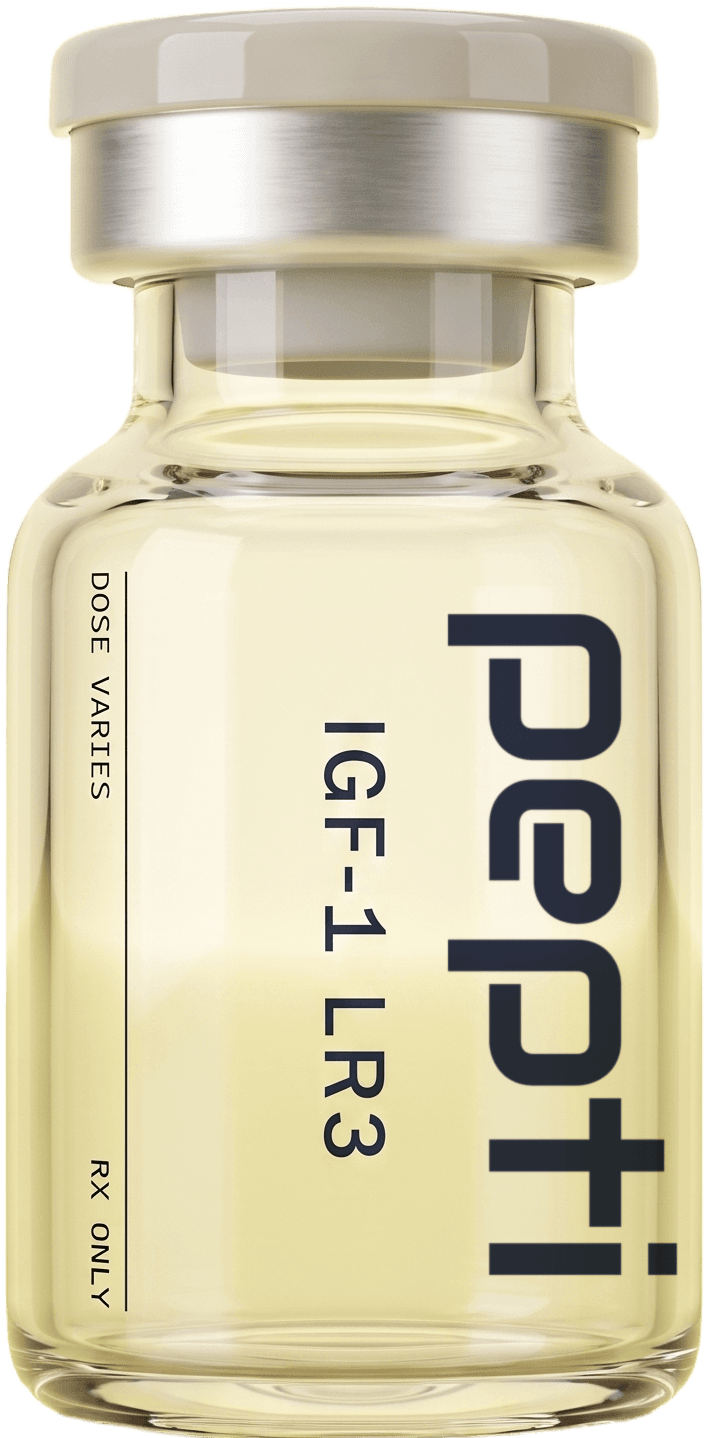
IGF-1 LR3 is a prescription injection supplied as 5 mL multi-dose vial, IGF-LR3 200 mcg/mL (1000 mcg IGF-LR3 per vial). The reviewed directions are: Inject 0.25 mL (25 units) subcutaneously Monday through Friday nights at bedtime. That is 20 doses per vial, about 4 weeks at Monday through Friday. It requires a prescription from a physician licensed in your state, is compounded by a state-licensed US pharmacy, and is not FDA approved.
This page covers what IGF-1 LR3 is and how it differs from the body's own IGF-1 and from the approved drug made from it, the pathways researchers have described, what the published work does and does not establish, where it currently stands with the FDA, how it is dosed, the safety points that matter more here than for most peptides, and how to get it prescribed.
IGF-1 LR3
What IGF-1 LR3 actually is
An engineered version of a hormone the liver makes
Insulin-like growth factor 1 is a 70-amino-acid peptide hormone. Most of it is made by the liver in response to growth hormone, and it is the messenger through which growth hormone does most of its work on muscle, bone and connective tissue. It gets its name from its structural resemblance to insulin, a resemblance that turns out to matter clinically. In the blood, almost all of it travels bound to a family of six IGF binding proteins, which hold it in reserve, extend its life in circulation and control where and how fast it is released to tissue. Free IGF-1 is cleared within minutes; the bound reservoir lasts hours.
IGF-1 LR3 — "Long R3 IGF-1" — is a laboratory-designed analogue of that hormone, first described by an Australian group in the Journal of Molecular Endocrinology in 1992. It has 83 amino acids: the 70 of human IGF-1 plus a 13-amino-acid extension at the front, a leftover of the fusion-protein method used to make it in bacteria, and one substitution, an arginine in place of the glutamate at position 3 (the "R3"). That single swap is the point of the molecule. It sharply reduces binding to the IGF binding proteins, so far more of the peptide stays free and active. The 1992 paper reported it to be more potent than native IGF-1 in a rat muscle-cell assay even though it binds the receptor somewhat less tightly, precisely because the binding proteins were no longer capturing it.
Why it exists at all
IGF-1 LR3 was not designed as a medicine. Its main legitimate use for three decades has been as an ingredient in serum-free cell-culture media in biomanufacturing: because it is not neutralised by the binding proteins present in culture, a very small amount keeps cells growing and producing. Most of what is published about it comes from that world and from 1990s animal physiology, not from clinical medicine. Its use as a prescribed injection in adults is a later development that rests on the mechanism, on animal work, and on what is known about native IGF-1 in people.
What it is not
It is not growth hormone, and it is not a growth hormone secretagogue. It does not prompt the pituitary to release anything; it delivers the downstream signal directly, and in animal work it lowers the body's own growth hormone and IGF-1 output while it is being given. It is not insulin, although it can lower blood glucose, which is covered below.
It is also not mecasermin. Mecasermin, sold as Increlex, is native human IGF-1 made by recombinant technology, and it is an FDA-approved biologic for growth failure in children aged two and over with severe primary IGF-1 deficiency. IGF-1 LR3 shares 70 of its 83 amino acids with that drug, but it is a different molecule with different pharmacokinetics. It has never been through an FDA approval process, it has no approved indication in anyone, and none of the trial data behind Increlex belongs to it. This page keeps the two strictly apart, and any source that borrows the approved drug's evidence to describe the analogue is misleading you.
IGF-1 LR3
How IGF-1 LR3 is described to work
Everything mechanistic below comes from cell and animal studies of IGF-1 and its analogues. Where a human observation is cited, it concerns native IGF-1, not LR3.
The IGF-1 receptor and the Akt pathway
IGF-1 LR3 acts on the same receptor as the native hormone, the IGF-1 receptor, a tyrosine kinase found on muscle and most other tissues. Binding activates the PI3K–Akt cascade, which drives protein synthesis through mTOR and, through a second arm, switches off the FoxO transcription factors that run muscle protein breakdown. A 2007 review in In Vivo lays out this signalling in skeletal muscle in detail: activation and proliferation of satellite cells, their fusion into existing fibres, and increased protein synthesis in the fibre itself. This is the logic behind describing IGF-1 as anabolic — it is described as pushing synthesis up and breakdown down at the same time.
Escaping the binding proteins
In the body, more than 99 percent of IGF-1 is bound to IGF binding proteins, and a 2018 review in Frontiers in Endocrinology describes why there are so many of them: they extend the hormone's life, keep it out of tissue until it is wanted, and buffer the insulin-like effects of the free fraction. The R3 substitution defeats most of that. The result described in cell work is more free peptide per microgram and a longer effective action. It is the whole reason the molecule was made, and it is also the reason the safety cautions later on this page are sharper than for native IGF-1: the binding proteins are a brake as well as a reservoir, and this analogue is built to bypass them.
Insulin-receptor cross-reactivity and blood glucose
IGF-1 and proinsulin are structurally related, and at high concentrations IGF-1 activates the insulin receptor as well as its own. Either route lowers blood glucose by pushing it into muscle and fat. This is not theoretical: a 1987 paper in the New England Journal of Medicine reported that recombinant native IGF-1 given to healthy adults produced hypoglycaemia, and the approved native product carries a warning for severe hypoglycaemia including seizures. For a version that is not held back by binding proteins, this is the mechanism a physician will be thinking about first.
Satellite cells and muscle repair
In animals, IGF-1 delivered locally into muscle is described as producing hypertrophy and supporting regeneration. A 1998 paper in the Journal of Applied Physiology reported that infusing IGF-1 directly into a rat muscle increased its mass. A 1998 paper in the Proceedings of the National Academy of Sciences and a 2001 paper in Nature Genetics used viral or transgenic expression of IGF-1 confined to muscle in mice and reported preservation of muscle mass and function into old age and sustained regeneration. Note what those methods have in common: the IGF-1 was native, and it was placed in or made by the muscle rather than injected under the skin. They support the biology; they are not studies of the product on this page.
Feedback on your own axis
IGF-1 is the signal the pituitary reads to decide how much growth hormone to release, so supplying it from outside turns the body's own output down. A 1995 paper in the Journal of Endocrinology infused LR3 IGF-1 into guinea pigs and reported that circulating native IGF-1, IGF-2 and the binding proteins all fell while organs grew. That is the fundamental difference between this peptide and a secretagogue such as sermorelin or CJC-1295 / Ipamorelin, which act upstream and leave the feedback loop intact.
IGF-1 LR3
What the research actually shows
Anabolic effects in catabolic animals
The classic LR3 studies used rats made catabolic with the steroid dexamethasone. A 1992 paper in the Biochemical Journal reported that IGF-1 and, more so, its modified variants including LR3 improved nitrogen balance and body-weight gain in those animals. A companion 1992 paper in the Journal of Endocrinology reported that the same analogues produced marked growth of the gut in the same model. Two things are worth holding onto: the animals were being actively wasted by a drug, which is not the situation of a healthy adult who trains, and the growth reported was not selective for skeletal muscle.
Muscle
The muscle work is mostly native IGF-1 delivered locally or genetically, as described above: hypertrophy in the rat with local infusion, preserved force and regeneration in ageing mice with muscle-restricted expression. The endpoints were muscle mass, fibre size and measured force in the animal. There is no equivalent body of work on subcutaneous IGF-1 LR3 in healthy animals, let alone people.
Organ growth and the wider axis
The 1995 guinea pig study is the one that describes what a systemic, binding-protein-free IGF-1 does when it is simply infused: organs grew, and the animal's own IGF-1, IGF-2 and binding proteins fell. It is an honest picture of a signal that grows whatever tissue it reaches, and it is why the cancer-history question is not a formality on the intake.
Native IGF-1 in humans, and why it does not transfer
Native IGF-1 has real human data, all of it with mecasermin. A 2007 paper in the Journal of Clinical Endocrinology and Metabolism reported long-term treatment of children with severe IGF-1 deficiency caused by growth hormone insensitivity, and the approved labelling pools five studies in 71 children: height velocity rose from about 2.8 to 8.0 cm a year in the first year of treatment, with hypoglycaemia reported at least once in 42 percent of them. The 1987 New England Journal of Medicine study described the metabolic effects of a single dose in healthy adults, including hypoglycaemia.
None of this can be read across to IGF-1 LR3. The population was children who could not make IGF-1; the drug was the native hormone, which is buffered by binding proteins; the doses were weight-based and titrated against glucose. The analogue was designed not to be buffered, which changes both what it might do and what it might do wrong.
What human data exists
This is the honest part. There are no randomised controlled trials of IGF-1 LR3 in humans, and there are essentially no published human clinical studies of it at all. The peer-reviewed human literature that mentions LR3 comes largely from anti-doping science; a 2010 paper in Growth Hormone & IGF Research, for example, describes analysing a black-market product sold as LR3 and finding a research-grade version with a purification tag still attached. What is prescribed rests on the mechanism, on animal work from the 1990s, on what native IGF-1 does in people, and on prescribers' clinical experience. That is a thinner base than for most of the peptides on this site, and this page says so plainly. Any source telling you it is "clinically proven" for muscle is wrong.
What the evidence does not establish
- It does not establish any effect on muscle size, strength or body composition in humans. That study has not been run.
- It does not establish a dose–response or a timeline in humans. Timelines below are clinical experience.
- It does not establish long-term safety, and the theoretical concern with any growth-promoting signal is exactly the kind that would only show up over years.
- It does not establish that findings for native IGF-1, favourable or unfavourable, transfer to the analogue at any particular dose.
- It does not establish efficacy for any condition as an approved treatment. It is not approved for anything.
IGF-1 LR3
Where IGF-1 LR3 stands with the FDA right now
This one is simpler than the peptides that made the news in 2026, and it is worth being precise about why. Verified against the FDA's own documents in September 2026.
IGF-1 LR3 does not appear in any of the three categories of the FDA's interim 503A bulk drug substances list as updated 14 May 2026 — not in Category 1 (under evaluation), not in Category 2 (identified safety risks), and not in Category 3 (nominated without adequate support). It does not appear on the FDA's safety-risks page, current as of 22 April 2026, either among the six substances still in Category 2 or among the peptides "nominated but withdrawn" after the removals of 15 April 2026. And unlike BPC-157, it was never there to begin with: the versions of the same list dated 29 September 2023 and 27 September 2024 do not mention it.
It was not on the agenda when the FDA's Pharmacy Compounding Advisory Committee met on 23–24 July 2026 to consider BPC-157, KPV, TB-500, MOTS-c, emideltide, Semax and epitalon, and it is not among the five peptides the FDA has said the committee will review before the end of February 2027. The only IGF-family peptide the FDA has flagged is PEG-MGF, a pegylated splice variant of IGF-1, which was removed from Category 2 in April 2026 and is on that February 2027 docket. It is a different molecule and its status says nothing about this one.
Native IGF-1, as mecasermin, is the active ingredient of the approved biologic Increlex. IGF-1 LR3 is not a component of that or of any approved product.
So the accurate description today is: never nominated, never placed in any category, never the subject of an FDA safety statement, and never reviewed by the advisory committee. The FDA has published no position on it, for or against. It is not an FDA-approved drug product, and compounded medications never are. See are peptides FDA approved.
IGF-1 LR3
Realistic expectations
These are patterns described by prescribers, not trial endpoints. There are no human trials to set a timeline, individual response varies, and a physician decides whether this peptide is appropriate for you at all.
The first week
Nothing visible happens. What matters in this window is what you notice, not what you see: shakiness, sweating, sudden hunger or light-headedness after a dose are the signs of low blood sugar, and they are a reason to eat something and call your physician, not to push on. Most people report nothing, which is normal.
Weeks two to four
This is where prescribers describe the things people started for, if they happen — mainly recovery between training sessions and a sense of muscle fullness. They are reports, not measurements, and they are inseparable from the training, sleep and protein that any change depends on. The first vial covers this window.
Weeks four to eight
This is where a physician commonly looks at bloodwork — fasting glucose, and IGF-1 as a marker of what the axis is doing — and decides whether the next refill is the right call. Refills run on a 28-day cycle so that decision is built in rather than left to you.
After stopping
Animal work describes the body's own IGF-1 and binding proteins being suppressed while the analogue is given, and recovering afterwards; there is no human data on how long any effect persists. Whatever was driven by training stays if the training stays. There is no withdrawal described, and no rebound has been reported, because the studies that would report it have not been done.
IGF-1 LR3
When something else makes more sense
A reference that only ever recommends its own product is not much of a reference, and for this peptide the honest list is longer than usual:
- You actually have low IGF-1. Low IGF-1 with symptoms is a diagnosis with its own testing and its own approved treatments. That is an endocrinologist's conversation, and IGF-1 LR3 is not a treatment for growth hormone deficiency.
- You want your own axis to do the work. Sermorelin, CJC-1295 / Ipamorelin, ipamorelin and tesamorelin prompt the pituitary to release growth hormone in pulses, with the body's feedback intact. Tesamorelin has human trial data in a specific population; sermorelin has controlled human trials. IGF-1 LR3 has neither, and it bypasses the feedback.
- Your goal is recovery from a specific injury. BPC-157, TB-500 and the BPC-157 + TB-500 stack are aimed at that far more directly.
- You want IGF-1 LR3 as one component rather than on its own. The ASCEND blend combines it with CJC-1295, ipamorelin and tesamorelin in one vial. Whether a blend or a single peptide is appropriate is your physician's decision.
- You have any history of cancer, or diabetes or a tendency to low blood sugar. This is not the peptide for you, and the intake will say so. That is a line, not a judgement call.
Your physician will tell you if IGF-1 LR3 is not the right tool for what you have described. A consultation does not guarantee a prescription, and being declined is refunded.
IGF-1 LR3
Strengths available
| Strength | Directions |
|---|---|
| IGF-1 LR3 1mg/5mL | Inject 0.25 mL (25 units) subcutaneously Monday through Friday nights at bedtime. |
| IGF-1 LR3 5mg/5mL | Inject 0.25 mL (25 units) subcutaneously Monday through Friday nights at bedtime. |
A higher strength delivers more medication in the same volume. Which one you are prescribed is your physician's decision.
IGF-1 LR3
Dosing, and how a vial is actually used
Why the dose is measured in units
The directions are written in millilitres and in insulin-syringe units because that is what you can read off the barrel. 0.25 mL is 25 units on a U-100 syringe. You are not calculating anything — the number is printed on your medication, and the strength on the label tells your physician how many micrograms that volume delivers.
Subcutaneous, and when
Subcutaneous means into the fat layer, not the muscle. Abdomen and thigh are the usual sites, rotated so the same spot is not used repeatedly. The reviewed directions specify Monday through Friday at bedtime, a five-days-on, two-off rhythm that prescribers use for this peptide. Because IGF-1 can lower blood glucose, the approved native product is labelled to be given close to a meal or snack; your own directions on timing and food are the ones to follow, and if they are unclear, ask before the first dose rather than after.
Why a vial covers about four weeks
20 doses at five per week is four weeks, which is why refills run on a 28-day cycle. One vial per fill, always — not a stockpile.
Storage
Refrigerated, and it ships that way in insulated packaging with ice packs. Beyond-use dating runs from first puncture and is on the label. Keep it out of the freezer and out of light.
IGF-1 LR3
Safety and side effects
Two things deserve a plain statement, because they are class effects of IGF-1 signalling and there is no data showing the analogue is exempt from either.
Low blood sugar. IGF-1 has insulin-like effects, native IGF-1 produced hypoglycaemia in healthy adults in the 1987 New England Journal of Medicine study, and the approved native product warns of severe hypoglycaemia including seizures and advises against driving or strenuous activity for two to three hours after a dose until a tolerated dose is established. IGF-1 LR3 is designed to escape the binding proteins that buffer that effect. Shakiness, sweating, sudden hunger, confusion or light-headedness after a dose mean eat, then call. Insulin and any other glucose-lowering medication are the interactions a physician will ask about first, and diabetes or a tendency to hypoglycaemia is raised at intake for that reason.
Growth signalling. IGF-1 promotes the growth and survival of cells, not only muscle cells. A 2004 systematic review in the Lancet reported that higher circulating IGF-1 in the general population was associated with higher risk of prostate cancer, premenopausal breast cancer and colorectal cancer. That is an association in observational data, not a demonstration that IGF-1 causes cancer, and it concerns the native hormone. But the approved native product is contraindicated in anyone with a malignancy or a history of one, and the prudent reading of a signal that grows whatever it reaches is that a personal or family history of cancer is a reason not to use this peptide. Pepti's intake treats it that way.
Beyond those, the approved native product's labelling lists swelling of lymphoid tissue, raised pressure inside the skull (headache with visual change), joint pain and injection-site changes, mostly in children; whether and how often they apply to adults on the analogue is unknown. What prescribers most often report is injection-site redness or soreness, headache, and the hunger or light-headedness described above. The FDA has also raised a general concern about immunogenicity with injectable compounded peptides, which is a reason to care who compounds your medication; what Pepti's pharmacies test for is on the quality page.
There is no established interaction list, because the trials that would produce one have not been run. That is why the intake asks for every medication you take and why a physician reviews it rather than a form. Stop and contact your physician for any reaction that is severe, spreading, involves difficulty breathing, or involves confusion or a seizure.
IGF-1 LR3
How IGF-1 LR3 compares
IGF-1 LR3 vs a growth hormone secretagogue
A secretagogue such as CJC-1295 / Ipamorelin or sermorelin acts on the pituitary; your own gland releases growth hormone in pulses, your liver makes the IGF-1, and rising IGF-1 feeds back to slow the pulses. IGF-1 LR3 delivers the end signal directly and, in animal work, turns that axis down while it is given. The secretagogues have human trials showing the hormone rise, and the feedback makes them self-limiting in a way this is not. For most people asking about "growth hormone peptides," a secretagogue is the first conversation and this is not.
IGF-1 LR3 vs native IGF-1 (mecasermin)
Same receptor, different molecule, different world. Mecasermin is FDA-approved, for children with severe primary IGF-1 deficiency, with weight-based dosing titrated against blood glucose under specialist supervision; it is buffered in the blood by the binding proteins the way the body's own IGF-1 is. IGF-1 LR3 is built to avoid those proteins, has no approved use in anyone, and has no clinical trials. Nothing from the approved drug's labelling can be transferred to the analogue except the cautions, which is the direction this page transfers them.
IGF-1 LR3 vs the ASCEND blend
Identical peptide, different context. The ASCEND blend pairs IGF-1 LR3 with CJC-1295, ipamorelin and tesamorelin in one vial, so the direct IGF-1 signal sits alongside upstream secretagogues. Whether that combination is appropriate, or whether a single peptide is, is your physician's decision, and the same cautions about blood sugar and cancer history apply to the blend.
IGF-1 LR3
Availability and formats
| Question | Answer |
|---|---|
| Can I get it by telehealth? | Yes, where a physician licensed in your state prescribes it |
| Which states? | All 50 states and DC |
| Does it come as a pen? | No, this one is a vial and syringe only |
| Does it come as a capsule? | No |
| Does it come as a nasal spray? | No |
| Is bloodwork required first? | Not routinely; your physician decides |
IGF-1 LR3
Where to get IGF-1 LR3 prescribed
IGF-1 LR3 cannot be bought legitimately without a prescription. Sites shipping it with no prescription are selling a research-use-only product, where no pharmacy is accountable for identity, purity, sterility or concentration.
The prescription route works like this:
- Complete a medical intake covering your history, medications, allergies and what you are treating.
- A physician licensed in your state reviews it.
- If appropriate, a state-licensed, FDA-registered pharmacy compounds it to that prescription.
- It ships refrigerated with your directions printed on the vial.
- Your physician stays reachable afterwards for dose questions and side effects.
Current all-in pricing for IGF-1 LR3 is published: medication, physician review, refill management and shipping in one figure, with no separate membership fee. What to check on any provider is in how to tell if a peptide seller is legitimate.
IGF-1 LR3
Who should not take it, or should discuss it first
| Situation | Why |
|---|---|
| Personal or family history of cancer | Raised at intake |
| Diabetes or hypoglycaemia risk | given insulin-receptor cross-reactivity |
| Pregnancy or breastfeeding | Not used; safety data is absent |
| Tested athletes | Many peptides are prohibited in competition; check the current list |
Full specification
Everything on the label.
Product
IGF-1 LR3 (Injectable)
How supplied
5 mL multi-dose vial, IGF-LR3 200 mcg/mL (1000 mcg IGF-LR3 per vial)
Typical directions
Inject 0.25 mL (25 units) subcutaneously Monday through Friday nights at bedtime.
Dose volume
0.25 mL (25 units on a U-100 insulin syringe)
Doses per vial
20
Coverage per vial
about 4 weeks at Monday through Friday
Formats
Vial and syringe
Available in
All 50 states and DC
Bloodwork
Not routinely required; your physician decides
Strengths available
2
Legal status
Prescription-only, compounded, not FDA approved
Category
Muscle
References
What this is based on.
References
- Philippou A, Maridaki M, Halapas A et al.. The role of the insulin-like growth factor 1 (IGF-1) in skeletal muscle physiology · In Vivo (2007) · PMID 17354613
- Francis GL, Ross M, Ballard FJ et al.. Novel recombinant fusion protein analogues of insulin-like growth factor (IGF)-I indicate the relative importance of IGF-binding protein and receptor binding for enhanced biological potency · J Mol Endocrinol (1992) · PMID 1378742
- Tomas FM, Knowles SE, Owens PC et al.. Insulin-like growth factor-I (IGF-I) and especially IGF-I variants are anabolic in dexamethasone-treated rats · Biochem J (1992) · PMID 1371669
- Read LC, Tomas FM, Howarth GS et al.. Insulin-like growth factor-I and its N-terminal modified analogues induce marked gut growth in dexamethasone-treated rats · J Endocrinol (1992) · PMID 1613443
- Conlon MA, Tomas FM, Owens PC et al.. Long R3 insulin-like growth factor-I (IGF-I) infusion stimulates organ growth but reduces plasma IGF-I, IGF-II and IGF binding protein concentrations in the guinea pig · J Endocrinol (1995) · PMID 7561636
- Guler HP, Zapf J, Froesch ER. Short-term metabolic effects of recombinant human insulin-like growth factor I in healthy adults · N Engl J Med (1987) · PMID 3299085
- Chernausek SD, Backeljauw PF, Frane J et al.. Long-term treatment with recombinant insulin-like growth factor (IGF)-I in children with severe IGF-I deficiency due to growth hormone insensitivity · J Clin Endocrinol Metab (2007) · PMID 17192294
- Renehan AG, Zwahlen M, Minder C et al.. Insulin-like growth factor (IGF)-I, IGF binding protein-3, and cancer risk: systematic review and meta-regression analysis · Lancet (2004) · PMID 15110491
- Adams GR, McCue SA. Localized infusion of IGF-I results in skeletal muscle hypertrophy in rats · J Appl Physiol (1998) · PMID 9572822
- Musarò A, McCullagh K, Paul A et al.. Localized Igf-1 transgene expression sustains hypertrophy and regeneration in senescent skeletal muscle · Nat Genet (2001) · PMID 11175789
- Barton-Davis ER, Shoturma DI, Musaro A et al.. Viral mediated expression of insulin-like growth factor I blocks the aging-related loss of skeletal muscle function · Proc Natl Acad Sci U S A (1998) · PMID 9861016
- Allard JB, Duan C. IGF-Binding Proteins: Why Do They Exist and Why Are There So Many? · Front Endocrinol (Lausanne) (2018) · PMID 29686648
Citations are provided for educational purposes. They do not constitute medical advice. Always discuss any peptide protocol with your prescribing physician.
Common questions
IGF-1 LR3, answered.
Through a telehealth provider where a physician licensed in your state reviews a medical intake and a licensed US pharmacy compounds the prescription. Pepti prescribes IGF-1 LR3 in all 50 states and DC; start with the free assessment.
5 mL multi-dose vial, IGF-LR3 200 mcg/mL (1000 mcg IGF-LR3 per vial)
Inject 0.25 mL (25 units) subcutaneously Monday through Friday nights at bedtime. Your physician sets your own dose and it is printed on your medication.
20 at the standard volume, about 4 weeks at Monday through Friday.
IGF-1 LR3 is supplied as a vial, drawn with an insulin syringe. It is not available as a pen or capsule.
Not routinely, though your physician may want labs depending on your history. at-home blood testing covers hormone, metabolic and thyroid markers without a lab visit.
It is legal to prescribe and dispense in the United States with a valid prescription. It is not FDA approved: compounded medications are prepared by licensed pharmacies pursuant to a prescription rather than approved as manufactured products. See are peptides FDA approved.
Pricing is published on the IGF-1 LR3 page as one all-in figure covering medication, physician review, refill management and shipping. What drives peptide pricing generally is in how much do peptides cost.
No. Mecasermin (Increlex) is native human IGF-1, an FDA-approved biologic for children with severe primary IGF-1 deficiency. IGF-1 LR3 is a laboratory analogue with a 13-amino-acid extension and one substitution designed to stop it binding to IGF binding proteins. It is a different molecule, it is not approved for anything, and the trial evidence behind Increlex does not apply to it.
No. It has never been nominated for the FDA's 503A bulks list, so it has never been in Category 2 or any other category, was not among the twelve peptides removed from Category 2 on 15 April 2026, and has never been reviewed by the Pharmacy Compounding Advisory Committee. The FDA has published no safety statement or position on it. It remains prescription-only and compounded, and it is not FDA approved.
No. There are no randomised controlled trials of IGF-1 LR3 in humans and essentially no published human clinical studies of it. The human evidence for IGF-1 belongs to the native hormone, mecasermin, in children with severe IGF-1 deficiency and in short studies in healthy adults. What is prescribed rests on mechanism, animal work and clinical experience, and this page says so rather than borrowing the native drug's data.
It can. IGF-1 has insulin-like effects, native IGF-1 produced hypoglycaemia in healthy adults in published work, and the approved native product carries a warning for severe hypoglycaemia. IGF-1 LR3 is designed to escape the binding proteins that buffer that effect. Shakiness, sweating, sudden hunger, confusion or light-headedness after a dose mean eat something and contact your physician. Diabetes, a tendency to low blood sugar, and any glucose-lowering medication are raised at intake for this reason.
A personal or family history of cancer is raised at intake, and for this peptide it is treated as a reason not to prescribe. IGF-1 signalling supports the growth and survival of cells generally, higher circulating IGF-1 has been associated with several cancers in observational research, and the approved native product is contraindicated in anyone with a malignancy or a history of one. The physician makes the call, and the answer will usually be no.
No. It works downstream of growth hormone, delivering the IGF-1 signal directly, and in animal work it lowers the body's own growth hormone and IGF-1 output while it is given. Peptides that raise your own growth hormone are the secretagogues: sermorelin, CJC-1295 / Ipamorelin, ipamorelin and tesamorelin.
The ones that matter are low blood sugar and the theoretical growth-signalling concern, both described above. Beyond those, prescribers most often report injection-site redness or soreness, headache, and hunger or light-headedness after a dose. The approved native product's labelling also lists lymphoid tissue swelling, raised pressure inside the skull and joint pain, mostly in children; how those apply to adults on the analogue is not known. There is no established interaction list, which is why your physician reviews every medication you take.
IGF-1 and its analogues are specifically named on anti-doping prohibited lists, and anti-doping laboratories have published methods for detecting LR3. If you are a tested athlete, check the current prohibited list for your sport before starting anything, and tell your physician.
Next step
See what a physician recommends for you.
A licensed physician in your state reviews your intake and decides what is appropriate. A consultation does not guarantee a prescription.