Anti-Aging · Reference
Glutathione Side Effects: What Is Reported, What Is Not Expected, and When to Call
This page is a practical reference: what is reported, how often, what to do about each, what is not expected, what the trials found, who should not take glutathione, and when to message your care team or get emergency help. For the molecule itself, see what is glutathione; for the evidence behind its uses, see glutathione benefits.
Treatments mentioned
The side effects reported with glutathione injections are mostly at the injection site: redness, mild soreness and occasional bruising, with some people describing brief light-headedness or nausea after a dose. In the controlled trials, intravenous glutathione at 1,400 mg three times a week had adverse events similar to placebo, and a six-month oral trial reported no safety signal. Fever, chills or shaking soon after an injection are not an expected side effect; in a 2019 FDA alert they were caused by bacterial endotoxin in a supplement-grade powder, and they are a same-day call. People with asthma should tell their physician, because inhaled glutathione has been reported to provoke bronchospasm.
This page is a practical reference: what is reported, how often, what to do about each, what is not expected, what the trials found, who should not take glutathione, and when to message your care team or get emergency help. For the molecule itself, see what is glutathione; for the evidence behind its uses, see glutathione benefits.
Glutathione Side Effects
The short answer
| Side effect | How often | What to do |
|---|---|---|
| Injection-site redness, mild soreness, occasional bruising | Common | Rotate sites between abdomen and thigh |
| Brief light-headedness or nausea after a dose | Uncommon | Report it to your care team |
| Wheeze or tight chest in someone with asthma | Caution | Tell your physician before starting; report any breathing change |
| Fever, chills or shaking shortly after a dose | Not expected | Stop and contact your physician the same day |
| Facial or throat swelling, widespread rash, difficulty breathing | Rare | Call 911 or get emergency care, then tell your physician |
The medication this page covers:
| Product | What is in it | Typical directions | Price |
|---|---|---|---|
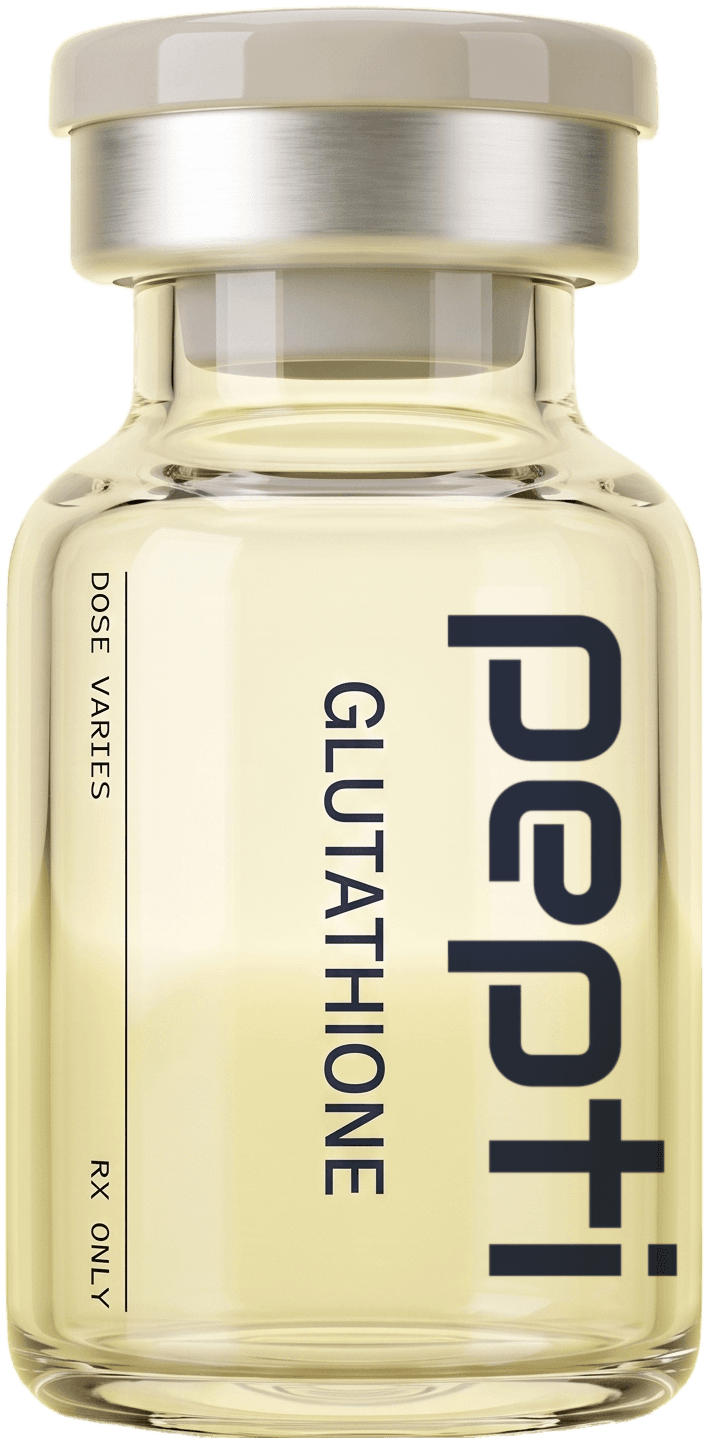
| Glutathione | 5 mL multi-dose vial, 200 mg/mL (1000 mg per vial) | 0.41 mL (41 units) subcutaneously three times per week | $199/mo |
The price is all-in: medication, physician review, refill management and shipping, with no membership fee. Pepti's glutathione is compounded by a PCAB-accredited, FDA-registered US 503A pharmacy. Compounded medications are not FDA approved.
Glutathione Side Effects
Common glutathione side effects
Injection-site reactions
The most frequent report with any subcutaneous injection, glutathione included, is a small area of redness, mild soreness or a bruise where the needle went in. At 41 units, the glutathione draw is a larger volume than most peptide doses, and a fast push into a small space is a common cause of an ache at the site. Injecting slowly and steadily, letting the alcohol dry before the needle goes in, rotating between the abdomen and thigh, and using a new syringe each time all reduce how often it happens. A site that is red for a day and then fades is expected.
What separates irritation from something that needs attention is direction of travel. A site that is larger, hotter or more painful at 48 hours than at 24 is behaving like an infection rather than irritation, and should be looked at the same day. Technique is in how to inject peptides safely.
Light-headedness and nausea
Some people report brief light-headedness or nausea after a dose. These are uncommon and transient. Report them to your care team, especially if they recur, so they are on your record and can be weighed against your directions. Do not change the dose yourself.
What most people notice: nothing
Glutathione has no stimulant, sedative or painkilling action, and most people notice nothing in the first several doses. That is expected, and it is not a side effect or a sign of a problem.
Glutathione Side Effects
What the trials reported
Glutathione's safety record is deeper than most compounded injectables because it has been given to people in randomized trials, by several routes. None of those trials used the subcutaneous injection, so their safety findings are supportive rather than directly transferable.
| Study | Route and dose | What it reported about safety |
|---|---|---|
| Movement Disorders, 2009, randomized, placebo-controlled | Intravenous, 1,400 mg three times a week for four weeks, 21 people with Parkinson's disease | Well tolerated; adverse events similar to placebo |
| European Journal of Nutrition, 2015, randomized, placebo-controlled | Oral, 250 mg or 1,000 mg daily for six months, 54 adults | No safety signal |
| Journal of Parkinson's Disease, 2017, phase IIb | Intranasal, three months, 45 people | Every arm improved, including placebo; no dose beat placebo |
| FDA compounding alert, 7 June 2019 | Intravenous, from a supplement-grade powder | Eight patients had reactions from chills and nausea to low blood pressure and hospitalization, caused by bacterial endotoxin, not glutathione |
Every cell in the body makes glutathione continuously, which is the strongest structural argument for its tolerability. It is still not a long-term injectable outcome study: no trial has followed people on years of continuous glutathione injections.
Glutathione Side Effects
Glutathione side effects that are not expected
Fever, chills or shaking after a dose
This row has a history. On 7 June 2019 the FDA published a compounding alert about a dietary-supplement-grade L-glutathione powder from one repackager that had been used to compound intravenous injections. FDA testing found bacterial endotoxin at up to five times the appropriate limit, and eight patients had reactions ranging from chills and nausea to low blood pressure and hospitalization, within minutes of an infusion.
The cause was the ingredient, not glutathione as a molecule. A sterile injectable has to be made from a pharmaceutical-grade active by a pharmacy accountable for endotoxin testing, which is the main reason not to buy glutathione vials "for research use only." Fever, rigors or chills shortly after a dose are not an expected side effect of a properly compounded glutathione injection. Stop dosing and contact your physician the same day. Lot test results for Pepti's pharmacies are published at /quality/lab-results, and sourcing is described on the quality page.
Allergic reactions
Any injected medication can provoke an allergic response. The pattern to act on is systemic: swelling of the face, lips or throat, hives or a rash spreading away from the injection site, wheeze, or difficulty breathing. That is emergency care first, by calling 911, and a message to your physician second. It is rare, but it is the one acute reaction on this page that needs a phone call rather than a follow-up message.
Glutathione Side Effects
Serious side effects: what to report, and how urgently
| What you notice | How urgent | What to do |
|---|---|---|
| Swelling of the face, lips or throat, widespread rash, wheeze or difficulty breathing | Emergency | Call 911 or go to an emergency department, then tell your physician |
| Fever, chills or shaking within hours of a dose | Same day | Stop dosing; contact your physician the same day |
| An injection site that is hot, spreading or more painful after 48 hours | Same day | Message your care team; it may be an infection |
| Light-headedness or nausea that keeps coming back | Next message | Report it to your care team |
| Redness or a small bruise that fades within a day or two | Routine | Rotate sites; mention it at follow-up |
If you are unsure which row you are in, treat it as the more urgent one. Glutathione must never be injected into a vein; if you think a dose went into a vein, or you injected more than your directions say, message your care team.
Glutathione Side Effects
Specific cautions
Asthma
Inhaled glutathione has been reported to provoke bronchospasm. Pepti's glutathione is injected, not inhaled, but asthma should be on your intake so your physician can weigh it, and any new wheeze or tightness in the chest after a dose should be reported.
Other medications
Glutathione is a cofactor in the metabolism of many drugs. There is no established interaction list for the subcutaneous route, because the trials that would produce one have not been run. That is why the intake asks for every medication and supplement you take and a physician reviews it rather than a form.
Liver and kidney function
Liver and kidney function matter to glutathione because of how it is cleared, so a history of liver or kidney disease belongs on the intake.
Skin lightening
Glutathione is widely marketed for skin lightening, sometimes by intravenous drip. There is no controlled evidence that injected glutathione changes skin tone; the three small trials that measured skin pigment used oral or topical forms for no longer than three months. A 2016 review in the Indian Journal of Dermatology, Venereology and Leprology is openly skeptical of how far that marketing has outrun the evidence. Pepti does not prescribe glutathione for skin lightening.
Glutathione Side Effects
Who should not take glutathione, or should discuss it first
| Situation | Why |
|---|---|
| Pregnancy or breastfeeding | Not used; there is no pregnancy data for glutathione as an injectable |
| Asthma | Inhaled glutathione has been reported to provoke bronchospasm |
| A prior reaction to a glutathione product | Discuss before any re-exposure |
| Liver or kidney disease | Relevant to clearance; discuss first |
| Many regular medications | No established interaction list; your physician reviews the full list |
| Tested athletes | Glutathione is not named on the 2026 WADA Prohibited List, but IV infusions over 100 mL in 12 hours are restricted; check with your governing body |
Bloodwork is not required for any Pepti treatment. If your physician wants labs for your care, they'll ask through your account.
Glutathione Side Effects
Reducing the common side effects
These are low-risk habits grounded in injection technique, not in trials that randomized people to them:
| Habit | Why it helps |
|---|---|
| Inject slowly and steadily | A fast push of 41 units into a small space causes ache and back-leak |
| Rotate between abdomen and thigh | Repeated use of one spot builds irritation |
| Let the alcohol dry before injecting | Wet alcohol stings and irritates the skin |
| Use a new syringe every time | A used needle is blunter and no longer sterile |
| Keep the vial cold, capped and in its carton | Reduced glutathione oxidizes in air and is light sensitive |
| Check the label and beyond-use date before each draw | A vial past its date, or a solution that looks different, should not be used |
The vial arrives as a ready-to-use multi-dose solution, refrigerated with ice packs, sterile syringes and alcohol prep pads. Nothing is mixed at home, which removes a major source of contamination. Storage is in how to store peptides.
Glutathione Side Effects
What the evidence shows, honestly
Glutathione's tolerability record is strong for a compounded injectable: randomized intravenous and oral trials with adverse events similar to placebo, and a molecule every cell already makes. The honest limits are that no trial has tested the subcutaneous route, no interaction list exists for it, and no study has followed people on years of continuous injections. The one serious safety event in the record, the 2019 endotoxin alert, came from a contaminated supplement-grade ingredient rather than from glutathione, which makes the source of the vial the most important safety decision. More on how the evidence reads is in glutathione benefits, and the injection itself is explained in glutathione injections.
Glutathione is in 503A Category 1, "Bulk Drug Substances Under Evaluation," on the FDA's list dated 14 May 2026, and was never in Category 2, the safety-concern category. Compounded glutathione is not FDA approved.
Glutathione Side Effects
Where to get glutathione prescribed
Glutathione injections cannot be bought legitimately without a prescription. Products sold "for research use only" have no accountable pharmacy behind their identity, purity, sterility, endotoxin or concentration. The prescription route:
- Complete a free online intake covering your history, medications and what you want help with.
- A physician licensed in your state reviews it, usually within 24 hours.
- If it is appropriate, a PCAB-accredited, FDA-registered US 503A compounding pharmacy prepares it to that prescription. Lot test results are published at /quality/lab-results.
- It ships refrigerated with your directions printed on the vial.
- Your physician stays reachable for questions about side effects and dose changes.
Pepti prescribes glutathione in every state except Oklahoma, plus DC Step by step: how to get glutathione prescribed online. Dosing is explained in glutathione dosage. For side effects across the whole category, see peptide side effects: what to watch for.
References
What this is based on.
References
- Richie JP Jr, Nichenametla S, Neidig W et al.. Randomized controlled trial of oral glutathione supplementation on body stores of glutathione · Eur J Nutr (2015) · PMID 24791752
- Allen J, Bradley RD. Effects of oral glutathione supplementation on systemic oxidative stress biomarkers in human volunteers · J Altern Complement Med (2011) · PMID 21875351
- Sinha R, Sinha I, Calcagnotto A et al.. Oral supplementation with liposomal glutathione elevates body stores of glutathione and markers of immune function · Eur J Clin Nutr (2018) · PMID 28853742
- Witschi A, Reddy S, Stofer B, Lauterburg BH. The systemic availability of oral glutathione · Eur J Clin Pharmacol (1992) · PMID 1362956
- Aebi S, Assereto R, Lauterburg BH. High-dose intravenous glutathione in man. Pharmacokinetics and effects on cyst(e)ine in plasma and urine · Eur J Clin Invest (1991) · PMID 1907548
- Arjinpathana N, Asawanonda P. Glutathione as an oral whitening agent: a randomized, double-blind, placebo-controlled study · J Dermatolog Treat (2012) · PMID 20524875
- Weschawalit S, Thongthip S, Phutrakool P, Asawanonda P. Glutathione and its antiaging and antimelanogenic effects · Clin Cosmet Investig Dermatol (2017) · PMID 28490897
- Watanabe F, Hashizume E, Chan GP, Kamimura A. Skin-whitening and skin-condition-improving effects of topical oxidized glutathione: a double-blind and placebo-controlled clinical trial in healthy women · Clin Cosmet Investig Dermatol (2014) · PMID 25378941
- Sonthalia S, Daulatabad D, Sarkar R. Glutathione as a skin whitening agent: Facts, myths, evidence and controversies · Indian J Dermatol Venereol Leprol (2016) · PMID 27088927
- Sechi G, Deledda MG, Bua G et al.. Reduced intravenous glutathione in the treatment of early Parkinson's disease · Prog Neuropsychopharmacol Biol Psychiatry (1996) · PMID 8938817
- Hauser RA, Lyons KE, McClain T, Carter S, Perlmutter D. Randomized, double-blind, pilot evaluation of intravenous glutathione in Parkinson's disease · Mov Disord (2009) · PMID 19230029
- Mischley LK, Lau RC, Shankland EG, Wilbur TK, Padowski JM. Phase IIb Study of Intranasal Glutathione in Parkinson's Disease · J Parkinsons Dis (2017) · PMID 28436395
Citations are provided for educational purposes. They do not constitute medical advice. Always discuss any peptide protocol with your prescribing physician.
Common questions
Glutathione Side Effects, answered.
Mostly injection-site redness, mild soreness or bruising, and sometimes brief light-headedness or nausea after a dose. Fever, chills or shaking after a dose are not expected and should be reported the same day. People with asthma should tell their physician.
The same: injection-site reactions are the most common report, with occasional light-headedness or nausea. Swelling of the face or throat, a widespread rash or difficulty breathing is an emergency: call 911.
Its tolerability record is strong for a compounded injectable. A randomized intravenous trial at 1,400 mg three times a week reported adverse events similar to placebo, and a six-month oral trial reported no safety signal. No trial has tested the subcutaneous route or years of continuous use.
Chills, fever or shaking after a dose are not an expected side effect. In a 2019 FDA alert, those reactions were caused by bacterial endotoxin in a contaminated supplement-grade powder. Stop dosing and contact your physician the same day.
Some people report brief nausea after a dose. It is uncommon and usually passes. Report it to your care team if it recurs.
Brief light-headedness after a dose is occasionally reported and usually passes. If it persists or keeps coming back, report it to your care team; if you faint or have trouble breathing, get emergency care.
Tell your physician first. Inhaled glutathione has been reported to provoke bronchospasm. Pepti's glutathione is injected rather than inhaled, but any new wheeze after a dose should be reported.
There is no established interaction list for the subcutaneous route. Glutathione is a cofactor in the metabolism of many drugs, so list everything you take on your intake for your physician to review.
It is not used in pregnancy or breastfeeding. There is no pregnancy data for glutathione as an injectable; see can you take peptides while pregnant.
There is no controlled evidence that injected glutathione changes skin tone. The small pigment trials used oral or topical forms. Pepti does not prescribe glutathione for skin lightening.
Do not change the dose yourself. Report the side effect to your care team, who may revise your directions; new directions are printed on the next label.
No. Bloodwork is not required for any Pepti treatment. If your physician wants labs for your care, they'll ask through your account. The free assessment goes to a physician licensed in your state. A consultation does not guarantee a prescription.
Next step
See what a physician recommends for you.
A licensed physician in your state reviews your intake and decides what is appropriate. A consultation does not guarantee a prescription.