Sleep · Reference
DSIP Benefits: What the Research on Delta Sleep Inducing Peptide Actually Shows
This page takes each claimed benefit in turn and says what was studied, in what, and how much weight it can bear. It is organised by benefit, not by molecule; for the biology, the FDA history and the dosing detail in full, read what is DSIP.
The benefit claimed for DSIP, deeper and less broken sleep without sedation, is one of the few compounded-peptide claims tested in randomised, double-blind, placebo-controlled human studies, and those studies split. In small intravenous trials of chronic insomniacs between 1981 and 1992, the originating group reported longer sleep with fewer interruptions; two independent groups found effects too weak to be clinically meaningful, and neither found slow-wave sleep itself increased. The stress, seizure and ageing claims come from animal work. No trial has tested DSIP as it is prescribed today, by injection under the skin at bedtime, and compounded medications are not FDA approved.
This page takes each claimed benefit in turn and says what was studied, in what, and how much weight it can bear. It is organised by benefit, not by molecule; for the biology, the FDA history and the dosing detail in full, read what is DSIP.
DSIP Benefits
The short answer
| Claimed benefit | What the evidence is | Strength of evidence |
|---|---|---|
| Deeper sleep, more delta waves | Animal (rabbits, rats and cats from 1977); not confirmed in the human studies that measured it | Preclinical; human data did not confirm |
| Better sleep in chronic insomnia | Human, small double-blind intravenous studies (1981 to 1992), with split results | Human but mixed; independent groups found weak effects |
| Sleep without daytime sedation | Human, healthy-volunteer and insomnia studies | Human, small |
| A calmer stress response | Animal (rats, Neuroendocrinology 1985; Stress 2001) | Preclinical only |
| Fewer narcoleptic sleep attacks | Human, one case report (1984) | Anecdotal |
| Less chronic pain | Human, uncontrolled pilot of seven patients (1984) | Very weak |
| Easier alcohol or opioid withdrawal | Human, open-label series (1984, 107 patients; 1998, 7 patients) | Weak; judged insufficient by the FDA in 2026 |
| Fewer seizures | Animal (rats, Seizure 2005) | Preclinical only |
| Longer life, fewer tumours | Animal (mice, 2003), with glycine in the preparation | Preclinical, and confounded |
The honest summary of the table: a striking animal story from the 1970s, a cluster of small, old human studies that disagree, and nothing at all on the subcutaneous route used today.
DSIP Benefits
What DSIP is, in one paragraph
DSIP is a nonapeptide, nine amino acids long: Trp-Ala-Gly-Gly-Asp-Ala-Ser-Gly-Glu. In the early 1960s Marcel Monnier's group in Basel reported that blood from the brain of a sleeping rabbit could induce sleep-like EEG patterns in a second rabbit. The factor was isolated, sequenced and synthesised by 1977, and a Proceedings of the National Academy of Sciences paper that year named it. It was proposed as a circulating "sleep factor." The World Health Organization assigned it the name emideltide in 1993, which is what the FDA calls it. It is not a hormone, not a steroid, not related to melatonin, not a sedative and not a growth hormone secretagogue. Nearly fifty years on, no gene encoding DSIP and no DSIP receptor has been identified.
DSIP Benefits
Benefit 1: Deeper sleep and more delta waves
What the research describes. The defining observation, repeated in rabbits, rats and cats from 1977 onward, is more slow delta-wave and spindle power, the EEG hallmarks of deep non-REM sleep, after DSIP is given into the brain or systemically. In the 1977 paper, the synthetic peptide was the only one of nine related sequences that increased delta-wave and spindle activity when infused into rabbit brains.
The complication. It was not universal even in animals: one 1980 rat study found no change, and the original group described bell-shaped dose curves, where more did not mean more effect. A 1984 review in Neuroscience and Biobehavioral Reviews lays this out, inconsistencies included. In people, the controlled studies that measured slow-wave sleep did not find it increased.
Evidence type. Animal, not confirmed in humans.
Strength. This is the origin of the name, and the part of the story the human data did not support. A 2006 review in the Journal of Neurochemistry called the sleep-factor hypothesis "extremely poorly documented and still weak."
DSIP Benefits
Benefit 2: Better sleep in chronic insomnia
What the research describes. This is where DSIP's human data sits, and it is unusual for a compounded peptide: there are randomised, double-blind, placebo-controlled studies in people.
| Study | Who | What was reported |
|---|---|---|
| Lancet, 1981, with a fuller report in Experientia | Six middle-aged chronic insomniacs, intravenous infusion or placebo before bed, crossover | Longer sleep with fewer interruptions, no daytime sedation |
| European Neurology, 1986 | A summary of further double-blind work | Reported benefit |
| European Neurology, 1987 | Fourteen chronic insomniacs, seven consecutive nights | Better night sleep and daytime alertness, but compared with matched normal sleepers rather than a placebo arm |
| International Journal of Clinical Pharmacology Research, 1987 | Crossover against placebo nights | No significant difference from placebo; improvement "of little clinical significance" |
| Neuropsychobiology, 1992 | Sixteen chronic insomniacs, parallel groups | Higher sleep efficiency, but effects judged weak; short-term treatment "not likely to be of major therapeutic benefit" |
Evidence type. Human, small, mostly double-blind and placebo-controlled, all intravenous.
Strength. Mixed. The originating group reported benefit; two independent groups did not find a clinically meaningful effect. The FDA counted roughly 209 people across all of this work, all treated intravenously, none after 1992, and singled out the comparison with normal sleepers in the 1987 study as a weakness. Any source that says DSIP is established to improve sleep is overstating it; any source that says it was never tested in people is wrong the other way.
DSIP Benefits
Benefit 3: Sleep without sedation
What the research describes. In the first healthy-volunteer study, subjects felt a "pressure to sleep" during the infusion but two hours later showed no sleepiness and no impaired performance. The 1981 insomnia study reported no daytime sedation, and the controlled studies that measured post-treatment nights reported no withdrawal and no rebound insomnia.
Evidence type. Human, small.
What it means. This is the main way DSIP differs from a sleeping pill: it is described as a modulator of sleep structure rather than a sedative. Approved hypnotics have large randomised trials and known dependence and next-day profiles; DSIP has small 1980s trials with mixed results and no dependence signal in the human record. Neither substitutes for the other, and a prescription sleeping medication is not stopped without the prescriber.
DSIP Benefits
Benefit 4: A calmer stress response
What the research describes. A 1985 paper in Neuroendocrinology reported that intravenous DSIP reduced corticosterone release triggered by corticotropin-releasing factor in rats, pointing to an action at the pituitary. A 2001 paper in Stress found DSIP reduced stress-induced Fos activation in the hypothalamus and septum of rats.
Evidence type. Animal.
What it means. This is where the "stress response" language comes from, and it is why DSIP is described as most relevant when poor sleep sits on top of a stress response rather than as long-standing insomnia. It is the reason SERENITY pairs DSIP with Selank, the peptide described around daytime anxiety. It has not been tested in people.
DSIP Benefits
Benefit 5: The opioid-system mechanism
What the research describes. In rats, the opioid antagonist naloxone blocked DSIP's ability to prolong sleep. Cell work found DSIP does not bind opioid receptors directly; it was instead reported to trigger calcium-dependent release of enkephalins from neurons in several brain regions.
Evidence type. Animal and cell.
What it means. It is an indirect action, not a direct opioid effect. It is the mechanism the 1980s withdrawal studies were built on, and the reason any opioid, benzodiazepine, sedative or regular alcohol use goes on your intake.
DSIP Benefits
Benefit 6: Narcolepsy and pain
What the research describes. A single-patient case report from 1984 described a man with narcolepsy whose sleep attacks became less frequent during weeks of intravenous dosing. A 1984 pilot study in European Neurology treated seven chronic pain patients and reported lower pain ratings in six, with no control group.
Evidence type. Human, one case and one uncontrolled pilot.
Strength. These are hypotheses, not evidence. The FDA evaluated narcolepsy as a nominated use in 2026 and the committee did not recommend DSIP.
DSIP Benefits
Benefit 7: Alcohol and opioid withdrawal
What the research describes. A 1984 European Neurology paper from Geneva gave intravenous DSIP to 107 inpatients in alcohol or opiate withdrawal and reported symptoms resolving or improving in the large majority, with insomnia often returning afterwards. A 1998 open trial in the Journal of Clinical Psychopharmacology treated seven opioid-dependent patients and reported withdrawal scores falling after the first injection, but only two completed the schedule.
Evidence type. Human, open-label, no control group.
Strength. Weak, and both sets of authors said so. The FDA reviewed this work in 2026 and found it insufficient. This is not a use Pepti prescribes for; withdrawal is managed in addiction medicine with approved medications.
DSIP Benefits
Benefit 8: Seizures and ageing
What the research describes. A 2005 paper in Seizure reported that DSIP and an analogue reduced chemically provoked seizures in rats. A 2003 study in Mechanisms of Ageing and Development gave female mice lifelong monthly courses of a DSIP-plus-glycine preparation and reported fewer chromosome aberrations, a longer maximum lifespan and fewer spontaneous tumours.
Evidence type. Animal.
What it means. The FDA's reviewers noted that glycine alone has reported anti-tumour properties, so the mouse result cannot be attributed to DSIP. Neither finding has been tested in people, and DSIP is not a seizure medication or a longevity treatment.
DSIP Benefits
What the evidence does not establish
| Question | What the research shows |
|---|---|
| Does subcutaneous DSIP at bedtime do what intravenous infusion did? | Unknown. Nobody has run that trial |
| Is there a clinically meaningful effect on sleep quality? | The two independent placebo-controlled studies concluded there was not |
| Does DSIP increase slow-wave sleep in humans? | The controlled studies that measured it did not find that |
| Is it safe over months of use? | Unknown. The longest human course on record is fifteen days |
| Is it an approved treatment for anything? | No |
When the FDA's reviewers assessed emideltide for its advisory committee, they proposed that neither form be added to the 503A Bulks List, citing missing characterisation data, human effectiveness evidence they judged "inconclusive and at best preliminary," and no safety data for the subcutaneous route. On 24 July 2026 the committee voted 6 in favour, 7 against, with 1 abstention, and did not recommend it; it was the only one of the seven peptides considered that week not to receive a favourable vote. The vote is advisory and the FDA's final determination is pending. DSIP was removed from Category 2 on 15 April 2026 and remains legal to prescribe and dispense.
DSIP Benefits
Side effects, in brief
| What is reported | When | What to do |
|---|---|---|
| Injection-site redness, mild soreness, occasional bruising | Any time | Rotate sites |
| Early headache or vivid dreams | The first weeks | Report it if it persists |
| Transient headache, nausea and vertigo; two cases of low blood pressure at the first injection | In the 107-patient withdrawal series | Report anything like it |
| A reaction that is severe, spreading, or involves difficulty breathing | Rare | Emergency care for breathing difficulty, then contact your physician |
In the small insomnia studies, DSIP was reported as well tolerated with no significant adverse events, and the FDA's adverse event database search for emideltide, through March 2024, returned zero reports. There is no subcutaneous safety data and no established interaction list. Laboratory work reports DSIP being broken down by an enzyme that some blood-pressure medicines inhibit, so every medication you take belongs on your intake. DSIP is not used in pregnancy or breastfeeding.
DSIP Benefits
How Pepti supplies DSIP
| Product | What is in it | Directions | Price |
|---|---|---|---|
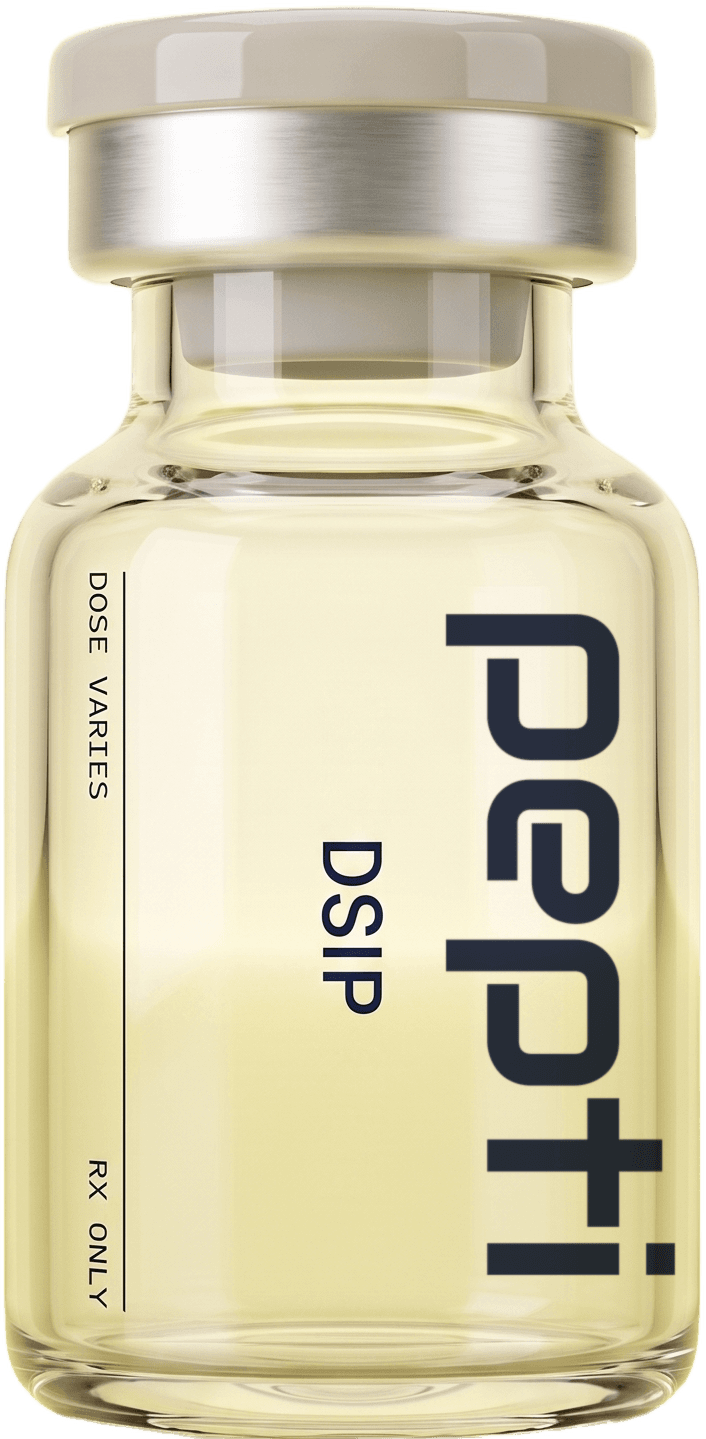
| DSIP | 5 mL multi-dose vial, 1 mg/mL (5 mg DSIP) | 0.25 mL (25 units) subcutaneously Monday through Friday nights at bedtime; 20 doses, about 4 weeks | $249/mo |
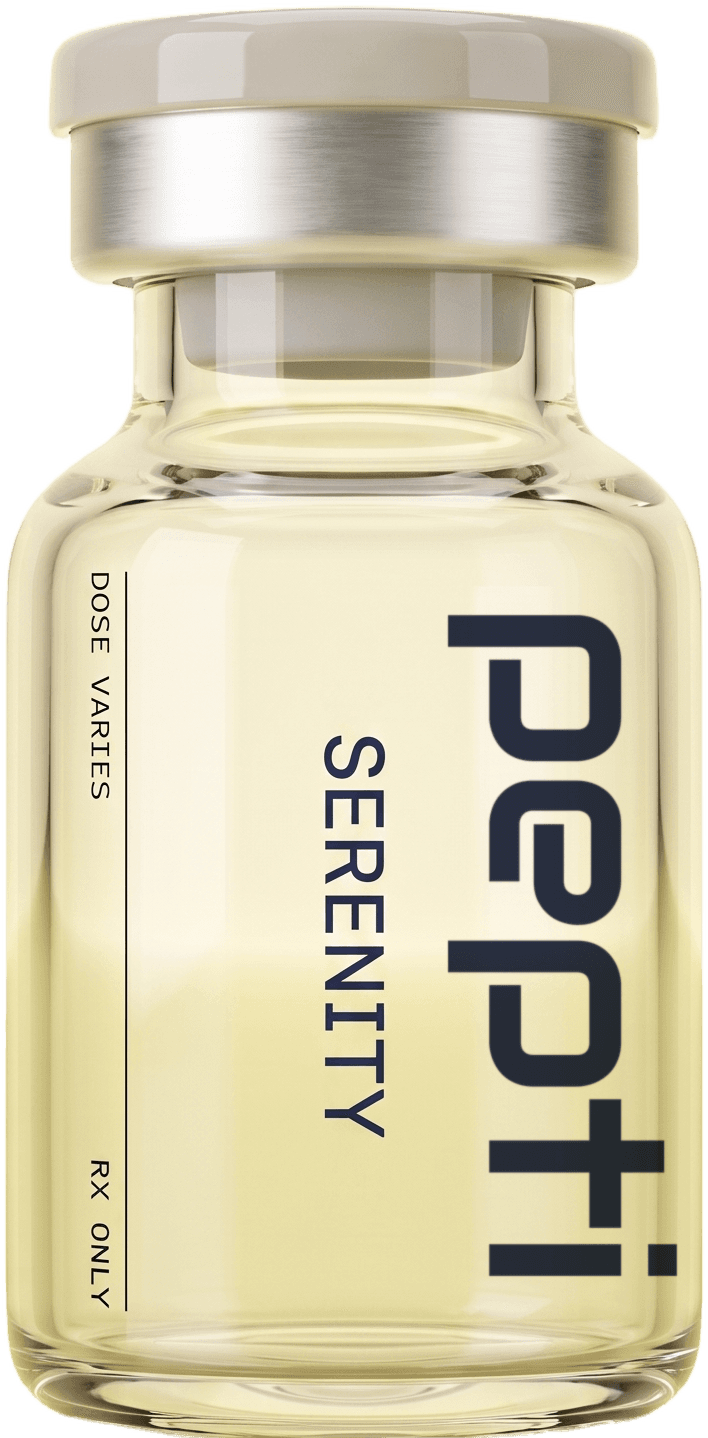
| SERENITY | 5 mg DSIP, 5 mg Selank, 6 mg CJC-1295, 12 mg ipamorelin in 5 mL | 0.25 mL (25 units) Monday through Friday nights at bedtime | $279/mo |
Every price is all-in, covering medication, physician review, refill management and shipping, with no separate membership fee. Pepti is cash-pay and does not bill insurance. Vials are multi-dose solutions shipped ready to use, refrigerated with ice packs, with sterile syringes and alcohol prep pads. Refills run every 28 days, one vial per fill. The dosing detail is in DSIP dosage. Your physician sets your directions after reviewing your intake, and they are printed on the vial.
When something else makes more sense
- You have not tried CBT-I. Cognitive behavioural therapy for insomnia is the first-line recommendation of every major sleep guideline and has large human trials behind it.
- Anxiety is what keeps you awake. Selank is described around anxiolytic signalling during the day.
- Your rhythm is off rather than your depth. Epithalon is described around the pineal gland and circadian timing; see what is Epithalon.
- Your interest is really the growth hormone pulse. Growth hormone release is concentrated in slow-wave sleep, but DSIP is not aimed at that axis; CJC-1295 / Ipamorelin and sermorelin are.
- A breathing problem at night. DSIP is not a treatment for sleep apnoea.
The wider category is in peptides for sleep.
DSIP Benefits
Where to get DSIP prescribed
DSIP cannot be bought legitimately without a prescription. Sites selling it "for research use only" are not accountable for identity, purity, sterility or concentration. The prescription route:
- Complete a free online intake covering your history, medications and what you want help with.
- A physician licensed in your state reviews it, usually within 24 hours.
- If it is appropriate, a PCAB-accredited, FDA-registered US 503A compounding pharmacy prepares it to that prescription. Lot test results are published at /quality/lab-results.
- It ships refrigerated with your directions printed on the vial.
- Your physician stays reachable for questions and side effects.
Pepti prescribes DSIP in every state except Oklahoma, plus DC The step-by-step page is how to get DSIP prescribed online. The blend is covered in what is the SERENITY blend.
References
What this is based on.
References
- Schneider-Helmert D. DSIP in sleep disturbances · Eur Neurol (1986) · PMID 3758119
- Teichman SL, Neale A, Lawrence B et al.. Prolonged stimulation of growth hormone (GH) and insulin-like growth factor I secretion by CJC-1295, a long-acting analog of GH-releasing hormone, in healthy adults · J Clin Endocrinol Metab (2006) · PMID 16352683
- Morin CM, Belleville G, Bélanger L, Ivers H. The Insomnia Severity Index: psychometric indicators to detect insomnia cases and evaluate treatment response · Sleep (2011) · PMID 21532953
- Raun K, Hansen BS, Johansen NL, et al.. Ipamorelin, the first selective growth hormone secretagogue · European Journal of Endocrinology (1998) · PMID 9849822
- Greenwood-Van Meerveld B, Tyler K, Mohammadi E, Pietra C. Efficacy of ipamorelin, a ghrelin mimetic, on gastric dysmotility in a rodent model of postoperative ileus · Journal of Experimental Pharmacology (2012) · PMID 27186127
- Andersen NB, Malmlöf K, Johansen PB, et al.. The growth hormone secretagogue ipamorelin counteracts glucocorticoid-induced decrease in bone formation of adult rats · Growth Hormone & IGF Research (2001) · PMID 11735244
- Lall S, Tung LY, Ohlsson C, Jansson JO, Dickson SL. Growth hormone (GH)-independent stimulation of adiposity by GH secretagogues · Biochemical and Biophysical Research Communications (2001) · PMID 11162489
- Adeghate E, Ponery AS. Mechanism of ipamorelin-evoked insulin release from the pancreas of normal and diabetic rats · Neuro Endocrinology Letters (2004) · PMID 15665799
- Semenistaya E, Zvereva I, Thomas A et al.. Determination of growth hormone releasing peptides metabolites in human urine after nasal administration of GHRP-1, GHRP-2, GHRP-6, Hexarelin, and Ipamorelin · Drug Test Anal (2015) · PMID 25869809
- Nass R, Pezzoli SS, Oliveri MC et al.. Effects of an oral ghrelin mimetic on body composition and clinical outcomes in healthy older adults: a randomized trial · Ann Intern Med (2008) · PMID 18981485
- Moreno-Reyes R, Kerkhofs M, L'Hermite-Balériaux M, Thorner MO et al.. Evidence against a role for the growth hormone-releasing peptide axis in human slow-wave sleep regulation · Am J Physiol (1998) · PMID 9612233
- Copinschi G, Leproult R, Van Onderbergen A, Caufriez A et al.. Prolonged oral treatment with MK-677, a novel growth hormone secretagogue, improves sleep quality in man · Neuroendocrinology (1997) · PMID 9349662
Citations are provided for educational purposes. They do not constitute medical advice. Always discuss any peptide protocol with your prescribing physician.
Common questions
DSIP Benefits, answered.
In animals, DSIP increased delta-wave and spindle activity on the EEG and damped the stress response. In small intravenous human studies from 1981 to 1992, the originating group reported longer, less interrupted sleep without daytime sedation, while two independent groups found the effects too weak to matter clinically. No trial has tested the subcutaneous bedtime injection.
The human evidence is split. Small placebo-controlled studies in chronic insomniacs reported benefit from the originating group and weak or no effect from independent groups. Prescribers generally treat the first vial as the window to judge whether sleep is steadier, ideally against a sleep diary.
It did in animals. The controlled human studies that measured slow-wave sleep did not find it increased.
No. Healthy volunteers showed no sleepiness or impaired performance two hours after an infusion. It is described as a modulator of sleep structure, not a sleeping pill.
Rat studies reported it reduced stress-hormone release and stress-induced brain activation. That has not been tested in people. It is why DSIP is paired with Selank in the SERENITY blend.
It is not a growth hormone secretagogue. People sometimes reach for it because growth hormone release is concentrated in deep sleep, but CJC-1295 / Ipamorelin and sermorelin are the products aimed at that axis.
That was studied in open-label series without control groups, which the FDA found insufficient in 2026. It is not a use Pepti prescribes for.
The ageing claim comes from a 2003 mouse study using a DSIP-plus-glycine preparation, and glycine alone has reported anti-tumour properties. Nothing shows DSIP extends life in people.
There is no trial-established timeline for the subcutaneous bedtime schedule. Some people report steadier sleep; some report nothing. Both are answers for your care team.
No. Compounded medications are not FDA approved, and DSIP is not approved for anything. On 24 July 2026 the FDA's advisory committee voted 6 to 7, with one abstention, and did not recommend adding it to the 503A Bulks List. The final determination is pending, and it remains legal to prescribe.
At Pepti, the DSIP vial is $249 a month and the SERENITY blend is $279, all-in, covering medication, physician review, refill management and shipping.
No. Bloodwork is not required for any Pepti treatment. If your physician wants labs for your care, they'll ask through your account. The free assessment goes to a physician licensed in your state. A consultation does not guarantee a prescription.
Next step
See what a physician recommends for you.
A licensed physician in your state reviews your intake and decides what is appropriate. A consultation does not guarantee a prescription.