Sleep · Reference
DSIP (Delta Sleep Inducing Peptide): What It Is, Where to Get It Prescribed, and What It Costs
This page covers what DSIP is, the pathways researchers have described, what the older human studies and the animal work do and do not establish, where it stands with the FDA after the July 2026 vote, how it is dosed, and how to get it prescribed.

Reviewed by Dr. Gene, MD · Board-certified Family Medicine
Every Pepti prescription is reviewed by a licensed U.S. physician before it's dispensed — and only provided if clinically appropriate.
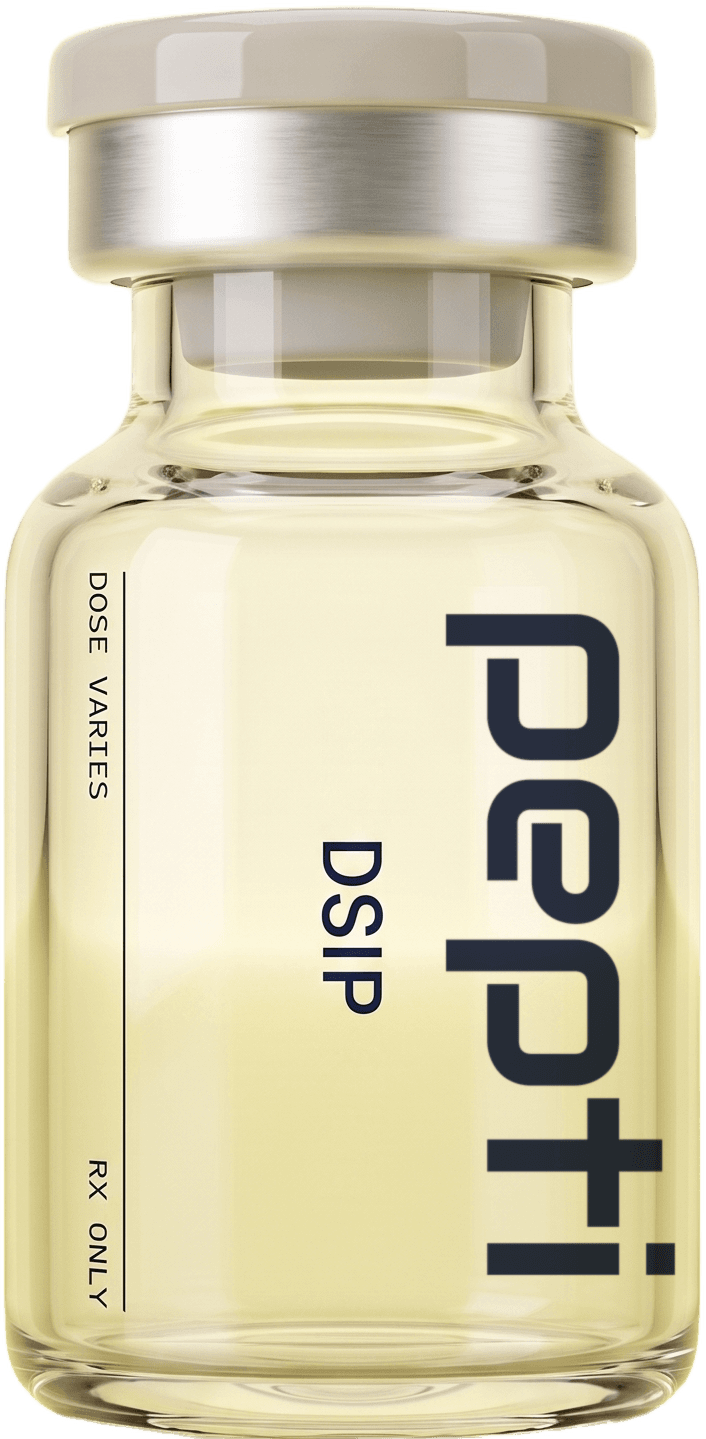
DSIP (Delta Sleep Inducing Peptide) is a prescription injection supplied as 5 mL multi-dose vial, DSIP 1 mg/mL (5 mg DSIP per vial). The reviewed directions are: Inject 0.25 mL (25 units) subcutaneously Monday through Friday nights at bedtime. That is 20 doses per vial, about 4 weeks at Monday through Friday. It requires a prescription from a physician licensed in your state, is compounded by a state-licensed US pharmacy, and is not FDA approved.
This page covers what DSIP is, the pathways researchers have described, what the older human studies and the animal work do and do not establish, where it stands with the FDA after the July 2026 vote, how it is dosed, and how to get it prescribed.
DSIP (Delta Sleep Inducing Peptide)
What DSIP actually is
A nine-amino-acid peptide first found in sleeping rabbits
DSIP is a nonapeptide — nine amino acids, sequence Trp-Ala-Gly-Gly-Asp-Ala-Ser-Gly-Glu. In the early 1960s Marcel Monnier's group in Basel reported that blood from the brain of a sleeping rabbit could induce sleep-like EEG patterns in a second rabbit. The factor was isolated, sequenced and synthesised by 1977, and the Proceedings of the National Academy of Sciences paper that year named it: infused into rabbit brains, the synthetic peptide was the only one of nine related sequences that increased delta-wave and spindle activity.
It was proposed as a circulating "sleep factor." It is not a hormone, not a steroid, and not related to melatonin. Research describes it as a modulator of sleep architecture and of the stress response, not a substance that forces sleep.
Why the FDA calls it "emideltide"
DSIP is a laboratory name. The World Health Organization assigned the International Nonproprietary Name emideltide in 1993, and that is the name the FDA uses. Its 2026 review covered two forms, the free base and the acetate salt, because the nominations did not make clear which was proposed.
What it is not
It is not a sedative. In the first healthy-volunteer study, subjects felt a "pressure to sleep" during the infusion but two hours later showed no sleepiness and no impaired performance. It is not a treatment for sleep apnoea or any sleep problem with a breathing cause, and it is not a growth hormone secretagogue. And it is not a proven treatment for insomnia.
DSIP (Delta Sleep Inducing Peptide)
How DSIP is described to work
Five threads run through the published work. Unless a human population is named, everything below is from animal and cell studies.
Delta-wave and spindle activity on the EEG
The defining observation, repeated in rabbits, rats and cats from 1977 onward, is more slow delta-wave and spindle power — the EEG hallmarks of deep non-REM sleep — after DSIP is given into the brain or systemically. It was not universal: one 1980 rat study found no change, and the original group described bell-shaped dose curves. The Neuroscience and Biobehavioral Reviews review of 1984 lays this out, inconsistencies included.
An indirect route through the body's own opioid system
In rats, the opioid antagonist naloxone blocked DSIP's ability to prolong sleep. Cell work found DSIP does not bind opioid receptors directly; it was instead reported to trigger calcium-dependent release of enkephalins from neurons in several brain regions. This is the mechanism the 1980s withdrawal studies were built on. It is an indirect action, not a direct opioid effect.
Damping of the stress axis
A 1985 paper in Neuroendocrinology reported that intravenous DSIP reduced corticosterone release triggered by corticotropin-releasing factor in rats, pointing to an action at the pituitary. A 2001 paper in Stress found DSIP reduced stress-induced Fos activation in the hypothalamus and septum of rats. This is where the "stress response" language comes from. It is animal data.
Crossing into the brain, and leaving quickly
Animal studies describe DSIP crossing the blood–brain barrier. It also disappears fast: a half-life of minutes in animals and about eight minutes in human plasma, because blood peptidases clip it apart. That is why the human researchers found the infusion itself mattered — a one-minute infusion did nothing, and the sleep effect appeared in the second hour. Any effect is a signalling event, not a drug level held through the night.
Why a leading researcher called it an "unresolved riddle"
Nearly fifty years on, no gene encoding DSIP and no DSIP receptor has been identified. A 2006 review in the Journal of Neurochemistry called the sleep-factor hypothesis "extremely poorly documented and still weak." The mechanism is a working hypothesis, not a settled pathway.
DSIP (Delta Sleep Inducing Peptide)
What the research actually shows
Sleep in people with chronic insomnia
This is where the human data sits, and it is unusual for a compounded peptide: there are randomised, double-blind, placebo-controlled studies in people. They are small, old, and split.
The first appeared in the Lancet in 1981, with a fuller report that year in Experientia: six middle-aged chronic insomniacs received an intravenous infusion or placebo before bed in a crossover design, and the authors reported longer sleep with fewer interruptions and no daytime sedation. A 1986 paper in European Neurology summarised further double-blind work, and a 1987 study in the same journal treated fourteen chronic insomniacs on seven consecutive nights and reported better night sleep and daytime alertness — but against matched normal sleepers rather than a placebo arm, which the FDA singled out as a weakness.
Two independent groups did not agree. A 1987 crossover study in the International Journal of Clinical Pharmacology Research found no significant difference from placebo nights and called the improvement "of little clinical significance." A 1992 parallel-group study of sixteen chronic insomniacs in Neuropsychobiology found higher sleep efficiency but judged the effects weak and concluded short-term treatment "is not likely to be of major therapeutic benefit." Neither found slow-wave sleep itself increased.
The FDA counted roughly 209 people across all this work, all treated intravenously, none after 1992.
Narcolepsy and pain
One single-patient case report from 1984 described a man with narcolepsy whose sleep attacks became less frequent during weeks of intravenous dosing. A 1984 pilot study in European Neurology treated seven chronic pain patients and reported lower pain ratings in six, with no control group. A single case and an uncontrolled pilot are hypotheses, not evidence.
Alcohol and opioid withdrawal
A 1984 European Neurology paper from Geneva gave intravenous DSIP to 107 inpatients in alcohol or opiate withdrawal and reported symptoms resolving or improving in the large majority, with insomnia often returning afterwards. A 1998 open trial in the Journal of Clinical Psychopharmacology treated seven opioid-dependent patients and reported withdrawal scores falling after the first injection, but only two completed the schedule. Both were open-label with no control group, and both sets of authors said so. This is not a use Pepti prescribes for.
Animal work: stress, seizures, ageing
A 2005 paper in Seizure reported that DSIP and an analogue reduced chemically provoked seizures in rats. A 2003 study in Mechanisms of Ageing and Development gave female mice lifelong monthly courses of a DSIP-plus-glycine preparation and reported fewer chromosome aberrations, a longer maximum lifespan and fewer spontaneous tumours; the FDA's reviewers noted glycine alone has reported anti-tumour properties, so it cannot be attributed to DSIP.
What human data exists
This is the honest part. There are no large randomised controlled trials of DSIP in humans, and there are no randomised human trials of subcutaneous DSIP at all. What exists is a cluster of small, mostly double-blind, placebo-controlled intravenous studies in chronic insomniacs from 1981 to 1992, in which the originating group reported benefit and two independent groups reported effects too weak to matter clinically, plus uncontrolled series in withdrawal and pain.
That is more human data than many compounded peptides have. But the populations are tiny, the route differs from how it is prescribed today, and nobody studied months of use. The accurate framing is "studied in small human trials with mixed results, and used clinically," not "clinically proven." Any source that says DSIP is proven to improve sleep is overstating it; any source that says it has never been tested in people is wrong the other way.
What the evidence does not establish
- It does not establish that subcutaneous DSIP at bedtime does what intravenous infusion did in the 1980s. Nobody has run that trial.
- It does not establish a clinically meaningful effect size for sleep quality. The two independent placebo-controlled studies concluded there was not one.
- It does not establish that DSIP increases slow-wave sleep in humans. The controlled studies that measured it did not find that.
- It does not establish long-term safety. The longest human course on record is fifteen days.
- It does not establish efficacy for any condition as an FDA-approved treatment. It is not approved for anything.
DSIP (Delta Sleep Inducing Peptide)
Where DSIP stands with the FDA right now
This moved twice in 2026, and most of what is published online is out of date.
DSIP was nominated for the FDA's 503A bulk drug substances list and placed in Category 2 in 2023, the category for substances with identified safety concerns. The nominations were later withdrawn. On 15 April 2026 the FDA removed emideltide from Category 2, effective 22 April 2026, along with eleven other peptides; its listing now records that "FDA has not identified safety-related information regarding emideltide for the proposed route of administration."
The FDA chose to evaluate it anyway. Its briefing document proposed that neither form be added to the 503A Bulks List, citing missing characterisation data in the nominations, human effectiveness evidence it judged "inconclusive and at best preliminary," and the absence of any safety data for the subcutaneous route.
On 24 July 2026 the Pharmacy Compounding Advisory Committee voted 6 in favour, 7 against, with 1 abstention, and so did not recommend adding emideltide to the 503A Bulks List. It was the only one of the seven peptides considered that week — BPC-157, KPV, TB-500, MOTS-c, epitalon, semax and emideltide — not to receive a favourable vote. The uses evaluated were opioid withdrawal, chronic insomnia and narcolepsy.
What that means, as of September 2026:
- The vote is a recommendation, not an agency action. It is not binding, and the FDA has not issued a final determination.
- DSIP is not on the Category 2 safety-risk list and never was "banned." It remains prescribed by licensed physicians and compounded by licensed pharmacies under the same conditions as before the meeting.
- Unlike the six peptides that were recommended, there is no current path toward the positive list for DSIP unless the FDA departs from the committee's advice. That decision has not been made.
It is still not an FDA-approved drug product, and compounded medications never are.
DSIP (Delta Sleep Inducing Peptide)
Realistic expectations
These are patterns described by prescribers, not trial endpoints. Individual response varies, and a physician decides whether DSIP is appropriate at all.
The first few nights
What the 1980s work described is a change in the shape of sleep — fewer awakenings, less light sleep — rather than sedation. People expecting the heaviness of a sleeping tablet are usually surprised by how little they notice going in.
Weeks one to four
Prescribers generally treat the first vial as the assessment window: a sleep diary against the Monday-to-Friday schedule. Some people report steadier sleep and clearer mornings within two weeks; some report nothing. Both are normal, and "nothing" is an answer for your physician, not a reason to change the dose yourself.
Chronic insomnia versus a stress-driven bad patch
The animal work on the stress axis leans toward DSIP being described as most relevant when poor sleep sits on top of a stress response. Long-standing insomnia is a different problem, and the human studies in exactly that population were the ones that split. Be honest with your physician about which one you have.
After the course
No withdrawal and no rebound insomnia was reported in the controlled studies that measured post-treatment nights. Whether any benefit persists depends on whether the thing driving the poor sleep has changed.
DSIP (Delta Sleep Inducing Peptide)
When something else makes more sense
A reference that only ever recommends its own product is not much of a reference. Some honest cases where DSIP is not the first thing to reach for:
- You have not tried CBT-I. Cognitive behavioural therapy for insomnia is the first-line recommendation of every major sleep guideline and has large human trials behind it. It is reasonable to do that first, or alongside.
- Anxiety is what keeps you awake. Selank is the peptide described in research around anxiolytic signalling, and Semax + Selank covers the daytime side of the same problem.
- Your rhythm is off rather than your depth. Epithalon is described in research around the pineal gland and circadian timing, and was reviewed for insomnia at the same July 2026 meeting, where the committee voted 7–4 in its favour.
- You want sleep, stress and recovery in one vial. The SERENITY blend combines DSIP with Selank, CJC-1295 and Ipamorelin.
- Your interest is really the growth hormone pulse. Growth hormone release is concentrated in slow-wave sleep, and people sometimes reach for DSIP on that basis. CJC-1295 / Ipamorelin and sermorelin are the products actually aimed at that axis.
Your physician will tell you if DSIP is not the right tool for what you have described. A consultation does not guarantee a prescription, and being declined is refunded.
DSIP (Delta Sleep Inducing Peptide)
Strengths available
| Strength | Directions |
|---|---|
| DSIP 5mg/5mL | Inject 0.25 mL (25 units) subcutaneously Monday through Friday nights at bedtime. |
| DSIP 10mg/5mL | Inject 0.25 mL (25 units) subcutaneously Monday through Friday nights at bedtime. |
A higher strength delivers more medication in the same volume. Which one you are prescribed is your physician's decision.
DSIP (Delta Sleep Inducing Peptide)
Dosing, and how a vial is actually used
Why the dose is measured in units
The directions are written in millilitres and in insulin-syringe units because that is what you can read off the barrel. 0.25 mL is 25 units on a U-100 syringe. You are not calculating anything — the number is printed on your medication.
Subcutaneous, at bedtime, on weeknights
Subcutaneous means into the fat layer, not the muscle. Abdomen and thigh are the usual sites, rotated. The reviewed directions are Monday through Friday nights at bedtime — five on, two off. That is a prescribing convention, not a schedule taken from the trials, which used intravenous infusion. Your directions say what your physician has decided; follow them.
Why a vial covers about four weeks
20 doses at five nights a week is four weeks, which is why refills run on a 28-day cycle. One vial per fill, always — not a stockpile.
Storage
Refrigerated, and it ships that way in insulated packaging with ice packs. Beyond-use dating runs from first puncture and is printed on the label. Do not freeze it.
DSIP (Delta Sleep Inducing Peptide)
Safety and side effects
In the small intravenous insomnia studies, DSIP was reported as well tolerated with no significant adverse events. The 107-patient withdrawal series reported transient headache, nausea and vertigo in a handful of patients and two cases of low blood pressure at the first injection, in people whose symptoms were hard to attribute. The FDA's search of its adverse event reporting system for emideltide, through March 2024, returned zero reports.
What prescribers report today is mostly injection-site: redness, mild soreness, occasional bruising. Some people report an early headache or vivid dreams.
Two things deserve a specific mention to your physician: any opioid, benzodiazepine, sedative or regular alcohol use, because the mechanism is described through the body's own opioid system; and every medication you take, because laboratory work reports DSIP being broken down by an enzyme that some blood-pressure medicines inhibit.
There is no human safety data for the subcutaneous route, no long-term human data, and no established interaction list, because those trials have not been run. That is precisely why a physician reviews the intake rather than a form.
Stop and contact your physician for any reaction that is severe, spreading, or involves difficulty breathing.
DSIP (Delta Sleep Inducing Peptide)
How DSIP compares
DSIP vs Epithalon
Both were reviewed at the same FDA meeting, and they are described around different things. DSIP is described around sleep architecture and the stress axis. Epithalon is a tetrapeptide described around the pineal gland and melatonin rhythm. If the problem reads as timing, a physician may reasonably start with epithalon; if it reads as fragmented sleep under stress, DSIP is the more usual conversation.
DSIP vs Selank, and the SERENITY blend
Selank is described around anxiety signalling and taken during the day. DSIP is taken at bedtime. They are not competing for the same job, which is why the SERENITY blend puts them in one vial with CJC-1295 and Ipamorelin.
DSIP vs a prescription sleeping pill
Approved hypnotics have large randomised trials, FDA labels, and known dependence and next-day profiles. DSIP has small 1980s trials with mixed results and no dependence signal in the human record. One is a sedative with proven short-term effect; the other is described as a modulator of sleep architecture without sedation. Neither substitutes for the other; do not stop a prescription hypnotic without your prescriber.
DSIP (Delta Sleep Inducing Peptide)
Availability and formats
| Question | Answer |
|---|---|
| Can I get it by telehealth? | Yes, where a physician licensed in your state prescribes it |
| Which states? | All 50 states and DC |
| Does it come as a pen? | No, this one is a vial and syringe only |
| Does it come as a capsule? | No |
| Does it come as a nasal spray? | No |
| Is bloodwork required first? | Not routinely; your physician decides |
DSIP (Delta Sleep Inducing Peptide)
Where to get DSIP (Delta Sleep Inducing Peptide) prescribed
DSIP (Delta Sleep Inducing Peptide) cannot be bought legitimately without a prescription. Sites shipping it with no prescription are selling a research-use-only product, where no pharmacy is accountable for identity, purity, sterility or concentration.
The prescription route works like this:
- Complete a medical intake covering your history, medications, allergies and what you are treating.
- A physician licensed in your state reviews it.
- If appropriate, a state-licensed, FDA-registered pharmacy compounds it to that prescription.
- It ships refrigerated with your directions printed on the vial.
- Your physician stays reachable afterwards for dose questions and side effects.
Current all-in pricing for DSIP (Delta Sleep Inducing Peptide) is published: medication, physician review, refill management and shipping in one figure, with no separate membership fee. What to check on any provider is in how to tell if a peptide seller is legitimate.
DSIP (Delta Sleep Inducing Peptide)
Who should not take it, or should discuss it first
| Situation | Why |
|---|---|
| Pregnancy or breastfeeding | Not used; safety data is absent |
| Tested athletes | Many peptides are prohibited in competition; check the current list |
Full specification
Everything on the label.
Product
DSIP (Delta Sleep Inducing Peptide) (Injectable)
How supplied
5 mL multi-dose vial, DSIP 1 mg/mL (5 mg DSIP per vial)
Typical directions
Inject 0.25 mL (25 units) subcutaneously Monday through Friday nights at bedtime.
Dose volume
0.25 mL (25 units on a U-100 insulin syringe)
Doses per vial
20
Coverage per vial
about 4 weeks at Monday through Friday
Formats
Vial and syringe
Available in
All 50 states and DC
Bloodwork
Not routinely required; your physician decides
Strengths available
2
Legal status
Prescription-only, compounded, not FDA approved
Category
Sleep
References
What this is based on.
References
- Schneider-Helmert D. DSIP in sleep disturbances · Eur Neurol (1986) · PMID 3758119
- Graf MV, Kastin AJ. Delta-sleep-inducing peptide (DSIP): a review · Neurosci Biobehav Rev (1984) · PMID 6145137
- Schoenenberger GA, Monnier M. Characterization of a delta-electroencephalogram (-sleep)-inducing peptide · Proc Natl Acad Sci U S A (1977) · PMID 265572
- Schneider-Helmert D, Graf M, Schoenenberger GA. Synthetic delta-sleep-inducing peptide improves sleep in insomniacs · Lancet (1981) · PMID 6112579
- Schneider-Helmert D, Schoenenberger GA. The influence of synthetic DSIP (delta-sleep-inducing-peptide) on disturbed human sleep · Experientia (1981) · PMID 7028502
- Schneider-Helmert D. Effects of delta-sleep-inducing peptide on 24-hour sleep-wake behaviour in severe chronic insomnia · Eur Neurol (1987) · PMID 3622582
- Monti JM, Debellis J, Alterwain P, Pellejero T, Monti D. Study of delta sleep-inducing peptide efficacy in improving sleep on short-term administration to chronic insomniacs · Int J Clin Pharmacol Res (1987) · PMID 3583493
- Bes F, Hofman W, Schuur J, Van Boxtel C. Effects of delta sleep-inducing peptide on sleep of chronic insomniac patients. A double-blind study · Neuropsychobiology (1992) · PMID 1299794
- Dick P, Costa C, Fayolle K, Grandjean ME, Khoshbeen A, Tissot R. DSIP in the treatment of withdrawal syndromes from alcohol and opiates · Eur Neurol (1984) · PMID 6548969
- Backmund M, Meyer K, Rothenhaeusler HB, Soyka M. Opioid detoxification with delta sleep-inducing peptide: results of an open clinical trial · J Clin Psychopharmacol (1998) · PMID 9617990
- Larbig W, Gerber WD, Kluck M, Schoenenberger GA. Therapeutic effects of delta-sleep-inducing peptide (DSIP) in patients with chronic, pronounced pain episodes. A clinical pilot study · Eur Neurol (1984) · PMID 6548970
- Scherschlicht R, Aeppli L, Polc P, Haefely W. Some pharmacological effects of delta-sleep-inducing peptide (DSIP) · Eur Neurol (1984) · PMID 6548967
Citations are provided for educational purposes. They do not constitute medical advice. Always discuss any peptide protocol with your prescribing physician.
Common questions
DSIP (Delta Sleep Inducing Peptide), answered.
Through a telehealth provider where a physician licensed in your state reviews a medical intake and a licensed US pharmacy compounds the prescription. Pepti prescribes DSIP (Delta Sleep Inducing Peptide) in all 50 states and DC; start with the free assessment.
5 mL multi-dose vial, DSIP 1 mg/mL (5 mg DSIP per vial)
Inject 0.25 mL (25 units) subcutaneously Monday through Friday nights at bedtime. Your physician sets your own dose and it is printed on your medication.
20 at the standard volume, about 4 weeks at Monday through Friday.
DSIP (Delta Sleep Inducing Peptide) is supplied as a vial, drawn with an insulin syringe. It is not available as a pen or capsule.
Not routinely, though your physician may want labs depending on your history. at-home blood testing covers hormone, metabolic and thyroid markers without a lab visit.
It is legal to prescribe and dispense in the United States with a valid prescription. It is not FDA approved: compounded medications are prepared by licensed pharmacies pursuant to a prescription rather than approved as manufactured products. See are peptides FDA approved.
Pricing is published on the DSIP (Delta Sleep Inducing Peptide) page as one all-in figure covering medication, physician review, refill management and shipping. What drives peptide pricing generally is in how much do peptides cost.
No. It was placed in Category 2 of the FDA's 503A bulk substances list in 2023 and removed on 15 April 2026. On 24 July 2026 the FDA's Pharmacy Compounding Advisory Committee voted 6–7 with one abstention and did not recommend adding it to the 503A Bulks List. That vote is advisory; the FDA's final determination is pending, and DSIP remains legal to prescribe and dispense.
Emideltide is the International Nonproprietary Name assigned by the World Health Organization in 1993. DSIP is the older laboratory name from the 1970s research. They are the same nine-amino-acid compound.
Yes, and it is older than most people expect: small randomised, double-blind, placebo-controlled intravenous studies in chronic insomniacs between 1981 and 1992. The originating group reported better sleep; two independent placebo-controlled studies concluded the effects were too weak to be clinically meaningful. There are no large randomised trials and no trials of the subcutaneous route.
Not in the way a hypnotic does. The human studies described changes in sleep structure rather than sedation, and the healthy-volunteer work found no sleepiness or impaired performance two hours after dosing.
There is no trial-established timeline for the subcutaneous bedtime schedule. Prescribers generally treat the first vial — four weeks of weeknight dosing — as the window to judge whether sleep is steadier, ideally against a sleep diary.
In the small human studies, no significant adverse events in insomniacs; transient headache, nausea and vertigo in patients in acute withdrawal. Clinically, mostly injection-site redness or soreness, with occasional early headache or vivid dreams. There is no subcutaneous safety data and no established interaction list, so your physician reviews every medication you take.
That was studied in the 1980s and 1990s in open-label series without control groups, which the FDA reviewed in 2026 and found insufficient. It is not a use Pepti prescribes for; withdrawal is managed in addiction medicine with approved medications.
DSIP is one of the four components of the SERENITY blend, so it is routinely combined. Whether a combination is appropriate for you is your physician's decision.
Next step
See what a physician recommends for you.
A licensed physician in your state reviews your intake and decides what is appropriate. A consultation does not guarantee a prescription.