Recovery · Reference
ARA-290 Dosage: How Pepti Prescribes the Peptide, in Units, mL and mg
This page explains the ARA-290 dosage Pepti prescribes, what the units on the syringe mean, a chart that converts units to millilitres and milligrams, how long a vial lasts, how the published trials were dosed, what can change your directions, and the side effects to know about. Nothing here is a reason to change your own dose.
Treatments mentioned
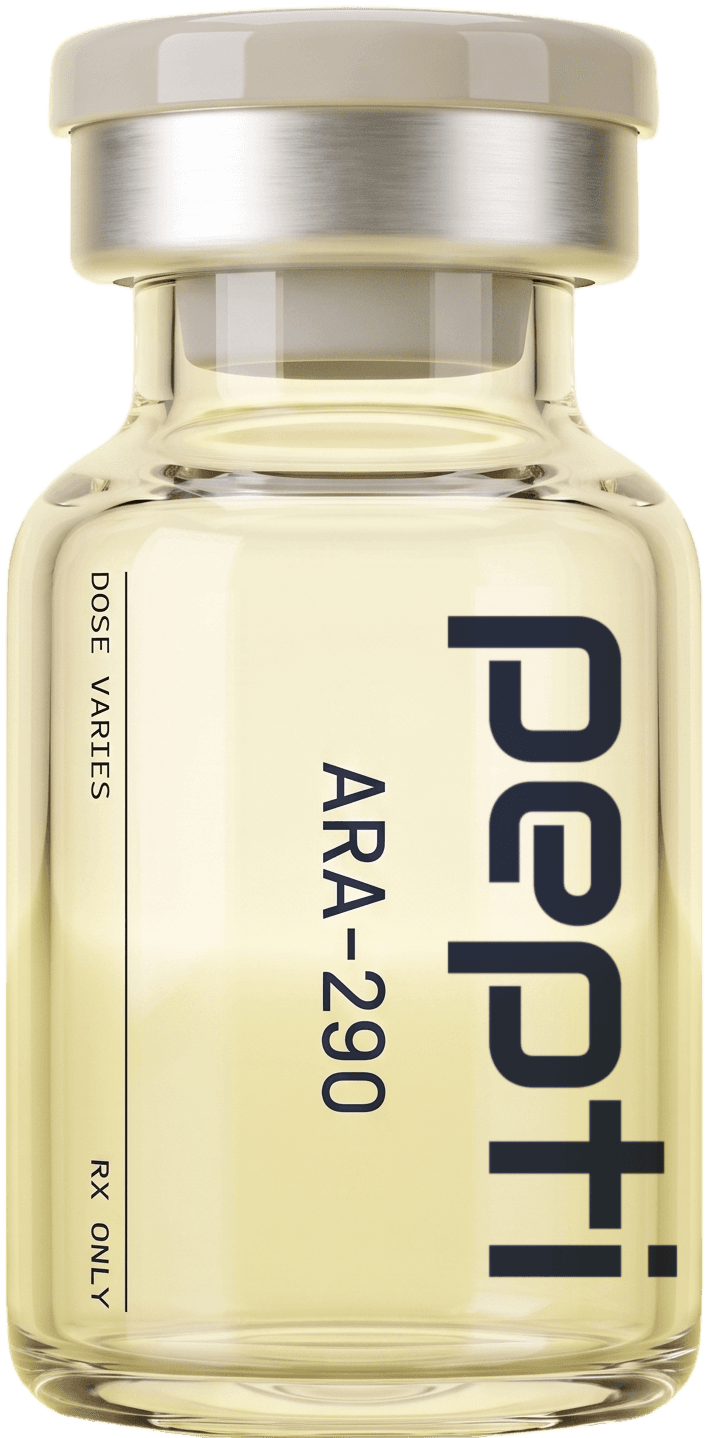
At Pepti, the ARA-290 peptide is prescribed as 0.25 mL, which is 25 units on a U-100 insulin syringe, injected under the skin once daily Monday through Friday. The vial is 5 mL at 2 mg/mL (10 mg per vial), so each dose carries 0.5 mg of ARA-290 and the vial holds 20 doses, about four weeks. Your physician sets your directions after reviewing your intake, and your exact dose and units are printed on the vial. The human trials of ARA-290, also called cibinetide, ran for four weeks at amounts set by the developer, which are not the same as a compounded prescription's directions.
This page explains the ARA-290 dosage Pepti prescribes, what the units on the syringe mean, a chart that converts units to millilitres and milligrams, how long a vial lasts, how the published trials were dosed, what can change your directions, and the side effects to know about. Nothing here is a reason to change your own dose.
ARA-290 Dosage
The short answer
| Product | Vial | Typical directions | ARA-290 per dose | Doses per vial | Price |
|---|---|---|---|---|---|
| ARA-290 | 5 mL, 2 mg/mL (10 mg per vial) | Inject 0.25 mL (25 units) subcutaneously once daily Monday through Friday | 0.5 mg | 20 | $219/mo |
The price is all-in, covering medication, physician review, refill management and shipping, with no separate membership fee. Pepti is cash-pay and does not bill insurance. These are the typical printed directions; your own directions are the ones on your vial. One strength is supplied.
ARA-290 Dosage
What ARA-290 is, briefly
ARA-290 is an eleven-amino-acid peptide whose sequence was taken from one helix of erythropoietin, the hormone that tells bone marrow to make red blood cells. It was engineered, not found in nature, and introduced in a 2008 paper in the Proceedings of the National Academy of Sciences. Its international non-proprietary name is cibinetide, and older papers call it helix B surface peptide. It is described as engaging a tissue-protective receptor assembly, called the innate repair receptor, without binding the receptor pair that drives red cell production, so it does not raise haemoglobin. The full reference is what is ARA-290.
ARA-290 Dosage
ARA-290 dosage in units, mL and mg
Pepti's directions are written in two forms, millilitres and units, because prescriptions are written in millilitres and insulin syringes are marked in units. On a U-100 insulin syringe, 1 unit is 0.01 mL, so 100 units is 1 mL and 25 units is 0.25 mL. A unit is a volume mark on the barrel, not a measure of how strong the medication is.
The milligram figure comes from the concentration. Pepti's ARA-290 is supplied at 2 mg/mL, so:
| What you read | Value | Where it comes from |
|---|---|---|
| Dose volume | 0.25 mL | Printed on the vial |
| On a U-100 insulin syringe | 25 units | 0.25 mL x 100 units per mL |
| Concentration | 2 mg/mL | Printed on the vial |
| ARA-290 per dose | 0.5 mg (500 mcg) | 2 mg/mL x 0.25 mL |
| Total in the vial | 10 mg in 5 mL | Printed on the vial |
| Doses per vial | 20 | 5 mL divided by 0.25 mL |
That arithmetic is a way to read a label, not a way to set a dose. A vial labelled 10 mg is not a 10 mg dose: it is twenty 0.5 mg doses. If your label and your syringe seem to disagree, do not dose; message your care team. How long does a peptide vial last explains every number on a vial label in more detail.
ARA-290 Dosage
ARA-290 dosage chart: units to mL to mg
The chart below is the conversion for a 2 mg/mL vial, drawn with a U-100 insulin syringe. It is math only. It is not a menu of doses, and the only line that applies to you is the one that matches the number printed on your vial.
| Syringe mark (U-100) | Volume | ARA-290 from a 2 mg/mL vial |
|---|---|---|
| 5 units | 0.05 mL | 0.1 mg |
| 10 units | 0.1 mL | 0.2 mg |
| 15 units | 0.15 mL | 0.3 mg |
| 20 units | 0.2 mL | 0.4 mg |
| 25 units (Pepti's typical directions) | 0.25 mL | 0.5 mg |
| 30 units | 0.3 mL | 0.6 mg |
| 40 units | 0.4 mL | 0.8 mg |
| 50 units | 0.5 mL | 1 mg |
| 100 units | 1 mL | 2 mg |
The rule behind every row: units divided by 100 gives millilitres, and millilitres multiplied by 2 gives milligrams. A chart written for a different concentration, or for a research powder mixed at home, gives different milligrams for the same units and does not transfer to this vial. That is the main reason not to dose from a chart, including this one.
ARA-290 is supplied as a vial and syringe only. There is no pen cartridge, capsule or nasal spray, so the syringe units are always how the dose is measured.
ARA-290 Dosage
How long an ARA-290 vial lasts
At Pepti's typical directions, one 10 mg vial lasts four weeks:
| Step | Value |
|---|---|
| Dose | 25 units, 0.25 mL, 0.5 mg |
| Doses per week | 5 (Monday through Friday) |
| Doses per vial | 20 (5 mL divided by 0.25 mL) |
| ARA-290 used | 20 x 0.5 mg = 10 mg, the whole vial |
| Time per vial | 20 doses divided by 5 per week = 4 weeks |
Four weeks is why refills run every 28 days, one vial per fill. It also happens to match the treatment length the human trials studied. Vials are multi-dose solutions shipped ready to use, refrigerated with ice packs, with sterile syringes and alcohol prep pads. Nothing is mixed at home. The peptide is broken down quickly by enzymes in blood, which is part of why it is injected rather than swallowed, but in the vial it is stable when kept cold. Keep the vial in the fridge and follow the beyond-use date printed on the label, which runs from first puncture. How to store peptides covers storage.
If a vial runs short before the refill, message your care team rather than adjusting anything yourself. If you miss a weekday dose, follow your directions and do not take two doses to make up for one.
ARA-290 Dosage
How and when ARA-290 is taken
Once daily, Monday through Friday
The weekday schedule is a prescribing pattern, not a trial design: the trials dosed daily. Five doses a week makes 20 doses land at four weeks. Pepti's directions do not name a time of day; if yours do, follow them.
Under the skin
Subcutaneous means into the fat layer, not the muscle. Abdomen and thigh are the usual sites, rotated so the same spot is not used repeatedly. The 2013 sarcoidosis trial and the 2015 diabetes trial both used daily subcutaneous self-injection, so this route is the one with human data behind it. There is no logic to injecting near a painful area: the mechanism described is systemic, through a receptor expressed where tissue is inflamed. Technique is in how to inject peptides safely.
| Directions say | What it means in practice |
|---|---|
| 0.25 mL (25 units) | Draw to the 25 mark on a U-100 insulin syringe |
| Subcutaneously | Into the fat layer, abdomen or thigh, rotating sites |
| Once daily Monday through Friday | Five doses a week, weekends off |
| 20 doses per vial | About four weeks, then the next refill |
ARA-290 Dosage
How the trials were dosed, and why that is not your dose
ARA-290 has more human trial data than most compounded peptides: small, short, randomized phase 2 trials, all run by the group that designed it. The schedules are often quoted online as protocols. They were set by the developer for specific patient groups:
| Study | Who | Route and schedule |
|---|---|---|
| Molecular Medicine, 2012, randomized pilot | 22 people with sarcoidosis and small-fibre neuropathy symptoms | Intravenous infusion three times a week for four weeks |
| Molecular Medicine, 2013, blinded, placebo-controlled | People with sarcoidosis and documented small nerve fibre loss | Once-daily subcutaneous injection for 28 days |
| Molecular Medicine, 2015, phase 2 | People with type 2 diabetes and painful neuropathy | Daily subcutaneous injection for 28 days, then a month of follow-up |
| Investigative Ophthalmology and Visual Science, 2017, phase 2b | 64 people with sarcoidosis-associated small nerve fibre loss | Placebo or one of three daily doses for 28 days; only the middle dose beat placebo on its primary endpoint |
| Journal of Clinical Medicine, 2020, open-label | 9 people with diabetic macular oedema | Daily for twelve weeks; no improvement in vision or retinal thickness |
Three points follow. First, every subcutaneous trial dosed daily for four weeks; none used a weekday schedule or the amount in Pepti's vial. Second, the 2017 dose-ranging trial found that only the middle of three doses separated from placebo on corneal nerve fibre area, so more was not better in that study. Third, no trial dosed for longer than four weeks, apart from the twelve-week open-label study in a different condition, so there is no human data on what longer courses do. That is why your directions come from a physician who has reviewed your intake, not from a study table. What the trials found is in ARA-290 benefits.
ARA-290 Dosage
What changes the directions
Your physician sets your directions after reviewing your intake. Things that can lead to different directions, or a different product, include:
| What can change | How it shows up |
|---|---|
| What you want help with | ARA-290's human trials were in nerve-related symptoms; a soft-tissue injury is usually a different conversation |
| Your medical history | Diabetes and pregnancy or breastfeeding change the conversation |
| Your other medications | One trial reported changes in haemoglobin A1c, so insulin or other glucose-lowering medication belongs on your intake; there is no established interaction list |
| How you respond | Side effects you report go to your physician, who may revise your directions |
When directions change, the new numbers are printed on the new label. Never carry a number over from a previous fill. Bloodwork is not required for any Pepti treatment. If your physician wants labs for your care, they'll ask through your account.
ARA-290 Dosage
Side effects, in summary
Across the human trials, intravenous and subcutaneous, investigators reported no safety concerns from clinical or laboratory assessments, and the twelve-week study found no antibodies against the peptide. That is a clean record over short courses in small groups; long-term data does not exist. The design purpose, no effect on red cell production, held up in the trials.
| What is reported | What it usually means | What to do |
|---|---|---|
| Injection-site redness, mild soreness, occasional bruising | The commonest complaint | Rotate sites |
| Changes in blood sugar if you take glucose-lowering medication | A precaution drawn from one trial's HbA1c finding, not an established interaction | List your medications at intake; report symptoms to your care team |
| A reaction that is severe, spreading or involves difficulty breathing | Not expected | Emergency care first (call 911), then tell your physician |
ARA-290 is not used in pregnancy or breastfeeding, where safety data is absent. It is named as a prohibited peptide in the anti-doping literature, and detection methods for it have been published, so tested athletes should check the current list for their sport.
ARA-290 Dosage
Where ARA-290 stands with the FDA
As of the FDA's 14 May 2026 update, cibinetide (ARA-290) is in Category 3 of substances nominated for the 503A bulks list, "Bulk Drug Substances Nominated Without Adequate Support." That is a paperwork category, not a safety finding: the nomination lacked enough supporting information for the FDA to evaluate it. It is not on the Category 2 list of substances with identified safety concerns, and it was not among the peptides the Pharmacy Compounding Advisory Committee reviewed in July 2026. It has never been approved by the FDA or any other regulator, and compounded medications are not FDA approved.
ARA-290 Dosage
Where to get ARA-290 prescribed
ARA-290 cannot be bought legitimately without a prescription. Sites selling it "for research use only" are not accountable for identity, purity, sterility or concentration, so even the concentration your units chart depends on is unknown. The prescription route:
- Complete a free online intake covering your history, medications and what you want help with.
- A physician licensed in your state reviews it, usually within 24 hours.
- If it is appropriate, a PCAB-accredited, FDA-registered US 503A compounding pharmacy prepares it to that prescription. Lot test results are published at /quality/lab-results.
- It ships refrigerated with your directions printed on the vial.
- Your physician stays reachable for questions and dose changes.
Pepti prescribes ARA-290 in every state except Oklahoma, plus DC What to check on any provider is in how to tell if a peptide seller is legitimate.
References
What this is based on.
References
- Dahan A, Dunne A, Swartjes M et al.. ARA 290 improves symptoms in patients with sarcoidosis-associated small nerve fiber loss and increases corneal nerve fiber density · Mol Med (2013) · PMID 24136731
- Heij L, Niesters M, Swartjes M et al.. Safety and efficacy of ARA 290 in sarcoidosis patients with symptoms of small fiber neuropathy: a randomized, double-blind pilot study · Mol Med (2012) · PMID 23168581
- Brines M, Patel NS, Villa P et al.. Nonerythropoietic, tissue-protective peptides derived from the tertiary structure of erythropoietin · Proc Natl Acad Sci U S A (2008) · PMID 18676614
- Swartjes M, Morariu A, Niesters M et al.. ARA290, a peptide derived from the tertiary structure of erythropoietin, produces long-term relief of neuropathic pain: an experimental study in rats and β-common receptor knockout mice · Anesthesiology (2011) · PMID 21873879
- Swartjes M, van Velzen M, Niesters M et al.. ARA 290, a peptide derived from the tertiary structure of erythropoietin, produces long-term relief of neuropathic pain coupled with suppression of the spinal microglia response · Mol Pain (2014) · PMID 24529189
- van Velzen M, Heij L, Niesters M et al.. ARA 290 for treatment of small fiber neuropathy in sarcoidosis · Expert Opin Investig Drugs (2014) · PMID 24555851
- Brines M, Dunne AN, van Velzen M et al.. ARA 290, a nonerythropoietic peptide engineered from erythropoietin, improves metabolic control and neuropathic symptoms in patients with type 2 diabetes · Mol Med (2015) · PMID 25387363
- Cerit H, Veer IM, Dahan A et al.. Testing the antidepressant properties of the peptide ARA290 in a human neuropsychological model of drug action · Eur Neuropsychopharmacol (2015) · PMID 26431906
- Dahan A, Brines M, Niesters M et al.. Targeting the innate repair receptor to treat neuropathy · Pain Rep (2016) · PMID 29392190
- Culver DA, Dahan A, Bajorunas D et al.. Cibinetide Improves Corneal Nerve Fiber Abundance in Patients With Sarcoidosis-Associated Small Nerve Fiber Loss and Neuropathic Pain · Invest Ophthalmol Vis Sci (2017) · PMID 28475703
- Thomas A, Knoop A, Schänzer W et al.. Characterization of in vitro generated metabolites of selected peptides <2 kDa prohibited in sports · Drug Test Anal (2017) · PMID 28941172
- Brines M, Culver DA, Ferdousi M et al.. Corneal nerve fiber size adds utility to the diagnosis and assessment of therapeutic response in patients with small fiber neuropathy · Sci Rep (2018) · PMID 29549285
Citations are provided for educational purposes. They do not constitute medical advice. Always discuss any peptide protocol with your prescribing physician.
Common questions
ARA-290 Dosage, answered.
At Pepti, 0.25 mL, which is 25 units on a U-100 insulin syringe, injected subcutaneously once daily Monday through Friday. From the 2 mg/mL vial that is 0.5 mg per dose. Your physician sets your directions after reviewing your intake, and your exact dose is printed on the vial.
An eleven-amino-acid peptide taken from part of erythropoietin, engineered to keep the tissue-protective signal without raising red blood cell counts. Its generic name is cibinetide.
The number printed on your vial. Pepti's typical directions are 25 units, which is 0.25 mL on a U-100 insulin syringe.
From a 2 mg/mL vial, 0.5 mg (500 mcg). Those figures only hold at 2 mg/mL; a different concentration gives different milligrams for the same units.
Twenty. A 5 mL vial divided by 0.25 mL per dose is 20 doses, about four weeks at five days a week.
The trials used developer-set amounts, intravenously three times a week in the first pilot and daily under the skin for 28 days in later trials. In the 2017 dose-ranging trial only the middle of three doses beat placebo on its main measure. None of those is a compounded prescription's directions.
Yes. ARA-290 is the developer's code name and cibinetide is the international non-proprietary name. The FDA's compounding lists use "Cibinetide (ARA-290)."
No. Take the dose printed on your vial, on the schedule printed on your vial. In the one dose-ranging trial, the highest dose did not beat placebo on the primary endpoint. If you have questions about your dose, message your care team.
No. Pepti vials are multi-dose solutions shipped ready to use, with sterile syringes and alcohol prep pads. Nothing is reconstituted at home.
Bloodwork is not required for any Pepti treatment. If your physician wants labs for your care, they'll ask through your account. The free assessment goes to a physician licensed in your state. A consultation does not guarantee a prescription.
Next step
See what a physician recommends for you.
A licensed physician in your state reviews your intake and decides what is appropriate. A consultation does not guarantee a prescription.