— Recovery · Reference
ARA-290: What It Is, Where to Get It Prescribed, and What It Costs
This page covers what ARA-290 is, the receptor pathway researchers have described, what the human trials did and did not show, where it currently stands with the FDA, how it is dosed, and how to get it prescribed.
— Treatments mentioned
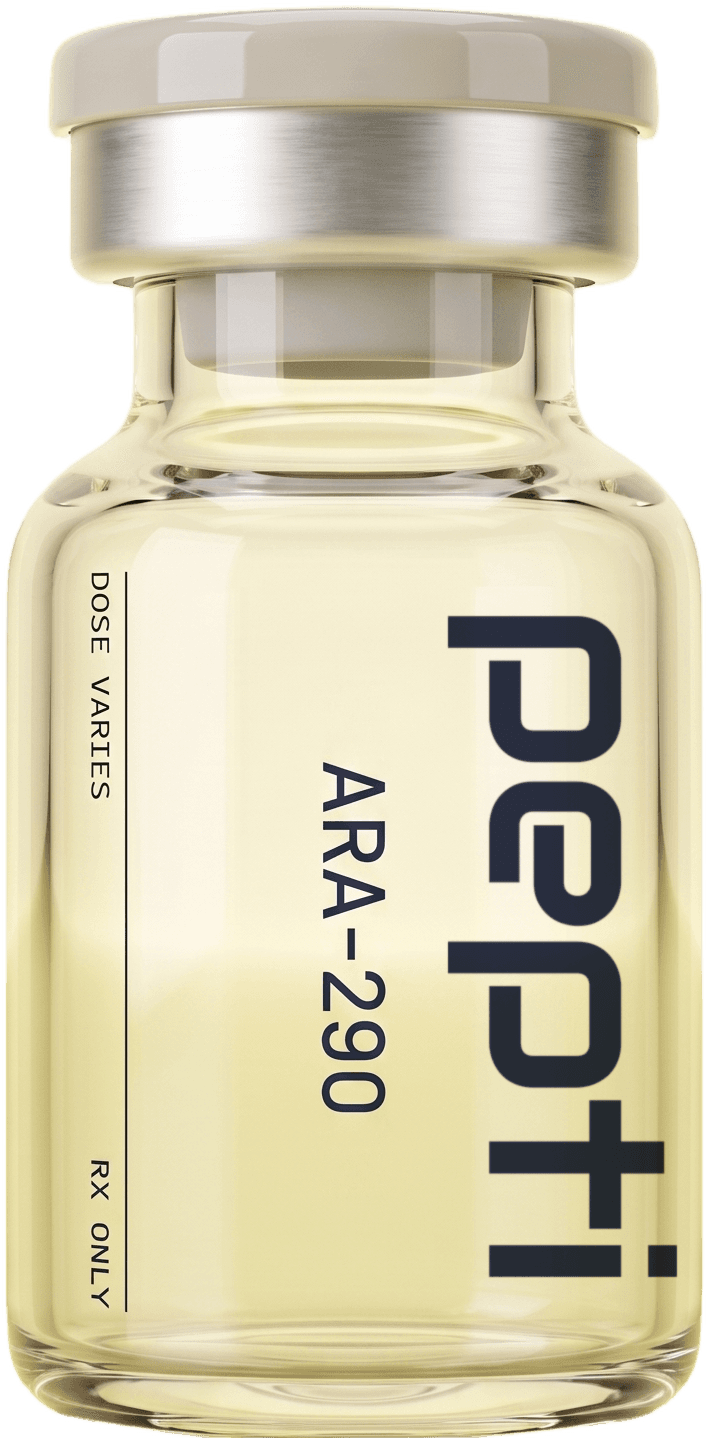
ARA-290 is a prescription injection supplied as vial — Ara-290 10mg/5mL 2mg/mL (5mL). The reviewed directions are: Inject 0.25 mL (25 units) subcutaneously once daily Monday through Friday. That is 20 doses per vial, about 4 weeks at Monday through Friday. It requires a prescription from a physician licensed in your state, is compounded by a state-licensed US pharmacy, and is not FDA approved.
This page covers what ARA-290 is, the receptor pathway researchers have described, what the human trials did and did not show, where it currently stands with the FDA, how it is dosed, and how to get it prescribed.
— ARA-290
What ARA-290 actually is
— An eleven-amino-acid piece of erythropoietin
ARA-290 is a short peptide — eleven amino acids — whose sequence was lifted from the surface of one helix of erythropoietin, the hormone the kidney releases to tell bone marrow to make red blood cells. It was not found in nature. It was engineered, and the 2008 paper in the Proceedings of the National Academy of Sciences that introduced it is titled "Nonerythropoietic, tissue-protective peptides derived from the tertiary structure of erythropoietin." That title is the whole idea: keep the part of erythropoietin that appears to protect tissue, leave behind the part that raises red cell counts.
Erythropoietin itself had been studied for nerve, heart and kidney protection and kept hitting the same wall: at the doses needed, it thickens the blood and raises clotting risk. ARA-290 was built to avoid that. It does not bind the erythropoietin receptor pair that drives red cell production, so it does not raise haemoglobin.
— Where the names come from
ARA-290 is the developer's code name — the compound came out of Araim Pharmaceuticals, and the same group (Brines, Cerami, Dahan and colleagues) authored most of the human work. Its international non-proprietary name is cibinetide, which is what the later papers and the FDA's own lists use. Older literature calls it "helix B surface peptide." All are the same molecule.
— What it is not
It is not erythropoietin, and it does not do what erythropoietin does to blood counts. It is not a conventional painkiller: it does not act on sodium channels or opioid receptors, and the trials measured it over weeks, not hours. It is not a hormone or a growth hormone secretagogue. And it is not an approved drug for anything: it went through phase 2 trials and has not been approved by the FDA or any other regulator.
— ARA-290
How ARA-290 is described to work
Four threads run through the published mechanism work. Receptor and pathway detail is from cell and animal studies; human observations are flagged where they occur.
— The innate repair receptor
Erythropoietin signals through two receptor assemblies. The classical one is a pair of erythropoietin receptors, and it drives red cell production. The second pairs one erythropoietin receptor with the β-common receptor (CD131); the research group named it the "innate repair receptor" and describes it as switched on in injured or inflamed tissue rather than healthy tissue. ARA-290 is described as engaging only this second assembly. The clearest evidence is a 2011 study in Anesthesiology: in rats and normal mice with a nerve injury, ARA-290 reduced pain-related behaviour for weeks, but in mice bred without the β-common receptor it did nothing.
— Switching off inflammatory signalling in nerve tissue
The proposed downstream effect is anti-inflammatory. A 2014 paper in Molecular Pain reported that five doses in the first ten days after a nerve injury in rats reduced pain-related behaviour for up to twenty weeks and suppressed activation of spinal cord microglia — the immune cells thought to sustain neuropathic pain once it starts. The 2016 review in Pain Reports frames this as reprogramming "a proinflammatory, tissue-damaging milieu into one of healing and tissue repair." That is the authors' language: a hypothesis with animal support, not a demonstrated human mechanism.
— Small nerve fibre regrowth
Small nerve fibres carry pain and temperature and run the autonomic system; they are what is lost in small-fibre neuropathy. The human trials used corneal confocal microscopy — a non-invasive eye scan that counts nerve fibres in the cornea — as a surrogate for small fibre density elsewhere. Across the sarcoidosis and diabetes trials below, corneal nerve fibre density or area increased in treated patients, and the 2017 phase 2b trial also reported more regenerating fibres in skin biopsies at the effective dose. The 2016 review notes that in the earlier trial regrowth was seen in the cornea but not the epidermis, so this is a real but partial signal.
— A metabolic signal in type 2 diabetes
This was not the original target. In a 2015 phase 2 study in Molecular Medicine, people with type 2 diabetes and painful neuropathy who took ARA-290 for 28 days showed improved haemoglobin A1c and lipid profiles compared with placebo. Animal work in diabetic rats (Molecular Medicine, 2016) reported improved insulin release and glucose tolerance. The mechanism in humans is not established, and it has not been pursued to a larger trial.
— ARA-290
What the research actually shows
ARA-290 is unusual among compounded peptides in that it has real randomised, placebo-controlled human trials — all small, all short, and all run by the group that designed it. Here is what each did and did not show.
— Sarcoidosis with small-fibre neuropathy: the 2012 pilot
The first human trial (Molecular Medicine, 2012) enrolled 22 people with sarcoidosis and symptoms of small-fibre neuropathy: 12 received ARA-290 by intravenous infusion three times a week for four weeks, 10 received placebo. No safety concerns were raised. At week four the treated group improved more than placebo on the Small Fiber Neuropathy Screening List, a symptom questionnaire, and improved from baseline on the pain and physical-functioning parts of the SF-36. The part most summaries leave out: the Brief Pain Inventory pain score and the fatigue score improved equally in both groups, and depressive symptoms did not change. The pilot showed a symptom-questionnaire signal, not a pain-intensity signal separated from placebo.
— Sarcoidosis: the 2013 subcutaneous trial
The follow-up (Molecular Medicine, 2013) moved to 28 days of once-daily subcutaneous injection — the route Pepti's product uses — in a blinded, placebo-controlled design in patients with documented small nerve fibre loss. Treated patients reported improved neuropathic symptoms, and the trial added objective measures: corneal nerve fibre density increased, skin temperature sensitivity changed, and six-minute walk distance increased. This is the trial that moved the authors' framing from "symptom relief" to "possible disease modification."
— Sarcoidosis: the 2017 phase 2b dose-ranging trial
The largest trial (Investigative Ophthalmology & Visual Science, 2017) randomised 64 people with sarcoidosis-associated small nerve fibre loss and neuropathic pain to placebo or one of three daily doses for 28 days. The primary endpoint was change in corneal nerve fibre area. Only the middle dose beat placebo on it; the low and high doses did not reach significance. The middle dose also increased regenerating fibres in skin biopsy. Pain improved in every group including placebo, and the placebo-corrected reduction in pain intensity at the middle dose — described as clinically meaningful in those with moderate-to-severe pain — was not statistically significant. The strongest evidence is for an objective nerve-fibre change; the evidence for pain relief beyond placebo is weaker than the marketing around this peptide usually implies.
— Type 2 diabetes with painful neuropathy
The 2015 phase 2 study in Molecular Medicine gave people with type 2 diabetes and painful neuropathy 28 days of daily subcutaneous ARA-290 or placebo, then followed them a further month. No safety issues were identified. Neuropathic symptoms on the PainDetect questionnaire improved significantly in the treated group. Corneal nerve fibre density increased in the subset who started with clearly reduced density and did not change on placebo. The HbA1c and lipid findings came from the same study. It has not been replicated in a larger population.
— What human data exists
There are randomised, double-blind, placebo-controlled phase 2 trials of ARA-290 in humans, in sarcoidosis-associated small-fibre neuropathy and in type 2 diabetes with painful neuropathy. That is more than most compounded peptides can say. The trials were small (22 to 64 people), short (four weeks of treatment), run by the developer, and used surrogate endpoints — questionnaires and corneal nerve counts — rather than hard outcomes. No phase 3 trial has been completed and no regulator has approved it.
Two smaller studies round out the picture. A 2020 open-label study (Journal of Clinical Medicine) gave nine patients with diabetic macular oedema twelve weeks of daily cibinetide and found no improvement in visual acuity or retinal thickness, though the course was safe and no antibodies to the peptide were detected. A single-dose study in 36 healthy volunteers (European Neuropsychopharmacology, 2015) found no effect on mood. Neither is a success, and an honest page says so.
The fair summary: a consistent signal on small nerve fibre regrowth and neuropathy symptom questionnaires in two specific patient populations, a clean safety record over four-week courses, and no proof of durable pain relief or of benefit in any other condition.
— What the evidence does not establish
- It does not establish that ARA-290 reduces pain intensity more than placebo. The symptom questionnaires separated from placebo; the pain-intensity scores did not.
- It does not establish benefit in neuropathy from other causes — chemotherapy, alcohol, idiopathic, injury — because those populations were not studied.
- It does not establish what happens beyond four weeks of treatment, or with repeated courses.
- It does not establish a benefit for general recovery, injury or performance. Those uses rest on animal work and mechanism.
- It does not establish efficacy for any condition as an FDA-approved treatment. It is not approved for anything.
— ARA-290
Where ARA-290 stands with the FDA right now
ARA-290 has never been submitted for FDA approval as a drug, so the relevant question is its status for compounding.
Cibinetide (ARA-290) appears on the FDA's current list of bulk drug substances nominated for the 503A bulks list in Category 3 — "Bulk Drug Substances Nominated Without Adequate Support" — in the document updated 14 May 2026. Category 3 is a paperwork category, not a safety finding: the nomination the FDA received did not include enough supporting information for the agency to evaluate the substance. A nominator can resubmit with adequate support, at which point a substance moves to Category 1 for evaluation.
It does not appear on the FDA's Category 2 list of substances that raise significant safety risks, current as of 22 April 2026. It was not among the peptides the Pharmacy Compounding Advisory Committee discussed on 23–24 July 2026 (those were BPC-157, KPV, TB-500, MOTS-c, DSIP, Semax and Epithalon).
So the accurate description today is: not flagged for a safety concern, not yet evaluated for the bulks list because the nomination was incomplete, and not scheduled for advisory committee review. It is compounded by state-licensed pharmacies under a physician's prescription. It is not an FDA-approved drug product, and compounded medications never are.
— ARA-290
Realistic expectations
These are patterns described by prescribers and by the four-week trial windows, not established treatment outcomes. Individual response varies and a physician decides whether treatment is appropriate at all.
— The first week or two
The trials measured nothing before week four, so there is no human data on what the first days feel like. Prescribers describe the early period as uneventful for most people. Nerve fibre regrowth, if it happens, is slow, and there is no reason to expect a change in burning or tingling within days.
— Weeks three to four
This is the only window with human trial data. At day 28 the sarcoidosis and diabetes trials reported changes in symptom questionnaires and corneal nerve fibre counts. A vial is sized to cover this window — twenty weekday doses over about four weeks — which lines up with the treatment length that has actually been studied.
— Beyond four weeks
No trial dosed for longer than four weeks. The diabetes study followed people for a month afterwards, during which the metabolic improvements persisted. Whether continued dosing adds anything is unknown. This is a conversation to have with your physician before starting, and again at the first refill.
— What it will not feel like
It is not an analgesic. If what you need is something that takes the edge off tonight, this is the wrong tool and your physician will say so. Pain-intensity scores in the trials moved in the placebo groups almost as much as in the treated groups.
— ARA-290
When something else makes more sense
A reference that only ever recommends its own product is not much of a reference. Some honest cases where ARA-290 is not the first thing to reach for:
- Your neuropathy has not been worked up. Small-fibre neuropathy has testable causes — B12 deficiency, thyroid disease, poorly controlled glucose. At-home blood testing covers these markers, and if B12 is the issue, methylcobalamin is the more direct conversation.
- Type 2 diabetes and weight are the drivers. Glycaemic control is the foundation of diabetic neuropathy care. Semaglutide and tirzepatide have large human trials behind them for glucose and weight, which ARA-290 does not.
- The problem is a soft-tissue injury, not nerve damage. A tendon, ligament or muscle problem is where BPC-157, TB-500 or the BPC-157 + TB-500 stack are usually discussed. ARA-290 has no human data for musculoskeletal injury.
- The picture is systemic inflammation rather than neuropathy. KPV or the FORTIFY blend are aimed at that more directly.
- You are chasing mitochondrial or energy symptoms. SS-31 and NAD+ work through different biology and are the usual starting point for that conversation.
Your physician will tell you if ARA-290 is not the right tool for what you have described. A consultation does not guarantee a prescription, and being declined is refunded.
— ARA-290
Strengths available
| Strength | Directions |
|---|---|
| Ara-290 10mg/5mL | Inject 0.25 mL (25 units) subcutaneously once daily Monday through Friday. |
One strength is supplied. The dose and schedule you are prescribed are your physician's decision and are printed on your medication.
— ARA-290
Dosing, and how a vial is actually used
— Why the dose is measured in units
The directions are written in millilitres and in insulin-syringe units because that is what you can actually read off the barrel. 0.25 mL is 25 units on a U-100 syringe. You are not calculating anything — the number is printed on your medication.
— Subcutaneous, and where
Subcutaneous means into the fat layer, not the muscle. Abdomen and thigh are the usual sites, rotated so the same spot is not used repeatedly. The 2013 sarcoidosis trial and the 2015 diabetes trial both used daily subcutaneous self-injection, so this route is the one with human data behind it. There is no logic to injecting near a painful area: the mechanism described is systemic, through a receptor expressed wherever tissue is inflamed.
— Why Monday to Friday, and why a vial covers about four weeks
The reviewed directions are once daily on weekdays, which is 20 doses per vial and about four weeks — the same treatment length the human trials used. The weekday schedule is a prescribing pattern, not a trial design: the trials dosed daily, at amounts set by the sponsor that are not the same as a compounded prescription's directions. Your physician sets yours. One vial per fill, always — not a stockpile.
— Storage
Refrigerated, and it ships that way in insulated packaging with ice packs. The peptide is broken down quickly by enzymes in blood, which is part of why it is injected rather than swallowed, but in the vial it is stable when kept cold. Beyond-use dating runs from first puncture and is on the label.
— ARA-290
Safety and side effects
Across the human trials — intravenous and subcutaneous, in sarcoidosis, type 2 diabetes, diabetic macular oedema and healthy volunteers — investigators reported no safety concerns from clinical or laboratory assessments, and the twelve-week study found no antibodies against the peptide. That is a clean record, but over short courses in a few hundred people at most; long-term data does not exist. The design purpose — no effect on red cell production — held up in the trials, so it does not carry erythropoietin's clotting risk.
What gets reported clinically is mostly injection-site: redness, mild soreness, occasional bruising. Because the diabetes trial reported changes in haemoglobin A1c, anyone on insulin or other glucose-lowering medication should tell their physician; this is a precaution drawn from trial data, not an established interaction.
There is no established interaction list, because the trials that would produce one have not been run. That is precisely why the intake asks for every medication you take and why a physician reviews it rather than a form.
Stop and contact your physician for any reaction that is severe, spreading, or involves difficulty breathing.
— ARA-290
How ARA-290 compares
ARA-290 vs BPC-157
Both sit in Pepti's Recovery category and answer different questions. BPC-157 is described around blood vessel growth and cell migration in tendon, muscle and gut, almost entirely from animal work. ARA-290 is described around an anti-inflammatory repair receptor in nerve tissue, with human trials in neuropathy. A sore tendon is a BPC-157 conversation; burning, tingling and numbness from small nerve fibre damage is an ARA-290 one. They are not interchangeable.
ARA-290 vs KPV
KPV is a three-amino-acid fragment of alpha-MSH described around broad anti-inflammatory signalling, mostly in gut and skin models. ARA-290's anti-inflammatory action runs through one specific receptor in injured tissue and has been tested in people with neuropathy. Where the problem is inflammation without a nerve-damage picture, KPV is generally the more direct discussion.
— ARA-290
Availability and formats
| Question | Answer |
|---|---|
| Can I get it by telehealth? | Yes, where a physician licensed in your state prescribes it |
| Which states? | All 50 states and DC |
| Does it come as a pen? | No, this one is a vial and syringe only |
| Does it come as a capsule? | No |
| Does it come as a nasal spray? | No |
| Is bloodwork required first? | Not routinely; your physician decides |
— ARA-290
Where to get ARA-290 prescribed
ARA-290 cannot be bought legitimately without a prescription. Sites shipping it with no prescription are selling a research-use-only product, where no pharmacy is accountable for identity, purity, sterility or concentration.
The prescription route works like this:
- Complete a medical intake covering your history, medications, allergies and what you are treating.
- A physician licensed in your state reviews it.
- If appropriate, a state-licensed, FDA-registered pharmacy compounds it to that prescription.
- It ships refrigerated with your directions printed on the vial.
- Your physician stays reachable afterwards for dose questions and side effects.
Current all-in pricing for ARA-290 is published: medication, physician review, refill management and shipping in one figure, with no separate membership fee. What to check on any provider is in how to tell if a peptide seller is legitimate.
— ARA-290
Who should not take it, or should discuss it first
| Situation | Why |
|---|---|
| Pregnancy or breastfeeding | Not used; safety data is absent |
| Tested athletes | Many peptides are prohibited in competition; check the current list |
— Full specification
Everything on the label.
— Product
ARA-290 (Injectable)
— How supplied
vial — Ara-290 10mg/5mL 2mg/mL (5mL)
— Typical directions
Inject 0.25 mL (25 units) subcutaneously once daily Monday through Friday.
— Dose volume
0.25 mL (25 units on a U-100 insulin syringe)
— Doses per vial
20
— Coverage per vial
about 4 weeks at Monday through Friday
— Formats
Vial and syringe
— Available in
All 50 states and DC
— Bloodwork
Not routinely required; your physician decides
— Legal status
Prescription-only, compounded, not FDA approved
— Category
Recovery
— References
What this is based on.
References
- Dahan A, Dunne A, Swartjes M et al.. ARA 290 improves symptoms in patients with sarcoidosis-associated small nerve fiber loss and increases corneal nerve fiber density · Mol Med (2013) · PMID 24136731
- Heij L, Niesters M, Swartjes M et al.. Safety and efficacy of ARA 290 in sarcoidosis patients with symptoms of small fiber neuropathy: a randomized, double-blind pilot study · Mol Med (2012) · PMID 23168581
- Brines M, Patel NS, Villa P et al.. Nonerythropoietic, tissue-protective peptides derived from the tertiary structure of erythropoietin · Proc Natl Acad Sci U S A (2008) · PMID 18676614
- Swartjes M, Morariu A, Niesters M et al.. ARA290, a peptide derived from the tertiary structure of erythropoietin, produces long-term relief of neuropathic pain: an experimental study in rats and β-common receptor knockout mice · Anesthesiology (2011) · PMID 21873879
- Swartjes M, van Velzen M, Niesters M et al.. ARA 290, a peptide derived from the tertiary structure of erythropoietin, produces long-term relief of neuropathic pain coupled with suppression of the spinal microglia response · Mol Pain (2014) · PMID 24529189
- van Velzen M, Heij L, Niesters M et al.. ARA 290 for treatment of small fiber neuropathy in sarcoidosis · Expert Opin Investig Drugs (2014) · PMID 24555851
- Brines M, Dunne AN, van Velzen M et al.. ARA 290, a nonerythropoietic peptide engineered from erythropoietin, improves metabolic control and neuropathic symptoms in patients with type 2 diabetes · Mol Med (2015) · PMID 25387363
- Cerit H, Veer IM, Dahan A et al.. Testing the antidepressant properties of the peptide ARA290 in a human neuropsychological model of drug action · Eur Neuropsychopharmacol (2015) · PMID 26431906
- Dahan A, Brines M, Niesters M et al.. Targeting the innate repair receptor to treat neuropathy · Pain Rep (2016) · PMID 29392190
- Culver DA, Dahan A, Bajorunas D et al.. Cibinetide Improves Corneal Nerve Fiber Abundance in Patients With Sarcoidosis-Associated Small Nerve Fiber Loss and Neuropathic Pain · Invest Ophthalmol Vis Sci (2017) · PMID 28475703
- Thomas A, Knoop A, Schänzer W et al.. Characterization of in vitro generated metabolites of selected peptides <2 kDa prohibited in sports · Drug Test Anal (2017) · PMID 28941172
- Brines M, Culver DA, Ferdousi M et al.. Corneal nerve fiber size adds utility to the diagnosis and assessment of therapeutic response in patients with small fiber neuropathy · Sci Rep (2018) · PMID 29549285
Citations are provided for educational purposes. They do not constitute medical advice. Always discuss any peptide protocol with your prescribing physician.
— Common questions
ARA-290, answered.
Through a telehealth provider where a physician licensed in your state reviews a medical intake and a licensed US pharmacy compounds the prescription. Pepti prescribes ARA-290 in all 50 states and DC; start with the free assessment.
vial — Ara-290 10mg/5mL 2mg/mL (5mL)
Inject 0.25 mL (25 units) subcutaneously once daily Monday through Friday. Your physician sets your own dose and it is printed on your medication.
20 at the standard volume, about 4 weeks at Monday through Friday.
ARA-290 is supplied as a vial, drawn with an insulin syringe. It is not available as a pen or capsule.
Not routinely, though your physician may want labs depending on your history. at-home blood testing covers hormone, metabolic and thyroid markers without a lab visit.
It is legal to prescribe and dispense in the United States with a valid prescription. It is not FDA approved: compounded medications are prepared by licensed pharmacies pursuant to a prescription rather than approved as manufactured products. See are peptides FDA approved.
Pricing is published on the ARA-290 page as one all-in figure covering medication, physician review, refill management and shipping. What drives peptide pricing generally is in how much do peptides cost.
Yes. ARA-290 is the developer's code name and cibinetide is the international non-proprietary name; older papers also call it helix B surface peptide. The FDA's compounding lists use "Cibinetide (ARA-290)."
Yes, more than for most compounded peptides. Randomised, placebo-controlled phase 2 trials in sarcoidosis-associated small-fibre neuropathy (2012, 2013 and a 64-person dose-ranging trial in 2017) and in type 2 diabetes with painful neuropathy (2015) reported improved neuropathy symptom scores and increased corneal nerve fibre density after four weeks. The trials were small, short and run by the developer; pain-intensity scores did not clearly separate from placebo; no phase 3 trial exists.
No. It was engineered specifically not to: it does not bind the erythropoietin receptor pair that drives red cell production, and the trials confirmed no effect on blood counts. It is not a blood-doping agent, though it is still a prohibited peptide in sport.
No. As of the FDA's 14 May 2026 update, cibinetide (ARA-290) is in Category 3 of substances nominated for the 503A bulks list, meaning the nomination lacked enough supporting information for the FDA to evaluate it. It is not on the Category 2 list of substances with identified safety concerns, and it was not among the peptides reviewed by the Pharmacy Compounding Advisory Committee in July 2026. It remains prescription-only and compounded, and it is not FDA approved.
The human trials measured outcomes at 28 days, and that is the only window with data. There is no evidence about the first days, and no trial has tested longer than four weeks of dosing, which is why a vial covers about four weeks. Nerve regrowth is slow, and this is not a fast-acting painkiller.
Nobody knows. The human trials were in sarcoidosis and type 2 diabetes only. Animal studies describe reduced pain-related behaviour after surgical nerve injury, but that has not been tested in people. Your physician will weigh whether the mechanism is plausible for your situation.
ARA-290 is specifically named as a prohibited peptide in the anti-doping literature, and detection methods for it have been published. If you are a tested athlete, check the current prohibited list for your sport before starting anything, and tell your physician.
The human trials reported no safety concerns over four- to twelve-week courses and no antibodies against the peptide. What is reported in practice is mostly injection-site redness, soreness or bruising. Because one trial reported improved HbA1c, people on glucose-lowering medication should tell their physician. Long-term safety data does not exist, and there is no established interaction list, which is why a physician reviews every medication you take.
— Next step
See what a physician
recommends for you.
A licensed physician in your state reviews your intake and decides what is appropriate. A consultation does not guarantee a prescription.
Important legal & safety information
The assessment process available on the Pepti website asks a series of medical questions, and the answers provided are reviewed by an independent licensed physician affiliated with our partner physician network. The licensed providers have established exclusionary criteria, and the answers provided determine if the individual is screened out of eligibility for treatment. The licensed clinicians retain the sole decision to prescribe peptide therapy and other compounded medications to patients. Treatment may be denied at the physician's sole discretion. If a prescription is not approved, you will not be charged for the medication.
Pharmacy Providers. Pepti is a technology platform and is not a healthcare provider, pharmacy, or prescriber. All medications offered through the platform are compounded by independent FDA-registered 503A or 503B compounding pharmacies based on a valid prescription written by a licensed physician for an individual patient. Compounded medications are not FDA-approved as products. The active pharmaceutical ingredients used by our partner pharmacies are sourced from FDA-registered facilities. Compounded medications may not undergo the same testing or quality control as commercially manufactured FDA-approved drugs.
Results vary. Results from peptide therapy and other compounded treatments vary based on individual factors, including age, weight, medical history, adherence to the prescribed protocol, lifestyle factors, and physiological response. Pepti makes no guarantee of any specific outcome. Statements about peptide therapy and compounded medications offered through the platform have not been evaluated by the Food and Drug Administration. These products are not intended to diagnose, treat, cure, or prevent any disease.
Product images. Product photographs and renderings shown on this website are for illustrative purposes only. The appearance of vials, packaging, labeling, and other materials you receive may vary and is determined by the dispensing compounding pharmacy.
Off-label use.Many peptides offered through the platform are prescribed for off-label use. “Off-label” means the medication is being prescribed for a use, dose, or patient population that is not specifically approved by the FDA. Off-label prescribing is legal and common in U.S. medical practice when supported by clinical experience and judgment.
Mailing & shipping. Pepti currently dispenses prescription medication to patients in all 50 states and Washington, D.C.. All orders ship in unbranded, tamper-evident packaging via expedited delivery from our partner compounding pharmacies. Temperature-sensitive medications ship with insulated packaging and ice packs. Shipping is included at no additional cost. We do not currently ship medication outside all 50 states and Washington, D.C., internationally, or to APO/FPO addresses.
Not for emergencies. Pepti is not designed for medical emergencies. If you are experiencing a medical emergency, call 911 or go to your nearest emergency room immediately. For urgent but non-emergency medical questions, contact your primary care provider or use an urgent care service.
No doctor-patient relationship with Pepti. Your use of the platform does not create a doctor-patient relationship between you and pepti LLC. A doctor-patient relationship is established only between you and the independent licensed physician who reviews your intake and prescribes your treatment. The physicians who use the platform are independent contractors and are solely responsible for the medical care they provide.
Prescription medications. All prescription products require a valid prescription from a licensed healthcare provider. By using the platform, you acknowledge that you are at least 18 years old and that the information you provide is true, accurate, current, and complete. Providing false information may result in inappropriate treatment recommendations or denial of service.
Cosmetic & wellness products.Certain products offered through Pepti — including skincare, hair care, body care, supplements, men's grooming, sports recovery, and sexual wellness products — are cosmetic or dietary supplement products, not prescription medications. These products do not require a prescription and are not reviewed or prescribed by a physician. Statements regarding dietary supplements have not been evaluated by the Food and Drug Administration. These products are not intended to diagnose, treat, cure, or prevent any disease. Results vary by individual. Consult your healthcare provider before starting any new supplement or topical product, especially if you are pregnant, nursing, or taking other medications.
pepti LLC · Delaware Limited Liability Company · 131 Continental Dr, Suite 305, Newark, DE 19713 · For media or partnership inquiries, email hello@hellopepti.com. For patient support, email support@hellopepti.com. For privacy and HIPAA inquiries, email privacy@hellopepti.com.