Anti-Aging · Reference
Where to Buy GHK-Cu Online: Injectable Prescription vs Serum vs Grey Market
This page covers what GHK-Cu is, the three very different products sold under that name, why the label on a vial tells you less than you think, how the prescription route works from intake to refill, what a legitimate provider should be able to show you, the red flags, what it costs, and where GHK-Cu stands with the FDA as of September 2026.

Reviewed by Dr. Gene, MD · Board-certified Family Medicine
Every Pepti prescription is reviewed by a licensed U.S. physician before it's dispensed — and only provided if clinically appropriate.
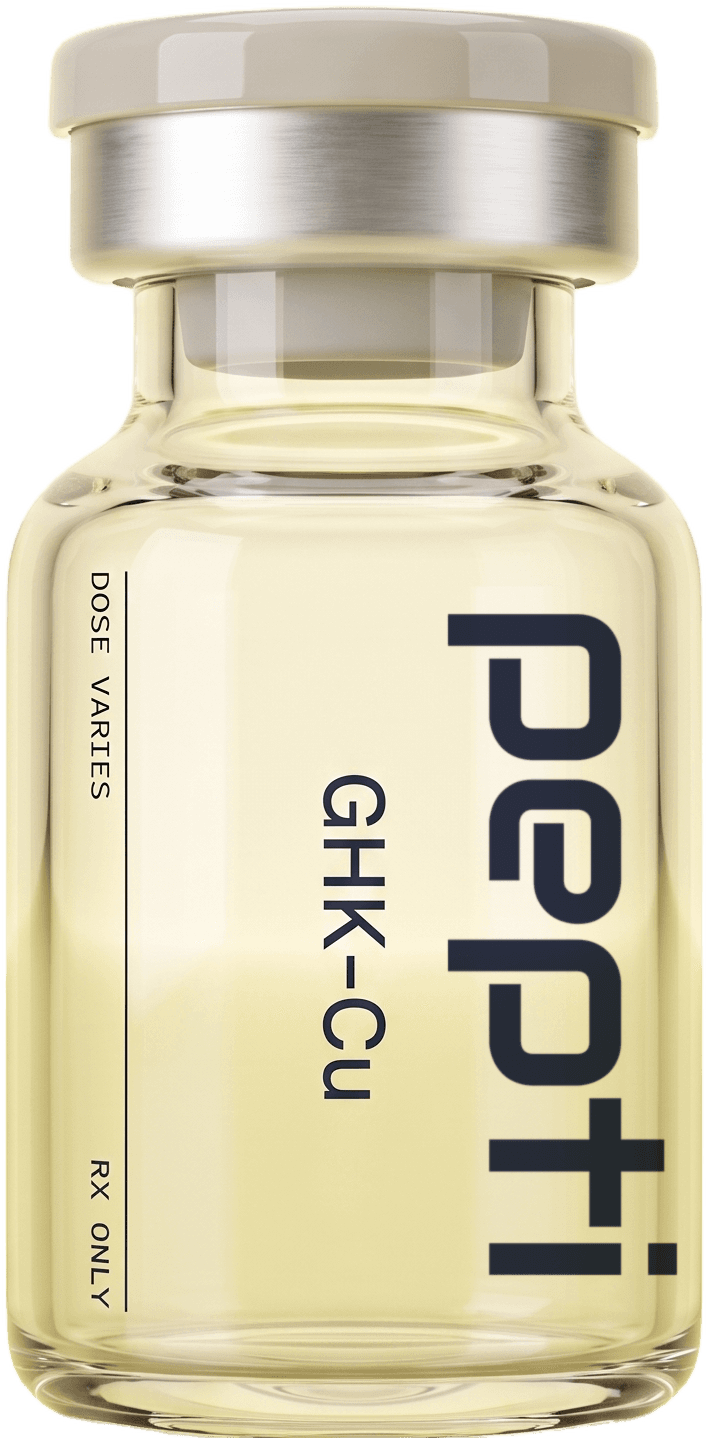
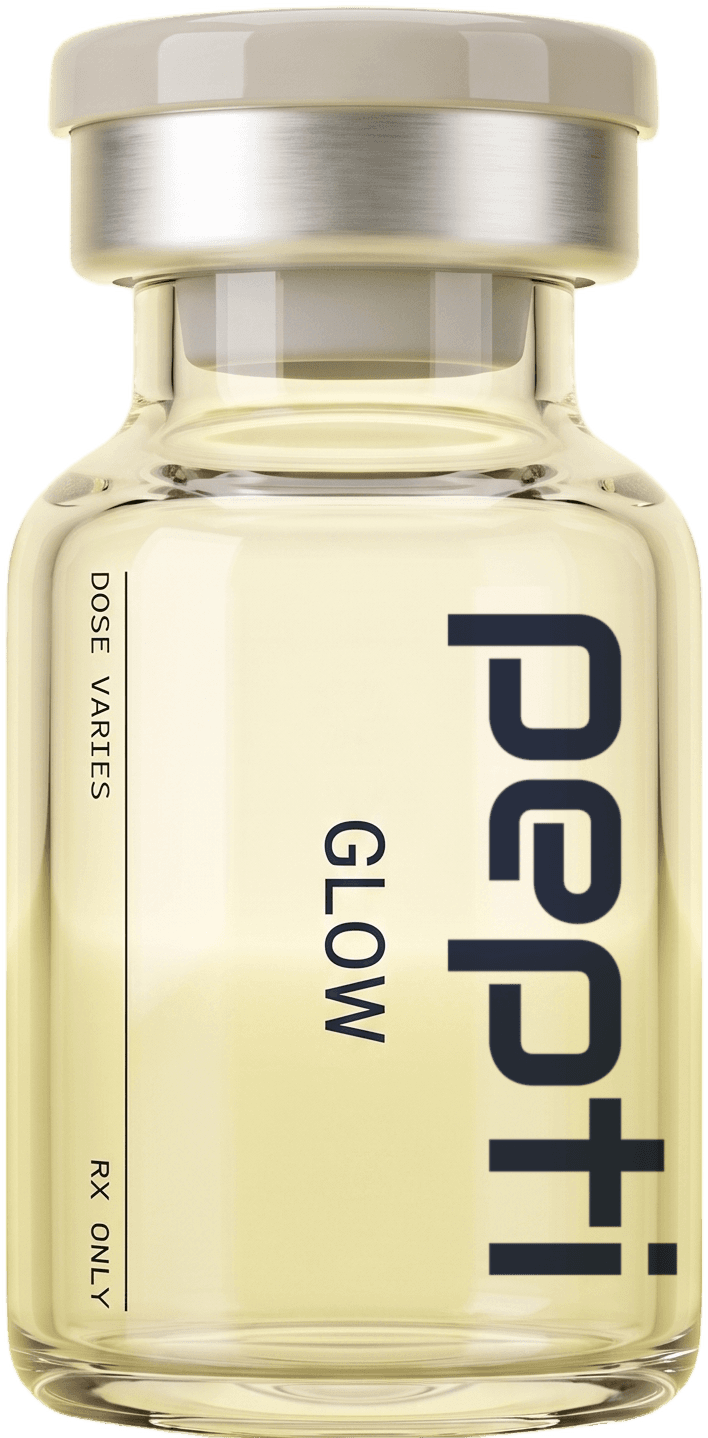
Injectable GHK-Cu is a prescription medication, so buying it online legitimately means a telehealth provider where a physician licensed in your state prescribes it and a licensed US compounding pharmacy compounds it. Cosmetic copper-peptide serums are a separate product sold without a prescription, and research-use-only GHK-Cu vials are a third thing again, shipped under a not-for-human-use label with no pharmacy behind them. Compounded injectable GHK-Cu is not FDA approved. What the prescription buys is a physician who checked your copper and zinc situation, a pharmacy answerable to a state board, and a documented dose.
This page covers what GHK-Cu is, the three very different products sold under that name, why the label on a vial tells you less than you think, how the prescription route works from intake to refill, what a legitimate provider should be able to show you, the red flags, what it costs, and where GHK-Cu stands with the FDA as of September 2026.
Where to Buy GHK-Cu Online
The short answer
| If your goal is | The usual prescription | What is in it | Price |
|---|---|---|---|
| Skin quality, collagen, scarring | GHK-Cu | 50 mg GHK-Cu in 5 mL | $239 |
| Skin plus soft-tissue repair | GLOW | 50 mg GHK-Cu, 10 mg BPC-157, 10 mg TB-500 | $259 |
| Skin plus repair plus inflammation | KLOW | 50 mg GHK-Cu, 10 mg KPV, 10 mg BPC-157, 10 mg TB-500 | $259 |
| Skin alongside growth signalling | RADIANCE | 50 mg GHK-Cu, 10 mg Tesamorelin | $249 |
| Longevity-oriented stack | ETERNAL | 50 mg GHK-Cu, 10 mg BPC-157, 10 mg TB-500, 10 mg Epithalon | $279 |
| Topical cosmetic use only | A copper-peptide serum from a retailer | Varies by brand | Not a prescription |
Prices are all-in per month and include medication, physician review, refill management and shipping. Treatment refills on a subscription until you cancel it.
Current pricing for each preparation is on its product page and on /cost/ghk-cu; the product page governs. If you only want something to put on your face, buy a serum from a cosmetics retailer and stop reading. If you want injectable GHK-Cu, the rest of this page is about getting it in a way that leaves someone accountable for what is in the vial.
Where to Buy GHK-Cu Online
What GHK-Cu actually is
A copper-carrying tripeptide from your own plasma
GHK-Cu is a copper-binding tripeptide, glycine-histidine-lysine, that occurs naturally in human plasma and declines with age. It was first described in a 1973 paper in Nature: New Biology as a component of human serum that prolonged the survival of liver cells in culture. The same three-residue motif sits inside larger proteins, including collagen and the matrix protein SPARC; a 1994 Journal of Cell Biology paper reported that SPARC is a source of copper-binding peptides, which is the basis for the idea that GHK is a signal released when tissue is being remodelled.
It works as a copper carrier: it binds copper with high affinity and delivers it where copper-dependent enzymes need it, which is why the compound is blue and why copper status matters to the conversation. The copper is chelated, held in a form that is not free and reactive. That distinction, carrier rather than mineral supplement, is the whole reason the injectable version needs a prescriber who has asked about Wilson's disease and zinc.
What the research describes
Research describes increased synthesis of collagen, elastin, proteoglycans and glycosaminoglycans, modulation of the balance between matrix metalloproteinases and the inhibitors that restrain them, antioxidant activity, and support for new blood-vessel formation. The collagen finding goes back to a 1988 FEBS Letters paper on cultured fibroblasts; the matrix-metalloproteinase work is in the Journal of Investigative Dermatology in 1999 and Life Sciences in 2000; a 1993 Journal of Clinical Investigation study reported connective-tissue accumulation in rat wounds. Gene-expression work, summarised in the Pickart group's reviews in BioMed Research International in 2015 and the International Journal of Molecular Sciences in 2018, reports effects across a large number of genes rather than one pathway, which is why GHK-Cu turns up in skin, wound and hair contexts at once. More in what GHK-Cu is and peptides for skin.
GHK-Cu is not a growth hormone secretagogue, not a hormone and not an anabolic agent. Most of the detail above is from cells and animals, and the human data is largely topical; that matters when deciding what to buy, and it is dealt with further down.
Where to Buy GHK-Cu Online
The three products sold as GHK-Cu
Confusing these is the most common mistake buyers make, and sellers rarely correct it.
| Injectable prescription GHK-Cu | Cosmetic copper-peptide serum | Research-use-only vial | |
|---|---|---|---|
| Requires a prescription | Yes | No | No |
| Who makes it | A licensed compounding pharmacy | A cosmetics manufacturer | A chemical supplier |
| Concentration disclosed | On the prescription label | Often not | On a sticker |
| Sterility | Required, to USP sterile-compounding standards | Not applicable | Not required |
| Copper load assessed against your history | Yes | Not applicable | No |
| Accountability | Pharmacy and prescriber, to state boards | Consumer product regulation | Nobody |
| What it is for | Systemic use under directions | Topical skin care | Laboratory use, per the seller's terms |
A serum is a reasonable purchase if topical skin care is what you want. It is not a cheaper version of the injectable, and the injectable is not a stronger serum.
The injectable prescription
A sterile solution of GHK-Cu in a multi-dose vial, prepared by a state-licensed, FDA-registered compounding pharmacy against a prescription written for you by name by a physician licensed in your state. The label carries your name, the strength, the volume, your directions and a beyond-use date. Pepti supplies it as GHK-Cu on its own and inside the GLOW, KLOW, RADIANCE and ETERNAL blends. It is the only one of the three products that is a medication.
The cosmetic serum
Copper-peptide serums are cosmetics: regulated as consumer products, sold without a prescription, and frequently silent on how much GHK-Cu they contain. That is not a criticism; a cosmetic is not required to be dosed, and most of the human evidence for GHK-Cu comes from topical use. The gap between serum and injection is not strength but exposure. A 2011 paper in Inflammation Research measured how much of a copper tripeptide penetrates human skin in vitro, layer by layer, and found that very little reaches deeper tissue; a serum is a local product acting on the outer skin. A subcutaneous injection delivers the whole dose into the body. The two are not interchangeable in either direction, and a seller describing one as the other is describing something untrue.
The research-use-only vial
The third product is a powder or solution sold by a chemical supplier under a label that says, in some wording, "for research use only, not for human consumption." That label is doing legal work: the seller is declaring that no medical claim is made and no person is meant to use it. There is no prescription, no pharmacy, no sterility requirement and no state board to complain to. Whatever the sticker says about identity, purity or concentration is the vendor's claim about its own product.
Where to Buy GHK-Cu Online
Why "GHK-Cu" on a label tells you almost nothing
The reason the pharmacy route matters is not that research-chemical vendors are all dishonest. It is that nobody is checking, and the things that need checking are invisible.
Identity and concentration
A white powder in a vial looks the same whether it is GHK-Cu, a different peptide or a filler. Identity is confirmed by mass spectrometry or HPLC against a reference standard; a licensed pharmacy's source material comes with that testing and the pharmacy keeps the paperwork. Concentration is on the prescription label because the dose depends on it. A research vial states a nominal quantity you reconstitute yourself, and the actual content may differ from the sticker; getting the concentration wrong in either direction is the most ordinary way self-sourcing goes wrong.
Purity, and the impurities the FDA worried about
Synthetic peptides carry by-products of synthesis: truncated and deletion sequences, residual protecting groups and solvents. When the FDA placed injectable GHK-Cu in Category 2 of its interim 503A list in 2023, the concern it recorded was that "compounded injectable drugs containing GHK-Cu may pose risk for immunogenicity due to the potential for aggregation and peptide-related impurities," alongside limited human data. That is a product-quality concern, and it is the strongest argument for a vial whose purity has been measured batch by batch rather than assumed.
Sterility and endotoxin
Anything injected under the skin has to be sterile and low in bacterial endotoxin. Compounding pharmacies prepare injectables under USP sterile-compounding standards, with sterility and endotoxin testing on the batch. A research vendor has no such obligation; "research use only" means the product was never meant to go into a person and was not prepared as if it would.
What analyses of unregulated peptide products have found
This is not hypothetical. A 2014 paper in the European Journal of Clinical Pharmacology reported the analysis of black-market products seized or obtained in Germany between 2010 and 2013, a substantial share of them peptides, and found products whose contents did not match their labels in identity or amount. A 2017 study in Substance Use & Misuse reported the same pattern in products seized at the Swiss border, of which peptide hormones and growth factors were a meaningful fraction. The point is not that every research vial is wrong. It is that nobody can tell you which ones are, which is precisely what the pharmacy route removes.
Where to Buy GHK-Cu Online
The copper question, which is the real reason for a prescriber
GHK-Cu delivers copper. That is the mechanism, not a side note, and it is why this molecule specifically needs someone reviewing your history rather than a checkout button.
| Situation | Why it matters |
|---|---|
| Wilson's disease or any copper-metabolism disorder | Copper handling is already the problem |
| High-dose zinc supplementation | Zinc and copper compete for absorption, and long-term high zinc can push copper down while GHK-Cu pushes the other way |
| Stacking several copper-containing blends at once | The copper adds up across vials, which people miss when they combine products |
| Personal history of cancer | Angiogenesis support is described for this class, and blood supply serves any tissue |
| Pregnancy or breastfeeding | Not used; safety data is absent |
Tell the prescriber what supplements you take. That single question is one of the clearest differences between a medical intake and a storefront. Tolerability detail is in is GHK-Cu safe.
Wilson's disease
Wilson's disease is an inherited disorder in which the liver cannot excrete copper, so it accumulates, and its lifelong treatment is built around removing copper. Prescribing a copper carrier into that situation is a contradiction, and a family history of it is a reason to want copper studies before considering GHK-Cu at all. A storefront does not ask; an intake does.
Zinc, stacking, and why the intake asks
Zinc and copper compete. Long-term high-dose zinc is a recognised cause of copper deficiency, which is why zinc is used deliberately to treat Wilson's disease. The point for a GHK-Cu patient is not that zinc makes the injection dangerous; it is that a physician cannot judge your copper balance without knowing your zinc dose, and that changing your zinc on your own in either direction is the wrong move. Iron and high-dose vitamin C belong on the intake for the same reason.
GLOW, KLOW, RADIANCE and ETERNAL each contain GHK-Cu. Someone who buys two of them from two places, or a research vial on top of a prescription, has doubled the copper without anyone noticing; a single prescriber managing the whole picture is the check against that. A history of cancer is the other conversation to have before starting: the research describes support for new blood-vessel formation, and a physician may reasonably decide against it.
Where to Buy GHK-Cu Online
How to buy it legitimately, step by step
- Complete a medical intake covering history, medications, supplements, allergies and what you are trying to change.
- A physician licensed in your state reviews it, asks follow-ups if something is missing, and decides whether GHK-Cu alone or a blend is appropriate. They can also decline.
- A prescription is written for a specific strength and volume with directions for you.
- A state-licensed, FDA-registered compounding pharmacy compounds the vial to that prescription and ships it cold, labelled with your name and your directions.
- You can message the prescriber afterwards, and refills are managed until you cancel.
Injection-site redness or a brief sting is the commonly described experience with this one, and the vial is visibly blue, which is normal for a copper complex rather than a sign of contamination.
The intake and the review
For GHK-Cu specifically the intake should ask about copper and zinc, Wilson's disease, supplements, cancer history and pregnancy, and it should ask what you are trying to change, because that determines whether GHK-Cu alone or one of the blends is the better fit. Pepti's starts at the free assessment. The physician's review is not a formality: it is the point at which a prescriber can ask a follow-up, request bloodwork through at-home blood testing if your history warrants it, decide between preparations, or decline. A consultation does not guarantee a prescription, and being declined is refunded.
The prescription and the pharmacy
The prescription names you, the preparation, the strength, the volume and your directions. For GHK-Cu the reviewed directions on the product page are once daily Monday through Friday, subcutaneously, and a vial covers about four weeks at that rhythm; your own directions are whatever your physician writes and are printed on the label. A state-licensed, FDA-registered compounding pharmacy compounds the vial to that prescription and is answerable to its state board for identity, purity, sterility and concentration. Which pharmacy fills your prescription is not a secret; a legitimate provider will name it. How Pepti's pharmacies work is on /quality.
Shipping, the blue vial, and refills
GHK-Cu ships refrigerated in insulated packaging. The solution is blue because copper complexes are blue. Cloudiness, visible particles, or a colour different from the one you were dispensed is a reason to stop and contact the pharmacy before using it. Treatment is long-term and refills run on a 28-day cycle, one vial per fill, managed by the provider until you cancel; you do not re-apply each month and you do not stockpile. Your physician stays reachable for dose questions and side effects.
Where to Buy GHK-Cu Online
What a legitimate provider shows you
You are not expected to audit a pharmacy. You are expected to be able to see three things, and to notice if any of them is missing.
The physician's licence and the pharmacy's identity
The prescriber must be licensed in the state you are in, not merely somewhere. A legitimate telehealth provider can tell you who reviewed your intake and confirm their licensure; if the provider cannot say which physician is prescribing, there may not be one. Ask which pharmacy compounds it. A legitimate provider answers with a name, a state and a licence, and the pharmacy's name is on your label; an FDA-registered, state-licensed pharmacy can be looked up with its state board.
Certificates of analysis
A certificate of analysis is the batch-level test report for identity, purity, sterility and endotoxin. It should carry the name of the testing laboratory, a lot number, the test methods and the actual results. Pepti publishes its certificates at /quality/lab-results. How to read one, and what a fake one looks like, is in how to read a certificate of analysis.
The label
Your vial arrives labelled with your name, the medication, the strength, the volume, your directions, the pharmacy and a beyond-use date. A vial with a printed sticker and no patient name is not a prescription product, whatever the website said.
Where to Buy GHK-Cu Online
Red flags when buying GHK-Cu
| What you see | What it tells you |
|---|---|
| Injectable GHK-Cu with no prescription required | Research-chemical seller. Their terms will say "research use only" |
| A serum marketed as equivalent to the injectable | Two different products, deliberately conflated |
| "FDA approved" on any compounded GHK-Cu | Untrue |
| No mention of copper, zinc or Wilson's disease anywhere in the intake | Nobody is assessing the one thing that needs assessing here |
| Before-and-after photographs tied to a named medication | A claim no legitimate provider makes |
| Certificate of analysis with no lab name or identical purity across the catalogue | Not a real certificate. See how to read a certificate of analysis |
| Pharmacy unnamed on request | Ask once. The answer or the silence is the information |
A ten-minute version of these checks for any provider is in how to tell if a peptide seller is legitimate.
"No prescription required" is the whole story; everything else on the list follows from it. If no prescription is required, no physician is involved, no pharmacy is compounding, and the product is sold under a research label, however medical the site looks. Two more are specific to GHK-Cu: an intake that never mentions copper was not written by anyone thinking about GHK-Cu, and real certificates vary batch to batch, so a catalogue where every peptide reports the same purity to the same decimal place is a template, not a test result.
Where to Buy GHK-Cu Online
Choosing between GHK-Cu alone and a blend
The physician makes this call, but it helps to know what each preparation is for before the intake. Copper adds up across GHK-Cu blends, so the decision is one preparation, not several, and the answer may be that GHK-Cu is not the right tool at all, in which case the physician will say so and may suggest something else from the catalogue.
GHK-Cu on its own
GHK-Cu alone is the choice when skin quality, collagen and scarring are the goal and nothing else is in the picture. It is the simplest preparation, with the deepest literature behind its single ingredient, and it is where most people start.
GLOW: GHK-Cu with BPC-157 and TB-500
GLOW pairs GHK-Cu with two repair peptides. BPC-157 is described in animal work, including a 2011 Journal of Applied Physiology tendon study, around cell migration and blood-vessel formation; TB-500 is a fragment of thymosin beta-4, which a 2005 Trends in Molecular Medicine review describes around actin regulation and cell motility. GLOW is the conversation when skin is the goal but a soft-tissue problem sits in the background. See what BPC-157 is and what TB-500 is.
KLOW: GLOW plus KPV
KLOW adds KPV, a tripeptide fragment of alpha-MSH that a 2008 Gastroenterology paper describes reducing intestinal inflammation in animal models. KLOW is the version prescribers reach for when inflammation is part of the picture alongside skin and repair.
RADIANCE: GHK-Cu with tesamorelin
RADIANCE pairs GHK-Cu with tesamorelin, a growth-hormone-releasing-hormone analogue with real human trial data in a different indication, reported in the New England Journal of Medicine in 2007. RADIANCE is a different conversation, about skin alongside growth signalling, and it is the one where a physician is most likely to want bloodwork first.
ETERNAL: GLOW plus epithalon
ETERNAL adds epithalon to the GLOW trio. ETERNAL is the longevity-oriented stack, and the physician will weigh the whole combination rather than GHK-Cu alone.
Where to Buy GHK-Cu Online
What it costs
No figures here, because they change and the product pages carry them. Current pricing for injectable GHK-Cu is on /cost/ghk-cu and on the GHK-Cu page, and each blend's price is on its own page. Pepti's price covers the medication, the physician review, refill management and shipping in one figure, billed monthly on a subscription that refills until you cancel, with no separate membership fee and no consultation fee carved out. Bloodwork, if your physician wants it, is a separate item through at-home blood testing. GHK-Cu is supplied as a vial and syringe.
A research vial is cheaper because it does not include a physician, a pharmacy, sterility testing, a certificate of analysis or anyone to contact. Whether that is a saving depends entirely on what those things are worth to you. For an injected copper carrier, they are the product.
Where to Buy GHK-Cu Online
Where GHK-Cu stands with the FDA right now
This has moved several times in 2026, and most of what is published online about it is out of date.
2023 to April 2026: into Category 2 and out again
In 2023 the FDA placed injectable GHK-Cu in Category 2 of its interim 503A bulk drug substances list, the category for nominated substances it considers to raise significant safety concerns, for the immunogenicity reason quoted above. Non-injectable GHK-Cu sat separately in Category 1, the list of substances under evaluation. On 15 April 2026 the FDA announced the removal of twelve peptides from Category 2, and injectable GHK-Cu was one of them. The FDA's safety-risk page, current as of 22 April 2026, now lists "GHK-Cu (for injectable routes of administration)" under bulk drug substances nominated but withdrawn, and the active Category 2 list no longer contains it. On 22 April 2026 GHK-Cu was also removed from Category 1, because the nominations for it had been withdrawn by the nominators.
14 May 2026: non-injectable GHK-Cu restored to Category 1
On 5 May 2026 one of those nominators clarified that it had intended to withdraw only its nomination for the injectable route. The FDA's 503A list, updated 14 May 2026, accordingly adds "GHK-Cu (except for injectable routes of administration)" back to Category 1. Injectable GHK-Cu is now in no category: not Category 1, not Category 2, not Category 3, and not on the 503A bulks list.
The advisory committee, before the end of February 2027
The same 14 May 2026 update states that the FDA "intends to consult the Pharmacy Compounding Advisory Committee (PCAC) before the end of February 2027 regarding the potential inclusion of GHK-Cu on the 503A bulks list." GHK-Cu was not on the committee's 23–24 July 2026 agenda, which considered BPC-157, KPV, TB-500 and MOTS-c on the first day and emideltide, Semax and epitalon on the second.
What that means for buying it
The accurate description as of September 2026 is: no longer flagged in Category 2, not yet on the 503A bulks list, with a formal advisory-committee review scheduled. It remains legal for a physician to prescribe and a licensed pharmacy to compound. It is still not an FDA-approved drug product, and compounded medications never are; a seller printing "FDA approved" on compounded GHK-Cu is wrong on the face of it. See are peptides FDA approved.
Where to Buy GHK-Cu Online
What the evidence shows, honestly
GHK-Cu has the deepest literature of the repair peptides, including human skin studies on topical use and a large body of cell and gene-expression work. That is genuinely stronger than most peptides in this category.
The honest limitation is the route. Clinical trial data specifically for injectable GHK-Cu remains limited, so systemic use extrapolates from topical and preclinical findings. It is not FDA approved. Patients commonly describe changes in skin texture over weeks rather than days, and response varies. Anyone quoting a percentage improvement for a named medication is inventing it.
The human skin studies, and the hair data
Wound Repair and Regeneration in 1994 reported enhanced healing of ulcers in patients with diabetes treated with a topical GHK-Cu preparation. Archives of Facial Plastic Surgery in 2006 reported the effects of a topical copper tripeptide complex on skin after CO2 laser resurfacing. These are real human studies, and the reason a cosmetic serum is not a foolish purchase; they are also topical, and topical exposure is a fraction of injected exposure. For hair, a 2007 Archives of Pharmacal Research study reported effects of a copper tripeptide complex on human hair growth in vitro; that is a dish, not a scalp, which is why the hair evidence is thinner than the skin evidence. Background is in peptides for hair growth.
The injectable route
There are no randomised controlled trials of injectable GHK-Cu in humans. What exists for the systemic route is animal work, including 2016 Oncotarget and 2020 Life Sciences studies in mouse lung-injury models and a 2022 Frontiers in Molecular Biosciences study in a mouse emphysema model, plus prescribing experience. The FDA's own summary of the human data was that it is limited. Prescribers describe skin texture changes over weeks, not days, with wide variation; those are patterns of clinical experience, not trial endpoints. A provider that tells you injectable GHK-Cu is proven in people is describing evidence that does not exist.
Where to Buy GHK-Cu Online
Tested athletes
Many peptides are prohibited in competition by anti-doping bodies, and the prohibited list is updated every year. If you are a tested athlete, check the current list for your sport before starting anything, and tell your physician at the intake, because the answer may change which preparation, if any, is appropriate.
References
What this is based on.
References
- Maquart FX, Pickart L, Laurent M, et al.. Stimulation of collagen synthesis in cultured fibroblasts by GHK-Cu · FEBS Letters (1988) · PMID 3169264
- Pickart L, Margolina A. GHK peptide as a natural modulator of multiple cellular pathways in skin regeneration · BioMed Research International (2015) · PMID 26236730
- Pickart L, Margolina A. Regenerative and protective actions of the GHK-Cu peptide in the light of the new gene data · International Journal of Molecular Sciences (2018) · PMID 29986520
- Pickart L. The human tri-peptide GHK and tissue remodeling · Journal of Biomaterials Science, Polymer Edition (2008) · PMID 18644225
- Pickart L, Thaler MM. Tripeptide in human serum which prolongs survival of normal liver cells and stimulates growth in neoplastic liver · Nature: New Biology (1973) · PMID 4349963
- Lane TF, et al.. SPARC is a source of copper-binding peptides that stimulate angiogenesis · Journal of Cell Biology (1994) · PMID 7514608
- Maquart FX, et al.. In vivo stimulation of connective tissue accumulation by the tripeptide-copper complex glycyl-L-histidyl-L-lysine-Cu2+ in rat experimental wounds · Journal of Clinical Investigation (1993) · PMID 8227353
- Mulder GD, et al.. Enhanced healing of ulcers in patients with diabetes by topical treatment with glycyl-l-histidyl-l-lysine copper · Wound Repair and Regeneration (1994) · PMID 17147644
- Siméon A, et al.. Expression and activation of matrix metalloproteinases in wounds: modulation by the tripeptide-copper complex glycyl-L-histidyl-L-lysine-Cu2+ · Journal of Investigative Dermatology (1999) · PMID 10383745
- Siméon A, et al.. The tripeptide-copper complex glycyl-L-histidyl-L-lysine-Cu2+ stimulates matrix metalloproteinase-2 expression by fibroblast cultures · Life Sciences (2000) · PMID 11045606
- Miller TR, et al.. Effects of topical copper tripeptide complex on CO2 laser-resurfaced skin · Archives of Facial Plastic Surgery (2006) · PMID 16847171
- Pyo HK, et al.. The effect of tripeptide-copper complex on human hair growth in vitro · Archives of Pharmacal Research (2007) · PMID 17703734
Citations are provided for educational purposes. They do not constitute medical advice. Always discuss any peptide protocol with your prescribing physician.
Common questions
Where to Buy GHK-Cu Online, answered.
For the injectable, yes. Cosmetic copper-peptide serums are sold without one, and research-use-only vials ship without one because the seller states they are not for human use. A site selling injectable GHK-Cu with no prescription is, by its own terms, selling the third product, not the first.
$239 a month all-in for GHK-Cu alone, $249 in the RADIANCE blend, and $259 in GLOW or KLOW, covering medication, physician review, refills and shipping. Those are the figures at the time of writing; the current price is always on /cost/ghk-cu and the product page.
They are different products for different purposes rather than better and worse. A serum acts on skin topically; the injectable is systemic and prescribed. Many people use a serum and never need a prescription at all. The 2011 Inflammation Research skin-penetration work is the clearest illustration: a serum's copper tripeptide mostly stays in the outer skin, which is what a serum is for.
Tell your physician before you start. Zinc and copper compete for absorption, and this is the specific interaction that should shape the decision rather than being discovered later. Do not change your zinc dose on your own in either direction.
Copper complexes are blue. That colour is expected. Cloudiness, particles or a colour change from the one you were dispensed is a reason to stop and contact the pharmacy.
It is studied for follicular support, and it appears in hair conversations for that reason, but the evidence there is thinner than the skin evidence. Background is in peptides for hair growth.
No compounded peptide is FDA approved. It is compounded by licensed US pharmacies against a valid prescription, which is a different thing and is explained in are peptides FDA approved. As of September 2026 non-injectable GHK-Cu sits in Category 1 of the FDA's 503A list, injectable GHK-Cu is in no category, and the Pharmacy Compounding Advisory Committee is due to review it before the end of February 2027.
No. It was placed in Category 2 of the FDA's interim 503A list in 2023 over a product-quality concern about aggregation and peptide-related impurities. On 15 April 2026 the FDA removed it from Category 2 along with eleven other peptides. Non-injectable GHK-Cu was restored to Category 1 in the FDA's 14 May 2026 list update, and the advisory committee is scheduled to review GHK-Cu before the end of February 2027. It remains legal to prescribe and dispense.
Buying injectable GHK-Cu through a telehealth provider, with a prescription from a physician licensed in your state and a licensed US compounding pharmacy filling it, is the legal route and the one this page describes; Pepti prescribes GHK-Cu in all 50 states and DC, and the assessment checks your state at the start. Cosmetic serums are legal to buy anywhere. Research-use-only vials are sold under a label that says they are not for human use; what a buyer then does with them is outside anything the seller stands behind.
Pepti's GHK-Cu is compounded by state-licensed, FDA-registered US compounding pharmacies, and the pharmacy's name is on your label. How they are chosen and what they document is on /quality, and batch certificates of analysis are at /quality/lab-results.
Not routinely, though your physician may want labs depending on your history, and copper studies are a reasonable request if there is any family history of a copper disorder. At-home blood testing covers it without a lab visit.
That is the physician's decision, based on what you are trying to change. GHK-Cu alone is for skin, collagen and scarring; GLOW adds soft-tissue repair; KLOW adds inflammation; RADIANCE adds growth signalling; ETERNAL is the longevity stack. One preparation at a time, because the copper adds up.
A vial is sized to cover about four weeks at the reviewed Monday-through-Friday rhythm printed on the product page, which is why refills run on a 28-day cycle. Your own directions are on your label. The free assessment goes to a physician licensed in your state. A consultation does not guarantee a prescription.
Next step
See what a physician recommends for you.
A licensed physician in your state reviews your intake and decides what is appropriate. A consultation does not guarantee a prescription.