Anti-Aging · Reference
Hexarelin: What It Is, Where to Get It Prescribed, and What It Costs
This page covers what hexarelin is, the receptors it acts on, what the 1990s human pharmacology and the later animal cardiac work do and do not establish, the desensitisation question, where it currently stands with the FDA, how it is dosed, and how to get it prescribed.

Reviewed by Dr. Gene, MD · Board-certified Family Medicine
Every Pepti prescription is reviewed by a licensed U.S. physician before it's dispensed — and only provided if clinically appropriate.
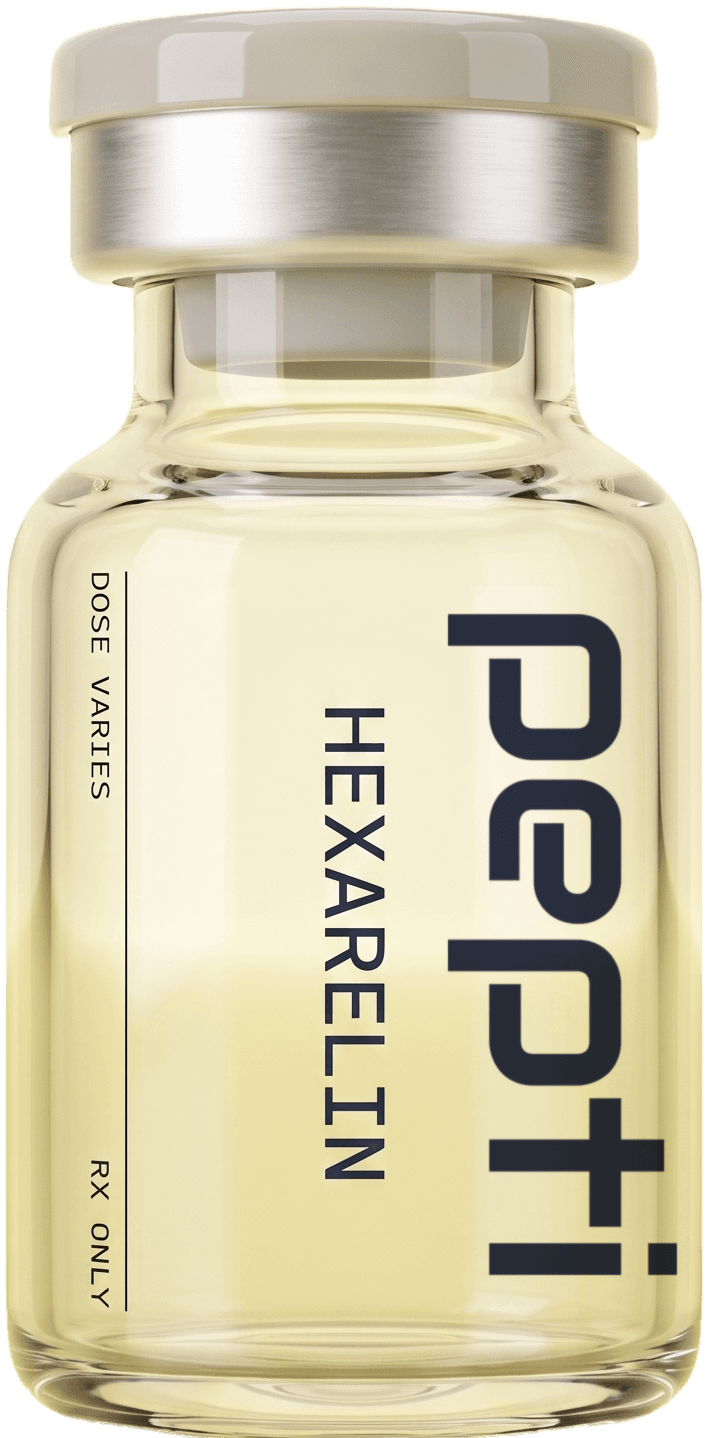
Hexarelin is a prescription injection supplied as vial — Hexarelin 12.5mg/5mL 2.5mg/mL (5mL). The reviewed directions are: Inject 0.25 mL (25 units) subcutaneously Monday through Friday nights at bedtime. That is 20 doses per vial, about 4 weeks at Monday through Friday. It requires a prescription from a physician licensed in your state, is compounded by a state-licensed US pharmacy, and is not FDA approved.
This page covers what hexarelin is, the receptors it acts on, what the 1990s human pharmacology and the later animal cardiac work do and do not establish, the desensitisation question, where it currently stands with the FDA, how it is dosed, and how to get it prescribed.
Hexarelin
What hexarelin actually is
A six-amino-acid synthetic peptide
Hexarelin is a hexapeptide — six amino acids, sequence His-D-2-methyl-Trp-Ala-Trp-D-Phe-Lys-NH2. Two of the six are unnatural D-amino acids and one carries a methyl group not found in any natural protein, which is what lets it survive in the body long enough to act. It is entirely synthetic. What it imitates is ghrelin, the stomach hormone that signals hunger and tells the pituitary to release growth hormone.
It is not growth hormone and contains none. It is a signal to the pituitary, and the pituitary decides how much to release: a secretagogue can only ask for what the gland is still able to give. In the 1995 paediatric work in the Journal of Clinical Endocrinology and Metabolism, children with organic hypopituitarism released no growth hormone at all in response to it, because there was nothing to stimulate.
Where it came from
Hexarelin was designed in the early 1990s by a European research group as an analogue of GHRP-6, the first of the growth hormone-releasing peptides; the papers of the period call it a "super-analogue," meaning a version built to be more stable and more potent than the parent. The founding human study, in the Journal of Clinical Endocrinology and Metabolism in 1994, gave it to twelve healthy young volunteers by four routes and reported that a single intravenous dose released about twice as much growth hormone as the same dose of GHRH, that the subcutaneous route delivered 77 per cent of the intravenous response, and that intranasal and oral doses released growth hormone too but with far lower bioavailability.
Through the rest of the 1990s the University of Turin and other groups used it as a research tool in hundreds of adults and children, mostly to probe how the growth hormone axis works and whether it could serve as a diagnostic test for growth hormone deficiency. That is why hexarelin has more human pharmacology on record than almost any other compounded peptide, and also why almost none of it concerns the way it is prescribed today.
What it is not
It is not an anabolic steroid; it does not bind the androgen receptor or suppress testosterone. It is not selective in the way ipamorelin is: a dose of hexarelin releases growth hormone and, in the same hour, a smaller pulse of prolactin, ACTH and cortisol. And it is not a heart medication — the cardiac work below is research, and no regulator has approved it as a treatment for anything.
Hexarelin
How hexarelin is described to work
The receptor pharmacology is well established in humans. The cardiac and metabolic pathways are described mainly in animals and cells.
Agonism at the ghrelin receptor in the pituitary
Hexarelin binds the growth hormone secretagogue receptor, GHS-R1a, the receptor ghrelin uses, and triggers a pulse of growth hormone from the pituitary rather than a sustained rise. In the 1994 volunteer study the response to an intravenous dose was dose-dependent and highly reproducible. A 2001 comparison in the Journal of Clinical Endocrinology and Metabolism gave healthy young men ghrelin, hexarelin and GHRH on separate days: ghrelin released the most growth hormone, hexarelin the next most, GHRH the least, and hexarelin and ghrelin did not add to each other, which is what you expect from two ligands for the same receptor.
Synergy with GHRH, and why it fades
The pituitary listens to two inputs: GHRH from the hypothalamus and ghrelin-type signals from the gut. They act on different receptors, and in a 1996 study in Clinical Endocrinology giving hexarelin together with GHRH produced a peak growth hormone secretion rate greater than the sum of the two alone. The same study found that a second dose two hours later produced a smaller peak, and that the synergy was lost on repeat dosing. That is the logic behind pairing a ghrelin-type peptide with a GHRH analogue, and it is also the first appearance in the human literature of the desensitisation theme that runs through everything else on this page.
Corticotroph and lactotroph stimulation
Unlike the later, selective secretagogues, hexarelin also stimulates the pituitary cells that make ACTH and prolactin. A 1997 study in Peptides compared hexarelin and GHRP-2 in young adults and reported that both raised prolactin, ACTH and cortisol; the ACTH and cortisol response was similar in size to that from corticotropin-releasing hormone, while the prolactin response was smaller than that from TRH. The 1997 work in the Journal of Clinical Endocrinology and Metabolism characterised the ACTH- and cortisol-releasing effect in normal subjects and in Cushing's patients. This is the pharmacological reason hexarelin is described as "stronger" and "less clean" in the same breath.
Direct cardiac receptors — GHS-R1a and CD36
Ghrelin receptors sit on heart muscle and blood vessels as well as in the pituitary, and hexarelin also binds a second, unrelated receptor called CD36 that is expressed on cardiomyocytes. A 2002 paper in Circulation Research reported that CD36 mediates the cardiovascular action of growth hormone-releasing peptides in the isolated heart. Together these are the proposed basis for the cardiac effects described below being independent of growth hormone: in the rat work, a GHRP that does not bind the heart had no cardiac effect, and in humans recombinant growth hormone itself did not reproduce hexarelin's effect on ejection fraction.
Metabolic signalling through CD36 and PPARγ
A 2008 review in PPAR Research described hexarelin binding CD36 on macrophages and activating PPARγ, a nuclear receptor involved in lipid handling, and a 2017 paper in Endocrinology reported that hexarelin improved lipid metabolic abnormalities in a non-obese insulin-resistant mouse. This is cell and mouse work, and it does not describe fat loss in people; it is the mechanistic thread behind the older rat work in obese Zucker rats and against atherosclerosis in a cholesterol-fed model.
Hexarelin
What the research actually shows
Growth hormone release in adults
This is the most solidly established finding, replicated across dozens of studies from 1994 onward. In healthy young adults a single dose reliably produces a large growth hormone pulse, larger than GHRH, by every route tested. The response is smaller in older adults — a 1994 paper reported it blunted in the elderly and restored by arginine or GHRH, and a 1997 paper in the European Journal of Endocrinology described the growth hormone, prolactin, ACTH and cortisol responses each changing differently with age. It is also blunted in obesity, and a 2000 paper in Hormone and Metabolic Research described food intake modulating the response. A 2002 study in the European Journal of Endocrinology gave six young men two or three subcutaneous injections across a day and reported that either schedule raised 24-hour growth hormone secretion by enlarging each pulse without changing pulse frequency, and did not alter 24-hour prolactin, ACTH or cortisol.
Growth hormone deficiency, and use as a diagnostic test
Much of the 1990s literature examines hexarelin as a stimulation test. A 1999 study in the Journal of Clinical Endocrinology and Metabolism compared low-dose hexarelin plus GHRH against the insulin tolerance test in adults with suspected growth hormone deficiency, and a 1999 paper in Clinical Endocrinology examined it as a test of pituitary reserve in patients with pituitary disease. Patients with a defective GHRH receptor were reported to show a selective lack of response. This is diagnostic pharmacology, not treatment, but it is the reason the human safety record of single doses is unusually deep.
Long-term treatment in short children
Two small open-label studies from the same Israeli group are the only sustained treatment courses in the literature. In Clinical Endocrinology in 1995, eight prepubertal short children were given intranasal hexarelin three times daily for up to eight months; IGF-1 rose and mean growth velocity was reported to increase from 5.3 to 8.3 cm per year, with a fall in skinfold thickness. The 1996 companion paper in the European Journal of Endocrinology, in seven children treated for six to ten months, reported that the growth hormone response to a test dose fell by about half within seven days and stayed at that level for the rest of treatment, recovering partly three months after stopping — while growth velocity still increased, from 5.3 to 7.4 cm per year. Eight and seven children, no control group, intranasal route, 30 years ago: those are the limits.
Long-term treatment in adults: the desensitisation study
The single most important paper for anyone considering a course is in the Journal of Clinical Endocrinology and Metabolism in 1998. Healthy elderly volunteers were given twice-daily subcutaneous hexarelin for sixteen weeks. The growth hormone response to a test dose fell steadily: the area under the curve dropped by about a third by week one, by more than a third by week four, and by nearly half by week sixteen. Four weeks after stopping, the response had returned to baseline. Over the same sixteen weeks, IGF-1, IGF-binding protein 3, total body fat, lean body mass and bone mineral density did not change significantly; one marker of collagen formation rose. The authors' summary was that chronic hexarelin produces "a partial and reversible attenuation of the GH response" and that the biological impact of that schedule on the growth hormone–IGF-1 axis "seems to be minimal."
Two shorter studies in older adults, in the European Journal of Endocrinology in 1996, used intermittent intranasal or oral dosing for eight and fifteen days and found no desensitisation, with a small rise in IGF-binding protein 3 and, on the oral schedule, in IGF-1. And a 2003 paper in the Journal of Endocrinological Investigation reported rapid desensitisation of the ghrelin receptor to hexarelin in cell culture. The picture across all of it is consistent: continuous exposure turns the receptor down, the turn-down is partial and reverses within weeks of stopping, and it is much less pronounced with intermittent dosing. That is the entire rationale for the five-nights-on, two-off schedule.
Cardiac effects in humans
Three small studies from Turin, all single intravenous doses, all measuring the heart directly. In the Journal of Endocrinological Investigation in 1999, seven male volunteers had left ventricular ejection fraction measured by radionuclide angiography after hexarelin and, separately, after recombinant growth hormone; hexarelin raised ejection fraction from 64 to about 71 per cent for roughly an hour, with no change in blood pressure or heart rate, and growth hormone did not. In the European Journal of Pharmacology in 2002, twenty-four men with coronary artery disease received hexarelin, GHRH, growth hormone or placebo during bypass surgery under anaesthesia; only hexarelin produced a rise in ejection fraction, cardiac index and cardiac output from ten minutes to ninety minutes, with a fall in wedge pressure and no change in systemic vascular resistance. In the European Journal of Heart Failure in 2002, a dose raised ejection fraction in five patients with ischaemic cardiomyopathy but not in eight with dilated cardiomyopathy, despite the same growth hormone release in both.
Read those for what they are: a short-lived, growth hormone-independent inotropic effect of a single intravenous dose. None of them dosed anyone for more than one session, none used the subcutaneous route, and none measured a clinical outcome.
Cardiac protection in animals
The animal literature is larger and runs from 1997 to the present. In Endocrinology in 1999, seven days of subcutaneous hexarelin in rats whose pituitaries had been removed prevented the worsening of ischaemia-reperfusion injury that hypophysectomy causes, and a related peptide that does not bind heart tissue did not, which is the origin of the "growth hormone-independent" description. A 2000 paper in Endocrinology reported improved cardiac function in rats after experimental myocardial infarction. Rat and mouse work through the 2000s and 2010s in the American Journal of Physiology – Heart and Circulatory Physiology, Endocrinology and Physiological Reports describes reduced cardiac fibroblast proliferation and collagen synthesis, attenuated fibrosis in spontaneously hypertensive rats, preserved myocardial function and reduced fibrosis after infarction in mice, and protection of cultured cardiomyocytes from angiotensin II- and doxorubicin-induced death. A 2014 review in the Journal of Geriatric Cardiology gathers it. All of it is preclinical.
Metabolic effects in animals
A 2000 paper in the Journal of Endocrinology reported endocrine, metabolic and cardioprotective effects in obese Zucker rats, a 2010 paper in Peptides described suppression of diet-induced atherosclerosis in rats, and the 2017 mouse work above described improved lipid handling in an insulin-resistant model. There is no human study of hexarelin on body composition that found a change; the one that measured it, the sixteen-week study, found none.
What human data exists
Stated precisely: hexarelin has a large body of human pharmacology — single-dose studies in hundreds of healthy adults, elderly subjects, children and patients with pituitary, adrenal and cardiac disease, almost all from 1994 to 2003 — plus two small open-label paediatric treatment courses of up to eight months, one sixteen-week subcutaneous study in healthy elderly adults, and three single-dose cardiac studies. There are no randomised controlled trials of hexarelin for sleep, recovery, body composition, ageing or any wellness use, and the only sustained subcutaneous course ever published measured body composition and found no change. No pharmaceutical development programme has taken it forward, so there is no phase 2 or phase 3 data of the kind that exists for tesamorelin or the GLP-1 medications.
That is a more substantial human record than most compounded peptides have, and it is what makes the pharmacology on this page reliable. It is not evidence that the use it is prescribed for works, and any source telling you otherwise is overselling it.
What the evidence does not establish
- It does not establish that nightly subcutaneous hexarelin changes body composition, recovery or sleep in adults. The one study that measured body composition over sixteen weeks found no change, and no study has measured sleep or recovery.
- It does not establish any cardiac benefit from ongoing subcutaneous use in people. The human cardiac data are single intravenous doses; the sustained data are in rodents.
- It does not establish long-term safety. The longest adult exposure on record is sixteen weeks, in a small study.
- It does not establish efficacy for any condition as an approved treatment. It is not approved for anything.
Hexarelin
Where hexarelin stands with the FDA right now
Much of what is online about peptides and the FDA is stale, and hexarelin is easy to confuse with its relatives.
Hexarelin is not on the FDA's 503A category lists at all. The FDA's document listing bulk drug substances nominated for compounding under section 503A, updated 14 May 2026, does not contain hexarelin in Category 1 (under evaluation), Category 2 (significant safety concerns) or Category 3 (nominated without adequate support). It does not appear on the FDA's safety-risks page, current as of 22 April 2026, either in the active Category 2 table or among the substances "nominated but withdrawn" — so it was never one of the peptides placed in Category 2 in September 2023, and it was not among the twelve removed from that category on 15 April 2026, because it was never there. It is not on the final 503A bulks list in 21 CFR 216.23, which as of September 2026 still contains only six substances.
It has never been reviewed by the FDA's Pharmacy Compounding Advisory Committee. The committee's 23–24 July 2026 meeting covered BPC-157, KPV, TB-500, MOTS-c, DSIP, Semax and Epitalon; the next announced session, due before the end of February 2027, lists LL-37, GHK-Cu, dihexa, Melanotan II and PEG-MGF. Hexarelin is on neither agenda.
Its closest relatives have been handled differently: the older GHRP-2 and GHRP-6 sit in 503A Category 3, and ipamorelin acetate was placed in Category 2 in 2023 and withdrawn in 2024. None of that applies to hexarelin, on which the FDA has made no determination either way.
So the accurate description today is: never flagged by the FDA for a safety concern, never categorised, never reviewed by the advisory committee, and not on the bulks list. It is prescribed by physicians and compounded by licensed pharmacies to those prescriptions. It is not an FDA-approved drug product, and compounded medications never are.
Hexarelin
Realistic expectations
These are patterns described by prescribers, not trial endpoints. Individual response varies and a physician decides whether treatment is appropriate at all.
The first night, and the first week
The pharmacology says what happens on night one: a growth hormone pulse within the hour, with a smaller and shorter rise in cortisol and prolactin alongside it, gone by morning. What people report early is mostly about sleep depth and a feeling of warmth, flushing or hunger shortly after the injection. Some report nothing. None of this signals whether the course is working.
Weeks two to four
This is where the desensitisation data matter. The sixteen-week study saw the growth hormone response to each dose fall by about a third within the first week of twice-daily dosing and then decline more slowly. The reviewed schedule — one dose a night, five nights a week — is designed to stay closer to the intermittent regimens that did not show desensitisation than to the continuous one that did. Prescribers describe the early sleep reports settling into a steady state in this window rather than building.
After the first vial
If a secretagogue is going to change anything measurable, prescribers describe it as the second or third refill rather than the first, which is why some physicians want a baseline IGF-1 to compare against even though bloodwork is not routinely required for this medication. Reports in this period concern recovery and body composition, and they are reports: the only adult study that measured body composition on hexarelin found no change.
After stopping
There is no withdrawal and no rebound described in the literature. Because hexarelin asks the pituitary for a pulse rather than replacing growth hormone, the gland's own output is not suppressed, and the human data show the receptor's responsiveness returning to baseline within four weeks of stopping. Some prescribers build that recovery into a course deliberately.
Hexarelin
When something else makes more sense
A reference that only ever recommends its own product is not much of a reference. Some honest cases where hexarelin is not the first thing to reach for:
- A course will run for months and you want the cleanest hormonal profile. Ipamorelin was designed specifically to release growth hormone without the cortisol and prolactin response hexarelin produces, and prescribers reach for it first for longer courses.
- You want the GHRH half as well. The synergy between a ghrelin-type peptide and a GHRH analogue is real in the human data. CJC-1295 / Ipamorelin, Ipamorelin + Sermorelin and Tesamorelin + Ipamorelin are those combinations in one vial.
- You want the compound with controlled human trial data. Sermorelin was an FDA-approved product for paediatric growth hormone deficiency, and tesamorelin is the active in an FDA-approved brand for abdominal fat in HIV-associated lipodystrophy. Compounded versions are not the approved products, but those molecules have been through randomised trials in a way hexarelin has not.
- Weight is the actual goal. The one adult study that measured body fat on hexarelin found no change. Semaglutide and tirzepatide have large randomised human trials behind them.
- Sleep is the only goal. A secretagogue is an indirect route to it. DSIP and the SERENITY blend are aimed at sleep more directly.
- You have a soft-tissue injury. Secretagogues are not injury treatments. BPC-157 and TB-500 are what the recovery literature is about.
- You have diabetes, impaired glucose tolerance or a condition affected by cortisol. Anything that raises growth hormone can raise blood glucose, and hexarelin adds a cortisol pulse. Your physician may decline, or want labs first.
Your physician will tell you if hexarelin is not the right tool for what you have described. A consultation does not guarantee a prescription, and being declined is refunded.
Hexarelin
Strengths available
| Strength | Directions |
|---|---|
| Hexarelin 12.5mg/5mL | Inject 0.25 mL (25 units) subcutaneously Monday through Friday nights at bedtime. |
One strength is supplied. The schedule is your physician's decision.
Hexarelin
Dosing, and how a vial is actually used
Why the dose is measured in units
The directions are written in millilitres and insulin-syringe units because that is what you can read off the barrel. 0.25 mL is 25 units on a U-100 syringe. You are not calculating anything — the number is printed on your medication.
Subcutaneous, at bedtime, five nights a week
Subcutaneous means into the fat layer, not the muscle; the 1994 volunteer work established that this route delivers most of the intravenous response. Abdomen and thigh are the usual sites, rotated. Bedtime lands the pulse on top of the natural nocturnal release rather than after a meal, and food intake was reported in 2000 to modulate the response. Monday through Friday with weekends off is the reviewed schedule; the two nights off are the practical answer to the desensitisation data, because intermittent exposure was the pattern that kept the receptor responsive. Your directions will say.
Why a vial covers about four weeks
20 doses at five nights a week is four weeks, which is why refills run on a 28-day cycle. One vial per fill, always — not a stockpile.
Storage
Refrigerated, and it ships that way in insulated packaging with ice packs. Beyond-use dating runs from first puncture and is on the label.
Hexarelin
Safety and side effects
Across the 1990s human studies, single doses of hexarelin were consistently reported as well tolerated, and the sixteen-week subcutaneous study and the eight-month paediatric course reported no significant adverse effects. What gets reported clinically at compounded doses is mostly minor and short: warmth or flushing after the injection, hunger, a transient headache, light-headedness, and injection-site redness or soreness.
Three things deserve a plain statement. First, hexarelin raises cortisol and prolactin transiently with each dose; in the 24-hour study this did not change total daily cortisol or prolactin, but it is a real pharmacological effect and the reason it is not the first choice for people with conditions sensitive to either hormone. Second, anything raising growth hormone and IGF-1 carries the class risks in approved growth hormone labelling — glucose intolerance, fluid retention and a theoretical concern about existing tumours — and no data show hexarelin is exempt, which is why cancer history and diabetes are raised at intake. Third, the acute cardiac effect is real: a single dose produced a measurable, short-lived rise in the heart's contractility in every human study that looked. That is described as protective in animals, but anyone with a cardiac diagnosis should raise it at intake rather than assume it is a benefit.
There is no established interaction list, because the trials that would produce one have not been run. That is precisely why the intake asks for every medication you take and why a physician reviews it rather than a form.
Stop and contact your physician for any reaction that is severe, spreading, or involves difficulty breathing.
Hexarelin
How hexarelin compares
Hexarelin vs ipamorelin
Same receptor, different generation. Hexarelin is the older, more potent, less selective compound: in the head-to-head literature it releases more growth hormone per dose than the later peptides, and it releases cortisol and prolactin with it. Ipamorelin was designed to keep the growth hormone pulse and drop the rest. Hexarelin is a physician's choice when a stronger pulse is the priority and the course is structured with breaks; ipamorelin is the default for longer courses.
Hexarelin vs GHRH analogues
Different receptors, same gland. Sermorelin and tesamorelin supply the GHRH signal and have controlled human trial data and regulatory history hexarelin lacks; hexarelin supplies the ghrelin signal and, in the human data, produced a larger single-dose response than GHRH. Because the two signals are additive, they are more often combined than chosen between.
Hexarelin vs CJC-1295 / Ipamorelin
The combination pairs a GHRH analogue with the selective GHRP in one vial. Prescribers who want the additive effect and a course that runs uninterrupted start with CJC-1295 / Ipamorelin; those who want the strongest single-agent ghrelin-receptor pulse, and are prepared to schedule around desensitisation, consider hexarelin. Neither has human trial evidence for the uses either is prescribed for.
Hexarelin
Availability and formats
| Question | Answer |
|---|---|
| Can I get it by telehealth? | Yes, where a physician licensed in your state prescribes it |
| Which states? | All 50 states and DC |
| Does it come as a pen? | No, this one is a vial and syringe only |
| Does it come as a capsule? | No |
| Does it come as a nasal spray? | No |
| Is bloodwork required first? | Not routinely; your physician decides |
Hexarelin
Where to get Hexarelin prescribed
Hexarelin cannot be bought legitimately without a prescription. Sites shipping it with no prescription are selling a research-use-only product, where no pharmacy is accountable for identity, purity, sterility or concentration.
The prescription route works like this:
- Complete a medical intake covering your history, medications, allergies and what you are treating.
- A physician licensed in your state reviews it.
- If appropriate, a state-licensed, FDA-registered pharmacy compounds it to that prescription.
- It ships refrigerated with your directions printed on the vial.
- Your physician stays reachable afterwards for dose questions and side effects.
Current all-in pricing for Hexarelin is published: medication, physician review, refill management and shipping in one figure, with no separate membership fee. What to check on any provider is in how to tell if a peptide seller is legitimate.
Hexarelin
Who should not take it, or should discuss it first
| Situation | Why |
|---|---|
| Personal history of cancer | Raised at intake |
| Diabetes or impaired glucose tolerance | Raised at intake |
| Pregnancy or breastfeeding | Not used; safety data is absent |
| Tested athletes | Many peptides are prohibited in competition; check the current list |
Full specification
Everything on the label.
Product
Hexarelin (Injectable)
How supplied
vial — Hexarelin 12.5mg/5mL 2.5mg/mL (5mL)
Typical directions
Inject 0.25 mL (25 units) subcutaneously Monday through Friday nights at bedtime.
Dose volume
0.25 mL (25 units on a U-100 insulin syringe)
Doses per vial
20
Coverage per vial
about 4 weeks at Monday through Friday
Formats
Vial and syringe
Available in
All 50 states and DC
Bloodwork
Not routinely required; your physician decides
Legal status
Prescription-only, compounded, not FDA approved
Category
Anti-Aging
References
What this is based on.
References
- Ghigo E, Arvat E, Gianotti L et al.. Growth hormone-releasing activity of hexarelin, a new synthetic hexapeptide, after intravenous, subcutaneous, intranasal, and oral administration in man · J Clin Endocrinol Metab (1994) · PMID 8126144
- Rahim A, O'Neill PA, Shalet SM. Growth hormone status during long-term hexarelin therapy · J Clin Endocrinol Metab (1998) · PMID 9589671
- Rahim A, Shalet SM. Does desensitization to hexarelin occur? · Growth Horm IGF Res (1998) · PMID 10990150
- Ghigo E, Arvat E, Gianotti L et al.. Short-term administration of intranasal or oral Hexarelin, a synthetic hexapeptide, does not desensitize the growth hormone responsiveness in human aging · Eur J Endocrinol (1996) · PMID 8921821
- Klinger B, Silbergeld A, Deghenghi R et al.. Desensitization from long-term intranasal treatment with hexarelin does not interfere with the biological effects of this growth hormone-releasing peptide in short children · Eur J Endocrinol (1996) · PMID 8766941
- Laron Z, Frenkel J, Deghenghi R et al.. Intranasal administration of the GHRP hexarelin accelerates growth in short children · Clin Endocrinol (Oxf) (1995) · PMID 8548949
- Loche S, Cambiaso P, Carta D et al.. The growth hormone-releasing activity of hexarelin, a new synthetic hexapeptide, in short normal and obese children and in hypopituitary subjects · J Clin Endocrinol Metab (1995) · PMID 7852535
- Massoud AF, Hindmarsh PC, Matthews DR, Brook CG. The effect of repeated administration of hexarelin, a growth hormone releasing peptide, and growth hormone releasing hormone on growth hormone responsivity · Clin Endocrinol (Oxf) (1996) · PMID 8762732
- Maccario M, Veldhuis JD, Broglio F et al.. Impact of two or three daily subcutaneous injections of hexarelin, a synthetic growth hormone (GH) secretagogue, on 24-h GH, prolactin, adrenocorticotropin and cortisol secretion in humans · Eur J Endocrinol (2002) · PMID 11888836
- Arvat E, di Vito L, Maccagno B et al.. Effects of GHRP-2 and hexarelin, two synthetic GH-releasing peptides, on GH, prolactin, ACTH and cortisol levels in man. Comparison with the effects of GHRH, TRH and hCRH · Peptides (1997) · PMID 9285939
- Ghigo E, Arvat E, Ramunni J et al.. Adrenocorticotropin- and cortisol-releasing effect of hexarelin, a synthetic growth hormone-releasing peptide, in normal subjects and patients with Cushing's syndrome · J Clin Endocrinol Metab (1997) · PMID 9253314
- Arvat E, Ramunni J, Bellone J et al.. The GH, prolactin, ACTH and cortisol responses to Hexarelin, a synthetic hexapeptide, undergo different age-related variations · Eur J Endocrinol (1997) · PMID 9437229
Citations are provided for educational purposes. They do not constitute medical advice. Always discuss any peptide protocol with your prescribing physician.
Common questions
Hexarelin, answered.
Through a telehealth provider where a physician licensed in your state reviews a medical intake and a licensed US pharmacy compounds the prescription. Pepti prescribes Hexarelin in all 50 states and DC; start with the free assessment.
vial — Hexarelin 12.5mg/5mL 2.5mg/mL (5mL)
Inject 0.25 mL (25 units) subcutaneously Monday through Friday nights at bedtime. Your physician sets your own dose and it is printed on your medication.
20 at the standard volume, about 4 weeks at Monday through Friday.
Hexarelin is supplied as a vial, drawn with an insulin syringe. It is not available as a pen or capsule.
Not routinely, though your physician may want labs depending on your history. at-home blood testing covers hormone, metabolic and thyroid markers without a lab visit.
It is legal to prescribe and dispense in the United States with a valid prescription. It is not FDA approved: compounded medications are prepared by licensed pharmacies pursuant to a prescription rather than approved as manufactured products. See are peptides FDA approved.
Pricing is published on the Hexarelin page as one all-in figure covering medication, physician review, refill management and shipping. What drives peptide pricing generally is in how much do peptides cost.
No. Hexarelin has never been placed in Category 2 of the FDA's 503A bulk substances list, so it was not among the twelve peptides removed from that category on 15 April 2026, and it has never been reviewed by the FDA's Pharmacy Compounding Advisory Committee, including at the July 2026 meeting. On the FDA's list updated 14 May 2026 it does not appear in any category. It remains prescription-only, compounded, and not FDA approved.
Partly, and reversibly. In a sixteen-week study of twice-daily subcutaneous hexarelin in healthy elderly adults, the growth hormone response to each dose fell by nearly half by week sixteen and returned to baseline four weeks after stopping. Shorter, intermittent schedules in the same age group did not show desensitisation. That is why the reviewed schedule is five nights on and two off, and why some physicians build breaks into a course.
More than for most compounded peptides, and almost all of it from 1994 to 2003: single-dose pharmacology in hundreds of adults and children, a sixteen-week subcutaneous study in elderly adults, two small open-label courses in short children, and three single-dose cardiac studies. There are no randomised controlled trials for sleep, recovery, body composition or any wellness use, and the sixteen-week study found no change in body fat, lean mass or bone density.
Yes, transiently, with each dose. Human studies from 1997 onward consistently report a rise in ACTH, cortisol and prolactin alongside the growth hormone pulse; the ACTH and cortisol response was similar in size to that from corticotropin-releasing hormone. In a 24-hour study, two or three daily injections did not change total daily cortisol or prolactin. Ipamorelin was designed not to do this, which is why it is preferred for longer courses.
In the human head-to-head literature, hexarelin releases more growth hormone per dose than GHRH and is grouped with the more potent secretagogues; ipamorelin has not been compared with it directly in people. The trade-off is selectivity: hexarelin also raises cortisol and prolactin and desensitises with continuous use, whereas ipamorelin does neither in the animal work. Which matters more for you is your physician's call.
The research is real but limited. A single intravenous dose raised left ventricular ejection fraction for about an hour in healthy volunteers, in bypass patients and in ischaemic cardiomyopathy, independently of growth hormone, and rodent work describes reduced fibrosis and protection from ischaemia-reperfusion injury. No study has examined ongoing subcutaneous hexarelin in people with heart disease, and it is not a heart treatment. If you have a cardiac diagnosis, raise it at intake.
Growth hormone is released mainly in the first hours of deep sleep, so a bedtime injection adds a pulse on top of the natural one rather than competing with a meal, which was reported to modulate the response. The two nights off are the practical answer to the desensitisation data: intermittent exposure kept the receptor responsive in the human studies, continuous exposure did not. Your physician sets your schedule.
The human data show a ghrelin-type peptide and a GHRH analogue producing more growth hormone together than either alone, so the combination is pharmacologically sound, and Pepti supplies CJC-1295 / Ipamorelin, Ipamorelin + Sermorelin and sermorelin separately. Whether hexarelin is combined with anything is your physician's decision.
Most commonly warmth or flushing after injection, hunger, a transient headache, light-headedness and injection-site redness or soreness, all short-lived. Each dose also raises cortisol and prolactin for an hour or two. Because it raises growth hormone and IGF-1, the class risks of glucose intolerance and fluid retention apply until shown otherwise, which is why diabetes and cancer history are raised at intake.
Next step
See what a physician recommends for you.
A licensed physician in your state reviews your intake and decides what is appropriate. A consultation does not guarantee a prescription.