Cognitive · Reference
Dihexa: What It Is, Where to Get It Prescribed, and What It Costs
This page covers what Dihexa is, the pathway its developers proposed, what the published animal work does and does not establish, where it currently stands with the FDA, how it is dosed, and how to get it prescribed.

Reviewed by Dr. Gene, MD · Board-certified Family Medicine
Every Pepti prescription is reviewed by a licensed U.S. physician before it's dispensed — and only provided if clinically appropriate.
Treatments mentioned
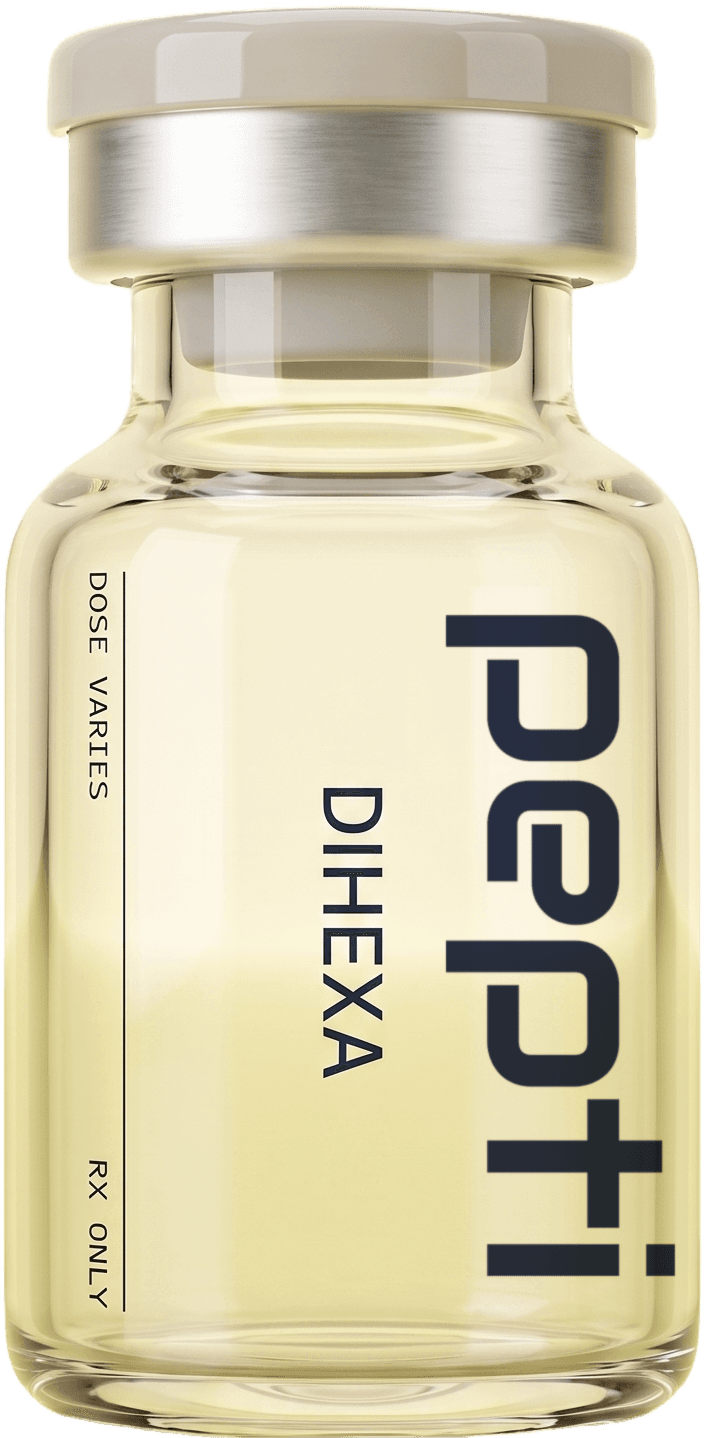
Dihexa is a prescription injection supplied as 5 mL multi-dose vial, Dihexa 1 mg/mL (5 mg Dihexa per vial). The reviewed directions are: Inject 0.25 mL (25 units) subcutaneously once daily Monday through Friday. That is 20 doses per vial, about 4 weeks at Monday through Friday. It requires a prescription from a physician licensed in your state, is compounded by a state-licensed US pharmacy, and is not FDA approved.
This page covers what Dihexa is, the pathway its developers proposed, what the published animal work does and does not establish, where it currently stands with the FDA, how it is dosed, and how to get it prescribed.
Dihexa
What Dihexa actually is
A modified fragment of a hormone the body already makes
Dihexa is a very small peptide built from a fragment of angiotensin IV, itself a breakdown product of angiotensin II, the hormone most people know from blood-pressure medicine. It circulates in the brain as well as the bloodstream. A group at Washington State University led by Joseph Harding and John Wright reported that angiotensin IV and close relatives improved memory-task performance in rats, and set out to build a version that would survive in the body long enough to be useful.
Dihexa is the result. Its full chemical name is N-hexanoic-Tyr-Ile-(6)-aminohexanoic amide: a tyrosine and an isoleucine from the parent hormone, capped with a six-carbon fatty chain at one end and a six-carbon linker at the other. Those additions make it "metabolically stabilised" — the naked fragment is destroyed by enzymes in minutes, the modified one is not. The 2013 paper in the Journal of Pharmacology and Experimental Therapeutics that introduced it describes the design, its stability in rat blood, and its ability to cross into the brain.
It is not a hormone in the usual sense, not a steroid, and not a stimulant. It does not act on dopamine or noradrenaline the way attention medicines do.
Where the name comes from
"Dihexa" is lab shorthand for the two hexanoic groups on either end of the molecule — di-hexa. It is sometimes written as PNB-0408, the code from the company the Washington State group set up to develop it. Compounding pharmacies label it dihexa acetate, the salt form. All three names refer to the same substance.
What it is not
Dihexa is not an approved treatment for Alzheimer's disease, dementia, or any memory disorder, in any country, and it has not been through human trials for those conditions or anything else. It is not a retail nootropic supplement and not a stronger racetam — it works on a different system. And it is not a substitute for a medical evaluation of memory complaints, which can have treatable causes (thyroid, B12, sleep apnoea, depression, medication side effects) that need to be found first.
Dihexa
How Dihexa is described to work
Everything below comes from animal and cell studies. There is no human mechanistic data, and the part of this story most online write-ups treat as settled — the growth-factor mechanism — has had a difficult history in the literature, set out honestly here.
The angiotensin IV story
The Washington State group's starting point was the observation, replicated across several labs, that angiotensin IV and stabilised analogues of it improve spatial learning in rodents, apparently through the hippocampus. A 2018 systematic review in Neuroscience and Biobehavioral Reviews gathered the experimental studies on angiotensin IV and the related fragment angiotensin-(1-7) and concluded the procognitive effect in animals is consistent across models. That review is not about Dihexa specifically, but it is the independent foundation the compound rests on; Dihexa was built to be a longer-lasting, brain-penetrant version of that signal.
The hepatocyte growth factor / c-Met proposal
Harding and Wright's central claim was that angiotensin IV analogues, including Dihexa, work by binding hepatocyte growth factor (HGF) and making it a more effective activator of its receptor, c-Met. HGF and c-Met are best known from liver regeneration and cancer biology, but the receptor is also present on hippocampal neurons, and the group argued in a 2015 review in the Journal of Alzheimer's Disease that this system is a plausible cognitive target because it drives the growth of new synaptic connections.
The two laboratory papers carrying that claim — a 2012 paper describing Dihexa as an HGF/c-Met modifier, and a 2014 paper reporting that its procognitive and synapse-forming effects depend on c-Met activation, both in the Journal of Pharmacology and Experimental Therapeutics — received expressions of concern in 2021 and were retracted in April 2025. The 2013 paper that introduced the compound carries a 2021 expression of concern and has not been retracted. This does not mean the mechanism is wrong; it means the strongest evidence for it can no longer be cited, and HGF/c-Met should be treated as the developing lab's hypothesis rather than an established finding.
PI3K/Akt signalling in an Alzheimer's mouse model
The most useful independent data comes from a separate group. A 2021 paper in Brain Sciences gave Dihexa to APP/PS1 mice — an engineered strain that accumulates amyloid plaques and develops memory deficits — and reported improved memory-task performance alongside increased signalling through PI3K/Akt, a downstream route shared by several growth-factor receptors including c-Met. It is one study, in mice, from one lab, but it was not produced by the compound's developers and it broadly points the same way.
Synapse formation and dendritic spines
The claim that Dihexa causes cultured hippocampal neurons to sprout new dendritic spines — the structures where synapses form — is why the compound gets described as helping brain cells "form new connections." That finding came from the retracted 2014 paper; the 2015 review in Progress in Neurobiology by the same authors summarises it alongside the rodent behavioural work. Until it is reproduced independently, the fair description is that spine formation was reported by the developing lab in cell culture and not confirmed elsewhere.
Dihexa
What the research actually shows
Learning and memory in rodents
The 2013 introductory paper reports that Dihexa, by mouth or by injection, improved performance in the Morris water maze — a swimming task that measures spatial memory — in rats whose memory had been impaired with scopolamine, and in aged rats. Those are the standard first-line models for a candidate cognitive drug, and the reason the compound attracted attention. The paper carries an expression of concern, which readers should weigh.
Alzheimer's-type pathology in mice
The 2021 Brain Sciences study in APP/PS1 mice is the strongest independent result: treated mice performed better on memory testing than untreated littermates. The interpretation offered is protection of neuronal signalling rather than removal of plaque.
A Huntington's-type model in rats
A 2024 paper in the Journal of Huntington's Disease examined an angiotensin IV analogue in rats given 3-nitropropionic acid, a toxin that produces movement and behavioural changes resembling Huntington's disease, and reports effects on some of those measures. This is early, single-study work and not evidence for any human neurological condition.
Reviews of the brain renin-angiotensin system
Reviews by Wright and Harding — in Frontiers in Endocrinology in 2013 and in Progress in Neurobiology and the Journal of Alzheimer's Disease in 2015 — set out the case that the brain's angiotensin system is a target for Alzheimer's and Parkinson's disease, with Dihexa as the lead compound. They are well argued, and written by the compound's inventors.
What human data exists
None. There are no randomised controlled trials of Dihexa in humans, no published open-label trials, and no published case series. The FDA's own summary states that it has not identified any human exposure data on drug products containing dihexa acetate by any route. What exists in people is prescriber experience, which is real but unpublished and unmeasured.
That is a thinner position than most peptides on this site. BPC-157 has early-phase human work and decades of animal literature from many labs; Dihexa has rodent studies, a few labs, and a retraction history. It is prescribed on mechanism plus a physician's judgement about a particular patient, and should be described that way — "studied in animals," not "shown to work."
What the evidence does not establish
- It does not establish that Dihexa improves memory, attention or thinking in humans. That trial has not been run.
- It does not establish a human dose. The doses used are extrapolated by prescribers, not derived from a dose-finding study.
- It does not establish safety in humans over any duration, and it does not answer the question raised by its proposed mechanism: HGF/c-Met is a growth pathway active in many cancers, and nobody has measured what long-term stimulation of it does in people.
- It does not establish that the c-Met mechanism is correct at all, now that the papers supporting it have been withdrawn.
- It does not establish efficacy for any condition as an FDA-approved treatment. It is not approved for anything.
Dihexa
Where Dihexa stands with the FDA right now
This has moved in 2026 and older pages are out of date.
Dihexa acetate was nominated for the FDA's 503A bulk drug substances list and placed in Category 2 in 2023 — the category for substances with identified safety concerns, where the FDA's stated concern was the complete absence of human exposure data. In the FDA's April 2026 revisions it was moved out of Category 2: the current 503A category document (updated 14 May 2026) does not list dihexa acetate in Category 1, 2 or 3 at all, and the FDA's safety-risks page (current as of 22 April 2026) now carries it under substances previously in Category 2 whose nomination was withdrawn.
The FDA has also announced that it will host a Pharmacy Compounding Advisory Committee meeting before the end of February 2027 to consider dihexa acetate for the 503A bulks list, alongside cathelicidin (LL-37), GHK-Cu, Melanotan II and PEG-MGF, with a Federal Register notice and public docket to follow.
So the accurate description as of September 2026 is: no longer in Category 2, not yet on the positive list, scheduled for advisory committee review by February 2027. A committee vote is a recommendation, not a decision; the FDA's determination comes afterwards. It remains a compounded medication and is not an FDA-approved drug product.
Dihexa
Realistic expectations
These are patterns described by prescribers, not trial endpoints. With Dihexa there is no human timeline to anchor to, so everything below is clinical impression, and a physician decides whether treatment is appropriate at all.
The first two weeks
Most people report nothing specific. Some describe feeling slightly sharper or sleeping differently; some describe mild headache or a wired feeling early on. None of this has been measured in a study, and noticing nothing in the first fortnight is not a sign the course is failing.
Weeks two to six
If a subjective change in recall or focus is going to be reported, prescribers generally describe it in this window, which is why a vial is sized at about four weeks of weekday dosing. Anyone expecting a dramatic effect is setting themselves up for disappointment; the honest framing is modest and uncertain.
Structured versus unstructured goals
People who start with a specific, checkable goal — names at work, a language, a task they had been struggling with — can usually say whether anything changed. "General brain fog" is much harder to judge, so agree with your physician beforehand what you will be watching for.
After the course
No withdrawal or rebound is described in the animal literature. Whether any subjective change persists once dosing stops is unknown. Because the proposed mechanism is a growth pathway and the long-term human safety picture is blank, most prescribers structure this as a defined course with a review rather than indefinite use.
Dihexa
When something else makes more sense
A reference that only ever recommends its own product is not much of a reference. Some honest cases where Dihexa is not the first thing to reach for:
- You have not had memory complaints evaluated. New or worsening memory problems in an adult need a proper work-up before any peptide: thyroid, B12, sleep, mood, medications. A physician on the intake will say so.
- You want the compound with the most human data for focus and stress. Semax and Selank have a longer history of human use than Dihexa has anywhere, and come combined as Semax + Selank or in nasal form as Semax Nasal Spray and Selank Nasal Spray.
- You want cognitive support inside a broader stack. The SYNAPSE blend and ELEVATE blend combine Semax and Selank with other agents, and are the usual starting point for people unsure a single cognitive peptide is what they need.
- Your problem is energy rather than memory. NAD+ injection, NAD+ Nasal Spray, MOTS-c and SS-31 are aimed at mitochondrial function, which is a different conversation.
- Your problem is sleep. Poor sleep is the most common reversible cause of poor recall, and DSIP or the SERENITY blend address it directly.
- You have a personal history of cancer. Because the proposed mechanism runs through a growth-factor receptor, many physicians will not prescribe Dihexa in that situation and will suggest a different route.
Your physician will tell you if Dihexa is not the right tool for what you have described. A consultation does not guarantee a prescription, and being declined is refunded.
Dihexa
Dosing, and how a vial is actually used
Why the dose is measured in units
The directions are written in millilitres and in insulin-syringe units because that is what you can read off the barrel. 0.25 mL is 25 units on a U-100 syringe. You are not calculating anything — the number is printed on your medication. A different volume is a physician decision, never a self-adjustment.
Subcutaneous, and where
Subcutaneous means into the fat layer, not the muscle. Abdomen and thigh are the usual sites, rotated so the same spot is not used repeatedly. There is no reason to inject near the head — the compound is designed to cross into the brain from the bloodstream, and the animal work used ordinary systemic routes.
Why it is dosed Monday through Friday
The reviewed directions are once daily on weekdays with weekends off. That is a prescriber convention, not something derived from a human study. The practical effect is 20 doses per vial covering about four weeks, which lines up with the 28-day refill cycle and gives a monthly checkpoint for you and your physician to decide whether to continue. One vial per fill, always.
Storage
Refrigerated, and it ships that way in insulated packaging with ice packs. Beyond-use dating runs from first puncture and is on the label. Keep it out of light and do not freeze it.
Dihexa
Safety and side effects
There is no human safety database for Dihexa. The animal work reports it as well tolerated at the doses used, but rodent tolerability studies are short and do not answer the questions that matter for people.
What prescribers report is mostly minor: injection-site redness or soreness, headache, trouble sleeping if dosed late in the day, and a restless or over-alert feeling in the first days. These are impressions, not trial data.
The theoretical concern worth stating plainly is the mechanism. HGF/c-Met is a proliferation pathway, and c-Met over-activity is a feature of many cancers. No study has shown Dihexa causes or accelerates a tumour, and the papers claiming it acts through c-Met have been withdrawn — but the absence of evidence either way is the problem. A personal or strong family history of cancer is something your physician needs to know before prescribing, and many will decline on that basis.
There is no established interaction list, because the trials that would produce one have not been run. That is why the intake asks for every medication you take and a physician reviews it rather than a form.
Stop and contact your physician for any reaction that is severe, spreading, or involves difficulty breathing.
Dihexa
How Dihexa compares
Dihexa vs Semax
Different systems entirely. Semax is a fragment of ACTH described around BDNF and attention, with a history of human use in its country of origin; Dihexa is an angiotensin IV analogue described around growth-factor signalling with no human use on record. Semax is the more conservative choice, available as an injection or nasal spray, and a physician cautious about Dihexa's evidence base will often suggest it first.
Dihexa vs Selank
Selank is a tuftsin analogue described around anxiety and stress tolerance rather than memory formation. People whose "brain fog" is driven by anxiety usually do better starting there. The two are not interchangeable and are occasionally prescribed together.
Dihexa vs NAD+
NAD+ is a coenzyme with human trial data and a well-understood biology, aimed at cellular energy rather than synapse formation. If the complaint is fatigue showing up as poor concentration, NAD+ is the more direct conversation. If it is specifically recall, Dihexa is the one built for that, with the caveats above.
Dihexa
Availability and formats
| Question | Answer |
|---|---|
| Can I get it by telehealth? | Yes, where a physician licensed in your state prescribes it |
| Which states? | All 50 states and DC |
| Does it come as a pen? | No, this one is a vial and syringe only |
| Does it come as a capsule? | No |
| Does it come as a nasal spray? | No |
| Is bloodwork required first? | Not routinely; your physician decides |
Dihexa
Where to get Dihexa prescribed
Dihexa cannot be bought legitimately without a prescription. Sites shipping it with no prescription are selling a research-use-only product, where no pharmacy is accountable for identity, purity, sterility or concentration.
The prescription route works like this:
- Complete a medical intake covering your history, medications, allergies and what you are treating.
- A physician licensed in your state reviews it.
- If appropriate, a state-licensed, FDA-registered pharmacy compounds it to that prescription.
- It ships refrigerated with your directions printed on the vial.
- Your physician stays reachable afterwards for dose questions and side effects.
Current all-in pricing for Dihexa is published: medication, physician review, refill management and shipping in one figure, with no separate membership fee. What to check on any provider is in how to tell if a peptide seller is legitimate.
Dihexa
Who should not take it, or should discuss it first
| Situation | Why |
|---|---|
| Pregnancy or breastfeeding | Not used; safety data is absent |
| Tested athletes | Many peptides are prohibited in competition; check the current list |
Full specification
Everything on the label.
Product
Dihexa (Injectable)
How supplied
5 mL multi-dose vial, Dihexa 1 mg/mL (5 mg Dihexa per vial)
Typical directions
Inject 0.25 mL (25 units) subcutaneously once daily Monday through Friday.
Dose volume
0.25 mL (25 units on a U-100 insulin syringe)
Doses per vial
20
Coverage per vial
about 4 weeks at Monday through Friday
Formats
Vial and syringe
Available in
All 50 states and DC
Bloodwork
Not routinely required; your physician decides
Legal status
Prescription-only, compounded, not FDA approved
Category
Cognitive
References
What this is based on.
References
- McCoy AT, Benoist CC, Wright JW et al.. Evaluation of metabolically stabilized angiotensin IV analogs as procognitive/antidementia agents · J Pharmacol Exp Ther (2013) · PMID 23055539
- Benoist CC, Kawas LH, Zhu M et al.. The procognitive and synaptogenic effects of angiotensin IV-derived peptides are dependent on activation of the hepatocyte growth factor/c-met system · J Pharmacol Exp Ther (2014) · PMID 25187433
- Sun X, Deng Y, Fu X et al.. AngIV-Analog Dihexa Rescues Cognitive Impairment and Recovers Memory in the APP/PS1 Mouse via the PI3K/AKT Signaling Pathway · Brain Sci (2021) · PMID 34827486
- Ho JK, Nation DA. Cognitive benefits of angiotensin IV and angiotensin-(1-7): A systematic review of experimental studies · Neurosci Biobehav Rev (2018) · PMID 29733881
- Wright JW, Harding JW. The Brain Hepatocyte Growth Factor/c-Met Receptor System: A New Target for the Treatment of Alzheimer's Disease · J Alzheimers Dis (2015) · PMID 25649658
- Wright JW, Kawas LH, Harding JW. The development of small molecule angiotensin IV analogs to treat Alzheimer's and Parkinson's diseases · Prog Neurobiol (2015) · PMID 25455861
- Wells RG, Azzam AF, Hiller AL et al.. Effects of an Angiotensin IV Analog on 3-Nitropropionic Acid-Induced Huntington's Disease-Like Symptoms in Rats · J Huntingtons Dis (2024) · PMID 38489193
Citations are provided for educational purposes. They do not constitute medical advice. Always discuss any peptide protocol with your prescribing physician.
Common questions
Dihexa, answered.
Through a telehealth provider where a physician licensed in your state reviews a medical intake and a licensed US pharmacy compounds the prescription. Pepti prescribes Dihexa in all 50 states and DC; start with the free assessment.
5 mL multi-dose vial, Dihexa 1 mg/mL (5 mg Dihexa per vial)
Inject 0.25 mL (25 units) subcutaneously once daily Monday through Friday. Your physician sets your own dose and it is printed on your medication.
20 at the standard volume, about 4 weeks at Monday through Friday.
Dihexa is supplied as a vial, drawn with an insulin syringe. It is not available as a pen or capsule.
Not routinely, though your physician may want labs depending on your history. at-home blood testing covers hormone, metabolic and thyroid markers without a lab visit.
It is legal to prescribe and dispense in the United States with a valid prescription. It is not FDA approved: compounded medications are prepared by licensed pharmacies pursuant to a prescription rather than approved as manufactured products. See are peptides FDA approved.
Pricing is published on the Dihexa page as one all-in figure covering medication, physician review, refill management and shipping. What drives peptide pricing generally is in how much do peptides cost.
No. There are no randomised controlled trials, no open-label trials and no published case series of Dihexa in humans, and the FDA states it has not identified any human exposure data for dihexa acetate by any route. The evidence is rodent behavioural studies and cell-culture work, some from the compound's inventors and some independent. Any source claiming it is proven to improve memory in people is overstating it.
No. Dihexa acetate was placed in Category 2 of the FDA's 503A bulk substances list in 2023 because there was no human exposure data. In April 2026 the FDA moved it out of Category 2, and it has announced a Pharmacy Compounding Advisory Committee meeting before the end of February 2027 to consider adding it to the 503A bulks list. It remains legal to prescribe and dispense, and it is not an FDA-approved drug.
That was the mechanism proposed by the Washington State University group that developed it, and most websites repeat it as fact. The two laboratory papers that made the case were retracted in 2025 after earlier expressions of concern. An independent 2021 mouse study points to the related PI3K/Akt pathway. The honest position is that the growth-factor mechanism is a hypothesis, not an established finding.
That comparison comes from the developers' own cell-culture work, which reported Dihexa producing more dendritic spines than BDNF at the concentrations tested. It is a dish comparison from a paper that has since been retracted, and says nothing about what either molecule does in a living human brain. Treat it as marketing shorthand.
It has been studied in a mouse model of Alzheimer's pathology, where a 2021 paper reported improved memory-task performance. It has never been studied in people with Alzheimer's disease and is not a treatment for it. Anyone with a diagnosed or suspected dementia needs a neurologist, not a peptide.
No study has shown that. But its proposed mechanism runs through HGF/c-Met, a growth pathway over-active in many cancers, and no human safety data exists to rule the concern in or out. A personal history of cancer is something your physician must know before prescribing, and a common reason to decline.
The reviewed directions are 0.25 mL once daily on weekdays with weekends off. That is a prescriber convention rather than a schedule from human studies; it gives 20 doses per vial and about four weeks of coverage, matching the 28-day refill cycle with a monthly checkpoint with your physician.
The 2013 animal paper reported Dihexa was active by mouth as well as by injection, which is unusual for a peptide and was a design goal. Pepti supplies it as a subcutaneous injection, because that is the route the prescribing and the pharmacy's preparation are built around, and it removes the uncertainty about how much of an oral dose reaches the bloodstream.
Next step
See what a physician recommends for you.
A licensed physician in your state reviews your intake and decides what is appropriate. A consultation does not guarantee a prescription.