Cognitive · Reference
PE-22-28 Dosage: How Pepti Prescribes It, in Units, mL and mg
This page explains the PE-22-28 dosage Pepti prescribes, what the units on the syringe mean, a dosage chart that converts units to millilitres and milligrams, how long a vial lasts, why the schedule runs on weekdays, what can change your directions, and the side effects to know about. It covers how Pepti's PE-22-28 is typically prescribed, not dosing protocols from the internet. Nothing here is a reason to change your own dose.
Treatments mentioned
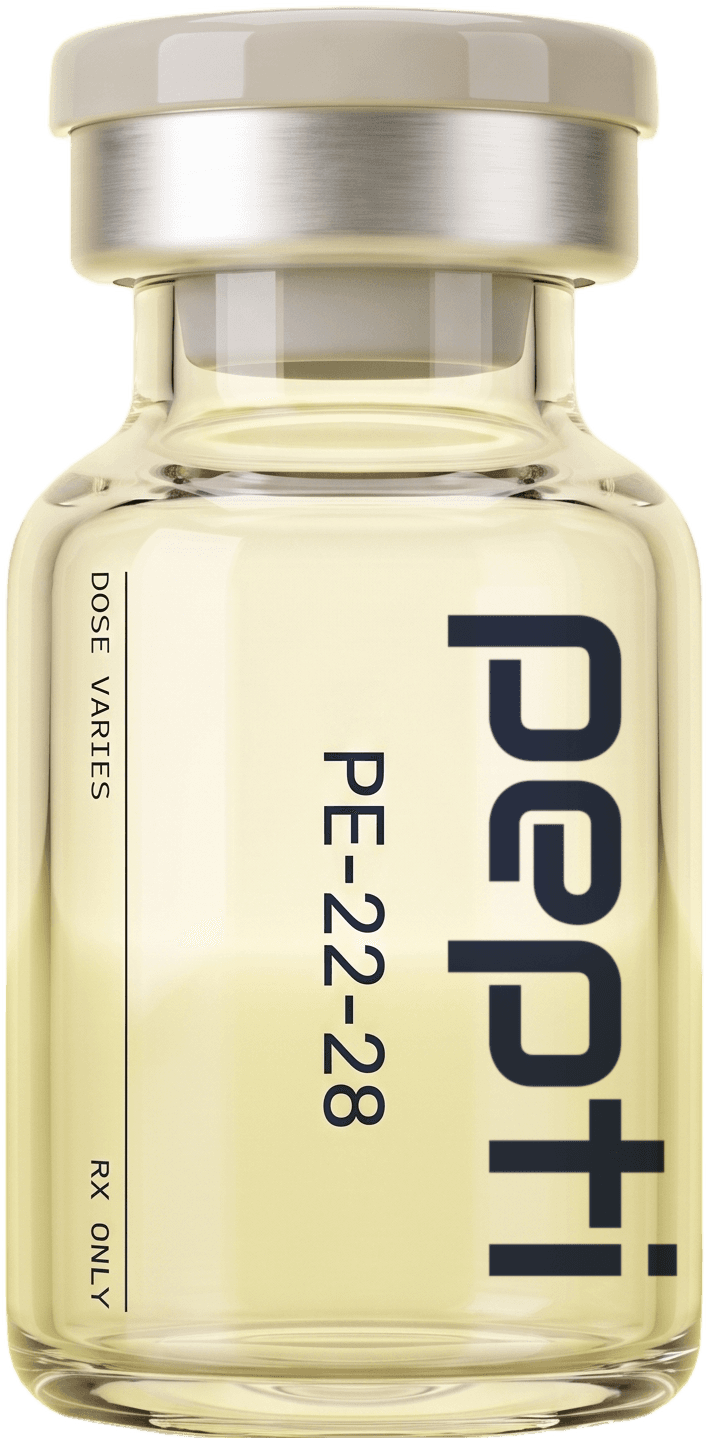
At Pepti, PE-22-28 is prescribed as 0.25 mL, which is 25 units on a U-100 insulin syringe, injected under the skin once daily Monday through Friday. The vial is 5 mL at 2 mg/mL, so each dose carries 0.5 mg of PE-22-28 and the vial holds 20 doses, about four weeks. There is no human dose-finding study behind any PE-22-28 dose: the schedule is a prescriber's translation from animal work, not a trial result. Your physician sets your directions after reviewing your intake, and your exact dose and units are printed on the vial.
This page explains the PE-22-28 dosage Pepti prescribes, what the units on the syringe mean, a dosage chart that converts units to millilitres and milligrams, how long a vial lasts, why the schedule runs on weekdays, what can change your directions, and the side effects to know about. It covers how Pepti's PE-22-28 is typically prescribed, not dosing protocols from the internet. Nothing here is a reason to change your own dose.
PE-22-28 Dosage
The short answer
| Product | Vial | Typical directions | PE-22-28 per dose | Doses per vial | Price |
|---|---|---|---|---|---|
| PE-22-28 | 5 mL, 2 mg/mL (10 mg per vial) | Inject 0.25 mL (25 units) subcutaneously once daily Monday through Friday | 0.5 mg | 20 | $219/mo |
Every price is all-in, covering medication, physician review, refill management and shipping, with no separate membership fee. Pepti is cash-pay and does not bill insurance. PE-22-28 is a vial only; it does not come as a pen or capsule. These are the typical printed directions; your own directions are the ones on your vial.
PE-22-28 Dosage
PE-22-28 dosage in units, mL and mg
Pepti's directions are written in two forms, millilitres and units, because prescriptions are written in millilitres and insulin syringes are marked in units. On a U-100 insulin syringe, 1 unit is 0.01 mL, so 100 units is 1 mL and 25 units is 0.25 mL. A unit is a volume mark on the barrel, not a measure of how strong the medication is. Units only mean something alongside the concentration on the label.
Pepti's PE-22-28 is supplied at 2 mg/mL, so:
| What you read | Value | Where it comes from |
|---|---|---|
| Dose volume | 0.25 mL | Printed on the vial |
| On a U-100 insulin syringe | 25 units | 0.25 mL x 100 units per mL |
| Concentration | 2 mg/mL | Printed on the vial |
| PE-22-28 per dose | 0.5 mg | 2 mg/mL x 0.25 mL |
| Total in the vial | 10 mg in 5 mL | Printed on the vial |
| Doses per vial | 20 | 5 mL divided by 0.25 mL |
That arithmetic is a way to read a label, not a way to set a dose. A vial labelled 10 mg is not a 10 mg dose: it is twenty 0.5 mg doses. If your label and your syringe seem to disagree, do not dose; message your care team. How long does a peptide vial last explains every number on a vial label in more detail.
PE-22-28 Dosage
PE-22-28 dosage chart: units to mL to mg
Online sources quote PE-22-28 doses in micrograms, milligrams and units interchangeably, and the numbers only line up if you know the concentration. The chart below is the conversion for a 2 mg/mL vial, drawn with a U-100 insulin syringe. It is math only. It is not a menu of doses, and the only line that applies to you is the one that matches the number printed on your vial.
| Syringe mark (U-100) | Volume | PE-22-28 from a 2 mg/mL vial |
|---|---|---|
| 5 units | 0.05 mL | 0.1 mg (100 mcg) |
| 10 units | 0.1 mL | 0.2 mg (200 mcg) |
| 15 units | 0.15 mL | 0.3 mg (300 mcg) |
| 20 units | 0.2 mL | 0.4 mg (400 mcg) |
| 25 units (Pepti's typical directions) | 0.25 mL | 0.5 mg (500 mcg) |
| 30 units | 0.3 mL | 0.6 mg (600 mcg) |
| 40 units | 0.4 mL | 0.8 mg (800 mcg) |
| 50 units | 0.5 mL | 1 mg |
| 100 units | 1 mL | 2 mg |
The rule behind every row: units divided by 100 gives millilitres, and millilitres multiplied by 2 gives milligrams. One milligram is 1,000 micrograms (mcg), which is why the same 25 unit draw can be written as 0.5 mg or 500 mcg. A chart from another source, written for a different concentration, will give different milligram figures for the same units. That is the main reason not to dose from a chart, including this one.
PE-22-28 Dosage
How long a PE-22-28 vial lasts
At Pepti's typical directions, one 10 mg vial lasts four weeks:
| Step | Value |
|---|---|
| Dose | 25 units, 0.25 mL, 0.5 mg |
| Doses per week | 5 (Monday through Friday) |
| Doses per vial | 20 (5 mL divided by 0.25 mL) |
| PE-22-28 used | 20 x 0.5 mg = 10 mg, the whole vial |
| Time per vial | 20 doses divided by 5 per week = 4 weeks |
Four weeks is why refills run every 28 days, one vial per fill. Vials are multi-dose solutions shipped ready to use, refrigerated with ice packs, with sterile syringes and alcohol prep pads. Nothing is mixed at home. Keep the vial upright in the fridge, do not freeze it, and follow the beyond-use date printed on the label, which runs from first puncture. How to store peptides covers storage.
If a vial runs short before the refill, message your care team rather than adjusting anything yourself. If you miss a dose, follow your directions and do not take two doses to make up for one.
PE-22-28 Dosage
When and how PE-22-28 is taken
Once daily, Monday through Friday
The reviewed directions are once daily on weekdays, weekends off. That gives twenty doses a vial, about four weeks, which lines up with the 28-day refill. It is a prescriber's schedule, not a trial-derived one: the rodent studies used short daily courses, and no human study has tested any schedule. Weekends off are part of the schedule, not missed doses. The directions do not specify a time of day; follow what is printed on your vial.
Under the skin
Subcutaneous means into the fat layer, not the muscle. Abdomen and thigh are the usual sites, rotated so the same spot is not used repeatedly. There is no reason to inject near any particular body part: the proposed mechanism is in the brain, reached through the circulation. Technique is covered in how to inject peptides safely.
| Directions say | What it means in practice |
|---|---|
| 0.25 mL (25 units) | Draw to the 25 mark on a U-100 insulin syringe |
| Subcutaneously | Into the fat layer, abdomen or thigh, rotating sites |
| Once daily Monday through Friday | Five doses a week, weekends off |
| 20 doses per vial | About four weeks, then the next refill |
PE-22-28 Dosage
What the research used, and why there is no human dose
PE-22-28 has no human trials of any kind, so there is no published human dose to compare against.
| Study | What was studied | What it says about dosing |
|---|---|---|
| PLoS Biology, 2010 | Spadin, the longer parent fragment, in mice | Antidepressant-like effects after a four-day course; a mouse result |
| Frontiers in Pharmacology, 2017 | PE-22-28 in cultured cells and mice | Reproduced spadin's effects after a four-day course; sub-nanomolar TREK-1 inhibition in cells; a half-life in the mouse of roughly a day |
| Human studies | None | No dose-finding trial, no human pharmacokinetics |
The honest reading is that the directions in use are a prescriber's translation from animal work. They are not a dose-finding result, and no study establishes that a higher or lower dose does anything different in people. That is why your directions come from a physician who has reviewed your intake, not from a study table or a forum. The full research picture is in what is PE-22-28 and PE-22-28 benefits.
PE-22-28 Dosage
What changes the directions
Your physician sets your directions after reviewing your intake. Things that can lead to different directions, or a different product, include:
| What can change | How it shows up |
|---|---|
| Your other medications | Antidepressants, triptans, lithium, tramadol and other serotonergic drugs need review, because the proposed mechanism overlaps with serotonin signalling |
| Diabetes or glucose-lowering medication | Cell work described the parent peptide increasing insulin secretion, so this is reviewed |
| A seizure history | TREK-1 is involved in seizure protection; the rodent work found no problem, but it is discussed |
| A diagnosed mood disorder | PE-22-28 is not a treatment for depression; the clinician managing that diagnosis should be involved |
| How you respond | Anything unexpected goes to your care team, who may revise your directions |
When directions change, the new numbers are printed on the new label. Never carry a number over from a previous fill. Bloodwork is not required for any Pepti treatment. If your physician wants labs for your care, they'll ask through your account.
PE-22-28 Dosage
Side effects, in summary
The full picture is in PE-22-28 side effects. In humans, the side-effect profile is unknown because no trials have been run.
| What is reported | How often | What to do |
|---|---|---|
| Injection-site redness, mild soreness, occasional bruising | The commonest clinical report | Rotate sites |
| Headache in the first days | Occasional | Report it if it persists |
| A change in mood that worries you or those around you | Not a described effect, always reportable | Contact your physician promptly |
| Thoughts of harming yourself | An emergency | Call or text 988, or call 911, now |
| Facial or throat swelling, widespread rash, difficulty breathing | Rare | Emergency care first (call 911), then tell your physician |
If you think you may have taken too much, call Poison Control at 1-800-222-1222 and message your care team. Do not skip, double or change a dose to compensate.
PE-22-28 has not been evaluated by the FDA at all: it is not in Category 1, 2 or 3 of the 503A nominated-substances list updated 14 May 2026, has no FDA safety notice and was not on the July 2026 advisory committee agenda. Compounded medications are not FDA approved. Tested athletes should know the 2026 WADA list does not name PE-22-28, but its S0 section on non-approved substances can apply.
PE-22-28 Dosage
Where to get PE-22-28 prescribed
PE-22-28 cannot be bought legitimately without a prescription. Sites selling it "for research use only" are not accountable for what is in the vial: identity, purity, sterility and concentration are untested, so even the concentration your units chart depends on is unknown. The prescription route:
- Complete a free online intake covering your history, every medication you take, any mood diagnosis, and what you want help with.
- A physician licensed in your state reviews it, usually within 24 hours.
- If it is appropriate, a PCAB-accredited, FDA-registered US 503A compounding pharmacy prepares it to that prescription. Lot test results are published at /quality/lab-results.
- It ships refrigerated with your directions printed on the vial.
- Your care team stays reachable for questions and dose changes.
Step by step: how to get PE-22-28 prescribed online. The prescription and legal questions are in do you need a prescription for PE-22-28.
References
What this is based on.
References
- Djillani A, Pietri M, Moreno S et al.. Shortened Spadin Analogs Display Better TREK-1 Inhibition, In Vivo Stability and Antidepressant Activity · Front Pharmacol (2017) · PMID 28955242
- Mazella J, Pétrault O, Lucas G et al.. Spadin, a sortilin-derived peptide, targeting rodent TREK-1 channels: a new concept in the antidepressant drug design · PLoS Biol (2010) · PMID 20405001
- Heurteaux C, Lucas G, Guy N et al.. Deletion of the background potassium channel TREK-1 results in a depression-resistant phenotype · Nat Neurosci (2006) · PMID 16906152
- Moha Ou Maati H, Veyssiere J, Labbal F et al.. Spadin as a new antidepressant: absence of TREK-1-related side effects · Neuropharmacology (2012) · PMID 21807005
- Devader C, Khayachi A, Veyssière J et al.. In vitro and in vivo regulation of synaptogenesis by the novel antidepressant spadin · Br J Pharmacol (2015) · PMID 25598009
- Moha ou Maati H, Bourcier-Lucas C, Veyssiere J et al.. The peptidic antidepressant spadin interacts with prefrontal 5-HT(4) and mGluR(2) receptors in the control of serotonergic function · Brain Struct Funct (2016) · PMID 25233810
- Ye D, Li Y, Zhang X et al.. TREK1 channel blockade induces an antidepressant-like response synergizing with 5-HT1A receptor signaling · Eur Neuropsychopharmacol (2015) · PMID 26441141
- Hivelin C, Béraud-Dufour S, Devader C et al.. Potentiation of Calcium Influx and Insulin Secretion in Pancreatic Beta Cell by the Specific TREK-1 Blocker Spadin · J Diabetes Res (2016) · PMID 28105440
- Devader C, Roulot M, Moréno S et al.. Serum sortilin-derived propeptides concentrations are decreased in major depressive disorder patients · J Affect Disord (2017) · PMID 27838145
- Roulot M, Minelli A, Bortolomasi M et al.. Increased serum levels of sortilin-derived propeptide after electroconvulsive therapy in treatment-resistant depressed patients · Neuropsychiatr Dis Treat (2018) · PMID 30233189
- Qi X, Xu H, Wang L et al.. Comparison of Therapeutic Effects of TREK1 Blockers and Fluoxetine on Chronic Unpredicted Mild Stress Sensitive Rats · ACS Chem Neurosci (2018) · PMID 29952548
- Djillani A, Pietri M, Mazella J et al.. Fighting against depression with TREK-1 blockers: Past and future. A focus on spadin · Pharmacol Ther (2019) · PMID 30291907
Citations are provided for educational purposes. They do not constitute medical advice. Always discuss any peptide protocol with your prescribing physician.
Common questions
PE-22-28 Dosage, answered.
At Pepti, PE-22-28 is typically prescribed as 0.25 mL, which is 25 units on a U-100 insulin syringe, injected subcutaneously once daily Monday through Friday. From the 2 mg/mL vial that is 0.5 mg per dose. Your physician sets your directions after reviewing your intake, and your exact dose is printed on the vial.
The amount printed on your vial, on the schedule printed on your vial. If you have questions about your dose, message your care team.
The number printed on your vial. Pepti's typical directions are 25 units, which is 0.25 mL on a U-100 insulin syringe, where 1 unit is 0.01 mL.
From a 2 mg/mL vial, 0.5 mg, which is 500 mcg. 10 units is 0.2 mg and 50 units is 1 mg. Those figures only hold at 2 mg/mL.
At Pepti's typical directions, 500 mcg per dose. One milligram is 1,000 micrograms, so 0.5 mg and 500 mcg are the same amount.
The chart above converts units to millilitres to milligrams for a 2 mg/mL vial, the concentration Pepti supplies. It is a conversion, not a list of doses to choose from.
No. There are no human trials of PE-22-28, so no dose has been tested in people. The rodent studies used four-day courses. The directions in use are a prescriber's translation from that animal work.
That is the reviewed prescriber schedule. It gives twenty doses a vial, about four weeks, matching the 28-day refill. It is not derived from a human trial.
About four weeks. A 10 mg vial at 25 units (0.5 mg) five days a week is 20 injections.
No. Take the dose printed on your vial, on the schedule printed on your vial. No study shows a higher dose does anything different in people. Message your care team with questions.
No. Pepti vials are multi-dose solutions shipped ready to use, with sterile syringes and alcohol prep pads. Nothing is reconstituted at home.
Bloodwork is not required for any Pepti treatment. If your physician wants labs for your care, they'll ask through your account. The free assessment goes to a physician licensed in your state. A consultation does not guarantee a prescription.
Next step
See what a physician recommends for you.
A licensed physician in your state reviews your intake and decides what is appropriate. A consultation does not guarantee a prescription.